122
Costa AN et al. Post-traumatic pulmonary pseudocyst: a case report
Radiol Bras. 2013 Mar/Abr;46(2):122–124
Post-traumatic pulmonary pseudocyst in a soccer player:
a case report
*
Pseudocisto pulmonar pós-traumático em jogador de futebol: relato de caso
Andre Nathan Costa1, Karina de Souza Giassi2, Guilherme Hipolito Bachion3, Andre Apanavicius4, Rafael Silva Musolino4, Ronaldo Adib Kairalla5
Pulmonary pseudocysts are uncommon cavitary lesions that develop in the lung parenchyma as a consequence of blunt thoracic trauma, whose diagnosis is based on an association of clinical history and imaging findings. The present report describes the case of a pulmonary pseudocyst observed in the parenchyma contralateral to the trauma site in a 31-year-old man presenting with hemoptysis after falling during a soccer match.
Keywords: Pulmonary pseudocyst; Post-traumatic pseudocyst; Post-traumatic pneumatoceles.
Pseudocistos pulmonares são lesões raras que se desenvolvem no parênquima pulmonar após traumas fechados e de grande energia, cujo diagnóstico se baseia na associação da história clínica com exames de imagem. Relata-se a seguir um pseudocisto pulmonar ocorrido no parênquima contralateral ao trauma em um homem de 31 anos que apresen-tou episódio de hemoptise após queda durante partida de futebol.
Unitermos: Pseudocisto pulmonar; Pseudocisto pós-traumático; Pneumatocele pós-traumática.
Abstract
Resumo
* Study developed at Hospital Sírio-Libanês, São Paulo, SP, Brazil.
1. PhD, MD, Pulmonologist, Hospital Sírio-Libanês and Insti-tuto do Coração da Faculdade de Medicina da Universidade de São Paulo (InCor-FMUSP), São Paulo, SP, Brazil.
2. MD, Resident of Radiology and Imaging Diagnosis, Hospi-tal Sírio-Libanês, São Paulo, SP, Brazil.
3. MD, Radiologist, Hospital Sírio-Libanês, São Paulo, SP, Brazil.
4. MDs, Pulmonologists, Hospital Sírio-Libanês, São Paulo, SP, Brazil.
5. PhD, Teacher at Faculdade de Medicina da Universidade de São Paulo (FMUSP), MD, Pulmonologist, Hospital SírioLibanês and Instituto do Coração da Faculdade de Medicina -Universidade de São Paulo (InCor-FMUSP), São Paulo, SP, Brazil.
Mailing Address: Dra. Karina de Souza Giassi; Instituto Sírio-Libanês de Ensino e Pesquisa. Rua Coronel Nicolau dos San-tos, 69, Bela Vista. São Paulo, SP, Brazil, 01308-060. E-mail: [email protected].
Received September, 2012. Accepted after revision Decem-ber 17, 2012.
Costa AN, Giassi KS, Bachion GH, Apanavicius A, Musolino RS, Kairalla RA. Post-traumatic pulmonary pseudocyst in a soccer player: a case report. Radiol Bras. 2013 Mar/Abr;46(2):122–124.
0100-3984 © Colégio Brasileiro de Radiologia e Diagnóstico por Imagem CASE REPORT
hemithorax. Chest and costal arches radio-graphic images were normal. The patient received symptomatic medications and persisted with episodes of hemoptysis for two days, returning for medical assistance. His condition remained unaltered at clini-cal examination. The patient underwent chest computed tomography which demon-strated a solitary cystic lesion measuring 2.5 cm and small air-fluid level located in the lower lobe of the right lung in associa-tion with subtle perilesional ground glass opacity (Figures 1 and 2).
CASE REPORT
Male, 31-year-old former smoker, with no comorbidity. During a soccer match, the man suffered left thoracic trauma after own-height fall, presenting intense local pain, with partial symptoms relief after use of analgesics. Six hours following the trauma, the patient progressed to hemopty-sis, with no other associated symptoms. The patient attended the emergency depart-ment, and clinical examination found ec-chymosis at the lateral aspect of the left INTRODUCTION
Post-traumatic pseudocysts are cavitary lesions that develop in the lung paren-chyma as a consequence of blunt thoracic trauma. In general, such lesions occur af-ter traffic collision or fall from height, and usually develop in areas of pulmonary con-tusion ipsilateral to the trauma site.
The present report describes a case of post-traumatic pulmonary pseudocyst con-tralateral to the trauma site in a young man after falling during a soccer match.
123
Costa AN et al. Post-traumatic pulmonary pseudocyst: a case report
Radiol Bras. 2013 Mar/Abr;46(2):122–124
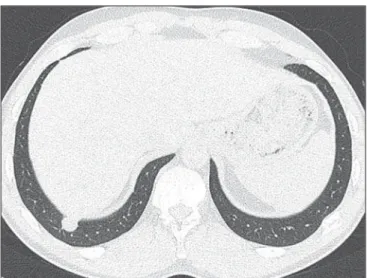
In the context of hemoptysis following an episode of blunt trauma in a patient with neither comorbidity nor any other previous systemic symptoms, the presence of a post-traumatic pseudocyst was considered as the main diagnostic hypothesis, so a conserva-tive approach was adopted. Hemoptysis resolved at the fifth day following the trauma. Follow-up CT performed 30 days after the episode demonstrated a significant decrease in the cavitary lesion size and in the ground glass opacity. Only a small noncalcified nodule remained in the sub-pleural diaphragmatic region (Figures 3 and 4). The patient remains asymptomatic.
DISCUSSION
The spectrum of lung parenchymal le-sions occurring after blunt trauma ranges from simple contusions to complicated lac-erations with pleural effusion and hydrop-neumothorax(1,2). Pseudocysts are included
in the range of such complications, but rep-resent a rare condition that is found in less than 3% of chest traumas(2,3).
Characteris-tically, such condition is found in children and individuals under the age of 30.
The term “pseudocyst” is justified by the presence of a thin wall of interstitial conjunctive tissue in association with the presence of macrophages and fibrous tis-sue, without epithelial lining or bronchial
wall elements, which differentiates pseudo-cysts from true pulmonary pseudo-cysts(2).
The genesis of this lesion is explained by the greater pliability of the thoracic cage in the youngsters, allowing the trans-mission of the force caused by the sudden chest compression on the subjacent lung parenchyma. The fast compression and de-compression cause small lacerations, re-sulting in small cavities which are filled
with air and fluid. Each cavity tends to grow until a balance is achieved between the pressure of the adjacent parenchyma and the intracavitary pressure(3–6).
More-over, it is believed that the glottic closure at the moment of the trauma plays a rel-evant role in the development of such le-sions, making that air remains in the con-tused parenchyma, triggering the men-tioned lacerations(6).
Figure 3. Follow-up CT 30 days after the trauma demonstrates the presence of a small lung nodule and disappearance of the perilesional ground-glass opacity.
Figure 2. Coronal reformation of the small cavitary lesion demonstrating the extent of the adjacent ground-glass opacities.
124
Costa AN et al. Post-traumatic pulmonary pseudocyst: a case report
Radiol Bras. 2013 Mar/Abr;46(2):122–124
The differential diagnosis includes the spectrum of cavitary lesions of the lung parenchyma and is relatively extensive, involving from infections such as tubercu-losis, mycosis, lung abscess, infectious pneumatocele, vasculitis and lung neoplasias, to congenital lesions such as bronchogenic cysts and adenomatoid cys-tic malformation. However, the diagnosis is based on the association of cavitary le-sion with a clinical history of chest trauma. Computed tomography is the method of choice, since small pseudocysts may be masked at supine plain radiographs(7). The
condition resolution observed at later im-aging findings corroborates the traumatic nature of the entity. On average, such con-dition takes one to three months to resolve, but such time span may significantly in-crease in cases of pseudocysts measuring > 2 cm or pseudocysts with hematic con-tent(7,8).
The development of pseudocysts in ar-eas of pulmonary contusion is considered as the usual pattern of the condition; on the other hand, reports on pseudocysts distant from the location of the original trauma are unusual(1,7). Additionally, such lesions
de-velop in patients who had high-energy trau-mas. So the present case becomes peculiar as the mentioned pseudocyst developed in the lung contralateral to the site of a me-dium-intensity trauma, possibly because the greater pliability of the lower chest wall allowed the conduction of the kinetic force by the thoracic cage. The conservative treatment of the patient has allowed an appropriate clinical and radiological evo-lution compatible with the patterns de-scribed in the literature(1,2).
REFERENCES
1. Yazkan R, Ozpolat B, Sahinalp S. Diagnosis and management of post-traumatic pulmonary pseudo-cyst. Respir Care. 2009;54:538–41.
2. Fagkrezos D, Giannila M, Maniatis P, et al. Post-traumatic pulmonary pseudocyst with hemopneu-mothorax following blunt chest trauma: a case re-port. J Med Case Rep. 2012;6:356.
3. Chon SH, Lee CB, Kim H, et al. Diagnosis and prognosis of traumatic pulmonary pseudocysts: a review of 12 cases. Eur J Cardiothorac Surg. 2006; 29:819–23.
4. Watanabe M, Igarashi N, Naruke M, et al. Trau-matic pulmonary pseudocyst with hemopneu-mothorax in a football player. Clin J Sport Med. 2005;15:41–3.
5. Monteiro AS, Addor G, Nigri DH, et al. Pseudocisto pulmonar traumático. J Bras Pneumol. 2005;31: 80–2.
6. Tsitouridis I, Tsinoglou K, Tsandiridis C, et al. Traumatic pulmonary pseudocysts: CT findings. J Thorac Imaging. 2007;22:247–51.
7. De Dios JA, Paoletti L, Bandyopadhyay T. A 27-year-old man with pleuritic chest pain and hemop-tysis after a rugby game. Chest. 2009;136:1165– 7.