RESUMO
JUSTIFICATIVA E OBJETIVOS: A sepse é a
expres-são de uma complexa rede de mediadores. Falência de múltiplos órgãos e choque séptico são as principais causas de óbito nas unidades de terapia intensiva em todo o mundo. Indicadores biológicos como as citoci-nas, bem como centenas de outros indicadores celu-lares, moléculas bioativas circulantes ou produtos da coagulação são potenciais indicadores biológicos que poderão ser de grande utilidade no reconhecimento e tratamento da infecção e sepse. O objetivo deste estu-do foi apresentar os principais indicaestu-dores que podem ser utilizados, atualmente ou possivelmente, no futuro, na prática clínica ou experimental.
CONTEÚDO: Revisão dirigida da literatura sobre pos-síveis indicadores de infecção e sepse, com ênfase aos da cascata da coagulação, proteína C-reativa e procalcitonina.
CONCLUSÕES: O papel da maioria dos indicadores
biológicos não está ainda dei nido para uso na prática clínica. Todavia os níveis séricos de PCR e de procal-citonina podem ser de grande auxílio no diagnóstico e
Markers and Mediators of Inl ammatory
Response in Infection and Sepsis*
Indicadores e Mediadores de Resposta Infl amatória na Infecção e Sepse
Suzana Margareth Lobo1, Francisco Ricardo Marques Lobo2
1. Coordinator of the Intensive Care Unit. Associated Professor of Internal Medicine. Division of Critical Care Medicine, Department of Internal Medicine, Medical School - Hospital de Base, São José do Rio Preto, São Paulo, Brazil
2. Associated Professor of Anesthesiology. Division of Anesthesiolo-gy, Department of Surgery. Medical School – Hospital de Base, São José do Rio Preto, SP, Brazil
*Received from Hospital de Base da Faculdade de Medicina de São José do Rio Preto (FAMERP), SP
Submitted December 3, 2006 Accepted March, 2, 2007
Address correspondence: Prof. Dra. Suzana Margareth Lobo Avenida Brigadeiro Faria Lima, 5544 15090-000 São José do Rio Preto, SP, Brasil E-mail: [email protected]
©Associação de Medicina Intensiva Brasileira, 2007
no prognóstico da infecção e da sepse quando usados em conjunto com os parâmetros convencionais. Unitermos: choque séptico, falência de múltiplos ór-gãos, indicadores, mediadores, sepse, síndrome da resposta inl amatória sistêmica.
SUMMARY
BACKGROUND AND OBJECTIVES: Sepsis is the
ex-pression of a complex network of mediators. Multiple organ dysfunction and septic shock indeed remain a major cause of death among ICU patients worldwide. Prompt recognition of both the diagnosis and the com-plicated evolution are essential, hence the importance of using biological markers. The main pro-inl ammatory and anti-inl ammatory cytokines as well as hundreds of others cellular markers, circulating bioactive mole-cules or coagulation products are potential biological markers that could help to characterize the presence of infection and sepsis. We aimed to review the main bio-logical markers that could be used nowadays or possi-bly in the future, either in clinical or research i elds. CONTENTS: A selective review of biologic markers of sepsis focusing on markers of the coagulation casca-de, C-reactive protein and procalcitonin.
CONCLUSIONS: Most of the available biological mar-kers is still not a practical method to be used at the bed-side and is currently restricted to research works. Nowadays the determination of CRP or PCT serum le-vels can be of great help in the critically ill patient care along with the conventional parameters.
Key Words: markers, mediators, multiple organ dys-function, sepsis, septic shock, systemic inl ammatory response syndrome.
INTRODUCTION
develop severe sepsis annually in US and more than 300,000 require organ support1. Septic shock indeed remains a major cause of death. Therefore, prompt recognition of both the diagnosis and the severity of the disease are essential. The main pro-inl ammatory and anti-inl ammatory cytokines as well as lots of other cellular markers, bioactive circulating molecules or co-agulation products are potential biological markers that could help to distinguish the presence of systemic in-l ammatory response syndrome (SIRS), disseminated intravascular coagulation (DIC) and sepsis2. We aimed to review the main biological markers that could be used nowadays or possibly in the future, either in clini-cal or research i elds.
BIOLOGICAL MARKERS
In a simplii ed way, in sepsis, the mononuclear pha-gocytes bind to microbial structures through receptors such as CD14 and Toll-like, signaling for the produc-tion of some mediators, dependent on the activaproduc-tion of nuclear factor-κB genes2,3. Toll-like receptors (TLR) are transmembrane proteins that interact with different agents4. The most known are the TLR4 that interacts with the endotoxin; the TLR2 that interacts with the components of the cellular membrane of the gram-po-sitive bacteria; the TLR5 whose ligand is the l agellin, the main protein component of the l agella of bacteria, and the TLR3 for the virus. Efforts have been made in understanding the signaling mechanisms of TLR. Inhi-bition of TLR and proinl ammatory cytokine signaling highlights new ways for future treatments.
There are other receptors that recognize the lypopoly-saccaride (LPS), such as CD11/CD18, K+ channels and macrophage scavenger receptor. Other soluble and membrane proteins are involved in the recognition of bacteria and its products, such as protein recognition peptidoglicans and triggering receptor expressed on myeloid cells (TREM-1)5. TREM-1 may be a potential therapeutic target for septic shock. The determination of the level of a soluble form of TREM-1 (sTREM1) rele-ased from the activated macrophages in biological l ui-ds as plasma or bronchoalveolar lavage help to rapidly identify the presence of infection6.
Some cytokines are earlier released during the inl am-matory response; interleukin-1 (IL-1) and the tumor necrosis factor-α (TNF). It is followed by the produc-tion of other pro-inl ammatory cytokines, such as IL-6, IL-8; and anti-inl ammatory, such as soluble IL-10 and its receptors (IL-2r, TNF55r and TNF75r)2,3. Both the
IL-6 and the TNF-α induce the synthesis of acute phase proteins, particularly C-reactive protein (CRP) and the procalcitonin (PCT)7. The extreme and prolonged incre-ase of IL-6 circulating level after trauma, burning, SIRS, sepsis and elective surgery is related to morbidity and mortality8,9. After major surgery, a raised IL-6 level in day 1, when associated with signs of SIRS, is an ear-ly marker of sepsis10. An up-regulation of inl ammatory cytokines production was reported in the earliest stage of sepsis followed by dramatic down-regulation in the phases of severe sepsis or septic shock11.
An important cytokine protein is the macrophage migra-tion-inhibitory factor (MIF). The MIF plays a role in the modulation of immune response through TLR4 allowing the prompt macrophage response. High levels of MIF have been detected in patients with severe sepsis and septic shock and were associated with microbiologi-cally documented sepsis after cardiac surgery12,13. Ano-ther mediator, pre-B-cell colony-enhancing factor may be required for complete expression of the thrombin-induced inl ammatory response and has the potential to be a novel marker of acute lung injury and endothe-lial barrier dysfunction14. A protein known as HMGB1 (High Mobility Group Box-1) has been described as a late mediator of inl ammation and sepsis. Patients with sepsis have a high concentration of HMGB 1 up to 1 wk after admission15.
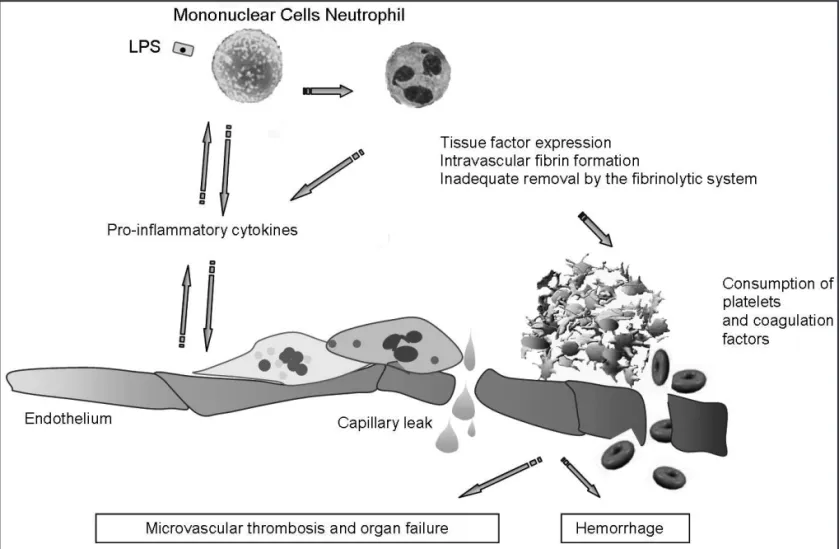
COAGULATION MARKERS
The systemic inl ammation is followed by the coagu-lation system activation16. Figure 1 represents the in-teraction between inl ammation and coagulation. The endothelial injury caused by LPS and pro-inl ammatory cytokines stimulates the production of the tissue fac-tor (TF). The excessive production of thrombin and its inadequate removal by the i brinolytic system result in widespread intravascular deposition of i brin characte-rizing DIC. Routine blood tests do not have the neces-sary specii city for DIC diagnosis17. DIC dynamics may be better evaluated by measuring markers of the coa-gulation activation or the secondary i brinolysis, such as prothrombin fragment 1+2 (F1+2), antithrombin (AT), soluble i brin (SF), thrombin-antithrombin complex (TAT), and i brin degradation products (FDP)18,19.
process can also be triggered in the extravascular spa-ce in the absenspa-ce of DIC, as in trauma or pancreatitis21. The plasma levels of TAT are high in the majority of pa-tients with sepsis even in the absence of clinical signs of DIC, and it is related to multiple organ dysfunction (MOD), shock and death22. The TAT high sensitivity can be useful to detect coagulation activation, even at sli-ght degrees; nevertheless its specii city is limited once increased TAT serum levels can also appear in other clinical situations such as venous thromboembolism. The initial i brin formation product will be a complex of i brin monomer with two i brinogen molecules that will aggregate more molecules and will become insoluble. Thus, it consists of a variety of complexes such as the i brin-i brinogen trimolecular complex, the i brin-FDP complexes, the i brin-factor XIIIa complexes, and others. The SF is an indicator of continuous intravascular coa-gulation process once it is only produced in intravascu-lar medium, and remains in circulation for many hours23. It was showed a high sensitivity of SF for DIC diagnosis in neurosurgical and critically ill patients24.
When i brinogen is converted into i brin by thrombin, a
systemic i brinolytic, plasmin, cleaves the i brinogen/i -brin of thrombus originating its degradation products. The D-dimer is a specii c test for i brin degradation products. However, high D-dimer serum levels are also found in many clinical situations, such as deep venous thrombosis and pulmonary thromboembolism25. A nega-tive serum test for FDP does not exclude the diagnosis of DIC. But in severe sepsis changes in D-dimer serum concentration was an independent predictor of death20. On the other hand, the plasma levels of coagulation na-tural inhibitors, such as AT and protein C are remarka-bly reduced in sepsis and septic shock with or without signs of DIC18,26. Mortality rates of 90-100% are descri-bed in surgical and septic patients after trauma with AT lower than 70% and 60%, respectively27. A reduced AT serum level is a predictor of infection or complicated course in polytraumatized patients28. The presence of an AT lower than 54% in the i rst day of severe sepsis was an independent predictor of death20. In severe sep-sis more than 80% of the patients have reduced protein C levels. The protein C plasma levels are inversely cor-related to mortality29.
Up to date, the available tests do not present the ne-cessary specii city for their routine use. Therefore, in the absence of a gold standard the diagnosis of DIC is based on a combination of an appropriate clinical en-tity known to be associated with DIC, the presence of clinical manifestations, mainly organ dysfunction, and laboratory markers of deranged clotting, such as pro-longed clotting times (activated partial thromboplastin time, prothrombin time), and reduced levels of i brino-gen and platelets, and if available an abnormal test for activated clotting such as i brin degradation products17. Other more complex tests are available only in specia-lized laboratories.
C-REACTIVE PROTEIN
Signii cant rises in CRP serum concentrations are ob-served in invasive infections, caused by gram-positive and gram-negative bacteria, as well as systemic fun-gal infections even in immunodei cient patients30. In contrast, lower increases are observed in acute viral infections. The value of a single CRP measurement in the diagnosis of infection and sepsis was investiga-ted in some studies. It has been show that CRP is an excellent infection marker in patients admitted in the emergency room with a cut-off level of 6 mg/dL (sen-sitivity = 67%, specii city = 94% and a ROC curve of 0.88)29. On hospital admission, plasma levels of CRP have been over 5 mg/dL in all the patients with com-munity-acquired pneumonia (CAP), and over 10 mg/dL in 75%32. CRP serum level is the best predictor of po-sitive cultures after aspirative bronchopneumonia and higher levels are found in patients with pneumonia than in patients with infected bronchitis33. Patients presen-ting maximum daily CRP variation > 4.1 mg/dL plus a CRP level > 8.7 mg/dL had an 88% risk of infection34. In the i rst 24 hours decreases of CRP over 20% is in-dependently associated with survival and are indicative of infection resolution35,36.
Discrete increases in CRP serum concentrations are associated with cardiovascular disease, systemic lupus erythematosus, dermatomyositis, systemic sclerosis, graft versus host disease, and leukemia37,38. However, in response to the infection, these patients are still ca-pable of raising their CRP, distinguishing infection from disease relapse. Signii cant raises are still observed in major burning, acute pancreatitis and cancer30. In these conditions the persistence of high levels has suggested a complicated course and a second increase is highly suggestive of an infectious complication.
CRP serum levels between 5-10 mg/dL have been sug-gested as cut-off point for diagnosis of sepsis with sen-sitivity ranging from 71.8% to 98.5%, and specii city ranging from 47.5% to 75%39,40. High levels of CRP can indicate an evolution with organ dysfunction. In a hete-rogeneous group of critically ill patients the presence of high concentrations of CRP is related to the presen-ce of organ dysfunction, nepresen-cessity of dialysis therapy, higher ICU length of stay, and high rates of infection and mortality41. Higher CRP concentrations (10 mg/dL) at admission were associated to a particularly raised mortality. A fast decrease was associated to a more fa-vorable evolution.
The differential diagnosis between graft rejection and sepsis is frequently difi cult after organ transplants. The CRP serum levels raises just after liver transplant and reaches the maximum peak in the second day. The ma-ximum CRP levels observed in patients with graft rejec-tion remain low in comparison with increased CRP le-vels in those with infectious complications42. After bone marrow transplant CRP peak was the best independent predictor of a complicated evolution43.
CRP has negative prognostic value in critically ill pa-tients. Elderly critically ill patients who have not survi-ved presented average CRP serum concentrations at ICU admission signii cantly higher than the survivors44. A good correlation was reported between CRP and two prognostic scores - MPM II (Mortality Predict Model) and APACHE III score45. The dynamic serial evaluation of CRP levels is a valuable tool in the diagnosis and follow-up of critically ill patients and can be of great help in the decision of further procedures such as cul-ture sampling, radiology exams or the re-adequacy of antibiotic therapy.
Procalcitonin
The use of PCT as an infection marker has been studied especially in newborn and children, in whom the infec-tion diagnosis is more difi cult46. Slight increases in PCT serum concentrations occur in local bacterial and viral infections besides other conditions as uremia, cardioge-nic shock, noninfectious chrocardioge-nic inl ammatory proces-ses and neoplastic diseaproces-ses47. Important increases of PCT are observed in systemic bacterial infections, bac-terial meningitis, peritonitis, and septic shock.
duration in CAP by procalcitonintest markedly reduced antibiotic exposure in patientswith CAP by reducing the duration of therapy from a median of 12 to 5 days49. This i nding might have enormous implications in clini-cal practice.
In community-acquired bacterial meningitis a signi-i cant decrease signi-in serum PCT was assocsigni-iated wsigni-ith cure50. PCT serum levels of 1.3 ± 0.2 ng/mL, 2 ± 0 ng/ mL, 8.7 ± 2.5 ng/mL and 38.6 ± 5.9 ng/mL were re-ported respectively for SIRS, sepsis, severe sepsis and septic shock47.
The behavior of the PCT plasma concentrations in pa-tients with acute renal failure is still not well known. Howe-ver, PCT is better related to the severity of complications in cardiac surgery and trauma patients than CRP51,52.
CONCLUSION
The dosage of the majority of the biological markers is not yet a practical method to be used. Although many markers can identify patients at risk of infection, risk of organ dysfunction, renal failure and other outcomes whether they can be used to guide clinical decisions is not yet very clear. To date sepsis remains a clinical diagnosis. Nevertheless, at the moment, either PCT or the CRP are good markers of infection and sepsis and should be used judiciously to help decisions in the cri-tically ill patient care along with the conventional para-meters. Daily, sequential measurement of inl ammatory markers is of much more value to guide therapy. Parti-cularities of the two tests should be taken into conside-ration. Coagulation markers and sTREM-1 seem to be promising tools to help the management of sepsis.
Abbreviators
TLR -Toll-like receptors
TREM-1 - triggering receptor expressed on myeloid cells
IL – interleukin
TNF - tumor necrosis factor-α CRP - C-reactive protein PCT – PCT
MIF- macrophage migration-inhibitory factor High Mobility Group Box-1- HMGB1
TF- tissue factor
F1+2 - prothrombin fragment 1+2 AT – antithrombin
SF - soluble i brin
TAT - thrombin-antithrombin complex FDP - i brin degradation products
REFERENCES
01. Angus DC, Linde-Zwirble WT, Lidicker J et al - Epidemiology of severe sepsis in the United States: analysis of incidence, outcome, and asso-ciated costs of care. Crit Care Med, 2001;29:1303-1310.
02. Takala A, Nupponen I, Kylanpaa-Back ML et al - Markers of inl ammation in sepsis. Ann Med, 2002;34:614-623.
03. Martin C, Boisson C, Haccoun M et al - Patterns of cytokine evolution (tumor necrosis factor-alpha and interleukin-6) after septic shock, he-morrhagic shock, and severe trauma. Crit Care Med, 1997;25:1813-1819.
04. Duan ZX, Zhu PF, Jiang JX - Sepsis and membrane receptors. Chin J Traumatol, 2005;8:60-64.
05. Gibot S - Clinical review: role of triggering receptor expressed on mye-loid cells-1 during sepsis. Crit Care, 2005;9:485-489.
06. Gibot S, Cravoisy A, Kolopp-Sarda MN, et al - Time-course of sTREM (soluble triggering receptor expressed on myeloid cells)-1, procalcitonin, and C-reactive protein plasma concentrations during sepsis. Crit Care Med, 2005;33:792-796.
07. Baumann H, Gauldie J - The acute phase response. Immunol Today, 1994;15:74-80.
08. Bifl WL, Moore EE, Moore FA et al - Interleukin-6 in the injured patient. Marker of injury or mediator of inl ammation? Ann Surg, 1996;224:647-664.
09. Oda S, Hirasawa H, Shiga H et al - Sequential measurement of IL-6 blood levels in patients with systemic inl ammatory response syndrome (SIRS)/sepsis. Cytokine, 2005;29:169-175.
10. Mokart D, Merlin M, Sannini A et al - Procalcitonin, interleukin 6 and systemic inl ammatory response syndrome (SIRS): early markers of pos-toperative sepsis after major surgery. Br J Anaesth, 2005;94:767-773. 11. Brunialti MK, Martins PS, Barbosa de Carvalho H et al. TLR2, TLR4,
CD14, CD11B, and CD11C expressions on monocytes surface and cytokine production in patients with sepsis, severe sepsis, and septic shock. Shock, 2006; 25:351-7
12. Bozza FA, Gomes RN, Japiassu AM et al - Macrophage migration inhibitory factor levels correlate with fatal outcome in sepsis. Shock, 2004;22:309-313.
13. de Mendonca-Filho HT, Gomes GS, Nogueira PM et al - Macrophage migration inhibitory factor is associated with positive cultures in patients with sepsis after cardiac surgery. Shock, 2005;24:313-317.
14. Ye SQ, Zhang LQ, Adyshev D et al - Pre-B-cell-colony-enhancing factor is critically involved in thrombin-induced lung endothelial cell barrier dys-regulation. Microvasc Res 2005;70:142-151.
15. Sunden-Cullberg J, Norrby-Teglund A, Rouhiainen A et al - Persistent elevation of high mobility group box-1 protein (HMGB1) in patients with severe sepsis and septic shock. Crit Care Med, 2005;33:564-573. 16. Levi M, van der Poll T, ten Cate H et al - The cytokine-mediated
imba-lance between coagulant and anticoagulant mechanisms in sepsis and endotoxemia. Eur J Clin Invest, 1997;27:3-9.
17. Taylor FB Jr, Toh CH, Hoots WK et al - Towards dei nition, clinical and laboratory criteria, and a scoring system for disseminated intravascular coagulation. Thromb Haemost, 2001;86:1327-1330.
18. Fourrier F, Chopin C, Goudemand J et al - Septic shock, multiple or-gan failure, and disseminated intravascular coagulation. Compared pat-terns of antithrombin III, protein C, and protein S dei ciencies. Chest, 1992;101:816-823.
19. Horan JT, Francis CW - Fibrin degradation products, i brin monomer and soluble i brin in disseminated intravascular coagulation. Semin Thromb Hemost, 2001;27:657-666.
20. Dhainaut JF, Shorr AF, Macias WL et al - Dynamic evolution of coagu-lopathy in the i rst day of severe sepsis: relationship with mortality and organ failure. Crit Care Med, 2005;33:341-348.
21. Hulka F, Mullins RJ, Frank EH - Blunt brain injury activates the coagula-tion process. Arch Surg, 1996;131:923-928.
22. Wilson RF, Mammen EF, Tyburski JG et al - Antithrombin levels related to infections and outcome. J Trauma, 1996;40:384-387.
23. Dempl e CE - The use of soluble i brin in evaluating the acute and chro-nic hypercoagulable state. Thromb Haemost, 1999;82:673-683. 24. Bredbacka S, Blomback M, Wiman B et al - Disseminated intravascular
25. Eisenberg PR - Does a negative D-dimer exclude trombosis? Fibrinoly-sis, 1993;(Suppl2):32-35.
26. Mesters RM, Helterbrand J, Utterback BG et al - Prognostic value of protein C concentrations in neutropenic patients at high risk of severe septic complications. Crit Care Med, 2000;28:2209-2216.
27. Wilson RF, Mammen EF, Robson MC et al - Antithrombin, prekallikrein, and i bronectin levels in surgical patients. Arch Surg, 1986;121:635-640.
28. PennerJ - Antithrombin dei ciency in special clinical syndromes-Part II: trauma/burns. Semin Hematol, 1995;32:(Suppl2):42-48.
29. Fijnvandraat K, Derkx B, Peters M et al - Coagulation activation and tissue necrosis in meningococcal septic shock: severely reduced protein C levels predict a high mortality.Thromb Haemost, 1995;73:15-20. 30. Povoa P - C-reactive protein: a valuable marker of sepsis. Intensive Care
Med, 2002;28:235-243.
31. Chan YL, Tseng CP, Tsay PK et al - Procalcitonin as a marker of bacte-rial infection in the emergency department: an observacional study. Crit Care, 2004;8:R12-R20.
32. Smith RP, Lipworth BJ, Cree IA et al - C-reactive protein. A clinical ma-rker in community-acquired pneumonia. Chest, 1995;108:1288-1291. 33. Adnet F, Borron SW, Vicaut E et al - Value of C-reactive protein in the
detection of bacterial contamination at the time of presentation in drug-induced aspiration pneumonia. Chest, 1997;112:466-471.
34. Povoa P, Coelho L, Almeida E et al - Early identii cation of intensive care unit-acquired infections with daily monitoring of C-reactive protein: a prospective observational study. Crit Care, 2006;10:R63.
35. Rezende Jr DC, Moraes JMMF, de Lucca MG et al - O rápido declínio da concentração sérica de proteína C-reativa na fase inicial da sepse é preditivo de boa evolução. RBTI, 2005;17:104-107.
36. Yentis SM, Soni N, Sheldon J - C-reactive protein as an indicator of resolution of sepsis in the intensive care unit. Intensive Care Med, 1995;21:602-605.
37. Ridker PM, Hennekens CH, Buring JE et al - C-reactive protein and other markers of inl ammation in the prediction of cardiovascular disease in women. N Engl J Med, 2000;342:836-843.
38. Kushner I - C-reactive protein in rheumatology. Arthritis Rheum, 1991;34:1065-1068.
39. Soares AJC, David CMN - A avaliação do comportamento da proteína C-reativa em pacientes com sepse na UTI. RBTI, 2003;14:156-165.
40. Ugarte H, Silva E, Mercan D et al - Procalcitonin used as a marker of infection in the intensive care unit. Crit Care Med, 1999;27:498-504. 41. Lobo SM, Lobo FR, Bota DP et al - C-reactive protein levels correlate with
mortality and organ failure in critically ill patients. Chest, 2003;123:2043-2049.
42. Tilg H, Nordberg J, Vogel W et al - Circulating serum levels of interleu-kin 6 and C-reactive protein after liver transplantation. Transplantation, 1992;54:142-146.
43. Schots R, Kaufman L, Van Riet I et al - Monitoring of C-reactive protein after allogeneic bone marrow transplantation identii es patients at risk of severe transplant-related complications and mortality. Bone Marrow Transplant, 1988;22:79-85.
44. Cox ML, Rudd AG, Gallimore R et al - Real-time measurement of se-rum C-reactive protein in the management of infection in the elderly. Age Ageing, 1986;15:257-266.
45. Presterl E, Staudinger T, Pettermann M et al - Cytokine proi le and corre-lation to the APACHE III and MPM II scores in patients with sepsis. Am J Respir Crit Care Med, 1997;156:825-832.
46. Chiesa C, Panero A, Rossi N et al - Reliability of procalcitonin concentra-tions for the diagnosis of sepsis in critically ill neonates. Clin Infect Dis, 1998;26:664-672.
47. Wanner GA, Keel M, Steckholzer U et al - Relationship between pro-calcitonin plasma levels and severity of injury, sepsis, organ failure, and mortality in injured patients. Crit Care Med, 2000;28:950-957.
48. Stucker F, Herrmann F, Graf JD et al - Procalcitonin and infection in el-derly patients. J Am Geriatr Soc, 2005;53:1392-1395.
49. Christ-Crain M, Stolz D, Bingisser R et al - Procalcitonin Guidance of Antibiotic Therapy in Community-acquired Pneumonia: A Randomized Trial. Am J Respir Crit Care Med, 2006;174:84-93.
50. Viallon A, Guyomarc’h P, Guyomarc’h S et al - Decrease in serum pro-calcitonin levels over time during treatment of acute bacterial meningitis. Crit Care, 2005;9:R344-R350.
51. Meisner M, Adina H, Schmidt J - Correlation of procalcitonin and C-reac-tive protein to inl ammation, complications, and outcome during the in-tensive care unit course of multiple-trauma patients. Crit Care, 2006;10: R1.