A
rt
ic
le
J. Braz. Chem. Soc., Vol. 19, No. 6, 1073-1077, 2008. Printed in Brazil - ©2008 Sociedade Brasileira de Química 0103 - 5053 $6.00+0.00
*e-mail: [email protected]
16,17-
Seco
- and 2,3:16,17-di-
Seco
-pregnanes from
Guarea guidonia
Walmir Silva Garcez,*,a Fernanda Rodrigues Garceza and Luzinátia Ramos Soaresa,b
aDepartamento de Química, Universidade Federal de Mato Grosso do Sul, 79070-900 Campo Grande-MS, Brazil
b Universidade Estadual de Mato Grosso do Sul, Coxim, 79400-000 Campo Grande-MS, Brazil
Dois novos seco- e di-seco-pregnanos, 2α,3β-diidróxi-2β,19-hemicetal-16,17-seco -pregn-17-en-16-oato de metila (1) e ácido 2,3:16,17-di-seco-pregn-17-en-3-óico-16-oato de metila-19-hidróxi-2-carboxílico-2,19-lactona(2), foram isolados da casca do caule de Guarea guidonia. Suas estruturas foram determinadas com base em dados espectrais, particularmente RMN uni- e bidimensionais e massas. Os esqueletos pregnânicos incomuns seco- e di-seco destes compostos estão sendo relatados pela primeira vez em Meliaceae, assim como a ocorrência de pregnanos no gênero Guarea.
Two new seco- and di-seco-pregnanes, 2α,3β-dihydroxy-16,17-seco-pregn-17-ene-16-oic acid methyl ester 2β,19-hemiketal (1) and 2,3:16,17-di-seco-pregn-17-ene-3-oic acid-16-oic acid methyl ester-19-hydroxy-2-carboxylic acid-2,19-lactone(2), have been obtained from the trunk bark of
Guarea guidonia. Their structures have been established by a combination of 1D- and 2D-NMR spectroscopic techniques and MS data. The unique seco- and di-seco-pregnane carbocyclic skeletal types as found in compounds 1 and 2 are being reported in the Meliaceae for the first time as well as the occurrence of pregnanes in the genus Guarea.
Keywords:Guarea guidonia, Meliaceae, seco-pregnane, di-seco-pregnane
Introduction
Species of Guarea (Meliaceae) are found throughout tropical America and also in Africa.1 This genus has been the
subject of a number of investigations and is known as a rich source of secondary metabolites, including limonoids, sesqui-, di- and triterpenes and steroids.2-5Guarea guidonia L. Sleumer
is a tree widely distributed in Brazil and the wood bark of this plant is employed in traditional medicine as an abortive and febrifugal agent and the seeds are used to treat rheumatism while the leaves and fruits are reported to be toxic to cattle.6,7
Moreover, seed extracts of G. guidonia were shown to have anti-inflammatory activity in rats while antiviral properties against pseudo-rabies virus were reported for crude extracts of leaves and fruits.7,8 In previous works sesquiterpenes were
isolated from the stem bark of a specimen of G. guidonia occurring in south-eastern Brazil3 while a specimen of G.
guidonia collected in the central-western region of Brazil afforded a number of constituents, including di-, tri- and sesquiterpenes and steroids from the leaves4 and compounds of
the sesquiterpene, limonoid and coumarin types from the trunk bark.5 In the course of the investigation of the trunk bark of
the latter specimen,5 the CHCl
3-soluble fraction of the ethanol
extract was shown to contain two minor steroidal derivatives which, nevertheless, were not further isolated. The present study of the trunk bark of this same specimen has now allowed the isolation of these constituents which were characterized as two novel seco- and di-seco-pregnane derivatives (1 and
2). Their structural elucidation was mainly based on 1D and 2D NMR spectroscopic techniques.
Results and Discussion
Compound 1 was obtained as an oil. Its molecular formula was established as C22H34O5 by NMR spectroscopic data and HREIMS, which showed a molecular ion peak at m/z 378.2410, indicating six degrees of unsaturation. The IR absorptions at 3402 and 1734 cm-1 were consistent with
16,17-Seco- and 2,3:16,17-di-Seco-pregnanes from Guarea guidonia J. Braz. Chem. Soc.
1074
the presence of hydroxyl and ester carbonyl groups. The 1H
NMR spectrum of 1 (Table 1) showed signals attributable to a propenyl moiety [d 5.36 (dq, J = 16.6, 6.0 Hz), 5.23 (brd, J = 16.6 Hz), 1.61 (brd, J = 6.0 Hz)], a methoxyl group [d
3.60 (s)], a carbinolic hydrogen [d 3.60 (m)] and two AB doublets at d 3.92 (J = 8.1 Hz) and 3.67 (J = 8.1 Hz) ascribed to an oxymethylene group. The 13C NMR spectrum (Table
1) displayed signals for 22 carbon atoms, seven of which, with the aid of information afforded by the DEPT spectrum, confirmed the presence of propenyl (d 142.0, 122.4, 18.2), carbomethoxy (d 175.0, 51.6), oxymethylene (d 67.4) and oxymethine (d 73.6) groups. The remaining signals were attributed to a methyl, seven methylenes, four methines and three quaternary carbons, one of which could be assigned to a hemiketal carbon (d 104.5). Comparison of 1H and 13C NMR data of 1 and 2α,3β-dihydroxypregnan-16-one
2β,19-hemiketal (3), a pregnane previously isolated from Trichilia claussenii9 and Melia volkensii,10 revealed that
they have identical rings A, B and C, with the same cyclic hemiketal funcionality with an oxy linkage between C-2 and C-19 and with a β-hydroxyl substituent at C-3, bearing
a trans di-equatorial relationship with the hydroxyl group at C-2. The presence of the aforementioned propenyl and carbomethoxy groups in 1, in addition to the long-range connectivities observed in the HMBC spectrum between the methylene hydrogens at d 2.27 and 1.88 assigned to H2-15 and the carbonyl ester carbon and between H3-18 (d 0.79) and the olefinic carbon at d 142.0 of the propenyl moiety were in accordance with a 16,17-seco-pregnane skeleton. The location of the 1-propenyl and the carbomethoxy groups at C-13 and C-14, respectively, was then established. Accordingly, two-bond proton-carbon correlations were observed between H2-15 and C-14 (d 46.5) and the olefinic hydrogen H-17 (d
5.23) and C-13 (d 39.5). The cis-orientation of C-18 methyl and the C-14 CH2CO2Me substituents was revealed by the correlations observed in the NOESY spectrum between H-18 and H-15. Hence, considering that the carbon backbones of 1
and 3 are likely to be formed by the same biosynthetic route accepted for all pregnane structural types, the orientation of both C-18 methyl group and H-14 of these compounds are assumed to be the same. The structure of this 16,17-seco -pregnane was then characterized as 1.
Table 1. 1H and 13CNMR spectral data of 1 (CDCl
3) and 2 (pyridine-d5)
No. 1 2
dC dH (J in Hz)
a HMBC (H→C) d
C dH (J in Hz)
a HMBC (H→C)
1 42.1 1.16 d (12.0)
2.32 brd (12.0) C-2, C-3, C-5, C-10, C-19 37.3
2.90 d (18.6) H-1a
2.51 d (18.6) H-1b C-2, C-9, C-10, C-19
2 104.5 - 175.3 - C-1, C-19
3 73.6 3.60 m 177.2
-4 37.7 2.05 ddd (13.2, 11.8, 4.6) H-4a
1.11 m H-4b C-2, C-3, C-5, C-10 36.9
2.92 dd (15.1, 1.9) H-4a 2.39 dd (15.1, 9.5) H-4b
C-5 C-3, C-5
5 42.3 1.42 m 41.3 1.13 m
6 30.7 1.56 m 29.5
7 29.3 1.58 m 30.4
8 39.5 1.40 m 38.6 1.35 m
9 45.3 1.20 m 50.5 1.34 m
10 47.6 - 45.5
-11 20.8 1.37 m 21.8 1.03 m
12 39.4 1.38 m 39.6
13 39.5 - 39.6
-14 46.5 1.54 m 46.3 1.33 m
15 35.2 2.27 dd (15.0, 3.0) H-15a
1.88 dd (15.0, 7.9) H-15b C-8, C-12, C-13, C-14, C-16 35.3
2.38 dd (17.0, 1.6) H-15a 2.01 dd (17.0, 7.8) H-15b
C-8, C-14, C-16 C-8, C-14
16 175.0 - 174.6
-17 142.0 5.23 brd (16.6) C-8, C-12, C-13, C-14, C-18,
C-20, C-21 142.5 5.37 m C-13, C-18, C-20, C-21
18 16.3 0.79 s C-8, C-13, C-14, C-17 16.6 0.81 s C-12, C-13, C-14, C-17
19 67.4 3.92 d (8.1) H-19a
3.67 d (8.1) H-19b C-1, C-2, C-5, C-10 69.5
4.28 d (10.3) H-19a
4.20 d (10.3) H-19b C-5, C-9 20 122.4 5.36 dq (16.6, 6.0) C-12, C-17, C-18, C-21 122.5 5.37 m C-12, C-13, C-18, C-21
21 18.2 1.61 brd (6.0) C-17, C-20 18.2 1.56 d (4.3) C-17, C-20
OCH3-16 51.6 3.60 s 51.4 3.60 s C-16
Garcez et al. 1075 Vol. 19, No. 6, 2008
Compound 2 was isolated as an oil. The HRESITOFMS ([MH+], m/z 393.2328) and NMR spectroscopic data of 2
suggested a molecular formula of C22H32O6. Its IR spectrum showed absorption bands at 3451 (broad), 1774 and 1732 (broad) cm-1 indicating the presence of lactone and ester
carbonyl and carboxyl groups. The 1H and 13C NMR spectra
of 2 (Table 1) were similar in many respects to those of 1. The proton and carbon shifts of the rings B and C corresponded to each other as well as the signals relative to the propenyl and methylene carbomethoxy groups. The 13C NMR spectrum
of 2, however, lacked the hemiketal and carbinolic carbon resonances at d 104.5 and 73.6 assigned to C-2 and C-3, respectively, in 1 and instead displayed signals ascribed to a carboxyl group (d 177.2) and a lactone moiety (d 175.3). Likewise, the multiplet at d 3.60 attributed to the carbinolic hydrogen at C-3 in 1 was absent in the 1H NMR spectrum
of 2. When 2 was methylated with diazomethane, a methyl ester derivative (2a) was obtained. Its 1H NMR spectrum
showed, in addition to a singlet at d 3.69 assignable to a second carbomethoxy group and besides the one located at C-15, an AB pattern of two doublets at d 4.03 and 4.20 (J = 10.7 Hz), suggestive of methylene hydrogens linked to an oxygen ester group. This pair of doublets showed a connectivity in the HMQC spectrum with the carbon signal at d 69.1, and three-bond correlations in the HMBC spectrum with the carbon signals attributable to C-5 (d 41.2) and C-9 (d 50.3). These information, along with the long-range correlations discernible between the two-proton singlet at d 2.48 (H-1) and the carbon signals at d 69.1 (C-19), 176.7 (lactone carbonyl) and 45.3 (C-10), and between H2-4 and the carbonyl group at d 172.6 attributable to C-3, supported the presence of a 2,3-seco-A ring in 2a, and also, in compound 2. Accordingly, the location of a carboxyl moiety at C-3 as well as the formation of a γ-lactone ring between C-19 and C-2, with the latter bearing the carbonyl group, were established. As in the case of 1, the β-configurations suggested for C-19 and C-4 are based on biogenetic grounds. The above-mentioned data could be satisfactorily assembled to give structure 2 for this 2,3:16,17-di-seco-pregnane steroid, whose unusual skeleton could have been originated from 1 through an oxidative cleavage of the C-2/C-3 bond. In order to allow a better comparison between the spectral data of 1 and 2, 1H and 13C NMR spectra of 1 were also obtained
in pyridine-d5(Table 2) whose results further supported the proposed structures for these compounds.
The finding of pregnane steroids in the Guarea genus is noteworthy, since this class of compounds has so far been described in only seven among the almost fifty genera comprising the Meliaceae, namely Trichilia,9 Melia,10
Aglaia,11 Dysoxylum,12Munronia,13Toona14 and Turraea.15
In addition, seco-pregnane steroid derivatives are not of
widespread occurrence in plant taxa. The great majority of these compounds has been described in members of the Asclepiadaceae, namely 14,15-, 15,16- and 8,14-seco- and 13,14:14,15-di-seco-pregnanes and their glycosides isolated from Cynanchum species16 and from Adelostemma
gracillimum,17Biondia insignis,18Sarcostemmaviminale,19
Solenostemma argel20 and Tylophora tanakae.21 However,
no records are available for the occurrence in the family Meliaceae of the unique 16,17-seco- and 2,3:16,17-di-seco-pregnane carbocyclic skeletal types displayed by compounds 1 and 2.
Experimental
General experimental procedures
Optical rotations were determined on a Perkin-Elmer 341 polarimeter (Na filter, λ=589 nm). IR spectra were recorded as films on a Bomem-Hartmann & Braun FT IR
Table 2. 1H and 13CNMR spectral data of 1 in pyridine-d
5
No. dC dH (J in Hz)
a HMBC (H→C)
1 43.9 1.34, overlapped H-1a 2.52 d (11.2) H-1b
C-3, C-5, C-10, C-19 C-2, C-3, C-5, C-9,
C-10
2 105.6
-3 74.2 4.06 dd (10.2, 6.1) C-4, C-5, C-10
4 38.4 2.14 m
1.66 m
C-3
5 42.6 1.36 m
6 31.2 0.95 m
1.64 m
7 29.9 1.50 m
1.99 m
8 39.6 0.78 m
9 45.6 1.08 m
10 47.8
-11 20.9 1.27 m
1.56 m
12 39.9 1.33 m
13 39.7
-14 46.8 1.74 m
15 35.5 2.37 dd (16.3, 2.0) H-15a 2.02 dd (16.3, 7.9) H-15b
C-3, C-8, C-14
16 174.8
-17 142.9 5.38 m C-13, C-18, C-20,
C-21
18 16.5 0.76 s C-13, C-14, C-17
19 67.1 4.05 d (8.1) H-19a 3.83 d (8.1) H-19b
C-5 C-1, C-2, C-3, C-5,
C-10
20 122.2 5.38 m C-17, C-21
21 18.2 1.57 m C-17, C-20
OCH3-16 51.4 3.61 s C-16
16,17-Seco- and 2,3:16,17-di-Seco-pregnanes from Guarea guidonia J. Braz. Chem. Soc.
1076
spectrometer. 1D- and 2D-NMR experiments were run on a Bruker DPX-300 spectrometer at 300 MHz (1H) and 75 MHz
(13C), using TMS as an internal standard. HREIMS data was
obtained at 70 eV on a VG Autospec spectrometer (Instituto de Química, UNICAMP, SP, Brazil), and HRQTOFESIMS spectrum (positive mode) was performed with an UltrOTOF mass spectrometer (Fiocruz/Farmanguinhos, RJ, Brazil). Silica gel 70-230 mesh and Sephadex LH-20 were used for column chromatography. Preparative TLC was performed on silica gel 60 PF254 and compounds were visualized by exposure of the edges of the plate to iodine vapors.
Plant material
The trunk bark of Guarea guidonia L. Sleumer was collected in Campo Grande, MS, Brazil, in June, 2002. The plant material was identified by Dr. Humberto Barreiros, Jardim Botânico do Rio de Janeiro, RJ, Brazil, where a voucher specimen (No. 1870) is deposited.
Extraction and isolation of chemical constituents
Air-dried and powdered trunk bark of G. guidonia (2.2 kg) was extracted successively at room temperature with hexane and then with EtOH. After evaporation of the solvent under reduced pressure, the residue obtained from the EtOH extract (145.3 g) was subsequently partitioned between MeOH-H2O 1:1 and hexane, CHCl3 and EtOAc. The dried CHCl3 partition (29.5 g) was applied to a silica gel column and eluted with hexane-CHCl3, CHCl3-EtOAc and EtOAc-MeOH gradient systems to give 9 fractions. Gel filtration chromatography over Sephadex LH-20 of fraction 5 (CHCl3-EtOAc 1:1, 315.3 mg) using CHCl3-MeOH 7:3 as eluent gave 80 fractions. Fractions 47-52 from this column (18.0 mg) afforded 1 (7.8 mg) and 2 (4.9 mg) after prep. TLC on silica gel (CH2Cl2-EtOAc-MeOH-AcOH 10:4:0.15:0.1), Rf values 0.4 (1) and 0.5 (2).
2α,3β-dihydroxy-16,17-seco-pregn-17-ene-16-oic acid methyl ester 2β,19-hemiketal (1)
Yellowish oil; [α]D23- 4.5o (c 0.88, CHCl
3); IR (film) νmax/cm
-1: 3402, 2930, 2856, 1734; 1H and 13C NMR data:
see Table 1; HREIMS: m/z 378.2410 [M]+ (calcd for
C22H34O5, 378.2407).
2,3:16,17-di-seco-pregn-17-ene-3-oic acid-16-oic acid methyl ester-19-hydroxy-2-carboxylic acid-2,19-lactone (2)
Yellowish oil; [α]D23- 7.8o (c 0.25, CHCl
3); IR (film) νmax/cm
-1: 3451, 2962, 2927, 1774, 1732; 1H and 13C NMR
data: see Table 1; HRESIMS: m/z 393.2328 [M+H]+
(calcd for C22H33O6, 393.2278). Compound 2 was treated with an ethereal solution of diazomethane to yield the corresponding dimethyl ester 2a. 1H NMR spectral data
(CDCl3): d 0.88 (3H, s, H-18), 1.26 (1H, m, H-9), 1.56 (2H, m, H-11), 1.58 (2H, m, H-7), 1.66 (3H, dd, J 6.8, 0.9 Hz, H-21), 1.70 (1H, m, H-14), 1.96 (1H, dd, J 16.8, 8.4 Hz, H-15b), 1.98 (1H, m, H-5), 2.11 (1H, dd, J 16.0, 10.1 Hz, H-4b), 2.37 (1H, dd, J 16.8, 2.4 Hz, H-15a), 2.48 (2H, s, H-1), 2.48 (1H, dd, J 16.0, 2.8 Hz, H-4a), 3.64 (3H, s, OCH3-16), 3.69 (3H, s, OCH3-3), 4.03 (1H, d, J 10.7 Hz, H-19b), 4.20 (1H, d, J 10.7 Hz, H-19a), 5.27 (1H, dq, J 16.8, 6.8 Hz, H-20), 5.42 (1H, dd, J 16.8, 0.9 Hz, H-17).
13C NMR spectral data (CDCl
3): d 16.5 (q, C-18), 18.2 (q,
C-21), 21.6 (t, C-11), 29.2 (t, C-6), 29.9 (t, C-7), 35.1 (t, C-15), 36.2 (t, C-4), 37.1 (t, C-1), 38.8 (d, C-8), 39.1 (s, C-13), 39.1 (t, C-12), 41.2 (d, C-5), 45.3 (s, C-10), 46.1 (d, C-14), 50.3 (d, C-9), 51.7 (q, OCH3-3), 52.0 (q, OCH3-16), 69.1 (t, C-19), 122.8 (d, C-20), 141.6 (d, C-17), 172.6 (s, C-3), 174.8 (s, C-16), 176.7 (s, C-2).
Acknowledgments
The authors are grateful to FUNDECT-MS and CPq-PROPP/UFMS for their financial support and to CAPES for the scholarship awarded. Dr. H. Barreiros (Jardim Botânico do Rio de Janeiro-RJ, Brazil ) is acknowledged for his assistance in the identification of the plant material and Dr. A. Magalhães (Fiocruz/Farmanguinhos, Rio de Janeiro, RJ, Brazil) for HRESITOFMS measurements.
Supplementary Information
1H NMR, 13C NMR, 1H-11H COSY, HMQC and HMBC
NMR spectra of compounds 1, 2 and 2a are available free of charge at http://jbcs.org.br, as PDF file.
References
1. http://mobot.mobot.org/W3T/Search/vast.html, accessed in November 2007.
2. Garcez, F. R.; Garcez, W. S.; da Silva, A. F. G.; Bazzo, R. C.; Resende, U. M.; J. Braz. Chem. Soc.2004, 15, 767; Lago, J. H. G.; Roque, N. F. Phytochemistry2002, 60, 329; Harding, W. W.; Jacobs, H.; McLean, S.; Reynolds, W. F. Magn. Reson.
Chem. 2001, 39, 719; Camacho, M. R.; Phillipson, J. D.; Croft,
S. L.; Kirby, G. C.; Warhurst, D. C.; Solis, P. N. Phytochemistry
2001, 56, 203; Furlan, M.; Lopes, M. N.; Fernandes, J. B.; Pirani, J. R. Phytochemistry 1996, 41, 1159; Mootoo, B. S.; Játiva, C.; Tinto, W. F.; Reynolds, W. F.; McLean, S. Can. J.
Garcez et al. 1077 Vol. 19, No. 6, 2008
D. S.; Sondengam, B. L.; Ifeadike, N. P.; Can. J. Chem. 1980,
58, 1865.
3. Núñez, C. V.; Roque, N. F.; J. Essent. Oil Res. 1999, 11, 439. 4. Brochini, C. B.; Roque, N. F.; J. Braz. Chem. Soc. 2000, 11, 361;
Lago, J. H. G.; Brochini, C. B.; Roque, N. F.; Phytochemistry
2002, 60, 333.
5. Garcez, F. R.; Núñez, C. V.; Garcez, W. S.; Almeida, R. M.; Roque, N. F.; Planta Med. 1998, 64, 79.
6. Correa, M. P.; Dicionário das Plantas Úteis do Brasil e das
Exóticas Cultivadas, Imprensa Nacional: Rio de Janeiro, 1978;
Camargo, W. V. A.; O Biológico1966, 32, 23.
7. Oga, S.; Sertie, J. A.; Brasilie, A. C.; Hanada, S.; Planta Med.
1981, 42, 310.
8. Simoni, I. C.; Munford, V.; Felício, J. D.; Lins, A. P.; Braz. J.
Med. Biol. Res.1996, 29, 647.
9. Pupo, M. T.; Vieira, P. C.; Fernandes, J. B.; da Silva, M. F. G. F.; Rodrigues Filho, E.; Phytochemistry 1997, 45, 1495. 10. Rogers, L. L.; Zeng, L.; McLaughlin, J. L.; J. Org. Chem. 1998,
63, 3781.
11. Inada, A.; Murata, H.; Inatomi, Y.; Nakanishi, T.; Darnaedi, D.;
Phytochemistry1997,45, 1225.
12. Mohamad, K.; Martin, M. T.; Litaudon, M.; Gaspard, C.; Sévenet, T.; Païs, M.; Phytochemistry 1999, 52, 1461. 13. Cai, X. H.; Luo, X. D.; Zhou, J.; Hão, X. J.; J. Integr. Plant
Biol. 2006, 48, 1126.
14. da Silva, M. F. G. F.; Agostinho, S. M. M.; Paula, J. R.; Oiano Neto, J.; Castro-Gamboa, I.; Rodrigues Filho, E.; Fernandes, J. B.; Vieira, P. C.; Pure Appl. Chem.1999, 71, 1083.
15. Wang, X. N.; Fan, C. Q.; Yue, J. M.; Steroids 2006, 71, 720. 16. Bai, H.; Li, W.; Koike, K.; Steroids2008, 73, 96; Liu, Y.; Qu,
J.; Yu, S. S.; Hu, Y. C.; Huang, X. Z.; Steroids 2007, 72, 313; Yanmei, W. L.; Li, S.; Chen, X.; Shen, Y.; Zhang, Z.; He, H.; Xu, W.; Shu, Y.; Liang, G.; Fang, R.; Hao, X.; Proc. Natl. Acad.
Sci. U.S.A. 2007, 104, 8083; Warashina, T.; Noro, T.; Chem.
Pharm. Bull. 2006, 54, 1551; Kanchanapoom, T.; Kasai, R.;
Ohtani, K.; Andriantsiferana, M.; Yamasaki, K.; Chem. Pharm.
Bull. 2002, 50, 1031.
17. Mu, Q. Z.; Shen, Y. M.; Zhou, Q. L.; Wang, S. Q.; Wu, B.; Zheng, Q. T.; Planta Med. 1992, 58, 200.
18. Zhang, Y. H.; Shen, Y. M.; Wen, Y. Y.; Kuang, T. Y.; Chin. Chem
Lett.2000, 11, 1065.
19. Vleggaar, R.; van Heerden, F. R.; Anderson, L. A. P.; Erasmus, G. L.; J. Chem. Soc. Perkin Trans. I 1993, 483.
20. Perrone, A.; Plaza, A.; Ercolino, S. F.; Hamed, A. I.; Parente, L.; Pizza, C.; Piacente, S.; J. Nat. Prod.2006, 69, 50; Plaza, A.; Perrone, A.; Balestrieri, M. L.; Bifulco, G.; Carbone, V.; Hamed, A. I.; Pizza, C.; Piacente, S.; Tetrahedron 2005, 61, 7470. 21. Abe, F.; Hirokawa, M.; Yamauchi, T.; Honda, K.; Hayashi, N.;
Nishida, R.; Chem. Pharm. Bull.1999, 47, 1384.
S
u
p
p
le
m
e
n
ta
ry
In
fo
rm
a
ti
o
n
J. Braz. Chem. Soc., Vol. 19, No. 6, S1-S29, 2008. Printed in Brazil - ©2008 Sociedade Brasileira de Química 0103 - 5053 $6.00+0.00
16,17-
Seco
- and 2,3:16,17-di-
Seco
-pregnanes from
Guarea guidonia
Walmir Silva Garcez,*,a Fernanda Rodrigues Garceza and Luzinátia Ramos Soaresa,b
aDepartamento de Química, Universidade Federal de Mato Grosso do Sul, 79070-900 Campo Grande-MS, Brazil
bUniversidade Estadual de Mato Grosso do Sul, Coxim, 79400-000 Campo Grande-MT, Brazil
*e-mail: [email protected]
Figure S1.1H NMR spectrum (300 MHz, CDCl
16,17-Seco- and 2,3:16,17-di-Seco-pregnanes from Guarea guidonia J. Braz. Chem. Soc.
S2
Figure S2. 1H NMR spectrum (300 MHz, CDCl
Garcez et al. S3 Vol. 19, No. 6, 2008
Figure S3. 13C NMR spectrum (75 MHz, CDCl
3) of compound 1.
Figure S4. 13C NMR spectrum (75 MHz, CDCl
16,17-Seco- and 2,3:16,17-di-Seco-pregnanes from Guarea guidonia J. Braz. Chem. Soc.
S4
Figure S5. 13C NMR spectrum- DEPT 135o (75 MHz, CDCl
3) of compound 1
Figure S6.13C NMR spectrum- DEPT 135o (75 MHz, CDCl
Garcez et al. S5 Vol. 19, No. 6, 2008
Figure S7. HMQC spectrum (CDCl3) of compound 1
16,17-Seco- and 2,3:16,17-di-Seco-pregnanes from Guarea guidonia J. Braz. Chem. Soc.
S6
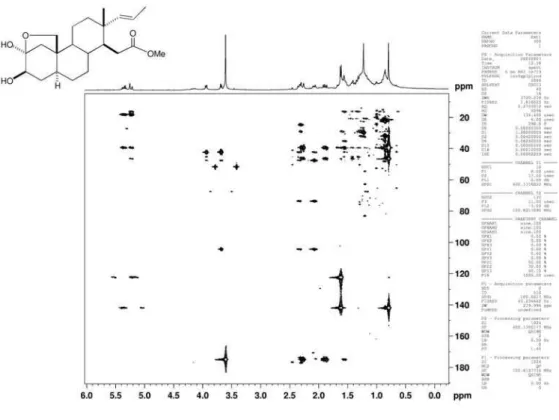
Figure S9. HMBC spectrum (CDCl3) of compound 1
Garcez et al. S7 Vol. 19, No. 6, 2008
16,17-Seco- and 2,3:16,17-di-Seco-pregnanes from Guarea guidonia J. Braz. Chem. Soc.
S8
Figure S12. 1H NMR spectrum (300 MHz, pyridine-d
5) of compound 1.
Figure S13. 1H NMR spectrum (300 MHz, pyridine-d
Garcez et al. S9 Vol. 19, No. 6, 2008
Figure S14. 1H NMR spectrum (300 MHz, pyridine-d
5) of compound 1 (expansion).
Figure S15.13C NMR spectrum (75 MHz, pyridine-d
16,17-Seco- and 2,3:16,17-di-Seco-pregnanes from Guarea guidonia J. Braz. Chem. Soc.
S10
Figure S16.13C NMR spectrum (75 MHz, pyridine-d
5) of compound 1 (expansion).
Figure S17.13C NMR spectrum – DEPT-135o (75 MHz, pyridine-d
Garcez et al. S11 Vol. 19, No. 6, 2008
Figure S18.13C NMR spectrum – DEPT-135o (75 MHz, pyridine-d
5) of compound 1 (expansion).
Figure S19. 1H-1H COSY NMR spectrum (300 MHz, pyridine-d
16,17-Seco- and 2,3:16,17-di-Seco-pregnanes from Guarea guidonia J. Braz. Chem. Soc.
S12
Figure S20. 1H-1H COSY NMR spectrum (300 MHz, pyridine-d
5) of compound 1 (expansion)
Garcez et al. S13 Vol. 19, No. 6, 2008
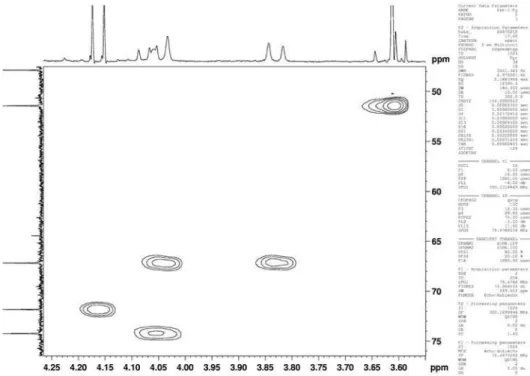
Figure S22. HMQC (pyridine-d5) of compound 1 (expansion)
16,17-Seco- and 2,3:16,17-di-Seco-pregnanes from Guarea guidonia J. Braz. Chem. Soc.
S14
Garcez et al. S15 Vol. 19, No. 6, 2008
16,17-Seco- and 2,3:16,17-di-Seco-pregnanes from Guarea guidonia J. Braz. Chem. Soc.
S16
Garcez et al. S17 Vol. 19, No. 6, 2008
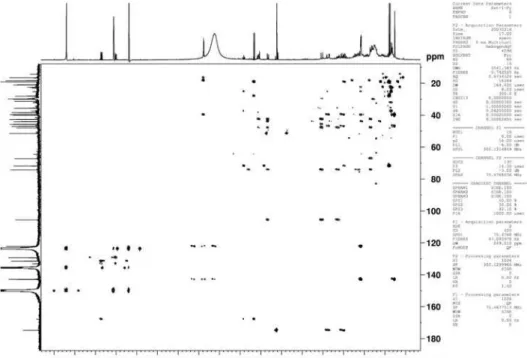
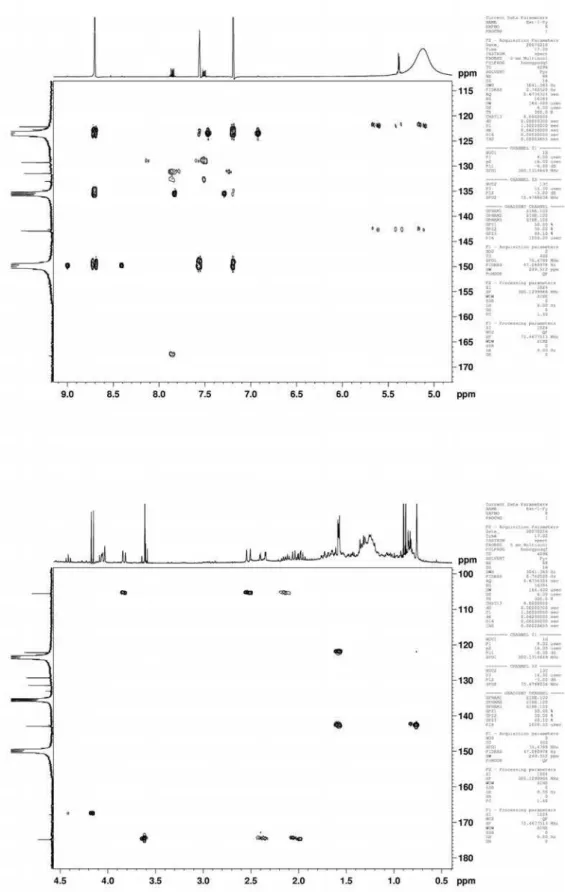
Figure S27. HMBC (pyridine-d5) of compound 1 (expansion)
Figure S28. 1H NMR spectrum (300 MHz, pyridine-d
16,17-Seco- and 2,3:16,17-di-Seco-pregnanes from Guarea guidonia J. Braz. Chem. Soc.
S18
Figure S29. 1H NMR spectrum (300 MHz, pyridine-d
5) of compound 2 (expansion).
Figure S30.13C NMR spectrum (75 MHz, pyridine-d
Garcez et al. S19 Vol. 19, No. 6, 2008
Figure S31.13C NMR spectrum (75 MHz, pyridine-d
16,17-Seco- and 2,3:16,17-di-Seco-pregnanes from Guarea guidonia J. Braz. Chem. Soc.
S20
Figure S32. 13C NMR spectrum (75 MHz, pyridine-d
5) of compound 2 (expansion)
Figure S33. 13C NMR spectrum- DEPT 135o (75 MHz, pyridine-d
Garcez et al. S21 Vol. 19, No. 6, 2008
Figure S34. 13C NMR spectrum- DEPT 135o (75 MHz, pyridine-d
16,17-Seco- and 2,3:16,17-di-Seco-pregnanes from Guarea guidonia J. Braz. Chem. Soc.
S22
Figure S35.1H NMR spectrum (300 MHz, CDCl
3) of compound 2a.
Figure S36.1H NMR spectrum (300 MHz, CDCl
Garcez et al. S23 Vol. 19, No. 6, 2008
Figure S37.1H NMR spectrum (300 MHz, CDCl
3) of compound 2a (expansion).
Figure S38.13C NMR spectrum (75 MHz, CDCl
16,17-Seco- and 2,3:16,17-di-Seco-pregnanes from Guarea guidonia J. Braz. Chem. Soc.
S24
Figure S39.13C NMR spectrum (75 MHz, CDCl
3) of compound 2a (expansion).
Figure S40.13C NMR spectrum DEPT-135o (75 MHz, CDCl
Garcez et al. S25 Vol. 19, No. 6, 2008
Figure S41.13C NMR spectrum DEPT-135o (75 MHz, CDCl
3) of compound 2a (expansion).
16,17-Seco- and 2,3:16,17-di-Seco-pregnanes from Guarea guidonia J. Braz. Chem. Soc.
S26
Figure S43. HMQC of compound 2a (expansion).
Garcez et al. S27 Vol. 19, No. 6, 2008
Figure S45. HMBC (CDCl3) of compound 2a.
16,17-Seco- and 2,3:16,17-di-Seco-pregnanes from Guarea guidonia J. Braz. Chem. Soc.
S28
Garcez et al. S29 Vol. 19, No. 6, 2008