Article
0103 - 5053 $6.00+0.00*e-mail: [email protected]
Unusual 1,6‑Diphenyl‑1,3,5‑hexatriene (DPH) Spectrophotometric Behavior in
Water/Ethanol and Water/DMSO Mixtures
Augusto C. Gracetto,a Vagner R. Batistela,a Wilker Caetano,a Hueder P. M. de Oliveira,b
Willy Glen Santos,c Carla C. S. Cavalheiroc and Noboru Hioka*,a
aDepartamento de Química, Universidade Estadual de Maringá, Av. Colombo 5.790, 87020-900 Maringá-PR, Brazil
bUniversidade Camilo Castelo Branco, São José dos Campos, 12247-004 São Paulo-SP, Brazil
cInstituto de Química, Universidade de São Paulo, CP 780, 13560-970 São Carlos-SP, Brazil
O espectro de absorção de DPH, em concentração ixa, não varia com o teor de água em solvente orgânico. Tem-se a banda de monômeros igual àquela em etanol puro. A absorção não muda até o limite de 54 e 46% de água em etanol e DMSO, respectivamente, para [DPH] = 5,0 × 10⁻⁶ mol L-1
a 30 °C. Entretanto, em misturas com água muito abaixo desses conteúdos críticos, observou-se um decaimento intenso de luorescência enquanto a absorção manteve-se constante. Propõe-se que moléculas de água atuam como supressores dos estados excitados e a constante de supressão de Stern-Volmer através de intensidade relativas, resultou em 7,4 × 10⁻² (água/etanol) e
2,6 × 10⁻² L mol-1 (água/DMSO). Os tempos de vida do DPH na ausência e presença do supressor
forneceram constantes de 7,1 × 10⁻² L mol-1 em água/etanol, indicando supressão dinâmica. Em
investigações de ambientes com esta sonda, este processo deve ser considerado tendo em vista o risco de erros de interpretação.
The absorption spectra of DPH at ixed concentration do not change with water content in organic solvents. It exhibits monomer bands, such as those obtained in ethanol. The absorption did not change for solutions up to 54 and 46% of water in ethanol and DMSO, respectively, for [DPH] = 5.0 × 10⁻⁶ mol L-1 at 30 °C. However, at the same experimental conditions, a gradual
sharp decay of the DPH luorescence is observed. It is proposed that water molecules below these water concentration limits act as quenchers of the excited states of DPH. Stern-Volmer quenching constants by intensities measurements are 7.4 × 10⁻² (water/ethanol) and 2.6 × 10⁻² L mol-1
(water/DMSO). DPH lifetime measurements in the absence and presence of water resulted in 7.1 × 10⁻² L mol-1 in water/ethanol, which pointed out that the process is a dynamic quenching
by water molecules. For experiments using DPH as probe, this process can affect data, leading to misunderstanding interpretation.
Keywords: diphenylhexatriene, DPH, DPH luorescence, dynamic quenching, lifetime
Introduction
trans-1,6-Diphenyl-1,3,5-hexatriene (DPH), which is used as a luorescence probe, has a rod-like structure that absorbs and emits light with a high quantum eficiency, although it is not a large conjugative π-electron system.1,2
The spectrophotometric properties of DPH are very sensitive to the experimental conditions, which allows using this compound and its derivatives as environmental probes in colloidal systems to determine the critical
micellar concentration of surfactants3 and in biological
cell membranes.4,5 The measurement of the luorescence
anisotropy of DPH is extensively used for membranes, particularly in studies of microviscosities,6 due to the
non-polar characteristic, the low water solubility, and the suitable geometric design, which maintains the molecule aligned parallel to the phospholipids chains of the membranes.7 Although the DPH molecule remains
inserted in the membrane layer, it stays in contact with water molecules.2,5
For DPH, the ground state (S0) and the irst excited state (S1) have Ag symmetry, while the second excited state (S2) has Bu symmetry. Therefore, the So-S1 transition is not allowed by the symmetry rule, while the So-S2 transition is.10 Therefore,
the DPH absorption band corresponds to the 1A g
-1B u
* (S o-S2)
transition. In contrast, the very long luorescence lifetime of DPH indicates that the emission does not correspond to a reverse 1B
u *-1A
g (S2-So) transition. As known, the 1A
g *
state (S1) is more stable than the 1B u
* state (S
2) in long
diphenylpolyenes, such as DPH. Birks11,12 irst suggested
that the low S1-S2 energy difference, about 1000 cm-1
in hexane, allows coupling (Herzberg-Teller vibronic coupling) of both states, as shown by the energy diagram in Scheme 1. This coupling changes the “purity” state of
1A g
* by orbital symmetry modiications, thus diminishing
the forbiddance of DPH S1-So luorescence emission after a quick non-radiative internal S2-S1 conversion.18 In fact,
either luorescence or rotation (cis-trans isomerization) occurs from 1A
g * (S
1 state). As the coupling diminishes,
the luorescence yield, Φ
F, decreases, while the cis-trans
rotation increases.14
Several spectrophotometric and photochemical properties of DPH depend on environmental factors such as the temperature, solvent nature, etc. They inluence the energy diagram, particularly the energy gap of S1-S2 states and their coupling, and accordingly, so are the characteristics of the involved orbital. Orbital Ag is assigned to a highly symmetric state, a “covalent” character, while the Bu state presents more “ionic” characteristics.10 Therefore,
the energy of the 1A g
-1B u
* (S
o-S2 absorption) transition is
affected by the solvent polarity and polarizability. A highly polar and polarizable solvent stabilizes the 1B
u
* state (S 2)
better than the 1A
g state (So), which is less sensitive, leading
to red-shifted absorption peaks. Dupuy and Montagu2
showed that the main absorptivity parameter of DPH is the solvent polarizability (α
S) rather than the polarity, which
is related to the refractive index. The higher the solvent refractive index, the greater the red-shifted absorption band.1,2 However, the solvent nature does not affect the
luorescence wavelength, since the (S1-So) process involves two Ag orbitals, which suffer the same type of stabilization by the solvent and are less sensitive to polarizability. Additionally, a solvent with high polarizability stabilizes the S2 orbital and favors the S2-S1 coupling, leading to a high luorescence yield.9,15 The slightly decrease in the
polarizability of organic solvents with the increase in the temperature destabilizes the 1B
u
* state. The resulting
decrease of the S1-S2 coupling promotes a decrease of
Φ F.
10,15,16 This effect is more evident in polar solvents, such
as ethanol and acetonitrile, than in non-polar solvents.1 The
present work investigated an unusual luorescence behavior of DPH associated with the presence of water in organic solvents (ethanol and DMSO) attributed to DPH excited states quenching by water molecules.
Experimental
Anhydrous ethanol (Merck) and DMSO (Malinckrodt) were used as supplied. Sodium dodecyl sulfate (SDS) was purchased from Aldrich. Deionized and distilled water was used throughout. The DPH (all-trans, Aldrich) stock solutions were prepared in DMSO and kept frozen in the dark. Before use, the melted solutions were standardized by UV-Vis spectrophotometry in methanol (Merck) using a molar absorptivity of ε
350 nm = 88000 L mol -1cm-1.17
Approximately 100 mL of the solvent solution was prepared by mixing accurately measured volumes of water and organic solvents using a calibrated pipette. An aliquot of DPH stock solution was added to 2 mL of solvent mixture in a quartz cuvette using a micro syringe and agitated vigorously. The inal samples contained no more than 0.07% (v/v) of DMSO and its presence did not inluence the experimental results. All experiments were carried out at 30 °C. The absorption and luorescence
spectra were obtained in Varian Cary-50 and Perkin-Elmer LS-5 spectrometers, respectively. For luorescence experiments, the excitation was ixed at 353 nm and the emission was monitored at 430 nm. For Resonance Light Scattering spectra the spectroluorometer were operated in synchronous mode (∆λ = 0). The lifetime measurements
were conducted in equipment from Optical Building Blocks Corporation (OBBC) with excitation source at 370 nm (LED) and emission at 435 nm, and the software
DPH
EasyLife V. The luorometer light exposure time was controlled to avoid DPH photodegradation.1 The amount of
water is given as v/v percentage in organic solvent.
Results and Discussion
The electronic absorption spectrum of DPH in anhydrous organic solvents, such as ethanol, methanol, and DMSO, exhibits a long wavelength band (300-400 nm) composed of three characteristic vibrational peaks and shoulders that correspond to DPH in monomeric form. The absorption and luorescence spectra of monomeric DPH are illustrated in Figure 1. The lack of a mirror image between these spectra is due to the electronic states involved once the absorption corresponds to So-S2* transition and the emission
corresponds to S1*-S
o transition. 12,13
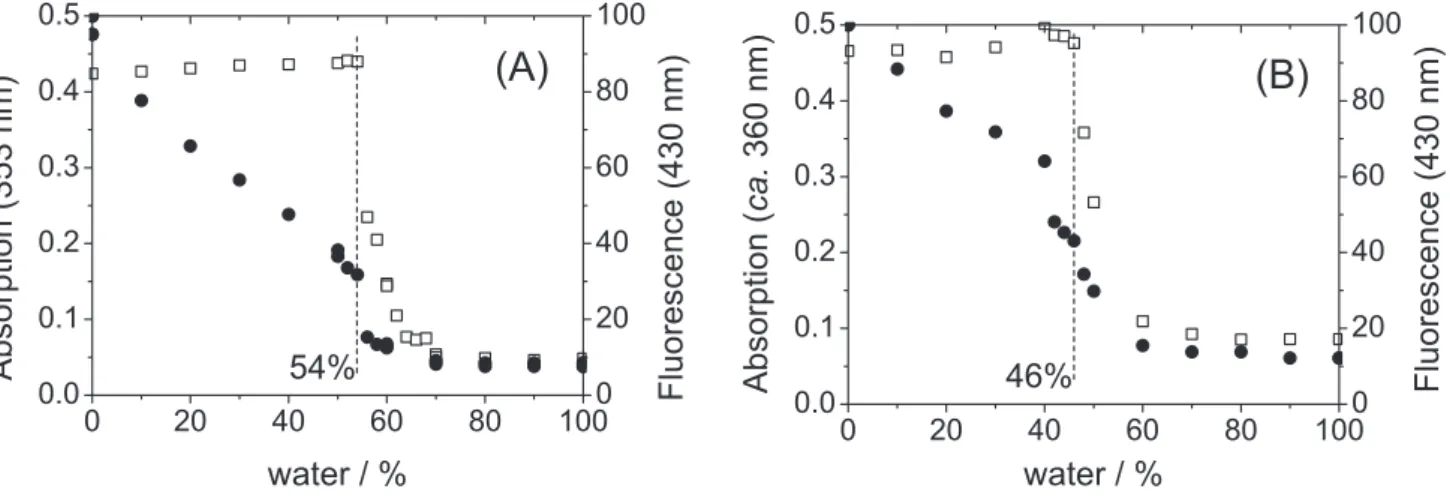
In the presence of large amounts of water in ethanol and in DMSO, the absorption spectra of DPH changed as illustrated in Figure 2 (water/ethanol system as an example). However, these changes for [DPH] = 5.0 × 10⁻⁶ mol L-1 at
30 °C are observed only above 54% water in ethanol and
46% water in DMSO.
These absorption spectral changes, expressed by a strong decrease in the intensity of the peak around 353 nm (the most intense monomer absorption peak) and a new absorption band at 300 nm, may be attributed to a DPH self-aggregation process that leads to dimers, trimers, and other aggregates. These results will not be discussed in the present report18 as its focus is presently on the
experimental conditions below this critical amount of water and the resulting effects observed on the spectrophotometric properties of DPH. Therefore, all subsequent results are related to these water ranges, below 54% water in ethanol and below 46% in DMSO for [DPH] = 5.0 × 10⁻⁶ mol L-1
at 30 °C. In these ranges, while the absorption spectra
did not vary, remaining almost the same as in anhydrous organic solvents, the luorescence decays even for low water contents as illustrated in Figure 3. Indeed the absorbance at 353 nm presented a linear correlation
Figure 1. Absorption (a) and luorescence (b) spectra of DPH in ethanol.
Figure 2. DPH absorption spectra in water/ethanol mixtures (water %, v/v): (a) 0-54%; (b) 60%; and (c) 70%. [DPH] = 5.0 × 10⁻⁶ mol L-1. T = 30 °C.
with DPH concentration (Beer’s plot) for [DPH] up to 5.0 × 10⁻⁶ mol L-1 in water/ethanol solution (experiment
series at water ranging from 0 to 40%), not shown. The absence of new absorption bands or peak shifts in the absorption and fluorescence spectra of DPH makes the isomerization hypothesis improbable, since cis-polyenes usually exhibit blue-shifted absorption bands when compared to trans-polyenes.19 This effect of
water on the DPH luorescence was previously reported by Dupuy and Montagu.2 In that work the luorescence
intensity decayed 16 and 29% in ethanol, and 3 and 13% in DMSO for 3 and 10% water, respectively. They assigned this phenomenon to DPH and water interactions without further discussion.5 While water does not shift the
wavelength of the emission bands, its low polarizability,
α
S, water = 0.206, compared to 0.222 of ethanol and 0.284 of
DMSO at 30 °C, destabilizes the S
2 orbital and reduces the
S2-S1 coupling, which are relected as a weak luorescence emission (low Φ
F).
9,15 However, the large decrease in the
luorescence intensity for such low water percentage in the solvent cannot be attributed to a simple solvent polarizability effect, as demonstrated by the luorescence intensity decay of 27% for the addition of 10% water in methanol.2 The α
S of methanol is even smaller than that of
water (α
S, methanol = 0.203). As the same time the observed
luorescence decrease can not be attributed to dielectric constant effects. Therefore, a speciic mechanism of quenching process should exist, which promotes DPH luorescence decreases. The luorescence data was applied to the Stern-Volmer equation (1), considering water molecules acting as the quenchers:
(1)
where Fo is DPH luorescence intensity in organic solvent, F is observed luorescence intensity, KSV is Stern-Volmer quenching constant and [H2O] is water molar concentration. The plots of Fo/F against [H2O] for three fixed DPH concentrations are illustrated in Figure 4.
All plots in Figure 4 show linear dependence upon the quencher concentration. Table 1 shows the KSV values and the correlation coeficients (cc) of the luorescence data. Figure 4 and the results in Table 1 show the excellent curve itting and that the Stern-Volmer constants are independent of the DPH concentration. The average KSV value for the DPH in water/ethanol mixtures resulted in 7.4 × 10⁻² L mol-1
while in water/DMSO 2.6 × 10⁻² L mol-1 with cc = 0.9977.
Therefore, it is demonstrated that the water molecules are acting as quenchers.
In the present work, two basic mechanisms: the dynamic (or collisional) quenching and the static quenching can be
responsible for DPH deactivation. A similar Φ
F decay in
aqueous solutions of luoresceins20,21 and cumarins22 was
attributed to speciic water molecule interactions caused by hydrogen bonding, as discussed by Arbeloa.20 Although
hydrogen bonding or even polar-polar interactions are not recognizable for DPH, some authors have reported experimental and theoretical ground state benzene-water weak structures in which the aromatic rings would act as hydrogen bond acceptors.23 For DPH, as reported,10 the S
2 *
electronic state (1B u
*) of DPH is assigned as more “ionic”
symmetry and there is a S2*-S 1
* coupling that changes the
“purity” of both states,12 which may turn the S 1
* state more
“ionic”, so that more sensible to interactions.
The luorescence measurements at 30 and at 50 °C, represented as F30 and F50, respectively, showed a decrease in the intensity at higher temperatures for the water percentage range considered (F50/F30 ratio < 1). This effect was irst
explained by Alford and Palmer,16 who attributed it to a
small decrease in polarizability with the rise in temperature, which destabilized the S2 orbital and resulted in the S2-S1 decoupling (decrease in Φ
F). Additionally the temperature
elevation favors internal conversion instead luorescence emission. However, another explanation for the present case is the viscosity diminution as the temperature
Figure 4. Stern-Volmer plot. Fixed DPH concentration at: (a) 0.18 × 10⁻⁶ mol L-1; (b) 0.47 × 10⁻⁶ mol L-1; and (c) 0.67 × 10⁻⁶ mol L-1. Water/ethanol mixtures at 30 °C. The values of Fo/F (y-axis) for (b) and (c) curves are increased by, respectively, +1 unit and +2 units, to permit the visualization of the adjustment.
Table 1. Values of KSV and correlation coeficients (cc) obtained by the itting of experimental data for DPH luorescence measurements at 30°C in water/ethanol mixtures
[DPH] (10-6 mol L-1) K SV (L mol
-1) cc
0.18 0.074 ± 0.002 0.9991
0.47 0.074 ± 0.001 0.9999
increases, resulting in faster diffusion and hence larger amounts of collisions (higher energy suppression), which suggests dynamic quenching. The value of the F50/F30 ratio was independent of the water content. Additionally, the luorescence intensity decayed even with the addition of SDS to an aqueous ethanolic solution of DPH (not shown). These results eliminate the possibility of DPH self-aggregation for water contents below the previously mentioned critical water concentration, since the increase in temperature and the addition of surfactant cause monomer formation, which should result in higher luorescence.24 In
addition Resonance Light Scattering (RLS) experiments using the spectroluorometer in synchronous mode did not show RLS signals that pointed out absence of aggregates in these solutions.
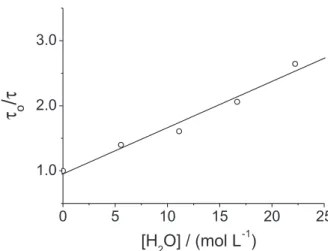
To confirm that the DPH fluorescence diminution by water molecules follows the mechanism of dynamic quenching, time-resolved experiments were performed at several water/ethanol conditions (Figure 5). From the data exposed in Figure 5, the luorescence lifetimes of DPH in the absence (τ
o) and presence (τ) of quenchers were calculated.
The obtained lifetime of DPH in pure ethanol (τ
o = 5.0 ns)
is in accordance to the value found in the literature1 (5.0 ns
at 32 °C in the absence of oxygen). Figure 6 presents the
plot of τ
o/τ against water molar concentration.
As can be seen, the plot in Figure 6 follows a linear relationship whose slope is 7.1 × 10⁻² L mol-1. This value
is the same as the KSV obtained from luorescence stead-state results (7.4 × 10⁻² L mol-1). The equivalence of the
ratios, Fo/F (Figure 4) and τ
o/τ (Figure 6), demonstrates
that the investigated luorescence decay is due to dynamic quenching of the DPH excited states by water molecules. Indeed, the calculated bimolecular quenching constant
kqca. 1.5 × 10⁷ L mol-1 s-1 (calculated from τ
o and KSV) is
smaller than the typical diffusion-controlled value, which shows low quenching eficiency.
Conclusion
Once DPH is used as probe for colloid and membrane investigations, the large luorescence decay of DPH in presence of water must be taken into account. Despite being hydrophobic, the DPH probe can be exposed to water molecules in some microenvironments. This quenching process can affect experimental data, leading to misunderstanding interpretation. The deactivation mechanism of excited states of DPH is due to the dynamic quenching by water molecules.
Acknowledgments
This work was supported by the Brazilian agencies: Fundação Araucária-Seti/Paraná, FAPESP, CNPq and CAPES NanoBiotec. The authors want to thank Laerte J. da Silva for the English language revision.
References
1. Cehelnik, E. D.; Cundall, R. B.; Lockwood, J. R.; Palmer, T. F.; J. Phys. Chem.1975, 79, 1369.
2. Dupuy, B.; Montagu, M.; Analyst1997, 122, 783.
3. Alexandridis, P.; Holzwarth, J. F.; Hatton, T. A.; Macromolecules
1994, 27, 2414; Hioka, N.; Chowdhary, R. K.; Chansarkar, N.; Delmarre, D.; Stenberg, E.; Dolphin, D.; Can. J. Chem.2002, 80, 1321; Gaisford, S.; Beezer, A. E.; Mitchell, J. C.; Bell, P. C.; Fakorede, F.; Finnie, J. K.; Williams, S. J.; Int. J. Pharm.
1998, 174, 39.
4. Shinitzky, M.; Barenholz, Y.; J. Biol. Chem.1974, 249, 2652.
Figure 5. Lifetime determinations for DPH in different water/ethanol mixtures: (a) pure ethanol; (b) 10%; (c) 20%; (d) 30%; and (e) 40% of water (v/v). [DPH] = 0.5 × 10⁻⁶ mol L-1. Excitation at 370 nm and emission at 435 nm.
Figure 6. Lifetime relationship (τ
5. Trotter, P. J.; Storch, J.; Biochim. Biophys. Acta, Biomembr.
1989, 982, 131.
6. Soto, M. A.; Sotomayor, C. P.; Lissi, E. A.; J. Photochem. Photobiol., A2002, 152, 79; Lakowicz, J. R.; Principles of Fluorescence Spectroscopy, 2nd ed.; Plenum Press: New York,
1994.
7. Shinitzky, M.; Barenholz, Y.; Biochim. Biophys. Acta, Biomembr.1978, 515, 367.
8. Turek, A. M.; Krishnamoorthy, G.; Sears, D. F.; Garcia, I.; Dmitrenko, O.; Saltiel, J.; J. Phys. Chem. A2005, 109, 293; Hilinski, E. F.; McGowan, W. M.; Sears, D. F.; Saltiel, J.; J. Phys. Chem. 1996, 100, 3308.
9. Itoh, T.; Kohler, B. E.; J. Phys. Chem.1987, 91, 1760. 10. Allen, M. T.; Whitten, D. G.; Chem. Rev.1989, 89, 1691. 11. Birks, J. B.; Birch, D. J. S.; Chem. Phys. Lett.1975, 31, 608;
Birks, J. B.; Chem. Phys. Lett.1978, 54, 430.
12. Birks, J. B.; Tripathi, G. N. R.; Lumb, M. D.; Chem. Phys.1978, 33, 185.
13. Saltiel, J.; Wang, S.; J. Am. Chem. Soc.1995, 117, 10761. 14. Saltiel, J.; Ko, D. H.; Fleming, S. A.; J. Am. Chem. Soc.1994,
116, 4099.
15. Allen, M. T.; Miola, L.; Whitten, D. G.; J. Phys. Chem.1987, 91, 6099.
16. Alford, P. C.; Palmer, T. F.; Chem. Phys. Lett.1982, 86, 248. 17. Haugland, R. P.; Handbook of Fluorescent Probes and Research
Chemicals, 6th ed.; Molecular Probes Inc.: New York, 1996.
18. Gracetto, A. C.; Batistela, V. R.; de Oliveira, H. P. M.; Hioka, N.; unpublished work.
19. Lunde, K.; Zechmeister, L.; J. Am. Chem. Soc.1954, 76, 2308. 20. Arbeloa, F. L.; Arbeloa, T. L.; Bartolome, P. H.; Estevez, M. J. T.; Arbeloa, I. L.; Proc. Indian Acad. Sci. (Chem. Sci.)1992, 104, 165.
21. Arbeloa, F. L.; Arbeloa, T. L.; Estevez, M. J. T.; Arbeloa, I. L.; J. Phys. Chem.1991, 95, 2203; Arbeloa, F. L.; Arbeloa, T. L.; Arbeloa, I. L.; Costela, A.; Garcia-Moreno, I.; Figueira, J. M.; Amat-Guerri, F.; Sastre, R.; J. Lumin.1997, 75, 309. 22. Arbeloa, F. L.; Arbeloa, T. L.; Arbeloa, I. L.; J. Lumin.1996,
68, 149.
23. Suzuki, S.; Green, P. G.; Bumgarner, R. E.; Dasgupta, S.; Goddard, W. A.; Blake, G. A.; Science1992, 257, 942; Li, S.; Cooper, V. R.; Thonhauser, T.; Puzder, A.; Langreth, D. C.; J. Phys. Chem. A2008, 112, 9031.
24. Simplicio, F. I.; Maionchi, F.; Santin Filho, O.; Hioka, N.; J. Phys. Org. Chem.2004, 17, 325; Simplicio, F. I.; Soares, R. R. S.; Maionchi, F.; Santin Filho, O.; Hioka, N.; J. Phys. Chem. A2004, 108, 9384.
Received: January 18, 2010
Web Release Date: April 12, 2010