Critical Behavior of Models with Innitely
Many Absorbing States
J.F.F. Mendes
Departamento de Fsica and Centro de Fsica do Porto, Universidade do Porto, Rua do Campo Alegre 687, 4169-007 Porto, Portugal
Received 1 November 1999
In this article we review several models with many absorbing congurations. In all these models attention will be focused on the inuence of the initial state on the dynamic evolution. The rela-tion of systems with many absorbing congurarela-tions to those displaying avalanches (self-organized criticality) is also investigated. Some new results are presented both for systems with and without parity conservation. Recently derived scaling relations are tested.
I Introduction
The study of nonequilibrium models exhibiting phase transitions from an active to an absorbing phase has been a topic of intense research in the last years [1-11] since Broadbent and Hammersley [12] introduced directed percolation (DP) [13-15]. Later studies have connected this to other elds, and the topic has be-come familiar in many processes encountered in nature. Among them we refer to models of epidemics [19-21], catalytic kinetics [22], surface growth [23], and self-organized criticality [24]. Most of these models were found to belong to the universality class of DP, sup-porting the conjecture of Jenssen [25] and Grassberger [26] that all systems exhibiting a continuous transition into a unique absorbing state, without any other sym-metry or conservation law, belong to the DP universal-ity class. This conjecture was later extended by Grin-stein et al. [27] to systems with multiple components. Exceptions to this universality class were introduced by Grassberger [28,29]; they correspond to models with doubly degenerated absorbing states and modulo 2 par-ity conservation.
More recently Jensen [30] introduced a model (the pair contact process - PCP) that is the prototype of a model with a number of absorbing congurations growing with the system size, which goes to innity in the thermodynamic limit. Other models with in-nitely many absorbing states (IMAS) were introduced since then, and have proved to have a more complex dynamics than the ones with only a single absorbing state. Apart from this, all them of show - in agree-ment with the previous conjecture - a DP-like behavior in what concerns the static critical behavior. However,
the critical exponents that govern the spreading from an initial seed (the closest conguration to the absorbing one) show non-universal behavior. The critical expo-nents describing time dependence depend on the initial conguration of the system. Only for the "natural" con-guration (the one obtained from the evolution of the system) are DP values recovered. An attempt to justify this behavior on solid grounds was made by Mu~noz et al. [31] using a continuous eld theory. Other features of IMAS models were discovered recently by Lipowski [32], who observed that a model inspiried by \biological evolution" in (2+1)-dimensions has the critical behav-ior of (1+1)-dimensional DP (an eect similar to the dimensional reduction encountered in random systems [33]).
Another topic of intense research in our days is self-organized criticality (SOC). Recently some attempts to connect SOC with absorbing-state phase transitions were made [34, 35]. SOC was introduced by Bak, Tang and Weisenfeld (BTW) [36], who proposed a model for the self-organization of a sandpile. The pile obtained by adding single grains self-organizes to the critical angle, where innitely large avalanches (by avalanche we un-derstand a successive sequence of toppling events) can occur. This process will reduce again the slope of the pile, which will evolve through small avalanches until it again reaches again the critical point. A very good pedagogical review on this topic is given by Dickman et al. [37].
thresh-old above which sand topples. This model also presents avalanches of all sizes, which obey a power-law size dis-tribution.
Another model to be studied is the parity-conserving dimer model (PCD), which is known to belong to a dierent universality class - the parity-conserving universality class (PC). The dynamic rules are such that there is parity conservation in the number of dimers.
Previous studies by Dickmanetal. [34] using scal-ing analysis yielded new relations between critical ex-ponents governing avalanches and the ones of critical phenomena in systems with many absorbing states. In this paper we use numerical simulations to study such relationships, and test scaling laws. Also in this case ex-ponents will be obtained for avalanches and compared with ones for time-dependent evolution through scaling laws.
Hereafter, we will consider only two models (TTP and PCD) to illustrate the relationship between sys-tems with IMAS and SOC. Other models exist in the literature with the same characteristics [30] [40], how-ever we chose these two because they are more familiar to the author.
II The models
As mentioned before, we will present studies of two one-dimensional models with multiple absorbing congura-tions, and obeying dierent kinds of conservation laws (with parity conservation (PC) and without (DP)). The former consists in a model of dimers whose dynamic rules will be dened below (PCD) [41]. The latter is the so-called threshold transfer process (TTP) [42], in which each site of the lattice can be either vacant, or singly or doubly occupied (
i = 0
;1;2, respectively). At each time step, a sitei is chosen at random. In the absence of active (doubly occupied) sites the dynamics is indeed trivial: if
i(
t) = 0 (1), then i(
t+ 1) = 1(0) with probabilityp(1,p). The system relaxes exponen-tially to a steady state where a fractionpof sites have
i = 1 and the others are vacant. If
i(
t) = 2, then
i(
t+ 1) = 0; i,1(
t+ 1) = i,1(
t) + 1; i+1(
t+ 1) =
i+1(
t) + 1 if i+1(
t) and i,1(
t) are both < 2 and
i(
t+ 1) = 1 if only one of the nearest neighbours of site i (j =i,1 or i+ 1) has
j(
t)<2, in which case
j(
t+ 1) = j(
t) + 1. As can be easily seen, the num-ber of active sites either decreases or remains the same in all processes other than (1;2;1)!(2;0;2); the fre-quency of this process depends on the concentration of '1'-s, which is controlled by the parameterp. Any con-guration consisting of only '0'-s or '1'-s is absorbing
in what concerns the active sites. Thus in a chain of length N, there are 2N absorbing congurations. The absorbing states in this model are uctuating - in this subsector of phase space, ergodicity is not broken. Thus we identify the density of doubly-occupied sites,
2, as the order parameter of the threshold transfer process. Under the correspondence: 2!burning tree, 1!live tree, and 0 ! ashes, the process (1;2;1) ! (2;0;2) describes a burning tree setting its neighbours on re. But the TTP permits doubly occupied sites to arise onlyvia transfer; there is no \lightning" process, as in the FFM. Despite certain common aspects, our model is therefore very dierent from the FFM.
The other model to be considered here was intro-duced by Marquesetal. [41] and is the rst to combine parity conservation (PC) with innitely many absorb-ing states. The original idea of this model was to clarify whether, as in the TTP, PCP and other models without PC conservation, dynamic critical exponents will also depend on the initial state. This model resembles the PCP introduced by Jensen [30] but with the number of dimers conserved modulo 2. The dynamic evolution of this model involves creation and annihilation processes, which are attempted with probabilitiespand 1,p re-spectively. If one chooses to annihilate, then a dimer (represented by = ) is selected at random and one looks for an adjacent dimer. If the pair of dimers is surrounded by empty sites (), then the two dimers are annihilated and the respective sites become empty:
,,==,,,!,,,,,, otherwise, annihilation is eected by simply vacating the site that is shared by the two dimers, leaving the other sites unchanged:
,,===,,!,,,,=,. In this way, the number of dimers is conserved mod-ulo 2. In case of a creation attempt, if the nearest-and next-nearest-neighbor sites of a selected dimer are, respectively, vacant and occupied, a pair of dimers is produced by simply occupying that vacant site:
,=,,,,,!,===,, Another possibility requires three vacant sites adjacent to a dimer, in which case a pair of dimers is created (with probability ) by lling the nearest- and next-nearest neighbour sites and leaving the third vacant site unchanged:
,=,,,,
work, we consider = 1=2. We should also point out that this model presents another conservation law, in addition to parity conservation. Dene sublattices A and B, and let N
AB ( N
B A) be the total number of dimers with their left particle on the A(B) sub-lattice. Then N =N
AB ,N
B A is conserved, since dimers are created and annihilated in pairs on adjacent pairs of sites. This implies that congurations with dierent values ofN are not connected by the dynamics used.
With these rules, diusion is only present indirectly. Also, the annihilation of isolated dimers is possible only through successive processes of creation and annihila-tion, which slows down the dynamical processes leading to absorbing congurations. One can of course enlarge the parameter space to include diusion or longer range processes and consider a dynamics that mixes sectors in the phase space with dierent values of N. In the ab-sence of such processes, creation of dimers is inhibited in congurations where a pair of vacant sites is sur-rounded by occupied sites. Initial congurations were chosen such that this situation does not occur in the dy-namical process; this means a restriction to the N = 0 sector.
III Summary of previous results
In this section we present briey results from [41] and [42]. In these two models with innitely many absorb-ing congurations, it was shown that the static expo-nents belong to the corresponding universality class, that is, PC for PCD, and DP for TTP. In what concerns the spreading exponents, it was observed in both mod-els that they depend on the initial conguration. To
account for this a new hyperscaling relation was pro-posed [42]. This consists in a generalisation of the one proposed by Grassberger and de la Torre [43], and as-sumes that the ultimate survival probability behaves likeP 1 0 .
A. Mean-eld theory
The mean-eld theory for the TTP model can be easily obtained. Dening by
i the densities for the three kinds of site occupation, we arrive at
d dt i = X k R (k ) (k ) i P
(k ) (1)
whereR (k ),
(k ) i and
P
(k )are respectively the rate for the processk, the change in the number of particles of typei, and the probability of the conguration required for process k.
Process R
(k )
0 1 2
P (k )
1!0 1,p 1 ,1 0
1
0!1 p ,1 1 0
0
121!202 1 1 ,2 1
2
2 1
020!101 1 ,1 2 ,1
2
2 0
221!212 1 0 1 ,1
1
2 2
021!102 1 0 0 0
0
1
2
220!211 1 ,1 2 ,1
0
2 2
222!222 1 0 0 0
3 2 TABLE I. Rules for the TTP model, and the
respective rate processes[44].
Using the results of Table I, the dynamic equations for the densities appear in the form:
c d
0 dt
= ,p
0+ (1 ,p)
1 , 2 0 2+ 2 1 2 ,2 0 2 2 d 1 dt = p 0
,(1,p) 1+ 2
2 0 2 ,2 2 1
2+ 4 0 2 2 (2) d where
2= 1 ,
0 ,
1. This analysis leads to a p
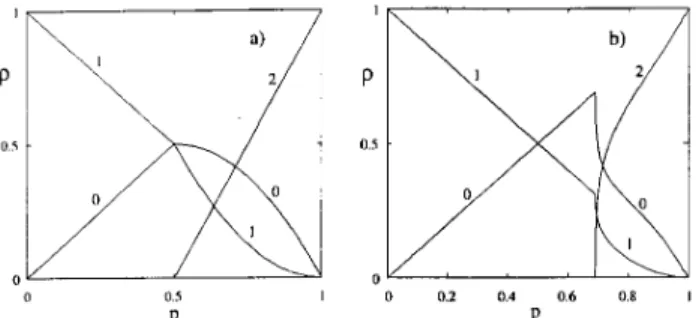
c= 1 =2 and = 1. It allows us to get information about the transition, however it is quantitatively wrong. In Fig. 1 we show the phase diagram in the mean-eld approx-imation and from numerical simulations.
Based on these equations it is possible to write down a eld-theory (or set of Langevin equations), for the density of particles (
1) and of active sites (
2) based on symmetry principles. This type of analysis was intro-duced by Mu~nozetal. [31, 45] for models with IMAS, c
@ 1(
x;t) @t = r 1 1+ c 1 r 2 x 1 ,u 1 2 2 ,w 1 1 2+ 1=2 1 1 @ 2( x;t)
where the coecients c i,
r i
u i and
w
i are all constants depending on the microscopic parameter of the system, p, and
i are Gaussian white noise variables, obeying, h
i( x;t)
j(
x;t)i = D i;j
2(
x;t)(x,x 0)
(t,t
0). This analysis has yet to reproduce the nonuniversal spread-ing exponents observed in models with INAS. This set of equations can be reduced to a single equation (for
2) with an exponential non-Markovian term, @
2 @t
= D r
2
2 ,r
1
2 ,u
2
2 2+
2
, w
2 r
1
2( x;t)
Z t 0
dt 0
2(
x;t 0)
e ,w1
R t t
0
ds2(x;s) with a long-memory eect [31]. The last term on the right side is irrelevant to the stationary properties of the active phase, because it goes exponentially to zero if the density of active sites is non-null. This equation is dierent from the equation that describes Reggion eld theory [48, 49, 50]. A numerical analysis was later made by Lopezetal. [51]. Numerical integration shows the nonuniversal dynamic critical exponents observed previously for the PCP and other models with INAS.
Figure 1. Density versuspfor the TTP model. Left:
mean-eld theory; right: Monte Carlo simulations. The labels on top of curves (0, 1, 2) mean the densities of vacant, particles and pairs respectively.
B. Steady-state simulations
To perform these simulations we started with a fully occupied lattice in the case of PCD, and with equal fractions of the three states in the case of TTP. The concentrations are averaged over a long period of time, once the steady state has been reached. As noted above, the order parameter for the TTP is the density of 2's (
2); it obeys
2= jp,p
TTP c
j
(3)
The critical value isp TTP
c = 0
:68940:0003. The expo-nentwas measured previously for this model [42], and is in very good agreement with the DP universality class (d= 1 + 1). In simulations we found= 0:2790:005 [42].
The order parameter for the PCD is the concentra-tion of dimers; it too vanishes algebraically as p ap-proaches the critical probabilityp
c: jp
PCD c
,pj
(4)
where is the order parameter exponent (p PCD
c =
0:29950:0005). Simulations yield= 0:285, in agree-ment with the value for the PC universality class in 1 + 1,d.
As usual, the steady-state concentration is obtained for several values of p near p
c, and dierent values of system size, up to a maximum value ofL= 2000. The maximum duration was chosen according the value of p; studies near p
c require long durations, because of slowing-down eects. We used 104
< t < 10 6. The simulations were carried out for about 1000 indepen-dent trials which had not yet entered the absorbing state. From a log-log plot of density against p,p
c, the slope of the data gives the estimate = 0:98(5), a value which agrees with the results of [52], and is slightly above the values obtained by other authors for (1 + 1),d models in the PC universality class. De-termining the critical point by steady-state simulations requires an accurate measurement of the order param-eter near criticality, which becomes rather dicult due to the critical slowing-down. We have complemented this study with a nite-size scaling analysis based on the ansatz that the order parameter depends on sys-tem size L through the ratio of L and the correlation length
?
,?, ( = jp,p
c j): (p;L)L
, =? f(L
1=?) (5)
(with f(x) / x for
x! 1, so that (1) is recovered whenL!1). At the critical point we have,
(p c
;L)/L
, =? (6)
and from a log-log plot of (p c
;L) as a function of L; a linear dependence is obtained, with slope =
? = 0:54(4), in good agreement with the values 0:48 and 0:50, as obtained in [53] and [54].
The ultimate survival probability exponent 0 was determined from similar studies, usingpvalues slightly away from the critical point. The numerical procedure will be explained in the next section.
C. Time-dependent simulations
Time-dependent simulations [43] have become an ef-fective tool to explore dynamical critical exponents of systems at nonequilibrium phase transitions.
the case of PCD, or a doubly-occupied site in the case of TTP), embedded in a sea of inactive sites (vacant or singly-occupied sites), i.e, (,,,, = ,,,,,) located on the center of the system (sitesL=2 andL=2 + 1 for a lattice ofLsites). We place a given concentration
1 of particles on the other sites, with the condition (in the case of the PCD) that there are no nearest-neighbor pairs (i.e., no dimers other than the central seed). For the PCD model the maximum initial density is 1=2; for TTP it is 1.
Temporal evolution. We set a maximum time for the evolution (t
MAX) chosen in such a way that active sites cannot reach the borders of the system. In this way there are no nite size eects. Since the number of active particles during the time evolution is small, we save CPU time by choosing from a list of the ac-tive sites and then applying the the process (creation or annihilation). This procedure entails a variable time increment, t = 1=N
act, for each event, where N
actis the current number of active sites. The quantities usu-ally investigated are the mean number of active sites N(t) (dimers in case of PCD and '2'-s in case of TTP model), averaged over all trials, the survival probability P(t), and the mean spread or size, R(t), of the surviv-ing trials. Near the critical point, and for asymptoti-cally long times these quantities follow power laws of the form
N(t;) = Z
dx(x;t;) =t
(t
k) (7)
P(t;) = t , (
t
k) (8)
R 2(
t;) = 1 N(t;)
Z dxr
2
(x;t;) =t z(
t
jj) ; (9) where xis the distance from the seed and the normal-isation quantity N(t;) is the mass of the cluster at timet. The latter expressions dene the exponents , andzrespectively.
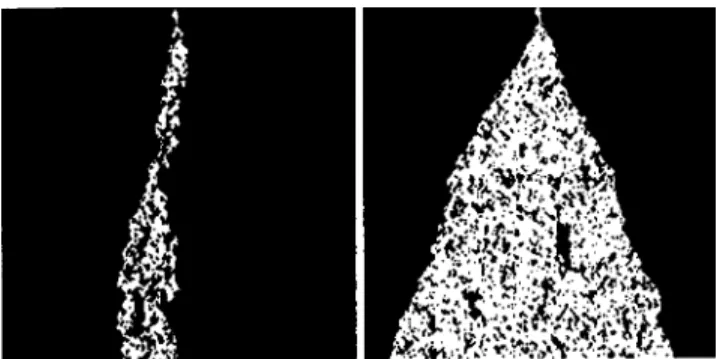
Figure 2. Ilustration of space-time evolution: below and above p
c.
It was observed by Mendes et al. [42] that P 1 (ultimate survival probability) as a function of p,p
c
for several initial densities is no longer proportional to the density, but is characterised by a new exponent
0, P
1
/
0
( =jp,p c
j). From this it follows that the density is
(x;t) =P 1(
)
: (10)
Using this assumption one can obtain a hyperscaling re-lation [42], that generalises the one of Grassberger and de la Torre [43],
1 +
0
0+
0= dz
0
2 (11)
where the primes denote exponents dependent upon the initial particle density,. This relation has been veri-ed for a vast variety of models in dierent universality classes [41] [42] [31] [51] [46].
We have veried Eq. (11) in simulations of the parity-conserving dimer reaction and the threshold transfer process. Using time-dependent simulations(for t5000, and a number of trials of order 10
7), we deter-mined the critical point of the TTP asp
c = 0
:6894(3). We note in passing that some controversy exists regard-ing a possible shift ofp
c as the initial density is varied, in models with INAS. A recent work by Dickman [55], using a new technique applied to the pair contact pro-cess (PCP), claims thatp
c is not aected by the initial concentration, contrary to what was seen by Odor et al. [47]. The exponents
0,
0 and z
0 may be deter-mined from simulations at p
c, using an initial cong-uration very close to the absorbing state. We studied various initial densities, including
i= 0
:6894, the nat-ural value. The ultimate survival probability exponent
0was determined from similar studies, using
pvalues slightly above critical. The simulations begin with one doubly-occupied site at the origin; the remaining sites are taken as occupied or vacant, independently, with probabilities
i and 1 ,
i, respectively. The dynam-ics is restricted to the active region, dened as follows. Let ibe the set of all sites which are doubly-occupied or have a doubly-occupied neighbour, after thei
th step of the trial. (0 comprises the origin and its neigh-bours.) The site to be updated at stepi+ 1 is selected at random from[
i j=0
j. Thus the evolution proceeds on an expanding set within the \light-cone" emanating from the origin. Distant sites are not updated until the active region reaches their neighborhood.
In these simulations, starting from a pair of dimers at the center of the lattice for the PCD and a 2 in the case of TTP, we measure the survival probabilityP(t), the number of active particles (dimers or 2's)N(t) (av-eraging over all runs), the average spread of the cluster R
2(
Spreading exponents are usually obtained from a local-slope analysis. For instance, from a plot of ln[P(mt)=P(t)]=lnm vs. t,1, we can get the exponent 0. However a more recent analysis [55], shows that it is better to plot against t,D P. This because in previous studies it was observed that the leading term in,
(t) [1 + a t ,+
] (12)
was controled by = 1, however from the observations of Odorel al. [47] the particle density evolves in time with a power-law decay controlled by an exponent equal to D P, thus suggesting a dierent leading correction term in (t).
We have carried out simulations at the critical prob-ability pc. In a plot of the local slopes versus 1=t, the critical exponents are given by the intercept of the curves for pc with the vertical axis, whereas curves for p > pc (p < pc) veer downward (upward). From this analysis, we too do not see any shift in the critical value, pc. Our results are listed in Table II.
One goal of this study is to obtain numerical conr-mation of the exponents describing cluster-size distri-butions at criticality. The typical cluster size s of nite clusters scales as volume times density, i.e.,
s
d ?
k() jj
,1= 0
; (13)
with
1=0= d ?+ k
,
0; (14)
where ?and kare the correlation lengths in the space and time directions, respectively. From the lifetime sur-vival distribution, Eq. (8), it is then straightforward to obtain the probabilityP(s) to have a cluster of size s, for clusters starting from a single seed. Using the fact that the lifetime is set by the parallel correlation length, t
k jj
,
k, we see that the typical cluster size and lifetime are connected by
st 1=
k
0
: (15)
Hence we obtain P(s)P(ts
k
0 )s
, 0
0
. Thus, we eventually obtain the probability P(s) to have a cluster of exactly size s, P(s) = ,dP(s)=ds, with the result
P(s)s
,s; (16)
where
s= 1 +
0 d?+ k
,
0 = 1 + 0+ 20
1 + 0+ 0: (17) Proceeding in the same way, we get P(t) = ,dP(t)=dt/t
,(1+ 0
), and thence, t= 1 +
0: (18)
In simulations we measure the probability of having a cluster of size s in the critical state.
In Marques et al. [41] a slight shift in pc was ob-served in the time-dependent simulations for the PCD model, however a more precise analysis seems to suggest that this dependence may not exist. In a recent paper [55] a claim based on a more precise method ( reweight-ing method [56]) states that in the case of PCP the critical parameter is not shifted when considering dif-ferent initial congurations as was observed previously [47].
In these simulations we started the system in a way that one sublattice of alternating sites is vacant except for one central site, and the sites of the other sublat-tice are occupied with probability ; the two nearest neighbours of the central site are also occupied, thus constituting a perturbation of exactly two dimers. The size of the lattice was chosen such that activity never hits the boundaries. For dierent values, a number of independent runs, typically 107, were performed, up to 4000 time steps each, for various values of p.
Results for the -dependence of 0and 0are given in Table II. Indeed, the exponent z0does not present a sig-nicant dependence on the parameter , given the nu-merical errors. The exponent governing the population growth in surviving critical trials, 0+ 0, seems not to depend on the initial particle concentration; we do not see a systematic change with . For the PCP, a recent study [55] suggests that this quantity, and the exponent z, have a systematic dependence upon . The clari-cation of such results is a topic for further research, namely through the use of thereweighting method[56].
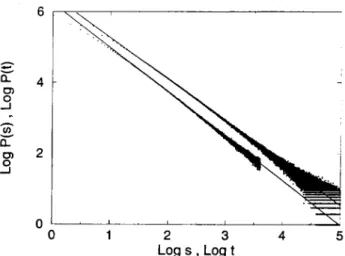
Figure 3. Log-log plot of the distributions P(s) and P(t)
IV Numerical results for
avalanche spreading
When the system is tuned to its critical value, it devel-ops avalanches obeying a power-law distribution. We will characterise the avalanche activity through two quantities, its spatial and temporal duration distribu-tions:
P(s) s ,
s P(t) t
,t (19)
We have measured these avalanche distributions in both models. The simulation results are given in Table II. Fig. 3 shows (for a particular case, = 0:3, in the PCD model) a log-log plot of the distributions of space and time avalanche duration. The exponents obtained from the slopes of data points in this particular case are,
s = 1
:1930:010 and t = 1
:2560:010. The values are in very good agreement with the ones ob-tained through the scaling laws, and using the values of the non-universal spreading critical exponents (see Table II), we get
s= 1
:184 and t= 1
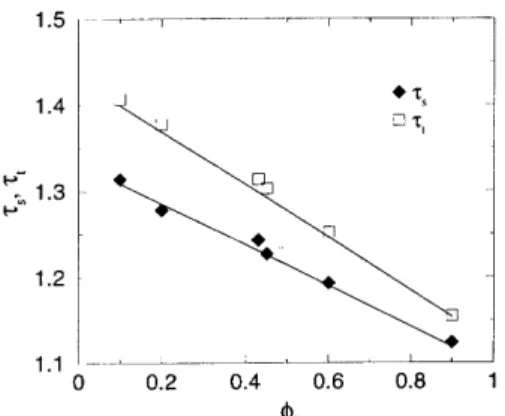
:239. In Fig. 4 we plot the values for
sand
tfor dierent values ofin the PCD model. The lines correspond to the exponents obtained from the scaling laws.
From the previous studies we got the p
c value for each model. In order to study avalanches we prepare the system in the initial state with some density of par-ticles andp=p
c, then through the evolution of a single perturbation (adding a \critical" particle at the middle site) we will measure the propagation of this damage through the system. It will aect a certain number of sites - this is the avalanche size - and also has a certain lifetime - this is the time duration of the avalanche. In order to have a good precision in the avalanche expo-nents it is necessary to use a large number of trials (we used 210
7).
Figure 4. Avalanche exponentssandt versus initial
den-sityin the PCD model.
V Conclusion
We reviewed some topics related to models with in-nitely many absorbing states (namely, the PCD and TTP), and have presented some new results for avalanche spreading. The numerical values obtained by from Monte Carlo simulations are in good agree-ment with those obtained from scaling analysis. The models studied here belong to two dierent universality classes (DP and PC). The nonuniversal spreading expo-nents previously observed in models with INAS, when the initial conguration diers from the \natural" one, are also seen in the exponents that characterise both spatial and temporal distributions of avalanches.
This work was supported in part by PRAXIS XXI (Project /2/2.1/Fis/299/94) and NATO (Grant CRG-970332). I would like to thank R. Dickman, S.N. Doro-govtsev, M. Henkel, H. Herrmann, E.J.S. Lage, M.C. Marques, G. Odor and M.A. Santos for many usefull discussions, and from whom I have learned a lot. I would like to thank M.A Santos and M.C. Marques for a critical reading of the manuscript.
Exponents 0 0
s t
DP 0.1597(3) 0.312(2) 1.108 1.159
PC 0.285(2) 0.000(1) 1.222 1.285
initial
Parity Conserving Dimer(PCD)
0.05 0.400(6) -0.106(5) 1.313(10) 1.407(10) 0.10 0.366(6) -0.069(5) 1.278(10) 1.385(10) 0.215 0.291(6) 0.005(5) 1.243(10) 1.318(10) 0.225 0.284(6) 0.014(5) 1.227(10) 1.303(10) 0.30 0.239(6) 0.062(5) 1.193(10) 1.256(10) 0.45 0.156(6) 0.154(5) 1.124(10) 1.169(10)
Threshold Transfer Procces(TTP)
0.75 0.136(1) 0.347(4) 1.093(10) 1.14(2) 0.69 0.161(2) 0.319(3) 1.121(10) 1.17(2) 0.50 0.227(2) 0.246(2) 1.157(10) 1.20(2) 0.10 0.371(4) 0.097(1) 1.254(10) 1.37(2) TABLE II. -dependence of the critical exponents 0, 0 for spreading, and of
s and t, for the extent and duration of
[1] Percolation Structures and Processes, edited by G. Deutscher, R. Zallen, and J. Adler, Ann. Israel Soc.5 (Hilger,Bristol,1983).
[2] T.M. Liggett, Interacting Particle Systems, (Springer-Verlag, New York, 1985).
[3] J. Marro and R. Dickman, Nonequilibrium phase tran-sitions in lattice models (Cambridge University Press, Cambridge, 1999).
[4] P. Grassberger, J. Phys. A22, 3673 (1989).
[5] R. Dickman, Phys. Rev. B40, 7005 (1989).
[6] R. Dickman, Phys. Rev. A42, 6985 (1990).
[7] E. Domany and W. Kinzel, Phys. Rev. Lett. 53, 31
(1984).
[8] D. Stauer and A. Aharony,Introduction to Percolation Theory(Taylor & Francis, London, 1992).
[9] J. L. Cardy and R. L. Sugar, J. Phys. A13, L423 (1980).
[10] I. Jensen, H. C. Fogedby, and R. Dickman, Phys. Rev. A41, 3411 (1990).
[11] G. Grinstein, Z. W. Lai, and D. A. Browne, Phys. Rev. A40, 4820 (1989).
[12] Braodbent and Hammersley, Proc. Camb. Philos. Soc.
53, 629 (1957)
[13] J. Blease, J. Phys. C10, 923 (1977)
[14] J. W. Essam and K. De'Bell, J. Phys. A 14, L459
(1981)
[15] W. Kinzel, Z. Physik B58, 229 (1985).
[16] R. Bidaux, N. Boccara, H. Chate, Phys. Rev. A39,
3094 (1989).
[17] D. ben-Avraham, J. Kohler, J. Stat. Phys. 65, 839
(1991).
[18] H. Takayasu, A. Yu. Tretyakov, Phys. Rev. Lett.68,
3060 (1992).
[19] T. E. Harris, Ann. Prob.2, 969 (1974).
[20] R. Dickman, J. Stat. Phys.55, 997 (1989).
[21] I. Jensen, Phys. Rev. A43, 3187 (1991).
[22] R.M. Zi, E. Gulari, Y. Barshad, Phys. Rev. Lett.56,
2553 (1986).
[23] M. Alon, M. R. Evans, H. Hinrichsen and D. Mukamel, Phys. Rev. Lett.76, 2746 (1996).
[24] S. Maslov, M. Paczuski and P. Bak, Europhys. Lett.
27, 97 (1994).
[25] H. K. Jenssen, Z. Phys. B42, 151 (1981)
[26] P. Grassberger, Z. Phys. B47, 365 (1982).
[27] G. Grinstein, C. Jayaprakash and Y. Hu, Phys. Rev. Lett.55, 2527 (1985).
[28] P. Grassberger, F. Krause, T. von der Twer, J. Phys. A17, L105 (1984).
[29] P. Grassberger, J. Phys. A , L1103 (1984).
[30] I. Jensen, Phys. Rev. Lett.70, 1465 (1993), I. Jensen,
Phys. Rev. E427, R1 (1993).
[31] M. A. Mu~noz, G. Grinstein, R. Dickman and R. Livi, Phys. Rev. Lett.76, 451 (1996)
[32] A. Lipowski, cond-mat/9910029; A. Lipowski and M. Loparta, Phys. Rev. E60, 1516 (1999).
[33] G. Parisi and N. Sourlas, Phys. Rev. Lett. 43, 744
(1979).
[34] R. Dickman, A. Vespignani, S. Zapperi, Phys. Rev. E
57, 5095 (1998).
[35] A. Vespignani, R. Dickman, M.A. Mu~noz and S. Zap-peri, Phys. Rev. Lett81, 5676 (1998).
[36] P. Bak, C. Tang and Weisenfeld, Phys. Rev. Lett.59,
381 (1987).
[37] R. Dickman, M. Mu~noz and A. Vespignani, S. Zapperi. This volume.
[38] S.S. Manna, J. Phys. A24, L363 (1991).
[39] B. Drossel, Phys. Rev. Lett.76, 936 (1996).
[40] I. Jensen, R. Dickman, Phys. Rev. E48, 1710(1993).
[41] M.C. Marques and J.F.F. Mendes, Eur. Phys. J. B12,
123 (1999).
[42] J.F.F. Mendes, R. Dickman, M. Henkel, M.C. Marques, J. Phys. A27, 3019 (1994).
[43] P. Grassberger and de la Torre, Ann. Phys. 122, 373
(1979).
[44] J.F.F. Mendes, Phd thesis (1994).
[45] M. A. Mu~noz, G. Grinstein and R. Dickman, J. Stat. Phys.91, 541 (1998)
[46] R. Dickman, Phys. Rev. E53, 2223 (1996).
[47] G. Odor, J.F.F. Mendes, M.A. Santos, M.C. Marques, Phys. Rev. E58, 7020 (1998)
[48] V. N. Gribov, Sov. Phys. JETP26, 414 (1968)
[49] P. Grassberger and K. Sundermeyer, Phys. Lett. B77,
220 (1978).
[50] R. C. Brower, M. A. Furman and M. Moshe, Phys. Lett. B76, 213 (1978).
[51] C. Lopez and M.A. Mu~noz, Phys. Rev. E 56, 4864
(1997).
[52] N. Inui and A. Yu Tretyakov, Phys. Rev. Lett.80, 5148
(1998).
[53] Mann Ho Kim, Hyunggyu Park, Phys. Rev. Lett. 73,
2579 (1994); Heungwon Park, Mann Ho Kim, Hyunggyu Park, Phys. Rev. E52, 5664 (1995).
[54] I. Jensen, Phys. Rev. E50, 3623 (1994).
[55] R. Dickman, cond.mat/9909347.
![TABLE I. Rules for the TTP model, and the respective rate processes[44].](https://thumb-eu.123doks.com/thumbv2/123dok_br/18979055.456355/3.918.499.809.463.636/table-i-rules-ttp-model-respective-rate-processes.webp)