www.bjorl.org
Brazilian
Journal
of
OTORHINOLARYNGOLOGY
ORIGINAL
ARTICLE
Free
Field
Word
recognition
test
in
the
presence
of
noise
in
normal
hearing
adults
夽
Gleide
Viviani
Maciel
Almeida
a,∗,
Angela
Ribas
a,
Jorge
Calleros
baUniversidadeTuiutidoParaná(UTP),ProgramadeMestradoeDoutoradoemDistúrbiosdaComunicac¸ão,Curitiba,PR,Brazil bLaboratóriodeAcústicaeEquipamentosAudiológicos,Curitiba,PR,Brazil
Received22April2016;accepted29August2016 Availableonline27September2016
KEYWORDS
Auditoryperception; Hearingtests; Noise; Hearing
Abstract
Introduction:Inideallisteningsituations,subjectswithnormalhearingcaneasilyunderstand speech,ascanmanysubjectswhohaveahearingloss.
Objective: TopresentthevalidationoftheWordRecognitionTestinaFreeFieldinthePresence ofNoiseinnormal-hearingadults.
Methods:Sampleconsisted of100healthyadultsover18 yearsofagewith normalhearing. Afterpuretoneaudiometry,aspeechrecognitiontestwasappliedinfreefieldconditionwith monosyllablesanddisyllables,withstandardizedmaterialinthreelisteningsituations:optimal listeningcondition(nonoise),withasignaltonoiseratioof0dBandasignaltonoiseratioof −10dB.Forthesetests,anenvironmentincalibratedfreefieldwas arrangedwherespeech waspresentedtothesubjectbeingtestedfromtwospeakerslocatedat45◦,andnoisefroma
thirdspeaker,locatedat180◦.
Results:Allparticipantshadspeechaudiometryresultsinthefreefieldbetween88%and100% inthethreelisteningsituations.
Conclusion: WordRecognitionTestinFreeFieldinthePresenceofNoiseprovedtobeeasyto beorganizedandapplied.Theresultsofthetestvalidationsuggestthatindividualswithnormal hearingshouldgetbetween88%and100%ofthestimulicorrect.Thetestcanbeanimportant toolinmeasuringnoiseinterferenceonthespeechperceptionabilities.
© 2016 Associac¸˜ao Brasileira de Otorrinolaringologia e Cirurgia C´ervico-Facial. Published by Elsevier Editora Ltda. This is an open access article under the CC BY license (http:// creativecommons.org/licenses/by/4.0/).
夽 Pleasecitethisarticleas:AlmeidaGV,RibasA,CallerosJ.FreeFieldWordrecognitiontestinthepresenceofnoiseinnormalhearing
adults.BrazJOtorhinolaryngol.2017;83:665---9.
∗Correspondingauthor.
E-mail:[email protected](G.V.Almeida).
PeerReviewundertheresponsibilityofAssociac¸ãoBrasileiradeOtorrinolaringologiaeCirurgiaCérvico-Facial.
http://dx.doi.org/10.1016/j.bjorl.2016.08.015
PALAVRAS-CHAVE
Percepc¸ãoauditiva; Testesauditivos; Ruído;
Audic¸ão
Testedereconhecimentodepalavrasemcampolivrenapresenc¸aderuído
emindivíduosadultosnormo-ouvintes
Resumo
Introduc¸ão:Emsituac¸õesideaisdeescuta,indivíduoscomaudic¸ãonormalconseguemrealizar ereconhecerafalafacilmente.Porém,napresenc¸aderuídocompetitivo,écomumaspessoas sentiremdificuldadesdecompreensão,principalmentesetiveremperdaauditiva.
Objetivo:Apresentaravalidac¸ãodotestedereconhecimentodepalavrasemcampolivrena presenc¸adoruídoemindivíduosadultosnormo-ouvintes.
Método: A amostra foi composta por 100 sujeitos hígidos, com audic¸ão normal e maiores de18anos.Depois daaudiometriatonalfoiaplicadotestedereconhecimentodafala,com monossílabos edissílabos,em campolivre,commaterialpadronizado, emtrêssituac¸õesde escuta:condic¸ãoótimadeaudic¸ão(semruído),comruídoemrelac¸ãode0dB,ecomruídoem relac¸ãode-10dB.Paratanto,montou-seumambientedetesteemcampolivrecalibrado,onde afalafoiapresentadaao indivíduoemtestecomduascaixasacústicaslocalizadasa45◦ eo
ruídoemumaterceira,localizadaa180◦.
Resultados: Todososparticipantestiveramresultadosdelogoaudiometriaemcampolivreentre 88e100%nastrêssituac¸õesdeescuta.
Conclusão:O teste de reconhecimento de palavras em campo livre na presenc¸a do ruído mostrou-se de fácil organizac¸ão e aplicac¸ão. Os resultados obtidos na validac¸ão do teste sugeremqueindivíduoscomaudic¸ãonormaldevemacertarentre88e100%dosestímulos apre-sentados.Otestepodeconfiguraruminstrumentoimportantenamensurac¸ãodainterferência doruídosobreashabilidadesdepercepc¸ãodefala.
© 2016 Associac¸˜ao Brasileira de Otorrinolaringologia e Cirurgia C´ervico-Facial. Publicado por Elsevier Editora Ltda. Este ´e um artigo Open Access sob uma licenc¸a CC BY (http:// creativecommons.org/licenses/by/4.0/).
Introduction
Tounderstandspeechsatisfactorily,someauditorytasksare necessary,including:attention,analysis,synthesis,memory, amongothers. Suchskills,when combined,promote audi-toryrecognition,whichimpliesderivingmeaningfromwhat isheard.Thus,theunderstandingofspeechisavery com-plexactivitythatdependsdirectlyontheperipheralhearing mechanisms,centralauditoryprocessingandcognition.1
Inideallisteningsituations,thatis,acoustically comfort-ableenvironments, individuals with normalhearing easily canperformthe auditoryrecognition. However,whenthe environmentisdegraded, duetothecompetitivenoise or reverberation,2 it iscommonfor people tohave difficulty understanding.
Inindividualswithhearinglossandhearingaidusers (con-ventionalorimplantable)thisdifficultyisgreater.3,4
Among other uses, the speech perception test in the presenceofnoisehasbeendevelopedandusedin audiolog-icaldiagnosis5toevaluatecentralauditoryprocessing1and toselect and evaluate the performance of hearing aids.6 Mostavailable tests use supra-aural headphones or insert earphones1;aminorityareperformedinafreefieldsetting.7 Someofthesetestsrequireexpensivetechnological appara-tusthatcanmakeitlessavailableforuseinroutinespeech therapy.
Becauseofthis,alow-cost,easytoinstallaudiology lab-oratorywasdesigned,consistingofanacousticallytreated boothandafreefieldsystemattachedtothreespeakers,to performspeechrecognitiontestinginthepresenceofnoise.
Theaimofthispaperistopresentthevalidationofthe FreeFieldWordRecognitionTestinthePresenceofNoisein normal-hearingindividuals.
Methods
Thisisanexperimental,self-controlledstudy,aimedto ver-ify the accuracy of the Free Field Word Recognition Test in the Presenceof Noise. The study wasapproved by the InstitutionalEthicsCommitteeunderprotocol937031/15.
Onehundredindividualswhoagreedtoparticipatewere randomly selected. All of them were oriented about the studyandsignedtheInformedConsent.
Thestudyincludedpersons18yearsofageorgreateron thedateofthetests,whohadnormalhearingandnohearing complaints.Weexcludedindividualswithspeechproblems. For data collection a booth, a two-channel audiome-ter,conventionalopenfieldequipment(forspeechstimulus output)andauxiliaryequipment(fornoiseemission)were used.
Theequipment
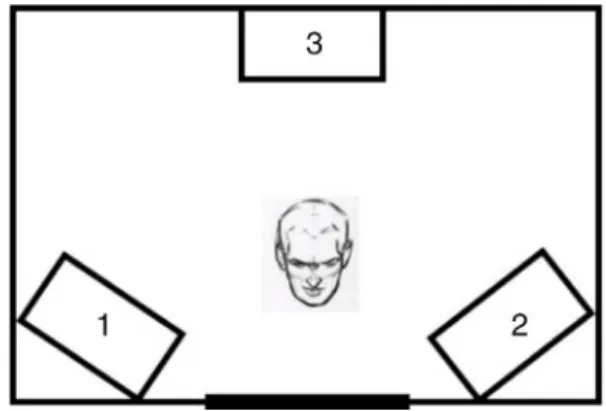
Figure1 Positioningofspeakersinsidethebooth.1---speaker at45◦ontheleft;2---speakerat45◦ontheright;3---speaker
at180◦withnoise.
steps,andfullrangeof0---100dBSPL,50-W class-Tdigital poweramplifier,PIC18F2550MICROCHIP microcontroller,a 2-linesby20charactersDisplay,andakeyboard.
Thesystemoperationallowstheadjustmentofthe exter-nal sound source, which in this project was a Samsung mobile,withanSG(SoundGenerator)application;the appli-cation was set to generate(broadband) white noise. The professionalcancalibratethe correctsignallevel usedby the‘‘calibration mode’’of the equipmentbyviewing the signalonthedisplay,andadjustingitto‘‘0dB’’ontheVU. Onceadjusted,thesignalcanbedisplayedintheselected intensityoftheattenuatorthroughthestimulusbuttonthat turnsthepresentationofthisnoiseonoroff.
Test environment consisted of twospeakers locatedat 45◦ (rightandleftoftheevaluatedsubject)andnoiseina thirdone,located180◦ fromthesubjectfromwhere com-petitivenoiseisproduced(Fig.1).
The conventional free field used is Oto Sonic CL30-V model, with noseries number, calibrated onOctober 17, 2013,withcertificateNo.415-2013F,accordingto ISO8253-3andIEC645-2:1993,thestandardsusedforcalibrationwere Larson Davis Sound Pressure Meter, Mod. 824, series No. 824A2867(CertificateNo.50381/2013),LarsonDavisSound Calibrator, mod.CAL250, seriesno.4128 (CertificateNo. 50378/2013), Larson Davis Microphone, Mod. 2575, series no.1698(CertificateNo.50379/2013).
The ‘‘thirdchannel’’equipmentwascalibrated onJuly 31, 2014, with certificate no. 425a-2014-F, according to ISO8253-3 andIEC645-2:1993, thestandardsusedfor cali-brationwereBruel &KjaerSoundLevelMeter,Mod.2250, series No. 3006245 (Certificate No. CBR1400264/2014), Bruel & Kjaer Acoustic Calibrator, mod. 4231, series No. 3007539 (Certificate No. CBR1400268/2014) and Larson Davis Microphone, Mod. 2575,series no.2119 (Certificate No.60381/2014).
Datacollection
After completing a form of identification, all research subjects underwent pure tone audiometry to determine theauditorythresholds.Thosewithhearingwithinnormal limits8weresubmittedtothespeechrecognitiontest,using standardizedandrecordedmaterial.9
Therecognitiontestwasappliedinthreesituations:
1. Monosyllabic wordlists presented without competitive noise(control);
2. Monosyllabicwordlistspresentedinsignal/noiseratioof 0dB(study);
3. Monosyllabicwordlistspresentedinsignal/noiseratioof
−10dB(study).
Thewordlistswerepresentedat40dBNS,or40dBabove the mean tritone levelspreviously obtained in pure tone audiometry. In the signal/noise ratio of 0dB, speechand noise were presented at the same intensity. With a sig-nal/noiseratioof−10dB,thenoisewas10dBstrongerthan
speech.Thespeechwaspresentedintheconventionalfree fieldsystems(speakers at 45◦) andthe competitive noise waspresentedatthe‘‘thirdchannel’’(180◦).
Data were recorded in a special record protocol, and werestatisticallyanalyzed.Weusedthechi-squaretestat the0.05significancelevel.
The following variables were analyzed and compared: test results withno noise (control) withtest results with noiseat0dBand−10dBratio(study).
After this, the study subjects were divided into two groups:G1---peopleunder40yearsofage,andG2---people with40.1yearsormore,anddatawerecomparedtoseeif thescoresvariedwithincreasingage.
Results
Onehundred normal-hearing subjects were evaluated for purposesofthisstudy,83beingfemalesand17males.The minimumageofthesamplewas19yearsandthemaximum 64 years.The mean age was34.1 years, with a standard deviationof10.8.
Giventhestandarddeviationfound,andtoverifyifage factor interfered with the results of auditory perception, thesample wasdivided intotwo groups, G1composed of 72individualsunder40yearsandG2formedby28subjects over40.1years.
Allsubjectsofthesampledemonstratedfreefieldspeech recognitionscoresbetween88%and100%accuracy onthe threelisteningconditions(Table1).
Speech perception performance obtained in the Free FieldWord RecognitionTest in the Presenceof Noise was comparedbetweenthetwogroups(Table2).Therewasno statisticallysignificantdifference.
Discussion
Theability tounderstand speechin thepresence of com-petitive noise is the object of the study of audiology,10 becauseitisanimportantphenomenonthatgreatly inter-feres inpeople’s quality of life,especially thosewho are usersofconventionalorimplantablehearingaids.11,12 Asso-ciatedwiththisresearch,theuseofstandardized(recorded) materialhasbeendeveloped13,14toensurethereliabilityof results,afactthatisstrictlyfollowedinthisstudy.
Table1 Descriptivestatisticsofspeechperceptionwithnonoiseandwithcompetitivenoise.
Conditions n Mean Median Minimum Maximum Standarddeviation
Nonoise 100 99.96 100.00 96.00 100.00 0.40
Withnoise0dB 100 98.28 100.00 92.00 100.00 2.22
Withnoise−10dB 100 96.04 96.00 92.00 100.00 3.03
Table2 ComparisonofG1andG2means.
Variable G1above40years G2over40.1years p
n Mean Standarddeviation n Mean Standarddeviation
Speechwithnonoise 72 99.9 0.47 28 100.0 0.00 0.5356
Speechwithnoise0dB 72 98.2 2.22 28 98.4 2.27 0.6787
Speechwithnoise−10dB 72 96.3 3.10 28 95.4 2.82 0.2106
significant difference when considering the three varia-bles(listening conditions),withthescores obtained being virtually identical, ranging from 99.96---96.4%. In normal-hearing individuals, between 88% and 100% accuracy is expected in speech recognition tests in optimal listening environment.9,13,15
Whentherespondentsweredividedintotwosubgroups (Table2)fortheinvestigationoftheagefactoronthetest,it wasobservedthattheanswerswerealsosimilar,withno sig-nificant differencesbetween them. The literature10,11,16,17 indicatedthatwithage,auditoryprocessingtendstobe dif-ficultduetoseveralfactors,butthiswasnottheobjectof thisstudy.
Normally,thebroad spectrumnoisetendstohinderthe task of auditory discrimination because speech consists of sounds of differentfrequencies thathave continuously varying intensities,18 and these sound characteristics can be masked by noise, and result in important perceptual confusions.19Indifficultlisteningconditions,cognitive over-loadcanoccur,resultinginsignificantfrustrationtoboththe listenersandthespeakers,andgreater languageskills are neededtoimprovespeechperception, thatis also associ-atedwiththeincreaseofintensityload.20
Thecompetingnoiseproposedinourtestwaspresented atanangleof180◦,inaccordancewithBrazilianresearch21 onspeechrecognitionthresholdsinnormal-hearing individ-uals in the presence of noise that demonstrated that in freefieldcondition,thebestthresholdsareachievedwith incidence angles of 0◦---90◦ and 0◦---270◦, followed by the condition0◦---180◦and,finally,0◦---0◦.Itisnoteworthythatin thedailylifeenvironmentsthenoiseandspeechfallon peo-plefromdifferentangles,butatestthatreproducesthese conditionsis not feasible in the speechtherapy practice, duetocostandtime.
Itisnoteworthythat,inaudiologyclinics,itisextremely importanttoestablishreferencevaluesobtainedin normal-hearingsubjectsinorderthatthedifficultiesencounteredby theindividualwithhearingdisordercomplaintscanbe com-pared.Consideringthefindingsreportedinthisstudy,values between 90% and 100% accuracy can be inferred as nor-malstandardoftheFreeFieldWordRecognitionTestinthe PresenceofNoiseinsubjectswithnohearingcomplaints.
The test proposed here consisted of a low-cost, easy to install system that provided reliable results that were consistent with the literature. It can be a valuable tool in the investigation of auditory processing, selection and indication of hearing aids, as well as in the evaluation of performance of patients usingsound amplification and implantable prostheses,and can provide a frameworkfor researchandtestingofdifferentpopulationsinthefuture.
Conclusion
The Free Field Word Recognition Test in the Presence of Noiseprovedtobeeasytoorganizeandapply.Theresultsof thetestvalidationsuggestthatsubjectswithnormalhearing shouldgetbetween90%and100%ofthestimulipresented correct,eveninthepresenceofnoise.Thetestcanbean important toolin measuringnoise interference onspeech perceptionskillsindifferentpopulations.
Conflicts
of
interest
Theauthorsdeclarenoconflictsofinterest.
References
1.Anderson S, White-Schwoch T, Parbery-Clark A, Kraus N. A dynamic auditory-cognitive system supports speech-in-noise perceptioninolderadults.HearRes.2013;300:18---32. 2.Santos JF, Seligman L, Tochetto TM. Conforto acústico na
percepc¸ãodeescolaresalfabetizados.RevSocBrasFonoaudiol. 2012;17:254---9.
3.PlackCJ,BarkerD,PrendergastG.Perceptualconsequencesof hiddenhearingloss.TrendsHear.2014;18:1---11.
4.OxenhamAJ,KreftHA.Speechperceptionintonesandnoise viacochlearimplantsrevealsinfluenceofspectralresolution ontemporalprocessing.TrendsHear.2014;18:1---18.
5.ArietaAM,CoutoCM,CostaEA.Testedepercepc¸ãodafalaHINT Brasilemgruposdesujeitosexpostosenãoexpostosaruído ocupacional.RevCEFAC.2013;15:786---95.
individual com microfone direcional. Audiol Commun Res. 2014;19:124---9.
7.SbompatoAF,CortelettiLCB,MoretALM,JacobRTS.Hearingin noisetestBrasil:padronizac¸ãoemcampolivre---adultoscom audic¸ãonormal.BrazJOtorhinolaryngol.2015;81:384---8. 8.CFFA.ManualdeProcedimentosemAudiologia.Brasília:
Con-selhoFederaldeFonoaudiologia;2013.
9.RibasA. Logoaudiometria: utilizandomaterial padronizadoe gravadonaavaliac¸ãodapercepc¸ãoauditivadafala.Curitiba: UTP;2009.
10.Fiorini AC, Passos PS, Souza LAP. A importância do sistema auditivoecognitivonapercepc¸ãodafalanoruídoemidosos. DistúrbiosComun.2014;26:840---2.
11.GomesMVSG,MagalhãesATM.Índicedereconhecimentodafala napresbiacusia.IntArchOtorhinolaryngol.2007;11:169---74. 12.Iorio MCM, Zaboni ZC. Reconhecimento de fala no nível de
máximoconfortoempacientesadultoscomperdaauditiva neu-rossensorial.RevSocBrasFonoaudiol.2009;1:112---54. 13.Costa-Garisco LP, Fernandes DGD, Sousa PC. Estudos do
reconhecimentodafalanasperdasauditivasneurossensoriais descendentes.RevCEFAC.2014;16:792---7.
14.DuqueP,Garcia-MorenoJM,Soria-UriosG.Música ycerebro: evidenciascerebralesdelentrenamientomusical.RevNeurol. 2011;53:739---46.
15.Russo ICP, SantosMTM. A prática da audiologia clínica. São Paulo:Cortez;2005.
16.Bortnem LEM, Seara IC. Diferenc¸as de parâmetros acústicos e perceptuais de voz entre sujeitos idosos e jovens com intensidade normal e alta. Rev Acta Otorrinolaringol Esp. 2014;49:95---105.
17.LavieL, Banai K,AttiasJ, KarniA.How difficultis difficult? Speechperceptioninnoiseintheelderlyhearingimpaired.J BasicClinPhysiolPharmacol.2014;25:313---6.
18.Russo ICM, PereiraLD, CarvalloRMM,Anastásio ART. Encam-inhamentos sobre a classificac¸ão do grau de perda auditiva em nossa realidade. Rev Soc Bras Fonoaudiol. 2009;14: 287---8.
19.LemosSMA,Rothe-NevesR,SantosLM.Confusõesperceptivas entreconsoantesdoportuguêsbrasileiroemfunc¸ãodoruído. AudiolCommun.2014;19:145---52.
20.Zekveld AA, Kramer SE, Festen JM. Cognitive load during speech perception in noise: the influence of age, hearing loss,andcognitiononthepupilresponse. EarHear.2011;32: 498---510.