Research conducted as part of the dissertation for completion of the Professional Master’s Degree in Speech-Language Pathology and Audiology, Universidade Veiga de Almeida – UVA – Rio de Janeiro (RJ), Brazil.
(1) Program for Moderate Complexity Hearing Health Care, Waldyr Franco Municipal Health Center (Centro Municipal de Saúde Waldyr Franco), Municipal Health Authority of Rio de Janeiro (Secretaria Municipal de Saúde do Rio de Janeiro), Rio de Janeiro (RJ), Brazil.
(2) Speech-Language Pathology and Audiology Course, Universidade Federal do Rio de Janeiro – UFRJ – Rio de Janeiro (RJ), Brazil. Conflict of interests: None
Author’s contributions:GGOM performed the data collection and wrote the manuscript; SF directed the research.
Correspondence adress: Giselle Goulart de Oliveira Matos. Núcleo de Estudos da Saúde do Adolescente (NESA/UERJ). Av. Boulevard 28 de Setembro, 109, Vila Isabel, Rio de Janeiro (RJ), Brazil, CEP: 20551-030. E-mail: [email protected]
Received: 8/29/2011; Accepted: 2/14/2013
Temporal resolution in sensorineural hearing loss
Resolução temporal em perdas auditivas sensorioneurais
Giselle Goulart de Oliveira Matos1, Silvana Frota2
ABSTRACT
Purpose: To evaluate temporal resolution in adults with mild and mo-derate sensorineural hearing loss using the Gaps in Noise (GIN) test to determine whether these losses affect the test performance. Methods: Fifty-seven patients between 20 and 59 years of age (30 men and 27 women) were evaluated; these patients had a complete medical history taken and underwent ENT examination, basic audiological evaluation, and auditory screening via the dichotic digits test. The subjects were divided into three groups: G1 (normal hearing), G2 (mild hearing loss), and G3 (moderate hearing loss). The appropriate statistical analysis was performed, and the adopted level of significance was 5%. Results: A significant proportion of men was observed in the group with hearing loss. There were no significant differences in test performance between the groups. However, the control group’s performance was worse than the normality criteria set for young Brazilian adults. The mean gap detection threshold for the total sample was 8.2 ms in both ears, and the mean percentage of correct responses was 49.7% for the right ear (RE) and 50.6% for the left ear (LE). Conclusion: The temporal resolution evaluated by the GIN test was not influenced by mild-to-moderate sen-sorineural hearing loss either in the gap detection thresholds or in the percentage of correct responses for both ears.
Keywords: Hearing; Hearing loss; Auditory perception; Auditory per-ceptual disorders; Acoustic stimulation; Hearing tests; Adult
RESUMO
Objetivo: Avaliar a resolução temporal em adultos com perdas auditivas sensorioneurais de graus leve e moderado, por meio do teste Gaps in Noise (GIN), a fim de verificar se essas perdas influenciam no desempe-nho do teste. Métodos: Foram avaliados 57 pacientes, com idades entre 20 e 59 anos (30 homens e 27 mulheres), que realizaram anamnese, ava-liação otorrinolaringológica, avaava-liação audiológica básica e triagem do processamento auditivo, com o teste Dicótico de Dígitos. Os sujeitos fo-ram alocados nosgrupos G1 (audição normal), G2 (perda auditiva leve) e G3 (perda moderada). Foi realizada análise estatística apropriada e o nível de significância adotado foi de 5%. Resultados: Observou-se pre-sença significativa de homens no grupo com perda auditiva. Não foram encontradas diferenças significativas no desempenho do referido teste entre os grupos. Porém, no grupo controle, foram observados piores de-sempenhos, quando comparados com o critério de normalidade previsto para adultos jovens brasileiros. A média do limiar de detecção de gaps, da amostra geral, foi de 8,2 ms, em ambas as orelhas, e a média das por-centagens de acertos foi de 49,7% para a orelha direita (OD) e de 50,6% para a orelha esquerda (OE). Conclusão: A habilidade de resolução temporal avaliada pelo teste GIN não sofre influência da perda auditiva sensorioneural de graus leve e moderado, tanto nos limiares de detecção de gaps quanto na porcentagem de acertos, em ambas as orelhas.
INTRODUCTION
Hearing integrity is necessary to ensure adequate perception of speech sounds so that stimuli can reach the central nervous system. It is believed that hearing disorders involve two aspects: 1) hearing loss, characterized by the impaired detection of sound energy; and 2) auditory processing disorders, which are hearing disorders characterized by the impaired analysis and/ or interpretation of sound patterns(1). An auditory processing
disorder is a deficiency in one or more of the mechanisms and processes of the auditory system that are responsible for behavioral phenomena, such as sound localization and latera-lization; auditory discrimination; auditory pattern recognition; temporal aspects of audition, including temporal resolution, temporal masking, temporal integration and temporal orde-ring; and auditory performance with competing and degraded acoustic signals(2).
Temporal processing refers to the perception of sound cha-racteristics and their changes within a time interval(3). Temporal
resolution refers to the minimum time required to segregate or resolve acoustic events(4). Because temporal resolution is
closely related to speech intelligibility(5,6), which is a complex
acoustic signal that is rich in both spectral and temporal cha-racteristics(7,8), and because hearing-impaired individuals may
complain of not being able to understand speech(9), we may
hypothesize that temporal resolution is impaired in auditory deficiency. In a recent investigation(10), this ability was
demons-trated to be influenced by sensorineural hearing loss. However, a question arose in that study as to whether the influence was due to hearing loss or to aging, as there was a significant diffe-rence in the age of each group, which indicated the necessity of conducting similar research on cochlear hearing loss in a younger group.
Therefore, the objective of the present study was to evalu-ate the temporal resolution in adults with mild and moderevalu-ate sensorineural hearing loss, using the Gaps in Noise (GIN) test to determine whether these losses affect the test performance.
METHODS
This study was approved by the Research Ethics Committee of the Municipal Health and Civil Defense Authority of Rio de Janeiro (Secretaria Municipal de Saúde e Defesa Civil do Rio de Janeiro - RJ-SMSDC CEP), protocol no 204/09. Each
participant was informed about the purpose of the study and began the trial after agreeing to participate and signing the informed consent form.
Data collection was performed at Centro Municipal de Saúde Waldyr Franco (CMSWF), which is a moderate--complexity unit of the Program for Hearing Health Care of the City of Rio de Janeiro, between the months of February and August 2010.
The following materials were used: a Danplex® DA 65
audiometer, an Interacoustics® AT 235h Immittanciometer; a Potenza® CD playerconnected to the audiometer; and CDs for the dichotic digits test(11) and GIN test(3).
The present investigation was a prospective, cross-sectional cohort study that (at the end of the selection process) included 57 individuals of both genders: 30 (52.6%) men and 27 (47.4%) women. The 57 subjects were distributed into the following three groups: G1, consisting of 22 individuals (38.6%) with normal hearing; G2, consisting of 17 individuals (29.8%) with mild hearing loss; and G3, consisting of 18 individuals (31.6%) with moderate hearing loss. The subjects’ ages ranged from 20 to 59 years, with a mean age of 45.4 (±9.6) years. The group with normal hearing was matched with individuals in both hearing loss groups. The selection of groups of individuals with hearing loss was made according to convenience, due to the difficulty of gathering the sample.
All of the subjects underwent a selection process that consisted of a medical history, ENT examination, basic audiological evaluation, and auditory screening using the dichotic digits test.
To arrive at the final sample, the following subjects were excluded based on the medical history: individuals outside the defined age range, illiterate individuals who regularly practiced music, individuals with associated neurological diseases or di-sorders, individuals having used psychotropic drugs within the 12 months preceding the survey, and individuals with a history of ear disease or surgery. Based on the ENT evaluation, sub-jects with external and middle ear and/or mastoid involvement were excluded. Based on the basic audiological evaluation, the following patients were excluded: individuals with conductive and mixed hearing losses, individuals with differences between the RE and LE thresholds at each frequency greater than 20 dB HL, individuals with tritonal averages above 55 dB HL, indi-viduals with a percentage index of speech recognition (PISR) below 92% (for normal hearing) and less than 80% (for mild and moderate hearing losses)(12), individuals with a type B or
C tympanometric curve, and individuals with no contralateral acoustic reflex in at least two of the four tested frequencies. Based on the central auditory processing evaluation, in which we chose to screen using the dichotic digits test, subjects who had a percentage score of less than 95% in each ear were also excluded(13).
Tritonal means (TM) of 500/1000/2000 Hz were used with air thresholds of 3000/4000/6000 Hz(14) to define the degree of
normality or the degree of hearing loss. If there were different TMs in the same ear, then the degree of loss was defined as the greater mean. To define the individual’s degree of hearing loss as the difference between the degree of RE hearing loss and the degree of LE hearing loss, criteria were adopted similar to those described above, i.e., the degree was defined based on the worse ear.
The GIN test(15) was applied under conditions of monaural
presentation, at 50 dB SL above the TM of 500/1000/2000 Hz. To eliminate the ear variable at the beginning of the test, 29 subjects (50.8% of the sample) began testing with the RE, and 28 indi-viduals (49.12%) began testing with the LE. A practice run was conducted, and each subject was given guidance or clarification if there were uncertainties concerning the achievement of the proposed task. The perceived gapswere counted and recorded according to their durations. The gap detection threshold was considered to be the shorter gap perceived in at least 67% of the presentations, i.e., four times, as each gap appeared six times per test. The percentage of total correct responses above the threshold was defined for each test, based on the 60 existing gaps. A mean threshold of 5.43 ms and a mean percentage of correct responses of 67.25% have been proposed as normality criteria for young Brazilian adults with normal hearing(16).
The presence of two false positives (false intervals of silence that are designated by the subject) was counted as an error, thereby deducting a correct response from the percentage of total correct responses without affecting determination of the threshold(3).
Mann-Whitney, Kruskal-Wallis ANOVA, Student’s t-test, One-way ANOVA, and Chi-squared tests were used for the sta-tistical analysis. Nonparametric tests were applied because the variables did not exhibit a normal distribution (Gaussian) due to scattering, lack of distribution symmetry, the rejection of the normality hypothesis according to the Kolmogorov-Smirnov test, and/or the small sample size in some of the groups. A significance level of 5% was adopted.
RESULTS
There were no significant differences between the mean ages of the groups with normal hearing and hearing loss (43.5 years, with a standard deviation [SD] of ± 7.7 years, and 46.6
years, with SD ± 10.5 years, respectively, p=0.23), verified by Student t-test for independent samples. Similarly, there were no significant differences between the groups with normal hearing, mild hearing loss, and moderate hearing loss (43.5 years, with SD ± 7.7 years; 45.9 years, with SD ± 11.3 years; and 47.3 years, with SD ± 10.0 years, respectively, p=0.45), analyzed by one-way ANOVA. Theχ2 test revealed that the groups with hearing losses (G2+G3) had a significantly higher proportion of men (p=0.051) than did the group with normal hearing, and there was no significant difference (p=0.078) in the proportion of males in G1 (36.4%), G2 (52.9%), and G3 (72.2%).
No significant difference existed in the gap detection thresholds between individuals who began testing with the RE and individuals who began with the LE. The χ2 test revealed
no significant difference (p=0.35) in the proportion of men among the subgroups that began with the RE (58.6%) versus
the LE (46.4%).
The results are presented as the means of gap detection thresholds and the mean percentage of correct responses, as these were the independent variables.
Table 1 presents the measures of central tendency of the GIN test for the 57 evaluated patients. Table 2 presents the measures of central tendency according to the group: G1 versus G2+G3, G1 versus G2 versus G3, and the corresponding descriptive levels (p values) of the statistical tests.
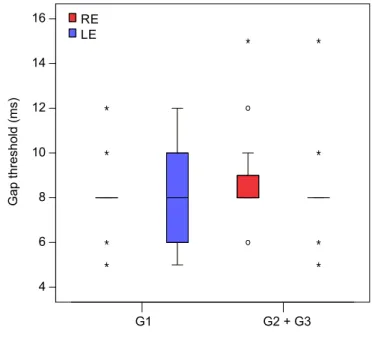
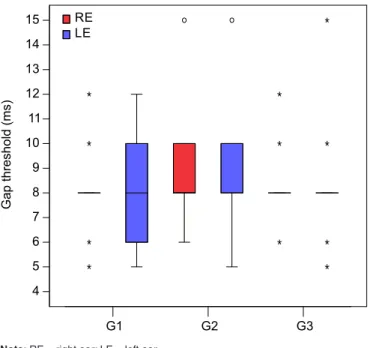
There was no significant difference in the GIN test measures between the groups with normal hearing (G1) and hearing loss (G2 + G3), as illustrated in Figures 1 and 2, or between groups G1, G2, and G3, as illustrated in Figures 3 and 4.
Figure 5 depicts the gap recognition performance of each group and of the total sample.
DISCUSSION
The present study was based on the analysis of 641
Chart 1. Groups selected for the study procedure and their respective degrees of hearing
Groups n Degree of hearing
G1 22 Normal Both TM ≤ 25 dB HL
G2 17 Mild loss At least one TM between 26 – 40 dB HL G3 18 Moderate loss At least one TM between 41 – 55 dB HL G2 + G3 35 Group with loss ******************
Note: G1 = Group 1; G2 = Group 2; G3 = Group 3; TM = tritonal mean
Table 1. General description of the gap detection threshold means and correct response percentages, by ear, using the GIN test
Variable Ear Mean SD Median Minimum Maximum
GIN
Threshold (ms) Right 8.2 1.6 8 5 15
Left 8.2 2.0 8 5 15
% correct Right 49.7 8.2 51.6 23.3 63.3
Left 50.6 8.6 51.6 23.3 75
evaluation forms for patients enrolled in the Program for Hearing Health Care at CMSWF. It was extremely difficult to collect the sample. The small number of patients in the mild and moderate hearing-loss groups was due to the rigorous nature of the inclusion criteria, such as age, absence of asymmetries between the ears, presence of an acoustic reflex in at least two of the four frequencies tested and as a result of auditory pro-cessing screening using the dichotic digits test(13).
After obtaining the patient’s medical history and conduc-ting an ENT examination and an audiological evaluation, 66 patients were selected. However, of these, nine subjects were
excluded as a result of the dichotic digits test. Despite the fact that the dichotic digits test does not evaluate the entire central auditory nervous system but only evaluates dichotic listening with binaural integration(11), this test was nonetheless chosen
for auditory screening because the evaluation is widely used and described for this purpose(16,17). Changes in central auditory
processing in dichotic listening interfere with the performance of temporal resolution(18,19).
The lack of statistical significance between the mean ages of
Table 2. Gap thresholds and percentage of correct responses, by group, for the GIN test
Variable
GIN
Threshold (ms) Correct (%) Right
ear
Left ear
Right ear
Left ear
G1 (n=22)
Mean 7.8 8 51.3 52.7 SD 1.4 1.8 8.7 9.3
Med 8 8 51.6 52.5
Min 5 5 28.3 33.3
Max 12 12 63.3 75
G2+G3 (n=35)
Mean 8.5 8.3 48.7 49.2
SD 1.7 2.1 7.9 8
Med 8 8 51.6 50
Min 6 5 23.3 23.3
Max 15 15 58.3 63.3 p-valueª 0.085 0.73 0.28 0.22
G1 (n=22)
Mean 7.8 8 51.3 52.7 SD 1.4 1.8 8.7 9.3
Med 8 8 51.6 52.5
Min 5 5 28.3 33.3
Max 12 12 63.3 75
G2 (n=17)
Mean 8.8 8.6 47.7 48.7
SD 2 2.2 8 8.4
Med 8 8 50 50
Min 6 5 23.3 23.3
Max 15 15 58.3 58.3
G3 (n=18)
Mean 8.2 8.1 49.7 49.7
SD 1.4 2 7.8 7.7
Med 8 8 52.5 50
Min 6 5 26.6 26.6
Max 12 15 58.3 63.3 p-valueb 0.15 0.59 0.33 0.46 aMann-Whitney test (p>0.05)
b Kruskal-Wallis ANOVA (p>0.05)
Note: SD = standard deviation; Med = median; Min = minimum; Max = maximum; G1 = normal hearing group; G2 = mild loss group; G3 = moderate loss group; G2 + G3 = loss group
Note: RE = right ear; LE = left ear
Figure 1. Gap detection thresholds for the right and left ear in the normal-hearing (G1) and hearing-loss (G2+G3) groups
Note: RE = right ear; LE = left ear
the groups eliminated age bias, which could have compromised the sample analysis(10).
The overall sample was homogeneous as to gender. The significantly higher proportion of men in the groupwith he-aring loss may be attributed to two factors: first, this study was conducted with adults of working age, in whom there is a higher incidence of male subjects with hearing loss induced by high sound pressure level (HSPLIHL)(20); second, there was
participation by military personnel complaining of HSPLIHL, who reported not using proper protection during shooting activities(21).
The GIN test revealed a low incidence of false positives, which did not alter the final percentage of correct responses. This test was applied monaurally, although research has indi-cated that there are no differences between the performance of the RE and LE(10,17,22,23) due to the involvement of ipsilateral
and contralateral pathways. Such differences were not found in our study (Table 1).
Based on the GIN test performance of the normal-hearing group, our control group, which showed mean gap detection thresholds of 7.8 ms in the RE and 8 ms in the LE and a per-centage of correct responses of 51.3% in the RE and 52.7% in the LE, the mean gap detection threshold in both ears was longer, and the percentage of correct responses was lower than the normality criterion for young Brazilian adults with normal hearing(16). Our findings also differed from the previously
repor-ted results(3,22). In a study comparing the GIN test performance
in individuals with normal hearing and with neurological im-pairment of the central auditory nervous system(3), gap detection
thresholds of 4.8 ms for the RE and 4.9 ms for the LE were found in the control group for subjects aged 13 to 43 years, with a mean age of 24.6 years. In a study comparing the performance of GIN tests and Random Gap Detection Tests (RGDT) in a group of adults aged 18 to 29 years(22),thresholds of 5.38 ms
were found for the RE and 4.88 ms for the LE. However, in the latter study, because the research was performed with men enrolled in a music therapy course, the results might have been influenced by the training on musical instruments, as musical perception cues are located within the temporal processing field(24), and this auditory experience might have modified the
sensory coding(25,26). In our study, musical training was one of
the exclusion criteria in the medical history.
Despite awareness of the possible influence of age on performance in temporal processing tests(10,27-29), it was not
Note: RE = right ear; LE = left ear
Figure 3. Gap detection thresholds in the right and left ears of the normal-hearing (G1), mild-loss (G2), and moderate-loss (G3) groups
Note: RE = right ear; LE = left ear
Figure 4. Percentage of gaps perceived in the right and left ears of the normal-hearing (G1), mild-loss (G2), and moderate-loss (G3) groups
Note: G1 = normal hearing group; G2 = mild loss group; G3 = moderate loss group
possible to allocate younger individuals to the control group because the groups had to be matched for age and it was extremely difficult to find young people with hearing losses appropriate for the sensorineural loss groups (i.e., G2 and G3). In our control group of 22 participants, 16 subjects were older than 40 years (72.7%), and of these, eight subjects were older than 49 years (50%).
The mean age (45.4 years) in the present investigations was higher than the mean age in the studies that determined shorter gap detection thresholds and higher percentages of correct responses. This fact created problems in comparing the values found because no reference values existed for this age group. Despite the lower mean age, our results were similar to those of the control group from another study, in which the mean age was 67.3 years. In that investigation, mean gap detection thresholds of 7.3 ms for the RE and 7.7 ms for the LE were observed, and there were 57.6% correct responses for the RE and 55.8% for the LE(10).
Because of this intermediate mean of ages with no refe-rence values, we recommend additional studies that would divide the groups by decades to better monitor performance in this regard. Our suggestion is based on research that has revealed an age-related decrease in response speed(27) and
duration(28). Did performance change in this group due to the
age factor? If so, this fact may be a possible reason for our findings, in addition to possible changes in central auditory processing that were not evident because our screening was only conducted using the dichotic digits test, which evaluates only dichotic listening via binaural integration rather than evaluating the entire central auditory nervous system(11), as
mentioned above.
Figure 5 reveals that, up to an interval of 4 ms, the gap recognition percentage was less than 10%. After 10 ms, the recognition percentage began to surpass 90%. However, it was only after 12 ms that all of the groups obtained a recognition percentage above 90%. The performance for each gap interval did not differ between the groups and the overall sample.
No significant differences were found between the group with normal hearing and the group with hearing loss or between the group with normal hearing and the groups with different degrees of hearing loss, regarding either the gap detection threshold or the percentage of correct responses (Table 2). There was no variation in the test performance, as evidenced by p values above the significance level for this study. The temporal resolution, as evaluated by the GIN test, was not affected by mild-to-moderate sensorineural hearing loss. These findings agree with studies that have demonstrated no influence of hearing loss on this ability(28,29). However, the audiometric
configurations found in the groups with hearing loss were mostly descending, with greater involvement of high frequen-cies. Thus, we hypothesize that audiometric configurations worse than those found in this study, with involvement of low frequencies, may negatively influence the level of temporal
resolution. Ideally, additional investigations of temporal re-solution in sensorineural hearing loss should be conducted with larger samples and various audiometric configurations to explain the hearing-impaired population’s difficulties in understanding speech.
Temporal resolution appears to be more closely related to aging than to hearing loss(28), which may be associated with a
decreased perception speed processed by the auditory cortex(27).
The study of elderly individuals(10) did not clarify whether the
decrease in GIN test performance was influenced by hearing loss or by aging, as each group had a significantly increased mean age, compared with the previous group. Based on this discussion, we conclude that the decrease in GIN test perfor-mance is due to aging(28).
Certain complaints of difficulty hearing or of singing the same melody as the one heard are caused not by hearing loss but rather by decreased ability to temporally process the acoustic cues heard(30).
The results of the present investigation appear to contradict studies that designate temporal resolution as critical for spe-ech intelligibility. However, we must analyze the suggestions described and conduct additional research to further clarify these findings.
CONCLUSION
In the present study, the temporal resolution, as evaluated by the GIN test, was not influenced by mild-to-moderate sensori-neural hearing loss either in terms of gap detection thresholds or in the percentage of correct responses for both ears. However, one must consider that the control group individuals only received a dichotic digits test and, thus, might have had some type of auditory processing disorder.
ACKNOWLEDGEMENTS
Special thanks to the management and employees of Waldyr Franco Municipal Health Center for their collaboration in the data collection for this research project.
REFERENCES
1. Pereira LD, Cavadas M. Processamento auditivo central. In: Frota S (Org.). Fundamentos em Fonoaudiologia: audiologia. 2ª. ed. Rio de Janeiro: Guanabara Koogan, 2003. p.135-60.
2. ASHA: American Speech-Language-Hearing Association. Central Auditory Processing: current status and implications for clinical practice. Am J Audiol. 1996;5(2):41-54.
3. Musiek FE, Shinn JB, Jirsa R, Bamiou DE, Baran JA, Zaida E. The GIN (Gaps in Noise) test performance in subjects with confirmed central auditory nervous system involvement. Ear Hear. 2005Dec;26(6):608-18.
5. Eggermont JJ. Neural responses in primary auditory cortex mimic psychophysical, across-frequency-channel, gap-detection thresholds. J Neurophysiol. 2000Sep;84(3):1453-63.
6. Abrams DA, Kraus N. Auditory pathway representations of speech sounds in humans. Trends Neurosci. 2008Jun; 28(4):611-26. 7. Wible B, Kraus N, NicoI T. Correlation between brainstem and
cortical auditory processes in normal and language-impaired children. Brain. 2005Fev;128(2):417-23.
8. Johnson KL, Nicol T, Zecker SG, Bradlow AR, Skoe E, Kraus N. Brainsten encoding of voiced consonant-vowel stop syllables. Clin Neurophysiol 2008Nov;119(11):2623-35.
9. Alvarez AMMA, Ballen S, Misorelli MIL. Processamento auditivo central: proposta de avaliação e diagnóstico diferencial. In: Munhoz MSL, Silva MLG, Caovilla HH. Audiologia clínica. São Paulo: Atheneu, 2000. p.103-20
10. Liporaci FD, Frota SMMC. Resolução temporal auditiva em idosos. Rev Soc Bras Fonoaudiol. 2010Dez;15(4):533-39.
11. Santos MFC, Pereira LD. Escuta com Dígitos. In: Pereira LD. Schochat E. (Org.) Processamento auditivo: manual de avaliação. São Paulo: Lovise, 1997.
12. Wilson RH, Strouse AL. Audiometria com estímulos de fala. In: Musiek FE, Rintelmann NF. Perspectivas atuais em avaliação auditiva. São Paulo: Manole, 2001. p.21-54
13. Santos MFC. Processamento auditivo central: teste dicótico de dígitos em crianças e adultos normais [dissertação]. São Paulo: Escola Paulista de Medicina, Universidade Federal de São Paulo, 1998.
14. Lloyd LL, Kaplan H. Audiometric interpretation: a manual o basic audiometry. University Park Press: Baltimore, 1978.
15. Musiek FE, Zaidan EP, Baran JA, Shinn JB, Jirsa RE. Assessing temporal processes in adults with LD: the GIN test. Proceedings of the 2004 Convention of American Academy of Audiology, Salt Lake City; march-april 2004. p. 203.
16. Samelli AG, schochat E. The gaps in noise test: Gap detection thresholds in normal-hearing yong adults. Int J Audiol. 2008May; 47(5):238-45.
17. Perez AP, Pereira LD. O teste Gap in Noise em crianças de 11 e 12 anos. Pro Fono. 2010Mar;22(1):7-12.
18. Ziliotto K, Pereira LD. Random gap detection test in subjects with and without APD. In: 17th American Academy of Audiology – Annual Convention and Exposition. Washington, DC; 2005. p. 30. 19. Balen SA, Bretzke L, Mottecy CM, Liebel G, Boeno MRM, Gondim
LMA. Resolução temporal de crianças: comparação entre audição normal, perda auditiva condutiva e distúrbio do processamento auditivo. Rev Bras Otorrinolaringol. 2009Jan-Fev;75(1):123-9. 20. Leão RN, Dias FAM. Perfil audiométrico de indivíduos expostos
ao ruído atendidos no núcleo de saúde ocupacional de um hospital do município de Montes Claros, Minas Gerais. Rev CEFAC. 2010Abr;12(2):242-9.
21. Neves EB, Soalheiro MA. A proteção auditiva utilizada pelos militares do Exército Brasileiro: há efetividade? Ciênc Saúde Coletiva Rio de Janeiro. 2010May;15(3).
22. Zaidan E, Garcia AP, Tedesco MLF, Baran, JA. Desempenho de adultos jovens normais em dois testes de resolução temporal. Pro Fono. 2008Jan-Mar;20(1):19-24.
23. Samelli AG, Schochat E. Estudo da vantagem da orelha direita em teste de detecção de gap. Rev Bras Otorrinolaringol. 2008;74(2):234-40.
24. Buonomano DV, Karvakar UR. How do we tell time? Neuroscientist. 2002Feb;8(1):42-51.
25. Wong PC, Parsons LM, Martinez M, Diehl RL. The role of the insular cortex in pitch pattern perception: the effect of linguistic contexts. J Neurosci. 2004Out;24(41):9153-60.
26. Gil D. Treinamento auditivo formal em adultos com deficiência auditiva [tese]. São Paulo: Universidade de São Paulo, 2006. p.185. 27. Mendelson JR, Riccketts C. Age-related temporal processing speed
deterioration in auditory cortex. Hear Res. 2001Aug;158(1-2):84-94. 28. Roberts RA, Lister JJ. Effects of age and hearing loss on gap
detection and the precedence effect: broadband stimuli. J Speech Lang Hear Res. 2004Oct;47(5):965-78.
29. Queiroz DS, Branco-Barreiro FCA, Momensohn-Santos TM. Desempenho no teste de detecção de intervalo aleatório – Random Gap Detection Test (RGDT): estudo comparativo entre mulheres jovens e idosas. Rev Soc Bras Fonoaudiol. 2009;14(3):503-7. 30. Ishii C, Arashiro PM, Pereira LD. Ordenação e resolução temporal