404
Brazilian Journalof otorhinolaryngology 79 (3) May/June 2013 http://www.bjorl.org / e-mail: [email protected]
Sialadenoma papilliferum of the tongue mimicking a malignant tumor
Jean Nunes dos Santos
1, Adna Conceição Barros
2, Clarissa Araújo Gurgel
3, Luciana Maria Pedreira Ramalho
41 PhD in Oral Pathology (Associate Professor).
2 MSc in Odontology at the Federal University of Bahia (PhD student, Odontology, Federal University of Bahia). 3 PhD in Pathology (Adjunct Professor at the Federal University of Bahia).
4 PhD in Stomatology (Associate Professor at the Federal University of Bahia). Federal University of Bahia. Surgical Pathology Lab - Denistry School.
Send correspondence to: Jean Nunes dos Santos. Faculdade de Odontologia - UFBA. Av. Araújo Pinho, nº 62. Canela. Salvador - BA. Brazil. CEP: 40110-150. Tel: (71) 3283-9019. Fax: (71) 3283-8962. E-mail: [email protected]
Paper submited to the BJORL-SGP (Publishing Management System - Brazilian Journal of Otorhinolaryngology) on May 3, 2012; and accepted on August 4, 2012. cod. 9186.
CASE REPORT
Braz J Otorhinolaryngol. 2013;79(3):404.
BJORL
Keywords:
mouth; salivary gland neoplasms; tongue neoplasms.
.org
INTRODUCTION
Sialadenoma papilliferum is a rare tumor of the salivary gland described for the first time by Abrams & Finck in 19691. It is histologically similar
to syringocystadenoma papilliferum2. The origin of
this tumor is yet unclear, although reports indicate it appears to stem from myoepithelial cells1, blocked
glandular ducts resulting in hyperplasia3, metaplastic
phenomena4, intercalated duct cells5, or excretory
duct cells6.
Sialadenoma papilliferum often involves the palate6, and only one case has been reported
to date in Portuguese2. This case report discusses
the clinical and pathological findings of a patient with minor salivary gland sialadenoma papilliferum of the tongue.
CASE REPORT
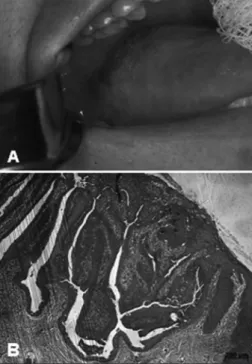
A 32-year-old brown female patient came to the stomatology clinic complaining of a painless lump in the back of her tongue that had been evolving for a year. Physical examination showed an exophytic irregular lesion, with a dis-cretely papillomatous surface located in the right posterior lateral border of the tongue measuring approximately 1.0 x 1.0 cm (Figure 1A). The pa-tient said she did not smoke or drink alcohol, and in neck palpation no suspicious nodes were felt. Incisional biopsy was done as she was suspected to have a squamous cell carcinoma. Pathology tests showed presence of superficial ulcerations on the mucosa covered with parakeratinized stra-tified squamous epithelium parallel to endophytic growth of papilliferous squamous epithelium supported by connective tissue with significant inflammation. The base of the tumor presented a transition from papilliferous squamous epithelium to columnar duct epithelium covering prolifera-ting ductal elements, which had cuboidal basal cells and overlying columnar cells, in addition to mucocytes (Figure 1B).
Ductal, at times branching, elements and small cystic spaces at the depth of the tumor were present. Histopathology diagnosis was consistent with sialadenoma papilliferum of the tongue. Despite the scarcity of material, immunohistochemistry tests were run using cytokeratins 7, 13, and 14 applied in an polymer amplification system (EnvisionTM, Dako
Cytomation). Cytokine 13 was strongly labeled. The tumor was completely removed, although the biopsy report described partial removal of the lesion. The
patient has been followed for almost two years without signs of recurrent disease.
DISCUSSION
The patient’s tumor involved the lateral posterior border of the tongue. Sialadenoma papilli-ferum in this location has not been reported in the literature, except for one case described by Liu et al.2 from which arose a mucoepidermoid carcinoma.
Therefore, this is a quite rare site for oral involve-ment, once the palate is the preferential location of this tumor type6.
In clinical terms, the tumor had an irregular, discretely papillomatous surface, which led to the consideration of squamous cell carcinoma. However, histology tests ruled out this suspicion, despite the squamous differentiation and papilliferous aspect of the tumor, at times seen in squamous cell carci-nomas. Our patient had a tumor with endophytic growth, papilliferous squamous epithelium, with
visible transition between papilliferous epithelium and proliferative ductal epithelium with cuboidal cells, columnar cells and mucocytes. Therefore, the morphological aspects described were consistent with sialadenoma papilliferum1,2,5,6. It is worth
re-membering that exophytic growth2,6 and
inflamma-tion2,6 have also been associated with sialadenoma
papilliferum. Immunohistochemistry findings were consistent with the origin of the tumor being the glandular excretory ducts, as confirmed by tests labeled for CK136. This is why care must be taken
in the differential diagnosis against mucoepidermoid carcinoma and ductal papilloma.
The patient’s tumor was completely remo-ved, and she has been free of disease for almost two years without signs of recurrence, as similarly reported by Liu et al.2.
CLOSING REMARKS
The diagnosis of sialadenoma papilliferum requires careful examination, as tumors of the tongue may be malignant, and benign tongue tumors of the tongue may mimic malignant disease.
REFERENCES
1. Abrams AM, Finck FM. Sialadenoma papillife-rum. A previously unreported salivary gland tu-mor. Cancer. 1969;24(5):1057-63. http://dx.doi. org/10.1002/1097-0142(196911)24:5<1057::AID--CNCR2820240529>3.0.CO;2-L
2. Liu W, Gnepp DR, de Vries E, Bibawy H, Solomon M, Gloster ES. Mucoepidermoid carcinoma arising in a background of sialadenoma papilliferum: a case report. Head Neck Pathol. 2009;3(1):59-62. http:// dx.doi.org/10.1007/s12105-009-0106-5 PMid:20596992 PMCid:2807533
3. Eversole LR, Sabes WR. Minor salivary gland duct changes due to obstruction. Arch Otolaryngol. 1971;94(1):19-24. http://dx.doi.org/10.1001/archo-tol.1971.00770070055004
4. Testa Riva F, Riva A, Puxeddu P. Ciliated cells in the main excretory duct of the submandibular gland in obstructive sialadenitis: a SEM and TEM study. Ultrastruct Pathol. 1987;11(1):1-10. http://dx.doi. org/10.3109/01913128709023177 PMid:3824561 5. Nakahata A, Deguchi H, Yanagawa T, Yoshida H,
Sato M, Hayashi Y. Coexpression of intermediate-sized filaments in sialadenoma papilliferum and other salivary gland neoplasms. J Oral Pathol Med. 1990;19(7):313-8. http://dx.doi.org/10.1111/j.1600-0714.1990.tb00851.x PMid:1700116
6. Gomes AP, Sobral AP, Loducca SV, de Araújo VC. Sialadenoma papilliferum: immunohistochemical study. Int J Oral Maxillofac Surg. 2004;33(6):621-4. http:// dx.doi.org/10.1016/j.ijom.2003.10.019 PMid:15308267