Graziella Nuernberg Back Brito(a) Aline Cássia Inocêncio(a)
Sílvia Maria Rodrigues Querido(a) Antonio Olavo Cardoso Jorge(a) Cristiane Yumi Koga-Ito(a)
(a)Department of Biosciences and Oral Diagnosis, São José dos Campos Dental School, UNESP, Univ Estadual Paulista, SP, Brazil.
Corresponding author: Cristiane Yumi Koga-Ito
Av. Engenheiro Francisco José Longo, 777 - Jd. São Dimas
São José dos Campos - SP - Brazil CEP: 12245-000
E-mail: [email protected]
Received for publication on Jul 15, 2010 Accepted for publication on Sep 27, 2010
In vitro
antifungal susceptibility of
Candida
spp. oral isolates from
HIV-positive patients and control individuals
Abstract: Oropharyngeal candidiasis is the most common fungal infec-tion among HIV-positive patients. This condiinfec-tion can be treated with either systemic or topical antifungal agents; treatments are usually in-dicated empirically on the basis of clinical data. The knowledge of in vitro antifungal susceptibility is important to determine correct thera-peutic guides for the treatment of fungal infections. Therefore, the objec-tive of this study was to determine the antifungal susceptibility proile of oral Candida isolates from HIV-positive patients and control individu-als. Amphotericin B, luconazole, lucytosine, nystatin and ketoconazole were tested according to the methodology of microdilution proposed by the Clinical and Laboratory Standards Institute (CLSI); results were re-corded in values of minimal inhibitory concentration (MIC). A total of 71 Candida isolates from HIV-positive patients were examined with the following species represented: C. albicans (59), C. tropicalis (9), C. gla-brata (1), C. guilliermondii (1) and C. krusei (1). A total of 15 Candida
isolates were evaluated from control individuals comprised of 11 C. albi-cans and 4 C. tropicalis samples. Our results demonstrated that the test-ed antifungal agents showtest-ed good activity for most isolates from both groups; however, variability in MIC values among isolates was observed.
Descriptors: HIV; Antifungal Agents; Candida.
Introduction
HIV-positive patients appears to be correlated to the severity of immunological disfunction.5,6 The occur-rence of oral candidosis at initial stages of AIDS is common, particularly when the CD4 T cell count is low (400-700 cells/mm³).5
The widespread use of antifungal agents to pre-vent the occurrence of oral candidosis in HIV-in-fected patients has been cited as an important factor for the positive selection of non-albicans species as opportunistic pathogens; these species have differ-ent susceptibilities to the antifungal agdiffer-ents utilized to treat C. albicans.7 Certain non-albicans spe-cies, such as C. glabrata and C. krusei, are inher-ently less susceptible to luconazole than C. albicans
and have been isolated with increasing frequency in HIV-infected patients.7,8,9,10,11
The increasing resistance to antifungal treat-ments and expanding drug therapy options has prompted the need for clinically relevant antifun-gal susceptibility testing; these results could act as a guide in the selection and control of antifungal therapy. For this purpose, the Clinical and Labora-tory Standards Institute (CLSI) proposed a reference method for yeast antifungal susceptibility testing us-ing serial dilutions and obtained values of minimal inhibitory concentration.12,13,14
Fluconazole is considered to be the drug of choice for the treatment of most common HIV-associated opportunistic yeast infections.14,15 It has been the most widely used drug because of its good absorption, low toxicity and ability to be adminis-tered through both oral and intravenous routes.16 Fluconazole resistance is associated with prolonged exposure to azoles.14,17 Further, in 2002 Espinel-In-groff18 reported an association between the in vitro resistance of Candida to luconazole and clinical failure in the treatment of candidosis. Ketoconazole is the irst drug of the azole class of agents capable of achieving therapeutic blood levels when adminis-tered orally. While ketoconazole is used to treat im-munocompromised patients, its adverse side effects, including nausea and hepatotoxicity, has restricted its use.19 However, despite the toxicity, it shows sev-eral adverse drug interactions, disabling its use in association with some drugs, including antiretrovi-rals.16 The antifungal drug amphotericin B decreases
the adherence of Candida to buccal epithelial cells and can interfere in the pathogenesis of candidosis. The use of amphotericin B in dentistry is common; it is indicated for the treatment of supericial candi-dosis cases and is used locally. The systemic use is generally indicated for the treatment of disseminat-ed cases and is highly toxic to the patient, causing kidney disorders.16 The antifungal drug lucytosine has better gastrointestinal absorption compared to amphotericin B. However, lucytosine also has tox-icity, negatively impacting metabolic and liver func-tion.19
Based on this information, it can be observed that all antifungals have “pros and cons” when used in the treatment of candidosis. Thus, the evaluation of the susceptibility proile of oral Candida isolates is important in determining the proper method of treatment in candidosis. The objective of this study was to determine the antifungal susceptibility pro-ile of oral Candida isolates from HIV-positive pa-tients and control individuals.
Materials and Methods
Oral rinses and dental bioilm samples were col-lected from HIV-positive patients and control indi-viduals. The isolates were identiied by germ tube test, hyphae/pseudohyphae, chlamydospore for-mation, assimilation and fermentation of carbohy-drates as previously described20 (Local Ethics Com-mittee 012-PH/CEP).
In total, 59 C. albicans, 9 C. tropicalis, 1 C. glabrata, 1 C. guilliermondii and 1 C. krusei iso-lates from HIV-positive patients and 11 C. albicans
and 4 C. tropicalis isolates from control individuals were evaluated.
The antifungal agents tested were: amphoteri-cin B (Sigma Chemical Company, St. Louis, USA), luconazole (Galena Chemical and Farmacêutica, São Paulo, Brazil), ketoconazole (Galena Chemi-cal and Farmacêutica, São Paulo, Brazil), nystatin (Galena Chemical and Farmacêutica, São Paulo, Brazil) and lucytosine (Sigma Chemical Company, St. Louis, USA). Amphotericin B and ketoconazole were dissolved in dimethylsulfoxide (Sigma, Irvine, United Kingdom). The other antifungal agents were dissolved in sterile distilled water. The drugs were prepared at the following concentrations: 320 µg/ ml for amphotericin B, 1000 µg/ml for lucytosine, 1250 µg/ml for luconazole, and 640 µg/ml for ke-toconazole. The solutions were diluted in RPMI me-dium and inal drug concentrations ranged from 64 to 0.03 µg/ml. Antifungal susceptibility was deter-mined by the microdilution method in 96-well mi-croplates as described by the CLSI.21 An aliquot of 100 µL of the inal concentration of antifungal drug and 100 µL of the inoculum test sample were added to each well. The plates were incubated at 37°C and readings were performed after 48 h. The plates with amphotericin B were covered with aluminum foil to protect against light. Result readings were based on the visual scale of turbidity of control tubes repre-sented by: 0 (completely clear), 1 (slightly cloudy), 2
(intermediate turbidity), 3 (prominent turbidity) and 4 (completely cloudy).
For the members of the azole drug class and lu-cytosine, the MIC were deined as the lowest drug concentration that resulted in 80% growth inhibi-tion. For amphotericin B, this value was deined as the value in which 100% growth inhibition was ob-served.
The results are expressed as ranges of minimum
and maximum MIC values and the values of MIC50
and MIC90. These values represent the drug concen-tration that inhibits the growth of 50% and 90% of the isolates, respectively. C. parapsilosis ATCC 22019 was used as a reference for quality control in all the experiments.
The endpoints for luconazole, lucytosine and ketoconazole considered for the classiication of the isolates followed the values of the CLSI21 represent-ed in Table 1. There were no CLSI endpoints deinrepresent-ed for amphotericin B and nystatin.
Results
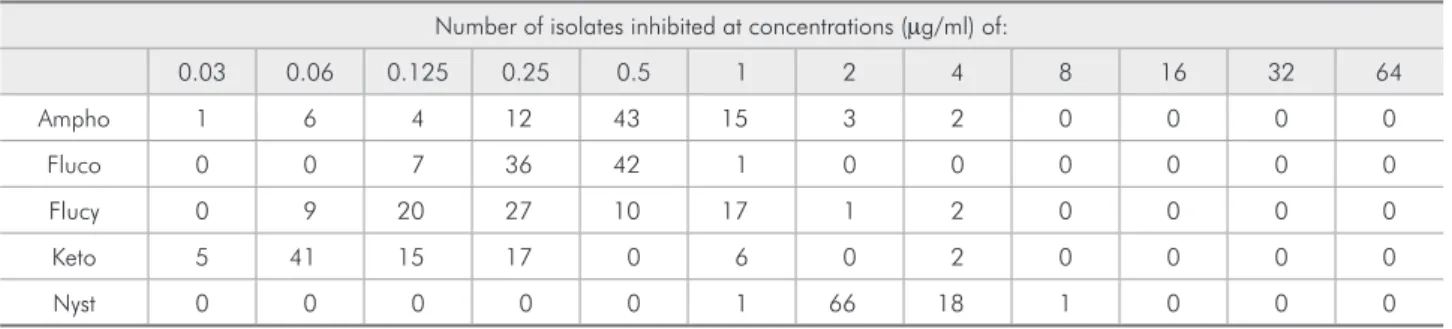
The number of isolates from both studied groups according to the MIC value for each tested drug is displayed in Table 2.
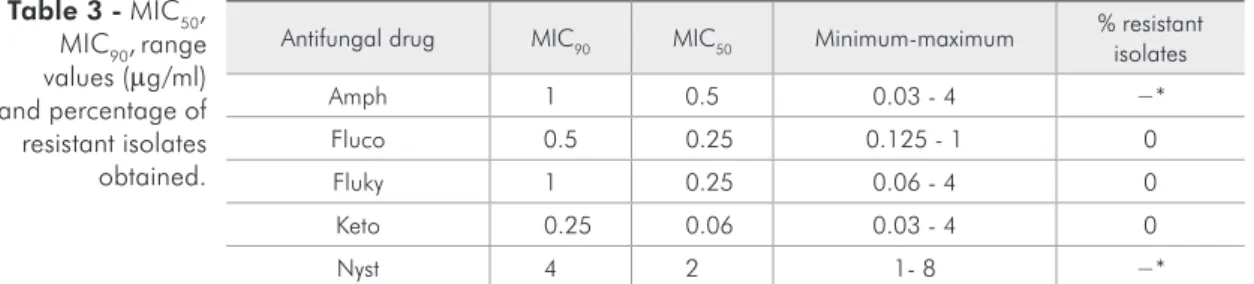
The results obtained for Candida isolates to the drugs tested are presented in Table 3. The values are
Antifungal agents Susceptible S-DD Intermediate Resistant
Fluconazole ≥ 8 16 - 32 − ≥ 64
Flucytosine ≤ 4 − 8 - 16 ≥ 32
Ketoconazole ≤ 8 − - > 16
S-DD: susceptible dose-dependent. Table 1 - Endpoints for
fluconazole, flucytosine and ketoconazole (µg/m).
Table 2 - Distribution of Candida spp. according to the MIC of each antifungal agent tested.
Number of isolates inhibited at concentrations (µg/ml) of:
0.03 0.06 0.125 0.25 0.5 1 2 4 8 16 32 64
Ampho 1 6 4 12 43 15 3 2 0 0 0 0
Fluco 0 0 7 36 42 1 0 0 0 0 0 0
Flucy 0 9 20 27 10 17 1 2 0 0 0 0
Keto 5 41 15 17 0 6 0 2 0 0 0 0
Nyst 0 0 0 0 0 1 66 18 1 0 0 0
expressed as ranges of MICs, as well as MIC50 and MIC90 values. The MIC ranges for all the isolates from the control and HIV-infected groups indicate susceptibility to luconazole, lucytosine and keto-conazole.
The distribution of the species isolates of each group according to the range concentration of the drugs studies is shown in Table 4.
Discussion
Despite the increasing number of commercially available antifungal drugs in recent years, antifun-gals are still at a disadvantage when compared to antibacterial drugs. Resistance to antifungal drugs also represents a great clinical challenge. Given the dificulties observed in the treatment of fungal in-fections in some groups of patients, isolation of the causative infectious agent and identiication of the susceptibility proile of the yeast isolate are recom-mended. In this context, screening studies for anti-fungal resistance are of the utmost importance.
The incidence of clinical luconazole resistance
varies in the literature from 5 - 15%.14 Lyon et al.22 observed that 90% of C. albicans, C. parapsilosis
and C. tropicalis isolates were inhibited by lucon-azole at a concentration of 2.0 µg/ml; further, there was no difference between the samples obtained from denture wearers and from patients with natural teeth. However, in C. glabrata isolates, the MIC90 value reached 8 µg/ml for samples obtained from denture wearers. Interestingly, this study found that all C. krusei isolates were resistant. These results contrast with our indings; we found all isolates to be susceptible to luconazole.
For ketoconazole, all isolates were susceptible in both groups; isolates from HIV-infected patients showed MIC values between 0.03 - 4.0 µg/ml while the MIC values ranged from 0.03 - 0.25 µg/ml for the isolates from control patients. Ketoconazole has been used in the treatment of supericial infections in dentistry patients. However, its use in dentistry is predominately restricted to local administration, as systemic treatment can be highly toxic to the pa-tient.23 Similar values for azoles have been reported, Table 4 - Values of MIC range (µg/ml) for Candida spp. according to antifungal drug.
Species N MIC range
amph fluco flucy keto nyst
HIV-infected group
C. albicans 59 0.06 - 4 0.125 - 1 0.06 - 4 0.03 - 4 1 - 8
C. glabrata 1 0.5 0.5 2 0.25 2
C. guilliermondii 1 0.125 0.25 0.125 0.03 4
C. krusei 1 0.5 0.25 0.125 0.03 4
C. tropicalis 9 0.03 - 0.5 0.25 - 0.5 0.125 - 0.5 0.06 - 4 2 - 4
Control group
C. albicans 11 0.125 - 2 - 0.125 - 0.5 0.06 - 4 0.06 - 0.25 2
C. tropicalis 4 0.125 - 0.5 - 0.25 - 0.5 0.06 - 1 0.03 - 0.25 2 - 4
N, number of isolates; Amph, amphotericin B; Fluco, fluconazole; Flucy, flucytosine; Keto, ketoconazole; Nyst, nystatin; MIC, minimal inhibitory concentration. Antifungal drug MIC90 MIC50 Minimum-maximum % resistant
isolates
Amph 1 0.5 0.03 - 4 −*
Fluco 0.5 0.25 0.125 - 1 0
Fluky 1 0.25 0.06 - 4 0
Keto 0.25 0.06 0.03 - 4 0
Nyst 4 2 1- 8 −*
Amph B, amphotericin B; Fluco, fluconazole; Flucy, flucytosine; Keto, ketoconazole; Nyst, nystatin; MIC50,
minimal inhibitory concentration values for 50% of the isolates; MIC90, minimal inhibitory concentration values
for 90% of the isolates; *no endpoints defined by the CLSI.21
as in the study of Wingeter et al.13 They reported that from oral isolates, 72% were sensitive to keto-conazole (MIC < 1 µg/ml), and 86% of the isolates were susceptible to luconazole (MIC < 8 µg/ml).
There are no endpoints for amphotericin B de-ined by the CLSI;21 therefore, we could not clas-sify our results for this drug as susceptible or resis-tant. However, Sutton et al.24 suggested the values of < 1 µg/ml for an isolate to be considered suscep-tible and > 2 µg/ml for resistance to amphotericin B as endpoints. If we consider these values for clas-siication, 94.4% of isolates from the HIV-infected group and 93.3% of isolates from the control group were susceptible. Further, this parameter showed that C. albicans was the species with the highest level of resistance. This result is in accordance with results published by Rautemaa et al.,25 who reported that most isolates of C. albicans were sensitive to amphotericin B. Further, Wingeter et al.13 reported that despite over 50 years of use of polyene anti-fungal drugs, resistance to amphotericin B is rare. However, in their study 2 of 57 isolates showed MIC > 2 µg/ml for amphotericin B, indicating resis-tance. Batista et al.26 studied isolates from patients with total dentures and observed good fungistatic activity of amphotericin B with MIC values rang-ing from 0.03 - 0.15 µg/ml. Lyon et al.22 reported a MIC90 value of 1.0 µg/ml for all isolates, regardless of whether they were taken from denture wearers or individuals with natural teeth.
Alves et al.27 found that among isolates suscep-tible to luconazole, the activity of lucytosine was highest against C. albicans (84.6%) and C. glabrata
(94.1%). Additionally, they reported that 40% of C. krusei isolates were susceptible to lucytosine. Alves
et al.27 have argued that the great potential of lucy-tosine against C. glabrata has not been suficiently explored and that this antifungal may be used as a treatment option when resistance to azoles is
ob-served. In our study, the C. glabrata isolate was sus-ceptible to luconazole and lucytosine.
In a study evaluating oral isolates from patients with periodontal disease,12 it was observed that all isolates were susceptible to amphotericin B and lu-conazole. However, the same was not observed for ketoconazole; one isolate of C. albicans and C. glabrata from the periodontitis group and one iso-late of Candida spp. from the control group were resistant. In the same study, only one isolate of C. albicans from the periodontitis group was resistant to lucytosine. In our study, while all isolates were susceptible to the azole drugs, strains of C. albicans
showed a wide variation in MIC values. This inding was especially prominent in isolates from the HIV-infected group.
The antifungal drug nystatin has been reported in the literature to be widely used in fungal infec-tions in the oral cavity.28 In this study, the range of MICs for nystatin was similar to those reported by Hamza et al.;29 they reported intervals between 2 - 16 for C. albicans and 2 - 4 for C. glabrata and C. tropicalis. Wingeter et al.13 adopted the following end points: ≤ 4, susceptible; 8 - 32, susceptible dose-dependent; and ≥ 64, resistant. In our study, only one isolate from the HIV-infected group had a MIC value of 8 µg/ml; all other isolates were susceptible to nystatin. This result is in accordance with a previ-ous study that reported that 95% of isolates were susceptible.13
Conclusion
Our results demonstrate that the tested antifun-gal agents showed good activity for most isolates of both groups; however, variability found among iso-lates and resistance to antifungal agents conirmed the importance of susceptibility tests as a guide to the therapeutic prescription of antimycotics.
References
1. Samaranayake LP, Fidel PL, Naglik JR, Sweet SP, Teanpaisan R, Coogan MM, et al. Fungal infections associated with HIV infection. Oral Dis. 2002;8 Suppl 2:151-60.
3. Jabra-Rizk MA, Falkler WA Jr, Enwonwu CO, Onwujekwe DI Jr, Merz WG, Meiller TF. Prevalence of yeast among children in Nigeria and the United States. Oral Microbiol Immunol. 2001 Dec;16(6):383-5.
4. Laupland KB, Gregson DB, Church DL, Ross T, Elsayed S. Invasive Candida species infections: a 5 year population-based assessment. J Antimicrob Chemother. 2005 Sep;56(3):532-7. 5. Lin AL, Johnson DA, Patterson TF, Wu Y, Lu DL, Shi Q,
et al. Salivary anticandidal activity and saliva composition
in a HIV-infected cohort. Oral Microbiol Immunol. 2001 Oct;16(5):270-8.
6. Al-Abeid HM, Khaled HA, Elkarmi AZ, Hamad MA. Isola-tion and characterizaIsola-tion of Candida spp. in Jordanian cancer patients: prevalence, pathogenic determinants, and antifungal sensitivity. Jpn J Infect Dis. 2004 Dec;57(6):279-84. 7. Schorling SR, Kortinga HC, Froschb M, Mühlschlegel FA.
The role of Candida dubliniensis in oral candidiasis in hu-man immunodeficiency virus-infected individuals. Crit Rev Microbiol. 2000;26(1):59-68.
8. Alves SH, Silva GM, Scopel PA, Oliveira LTO, Costa JM, Milan EP, et al. Isolamento de Candida dubliniensis da mucosa oral de um paciente com SIDA no Rio Grande do Sul. Rev AMRIGS. 2000 Jul-Dez;44(3,4):185-7.
9. Redding SW, Kirpatrick WR, Dib O, Fothergill AW, Rinaldi MG, Patterson TF. The epidemiology of non-albicans
Can-dida in oropharyngeal candidiasis in HIV patients. Spec Care
Dentist. 2000 Sep-Oct;20(5): 178-81.
10. Crocco EI, Mimica LMJ, Muramatu LH, Garcia C, Suza VM, Ruiz LRB, et al. Identificação de espécies de Candida e sus-ceptibilidade antifúngica in vitro: estudo de 100 pacientes com candidíases superficiais. An Bras Dermatol. 2004 Nov-Dez;79(6):689-97.
11. Ship JA, Vissink A, Chalacombe ST. Use of prophylactic an-tifungals in the immunocompromised host. Oral Surg Oral Med Oral Pathol Oral Radiol Endod. 2007 Mar;103 Suppl:S6. e1-14.
12. Koga-Ito CY, Martins CAP, Loberto JCS, Santos SSF, Jorge AOC. In vitro antifungal susceptibility of Candida spp. Iso-lates from patients with chonic periodontitis and from control patients. Braz Oral Res. 2004 Jan-Mar;18(1):80-4.
13. Wingeter MA, Guilhermetti E, Shinobu CS, Takaki I, Svidzinski TIE. Identificação microbiológica e sensibilidade in vitro de
Candida isoladas da cavidade oral de indivíduos HIV positivos. Rev Soc Bras Med Trop. 2007 May-Jun;40(3):272-6. 14. Enwuru CA, Ogunledun A, Idika N, Enwuru NV, Ogbonna
F, Aniedobe M, et al. Fluconazole resistant opportunistic oro-pharyngeal Candida and non-Candida yeast-like isolates from HIV infected patients attending ARV clinics in Lagos, Nigeria. Afr Health Sci. 2008 Sep;8(3):142-8.
15. White TC, Hollemann S, Dy F, Mirels LF, Stevens DA. Re-sistance mechanisms in clinical isolates of Candida albicans. Antimicrob Agents Chemother. 2002 Jun;46(6):1704-13.
16. Chapman SW, Sullivan DC, Cleary JD. In search of the holy grail of antifungal therapy. Trans Am Clin Climatol Assoc. 2008;119:197-215.
17. Lewis RE, Kepser ME, Pfaller MA. Update on clinical anti-fungal susceptibility testing for Candida species. Pharmaco-therapy. 1998 May-Jun;18(3):509-15.
18. Espinel-lgroff A. Clinical utility of in vitro antifungal suscep-tibility testing. Rev Esp Quimioter. 2000 Jun;13(2):161-6. 19. Samanarayake YH, Samanarayake LP. Candida krusei:
biol-ogy, epidemiolbiol-ogy, pathogenicity of Candida krusei and clini-cal manifestations of emerging pathogen. J Med Microbiol. 1994 Nov;41(5):295-310.
20. Back-Brito GN, Mota AJ, Vasconcellos TC, Querido SMR, Jorge AOC. Frequency of Candida spp. in the oral cavity of Brazilian HIV-positive patients and correlation with CD4 cell counts and viral load. Mycopathologia 2009 Feb;167(2):81-7. 21. Clinical and Laboratory Standards Institute. Reference meth-od for broth dilution antifungal susceptibility testing of yeast: approved standart. 2nd edition. Pennsylvania: NCCLS; 2002. 51 p.
22. Lyon JP, Moreira LM, Cardoso MAG, Saade J, Resende MA. Antifungal suscepitibility profile of Candida spp. oral iso-lates obtained from denture wearers. Braz J Microbiol. 2008 Dec;39(4):668-72.
23. Castro TL, Coutinho HDM, Gedeon CC, Santos JM, Santana WJ, Souza LBS. Mecanismos de resistência de Candida sp. a antifúngicos. Infarma. 2006;18(9/10):30-5.
24. Sutton PA, Fothergill AM, Rinaldi MG. Clinically significant fungi. 1st ed. Baltimore: William & Wilkins; 1998. 471 p. 25. Rautemaa R, Richardson M, Pfaller MA, Perheentupa J, Saxén
H. Activity of amphotericin B, anidulafungin, caspofungin, micafungin, posaconazole, and voriconazole against Candida albicans with decreased susceptibility to fluconazole from APECED patients on long-term azole treatment of chronic mucocutaneous candidiasis. Diagn Microbiol Infect Dis. 2008;62(2):182-5.
26. Batista JM, Birman EG, Cury AE. Suscetibilidade a anti-fúngicos de cepas de Candida albicans isoladas de pacien-tes com estomatite protética. Rev Odontol Univ São Paulo. 1999;13(4):1-12.
27. Alves SH, Da Mata DA, Azevedo AC, Loreto ES, Boff E, San-turio JM, et al.In vitro activities of new and conventional an-timycotics against fluconazole-susceptible and non-susceptible Brazilian Candida ssp. isolates. Mycoses. 2006;49(3):220-5. 28. Miotto NML, Yurgel LS, Cherubini K. Abordagem terapêutica
da candidíase bucal. Sci Med. 2004;14(4):364-70.