Resistance of non-fermenting Gram-negative
bacilli isolated from blood cultures from
an emergency hospital
Resistência de bacilos Gram-negativos não fermentadores isolados de
hemoculturas de um hospital de emergência
Marcelo Eduardo F. Oliveira; Danielle G. Araújo; Sibele R. Oliveira
Centro Universitário Tabosa de Almeida (Asces-Unita), Pernambuco, Brazil.
First submission on 31/08/16; last submission on 01/11/16; accepted for publication on 26/01/17; published on 20/04/17
aBStraCt
Introduction: Non-fermenting Gram-negative bacilli (NFGNB) are a heterogeneous group of microorganisms that do not have the ability
to ferment carbohydrates as a way to obtain energy. There are more than 120 species classiied as pathogenic, among them, Pseudomonas
aeruginosa, Acinetobacter baumannii, Stenotrophomonas maltophilia and Burkholderia cepacia. Infections caused by these
microorganisms are mostly acquired in the hospital environment, since they are opportunistic pathogens and are among the most important bacteria of greater clinical and epidemiological relevance. Objective: This study evaluated the resistance proile of NFGNB isolated from blood cultures at an emergency hospital in the city of Caruaru, Agreste Pernambuco (PE), Brazil. Methods: The strains present in the blood
cultures were isolated on culture media MacConkey and Triple Sugar Iron (TSI) agar. The samples were also submitted to the oxidase test and the polymyxin resistance test, in addition to the Gram staining, to better identify NFGNB bacterial genera. An antibiogram test was carried out to verify the resistance proile. Results: It was found that from 87 (100%) isolated and analyzed strains, 11 (13%) were classiied as NFGNB. The genus Acinetobacter sp. was the most frequently found (55%). The Acinetobacter sp. strains were resistant to gentamicin,
meropenem, imipenem, amikacin, ciproloxacin, ceftazidime and ceftriaxone. Conclusion: Screening of resistant NFGNB isolated, as well
as greater attention to hospital-acquired infection control practices and epidemiological surveillance systems, in addition to continued care with regard to the targeted use of antibiotics can contribute to successful this battle against infections by these microorganisms.
Key words: hospital-acquired infection; Gram-negative bacteria; antibacterial agents.
introDuCtion
Non-fermenting Gram-negative bacilli (NFGNB) are a heterogeneous group of microorganisms that do not have the ability to ferment carbohydrates as a way of obtaining energy. They are widely distributed in nature, and can be found in water, soil, and plants. More than 120 species of NFGNB were classiied as pathogenic, highlighting the following as etiological agents involved in most hospital-acquired infections: Pseudomonas
aeruginosa, Acinetobacter baumannii, Stenotrophomonas
maltophilia and Burkholderia cepacia. The pathologies
caused by these microorganisms are mostly acquired in hospital environments, since they are opportunistic pathogens,
and the importance of these infections has been increasing since the 1970s(1-4).NFGNB are among the most clinically and
epidemiologically relevant bacteria, however the phenotypic diagnose is not easy in clinical microbiology laboratories, requiring more attention regarding the practice used, and there may be dificulties with the sensitivity and resistance tests of these pathogens(2, 3, 5, 6).
Hospital-acquired infections are those acquired after patient admission, and may occur during hospitalization or after discharge(7).NFGNB is found with a high frequency in the bronchial
tree, especially in immunosuppressed and cystic ibrosis patients, which has been shown to be a problem because these bacteria acquire high resistance to a wide variety of drugs, including penicillins, cephalosporins, aminoglycosides, tetracyclines,
luoroquinolones, trimetropim-sulfamethoxazole, carbapenems and polymixins, the latter is widely used in the treatment of
P. aeruginosa and Acinetobacter spp. infections(1, 3, 4, 6, 8, 9). The
current limitation in the use of antibiotics against NFGNB is due, among other reasons, to its abusive use, often incorrectly applied by some health professionals, which causes a selection of resistant bacteria, making its treatment dificult. The analysis of the degree of sensitivity and resistance of NFGNB is essential for a better understanding of the epidemiology of infections caused by such microorganisms, besides contributing with the proposition of new therapeutic schemes to battle them more eficiently(3, 7, 10).
One of the most important laboratory tests in the diagnosis of sepsis, very common in intensive care units (ICUs) of emergency hospitals, is the blood culture used to isolate and identify pathogenic microorganisms in the blood of a patient who is thought to have a systemic infection, which represents one of the most severe complications of the infectious process, making it signiicant in relation to its predictive value, since its result will directly relect on the therapeutics to be adopted by health professionals(5).
Therefore, this study aimed to determine the resistance proile of NFGNB, isolated and phenotypically identiied from blood cultures of hospitalized patients in a public emergency hospital in the city of Caruaru, in the Agreste Pernambuco, Brazil.
MEthoDS
This is a descriptive and cross-sectional laboratory study, which analyzed the blood cultures obtained from the clinical pathology laboratory of an emergency hospital in the city of Caruaru, Agreste Pernambucano, from April to October, 2015. The beginning of the study occurred after the approval by the ethics committee (CAAE: 36690214.5.0000.5203) of the Asces College.
The samples were sent, under ideal conditions of transport, to the Laboratory of Microbiology of the Asces College for the necessary microbiological procedures. Using a 3 ml syringe, about 0.25 ml of the blood sample from the blood cultures was aspirated. After aspiration, for macroscopic visualization, the material was seeded by depletion in Sheep Blood Agar and MacConkey Agar media, the plates were incubated in an oven at 35ºC-37ºC for 18 to 24 hours.
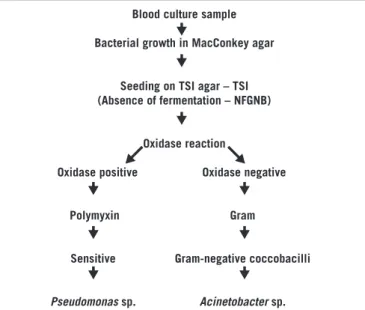
The Gram-negative bacteria which have grown on MacConkey agar were seeded on Triplice Sugar Iron (TSI) Agar in order to visualize the absence of sugar fermentation. After this proof, they were submitted to the oxidase test, and then, to the polymyxin-B resistance test and the Gram staining for initial phenotypic
laboratory identiication of the main bacterial genera belonging to the NFGNB group (Figure 1).
The NFGNB, once identiied, were submitted to the antibiogram by the Bauer-Kirby disk diffusion method(11) to analyze the
sensitivity proile to the main antibiotics used against NFGNB and to verify the presence of bacterial resistance. To perform the assay, the suspension of the test bacterium, adjusted to the standard of 0.5 on the McFarland scale, was inoculated onto the surface of the Mueller-Hinton agar plate. Subsequently, antimicrobial discs were placed and the plates were incubated in a bacteriological oven at a temperature of 35ºC-37ºC for 18 to 24 hours, the whole procedure was performed in a sterile way.
The method was performed following the recommendations of the Clinical and Laboratory Standards Institute (CLSI) 2015, as well as the choice of the antimicrobial discs that were used(12).
Blood culture sample
Bacterial growth in MacConkey agar
Seeding on TSI agar – TSI (Absence of fermentation – NFGNB)
Oxidase reaction
Oxidase positive Oxidase negative
Polymyxin Gram
Sensitive Gram-negative coccobacilli
Pseudomonas sp. Acinetobacter sp.
figurE 1 − Simplified flowchart of isolation and identification of the main NFGNB in hospital blood cultures
NFGNB: non-fermenting Gram-negative bacilli; TSI: triple sugar iron.
rESuLtS
From the total of 95 blood cultures analyzed, 87 (92%) were positive, showing bacterial growth, while eight (8%) were negative, with no growth of microorganism. Among the positive blood cultures, 57 (66%) were from male individuals and 30 (34%) from female.
most frequently found (55%), followed by Pseudomonas sp. (18%), Stenotrophomonas sp. (18%) and Burkholderia sp. (9%) (Figure 2).
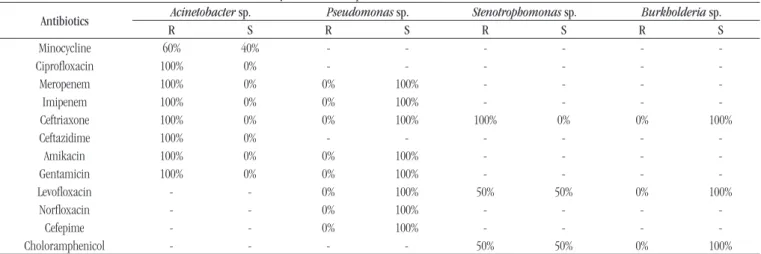
In general, regarding the proile of sensitivity and resistance, the Acinetobacter sp. strains were resistant to gentamicin,
meropenem, imipenem, amikacin, ciproloxacin, ceftazidime and ceftriaxone. The Pseudomonas sp. strains showed
sensitivity to all tested antimicrobials: gentamicin, meropenem, imipenem, amikacin, levoloxacin, norloxacin, ceftazidime and cefepime. All of Stenotrophomonas sp. strains presented
resistance to ceftriaxone and 50% of them showed resistance to both levoloxacin and chloramphenicol. The Burkholderia sp.
strains were sensitive to the antibiotics tested (Table).
Carbapenems, despite being a class of antibiotics highly recommended against resistant hospital bacteria, showed reduced effectiveness against the NFGNB strains analyzed in this study, showing, in general, 71% resistance.
1 2 3 4 60%
40%
20%
0%
figurE 2 − NFGNB genera isolated from blood cultures analysis
NFGNB: non-fermenting Gram-negative bacilli.
1. Acinetobacter sp.; 2. Pseudomonas sp.; 3. Stenotrophomonas sp.; 4. Burkholderia sp.
taBLE − Sensitivity and resistance profile of NFGNB isolated from blood cultures
Antibiotics Acinetobacter sp. Pseudomonas sp. Stenotrophomonas sp. Burkholderia sp.
R S R S R S R S
Minocycline 60% 40% - - -
-Ciproloxacin 100% 0% - - -
-Meropenem 100% 0% 0% 100% - - -
-Imipenem 100% 0% 0% 100% - - -
-Ceftriaxone 100% 0% 0% 100% 100% 0% 0% 100%
Ceftazidime 100% 0% - - -
-Amikacin 100% 0% 0% 100% - - -
-Gentamicin 100% 0% 0% 100% - - -
-Levoloxacin - - 0% 100% 50% 50% 0% 100%
Norloxacin - - 0% 100% - - -
-Cefepime - - 0% 100% - - -
-Choloramphenicol - - - - 50% 50% 0% 100%
NFGNB: non-fermenting Gram-negative bacilli; R: resistance; S: sensitivity.
DiSCuSSion
NFGNB represented about 13% of the microorganisms found in the positive blood cultures in this study, data lower than that demonstrated by Grillo et al. (2013)(6) with 28.3% of isolates, and
greater than those of Deliberali et al. (2011)(1) with 2.18%.
Acinetobacter sp. has been considered the second NFGNB
most frequently found in the laboratory studies of this genus, behind only the Pseusdomonas sp., however the present study showed a prevalence of 55% for Acinetobacter sp. and only 18% for Pseudomonas sp., in contrast to Grillo et al. (2013)(6) study,
in which Pseudomonas sp. reached a prevalence of 47% and
to Deliberali et al. (2011)(1), who showed 65% in their study. The
increased frequency of hospital-acquired infections associated with
Acinetobacter sp. and the rapid development of resistance of these
microorganisms have become a serious public health problem(13, 14).
The Acinetobacter sp. strains demonstrated sensitivity
exclusively to minocycline (40%), an antibiotic belonging to the tetracycline group. In a previous study, carried out by Deliberali
et al. (2011)(1) there was less sensitivity to tetracycline (10.4%).
A study by Pontes et al. (2006)(7) demonstrated sensitivity of
Acinetobacter sp. isolates to quinolones and imipenem.
Results from Grillo et al. (2013)(6) presented signiicant
resistance (> 90%) of Pseudomonas sp. in relation to the third
generation cephalosporins, such as ceftriaxone. In this study, ceftriaxone was 100% effective against the Pseudomonas sp.
strains. This bacterium has great clinical relevance, especially when associated with patients who are intubated or using venous catheters, as is the case of the majority of ICU patients(6, 8, 15, 16).
The Stenotrophomonas sp., often isolated from clinical
great importance, intrinsically resistant to a wide variety of antimicrobials, due to the presence of enzymes that inactivate various antibiotics, the impermeability of the outer membrane and the presence of eflux pumps to a multiplicity of drugs. Therefore, the treatment of infections caused by Stenotrophomonas sp.
requires great attention(4, 17).
The Burkholderia sp., known as an important opportunistic
pathogen, especially in hospital-acquired infections in immunocompromised patients or with cystic ibrosis(4), was the
NFGNB less prevalent in this study, representing 9% of the isolates, which differs from the percentage found in the Magalhães et al.
(2004)(8) study, which presented a prevalence of 29.2% of these
strains. There was no signiicant resistance of the Burkholderia sp. strains evidenced in this study with sensitivity to the antibiotics tested: ceftriaxone, levoloxacin and chloramphenicol.
Carbapenems are known to be potent agents for the treatment of NFGNB infections, especially in hospitals, but studies have already shown a reduction in its eficacy(1, 13-15). The study by Deliberalli
et al. (2011)(1) presented 32.8% and 37.1% of NFGNB isolates resistant to
imipenem and meropenem, respectively. This study detected signiicant resistance to carbapenems with regard to Acinetobacter sp. isolates (100%), showing greater resistance to imipenem and meropenem when compared to the aforementioned study.
No carbapenem has been shown to be more effective than the other, unlike the study by Marques et al. (2007)(15), in which
meropenem showed resistance greater (52.1%) than imipenem (32.9%). Inappropriate use of this class of drugs may exert selective pressure on nosocomial pathogens, leading to increased bacterial resistance to them due to the selection of less sensitive subpopulations(16).
ConCLuSion
The study highlights the importance of monitoring the resistance proile of NFGNB in blood cultures of hospitalized patients. This practice can contribute to the implementation of practices in partnership with the Commission for Control of Hospital-Acquired Infections [Comissão de Controle de Infecção Hospitalar (CCIH)] and with the epidemiological surveillance, in order to promote improvements in the key measures for the management of hospital-acquired infections, also contributing to a better targeting in the use of inpatient antibiotics.
Despite their low prevalence in routine in relation to other etiological agents, NFGNB are of signiicant importance, since they constitute an imminent risk to the hospitalized patients, also by the fact that these bacteria present decreased sensitivity to a large number of drugs. Studies like this, carried out periodically in the hospital environment, may help to control resistance rates, considering that microbiological data contribute to the choice of the most appropriate therapy for each patient.
aCknowLEDgES
To the Laboratory of Microbiology of the Hospital Regional do Agreste, due to the availability of the blood cultures analyzed, and to the Asces College, for the inancial support and availability of the infrastructure of the institution’s school laboratory.
rESuMo
Introdução: Os bacilos Gram-negativos não fermentadores (BGNNF) são um grupo heterogêneo de microrganismos que não possuem a capacidade de fermentar carboidratos como forma de obtenção de energia. Possuem mais de 120 espécies classificadas como patogênicas, destacando-se entre elas Pseudomonas aeruginosa, Acinetobacterbaumannii, Stenotrophomonas maltophilia e Burkholderia cepacia. As infecções causadas por esses microrganismos são, em sua maioria, adquiridas nos ambientes hospitalares, já que se tratam de patógenos oportunistas, estando entre as bactérias de maior relevância clínica e epidemiológica. Objetivo: Este trabalho avaliou o perfil de resistência dos BGNNF isolados de hemoculturas em um hospital de emergência na cidade de Caruaru, no Agreste
Pernambuco (PE), Brasil. Métodos: As cepas presentes nas hemoculturas foram isoladas nos meios de cultura ágar MacConkey e
ágar Triple Sugar Iron (TSI). As amostras também foram submetidas ao teste de oxidase e ao teste de resistência a polimixina, além da coloração de Gram, para melhor identificação dos gêneros bacterianos de BGNNF. Foi realizado o antibiograma para verificação do perfil de resistência. Resultados: Verificou-se que das 87 (100%) cepas isoladas e analisadas, 11 (13%) foram classificadas como BGNNF. O gênero Acinetobacter sp. foi o mais frequente (55%). As cepas de Acinetobacter sp. apresentaram-se resistentes a gentamicina,
meropenem, imipenem, amicacina, ciprofloxacina, ceftazidima e ceftriaxona. Conclusão: O rastreamento de isolados de BGNNF
resistentes, bem como uma maior atenção às práticas de controle de infecção hospitalar e sistemas de vigilância epidemiológica, além do cuidado contínuo em relação ao uso direcionado de antibióticos podem contribuir no combate a infecções por esses microrganismos.
rEfErEnCES
1. Deliberali B, Myiamoto KN, Winckler Neto CHP, et al. Prevalência de bacilos gram-negativos não fermentadores de pacientes internados em Porto Alegre-RS. J Bras Patol Med Lab. 2011; 47(5): 529-34.
2. Gales AC, Jones RN, Andrade SS, Sader HS. Antimicrobial susceptibility patterns of unusual nonfermentative gram-negative bacilli isolated from Latin America: report from the SENTRY Antimicrobial Surveillance Program (1997-2002). Mem Inst Oswaldo Cruz. 2005; 100(6): 571-7. 3. Menezes EA, Macedo FVV, Cunha FA, Andrade MSS, Rocha MVAP. Peril de infecção e resistência aos antimicrobianos de bacilos gram-negativos não fermentadores isolados no laboratório de patologia clínica Dr. Edilson Gurgel, Santa Casa de Misericórdia de Fortaleza-CE. RBAC. 2004; 36(4): 209-12.
4. Radice M, Marin M, Giovanakis M, et al. Criterios de ensayo, interpretación e informe de las pruebas de sensibilidad a los antibióticos en los bacilos gram negativos no fermentadores de importancia clínica: recomendaciones de la Subcomisión de Antimicrobianos de la Sociedad Argentina de Bacteriología, Micología y Parasitología Clínicas, Asociación Argentina de Microbiología. Rev Argent Microbiol. 2011; 43: 136-53. 5. Freire ILS, Araújo RO, Vasconcelos QLDAQ, Menezes LCC, Costa KF, Torres GV. Peril microbiológico, de sensibilidade e resistência bacteriana das hemoculturas de unidade de terapia intensiva pediátrica. Rev Enferm UFSM. 2013 set/dez; 3(3): 429-39.
6. Grillo VTRS, Gonçalves TG, Campos Júnior J, Paniágua NC, Teles CBG. Incidência bacteriana e peril de resistência a antimicrobianos em pacientes pediátricos de um hospital público de Rondônia, Brasil. Rev Ciênc Farm Básica Apl. 2013; 34(1): 117-23.
7. Pontes VMO, Menezes EA, Cunha FA, Ângelo MRF, Salviano MNC, Oliveira IRN. Peril de resistência de Acinetobacter baumannii a
antimicrobianos nas unidades de terapia intensiva e semi-intensiva do hospital geral de Fortaleza. RBAC. 2006; 38(2): 123-6.
8. Magalhães M, Britto MCA, Bezerra PGM, Veras A. Prevalência de bactérias potencialmente patogênicas em espécimes respiratórios de ibrocísticos de Recife. J Bras Patol Med Lab. 2004; 40(4): 223-7. 9. Marques EA. Peril microbiológico da ibrose cística. Rev Hospital Universitário Pedro Ernesto, UER. 2011; 10(4): 23-35.
10. McGowan Jr JE. Resistance in nonfermentinhg gram-negative bacteria: multidrug resistance to the maximum. Am J Med. 2006; 34(5 Suppl 1): 29-36.
11. Piaskowski CA, Yamanaka EHU, Romanel M. Manual para antibiograma. Técnica de difusão por disco. Laborclin produtos para laboratórios Ltda. Pinhais-PR. Maio, 2007.
12. Clinical and Laboratory Standards Institute. Perfomance standards for antimicrobial susceptibility testing. Twenty-second informational supplement M100-S22. 2015; 35(3).
13. Martins AF, Barth AL. Acinetobacter multirresistente – um desaio para a saúde pública. Scientia Med (Porto Alegre). 2013; 23(1): 56-62. 14. Bier KES, Luiz SO, Scheffer MC, et al. Temporal evolution of carbapenem-resistant Acinetobacter baumannii in Curitiba, Southern Brazil. Am J Infect control. 2010; 38(4): 308-14.
15. Marques PB, Vieira ABR, Farias MG. Peril de suscetibilidade a antibióticos de amostras de Pseudomonas aeruginosa isoladas no
centro de diagnóstico da Unimed Belém-Pará. RBAC. 2007; 39(3): 175-7. 16. Picoli SU. Metalo-beta-lactamase e Pseudomonas aeruginosa.
RBAC. 2008; 40(4): 237-77.
17. Garcia DO, Timenetsky J, Martinez MB, Francisco W, Sinto SI, Yanaguita RM. Proteases (caseinase and elastase), hemolysins, adhesion and susceptibility to antimicrobials of stenotrophomonas maltophilia isolates obtainedfrom clinical specimens. Braz J Microbiol. 2002; 33: 157-62.
CorrESPonDing author
Sibele Ribeiro de Oliveira