© FECAP
RBGN
Received on
November 27, 2013
Approved on
March 5, 2015
1. Eréndira Fierro Moreno
Ph. D. Economic and Administrative Sciences Universidad Autónoma del Estado de México.
[[email protected]; [email protected]]
2. José Luis Cantú Mata
Ph. D. Philosophy (Management)
Universidad Autónoma de Nuevo León (México) [[email protected]]
3.Joel Martínez Bello
Ph. D. Education Sciences Colegio de Estudios de Posgrado de la Ciudad de México.
4.Oscar Hernán López M.
Master in Management Universidad Nacional de Colombia
Revista Brasileira de Gestão e Negócios
DOI:10.7819/rbgn.v17i54.1820
Predictors of administrative innovation:
functions and organizational methods
- Mexican and Colombian
hospitals-Eréndira Fierro Moreno
Universidad Autónoma del Estado de México, Facultad de Economía, México
José Luis Cantú Mata
Universidad Autónoma de Nuevo León, Facultad de Ingeniería Mecánica y Eléctrica, México
Joel Martínez Bello
Universidad Autónoma del Estado de México, Facultad de Economía, México
Oscar Hernán López M.
Universidad del Tolima, Departamento de Administración, Colombia
Editor in charge: João Maurício Gama Boaventura, Dr. Evaluation process: Double Blind Review
ABstRACt
Objective – To determine to what extent functions and organizational methods inluence on administrative innovation.
Design/methodology/approach – This research is quantitative approach, with a not experimental and transversal design. he hypothesis was supported by using a transactional study with a sample of Mexican and Colombian hospitals through the perception of their high and medium level managers. he hospital sampling was by convenience.
Findings – Organizational functions and methods are associated and are predictors of administrative innovation.
Practical implications – As long as the hospital encourages the development of training and knowledge methods, autonomy methods for employees are developed, and when performance appraisal takes place in hospital, new methods will be able to develop and organize the routines and the management procedures, allocation of responsibilities and power among employees could be developed, as well as to develop new structure concepts for workplace, organizational practices and external relationships.
1 INtRODuCtION
Knowledge has turned into the most important factor in production (Drucker, 1993; Quinn, 1992) and, since Schumpeter in 1934 established that innovation plays an important and decisive role in economic development, it has caught great attention and has been studied for its aspects which impact organizations (Liao, Fei & Liu, 2008); it is generally accepted that innovation is essential for the increase of production and productiveness (OCDE & EUROSTAT, 2005).
Nonetheless, innovation here is related to Marshall’s work in his fourth book, called “Principles of Economics”; he considers that sometimes is better to recognize organization as a distinct agent from production. hat is, the internal structure variable acquires greater importance even for the costs as an explanation of the diferences in the competitiveness of irm (Milgrom & Roberts, 1993).
Marshall established that economies of scale of production also depend on each company’s own resources, of its organization and eiciency of management. In this way, Marshall introduced organizational activity as the fourth factor of production (Marshall, 1890:221, quoted by Sanidas, 2005).
An organizational activity can be the organizational innovation, and, inside this one, administrative innovation is found; it can be a previous and essential condition for technological innovations (Lam, 2005). It is not only a supporting factor for the innovation of a product and service, it also has a considerable inluence on the results of the organizations (OCDE & EUROSTAT, 2005). herefore it is unavoidable to carry out a research about predictors of administrative innovation.
From the logic of the principles which are the basis of the Resource-Based View, management and technical capabilities are based on internal resources (Eisenhardt & Martin, 2000). An organizational capacity refers to an ability of an organization to develop a structured set of tasks by means of organizational resources
in order to achieve a inal particular result (Helfat & Peteraf, 2003). Hence, it is considered that management skills resources generate capacities.
Capacities are the ones that cause creation, evolution and recombination of other resources into new ones, that is, they are the processes of organizations that use the resources to generate changes. Organizational and strategic routines are used to get new setting resources in organizations (Eisenhardt & Martin, 2000).
Specifically, the capacity to innovate involves the development of activities such as scientiic, technological, inancial, commercial, organizational and administrative operations, which are aimed to lead to introduce innovations (OCDE & EUROSTAT, 2005); that makes company eiciency and efectiveness based on internal resources (Bharathi, 2007; Utterback, 1994; Coutinho & Ferraz, 1995; Pinto et al., 2006; Pasquini & Mendes, 2009; Grify-Brown & Chun, 2007). Consequently, it is likely that some internal organizational resources are going to be managed and they will allow the creation of innovative administration capabilities.
The general topic about adopting innovation has resulted in plenty of research. However, this research is focused on analyzing the influence of methods development and organizational functions, in the introduction of new organizational methods in the workplace and in the organization of external relations (OCDE & EUROSTAT, 2005).
Based on the previous discussion, the research question is the following: To what extent organizational functions and methods inluence administrative innovation? In order to answer the previous question and taking into consideration the perspective of the Resource-Based View (Wernerfelt, 1984; Barney, 1991), this research contributes to current knowledge about organizational innovation showing the inluence of the development of methods of knowledge and training, the development of autonomy methods for employees, performance appraisal and decentralization of functions in innovative administration.
2 L I t E R A t u R E R E v I E w A N D HyPOtHEsIs
The grow strategy implies a balance between the exploitation of existing resources and the development of new ones. Even organizations are positioned in a strategic way according to its resources and capacities, and they consider idiosyncratic resources (common and shared characteristics by members in a group of people) and capacities as main sources of growth and development when they cannot be duplicated by other organizations, once it allows to form strategies for value creation (Penrose, 1959; Wernerfelt, 1984; Griffy-Brown & Chun, 2007; Constantinescu, 2009; Barney, 1991, 2001; Conner, 1991; Eisenhardt & Martin, 2000; Grant, 1991, Barney, 1991; Hall, 1992; Peteraf, 1993; Ventura, 1996; Barney, Wright & Ketchen, 2001).
Wernerfelt (1984) established that resources of a company could be defined as assets – tangible and intangible –, which are semi-permanently linked to the organization. Examples of those resources are brand names, internal technology knowledge, employing qualified personnel, machinery, eicient procedures, and
capital, among others1. Assets are implemented
to create value for strategies.
hen, to the extent that organizations develop efficient procedures by considering transformations and changes within them, strategic initiatives that contribute knowledge to processes will be changed, selected and maintained, with results derived from strategic autonomous behavior of each organization (Caldart, Vassolo & Silvestri, 2010; Calderón, Cuartas & Álvarez, 2009).
These efficient processes can be, among others, organizational, that is, internal organizational resources are vulnerable to develop new capacities such as innovation.
Innovation can be the generation of a new product, of a new service, of new technology or of a new administrative practice (Nogueira & Marques, 2008); it is the adoption of ideas which are new to the organization that adopts them (Rogers, 1983).
In general, organizations can innovate through the development of new products and services, in order to differentiate them and get additional income, through the creation (generally known as process innovation), through optimization of manufacture or the innovation of processes which aim is to facilitate relationships with customers and the organization (ISI, 2006).
Among diferent types of innovation, there are three which have caught greater attention: administrative and technical innovation, product and process innovation, radical and incremental innovation (Damanpour, 1991).
2004). In the same way, in the Oslo Manual, four types of innovation are distinguished: product innovation, process innovation, marketing innovation and organizational or administrative innovation (OCDE & EUROSTAT, 2005). Administrative innovation refers to recruitment policies, allocation of resources and authority, and task structure, as well as authority and reward tasks are related to management activities. It therefore implies that administrative components are connected to the structure or the social organization system. Technical innovations, in general, are related to technology and concerned by the products, services and the production/ technology process; they also refer to core activities (Daft 1978; Damanpour, 1991).
Administrative innovation refers to a change in the way decisions are taken: changes in the allocation of responsibilities, in the way the information is structured, and in communication structures within the organization (Greenan, 2003).
In other words, it is a way in the organization to face the structure and processes which are significantly different from the current practices in the organization and have an economic impact (Schienstock, Rantanen & Tyni, 2009). It is deined as “the implementation of changes in business practices that improve the capacity to innovate, as well as the company performance” (ISI, 2006, p.65).
Administrative innovation is “the introduction of a new organizational method in the practices, in the organization of a workplace, or in the external relations for the organization” (OECD, 2005:62). It involves organizational components and it is connected to the organization social system. hen, it is considered that predictors could be crucial organizational methods that had not been used before by the organization and they are the result of strategic decisions taken by leaders within the organization who impact the achievement of organizational innovations
(Daft, 1978); they also improve the results in the organization (OCDE & EUROSTAT, 2005; Ravinchandran, 2000).
Among these determining factors in the organization, it is found: the development of methods of knowledge and training, autonomy methods for employees, performance appraisal and decentralization of functions. Nonetheless, it must be speciied that not only intangible organizational resources, such as knowledge and those related to human capital, have an impact on innovation; within organizations, there are other factors which allow it. Such is the case of the use of information and communication technologies which lead to major transformations in all organizational methods and that is why innovation activity gets the most beneit (Jiménez, Martínez & González, 2008). Even information and communication technologies represent a competitive advantage because they are capable of promoting innovation processes (patents and trademarks), so they are considered strategic organizational tools (Bond & Houston; 2003). Furthermore, it is essential to recognize that knowledge, on its own, gives opportunities to stimulate the creation of new knowledge and thus brings about innovation (Kogut & Zander 1992; Tsai & Ghoshal, 1998; Constantinescu, 2009; Fong & Kwok, 2009; Nonaka, 1991; Milam, 2001; Broos & Cronjé, 2009; Santos, Sanzo, García & Trespalacios, 2009; Liao & Wu, 2008; Liao & Wu, 2010).
Knowledge is the most important productive resource in terms of contribution to its value added and it also has great strategic importance (Grant, 1997). If organizations are based on knowledge, they can develop other capacities, and influence the efficiency and efectiveness of organizational performance (Daft, 1983, quoted by Barney, 1991).
& Morris, 2007), and internal and external knowledge is important for organizations to innovate (Tsai, 2001; Santos, Sanzo, García & Trespalacios, 2009; Liao & Wu, 2010). When knowledge is produced, the innovation system as a whole inluences the environment and its external conditions (Quintero-Campos, 2010). Consequently, knowledge generation and methods of knowledge and training can alter, change and improve organizational methods. If this is true, the development of methods of knowledge and training might have positive inluence on administrative innovation.
According to the discussion above, the following hypothesis is suggested:
H1: The development of methods of knowledge and training has a positive efect on administrative innovation.
Alternatively, in addition to knowledge, other mechanisms are needed to make it possible to understand inherent challenges to the construction of new capacities in the organization, that is, to identify organizational systems and coordination mechanisms that should be established in order to develop new systematic capacities (Grant, 1996). Among these mechanisms, we consider the development of autonomy methods for employees, performance appraisal and decentralization of functions.
In general, autonomy for employees is referred to the freedom that is given to working groups and individuals to carry out their tasks in addition to the interdependence on them (Langfred, 2007). Autonomy encourages employees and working groups to take independent decisions that are used to improve organizational tasks, implicitly they give a higher degree of responsibility (Haas, 2010) and have inluence on organizational performance. Due to the above, it is likely that the design of autonomy methods is a predictor of administrative innovation.
In accordance with the previous discussion, the following hypothesis is suggested:
H2: The development of autonomy methods has a positive effect on administrative innovation.
All around the world, performance appraisal is used in almost every single organization; basically, the process of performance appraisal allows an organization to measure, to evaluate the behavior and the achievements of individual members for a speciied period of time (DeVries, Morrison, Shullman & Gerlach, 1981) and the importance attached to motivation, training and compensation has been vastly studied. However, it is important to consider its efectiveness to improve future organizational performance (Lee, 1985). One of these elements could be administrative innovation, as a key organizational element that improves results in an organization. According to the discussion above, the following hypothesis is suggested:
H3: Performance appraisal has a positive efect on administrative innovation.
Decentralization of functions is deined as the degree in which decision taking is distributed to all parts of the organization and employees are able to take independent decisions about their job (Aiken & Hage, 1971). According to literature, it has been found that decentralization facilitates innovation in organizations (Ruekert, Walker & Roering, 1985; Damanpour, 1991). herefore, it is likely that it may also have inluence on administrative innovation.
In accordance with the previous discussion, the following hypothesis is suggested:
H4: Decentralization of functions has a positive efect on administrative innovation.
3 MEtHOD
3.1 sample and data
examined as it was, and its design was not experimental or transversal (Creswell, 2009; Leedy & Ellis, 2002), with data gathering at a single moment. Data were used to explain organizational eiciency and efectiveness based on internal resources, and capacities should represent organizations which need a large extent building capability of administrative innovation due to high demands and social pressures. Hospitals are one of the most prone organizations to those pressures; hence, this research was carried out in hospitals, because in these organizations it is likely to observe the analyzed phenomenon. Hospital sampling was by convenience. However, hospitals were selected by looking for the most representative and convenient units for the research. he sample is formed by eight public hospitals in the State of Mexico: ive general hospitals for all the people in the community; one high specialty hospital for all the people in the community; and two high specialty hospitals for beneiciaries. Likewise, in this sample six general and high specialty Colombian hospitals were included; those hospitals are from Tolima and Bogota.
he study of administrative innovation considers as unit of analysis middle-ranking and senior management within organizations, by virtue of managers, leaders and directors are the ones in charge of inluence on employees and make them responsive, supportive and committed to the principles of the organization, from the knowledge (Kangas, 2009), therefore, over administrative innovation. In view of the foregoing, this is a managerial challenge and directors are the ones responsible for raising awareness about administrative innovation for personnel involved in processes (García, 2009). he participation in the sample in hospitals was voluntary and there was no control about its composition.
he research tool was administered to directors and middle-ranking (203) from diferent areas: medical, paramedical and administrative from Mexican hospitals.
The original number of answered questionnaires in Mexico was 203. However, 14 questionnaires were incorrectly answered and they were eliminated.
The final number of questionnaires analyzed was 183, this represents a participation fee of 93 percent.
The original number of answered questionnaires in Colombia was 55, this represents a participation fee of 90 percent.
Data were gathered through a research tool (questionnaire) carried out in Mexico from April to August in 2011; in Colombia, it was applied from November 2012 to June 2013.
The questionnaire was divided in two sections: the irst one about demographic data (sex and age) and organizational (job position, area, seniority in the hospital and in the job position); the second part has a series of questions intended to measure the ive variables of the study (administrative innovation, development of methods of knowledge and training, development of autonomy methods for employees, performance appraisal and decentralization of functions).
The items are based on literature and on the Oslo Manual (OCDE & EUROSTAT, 2005; ISI, 2006). For the questionnaire design, beyond the techniques of translation, adaptation and construction, (Muñiz & Hambleton, 1996), context (health sector) was considered, as well as new characteristics of the population (hospitals), unit of analysis – middle-ranking and directors - and a rhetorical review about the topic.
Reply options were deined in an ordinal scale with six options, which oscillated between 1 (extremely high) and 6 (very low).
To improve the questionnaire, content validation was carried out with a panel of experts (selected from a list of well-known experts in the ield), whose suggestions were added to a second version of the questionnaire.
3.2 Operational deinition of the measures
Administrative innovation (Y) refers to the activities involved in administrative elements that afect the social system in the organization (Daft, 1978; Damanpour, 1991). Five questions related to new methods to organize routines, management procedures and power among employees were operationalized, as well as concepts of structure (OCDE & EUROSTAT, 2005; ISI, 2006).
he development of autonomy methods for employees (X1) refers to the development of methods that inluence the freedom that is given to working teams and individuals to carry out tasks, in addition to the interdependence in their tasks (Langfred, 2007). hree more questions referring to the development of new methods of responsibility attribution, autonomy of decisions and greater lexibility were also operationalized.
Appraisal performance (X2) allows an organization to measure and evaluate behavior and achievements of an employee in a speciic period of time (DeVries, Morrison, Shullman & Gerlach, 1981). Two questions related to individual assessments and the importance of wage systems based on performance were also operationalized.
Decentralization of functions (X3) is deined as the degree in which decision taking is distributed to all parts in the organization and employees are able to take independent decisions about their jobs (Aiken & Hage, 1971). here were two questions about decentralization of functions for hospital service areas as well as administrative sections.
he development of knowledge methods and training (X4) refers to the development of training methods and education as well as the development of tools, procedures, methods of knowledge exchange, information, knowledge use and skills inside and outside hospitals. Six questions were operationalized.
4 REsuLts
4.1 sample characterization
From 244 middle-ranking and directors, 43% are men and 57% are women. Regarding age, there is similar ratio between ages from 25 and 35 years old and from 36 to 45 (34% respectively), 13.5% between 46 and 55 years old, only 3.7% is older than 56 years old and 3.3% did not answer.
In relation to job position, 16% works for medical and administrative area, 25.8% belongs to the medical area, 25% works for the administrative department and 17.6% belongs to the paramedical area.
With regard to job seniority, more than half of the sample has been there between 1 and 5 years (51.6%), 2% between 21 and 25 years and 4.5% for more than 26 years.
4.2 Comparison of variables averages in the research according to the group of hospitals in Mexico and Colombia
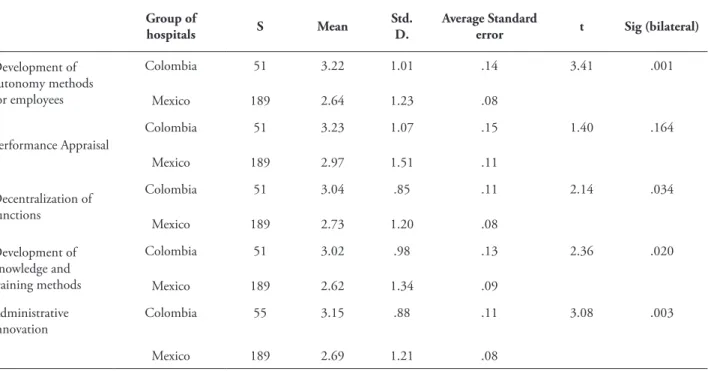
In accordance with the group of Mexican and Colombian hospitals, a student test was taken in order to compare averages among the variables studied. As it can be seen in table 1.
Values derived from Levene test showed signiicance ≤ 0.05 in all variables, the assumption of equal variances was not assumed.
All variables which depend on hospitals in Mexico and Colombia are perceived diferently with the exception of performance appraisal. hat is, regarding the variable related to performance appraisal, middle-ranking and directors agree that, in hospitals, regular individual evaluation is carried out and wage systems are based on performance appraisal.
tABLE 1 – Average comparison of variables studied according to the group of hospitals in Mexico and Colombia
Group of
hospitals s Mean
std. D.
Average standard
error t sig (bilateral)
Development of autonomy methods for employees
Colombia 51 3.22 1.01 .14 3.41 .001
Mexico 189 2.64 1.23 .08
Performance Appraisal
Colombia 51 3.23 1.07 .15 1.40 .164
Mexico 189 2.97 1.51 .11
Decentralization of functions
Colombia 51 3.04 .85 .11 2.14 .034
Mexico 189 2.73 1.20 .08
Development of knowledge and training methods
Colombia 51 3.02 .98 .13 2.36 .020
Mexico 189 2.62 1.34 .09
Administrative innovation
Colombia 55 3.15 .88 .11 3.08 .003
Mexico 189 2.69 1.21 .08
4.3 sampling adequacy and Cronbach’s Alpha
In order to validate the content of every single construct, the adequacy of measure called Kaiser-Meyer-Olkin (KMO) test was used. To deine if the analysis is appropriate, Bartlett’s test of sphericity was used. As it can be seen in table 2, constructs analyzed with KMO test
range from 0.50 to 0.89; this range indicates regular adequate sampling (Kaiser, 1974) and Bartlett’s test of sphericity is meaningful. With the aim to determine reliability of the instrument (questionnaire), as seen in table 2, Cronbach’s Alpha was used. Acceptable values are observed (.784 to .940).
tABLE 2 – KMO Bartlett’s test of sphericity and reliability
Development of autonomy methods for employees (X1)
Performance Appraisal (X2)
Decentralization of functions (X3)
Development of knowledge and training methods
(X4)
Administrative innovation (y)
KMO test 0.689 0.500 0.500 0.891 0.500
Sig. 0.000 0.000 0.000 0.000 0.000
Cronbach’s
4.4 Normality analysis
As it can be seen in table 3, the assumption of normality is veriied through values of skewness and kurtosis; allowed values are among ± 2 (Pérez, 2008). With the statistical of asymmetry
and skewness, it is proved that independent variables (development of knowledge and training methods, development of autonomy methods for employees, performance appraisal and decentralization of functions) proposed in the study are normal.
tABLE 3 – Normality
variables skewness Kurtosis
Administrative innovation (Y) 0.465 -0.504
Development of autonomy methods for employees (X1) 0.375 -0.705
Performance appraisal (X2) 0.381 -0.876
Decentralization of functions (X3) 0.547 0.230
Development of knowledge and training methods (X4) 0.552 -0.537
4.5 Linearity analysis and correlations
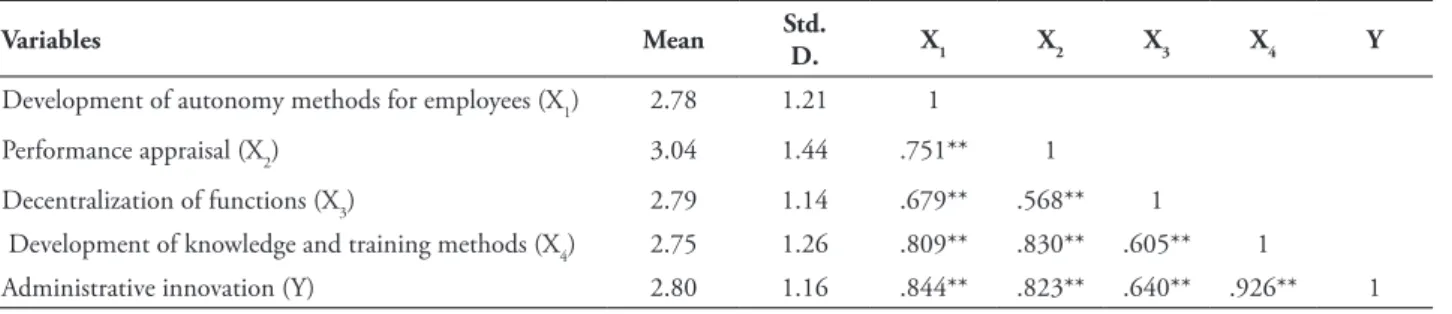
For this research, the assumption of linearity was evaluated through a partial correlation matrix and by comparing the signiicance of partial correlation with the conidence interval of 95% that corresponds to a signiicance of 0.05. he option of Zero order correlation was included. his option allows obtaining Pearson’s coeicient of correlation among every pair of variables without the interference of a third variable. Furthermore, residues against the independent variable were plotted, no apparent pattern was seen.
In table 4, the value of significance from the relationship between independent variables (development of knowledge and training methods, development of autonomy methods for employees, performance appraisal, and decentralization of functions) can be observed with the dependent variable (administrative innovation) and it is under 0.05, corresponding to the level of reliability of 95%. herefore, it is accepted that the relationship between the dependent variable and independent variables is linear.
tABLE 4 – Statistical descriptions, correlations and reliability coeicient
variables Mean std.
D. X1 X2 X3 X4 y
Development of autonomy methods for employees (X1) 2.78 1.21 1
Performance appraisal (X2) 3.04 1.44 .751** 1
Decentralization of functions (X3) 2.79 1.14 .679** .568** 1
Development of knowledge and training methods (X4) 2.75 1.26 .809** .830** .605** 1
Administrative innovation (Y) 2.80 1.16 .844** .823** .640** .926** 1
Note. **Correlation is signiicant at the 0.01 level (2-tailed)
In table 4, correlations are also reported for the used variables in this study.
4.6 Multiple linear regression analysis
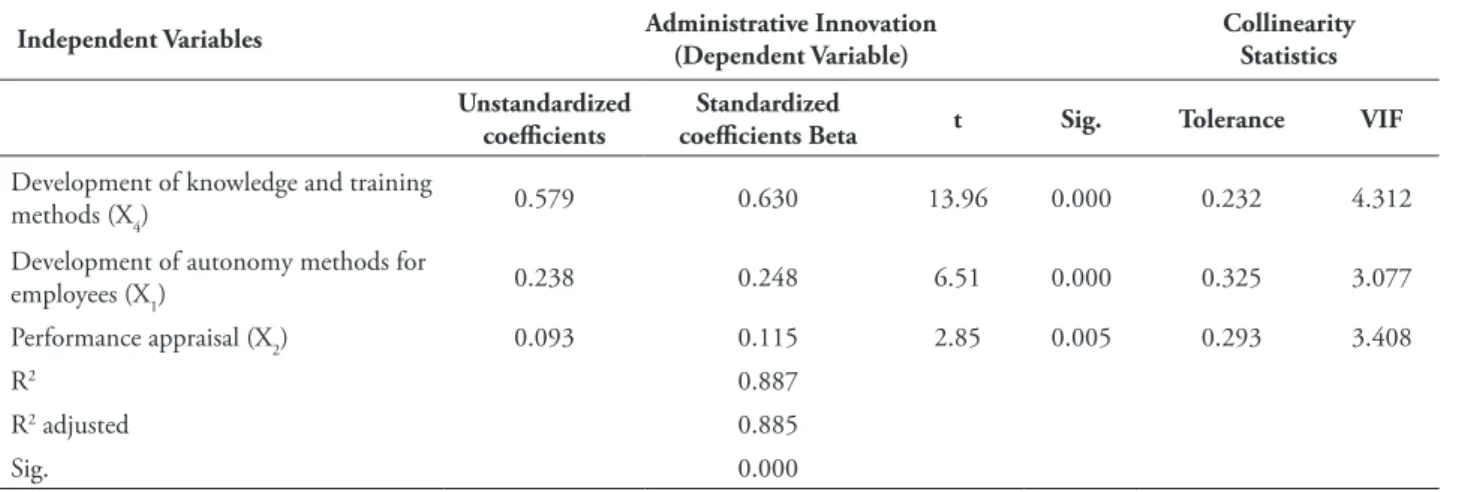
In order to test research hypotheses - that is, the positive inluence on the development of knowledge methods and training about administrative innovation, the positive inluence on performance appraisal about administrative innovation and the positive influence on decentralization of functions about administrative innovation -, verifying the combined efect of the variables, a multiple regression analysis was carried out (see table 5).
Durbin-Watson statistical has a result of 2.234, this means that residues (observations belonging to the sample) are not auto-correlated. he result of the standard error of the estimation was 0.3951. When this result is found close to the regression line or close to 0, it has a better model prediction.
In spite of that, it should be noted that data gathering is carried out at a single moment; the independence assumption is not infringed (Levine et al., 2006).
tABLE 5 – Model (Multiple Regression Analysis)
Independent variables Administrative Innovation
(Dependent variable)
Collinearity statistics
unstandardized coeicients
standardized
coeicients Beta t sig. tolerance vIF
Development of knowledge and training
methods (X4) 0.579 0.630 13.96 0.000 0.232 4.312
Development of autonomy methods for
employees (X1) 0.238 0.248 6.51 0.000 0.325 3.077
Performance appraisal (X2) 0.093 0.115 2.85 0.005 0.293 3.408
R2 0.887
R2 adjusted 0.885
Sig. 0.000
As seen in table 5, functions and organizational methods (development of knowledge and training methods, development of autonomy methods and performance appraisal) contribute to explain 88.7% of administrative innovation, and a highly meaningful statistical model is assumed.
According to observed values of typiied beta coeicients (table 4) it is seen that, in irst place, variable X4: development of knowledge and training methods (0.630) is the variable with most representation on administrative innovation; on second place, variable X1:development of autonomy methods for employees (0.248); and at last, variable X2: performance appraisal (0.115). For the decentralization of functions, variable (X3), it is not representative because of
the signiicance of “t” value (0.112), superior to value 0.05, which corresponds to reliability level of 95%; this means that meaningful relation between this variable and the dependent variable administrative innovation (Y) does not exist.
he variance inlation factor (VIF) shows values below 5 (see table 5), and the tolerance shown for each one of the independent variables is in an acceptable level (Martín, Cabero & De Paz, 2008). herefore, there is no presence of correlation between independent representative variables in the regression model.
H1: he development of knowledge and training methods (X4)has a positive efect on administrative innovation (Y).
H2: The development of autonomy methods (X1) has a positive effect on
administrative innovation (Y).
H3: Performance appraisal (X2) has
a positive effect on administrative innovation (Y).
F u r t h e r m o r e , h y p o t h e s i s f o u r, decentralization of functions has a positive efect on administrative innovation (Y), is rejected.
5 DIsCussION
Literature about the incidence of organizational predictors over administrative innovation is vast but it is diferent when it refers to the development of functions and organizational methods for administrative innovation, such as the development of knowledge and training methods, the development of autonomy methods for employees, performance appraisal and decentralization of functions.
With this study, a positive association was detected among the variables observed, even in a high meaningful way. According to middle-ranking, medical directors and paramedics who took part in the study from Mexico and Colombia, functions and organizational methods - speciically the development of knowledge and training methods, the development of autonomy methods as well as performance appraisal - are associated with administrative innovation. Although the development of knowledge and training methods, the development of autonomy methods and performance appraisal contribute to explain 88% of the variability of administrative innovation capacity, the decentralization of functions does not apply.
Regarding the hospital: 1) it must encourage the development of training and education methods, as well as the development of tools, procedures and methods, knowledge
exchange, information, knowledge use and skills inside and outside hospitals; 2) when autonomy methods for employees are developed, they influence freedom given to working groups and individuals to carry out their tasks in addition to the task interdependence; 3) when performance appraisal takes place in hospital and administrative areas, new methods to organize routines, procedures and management procedures, allocation of responsibilities and power among employees could be developed, as well as new structuration concepts for workplace, organizational practices and external relationships.
he above, in general, is coincidental with Torrent-Sellens and Ficapal-Cusi (2010) study. hey found out that in organizations (related to technology use) knowledge, labor relations based on safety at work as well as lextime have a positive inluence on the growth potential in the organization in the long term.
According to knowledge and training, it is observed that the development of knowledge and training methods is the variable of greater representation about administrative innovation. his study is coincidental with the results obtained by Cheng and Mohd (2010), who carried out studies in 171 manufacturing enterprises in Malaysia, since they got similar results.
This research agrees with Tannien, Jantunen and Saksa’s (2008) findings, once administrative innovation needs organizational changes at the same time in which innovation is taking place. Consequently, the development of functions and organizational methods are also predictors of achieving administrative innovation.
6 CONCLusIONs
into internal capacities in the organization that may inluence the capacity of innovation and thereby administrative innovation.
he development of knowledge and training methods, the development of autonomy methods for employees and performance appraisal are eicient strategies that contribute to place organizations strategically according to their own resources and capacities. his involves generation of innovation, growth and development when it cannot be duplicated by other organizations, as well as it allows forming strategies for the creation of value.
With the results of this research, it is possible to consider that decentralization of functions for hospital services and administrative areas are also determined by other restrictive factors which afect the achievement of innovation.
From the Resource-Based View emerges an aspect that emphasizes that knowledge should be considered as the most valuable resource that an organization may have (Zack, 1999). It is called resource-based knowledge, and its basis is that an organization is a deposit of knowledge: it is able to generate it and apply it (Grant, 1996; Conner & Prahalad, 1996). his perspective agrees with the results of this research; the development of knowledge and training methods is basic for the development of other capacities that lead to creation, evolution and recombination of other resources into new ones or in processes that the organization uses to create total changes, such as administrative innovation.
Value creation and the improvement of the organization can be generated, among others, with the development of functions and organizational method, through the identiication and creation of predictors generators of administrative innovation, that is, the one that is referred to management components. It is even connected to the structure or social system in the organization (Daft 1978; Damanpour, 1991), or the one that refers to a change in the way decisions are taken, a change in the allocation of responsibilities or a change in the structure and processes that are signiicantly diferent from current practices in the organization and have an economic impact (Schienstock, Rantanen & Tyni, 2009) - or the one that implements changes in business practices
that improve the innovation capacity and the performance of an organization (Schienstock, Rantanen & Tyni, 2009).
hought the results of this research, it could be shown that in a sample of middle-ranking and hospital directors, paramedics and managers who work in Mexican and Colombian hospitals, there is positive inluence of functions and organizational methods in administrative innovation, and this study contributes to current knowledge about organizational innovation to prove relationship with administrative innovation.
Future issues of study might carry out empirical evidence in another kind of organizations, in order to verify the association of variables and determine the efect of these predictors in administrative innovation based on non-hospital characteristics, as well as the identiication of other predictors.
When measurement of variables is considered in this study, longitudinal research studies are recommended.
Finally, one of the biggest limitations in this study was the range of the sample, and it is recommended to consider conclusions with caution. A second limitation was the use of only one measurement tool for data gathering.
NOtA
1. “By a resource is meant anything which could be thought of as a strength or weakness of a given irm. More formally, a irm´s resources at a given time could be deined as those (tangible and intangible) assets which are tied semipermanently to the irm. Examples of resources are: brand names, in house knowledge of technology, employment of skilled personnel, trade contacts, machinery, eicient procedures, capital, etc…” (Wernerfelt, 1984: 172).
REFERENCEs
Aiken, M., & Hage, J. (1971). Organic organization and innovation. Sociology,5(1), 63-82. doi: 10.1177/003803857100500105
embedding of new practice areas in management consulting irms. he Academy of Management Journal, 50(2), 406-428.
Barney, J. (1991). Firm resources and sustained competitive advantage. Journal o f M a n a g e m e n t, 1 7( 1 ) , 9 9 - 1 2 0 . d o i : 10.1177/014920639101700108
Barney, J., Wright, M., & Ketchen Jr., D. J. (2001). he resource-based view of the irm: ten years after 1991. Journal of Management, 27(6), 625-641. doi: 10.1016/S0149-2063(01)00114-3
Bharathi, G. (2007). Intellectual capital statements: what do they measure and report. he ICFAI Journal of Accounting Research,6(4), 52-64.
Bond, I., & Houston, M. B. (2003). Barriers to matching new technologies and market opportunities in established irms. Journal of Product Innovation Management, 20(2), 120-135. doi: 10.1111/1540-5885.2002005
Broos, E., & Cronjé, J. C. (2009). Information society needs of managers in a large governmental organisation. Educational Technology and Society,
12(1), 285-297.
Caldart, A., Vassolo, R., & Silvestri, L. (2010, August). Induced variation in administrative systems: experimenting with contexts for innovation. Academy of Management Annual Meeting Proceedings, Montreal, QC, CA, 1.
Calderón, G., Cuartas, J., & Álvarez, C. M. (2009). Transformación organizacional y prácticas innovadoras de gestión humana. Innovar, 19(35), 151-166.
Cheng, T., & Mohd, A. (2010). he inluence of knowledge management effectiveness on administrative innovation among Malaysian manufacturing irms. Asian Academy of Management Journal, 15(1), 63-77.
Conner, K. (1991). A historical comparison of resource-based theory and five schools of thought within industrial organizational economics: Do we have a new theory of the
irm? Journal of Management, 17(1), 21-154. doi: 10.1177/014920639101700109
Conner, K., & Prahalad, C. K. (1996). A Resource-based theory of the irm: knowledge versus Opportunism. Organization Science, 7(5), 477-501.
Constantinescu, M. (2009). Knowledge management: focus on innovation and labor productivity in a knowledge-based economy. he IUP Journal of Knowledge Management,7(1), 7-33.
Coutinho, L. G., & Ferraz, J. C. (Coords.). (1995). Estudo da competitividade da industria brasileira. Campinas: Papirus.
Creswell, J. W. (2009). Research design: qualitative, quantitative, and mixed methods approaches. (3rd ed.). Los Angeles: Sage.
Daft, R. L. (1978). A dual-core model of organizational innovation. Academy of Management Journal,21(2), 193-210. doi: 10.2307/255754
Damanpour, F. (1991). Organizational innovation: a meta-analysis of efects of determinants and moderators. heAcademy of Management Journal, 34(3), 555-590.
DeVries, D. L., Morrison, A. M., Shullman, S. L.; & Gerlach, M.L. (1981). Performance appraisal on the line. Greensboro, N. C: Center for Creative Leadership.
Drucker, P. (1993). Post-capitalist society. NewYork: Harper Business.
Eisenhardt, K. M., & Martin, J. (2000). Dynamic capabilities: What are they?
St ra t e g i c M a n a g e m e n t Jo u r n a l, 2 1( 1 0 1 1 ) , 1 1 0 5 1 1 2 1 . d o i : 1 0 . 1 0 0 2 / 1 0 9 7 - 0266(200010/11)21:10/11<1105::AID-SMJ133>3.0.CO;2-E
Fijalkowska, J. (2008). Review of guidelines for the intelectual capital statement – how to manage and communicate the company´s knowledge.
Fong, P., & Kwok, C. (2009). Organizational culture and knowledge management success at project and organizational level in contracting irms. Journal of Construction Engineering and Management, 135(12), 1348-1356.
García, S. (2009). La innovación como reto directivo. In Menguzzato, M. (Dir.). La dirección de empresas ante los retos del siglo XXI: homenaje al Profesor Juan José Renau Piqueras (pp. 193-202). Valencia: Universitat de Valencia.
Grant, R. M. (1991). he resource based theory of competitive advantage: implications for strategy formulation. California Management Review, 33(3), 114-135.
Grant, R. M. (1996). Toward a knowledge-based theory of the irms. Strategic Management Journal,
17(S2), 109-122. doi: 10.1002/smj.4250171110
Greenan, N. (2003). Organisational change, technology, employment and skills: an empirical study of French manufacturing. Cambridge Journal of Economics, 27(2), 287-316.
Grify-Brown, C., & Chun, M. (2007). Aligning business strategies and IS resources in japanese SMEs: a resource-based view. Journal of Global Information Technology Management, 10(3), 28-51. doi: 10.1080/1097198X.2007.10856448
Haas, M. R. (2010). he double-edged swords of autonomy and external knowledge: analyzing team efectiveness in a multinational organization.
Academy of Management Journal, 53(5), 989-1008.
Hall, R. (1992). he strategic analysis of intangible resources. Strategic Management Journal, 13(2), 135-144. doi: 10.1002/smj.4250130205
Helfat, C., & Peteraf, M. (2003). he dynamic resource-based view: capability lifecycles. Strategic Management Journal, 24(10), 997-1010.
Jiménez, A. I., Martínez, M. P., & González, O. (2008). Implicaciones de la orientación proactiva hacie el mercado, la cooperación y el uso de las
TIC en los procesos de innovación de productos y servicios. Universia Business Review, (20), 54-67.
Kaiser, H. F. (1974). An index of factorial simplicity. Psychometrika,39(1), 31-36.
Kangas, L. (2009). Assesing the value of the relationship between organizational culture types and knowledge management initiatives. Journal of Leadership Studies, 3(1), 29-35.
Kinkel, S., Lay, G., & Wengel, J. (2004).
Innovation: mehr als forschung und en twicklung: wachstumschancen auf anderen innovationspfade
(PI-Mitteilungen, 33). Karlsruhe: Fraunhofer ISI. Retrived from http://publica.fraunhofer.de/ eprints?urn:nbn:de:0011-n-215417.pdf
Kimberly, J. R., & Evanisko, M. J. (1981). Organizational innovation: the influence of individual organizational and contextual factors on hospital adoption of technological and administrative innovations. The Academy of Management Journal, 24(4), 689-713.
Kogut, B., & Zander, U. (1992). Knowledge of the irm, combinative capabilities, and the replication of technology. Organization Science,
3(3), 383-397.
Lam, A. (2005). Organizational innovation. In Fagerberg, J., Mowery, D., & Nelson, R. R. (Eds.),
he Oxford handbook of innovation (pp. 115-147). Oxford: Oxford University Press.
Langfred, C. W. (2007). The downside of self-management: a longitudinal study of the efects of conlict on trust, autonomy, and task interdependence in self-managing teams. Academy of Management Journal, 50(4), p. 885-900. doi: 10.5465/AMJ.2007.26279196
Lee, C. (1985). Increasing performance appraisal effectiveness: matching task types, appraisal process, and rater training. The Academy of Management Review, 10(2), 322-331.
Levine, D., Krehbiel, T. Y, & Berenson, M. (2006). Estadística para administración. México: Pearson Educación.
Liao, S., & Wu, C. (2010). System perspective of knowledge management, organizational learning, and organizational innovation. Expert Systems with Applications, 37(2), 1096-1103.
Liao, S., Fei, W., & Liu, C. (2008). Relations between knowledge inertia, organizational learning and organization innovation. Technovation,28(4), 183-195.
Martín, Q., Cabero, A., & De Paz, Y. R. (2008).
Tratamiento estadístico de datos con SPSS. Madrid: homson.
Milam, M. (2001). Knowledge management for higher education. Retrieved from http://www. ericdigests.org/2003-1/higher.htm
Milgrom, P., & Roberts, J. (1993). Economía, organización y gestión de la empresa. Revista de Economía Aplicada, 1(3), 203-207.
Muñiz, J.; Hambleton, R. (1996). Directrices para la traducción y adaptación de los tests. Papeles del psicólogo. Revista del Colegio Oicial de Psicología, 66(111), 63-70.
Nogueira, F. Y, & Marques, C. (2008). Organizational innovation: research into the information/training paths of decision-makers within hospital. Portuguese Journal of Management Studies,13(2), 237-254.
Nonaka, I. (1991). The knowledge-creating company. Harvard Business Review,69(6), 96-104.
Organisation for Economic Co-operation and Development, & Statistical Oice of the European. (2005). Manual de Oslo. Guía para la recogida e interpretación de datos sobre innovación. España: Grupo Tragsa.
Pasquini, M., & Mendes, M. (2009). Organizational values and innovative organizational knowledege creation. Revista de Administração Contemporânea, 13(1), 36-56.
Penrose, E. (1959). he heory of the growth of the irm. Oxford: Blackwell.
Pérez, C. (2008). Minería de datos: técnicas y herramientas. Madri, España: homson.
Peteraf, M. (1993). he cornerstone of competitive advantage: a resource based view. Strategic Management Journal, 14(3), 179-191.
Pinto, J. J., Fernández, R., Martínez, L., & Kaufmann, G. (2006). Análisis del énfasis en la innovación en la implantación del “Middle-Up-Down Management Model”: un estudio evolutivo en las empresas manufactureras del país vasco: aspectos metodológicos y empíricos. Estudios Gerenciales,22(101), 37-59.
Quinn, J. B. (1992). Intelligent enterprise: a knowledge and service based paradigm for industry. New York: he Free Press.
Quintero-Campos, L. J. (2010). Aportes teóricos para el estudio de un sistema de innovación.
Innovar, 20(38), 57-76.
Rogers, E. M. (1983). Difusion of innovations. New York: Free Press.
Ruekert, R. W., Walker, O. C., & Roering, K. J. (1985). he organization of marketing activities: a contingency theory of structure and performance. he Journal of Marketing, 49(1), 13-25.
Santos, M. L., Sanzo, M. J., García, N., & Trespalacios, J. A. (2009). Procesos de aprendizaje en las pyme industriales españolas: efectos en la innovación, calidad de la oferta y resultados empresariales. Innovar, 19(33), 35-52.
Sanidas, E. (2005). Organizational Innovations and economic growth: organosis and growth of irms, sectors, and countries. Cheltenham, UK: Elgar.
Tanninen, K., Jantunen, A., & Saksa, J. M. (2008). Adoption of administrative innovation within organization: an empirical study of TQM metamorphosis. International Journal of Innovation and Technology Management, 5(3), 321–340. doi: 10.1142/S0219877008001412
Torrent-Sellens, J., & Ficapal-Cusí, P. (2010). ¿Nuevas fuentes co-innovadoras de la productividad empresarial? Innovar, 20(38), 111-124.
Tsai, W. (2001). Knowledge transfer in intraorganizational networks: efects of network position and absorptive capacity on business unit innovation and performance. he Academy of Management Journal,44(5), 996-1004.
Tsai, W., & Ghoshal, S. (1998). Social capital and value creation: the role of intrairm networks. he Academy of Management Journal, 41(4), 464-476.
Utterback, J. M. (1994). Mastering the dynamics of innovation. Boston: Harvard Business School Press.
Ventura, V. (1996). Análisis dinámico de la estrategia empresarial: un ensayo interdisciplinar.
Oviedo: Universidad de Oviedo.
Wang, V. L.; Ahmed, P. K. (2003). Organizational learning: a critical review. The Learning Organization, United Kingdom, 10(1), 8-17.
Wernerfelt, B. (1984). A resource-based view of the irm. Strategic Management Journal, 5(2), 171-180. doi: 10.1002/smj.4250050207