PEDRO LUCAS DE RESENDE MELO [email protected]
Professor at Universidade Paulista, Programa de Mestrado em Administração –
São Paulo – SP, Brazil FELIPE MENDES BORINI [email protected]
Professor at Escola Superior de Propaganda e Marketing, Programa de Pós-Graduação em Administração – São Paulo – SP, Brazil
MOACIR DE MIRANDA OLIVEIRA JR. [email protected]
Professor at Universidade de São Paulo, Faculdade de Economia Administração e Contabilidade – São Paulo – SP, Brazil
RONALDO COUTO PARENTE [email protected]
Professor at Florida International University – Miami – FL, USA
FORUM
Submitted 02.11.2014. Approved 04.30.2014
Evaluated by double blind review process. Scientiic Editors: Gleen Morgan and Maria José Tonelli
INTERNATIONALIZATION OF BRAZILIAN
FRANCHISE CHAINS: A COMPARATIVE STUDY
Internacionalização das redes de franquias brasileiras: um estudo comparativo
Internacionalización de las redes de franquicias brasileñas: un estudio
comparativo
ABSTRACT
The primary goal of this paper is to comprehend the fundamental organizational diferences between Brazilian franchise chains that only operate in the home market and Brazilian franchise chains that operate internationally. The sample chosen for this study comprehends 96 Brazilian franchises ope-rating in the home market and 67 franchises with international operations; logistic regression was used to analyze data obtained from these sources. Our indings suggest that the development of a brand in international operations can be strategic for certain Brazilian franchise chains; this seems to be, however, a scarce resource for many franchises and it could be developed through international operations. With regard to the fees charged, the outcomes demonstrate that Brazilian franchises with international operations tend to charge lower fees from its franchisees to install new units. Regarding the monitoring and control of franchises, there is evidence that the monitoring capability is one of the determining factors in the development of Brazilian franchises international operations.
KEYWORDS | Franchising, internationalization, emerging markets, small businesses, entrepreneurship.
RESUMO
O principal objetivo do artigo é compreender as diferenças organizacionais fundamentais entre redes de franquias brasileiras com apenas operações domésticas em comparação com as redes que têm operações internacionais. Como critério para seleção da amostra foram escolhidas 96 redes de fran-quias com operações domésticas e 67 redes de franfran-quias brasileiras com operações internacionais. Nas análises de dados utilizou-se a regressão logística. Os resultados sugerem que é estratégico o desenvolvimento de uma marca nas operações internacionais. Parece ser um recurso escasso para muitas redes de franquias que podem ser desenvolvidas por meio de operações internacionais. Em relação às taxas cobradas, os resultados mostram que as cadeias brasileiras com operações inter-nacionais cobram taxas mais baixas para seus franqueados para a instalação. Em relação ao moni-toramento e controle de franquias verifica-se que a capacidade de monimoni-toramento é um dos fatores determinantes para as franquias brasileiras com operações internacionais.
PALAVRAS-CHAVE | Redes de franquias, internacionalização, mercados emergentes, pequenas em-presas, empreendedorismo.
RESUMEN
El principal objetivo del artículo es comprender las diferencias organizacionales fundamentales entre redes de franquicias brasileñas solo con operaciones domésticas en comparación con las redes que tienen operaciones internacionales. Como criterio para la selección de la muestra fueron elegidas 96 redes de franquicias con operaciones domésticas y 67 redes de franquicias brasileñas con operacio-nes internacionales. En los análisis de datos se utilizó la regresión logística. Los resultados sugieren que es estratégico el desarrollo de una marca en las operaciones internacionales. Parece ser un recur-so escarecur-so para muchas redes de franquicias que pueden ser desarrolladas por medio de operaciones internacionales. Con relación a las tasas cobradas, los resultados muestran que las cadenas brasi-leñas con operaciones internacionales cobran tasas más bajas para sus franquiciados para la instala-ción. Con relación al monitoreo y control de franquicias se verifica que la capacidad de monitoreo es uno de los factores determinantes para las franquicias brasileñas con operaciones internacionales.
PALABRAS CLAVE | Cadenas de franquicias, internacionalización, mercados emergentes, pequeñas empresas, emprendedorismo.
INTRODUCTION
The Brazilian franchising market has established itself yearly among the most competitive world players. The igures in this sector are striking, given that Brazil currently ranks sixth in the number of franchised units (114,409 sub-franchisees), placed only behind the United States, China, South Korea, Japan and the Philippines; regarding the number of franchises in the coun-try, one can ind in Brazil nowadays around 2,703 franchise chains. The revenues for the sector amounted to R$ 115 billion in 2013, a 12% increase over 2012 (Associação Brasileira de Fran-chising, 2014).
This growth implies beneicial efects for the Nation-al Franchise Association, Associação Brasileira de Franchis-ing (ABF), whose purpose is to represent the franchisFranchis-ing sec-tor as well as to reairm its relevance in the Brazilian economy. Thus, reaching broader goals becomes possible and more fre-quent in the institution’s activities e.g. the internationalization of Brazilian franchises – currently 120 Brazilian franchises have operations abroad. When one considers that in the year 2000 there were only 15 Brazilian franchises operating abroad, then it becomes clearer how representative the 120 international-ized franchises are, since they represent a growth of 800% in 14 years. To support Brazilian franchises aiming the interna-tional market, some partnerships have been established with the Brazilian Trade and Investment Promotion Agency (APEX), which supports the development of Brazilian franchises abroad through some of its sectorial speciic programs.
The bibliographic study accomplished by Prasad and Babbar (2000) reports all scientiic publications involving in-ternational operations between the mid-1980s and 1990s. The authors analyze several aspects related to international opera-tions, whose outcomes indicate a strong concentration of sci-entiic publications in developed countries, and emphasize the need to study the processes of internationalization in emerging countries, since irms from emerging economies have their own needs and particularities that cannot be compared to countries with diferent institutional and organizational background.
Emerging markets, therefore, require speciic research and study since they involve a group of countries that has gained a prominent role in the international economy, with het-erogeneous backgrounds due to historical, cultural, political and ethnic characteristics (Cuervo-Cazurra, 2008; Alon, Liqiang & Wang, 2010). Emerging markets are characterized by the pres-ence of infrastructure problems, restrictions to prepare human resources for international operations, and determined institu-tional and bureaucratic restrictions, which hampers the capaci-ty to do business and to internationalize irms (Khanna, Palepu,
& Bullock, 2010; Sull & Escobari, 2005). Brazilian franchise chains, more speciically, bring an additional challenge for in-ternationalization due to the economic growth scenario expe-rienced by the country over the last decade. In principle, there was a discouragement to investment abroad and the potential growth was focused on the domestic market. Additionally, the process of internationalization in the country can still be consid-ered a recent phenomenon, on average, 5 years as indicated in an oicial study of the sector in partnership with ABF, which sig-nals a stage of competence development for internationaliza-tion by the Brazilian franchise chains (Borini, Rocha, & Spers, 2012). Other relevant characteristic of Brazilian franchises is the lack of recognition of their brands internationally; this fea-ture becomes, therefore, an impediment to expand businesses
(Khauaja, 2009).
Despite the speciics of emerging markets (i.e. in the Bra-zilian context, there seems to be a lack of studies on franchising in emerging markets within top-tier management and marketing journals. One can notice that the behavior of franchise chains from BRIC countries (Brazil, Russia, India and China) is hardly addressed academically. In a 2011 special issue of the Journal of Retailing on franchising, for instance, there were no studies car-ried out by scholars from emerging markets; recently, there has been only a few studies addressing franchises from emerging economies. The work of Aliouche and Schlentrich (2011), for ex-ample, presents the creation of indexes of countries for invest-ment and the performance of the macro-environinvest-ment for Ameri-can franchisors to operate in emerging markets.
Studies addressing the internationalization of Brazil-ian franchise chains are still concentrated in national publica-tions (Melo & Andreassi, 2010) and they (Ribeiro & Melo, 2007; Khauaja, 2009;Borini, Souza, Biskamp, Coelho, & Sadzinski, 2013; Borini, Rocha, & Spears, 2012;Melo, Borini, Oliveira, & Parente, 2013) have limitations with regard to sample size and lack of particularization of variables that diferentiate interna-tionalized Brazilian franchises and franchises with only domes-tic operation. Therefore, further studies involving Brazilian fran-chises with international operations are necessary.
In sum, this paper brings signiicant contributions to the franchising literature by selecting a group of secondary data on relevant variables that may be determinant to promote inter-national operations. This contributions are based on variables related to the capacity for growth; capacity for monitoring and control; chain reputation and investment rate – which directly support the researches accomplished by Shane (1996a); Elango (2007); Mariz-Pérez and García-Álvarez (2009).
we proposed the following research question to guide our re-search: What are the fundamental organizational diferences between Brazilian franchise chains with only domestic opera-tions and their counterparts with international operaopera-tions? Our main focus is on the examination of determined organization-al characteristics that distinguish Brazilian franchise chains with domestic operations from Brazilian franchise chains with international operations.
We hope to contribute to the existing literature on fran-chising as well as to the international business literature by developing and testing a framework that considers the organi-zational variables related to franchise chain growth; the abili-ty to monitor and control operations; the franchise chain rep-utation; and the investment rate in this sector. In addition, our research provides a signiicant managerial contribution to the franchising segment by drawing the managers’ attention to franchise chains that are not yet internationalized regard-ing relevant aspects in international operations, thus provid-ing them help to be better prepared for a potential internation-alization process.
This paper is structured as follows: irst, a review of the literature and the theoretical framework are presented, as well as the development of the study’s hypotheses; hereupon we present the methodology, the analysis of the results, and, at last, the discussion of the indings and implications.
LITERATURE REVIEW AND HYPOTHESES
DEVELOPMENT
The Theory of Resource Scarcity (TRS) and the Agency Theo-ry (AT) are the two main theoretical approaches in franchins-ing studies (Castrogiovanni, Combs, & Justis, 2006; Combs, Mi-chael, & Castrogiovanni, 2004; Combs & Ketchen, 2003;Melo & Andreassi, 2010). These two theories have been used to ana-lyze the inluence of organizational aspects, such as franchise chain size (number of units), the chain geographical distribu-tion, its age, growth rates and fee charges (Fladmoe-Lindquist, 1996;Shane, 1996a; Alon, 1999; Alon & McKee, 1999a). These two theoretical backgrounds were used to develop this theo-retical framework because they play an important role in the internationalization process of franchise chains in emerging markets.
According to the Theory of Resource Scarcity, the fran-chising system is characterized by relationships that impli-cate scarcity of resources of the parties involved. One can ar-gue that the franchisor needs to obtain inancial resources from the franchisees to support their expansion. The
franchi-see, in turn, seeks to obtain expertise, brand recognition and human resources from the franchisors (Mathewson & Winter, 1985;Brickley & Dark, 1987). Franchise studies in developed markets show that internationalization occurs when franchi-sors manage to develop and accumulate suicient resources in their operations in the domestic market. These resources include inancial capital, human resources, brand recognition and know-how capabilities to operate the whole franchising system (Fladmoe-Lindquist, 1996;Shane, 1996a;Alon & McK-ee, 1999B;Delios & Beamish, 2001;Perrigot, Cliquet, & Mes-bah, 2004).
Moreover, the result of the relationship between the two parties (i.e., franchisee and franchisor), tends to create conlicts, which can be understood under the Agency Theo-ry perspective (Baker & Dant, 2008). The parties involved, the franchisor (principal) and franchisee (agent) have divergent interests, which will generate opportunistic behaviors and in-crease agency costs. The franchisor, in order to reduce agency costs and the opportunism, needs to establish monitoring and control mechanisms, generating beneits to franchisees (Cas-trogiovanni et al., 2006; Chen, 2010;Chu & Sappington, 2009; Jensen & Meckling, 1976). As for franchise chains, one of the risks involved in international operations lies in the loss of standards by the franchisee, and this risk accentuates as the geographical and cultural distance to the countries of destina-tion increases (Fladmoe-Linquist, 1996). Thus, the Agency The-ory, when applied to franchising, suggests that the greater the capability for franchisors to monitor and control the franchi-sees, the greater the probability and capacity to look for inter-national operations (Alon & McKee, 1999b).
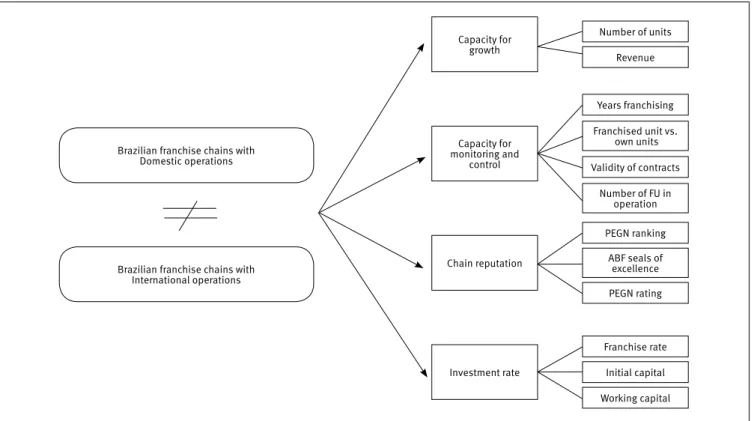
Our research proposes a framework based on the Agen-cy Theory and on the Theory of Resource Scarcity, which serve as means for analyzing variables that may be determinant when considering international operations.
Growth potential
Figure 1.
The research framework
Brazilian franchise chains with Domestic operations
Brazilian franchise chains with International operations
Capacity for growth
Capacity for monitoring and
control
Chain reputation
Investment rate
Number of units Revenue
Years franchising Franchised unit vs.
own units Validity of contracts
Number of FU in operation PEGN ranking
ABF seals of excellence PEGN rating
Franchise rate Initial capital Working capital
Therefore, the irm’s growth capacity in the domestic market can serve as an indicator of the restrictions and limita-tions for growth in the domestic market. In case there are growth obstacles in the domestic market, the search for international operations becomes an alternative to franchise chain growth
(Hackett, 1976; Aydin & Kacker, 1990; Elango, 2007).
Based on the argument mentioned above, it is expected that franchise chains will seek for international operations when they encounter low growth rates, which may indicate saturation in their domestic markets. Thus, it is appropriate to take the risks associated with international operations given the growth diiculties in the home market (Hackett, 1976; Aydin & Kack-er, 1990; Elango, 2007; Mariz-Pérez & García-Álvarez, 2009). Hence, we propose the following hypothesis:
H1: The lower the growth rate of the franchise chain in the domestic market, the greater its presence in international markets.
Monitoring and control capacities
The franchising system involves intense relationships between franchisor and franchisees, where the franchisor has to deal with the dilemma of balancing the control of its franchised units while providing them a certain level of autonomy too. In
inter-national operations, the need to control franchised units inten-siies, given the geographical distance and cultural, economic, political and social diferences among the diverse markets. The greatest diiculty of controlling lies in the provision of services, which creates a dependency and constant interaction between employees and customers (Fladmoe-Lindquist, 1996; Chen, 2010).
The control exerted by franchisors occurs both formal-ly and informalformal-ly with regard to the franchisees. Formal con-trol mechanisms include rules, regulations and penalties estab-lished by franchising agreements. On the other hand, informal control mechanisms depend on the sharing of beliefs and val-ues between franchisors and franchisees (Felstead, 1991;
Alti-nay, 2006; Clarkin & Swavely, 2006;Koza & Dant, 2007). Franchises with international operations require monitor-ing skills for controllmonitor-ingpatterns of their units and to ensure that the franchisees follow all the speciic guidelines. The ability to monitor and control is essential to reduce moral risks, which can be responsible for the deterioration of the franchise chain’s im-age among consumers and for the emergence of opportunistic actions among franchisees (Jensen and Meckling, 1976; Shane, 1996b; Fladmoe-Lindquist, 1996; Elango, 2007).
Welch, 2000; Pizanti & Lerner, 2003). Franchisors may have to deal with unwanted changes in the patterns of operation and per-ceptions of the brand due to the consumer market in the foreign country. Moreover, the partial information that reaches franchi-sors and the exclusive interests of certain franchisees require the intensiication in the monitoring and control of international op-erations (Dant & Nasr, 1998; Quinn & Doherty, 2000; Chow & Frazer, 2003). Hence, we propose the following hypothesis:
H2: The greater the monitoring and control capability of the franchise chain, the greater its presence in the internation-al market.
Chain reputation
One of the strategies used by Brazilian franchise chains to in-crease their recognition in the domestic market is the inter-nationalization of the brand. The presence in international markets shows how to add value in the domestic market by as-sociating the international process to the development of skills and innovations that beneit not only the franchise chain, but also the consumers of the speciic brand (Macedo, 2011). In ad-dition, international operations tend to generate greater recog-nition for irms in the domestic market as well (Eren-Erdogmus, Cobanoglu, Yalcin, & Ghauri, 2010). The efort to develop the brand in international markets is a corporate strategy adopted by companies that constantly seek for a better quality percep-tion of their brands. It is however important to point out that the international presence of a certain brand is strongly correlated to better quality products and higher reputation, which leads to a better sales performance (Steenkamp, Batra, & Alden, 2003; Holt, Quelch, & Taylor, 2004). Such correlations could be proved through a study involving American and Korean consumers
(Steenkamp, Batra, & Alden, 2003).
There are records of American franchise chains, which did not have a strong reputation, entering international markets in the emerging countries in Asia. In some cases, these fran-chise chains could not provide the required support to their in-ternational franchisees. In these situations, the tendency for lo-cal franchisees is to develop the brand recognition themselves; this phenomenon happens due to the low consumer recogni-tion regarding the foreign franchise chain and its limited capac-ity to deal with the cultural diferences in international markets
(Choo, Mazzarol, & Soutar, 2007).
Thus, the process of franchise chains internationaliza-tion involves not only large and consolidated brands; there are some cases of small and little-known internationalized British franchise chains that seeked for operations abroad
(Hadjimar-cou & Barnes, 1998). However, the brand may have little inlu-ence to attract potential franchisees in international markets in situations where the franchise chain does not have a known brand in its own domestic market (Choo et al., 2007). In turn, even though it is a strategy generating visibility to the franchise chain, the costs of these operations tend to be high when pro-moting an international status. Therefore, a plan is required in order to promote the expansion of the chain in international markets, reducing unit costs and generating the sustainability of international operations (Choo et al., 2007).
We argue that international operations of franchise chains require further analysis to ascertain the peculiarities of international markets. In international operations, there are fre-quent adjustments to the products and the business format, which requires from the franchisor a greater commitment to ex-pand in the domestic market (Aydin & Kacker, 1990; Sadi, 1994; Choo et al., 2007). Thus, the expansion in domestic markets be-comes interesting, especially due to the reduced complexity of the market. Speciically regarding the emerging markets, fran-chisors have favorable conditions to expand their business at lower risks and without an urgent need of larger investments
(Stanworth et al., 2001; Welsh et al., 2006). In turn, these con-ditions can stimulate franchise chains with great reputation in the domestic market to intensify their expansion process aiming the domestic market, given the ease to attract new franchisees. Hence, we propose the following hypothesis:
H3: The lower the reputation of the franchise chain in the domestic market, the greater its presence in the interna-tional market.
Investment rate
The initial investment rates required to open a franchise include the inancial amount for concession, capital for initial installa-tion and working capital. The franchise fee is paid upon the ac-quisition of the franchise; it corresponds to the amount required to join a franchise chain. The installation fee includes physical equipment, initial stock and training required to the establish-ment of the franchised unit. The working capital comprises the amount to support the operation (Bordonaba, Polo, & Lucia, 2005; Shane,Shankar, & Aravindakshan, 2006;Gigliotti, 2012). Investment rates, in turn, serve as a moderator during franchi-sees selection.
reputa-tion in order to attract franchisees (Shane et al.,2006; Flannery, 2007; Gigliotti, 2012). Franchise chains with no great reputation brands, can charge lower investment fees in order to attract oth-er franchisees. The lowoth-er investment rates soth-erves as a return to the franchisee for joining a franchise chain with lower market recognition. As the chain increases its reputation, the franchi-sor tends to increase the investment requirement necessary for joining its business (Shane et al., 2006). The collection of high investment rates may discourage individuals interested in ac-quiring franchises, who do not wish to spend large amounts of money on it (Gallini & Wright, 1990). Therefore, chains charging low investment rates tend to have larger number of parties in-terested in acquiring their franchises, given the lower inancial requirement for this acquisition (Shane et al.,2006;Flannery, 2007; Gigliotti, 2012).
Shane (1996b) argues that the lower the investment re-quired for opening a franchise, the greater the attraction of po-tential franchisees to expand the business abroad. For the fran-chisor interested in internationalizing its franchise chain, the level of initial investment required maybe limited. Therefore, charging high investment rates can be a discouraging factor, since the franchise chain tends to position itself as a new en-trant and needs to become competitive when attracting franchi-sees abroad. Hence, we propose the following hypothesis:
H 4: The lower the investment rates required to opening a fran-chise, the greater its presence in the international markets.
METHODOLOGY
Criteria to select the sample among Brazilian franchise chains with domestic operations was the selection of indicators presented in the Franchise Guide (2011), which is very renowned among Brazil-ian academics and publishes data and indexes by Serasa Experi-an. The 2011 issue was used herein since it was the most current edition when this research started being conducted.
The criteria for selection the variables were based on the franchise chains with domestic operation that had the best scores in their respective segments, given that this classiication is di-vided by sectors. Thus, we chose as criteria variables that quali-fy the best chains with domestic operations for this comparison. The variables “rating”, “ABF seal of excellence” and “inal score” were selected. That way, we have disregarded franchise chains that were classiied by revenue, number of units and age, since some internationalized chains with good scores demonstrated diferent scores regarding these three characteristics; e.g. young chains with low invoice and only a few units can still have opera-tions abroad. Initially, 100 Brazilian franchise chains with domes-tic operations were selected (See Table 1).
Exhibit 1. Sample selection criteria for domestic franchises
Criteria Composition index Description Criteria
Author selection index
Rating Reveals overall classiication in annual ranking
5 stars – Excellent 4 stars – Great 3 stars – Good 2 stars – Regular
5 stars – 5 points 4 stars – 4 points 3 stars – 3 points 2 stars – 2 points
ABF Seal of Excellence
Seal of excellence granted by the
association representing the sector Yes or No
Yes – 1 point No – 0 point
Final score
Result of the weighted performance index (weight 0.30), quality (0.30) and satisfaction (0.40)
Chain performance - Based on revenue growth rates and no. of stores
Chain quality - Based on three indicators: support to franchisee, brand strength, solidity and transparency Franchisee satisfaction - It is based on: quality of training, consultancy, operations manual and level of communication with franchisees
Score established by the guide – 0 to 10 points
Segment Sector of operation Category according to ABF Proportional to the sample of internationalized per sector
in order to exclude the outliers with two or more standard deviations, the number of 67 Brazilian franchise chains with internation-al operations was selected. The ive main sectors in which Brazilian franchise chains operate abroad are to be seen in the table be-low. Additionally, the representativeness of each one of these sectors in terms of numbers of chains in the Brazilian franchise mar-ket is also indicated (Table 2).
Table 1.
Segments in which franchises operate
Segment (ABF classiication) Internationalized franchises Franchises in the domestic market
Proportion of internationalized franchise
Beauty, health and natural products 14 508 2.76%
Nourishment 13 637 2.04%
Clothing 10 311 3.22%
Personal accessories and footwear 9 191 4.71%
Education and training 9 284 3.17%
Other sectors 12
In order to complement this study, the table below was created to present the main countries of destination chosen by the Brazilian franchises, in which a high concentration of Latin American countries can be observed.
Table 2.
Main countries operation by the Brazilian franchise chains
Countries Region Number of chains
Portugal Ibero Europe 20
United States North America 20
Paraguay Latin America 16
Angola Lusophone Africa 9
Argentina Latin America 9
Spain Ibero Europe 9
Bolivia Latin America 8
Venezuela Latin America 7
Chile Latin America 5
Colombia Latin America 5
France Europe 5
Japan Asia 5
Mexico Latin America 5
Australia Oceania 4
Costa Rica Latin America 4
South Africa Africa 4
Operationalization of variables and measurement
Exhibit 2. Composition of dependent, independent and control variables and their theories
Perspective Variable Type Reference theory Relationship with the reference theory
International
operation Internationalized Dependent
Agency theory
The greater the capacity for monitoring and control the franchisees, the greater the capacity to seek international operations
Resource scarcity
Internationalization occurs when chain accumulate suicient resources in their operations in their domestic market
Particularities of the
sector Segment of operation Control ----
----Period in operation
Years Control
Agency theory
The age of the company may be related to a greater know-how and the establishment of standards of operation
Resource scarcity
The age of the company may be related to the accumulation of resources
Chain size Total number of units
Control Agency theory
The company size may be related to its capacity for monitoring and controlling the units
Capacity for growth (H1)
Variation in the number of units
Variation in the revenue Independent Resource scarcity
The chain growth rate may be related to limitations in the domestic market, hence the need to seek international market
Capacity for
monitoring and control (H2)
Years of operating through franchises
Proportion of franchised units over the number of own units
Validity of agreements
Number of states in operation
Independent Agency theory
The period of operation in franchising generates expertise in monitoring and control of their units
Franchised units required a greater capacity for monitoring
The duration of the contracts imposed acts as a form of control imposed on franchisees
The number of states in operation demonstrates the capacity for monitoring and control of geographically dispersed franchises
Chain reputation (H3)
Ranking in Franchise Guide
ABF Award
Rating- chain performance
Independent Resource scarcity
The brand is a rare resource, after this accumulation the chain may have to start international operation
Investment rate (H4)
Franchise fee
Franchise installation
Working capital Independent
Agency theory
The inancial resources act as a compensation to the franchise generated
Resource scarcity
Dependent variable: Our dependent variable is the exis-tence or not of international operations accomplished by Bra-zilian franchises in 2011. It was operationalized as a dummy variable with the number (1) for internationalized and (0) for non-internationalized franchise.
Capacity for growth: The franchise chain’s growth rate can be related to limitations in the domestic market (Theory of Re-source Scarcity). We have considered: (i) the increase or decrease of annual units’ number (%) and (ii) the increase or decrease of the chain’s revenue (Shane, 1996a; Castrogiovanni & Justis, 2002;Elango, 2007; Mariz-Pérez & García-Álvarez, 2009).
Monitoring and control capacity: Operating in franchis-es generatfranchis-es expertise in monitoring and controlling units; fran-chised units require a greater capacity for monitoring and the con-tracts elaborated by franchisors are a form of control imposed on franchisees - the number of states in operation demonstrates the capacity for geographically monitoring and controlling dispersed franchises (Agency Theory). We have considered: (i) the number of years of operation; (ii) the proportion of franchised units over the total number of own units (%); (iii) the validity of agreements and; (iv) the number of states in operation - geographic disper-sion. (Lafontaine, 1992;Shane, 1996a; Shane, 1998a; Shane, 1998b;Hofman & Preble, 2003;Weaven & Frazer, 2003; Ma-riz-Pérez & García-Álvarez, 2009;Alon, Liqiang, & Wang, 2010). Reputation of the chain: The franchise chain coming from an emerging market seeks international operations in or-der to obtain resources, which is, in this case, the valuation of its brand in the domestic market (Theory of Resource Scarcity). The (i) irst indicator was based on the ranking “The Best Fran-chises in Brazil” (Franchise Guide - PEGN). According to studies conducted by other authors, we have credited the score 100 for one that ranks irst, and for each position below, we discounted one point from this score (Castrogiovanni & Justis, 2002; Elan-go, 2007). The classiication is done by market segment and there is not a general ranking comprising all segments. Another (ii) indicator is the seal of excellence granted by ABF. The fran-chise that had such award would receive an additional score (10 points). The (iii) other indicator, related to the franchise chain performance, classiies the chains between 5 (50 points) and 2 stars (20 points).
Investment rate: Financial resources are a sort of com-pensation for each franchise generated (Agency Theory) and represent the resources required for the franchise chain capi-talization (Theory of Resource Scarcity). We have considered: (i) the fee for the concession of a unit; (ii) the capital required for the installation of the unit and; (iii) the working capital (Brickley & Dark, 1987;Lafontaine, 1992; Shane, 1996a;Alon, 2001;Dant & Kaufman, 2003; Elango, 2007; Alon et al., 2010).
Control variables: The size can be related to the capaci-ty to monitor and control units (Agency Theory). We have con-sidered: First, the company’s age, considering know-how as a business and including the knowledge acquired before the fran-chise operation. The age may be related to a greater know-how, to the establishment of standards of operation (Agency Theory) and to the accumulation of resources (Theory of Resource Scar-city). Second, the sector in which the company operates, since diferent industries have their own particularities (Alon & McK-ee, 1999b; Elango, 2007). At last, we have considered the chise size, which refers to the total number of units of a fran-chise chain, whether franfran-chised or own units (Elango, 2007).
Statistical processing of data
In this study, the objective was to estimate the association be-tween independent variables and the dependent variable (binary), in other words, if the franchise was internationalized (1) or domes-tic (0). Since the dependent variable in question is a dichotomous variable, the most appropriate regression model for this study is the logistic regression, which is speciic to situations where the de-pendent variable is not rational, but binomial (Hair et al., 2006).
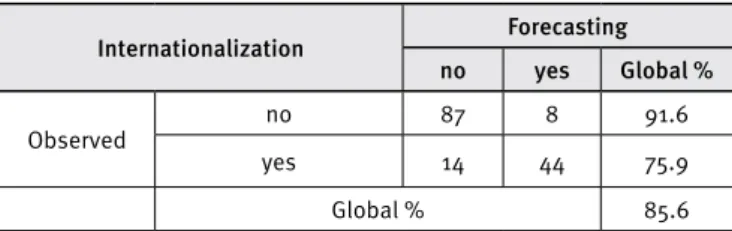
The adjustment of the inal model can be seen through the Hosmer and Lemeshow test, which was 2.524 and p = 0.961, Chi - square statistics was 117.71 with p = 0.000. The logarithmic likelihood function (- 2LL) indicated the decrease from the irst model (initial and inal = 196.89 and 85.355). One may verify in the table below the efectiveness of the model by checking the overall percentage and the percentage of correct classiication (hit ratio), which was higher than 85%.
Table 3.
Classification
Internationalization Forecasting
no yes Global %
Observed no 87 8 91.6
yes 14 44 75.9
Global % 85.6
It is possible to airm that the model is efective, since the overall rating is high (85%) and the Hosmer and Lemeshow test rejects H0 (p>0.05). One may also infer that the Chi-Squase statistics was signiicant (p<0.05) and an expected decreased was observed in the -2LL function.
ANALYSIS OF RESULTS
Table 4 shows the correlation and table 5 the logistic regression coeicients for the ive groups of independent variables analyzed herein.
Table 4.
Correlations
1 2 3 4 5 6 7 8 9 10 11 12
1 Variation in the revenue 1
2 Variation in the number of
units 0.191* 1
3
Proportion of frunchised inits over the number of own units
0.017 -0.101 1
4 Validity of the agreements 0.158 0.042 0.095 1
5 Number of states in
Operation -0.079 -0.133 0.389** 0.018 1
6 Period of operation through
franchises -0.299** -0.350** 0.207* -0.038 0.437** 1
7 Reputation of the Chain
(Franchise Guide Raking) 0.035 -0.082 -0.012 0.086 0.188* 0.11 1
8 Reputation of the chain
(ABF Award) -0.178* -0.124** 0.139 0.032 0.293** 0.0314** 0.231 1
9
Reputation of the chain (ABF Award Reputation of the chain (Rating – chain performance)
0.031 0.029 0.09 0.07 0.109 -0.021 0.406 0.429** 1
10 Franchise fee -0.082 -0.074 -0.128 0.019 -0.181* -0.027 0.047 0.136 0.084 1
11 Franchise installation -0.201* -0.159* -0.252** -0.007 0.094 0.186* -0.11 0.280** 0.129 0.489** 1
12 Working capital -0.156 -0.127 -0.104 -0.084 0.115 0.116 0.009 0.034 0.028 0.372** 0.425** 1
** p < 0.01; *p < 0.05
Table 5.
Logistic regression model
Model 1 Model 2 Model 3 Model 4 Model 5 Exp (b)
H1 – Variation in the revenue -0.683 0.038 0.963
H1 – Variation in the number of units -1.304 -0.006 0.994
H2 – Proportion of frunchised inits over the number of own units -0.245 -0.315 0.729
H2 – Validity of the agreements -0.049 0.383 1.466
H2 – Number of states in operation 0.373* 1.192** 3.293
H2 – Period of operation through franchises 0.071** 0.101** 1.106
H3 – Reputation of the Chain (Franchise Guide Raking) 0.61* 0.556 1.743
H3 – Reputation of the chain (ABF Award) 0.309 -0.288 0.75
H3 – Reputation of the chain (Rating – chain performance) -2.507 -3.408** 0.033
H4 – Franchise fee -0.86 -1.208! 0.299
H4 – Franchise installation 0.072 -1.114 0.121
H4 – Working capital 0.295 0.301 1.351
Constant -0.69 -1.258 -0.38 -0.501 -1.538
Nagelkerke R Square 0.054 0.156 0.527 0.077 0.73
The results indicate that there was no empirical support for Hypothesis 1 with regard to the capacity to grow. The theoret-ical model established that the lower the growth rate of the fran-chise chains in the domestic market, the greater their presence in international markets.
Hypothesis 2, stating that the greater the capacity for monitoring and controlling franchise chains, the greater their presence in the international market, supported by the variables (i) number of states in operation and (ii) franchises’ period in operation. In turn, column “EXP (B)” indicates a high inluence of these two variables in the model that involves characteristics related to the monitoring and controlling of franchises.
These results suggest that the franchises’ operation ex-perience and the geographical dispersion in the country of ori-gin can contribute to increase the franchisors’ conidence when operating internationally. The theoretical framework (Lafon-taine, 1992; Shane, 1996a; Shane, 1998a; Shane, 1998b; Hof-man & Preble, 2003) indicates that companies, which are insert-ed in the franchising activity for a longer period, tend to have more experience operating in chains. It means they are able to accumulate the know-how which shall be the driver for work-ing with geographically dispersed units. Such know-how accu-mulated by the franchisor provides greater certainty when one plans to start operating abroad. Brazil’s geographic location, characterized by great continental and broad areas, leads the franchisors to develop capacities of monitoring and control, since these are critical success factors in the franchising model.
Regarding Hypothesis 3, two variables related to the com-pany’s reputation are signiicant, even though the measurement related to the ranking is marginally signiicant. Meanwhile, in the ifth model (inal model), the variable “ranking” loses signif-icance. Thus, it is only possible to state that the “rating - chain performance” variable is signiicant (p< 0.05). This variable has a negative signal, which means that the lower the reputation in the domestic market, the higher the association with interna-tionalization. These results suggest that franchise chains with greater reputation in the domestic market have a higher focus on their domestic operations. On the other hand, chains with lower reputation in the domestic market can use international operations as strategy to improve their brand reputation inter-nationally.
Hypothesis 4 states that the lower the investment rate re-quired to opening a franchise, the greater its presence in the in-ternational market, only marginally supported (p<0,10). This is the variable with the lowest inluence among the variables ana-lyzed in investment rate. The results suggest that franchises that charge lower investment rates have a greater presence in inter-national markets, compared to those that charge higher
invest-ment rates. This outcome is relevant because internationalized franchise chains are mostly those with lower reputation in the domestic market and, therefore, try to establish more attractive investment rates in order to attract franchisees.
DISCUSSION AND IMPLICATIONS
This research deserves some particular considerations since it refers to the internationalization of franchises in an emerging market, with little experience in international business due to a late internationalization process.
The results indicate that Brazilian franchise chains with lower reputation in the domestic market seek for internation-al operations more intensively than franchises with higher rep-utation in the domestic market. We believe this behavior can be explained by the media exposure in the domestic market ac-complished by some chains that have international operations. These become recognized chains in oicial s franchising sec-tor programs (e.g., ABF and the Brazilian Trade and Investment Promotion Agency - APEX), and newspaper articles subjects. In some cases, franchisors explore the international brand status with their franchisees. In turn, this status integrates the chain as it starts having a greater potential for attracting new franchisees and consumers to these brands. One notices, therefore, a great-er recognition of the franchisor’s efort to the existing franchi-sees and consumers. Thus, internationalization is an alternative to overcome resource scarcity and not a preliminary condition so that the internationalization occurs, as has been pointed out in some studies (Fladmoe-Lindquist, 1996;Shane, 1996a; Alon & McKee, 1999b;Delios & Beamish, 2001; Perrigot et al., 2004). The indings presented herein contradict the assumptions advo-cated by the Theory of Resource Scarcity (TRS), which postulates that the internationalization occurs after accumulation of sui-cient resources in the domestic market.
It seems reasonable to assume that franchises with lower reputation in their domestic market need to ofer more attractive investment rates in order to develop a large pool of internation-al franchisees. Our research supports the fact that franchises charging lower investment rates seem to have greater presence in international markets.
Our indings regarding the monitoring and control of fran-chises is in line with other international studies, especially with regard to the American franchise chains (Shane, 1996a;Elango, 2007). We have found that the capacity for monitoring is one of the determining factors for Brazilian franchises to have interna-tional operations. Our research shows that the prior experience with franchise operations and geographic dispersion in the coun-try of origin contributes to the franchisors’ conidence in oper-ating in international markets. Because Brazil has a continental geographic structure, Brazilian franchise chains with operations in many regions need to develop technical skills and set techno-logical resources to monitor and control their units. This aspect conirms the assumptions proposed by the Agency Theory, given the concern of franchisors to reduce moral risks resulting from a low technical capacity for monitoring and control .
Surprisingly, we did not ind any statistical support re-garding the growth rate in the domestic market of Brazilian chise chains, which could increase the possibility of the fran-chise chain to seek for international markets due to saturation in the domestic market. Surprisingly, this hypothesis did not present enough statistic correlations to make of it a determin-ing factor in Brazilian franchise chains internationalization. Thus, this hypothesis was not proposed by the Theory of Re-source Scarcity, in which accumulation of reRe-sources precedes internationalization.
Our research contributes to the literatures on internation-alization and franchising by pointing out some organizational particularities (growth, ability to monitor and control, reputa-tion and investment rates) of Brazilian franchise chains with do-mestic and international operations. Therefore, this study adds value to the expertise of scholars interested in analyzing other emerging markets regarding franchise chains.
In terms of managerial contributions, our indings should help managers by selecting competencies to be developed in their franchise chains when they are willing to internationalize operations. Managers who intend to align Brazilian franchise chains with some international operation, in order to adjust some attributes in their operations and improve the perfor-mance in international operations.
The analysis of the franchises’ operation areas may pro-vide managers with an important contribution by revealing fea-tures of the internationalization process of these chains with
regard to product and service customization and standardiza-tion in order to adapt to the internastandardiza-tional market. Proporstandardiza-tional- Proportional-ly to the number of chains in the domestic market, some other sectors related to e.g. clothing and personal accessories have demonstrated a stronger commitment internationally, especial-ly when compared to the number of chains in the domestic mar-ket. From this, one can conclude that in this sort of market seg-ment it becomes easier to internationalize franchises since the products ofered demand regular updating. The dynamics of this sector is responsible for facilitating the internationalized fran-chises’ adjustment to the international market since the prod-uct portfolio is more frequently updated in comparison to mar-kets in which the need of standardization is more demanded and the need for innovation is not so urgent.
With regard to the Brazilian franchises’ countries of des-tination, one can notice a process of incremental international-ization guided by cultural and geographic proximity (Johanson & Vahlne, 1977), considering the concentration in Iberian and Lat-in countries. The United States may be seen as a cultural refer-ence country, which has a strong economic potential and an in-tense resident Latin population. These outcomes come forward to the internationalization process of Peruvian restaurants relat-ed by the study of Rivas and Mayorga (2011).
Regarding the managers responsible for the internation-alization process of their franchise chains, choosing the des-tination country is useful to identify diiculties to be faced in an international expansion process. However, the analyses for these Brazilian chains shouldn’t be guided only by the cultural and geographic proximity; institutional indicators such as level of bureaucracy, political stability and level of corruption should be taken into consideration (Melo et al., 2013).
One important limitation of this study is the use of sec-ondary data. Since Brazilian franchises comprehend only a small number of companies (less than 80), the use of secondary databases can be justiied, whereby the analysis of higher num-ber of franchises was possible and common behaviors could be identiied. The use of secondary databases in franchising stud-ies has a certain tradition and is a method accepted among ac-ademics; the use of these database, on the other hand, limits the depth of the analyses when determining organizational fac-tors for internationalizing.
rates required for opening a franchise. We suggest an analysis of these variables in Brazilian franchises operating in the do-mestic market, as well as internationalized franchises.
When elaborating a survey, we recommend investigation of internationalization strategies applied by franchises. Since franchise chains do not expand in uniform ways, one can ind franchises working with a master franchisee, alliance partners, wholly owned outlets and other combining strategies. In these other strategies, points of sales are inserted through the con-version of non-franchised store or even franchises belonging to diferent chains. Along with this conversion, it is important to analyze the impact of these resources added to internation-al operations (Hofman & Preble, 2003). Does the strategy inlu-ence results? Another suggestion is to categorize Brazilian fran-chise chains according to their level of commitment abroad in order to verify diferences in the degree of international devel-opment of Brazilian chains. Thus, future research should ana-lyze the performance of comparative studies between emerg-ing markets in order to understand the behavior of this group of countries and the diferences among themselves and among developed markets, particularly the USA and Europe.
ACKNOWLEDGEMENTS
We would like to thank the Associação Brasileira de Franchising (ABF) for the contribution to this research. We would also like to thank the contributions made by the two evaluators - their comments were very useful for improving the inal version of this paper.
NOTE FROM
RAE
A preliminary version of this article was presented in the 8th Iberoamerican Academy Conference – World in Transition: business, multiculturalism and society on December 2013, promoted by Fundação Getulio Vargas/ Escola de Administração de Empresas de São Paulo (FGV/ EAESP).
REFERENCES
Aliouche, E., & Schlentrich U. (2011). Toward a strategic model of global franchise expansion. Journal of Retailing, 87(3), 345-365.
Alon, I. (2001). The use of franchising by U.S. based retailers. Journal of
Small Business Management, 39(2), 111-122.
Alon, I. (1999). The internationalization of U.S. franchising systems. New York: Garland Publishing.
Alon, I., & McKee, D. (1999a). Towards a macro environmental model of international franchising. Multinational Business Review, 7(1), 76-82.
Alon, I., & McKee, D. (1999b). The internationalization of professional business service franchises. Journal of Consumer Marketing, 16(1), 74-85.
Alon, I., Liqiang, N., & Wang, R. (2010). Internationalization of franchising. In: I. Alon, I. Franchise Globally: Innovation, learning and imitation, pp. 54-72. UK: Palgrave Macmillan.
Altinay, L. (2006). Selection partners in an international franchise organisation. International Journal of Hospitality Management, 25(1), 108-128.
Arbaugh, J. Camp, S., & Cox, L. (2008). Why don’t entrepreneurial irms internationalize more? Journal of Management Issues, 20(3), 366-382.
Aydin, N., & Kacker, M. (1990). International outlook of U.S.-based frachisers. International Marketing Review, 7(2), 43-53.
Baker, B., & Dant, R. (2008). Stable plural forms in franchise systems: an examination of the evolution of ownership redirection research, In: G. Hendrikse, M. Tuunanen, J. Windsperger, & G. Cliquet. Strategy and governance of networks: cooperatives, franchising and strategic alliances, pp. 87-112, Heidelberg: Physica-Verla.
Bordonaba, M., Polo Y., & Lucia, L. (2005). The resource based view in the distribution sector: evidences from the Spanish franchise system, Proceedings of EMAC Conferece, 34.
Borini, F., Rocha, T., & Spers, E. (2012). Desaios para a internacionalização das franquias brasileiras: um survey com franquias internacionalizadas. In: P. Melo, & T. Andreassi (Eds), Franquias Brasileiras: Estratégia, empreendedorismo, inovação e internacionalização, pp.71-87, São Paulo: Cengage.
Borini, F., Souza, M., Biskamp, S., Coelho, F., & Sadzinski, A. (2013). A inluência dos traços da cultura brasileira no processo de internacionalização das franquias nacionais. Gestão Contemporânea, Porto Alegre, 10(13), 313-338.
Associação Brasileira de Franchising. (2013). Evolução do Setor
de Franchising. Retrieved August 5, 2013 from http://www.
portaldofranchising.com.br/numeros-do-franchising/evolucao-do-setor-de-franchising
Associação Brasileira de Franchising. (2014). Franchising cresce 11,9% e tem faturamento de R$ 115 bilhões em 2013. Retrieved April 15, 2014 from http://www.portaldofranchising.com.br/noticias/fran- chising-cresce-11,9-porcento-e-tem-faturamento-de-r-115-bilhoes-em-2013-segundo-abf.
Brickley, J., & Dark, F. (1987). The choice of organizational form: the case of franchising. Journal of Financial Economics, 18(2), 401-420.
Castrogiovanni, G., Combs, J., & Justis, R. (2006). Resource scarcity and agency theory predictions concerning the continued use of franchising in multi-outlet networks. Journal of Small Business Management, 44(1), 27-44.
Castrogiovanni, G., & Justis, R. T. (2002). Strategic and contextual inluences on irm growth: an empirical study of franchisors. Journal of
Small Business Management, 40(2), 98-108.
Chen, H. (2010). The development of international franchise network.
Journal of Global Business Management, 6(1), 1-11..
Chow, L., & Frazer, L. (2003). Servicing customers directly: mobile franchising arrangement in Australia. European Journal of Marketing, 37(3-4), 594-613.
Chu, L., & Sappington, D. (2009). Implementing high-powered contracts to motivate intertemporal efort supply. The Rand Journal of Economics,
40(2) , 296-316.
Clarkin, J., & Swavely, S. (2006). The importance of personal characteristics in franchisee selection. Journal of Retailing and
Consumer Services, 13(2), 133-142.
Combs, J., & Ketchen, D. (2003). Why do irms use franchising as an entrepreneurial strategy?: A meta-analysis. Journal of Management, 29(3), 443-465.
Combs, J. G., Michael, S. C., & Castrogiovanni, G. J. (2004). Franchising: a review and avenues to greater theoretical diversity. Journal of
Management, 30(6), 907-931..
Cuervo-Cazurra, A. (2008). The multinationalization of developing country MNEs: the case of multilatinas. Journal of International
Management, 14(2), 138-154.
Dant, R., & Kaufmann, P. (2003). Structural and strategic dynamics in franchising. Journal of Retailing, 79(2), 63-75.
Dant, R., & Nasr, N. (1998). Control techniques and upward low of information in franchising in distant markets: conceptualization and preliminary evidence. Journal of Business Venturing, 13(1), 3-28.
Declercq, D., Sapienza, H., & Crjns, H. (2005). The internationalization of small and medium-sized irms. Journal of Small Business Economics, 24(4), 409-419.
Delios, A., & Beamish, P. (2001). Survival and proitability: the roles of experience and intangible assets in foreign subsidiary performance
Academy of Management Journal, 44(5), 1028-1038.
Elango, B. (2007). Are franchisors with international operations diferent from those who are domestic market oriented? Journal of Small Business
Management, 45(2), 179-193.
Eren-Erdogmus, I., Cobanoglu, E., Yalcin, M., & Ghauri, P. (2010). Internationalization of emerging market irms: the case of Turkish retailers. International Marketing Review, 27(3), 316-337.
Felstead, A. (1991). The social organization of the franchise: a case of controlled self employment. Work Employment and Society, 5(1), 37-57.
Fladmoe-Lindquist, K. (1996). International franchising: capabilities and development. Journal of Business Venturing, 11(5), 419-438.
Flannery, J. (2007). Micro-franchise against malaria. Stanford Social
Innovation Review, 5(4), 69-70.
Franshise Guide. (2011). Revista Pequenas Empresas e Grandes Negócios (PEGN). Ed. Globo.
Gallini, N., & Wright, B. (1990). Technology transfer under asymmetric information Rand Journal of Economies, 21(1), 147-160.
Gigliotti, B. (2012). O funcionamento do sistema de franchising. In: P. Melo & T. Andreassi (Eds). Franquias Brasileiras: Estratégia, empreendedorismo, inovação e internacionacionalização, (pp. 3-16). São Paulo, SP: Cengage.
Hackett, D. (1976). The international expansion of US franchise systems: status and strategies. Journal of International Business, 7(1), 65-75.
Hadjimarcou, J., & Barnes, J. (1998). Case study: strategic alliances in international franchising: the entry of Silver Streak Restaurant Corporation into México. Journal of Consumer Marketing, 15(6), 598-607.
Hofman, R., & Preble, J. (2003). Convert to compete: competitive advantage through conversion franchising. Journal of Small Business
Management, 41(2), 187-204.
Holt, D., Quelch, J., & Taylor, E. (2004). How global brands compete.
Harvard Business Review, Boston, 82(9), . 68-75.
Jensen, M., & Meckling, W. (1976). Theory of the irm: managerial behavior, agency costs, and ownership structure. Journal of Financial
Economics, 3(4), 305-360.
Johanson, J., & Vahlne, J. (1977). The internationalization process of the irm – a model of knowledge development and increasing foreign market commitments. Journal of International Business Studies, 8(1), 25-34. Khanna, T., Palepu, K., & Bullock, R. (2010). Winning in emerging markets. Harvard Business Review, 88(6), 80-85.
Khauaja, D. (2009). Gestão de marcas na estratégia de internacionalização de empresas: um estudo com franqueadoras brasileiras, (Doctoral dissertation). Faculdade de Economia, Administração e Contabilidade, Universidade de São Paulo, São Paulo, Brazil.
Koza, K., & Dant, R. (2007). Efects of relationship climate, control mechanism, and communication on conlict resolution behavior and performance outcomes. Journal of Retailing, 88(3), 279-296.
Lafontaine, F. (1992). Agency theory and franchising: some empirical results. Rand Journal of Economics, 23(2), 263-283.
Macedo, T. (2011). A globalização do franchising brasileiro. Revista Franquia e Negócios, 39. Lamonica.
Mariz-Pérez, R., & García-Álvarez, T. (2009). The internationalization strategy of Spanish indigenous franchised chains: a resource-based view. Journal of Small Business Management, 47(4), 514-530.
Mathewson, G., & Winter, R. (1985). Economic of franchise contracts.
Journal of Law and Economics, 28(3), 503-526.
Melo, P., & Andreassi, T. (2010). Publicação cientíica nacional e internacional sobre franchising: Levantamento e análise do período 1998-2007. RAC-Revista de Administração Contemporânea, 14(2), 268-288.
Melo, P., Borini, F., Oliveira Jr., M., & Parente, R. (2013). Internationaliza-tion Market of Brazilian Franchises In: Annals of Academy of International Business Latin America, Puebla (MEX).
Oicial Franchise Guide (2011). Associação Brasileira de Franchising. Ed. Lamonica.
Oviatt, B., & McDougall, P. (2005). Deining international entrepreneurship and modeling the speed of internationalization. Entrepreneurship Theory
e Practice, 29(5), 537-554.
Perrigot, R., Cliquet, G., & Mesbah, M. (2004). Possible applications of survival analysis in franchising research. International Review of Retail,
Distribution e Consumer Research, 14(1), 129-143.
Petersen, B., & Welch, L. (2000). International retailing operations: downstream entry and expansion via franchising. International Business
Review, 9(4), 479-496.
Pizanti, I., & Lerner, M. (2003). Examining control and autonomy in the franchisor-franchisee relationship. International Small Business
Journal, 21(2), 131-159.
Prasad, S., & Babbar, S. (2000). International operations management research. Journal of Operations Magagement, 18(1), 209-247.
Quinn, B., & Doherty, A. (2000). Power and control in international retail franchising: evidence from theory and practice. International Marketing
Ribeiro, F., & Melo, P. (2007). O processo de internacionalização da rede de franquias “O Boticário” no mercado norte-americano. Revista FACEF
Pesquisa: Desenvolvimento e Gestão, 10(3), 299-308.
Rivas, R., & Mayorga, D. (2011). Internationalization of Peruvian cuisine: an analysis of internationalization strategies of Peruvian restaurants.
Revista Innovar, 11(39), 205-2016.
Sadi, M. (1994). International business expansion through franchising: the case of fast-food industry (Doctoral dissertation). Business Administration, Virgina Polytechnic Institute and State University, Blackshuig, United States of America.
Shane, S. (1996a). Why franchise companies expand overseas. Journal
of Business Venturing, 11(2), 73-88.
Shane. S. (1996b). Hybrid organizational arrangements and their implications for irm growth and survival: a study of new franchisors.
Academy of Management Journal, 39(1), 216-234.
Shane, S. (1998a). Explaining the distribution of franchised and company-owned outlets in franchise systems. Journal of Management, 24(6), 717-739.
Shane, S. (1998b). Making new franchise systems work. Strategic
Management Journal, 19(7), 697-707.
Shane, S., Shankar, V., & Aravindakshan, A. (2006). The efects of new franchisor partnering strategies on franchise system size. Management
Science, 52(5), 773-787.
Stanworth, J., Price, S., & Purdy, D. (2001). Franchising as a source of technology transfer to developing countries. In: D. Welsh e I. Alon (Eds.),
International franchising in emerging markets: Central and Eastern Europe and Latin America, (pp. 87-103). Chicago: CCH.
Steenkamp, J., Batra, R., & Alden, D. (2003). How perceived brand globalness creates brand value. Journal of International Business
Studies, 34(1), 53-65.
Sull, D., & Escobari, M. (2005). Success against the odds: what Brazilian champions teach us about thriving in unpredictable markets. London: Elsevier.
Weaven, S., & Frazer, L. (2003). Predicting multiple unit franchising: a franchisor and franchisee perspective. Journal of Marketing Channels, 10(3-4), 53-82.