NUTRITIONAL CONDITIONS
Márcio José Rossi*, Vetúria L. Oliveira
Departamento de Microbiologia, Imunologia e Parasitologia, Centro de Ciências Biológicas, Universidade Federal de Santa
Catarina, Florianópolis, SC, Brasil.
Submitted: November 13, 2009; Returned to authors for corrections: September 29, 2010; Approved: January 13, 2011.
ABSTRACT
The most important plant species employed in reforestation programs depend on ectomycorrhizal fungi for
their establishment and growth. The exploitation of this symbiosis to improve forest productivity requires
fungal inoculants in a large scale level. To develop such a technology it is necessary to define the optimal
composition of the culture medium for each fungus. With these objectives in mind, the effect of the
composition of the culture medium on biomass production of the ectomycorrhizal fungus Pisolithus
microcarpus (isolate UFSC-Pt116) was studied. The original composition of two culture media, already
employed for cultivation of ectomycorrhizal fungi, was submitted to several variations with the C/N ratio as
the main variable. A variation of the Pridham-Gottlieb medium was the most efficient for the production of
biomass. Therefore, it was submitted to a factorial assay where glucose, peptone and yeast extract
components were the factors analyzed. Results showed that the glucose concentration may be increased up
to 40 % in order to promote higher biomass production. Peptone had a positive effect on this variable,
whereas yeast extract promoted a deleterious effect. These results indicate that it is advisable to eliminate
yeast extract from the medium and replace it with peptone prior to use.
Key words:Pisolithus microcarpus, culture media, C/N ratio, submerged cultivation.
INTRODUCTION
The ectomycorrhizal symbiosis is an important factor for
the survival and growth of many forest trees. The
predominance of positive effects of this symbiosis in the
establishment and growth of forest plants demonstrates that
ectomycorrhizal inoculation is a valuable tool for plant
production in forestry (7, 19). Species of the ectomycorrhizal
genus Pisolithus are among those most studied concerning the
effects on plant growth. The species of that genus are relatively
easy to cultivate in laboratory and are able to adapt to many
soil and environmental conditions, hence their frequent
utilization in the inoculation of seedlings in reforestation
programs (13, 14).
The capacity of the ectomycorrhizal fungi (ECM) to
associate with plants under natural conditions is a sign that the
fungi derive carbonate substances from the plant host, which
are essential for the growth of those fungi (19). In culture,
these fungi require vitamins and sugars as growth factors.
Many isolates are able to metabolize several carbon sources
such as cellulose, maltose, trehalose and sucrose. However,
Smith (18) found that glucose is the best assimilated sugar by
Pisolithus tinctorius.
Most ECM can metabolize inorganic sources of nitrogen,
NH4+ or NO3-, the main source being the ammonium, because
enzymes involved in its assimilation are present (4). It seems
that Pisolithus species can utilize both ammonium and nitrate
(18). Several authors have observed that some isolates of this
genus are also able to utilize organic N, although this ability
has shown significant variation between species and isolates (2,
5, 6, 20). The capacity of an ectomycorrhizal fungus to obtain
N directly from proteins is an important trait since this is the
most abundant form of N available in temperate forest soils due
to the low mineralization rates in these ecosystems (1).
However, the capacity to utilize organic N in culture does not
necessarily imply that the microorganism is able to do the same
in natural conditions, where proteins may be linked to complex
chemical compounds such as polyphenols.
The balance between carbon and organic nitrogen sources
may also contribute to controlling the pH and hence to
increasing productivity of the culture. Smith (18) optimized the
biomass production of P. tinctorius in Modified
Melin-Norkrans (MMN) medium, developed by Marx (12), with an
equimolar solution of citric acid and calcium citrate (pH 5.4)
before sterilization. The Pridham-Gottlieb (PG) medium, used
by Litchfield and Arthur (11) and Kuek (10) to cultivate P.
tinctorius, is self-buffered by the presence of KH2PO4 and
K2HPO4. In this medium, organic components such as peptone
and yeast extract also contribute to control the pH. Rossi et al.
(17) obtained an expressive biomass production by Pisolithus
microcarpus through modifications of this medium in an airlift
bioreactor.
The inoculant production of ectomycorrhizal fungi
demands that studies have to be undertaken to determine the
nutritional requirements of these organisms before their
massive cultivation in bioreactors and inoculation in forest
plants take place. Another important factor to be studied
concerns the maximum biomass concentration in the bioreactor
in order to establish the initial level of nutrients to achieve such
production. This depends on the fungus morphology during
growth and on the hydrodynamic and oxygen transfer in the
bioreactor system (16). Most studies on cultivation of ECM
were performed in small flask scale, and only very few
involved large scale inoculant production. In order to help the
establishment of inoculant production methods, this study aims
to test some modifications of MMN and PG media for the
cultivation of the ectomycorrhizal fungus Pisolithus
microcarpus, one of the ectomycorrhizal fungi frequently
recorded in Eucalyptus plantations in southern Brazil (8).
MATERIAL AND METHODS
Fungal isolate
The ectomycorrhizal fungus Pisolithus microcarpus
(Cooke and Massee) G. Cunn., isolate UFSC-Pt116, was
employed in this study. This fungus was isolated from
Eucalyptus dunnii plantations in the State of Santa Catarina,
southern Brazil, and is kept in the ectomycorrhizal fungi
culture collection at the "Laboratório de Ectomicorrizas" at the
”Universidade Federal de Santa Catarina”, Florianópolis, SC,
Brazil. The isolate is maintained in solid MMN. The cultures
are stored at 25±1 ºC, and transferred to fresh medium every
two months.
Culture media
Modifications of two culture media were utilized as basal
media. These media were MMN (modified Melin-Norkrans)
be called PGK hereafter. The MMN medium presented the
following composition (g.L-1): glucose 10.0; malt extract 3.0;
CaCl2 0.05; NaCl 0.025; (NH4)2PO4 0.25; KH2PO4 0.50;
MgSO4.7H2O 0.15; and thiamine-HCl 100 µg.L-1 and 1.2 mL
of FeCl3 (1%, w/V). The PGK medium contained (g.L-1):
glucose 10.0; peptone 3.33; yeast extract 0.67; NH4NO3 1.0;
KH2PO4 0.264; K2HPO4 0.628; MgSO4.7H2O 0.33;
CuSO4.5H2O 0.0021; MnCl2.4H2O 0.0006; ZnSO4.7H2O
0.0005; and FeSO4.7H2O 0.0004. In both media, both addition
of glucose and pH adjustment to 5.8 were performed before
sterilization.
Inoculation procedures and culture conditions
Mycelia plugs with 7 mm-diameter were obtained from 20
to 25-day old cultures in MMN-agar in Petri dishes. These
plugs were previously tested for viability and purity in fresh
culture medium in Petri dishes for 2 days of incubation. Five
disks were employed to inoculate 30 mL of liquid medium
(MMN or PG) in 250 mL flasks. Medium had been previously
sterilized at 121 ºC for 20 min. The cultures were incubated at
25±1 °C in the dark with 3 replicates per treatment.
Analytical procedures
The amount of residual glucose was determined through
an enzymatic technique called GOD (glucose oxidase), by
employing the reagent EnzColor from Biodiagnóstica Indústria
Química Clínica Ltda. Biomass was estimated after drying the
mycelium at 75 °C for a period of 48 hours, and the pH was
determined conventionally. All samples represented the total
content of each flask.
Effect of the medium composition on the growth of Pisolithus microcarpus
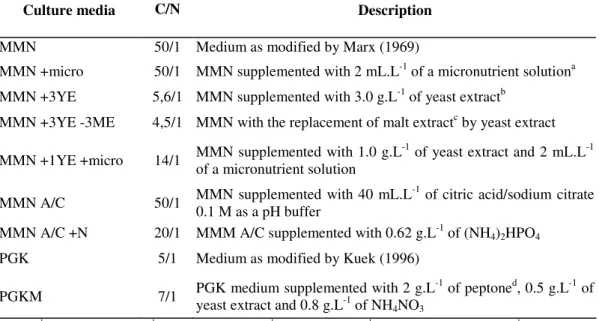
Different modifications on the composition of the culture
media (Table 1) were tested in order to obtain preliminary
information about the nutritional requirements of the fungus.
Two assays were performed and the fungus was cultivated in
the different media and incubated as described above.
Table 1. C/N ratio on the different modifications of Melin-Norkrans and Pridham-Gotllieb media.
Culture media C/N
(g/g)
Description
MMN 50/1 Medium as modified by Marx (1969)
MMN +micro 50/1 MMN supplemented with 2 mL.L-1 of a micronutrient solutiona
MMN +3YE 5,6/1 MMN supplemented with 3.0 g.L-1 of yeast extractb
MMN +3YE -3ME 4,5/1 MMN with the replacement of malt extractc by yeast extract
MMN +1YE +micro 14/1 MMN supplemented with 1.0 g.L
-1
of yeast extract and 2 mL.L-1 of a micronutrient solution
MMN A/C 50/1 MMN supplemented with 40 mL.L
-1
of citric acid/sodium citrate 0.1 M as a pH buffer
MMN A/C +N 20/1 MMM A/C supplemented with 0.62 g.L-1 of (NH4)2HPO4
PGK 5/1 Medium as modified by Kuek (1996)
PGKM 7/1 PGK medium supplemented with 2 g.L
-1
of peptoned, 0.5 g.L-1 of yeast extract and 0.8 g.L-1 of NH4NO3
In the first experiment out of six formulations tested, five
were modifications of the MMN medium. In the second assay,
two other modifications of the MMN medium and one of the
PGK represented the three treatments. Residual glucose,
biomass and pH of the culture media were measured at the end
of the cultivation period, which lasted 14 days. In the second
assay, there were five treatments represented by three
formulations of the MMN medium and two of the PGK
medium. The biomass yield (YX/S) was calculated using the
following equation:
0 X/S
0
X
X
Y
=
S
S
−
−
(1)
where (g.L-1): X0 = initial biomass; S0 = initial glucose; X =
final biomass; S = final glucose.
Biomass productivity (Px), in g.L-1.day-1, was calculated by the
equation:
X 0
X X
P = t
−
(2)
where: t = time of cultivation (days)
The medium that promoted maximum biomass production
in the preliminary assays was employed in the next study in
order to determine the minimal concentration of the more
expensive nutrients to allow for maximum growth. For that
purpose, a complete factorial design 23, including 4 central
points, was employed where the factors (variables) were:
glucose (GL), peptone (PP) and yeast extract (YE). The
relation between the biomass produced and substrate (glucose)
was used to obtain the values of y (gbiom.ggluc-1) according to the
equation below:
biomass produced
y =
initial content of glucose
(3)
The conversion defined by Equation 3 differs from the
classical definition of YX/S because it considers the entire amount
of glucose present in the culture medium instead of only the
amount used by the fungus. To establish the algorithm to
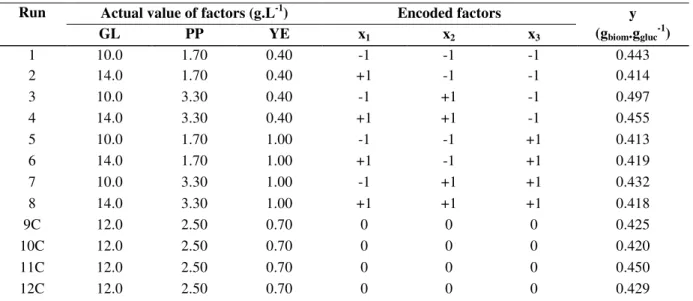
calculate the effects, the actual levels of the factors were
replaced by their respective encoded values (+1 and –1) (3) as
shown in Table 2.
Table 2. Real and encoded levels of the factors studied (glucose, peptone and yeast extract) and the conversion of substrate (glucose) into biomass (y), according to a factorial design.
Run Actual value of factors (g.L-1) Encoded factors
GL PP YE x1 x2 x3
y (gbiom.ggluc
-1 )
1 10.0 1.70 0.40 -1 -1 -1 0.443
2 14.0 1.70 0.40 +1 -1 -1 0.414
3 10.0 3.30 0.40 -1 +1 -1 0.497
4 14.0 3.30 0.40 +1 +1 -1 0.455
5 10.0 1.70 1.00 -1 -1 +1 0.413
6 14.0 1.70 1.00 +1 -1 +1 0.419
7 10.0 3.30 1.00 -1 +1 +1 0.432
8 14.0 3.30 1.00 +1 +1 +1 0.418
9C 12.0 2.50 0.70 0 0 0 0.425
10C 12.0 2.50 0.70 0 0 0 0.420
11C 12.0 2.50 0.70 0 0 0 0.450
12C 12.0 2.50 0.70 0 0 0 0.429
Data for biomass and biomass yield were submitted to
analysis of variance (ANOVA) and means compared using the
Fisher’s LSD test (p 0.05). The statistical significance of the
model to explain the effects of the factors was obtained by
ANOVA. This analysis included Fisher’s F-test (p 0.05) and
its associated coefficient of determination R2. All statistical
analyses were performed using the STATISTICA® 6.0
software (StatSoft Inc., Tulsa, Oklahoma, USA).
RESULTS AND DISCUSSION
Effect of the medium composition on the growth of Pisolithus microcarpus
During the first 10 days of cultivation, no treatment was
able to promote glucose exhaustion. After 25 days, the media
in the majority of treatments still presented more than 10% of
residual glucose (Figure 1). However, the MMN A/C +N
treatment promoted the highest yield (YX/S) (Figure 2), with
expressive biomass production of 5.0 g.L-1 and productivity of
0.20 g.L-1.day-1. The second highest value of biomass was
obtained with MMN A/C treatment, with 0.18 g.L-1.day-1.
These results seem to be related to the properties of the citric
acid, which acts as a pH buffer under acid conditions, or as a
chelating agent of metallic ions in the culture medium. It was
observed that the pH of the medium stabilized at 3.15, which is
the pKa of the citric acid. Besides these effects, it must also be
considered that this is one of the acids in the Krebs cycle and
may also be consumed by the fungus during the energy
producing metabolism.
The main difference between treatments MMN A/C +N
and MMN A/C resided in the amount of nitrogen. Results
indicate that the C/N ratio of 20/1 in the former is more
advantageous for the growth of the fungus. Smith (18) also
observed that a C/N ratio of 20/1 resulted in better biomass
production by the fungus P. tinctorius in MMN medium.
Addition of micronutrients to the culture medium (MMN
+micro) contributed to improving biomass production during
the first 10 days of cultivation (Figure 1a) when compared to
the control treatment (original MMN). However, after 25 days
(Figure 1b), the biomass produced by this treatment was
inferior to that of the control. The treatment with the addition
of yeast extract (YE) and those where malt extract (ME) was
replaced by YE (MMN +3YE and MMN +3YE -3ME) also
presented a lower biomass yield than the control (Figure 2),
inspite of the buffering effect of the proteins present in the
yeast extract. In the medium supplemented with 3 g.L-1 of YE
(MMN +3YE) (Figure 1b), the low biomass production
indicates a negative effect of this compound on the growth of
the fungus.
Figure 1. Biomass, residual glucose and pH after 10 days (a) and 25 days (b) of static cultivation of the ectomycorrhizal fungus Pisolithus microcarpus, at 25±1 °C, under different nutritional conditions. Values of biomass indicated by different letters are significantly different
according to Fisher's LSD test (p
≤
0.05).a)
Figure 2. Biomass yield (YX/S) after 10 and 25 days of a static cultivation of the ectomycorrhizal fungus Pisolithus microcarpus
in different modifications of the MMN culture medium at 25 °C.
Values indicated by different letters are significantly different
according to Fisher's LSD test (p
≤
0.05).Comparing the results after 10 days of cultivation (Figure
1a) to those after 25 days (Figure 1b), it is possible to notice
that all treatments containing YE presented lower biomass
production after 10 days. However, after this period there was a
recovery of the production rate, which suggests an adjustment
of the fungus to the medium conditions. A lag phase is not
recommended because it represents a longer cultivation period
and higher nutrient requirements, contributing to lower
biomass yield (0.34 in the treatment MMN +3YE, 0.38 in the
treatment MMN +3YE -ME, and 0.41 in the control MMN)
(Figure 2). Moreover, treatments containing YE presented a
dark color at the end of the cultivation, indicating intense
secondary metabolism. In this case, it shows a negative feature
of these treatments because it may contribute to loss of biomass
yield.
We suggest that the long term cultivation and the presence
of residual glucose in this assay impose high risk of
contamination of the inoculant. Moreover, residual glucose may
also indicate the existence of a growth limiting factor, which
could inhibit its complete utilization. For these reasons, a second
assay was performed, in which the amount of yeast extract in the
MMN medium was reduced to only 1.0 g.L-1, according to
Pradella et al. (15).
Among the new formulations studied, the PGK medium
and its variation (PGKM) were those that promoted glucose
exhaustion by the fungus (Figure 3), reaching a final pH of 2.7.
Cultivation time length was 12 days, which is considered
enough for the total uptake of glucose from both media, and
has ensured productivity of 0.50 g.L-1.day-1, higher than that
observed in any other formulation based on MMN medium.
Figure 3. Biomass, residual glucose, and final pH after 12 days of static cultivation of the ectomycorrhizal fungus Pisolithus
microcarpus, in different culture media, at 25 ± 1°C. Values indicated by different letters are significantly different according to Fisher's
LSD test (p
≤
0.05).The addition of 1 g.L-1 of yeast extract (YE) to the MMN
(MMN +1YE +micro, and MMN +1YE) increased biomass
production when compared to the original MNM formulation
(control). Values of pH after cultivation in these media (pHf)
were higher than in any other treatment (Figure 3). This was
possibly the result of a buffering effect of the yeast extract
When ectomycorrhizal fungi are cultivated in culture
systems without pH control, often the pH decreases reaching
values close to 2.5 (17). The stabilization of the pH then takes
place thank to a buffering effect of the phosphoric acid (pKa =
2.12). In the presence of this acid, pH values stay around pH =
pKa ± 1 (9). Although the fungus may tolerate low pH
conditions, it has to be maintained in the optimum range as
much as possible in order to obtain high productivity. In
conclusion, even if the addition of yeast extract has contributed
to stabilizing the culture pH, it was not possible to observe its
role as a fungal growth promoting factor as suggested by
Pradella et al. (15).
Several treatments promoted significant changes in the
color of the media during the cultivation. Such changes are
evidence of differences in terms of metabolite production, but
they did not present a direct relationship with biomass
production, even though the treatments presenting most intense
visual pigmentation were also those with lower biomass values.
We have also observed that pigmentation of the culturemedium
may occur as a result of fungal growth itself. However,
presence of pigmentation could indicate limitations inherent to
growing conditions.
Thus, the MMN medium was considered unbalanced for
cultivation of the fungus, hence not convenient for cultivation
procedures whose goals are high biomass production.
However, this medium seems to be appropriate for the
maintenance of fungal cultures. Its high C/N ratio and slower
growth will contribute to reducing both the frequency of
sub-culturing and the costs related to this process. On the other
hand, the PGK medium showed high efficiency for biomass
production of the ectomycorrhizal fungi, but further studies are
necessary in order to improve its composition.
Improvement of the culture medium through a factorial design
The objective of this experiment was to study variations in
the formulation of the PGK medium, in order to maintain high
biomass productivity and, at the same time, to reduce the
amount of certain ingredients considered to be expensive to a
minimum. The ingredients that are employed in higher quantity
in the medium are peptone (PP), yeast extract (YE) and glucose
(GL), thus contributing to high costs. The concentration of
glucose was increased by 40 % to verify if there was any other
limiting nutrient within this range (from 10 to 14 g.L-1) and if it
was possible to increase yield. This increase was established
taking into consideration the volume of medium available for
fungal growth into the bioreactor.
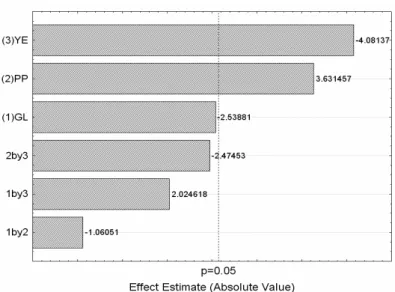
Factors PP and YE, individually, promoted significant
effects on substrate conversion (y). Factor GL and the
interactions between the factors studied had no significant
effect on this response. The Pareto chart, shown in Figure 4,
allows for a better understanding of this statement.
Figure 4. Pareto diagram illustrating the standardized effects (tcalc) of
peptone (PP), yeast extract (YE) and glucose (GL) on the substrate
conversion (y) by the ectomycorrhizal fungus Pisolithus microcarpus.
Values located on the right side of the broken line (ttab) are those
significantly different, according to the t-test (p 0.05).
Although the concentration of glucose (GL) presented no
effect on substrate conversion (y), results showed that it is
amount of this component up to 40 % without reducing the
conversion.
The addition of peptone (PP) has shown a favorable effect
on substrate conversion (y) (Figure 4). Results indicated that
the highest levels of peptone had a tendency to increase this
conversion, and this effect was even higher when addition of
peptone was combined to the smallest amounts of yeast extract
(YE) (Table 2). Yeast extract has shown a negative effect on
substrate conversion, which was also observed in the MMN
medium in the formulations containing the highest amounts of
yeast extract in the first 10 hours of cultivation (Figure 1a).
An ANOVA table for the regression model from Equation
4 is presented in Table 3, where the coefficient of
determination was 0.905 and the calculated F-value (Fcalc) was
1.6 times higher than the tabulated (Ftab) value, indicating
significant agreement between experimental results and the
values estimated by the statistical model.
Y = 0.435 + 0.014PP – 0.016YE (4)
Table 3. ANOVA for the linear model of substrate (glucose) conversion (y).
Source of Sum of squares Degrees of Mean squares Fcalc
Regression 0.005766 6 0.000961 7.94
Error 0.000605 5 0.000121
Total 0.006371 11
Ftab (6.5;0.05) = 4.95; R2, coefficient of determination = 0.905
CONCLUSIONS
PGK medium is more efficient than MMN to promote
biomass accumulation of the ectomycorrhizal fungus Pisolithus
microcarpus. The presence of peptone in the former medium
seems to be the factor which most contributed to that effect due
to its rich nutritive composition and more efficient pH
buffering. Yeast extract, on the other hand, may be eliminated
or replaced by a higher amount of peptone, which will
contribute to reducing media costs. Glucose concentration may
be increased up to 40 %, promoting significant increase on
biomass production without causing any limitation of other
nutrients. This variation of the PGK medium may be
potentially employed in studies of ectomycorrhizal inoculant
production in bioreactor.
ACKNOWLEDGEMENT
The authors gratefully acknowledge Conselho Nacional de
Desenvolvimento Científico e Tecnológico (National Council
for Scientific and Technological Development - CNPq) and
Coordenação de Aperfeiçoamento de Pessoal de Nível
Superior (Coordination for Improvement of Higher Level
Personnel - CAPES) for their financial support.
REFERENCES
1. Abuzinadah, R.A.; Read, D.J. (1989). The role of proteins in the nitrogen nutrition of ectomycorrhizal plants. New. Phytol. 112 (1), 55-60. 2. Anderson, I.C.; Chambers, S.M.; Cairney, J.W.G. (1999). Intra- and
interspecific variation in patterns of organic and inorganic nitrogen utilization by three Australian Pisolithus species. Mycol. Res. 103, 1579-1587.
3. Box, G.E.P; Hunter, W.G.; Hunter, J.S. (1978). Statistics for Experiments. John Wiley & Sons, Toronto.
4. Cairney, J.W.G. (1999). Intra-specific physiological variation: implications for understanding functional diversity in ectomycorrhizal fungi. Mycorrhiza 9 (3), 125-135.
6. Dickie, I.A.; Koide, R.T.; Stevens, C.M. (1998). Tissue density and growth response of ectomycorrhizal fungi to nitrogen source and concentration. Mycorrhiza 8 (3), 145-148.
7. Garbaye, J. (1990). Utilisation des mycorhizes en sylviculture. In: (Strullu, D.G., (ed.). Les mycorhizes des arbres et plantes cultivées), Lavoisier, Paris, France, p.197-248.
8. Giachini, A.J.; Oliveira, V.L.; Castellano, M.A.; Trappe, J.M. (2000). Ectomycorrhizal fungi in Eucalyptus and Pinus plantation in southern Brazil. Mycologia 92 (6), 1166-1177.
9. Jeffery, G.H.; Basset, J.; Mendham, J.; Denney, R.C. (1992). Vogel -Análise Química Quantitativa. Editora LTC, Rio de Janeiro.
10. Kuek, C. (1996). Shake-flask culture of Laccaria laccata, an ectomycorrhizal basiodiomycete. Appl. Microbiol. Biotechnol. 45 (3), 319-326.
11. Litchfield, J.H.; Arthur, M.F. (1983). Growth of selected ectomycorrhizal fungi in aerated liquid culture. Develop. Ind. Microbiol. 24, 289-293.
12. Marx, D. H. (1969). The influence of ectotrophic mycorrhizal fungi on the resistance of pine roots to pathogenic infections. I. Antagonism of mycorrhizal fungi to root pathogenic fungi and soil bacteria. Phytopathology 59 (2), 153-163.
13. Marx, D.H.; Hatch, A.B.; Mendicino, J.F. (1977). High soil fertility decreases sucrose content and susceptibility of loblolly pine roots to ectomycorrhizal infection by Pisolithus tinctorius. Can. J. Bot. 55 (12),
1569-1574.
14. Marx, D.H.; Ruehle, J.L.; Kenney, D.S.; Cordell, C.E.; Riffle, J.W.; Molina, R.J.; Pawuk, W.H.; Navratil, S.; Tinus, R.W.; Goodwin. O.C. (1982). Commercial vegetative inoculum of Pisolithus tinctorius: inoculation techniques of development of ectomycorrhizae on container-grow tree seedlings. For. Sci. 28 (2), 273-400.
15. Pradella, J.G.C.; Zuccolo, M.; Lopes, S.A.R.; Oliveira, M.S. (1991). Pisolithus tinctorius vegetativa mycelia production: effects of nitrogen sources and cultivation in stirred tank fermenter. Rev. Microbiol. 22 (1), 7-11.
16. Rossi, M.J.; Furigo Jr., A.; Oliveira, V.L. (2007). Inoculant production of ectomycorrhizal fungi by solid and submerged fermentations. Food. Technol. Biotechnol. 45 (3), 277-286.
17. Rossi, M.J.; Souza, J.A.R.; Oliveira, V.L. (2002). Inoculum production of the ectomycorrhizal fungus Pisolithus microcarpus in an airlift bioreactor. Appl. Microbiol. Biotechnol. 59, 175-181.
18. Smith, R.A. (1982). Nutritional study of Pisolithus tinctorius. Mycologia 74 (1), 54-58.
19. Smith, S.E.; Read, D.J. (2008). Mycorrhizal symbiosis. Academic Press, London, New York.
20. Turnbull, M.H.; Goodall, R.; Stewart, G.R. (1995). The impact of mycorrhizal colonization upon nitrogen source utilization and metabolism in seedlings of Eucalyptus grandis Hill ex Maiden and Eucalyptus maculata Hook. Plant, Cell Environ. 18 (12), 1386-1394.