MyPlate
, Children, and Lack of Formative Evaluation:
A Systematic Review
Nina Roofe Elson Bihm
University of Central Arkansas
Beginning at the critical preschool level, preventing childhood obesity is a multifaceted challenge with health, economic, ethical, and social implications. In particular, increasing emphasis will be placed upon educating children and their caregivers about the USDA’s MyPlate model of good nutrition. To date, evidence-based efforts to teach preschool children nutrition facts and appropriate behaviors are limited, and developers of evidence-based practices do not appear to use formative-evaluation to an adequate extent. Crucial among these
evaluations is assessing what the preschool child already knows about the MyPlate components (fruits, vegetables, grains, protein, and dairy). University researchers along with graduate students in nutrition and psychology conducted a review of current research regarding the use of MyPlate in early childhood education settings. Minimal empirical studies were found, indicating a need to expand the literature in the areas of MyPlate, early childhood nutrition
education, and formative evaluation. In the current article, authors present the systematic review process of the scant knowledge that exists regarding formative evaluation research to document what preschool-age children already know about nutrition, suggest ways that this research base might be expanded, and advocate for the increased use of formative evaluation in both research and curriculum development.
Keywords: MyPlate, formative evaluation, nutrition education, children, pediatric
Introduction
Health Implications
Beginning at the critical preschool level, preventing childhood obesity is a multifaceted challenge with health, economic, ethical, and social implications. In particular, increasing emphasis will be placed on educating children and their caregivers about the U.S. Department of Agriculture’s (USDA) MyPlate model of good nutrition. As we later demonstrate, evidence-based efforts to teach preschool-age children nutrition facts and appropriate behaviors are
limited, and developers of evidence-based practices do not appear to use formative evaluation to
an adequate extent. Crucial among these evaluations is assessing what the preschool child already knows about the MyPlate components (fruits, vegetables, grains, protein, and dairy).
Pediatric obesity has reached epidemic proportions in the U.S. According to the latest national survey conducted by the Centers for Disease Control and Prevention (CDC), 17% of children and adolescents aged 12-19 years are overweight (Ogden & Carroll, 2010), and one in seven low-income preschool children is obese (CDC, 2010) . Unfortunately, ethnic minority status and low socioeconomic status correlate with pediatric obesity (CDC, 2012). The increasing
prevalence of overweight youth presents a huge public health challenge, since overweight youth are more likely to become overweight adults. Additionally, improved body image and reduced teasing provide psychological and social benefits to children, which may enhance academic learning (Pyle et al., 2006).
Education Implications
Effective school-based programs are critical for addressing this problem (Briggs, Fleischhacker, & Mueller, 2010; Ritchie, Crawford, Hoelscher, & Sothern, 2006). However, studies show varying degrees of effectiveness of school-based programs in certain areas, such as enhancing nutrition knowledge and behavior change (Heim, Stang, & Ireland, 2009; Sweitzer et al., 2011). Despite considerable efforts, effective prevention of pediatric overweight and obesity remains elusive; therefore, it is imperative that such programs begin very early—in the preschool years when life-long habits are established—and involve the family in a comprehensive manner.
Formative Evaluation
Whatever the setting, both summative and formative evaluation are critical. Summative
evaluation is typically the focus of program developers, as this is required by most grant funders to demonstrate that the program works. Barriers to formative research include concerns about the time it takes to conduct and the usefulness of results which can be addressed with proper education and training (Looney, 2011). The results of this project confirm that formative evaluation receives less focus in the literature. Thus, a need exists for program developers and researchers to take formative evaluation seriously and to more openly describe these activities.
An essential first step in formative evaluation is to ask: What does the child already know? This question can be addressed by: (a) reviewing the published research literature on children’s age-related knowledge and understanding and (b) asking the child directly as part of the curriculum development process. The latter was pioneered in informal settings by Edward Palmer & the Children’s Television Workshop who developed the Sesame Street television program (Palmer, 1976). In this research, preschool-age children were observed watching various scenes. Their verbal responses, facial expressions and other nonverbal reactions were meticulously recorded to determine their level of acceptance of various puppets and engagement with the various topics. This information was then used to make programming decisions. The formative evaluation process used by the Children’s Television Workshop remains the gold standard for evaluation of informal education (Fisch & Bernstein, 2001; Truglio, Lovelace, Seguí, & Scheiner, 2001).
In the current study, researchers attempted to locate research articles that had relevance to understanding children’s knowledge of the components of MyPlate and to determine if any of these articles addressed formative evaluation in any way. This type of information, more so than the results of summative studies, reveals preconceptions, misconceptions, and effective
pedagogical practices.
Method
Researchers conducted a research review with the following databases: ERIC, PsycINFO, and Medline via EBSCO. To search, the following keywords were used: fruit(s), vegetable(s), calcium, dairy, protein, grains, and digestion. When a search yielded an unwieldy number of articles, the search was further limited with the keyword “knowledge.” Searches were limited to preschoolers and original research in full-text, peer-reviewed journal articles within the past ten years. Three researchers (the senior author and two graduate students) classified the abstract of each article as relevant to MyPlate or not, then divided all relevant articles into (a) empirically-based programs to teach children any one of the components of MyPlate (e.g., eating more fruits) or (b) a developmental study that assessed children’s pre-existing knowledge (accurate or
Findings
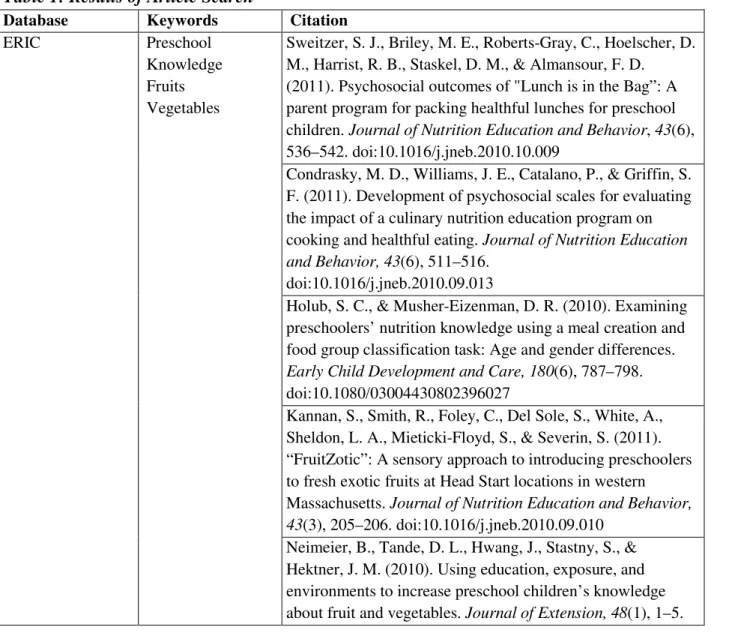
The number of peer-reviewed, empirical research articles identified by this search was minimal (see Table 1). Of the empirically-based educational programs designed to teach preschoolers about any of these concepts, there were thirteen articles. However, an analysis of these articles indicated that only one (Pivonka, Seymour, McKenna, Baxter, & Williams, 2011) focused on formative evaluation. Three experimental studies were found which focused on teaching methods; however, these articles did not include a program development emphasis, and therefore, no formative evaluation. The results of this search suggest that researchers do not emphasize formative evaluation in their work; however, this type of information, if published, would be invaluable for those who design nutrition programs for preschool-age children.
Table 1: Results of Article Search
Database Keywords Citation
ERIC Preschool
Knowledge Fruits Vegetables
Sweitzer, S. J., Briley, M. E., Roberts-Gray, C., Hoelscher, D. M., Harrist, R. B., Staskel, D. M., & Almansour, F. D.
(2011). Psychosocial outcomes of "Lunch is in the Bag”: A parent program for packing healthful lunches for preschool children. Journal of Nutrition Education and Behavior, 43(6), 536–542. doi:10.1016/j.jneb.2010.10.009
Condrasky, M. D., Williams, J. E., Catalano, P., & Griffin, S. F. (2011). Development of psychosocial scales for evaluating the impact of a culinary nutrition education program on cooking and healthful eating. Journal of Nutrition Education and Behavior, 43(6), 511–516.
doi:10.1016/j.jneb.2010.09.013
Holub, S. C., & Musher-Eizenman, D. R. (2010). Examining preschoolers’ nutrition knowledge using a meal creation and food group classification task: Age and gender differences.
Early Child Development and Care, 180(6), 787–798. doi:10.1080/03004430802396027
Kannan, S., Smith, R., Foley, C., Del Sole, S., White, A., Sheldon, L. A., Mieticki-Floyd, S., & Severin, S. (2011). “FruitZotic”: A sensory approach to introducing preschoolers to fresh exotic fruits at Head Start locations in western Massachusetts. Journal of Nutrition Education and Behavior, 43(3), 205–206. doi:10.1016/j.jneb.2010.09.010
PsycINFO Preschool Knowledge Fruits
Archuleta, M. (2009). Nutrition educators—providing practical support for families. Journal of Nutrition Education and Behavior, 41(2), 77. doi:10.1016/j.jneb.2009.01.002 Medline via
EBSCO
Preschool Knowledge Fruits
Pivonka, E., Seymour, J., McKenna, J., Baxter, S. D., & Williams, S. (2011). Development of the behaviorally focused Fruits & Veggies—More Matters public health initiative. Journal of the American Dietetic Association,
111(10), 1570–1577. doi:10.1016/j.jada.2011.07.001 Horodynski, M. A., Stommel, M., Brophy-Herb, H., Xie, Y., & Weatherspoon, L. (2010). Low-income African American and non-Hispanic White mothers' self-efficacy, "picky eater" perception, and toddler fruit and vegetable consumption.
Public Health Nursing, 27(5), 408–417. doi:10.1111/j.1525-1446.2010.00873.x
Horodynski, M., Hoerr, S., & Coleman, G. (2004). Nutrition education aimed at toddlers: A pilot program for rural, low-income families. Family and Community Health: The Journal of Health Promotion and Maintenance, 27(2), 103– 113
Contento, I. R., Randell, J. S., & Basch, C. E. (2002).
Review and analysis of evaluation measures used in nutrition education intervention research. Journal of Nutrition
Education and Behavior, 34(1), 2–25. doi:10.1016/S1499-4046(06)60220-0
Preschool Knowledge Vegetables
Wyse, R., Campbell, E., Nathan, N., & Wolfenden, L. (2011). Associations between characteristics of the home food environment and fruit and vegetable intake in preschool children: A cross-sectional study. BMC Public Health, 11(1), 938.
Edwards, J. A., & Hartwell, H. H. (2002). Fruit and vegetables: Attitudes and knowledge of primary school children. Journal of Human Nutrition and Dietetics, 15(5), 365–374. doi:10.1046/j.1365-277X.2002.00386.x
Lowe, C. F., Horne, P. J., Tapper, K., Bowdery, M., & Egerton, C. (2004). Effects of a peer modelling and rewards-based intervention to increase fruit and vegetable
consumption in children. European Journal of Clinical Nutrition, 58(3), 510–522. doi:10.1038/sj.ejcn.1601838
Discussion and Application
qualitative and narrative studies are published in addition to quantitative studies, a clearer picture of what the preschool child knows about these matters could be determined. This will better equip practitioners and educators to introduce children to fruits, vegetables, dairy, grains, and protein, as well as the self-monitoring skills that are crucial to appropriate eating behaviors. According to the Transtheoretical Model, behavior change is most effective when tailored to an individual’s stage of change (Prochaska, DiClemente, & Norcross, 1992). Knowledge and understanding are fundamental to the model, and increased formative evaluation research would assist in better establishing these stages for children. To date, the literature provides a vague understanding of what preschoolers know about these topics, and none relates it to the stages-of-change model.
There are many practical reasons for developing a better understanding of what children already know. For example, if children do not know the difference between a fruit and a vegetable, then programming should focus on defining characteristics of fruits and vegetables and how to tell these apart. However, if children already know the difference between fruits and vegetables, but do not understand why they should eat these foods, then programing should focus on the role these foods play in their health.
The public sharing of formative research would yield information about children’s pre-existing knowledge and skills relevant to learning MyPlate. This type of research could also document the process of developing instructional materials that addressed learning objectives such as:
1. Labeling appropriately the five sections of MyPlate;
2. Listing examples of fruits, vegetables, whole grains, and sources of protein and dairy (given these category labels) that occupy MyPlate;
3. Classifying examples fruits, vegetables, etc., into the appropriate categories on
MyPlate (when the examples are in the form of objects, pictures, diagrams, or words); 4. Saying “no” to foods that are not part of the MyPlate (e.g., candies and sodas); and 5. Shopping for MyPlate foods with parents or guardians.
Conclusion
evaluation studies to help educators create effective education programs, which help children understand the choices that impact their health.
References
Briggs, M., Fleischhacker, S., & Mueller, C. G. (2010). Position of the American Dietetic Association, School Nutrition Association, and Society for Nutrition Education:
Comprehensive school nutrition services. Journal of Nutrition Education and Behavior, 42(6), 360–371. doi:10.1016/j.jneb.2010.08.007
Centers for Disease Control and Prevention (CDC). (2010). Obesity among low-income preschool children. Available at
http://www.cdc.gov/obesity/downloads/PedNSSFactSheet.pdf
Centers for Disease Control and Prevention (CDC). (2012). 2011 Pediatric nutrition surveillance. Available at http://www.cdc.gov/pednss/pednss_tables/pdf/national_table18.pdf
Crooks, T. (2001). The validity of formative assessments. Paper presented at the British Educational Research Association Annual Conference, University of Leeds.
Fenichel, M., & Schweingruber, H. A. (2010). Surrounded by science: Learning science in informal environments. Washington, DC: National Academies Press.
Fisch, S. M., & Bernstein, L. (2001). Formative research revealed: Methodological and process issues in formative research. In S. M. Fisch & R. T. Truglio (Eds.), "G" is for growing: Thirty years of research on children and Sesame Street (pp. 39–60). Mahwah, NJ: Lawrence Erlbaum Associates.
Heim, S., Stang, J., & Ireland, M. (2009). A garden pilot project enhances fruit and vegetable consumption among children. Journal of the American Dietetic Association, 109(7), 1220–1226. doi:10.1016/j.jada.2009.04.009
Looney, J. W. (2011). Integrating formative and summative assessment: Progress toward a seamless system? OECD Education Working Papers, 58. doi:10.1787/5kghx3kbl734-en Ogden, C., & Carroll, M. (2010). Prevalence of obesity among children and adolescents: United
States, trends 1963-1965 through 2007-2008. Available at
http://www.cdc.gov/nchs/data/hestat/obesity_child_07_08/obesity_child_07_08.pdf Palmer, E. L. (1976). Applications of psychology to television programming: Program execution.
American Psychologist, 31(2), 137–138. doi:10.1037/0003-066X.31.2.137
Pivonka, E., Seymour, J., McKenna, J., Baxter, S. D., & Williams, S. (2011). Development of the behaviorally focused Fruits & Veggies—More Matters public health initiative.
Journal of the American Dietetic Association, 111(10), 1570–1577. doi:10.1016/j.jada.2011.07.001
Post, R., Haven, J., & Maniscalco, S. (2012). Putting MyPlate to work for nutrition educators.
Prochaska, J. O., DiClemente, C. C., & Norcross, J. C. (2003). In search of how people change: Applications to addictive behaviors. In P. Salovey & A. J. Rothman (Eds.), Social psychology of health (pp. 63–77). New York, NY: Psychology Press.
Pyle, S. A., Sharkey, J., Yetter, G., Felix, E., Furlong, M. J., & Poston, W. S. C. (2006). Fighting an epidemic: The role of schools in reducing childhood obesity. Psychology in the
Schools, 43(3), 361–376. doi:10.1002/pits.20146
Ritchie, L. D., Crawford, P. B., Hoelscher, D. M., & Sothern, M. S. (2006). Position of the American Dietetic Association: Individual-, family-, school-, and community-based interventions for pediatric overweight. Journal of the American Dietetic Association, 106(6), 925–945. doi:10.1016/j.jada.2006.03.001
Sweitzer, S. J., Briley, M. E., Roberts-Gray, C., Hoelscher, D. M., Harrist, R. B., Staskel, D. M., & Almansour, F. D. (2011). Psychosocial outcomes of “Lunch is in the Bag”: A parent program for packing healthful lunches for preschool children. Journal of Nutrition Education and Behavior, 43(6), 536–542. doi:10.1016/j.jneb.2010.10.009
Truglio, R. T., Lovelace, V. O., Seguí, I., & Scheiner, S. (2001). The varied role of formative research: Case studies from 30 years. In S. M. Fisch & R. T. Truglio (Eds.), “G” is for growing: Thirty years of research on children and Sesame Street(pp. 61–79). Mahwah, NJ: Lawrence Erlbaum Associates.
Nina Roofe, PhD, RD, LD, is an Assistant Professor and Didactic Program in Dietetics Director at the University of Central Arkansas.