Sara Patrícia
Magalhães da Silva
Uso de Solventes Alternativos no âmbito das
Biorefinarias
Alternative Solvents in the Biomass Refinery
Concept
Sara Patrícia
Magalhães da Silva
Uso de Solventes Alternativos no âmbito das Biorefinarias
Alternative Solvents in the Biomass Refinery Concept
Dissertação apresentada à Universidade de Aveiro para cumprimento dos requisitos necessários à obtenção do grau de Mestre em Engenharia Química, realizada sob a orientação científica do Dr. Rafał Marcin Bogel-Łukasik, Investigador Auxiliar da Unidade de Bioenergia do Laboratório Nacional de Energia e Geologia de Lisboa e, do Professor Doutor Armando Jorge Domingues Silvestre, Professor Associado com Agregação do Departamento de Química da Universidade de Aveiro.
o júri
Professor Doutor Dmitry Victorovitch Evtyugin
presidente Professor Associado com Agregação do Departamento de Química da Universidade de Aveiro
Doutor. Rafał Marcin Bogel-Łukasik
Investigador Auxiliar da Unidade de Bioenergia do Laboratório Nacional de Energia e Geologia
Professor Doutor Armando Jorge Domingues Silvestre
Professor Associado com Agregação do Departamento de Química da Universidade de Aveiro
Professor Doutor Carlos Manuel Santos Silva
agradecimentos Em primeiro lugar gostaria de agradecer ao Doutor Rafał Łukasik pela possibilidade de ter realizado a minha tese de mestrado sob a sua orientação. Os seus conselhos, perseverança e carácter único contribuíram não só para a realização de um melhor trabalho, mas sobretudo para a minha formação como pessoa. Gostaria também de agradecer ao Professor Armando Silvestre pela sua disponibilidade, ajuda e acompanhamento do meu trabalho.
Não posso também esquecer o excelente acompanhamento por parte do André Lopes. A sua dedicação, amizade e personalidade tornaram este percurso muito mais enriquecedor. A ele, o meu muito obrigado!
Um muito obrigado, também, à Dra. Luísa Roseiro pela disponibilidade, ajuda e conhecimentos transmitidos relacionados com a eletroforese capilar.
Gostaria também de agradecer à Rita Morais e à Sofia Graça pela amizade, simpatia e pelo apoio que me proporcionaram ao longo desta experiência no LNEG.
A passagem pela universidade fez-me, não só adquirir conhecimentos, mas também pessoas que sempre estarão presentes na minha vida. Sem nunca esquecer ninguém, gostaria de agradecer ao Nuno Costa, Cristiano Ramos e Luís Pereira por todos os momentos que partilhamos. Não podia deixar de agradecer à Sara Ribeiro e à Andreia Miguéis por todo o apoio e amizade partilhada durante estes anos. Além disso, gostaria de agradecer à Jéssica Machado e Tânia Borges pela excelente amizade e companheirismo.
À Rute Tavares e Andreia Lopes, companheiras de uma vida, pelo seu apoio, amizade e conselhos que tornaram a pessoa que sou hoje.
À minha prima Raquel Melfe por todo o apoio e companhia durante a minha estadia por Lisboa.
Por fim, e por isso não menos importante, gostaria de agradecer aos meus pais, irmão e às minhas tias pelo infinito e incondicional apoio que me deram durante este curso. Isto é para vocês!
fracionamento, celulose, hemicelulose, lenhina, produtos de valor acrescentado.
resumo O presente trabalho foi dedicado ao pré-tratamento de biomassa lenho-celulósica através de dois solventes alternativos – líquidos iónicos (LIs) e fluídos supercríticos (FSCs).
O estudo com líquidos iónicos focou-se em propor uma nova metodologia para o pré-tratamento da palha de trigo com o líquido iónico acetato de 1-etil-3-metilimidazólio ([emim][OAc]), que permitiu o fracionamento da mesma em frações de celulose, hemicelulose e lenhina num simples processo de três etapas. Com este processo de pré-tratamento foram estudadas diferentes temperaturas (80-140°C) e tempos (2-18h) de dissolução da biomassa no [emim][OAc]. A técnica de Espectroscopia de Infravermelho com Transformadas de Fourier (FTIR) permitiu efetuar análises qualitativas e quantitativas de todas as frações obtidas nos pré-tratamentos realizados. Para as frações ricas em celulose foram efetuados ensaios de hidrólise enzimática para avaliar o conteúdo em glucose. Além disso, a dependência da recuperação destas mesmas frações nas diferentes condições experimentais do pré-tratamento foi avaliada através de análises de regressão linear múltipla. O pré-tratamento a 140°C durante 6h deu o melhor resultado, no que toca à recuperação das frações ricas em celulose, onde se obteve uma recuperação de 37.1% (m/m) relativamente à massa inicial de biomassa utilizada. Para as mesmas condições, também foram obtidos resultados com elevada pureza, tanto para a fração de hemicelulose (96% em hidratos de carbono), bem como para a fração em lenhina (97%). Do mesmo modo, foi verificado um elevado teor em glucose (81.1% m/mbiomassa) presente na
fração celulósica. No final de cada pré-tratamento realizado, o LI foi recuperado atingindo sempre valores de recuperação superiores a 86% (m/m). Para avaliar a pureza dos LIs após os pré-tratamentos utilizou-se a técnica de espectroscopia de ressonância magnética nuclear (RMN). Para além disso, os LIs recuperados foram analisados através da técnica eletroforese capilar (EC) para investigar a presença de compostos fenólicos de valor acrescentado. Desta análise, foi possível verificar a presença de compostos de vanilina e seus derivados, bem como outros produtos derivados da lenhina.
O outro estudo centrou-se num processo de auto-hidrólise assistido com CO2 da
palha de trigo, com o objetivo de dissolver seletivamente a fração hemicelulósica. A formação in situ de ácido carbónico resultou numa maior dissolução da hemicelulose comparativamente a um processo de auto-hidrólise da palha de trigo em condições análogas (temperatura e razão líquido-sólido (RLS)). Um aumento da quantidade de CO2 obtido através da diminuição da quantidade de
biomassa levou a um aumento de mais de 60% de xilo-oligossacáridos (XOS) dissolvidos. Nomeadamente, a 210°C foi verificada uma recuperação de 15.75g·L-1 em XOS comparativamente a uma recuperação de 9.54 g·L-1 obtida num processo de auto-hidrólise sem adição de CO2. Nestas condições, foi
também verificado um enriquecimento de 20% (m/m) em glucose no sólido recuperado.
keywords Biorefineries, lignocellulosic biomass, ionic liquid, supercritical fluids pre-treatment, fractionation, cellulose, hemicellulose, lignin, value-added products.
abstract The present work is devoted to the pre-treatment of lignocellulosic biomass by two alternative solvents – ionic liquids (ILs) and supercritical fluids (SCF).
The IL study was focus on proposing a new methodology for the wheat straw pre-treatment with the ionic liquid (IL), 1-ethyl-3-methylimidazolium acetate ([emim][OAc]), that allowed to obtain cellulose, hemicellulose and lignin-rich fractions in a rapid and simple three-step fractionation process. Various temperatures (80-140°C) and processing times (2-18h) of the pre-treatment were studied. The quantitative and qualitative analysis of each lignocellulosic biomass fractions were determined by FTIR measurements. The glucan content in recovered cellulose-rich fractions was investigated by an enzymatic hydrolysis. Cellulose recovery dependency on pre-treatment conditions was ascertained through the regression analysis. The optimal result for the recovery of the cellulose-rich fraction was obtained at 140°C during 6h achieving 37.1 % (w/w) of the initial biomass loading. For the same conditions, optimal results were also produced regarding the amount of the glucan present (81.1 % w/wbiomass) in
cellulose-rich fractions, the carbohydrate enrichment in the hemicellulose fraction (96% wt) and the purity of lignin (97% wt).The recovery of IL was performed after each pre-treatment and the obtained yields were up to 86% (w/w). The recovered ILs were analyzed by 13C- and 1HNMR in order to verify their purities. The presence of value-added phenolic compounds in the recovered ILs was analyzed by capillary electrophoresis. Vanillin and its derivatives, as well as other lignin-based products were identified.
The other study was centered in a CO2-assisted autohydrolysis treatment of
wheat straw, in order to selectively dissolve the hemicellulose fraction. The in situ formation of carbonic acid resulted in a higher hemicellulose dissolution in comparison to autohydrolysis of wheat straw with analogous conditions (temperature and LSR). In addition, higher amount of CO2 obtained by the
relative reduction of biomass amount treatment guided to an increase by more than 60% of xylo-oligosaccharides (XOS) recovered. Namely, at 210°C a XOS recovery of 15.75 g·L-1 was obtained versus a 9.54 g·L-1 recovery with an autohydrolysis pre-treatment without CO2 addition. Furthermore, an enrichment of
List of contents
List of Figures ... III List of Tables... V Nomenclature ... VII 1. Introduction ... 1 1.1 Green Chemistry ... 1 1.2 Biorefinery Concept ... 2 1.3 Lignocellulosic Feedstock ... 3 1.4 Ionic Liquids ... 8 1.5 Supercritical Fluids ... 9 1.6 Biomass Pre-treatments ... 10 1.6.1 Conventional Methods ... 11 1.6.2 Alternative Methods ... 13
1.6.2.1 Pre-treatment with Ionic Liquids ... 13
1.6.2.2 Biomass Pre-treatment with sub-/supercritical CO2 / water ... 16
2. IL Pre-treatment ... 20
2.1 Materials and Methods ... 20
2.1.1 Materials ... 20
2.1.2 Pre-treatment of the wheat straw using [emim][OAc] ... 21
2.1.3 Chemical Analysis ... 23
2.1.3.1 FTIR characterization of fractionated samples ... 23
2.1.3.2 NMR analysis of recovered IL ... 23
2.1.3.3 Capillary electrophoresis of recovered IL ... 23
2.1.4 Enzymatic Hydrolysis ... 24
2.1.5 Experimental Errors ... 24
2.2 Results ... 25
2.2.1 Wheat straw pre-treatment with [emim][OAc] ... 25
2.2.2 FTIR Characterization ... 26
2.2.2.1 Qualitative Analysis ... 26
2.2.2.2 Quantitative Analysis... 28
2.2.3 Enzymatic Hydrolysis ... 29
2.2.5 Capillary Electrophoresis Analysis ... 30
2.3 Discussion ... 31
2.3.1 A three-step fractionation process ... 31
2.3.2 Effect of temperature and time on the pre-treatment of biomass ... 32
2.3.3 Ionic liquid recovery ... 35
3. CO2 assisted Pre-treatment ... 38
3.1 Materials and Methods ... 38
3.1.1 Materials ... 38
3.1.2 CO2-assisted autohydrolysis of wheat straw ... 38
3.1.3 Chemical Analyses ... 39
3.1.3.1 Characterization of the feedstock material composition... 39
3.1.3.2 Characterization of the processed solids ... 40
3.1.3.3 Liquor and post-hydrolysate characterization ... 40
3.1.3.4 Gas phase ... 40
3.2 Results ... 41
3.2.1 Feedstock composition ... 41
3.2.2 Composition of the liquors ... 41
3.2.3 Composition of the processed solids ... 43
3.2.4 Composition of the recovered gas phase ... 43
3.3 Discussion ... 44 3.3.1 Effect of temperature ... 44 3.3.2 Effect of CO2 ... 45 3.3.2.1 Influence of CO2 presence ... 45 3.3.2.2 Influence of CO2 concentration ... 46 3.3.3 Volatile products ... 48 4. Conclusions ... 49 5. References ... 52 6. List of Publications ... Erro! Marcador não definido.
List of Figures
Figure 1 – Twelve Principles of Green Chemistry (adapted from Anastas et al.)1 ... 1
Figure 2 – The Biorefinery Concept (Adapted from Carvalheiro et al.).18 ... 3
Figure 3 - Contents of cellulose (%C), hemicellulose (%H) and lignin (%L) in common residues and wastes. (Adapted from Sun et al.)25 ... 4
Figure 4 - Cellulose stereochemical formula. The dimeric unit repeated is cellobiose. ... 5
Figure 5 - Chemical structure of sugar building blocks. ... 6
Figure 6 – Chemical structure of xylans’ backbone... 6
Figure 7 – Chemical structure of the three lignin precursors: (a) p-coumaryl alcohol, (b) coniferyl alcohol, (c) sinapyl alcohol. ... 7
Figure 8 – Macromolecular representation of lignin structure.34 ... 7
Figure 9 - – Chemical structures of cations and anions commonly used to form ILs. Ri=1,…,7 = alkyl group(Adapted from Zakrzewska et al.).7 ... 8
Figure 10 - Definition of supercritical state for a pure component.59 ... 9
Figure 11 - Schematic of the role of pre-treatment.71 ... 11
Figure 12 - Water phase diagram: (A) Autohydrolysis; (B) Subcritical conditions; (C) Supercritical conditions.46 ... 18
Figure 13 - Schematic presentation of the optimized method. ... 21
Figure 14 - Color of the fresh [emim][OAc] and recovered ILs after the wheat straw pre-treatment at different dissolution temperatures: (a) 80°C; (b) 100°C; (C) 120°C and (d) 140°C. ... 26
Figure 15- Electropherogram recorded at 320 nm showing the phenolic profile of the recovered IL after pre-treatment at 100°C during 18h. ... 31
Figure 16- Representation of the adjusted model for %cellulose (w/wbiomass) obtained from the enzymatic hydrolysis. ( ) experimental data. ... 34
Figure 17- Graphical presentation of the amount of energy spent in the pre-treatments at the different dissolution conditions. The vertical bars present various pre-treatment time in the following manner: light blue – 2 hours, dark blue – 6 hours, red – 12 hours, green – 18 hours. .... 35
Figure 18- 1H NMR spectra of the a) pure [emim][OAc]; b) recovered [emim][OAc] from pre-treatment at 140°C, 6h. ... 36 Figure 19 - The scheme of CO2-assisted autohydrolysis pre-treatment apparatus. 1 – CO2 cylinder; 2 – magnetic drive; 3 – heating mantle; 4 – thermo par; 5 – pressure transducer; 6 –
Figure 20 - Furfural concentration in the recovered gas phase from depressurization for the studied temperatures and biomass loadings. Green bar - 250g of water/25g of biomass, blue bar - 150g of water/15g of biomass, red bar - 75g of water/7.5 g of biomass. ... 44 Figure 21- The XOS concentration (g·L-1) as a function of CO2 number of moles at 210C. The data for CO2-free reaction (■) taken from literature.92 ... 47
List of Tables
Table 1 – Critical parameters of the most common compounds. (Adapted from Jessop and Leitner).57... 10 Table 2 – Types of pre-treatment methods (Adapted from Mohammad et al.),70 Carolina et al.72 ). ... 12 Table 3 - Pre-treatment temperature and time studied in this work. ... 22 Table 4 - Results of the wheat straw pre-treatment with [emim][OAc]: fractionation at various pre-treatment temperatures and times. The yield of IL recovery after each pre-treatment is depicted... 25 Table 5 - Results of the FTIR quantification of the fractionated samples obtained at different pre-treatment temperatures and times. ... 28 Table 6 - Glucose yields (% w/wbiomass) and the amounts (mg) of pure cellulose and othercompounds present on the recovered cellulose after pre-treatment at different conditions. ... 30 Table 7 - Macromolecular composition of wheat straw (% of dried weigh). ... 41 Table 8 – Composition of the liquors (gL-1) from CO2–assisted autohydrolysis of wheat straw with initial CO2 pressure equal to 60 bar. ... 42 Table 9 - The solid phase composition (g(100g processed solids)-1) and solid yield (g(100g
feedstock)-1) obtained after CO2-assisted autohydrolysis of wheat straw for different biomass loading. ... 43 Table 10 - The CO2 density predicted by the Peng-Robinson (PR-EOS), as well as number of CO2 moles present in the reactor at initial conditions. ... 47
Nomenclature
AcO Acetyl groups linked to oligosaccharides
AFEX Ammonia Fiber Explosion
[amim][Cl] 1-allyl-3-methylimidazolium chloride
[bmim][OAc] 1-butyl-3-methylimidazolium acetate
°C Degree Celsius
(C6H10O5)n Cellulose
CE Capillary Electrophoresis
CO2 Carbon dioxide
Cpm Molar heat capacity
d doublet
DP Degree of Polymerization
e.g. example
[emim][OAc] 1-ethyl-3-methylimidazolium acetate
EtOH Ethanol
EU European Union
FPU Filter Paper Units
FTIR Fourier Transform Infra-Red
GLcOS Gluco-Oligosaccharides
HAPs Hazardous Air Pollutants
HLVL High-Value Low-Volume
HMF Hydroxymethylfurfural
HPLC High Performance Liquid Chromatography
i.d. Internal diameter
IL(s) Ionic Liquid(s)
LHW Liquid Hot Water
Log R0 Severity factor
LSR Liquid-to-Solid ratio
LVHV Low-Value High-Volume
M Molarity
N Nitrogen
NMR Nuclear Magnetic Resonance
NREL National Renewable Energy Laboratory
P Pressure
Pc Critical Pressure
PID Proportional-Integral-Derivative
PR-EOS Peng-Robinson Equation Of State
q quartet
R Gas constant
R2 Correlation coefficient
RI Refractive Index
scCO2 Supercritical Carbon Dioxide
SCF(s) Supercritical Fluid(s)
scH2O Supercritical Water
s singlet
SLR Solid-to-Liquid ratio
SPE Solid Phase Extraction
t time
T Temperature
Tc Critical temperature
Troom Room temperature
u Standard Deviation Error
UV/VIS Ultraviolet/Visible
VLE Vapor Liquid Equilibrium
VOCs Volatile Organic Compounds
XOS Xylooligosaccharides Regression coefficient δ Chemical shift ρ Density Ø Diameter ω Acentric Factor
“Be less curious about people and more curious about ideas”
1. Introduction
1.1 Green Chemistry
According to Anastas et al.1 Green Chemistry is “the design, development, andimplementation of chemical products and processes to reduce or eliminate the use and generation of substances hazardous to human health and the environment”. It is an innovative,
non-regulatory, economically driven approach toward sustainability. Green Chemistry aims to design and utilize matter and energy in a way that increases performance and value while protecting human health and the environment.2 This definition is also elucidated by the Twelve Principles of Green Chemistry that are used as a design framework (Figure 1). The principles of Green Chemistry need to become essential for future chemistry, in order to integrate sustainability into science and its innovations. It is also needed the application of these principles at early stages of the product development.
Figure 1 – Twelve Principles of Green Chemistry (adapted from Anastas et al.)1
Green Chemistry is an important tool in achieving sustainability. The Brundtland Commission (1987)3 defined sustainable development as “development that meets the needs of the present
without compromising the ability of future generations to meet their own needs”. The challenges
of global sustainability are complex, in a way that the three dimensions of sustainability, environmental, social and economic must be recognized. These three elements are essential to move sustainability forward.
1 - Introduction
The application of the Twelve Principles of Green Chemistry demonstrated the possibility of achieving this synergism by working at the most fundamental level.4 Green Chemistry provides solutions to such global challenges as climate change, sustainable agriculture, energy, toxics in the environment, and the depletion of natural resources.
A major concern regarding sustainability is the release of hazardous substances into the environment. Green Chemistry can have a significant impact in this area. It is important to use alternative solvents to organic solvents in order to decrease the negative environmental impact generated by the last ones, namely the release of volatile organic compounds (VOCs), hazardous air pollutants (HAPs). A green alternative to organic solvents is the use of ionic liquids and supercritical fluids. For instance, considering the supercritical fluids, supercritical carbon dioxide (scCO2) can be used. This compound has an easily accessible critical point and is toxic, non-flammable and inexpensive.5Regarding to ionic liquids (ILs), these salts are attractive because of their negligible vapor pressure, thermal stability6 and great solvent power.7 Their low vapor pressure reduces the risk of exposure which is an advantage related to classical VOCs.7 This class of solvents has the potential to design next generation of ILs thus is a significant promise for improved environmental benefits.8 However, the “green” concept of ILs sometimes is questionable as limited data about toxicity and biodegradability are available. Thus, it is important that ILs should be treated with the same caution as other solvents.7, 9-11 Nevertheless, ILs are still considered as more environmentally friendly compared to the other organic counterparts.7
1.2 Biorefinery Concept
The National Renewable Energy Laboratory defined Biorefinery as “a facility that integratesconversion process and equipments to produce fuels, power, chemicals and materials from biomass.” The main goal of the biorefinery is the generation of a variety of goods from different
biomass feedstocks through a combination of technologies.12-14 In other words it is the production of high-value low-volume (HVLV) and low-value high-volume (LVHV) products. The operations are designed to minimize the waste streams by converting LVHV intermediates into energy, while HVLV products enhance profitability.12 The biorefinery concept is presented in Figure 2.
The efficient production of transportation biofuels is seen as one of the main promoting factors for the future development of biorefineries.15 Once, biofuels have the potential to reduce greenhouse-gas emissions and to contribute to energy security by diversifying supply sources. Also, to respond to determined mitigation measures, such as the EU directive16 which put the objective to achieve a 20% share of energy from the renewable resources. Referring to biofuels in
Portugal, it is necessary to accomplish a level of 10% by 2020. Additionally, a reduction of greenhouse-gas emissions of 20% by 2020 was also established.17 Although, the implementation of biofuels as main source of energy is still a difficult and challenging process due to the technological limitations.17 However, to satisfy social and environmental aspects of biofuel production, a complex biorefinery concept must be explored leading to a maximal valorization of non-food and non-feed competitive feedstocks.
Figure 2 – The Biorefinery Concept (Adapted from Carvalheiro et al.).18
1.3 Lignocellulosic Feedstock
Within biorefinery processes the major lignocellulosic feedstock are lignocellulosic biomass, such as softwood (Pine, Spruce), hardwood (Willow, Poplar and Eucalyptus), grasses (Miscanthus, Switchgrass). In addition, agricultural residues (wheat straw, sugarcane, bagasse and corn stover), forest residues (sawdust, thinning rests), domestic and municipal solid wastes, and food industry residues are considered as biomass too.19 Annually are produced approximately 200 billion tones worldwide which make this type of biomass a potential source of a clean, uniform and a low-cost raw material for large-scale and environmentally sustainable biorefineries.20Lignocellulosic biomass from agricultural residues, forestry wastes, waste paper are currently being studied due to their potential use as a starting material for production of bioenergy/biofuels.20 Furthermore, using this type of biomass can also minimize the competition with the food/feed chain, which represents an advantage comparatively to 1st generation biofuels.21 Since, the 1st generation of biofuels appear unsustainable regarding to the source of feedstocks, including the impact that it may cause on biodiversity and land use.22 From lignocellulosic biomass not only biofuels (bioethanol, biobutanol) can be produced, but also other
1 - Introduction
valued-added products such as reducing sugars, organic acids (acetic acid, propionic acids and butyric acid), compost (organic fertilizer), bio-composites, furfural and its derivatives and other miscellaneous compounds.23
Lignocellulosic biomass is composed mainly of cellulose (35-50%), hemicellulose (20-35%) and lignin (5-30%).24 The composition of lignocellulose materials depends mainly on the species, age and origin of biomass. The contents of macromolecular materials in some residues and waste crops are illustrated in Figure 3.
Figure 3 - Contents of cellulose (%C), hemicellulose (%H) and lignin (%L) in common residues and wastes. (Adapted from Sun et al.)25
A simplified picture of the lignocellulosic materials’ macromolecular structure is that, cellulose forms a skeleton which is surrounded by other substances forming a matrix (hemicelluloses) and encrusting (lignin) materials.26 Cellulose and hemicellulose represent the carbohydrate fraction, while lignin is a very complex and amorphous phenylpropanoid polymer. Cellulose (C6H10O5)n is a homopolysaccharide composed of glucopyranose units linked together by (1 4)-glycosidic bonds generating cellobiose units. Cellulose is located predominantly in the secondary cell wall. Cellulose molecules are completely linear and have a strong tendency to form intra- and intermolecular hydrogen bonds. Bundles of cellulose molecules are thus aggregated together in form of microfibrils where highly ordered (crystalline)
regions are alternatives to less ordered (amorphous) regions. Microfibrils build up fibrils and finally cellulose fibers. The example of cellulose structure is presented in Figure 4.
O H HO HO H H OH H OH O H OH HO H H OH H H O O H HO H H OH H OH O O H OH HO H H OH H H H H OH O n
Figure 4 - Cellulose stereochemical formula. The dimeric unit repeated is cellobiose.
The number of glucose units that make up one single chain of cellulose is recognized as degree of polymerization (DP). Molecular weight measurements have shown that wood cellulose consists of about 10000 glucose residues. Based on properties cellulose in solution behaves like most of synthetic polymers, so this means that the molecules have no preferred structure in solution.26 In terms of solubility cellulose is insoluble in water and other common solvents due to its fibril structure and the presence of intra- and intermolecular hydrogen bonds. At the same time is hygroscopic at normal atmospheric conditions absorbing around 8-14% of water. In order to accomplish various demands for its industrial applications, cellulose is often modified by chemical, physical, enzymatic or, genetic procedures to improve solubility and others properties of the polymer.27 Cellulose is mostly hydrolyzed to sugar monomers, and then converted into alcohols (ethanol, butanol), hydrogen or methane by fermentation process. Apart from biofuel/bioenergy production, cellulose can be also used for the production of other valuable products, such as hydroxymethylfurfural (HMF) and levulinic acid.28
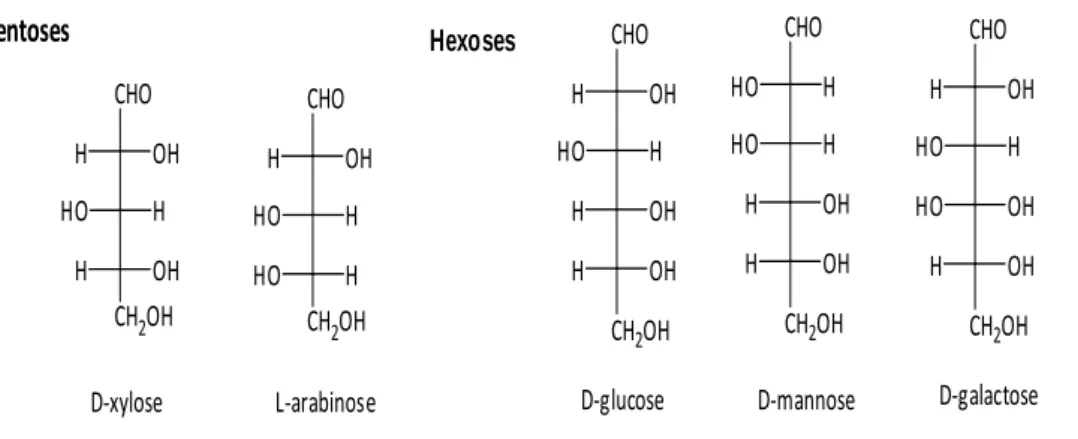
Hemicellulose is a non-crystalline, highly branched, water-insoluble heteropolysaccharide. Similarly to cellulose most of hemicelluloses has a supporting function in the cell walls.26 The term hemicellulose represents a family of polysaccharides such as arabino-xylans, gluco-mannans, galactans, and others which have different composition and structure depending on their source and the extraction method.29 The high complexity of hemicellulose, namely type, ratio contents of sugar units and structural conformation, is associated to the different building blocks present (Figure 5).
1 - Introduction CHO CH2OH OH H H HO OH H OH H D-glucose CHO CH2OH H HO H HO OH H OH H D-mannose CHO CH2OH OH H H HO OH HO OH H D-galactose Hexoses CHO CH2OH OH H H HO OH H D-xylose Pentoses CHO CH2OH OH H H HO H HO L-arabinose
Figure 5 - Chemical structure of sugar building blocks.
The major type of hemicellulose polymers’ content is xylans which have different structures depending on the type of branching. As can be seen from Figure 6, the backbone consists of xylopyranose units, linked by (1 4)-bonds. Most hemicelluloses have a DP of only 200. Additionally, the highly branched structure of hemicellulose and the presence of acetyl groups linked to the polymer chain lead to lack of crystalline structure of hemicellulose.
Hemicelluloses are relatively easily hydrolyzed by acids to their monomeric compounds consisting of pentoses (xylose and L-arabinose), hexoses (glucose, mannose and D-galactose), and small amounts of desoxyhexoses (L-rhamnose and L-fucose) in addition to glucuronic acids (D-glucuronic acid, 4-O-methyl-D-glucuronic acid and D-galacturonic acid).
O HO O OH O O HO OH O O HO OH O O HO OH O n Figure 6 – Chemical structure of xylans’ backbone.
Xylans can be isolated using alkali solutions such as KOH or NaOH. However, disadvantage of alkali extractions is almost complete hemicelluloses deacetylation. Then, the polysaccharides can be precipitated from the alkaline extract by acidification (acetic acid). The addition of a neutral organic solvent, for example ethanol, results in a more complete precipitation.26 Hemicelluloses are used as emulsifiers, stabilizers and binders in food, pharmaceutical (as food fibers, therapeutic agent in lowered immune conditions),30 cosmetics industries, production of xylitol, xylo-oligosaccharides (used as prebiotic ),31 furfural and other value-added products.32
Lignin is an amorphous three-dimensional polymer of phenylpropane units which has an important role in the cell's endurance and development. Thus, it affects the transport of water,
nutrients and metabolites in the plant cell. More specifically these phenylpropane units are three monolignol precursors, coniferyl alcohol, sinapyl alcohol and p-coumaryl alcohol (Figure 7) with various degrees of oxygenation/substitution on the aromatic ring. Moreover, these precursors are covalently linked to hemicelluloses.33
OH (a) O OH OH (b) O OH O OH (c) OH
Figure 7 – Chemical structure of the three lignin precursors: (a) p-coumaryl alcohol, (b) coniferyl alcohol, (c) sinapyl alcohol.
The nature of the lignin polymerization reactions results in the formation of a three-dimensional, highly-branched network of essentially infinite molecular weight (Figure 8).26 In terms of properties, high polydispersity degree characterizes lignin structure, once different branching and bonding in otherwise similar molecules are encountered. Lignin has a very low solubility in most solvents and exhibited a low viscosity. The polymeric properties are also extremely important when evaluating the suitability of lignin by-products for technical applications. Other issue is the isolation of lignin from wood without causing degradation.
1 - Introduction
Lignin has been used as a low-value heating fuel, binder, dispersant and emulsifier. Recently, there is noticed a growing interest in the characterization of isolated lignin extracted from different crop residues in order to find novel applications. Lignin can be used as source of polyols for various applications such as the synthesis of polyurethane and phenol–formaldehyde resins, for the production of bioproducts such as vanillin, guaiacol and other phenolic compounds.35 Beyond that it can also be used in automotive brakes, wood panel products, biodispersants, polyurethane foams, epoxy resins for printed circuit boards and surfactants.36
1.4 Ionic Liquids
ILs are salts composed of large organic cations and organic or inorganic anions with low lattice energy leading to low melting point usually below 100°C.37 Although ILs possess immeasurable combinations of anions and cations (more than 106), only a small number (≈1000) of these compounds are described and characterized in the literature.11 Examples of cations and anions studied are illustrated In Figure 8.N+ N imidazolium O O -acetate N+ pyridinium N+ pyrrolidinium HO O O -lactate O N -S O O saccharin O -O formate N+ N+ N+ benzotriazonium R1 R2 R R2 R1 R2 R3 R1 R5 R6 R4 R7
Figure 9 - – Chemical structures of cations and anions commonly used to form ILs. Ri=1,…,7 = alkyl
group(Adapted from Zakrzewska et al.).7
The ionic nature of ionic liquids results in several physical and chemical advantages over conventional and molecular organic solvents such as negligible flammability and vapor pressure, thermal stability and highly solvating capacity either for polar and nonpolar compounds,10, 38-41 large electrochemical window and high conductivity.6 Due to its unique properties ILs are interesting as an alternative to VOCs with the aim to facilitate sustainable chemistry. Since a large number of cationic and anionic structural combinations is possible, desired physicochemical properties of ILs for a particular processes can be easily tuned.42 Thus hydrophobicity, viscosity or density can be adjusted by changing the alkyl chain of the cation.43, 44 The viscosity is sometimes one of the obstacles in chemical reactions due to mass transfer limitations, once viscosity values’
for ILs can be generally up to 3 times higher than that of conventional organic solvents.45 The water content in ILs can be considered as an impurity in a way that it was found that decreases the solubility of carbohydrates.46 Also, their solvent properties can be varied by adjusting the anion and the alkyl constituents of the cation.
Due to the outstanding ILs’ properties they have been applied in numerous areas such as (bio-) catalysis,47 organic synthesis,48 separations processes such as liquid-liquid extraction,49-51 electrochemistry in solar and fuel cells,52-54 lubricants,55 and cosmetics.56
1.5 Supercritical Fluids
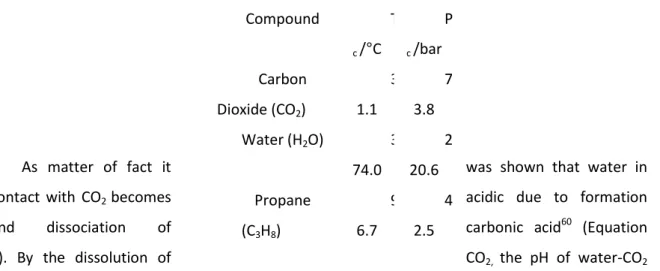
A supercritical fluid (SCF) is a state above the critical temperature, Tc, and critical pressure, Pc, but below the pressure required to condensate into a solid.57 Under these conditions, some properties of the fluid are placed between those of a gas and those of a liquid. Namely, the density of a supercritical fluid is similar to a liquid and its viscosity is similar to a gas, although its diffusivity is intermediate between the two states.57 It is also important to point out the great solvating power of the SCF similar to a liquid. SCFs’ solvent power is the highest for non-polar or slightly polar compounds.58 At the critical point, the density of the gas phase becomes equal to that of the liquid phase, thus the phase distinction between vapor and liquid disappears (Figure 10).The most commons SCFs are presented in Table 1, their critical parameters where can also be seen. Carbon dioxide (CO2) is frequently chosen as supercritical fluid due to its moderated critical constants, inertness, low cost, availability in pure form and the easy recovery after use.
Figure 10 - Definition of supercritical state for a pure component.59
In biomass pre-treatment water is often present or added deliberately. It was shown that supercritical water (scH2O) develops acidic characteristics at high temperatures (at 220°C results a pH of 5.5).59 However, to achieve critical conditions of water comparing with critical conditions of
1 - Introduction
CO2 demands much more energy. Thus combining both compounds can reduce significantly the energy demand.
Table 1 – Critical parameters of the most common compounds. (Adapted from Jessop and Leitner).57
As matter of fact it was shown that water in
contact with CO2 becomes acidic due to formation
and dissociation of carbonic acid60 (Equation
1). By the dissolution of CO2, the pH of water-CO2
mixture decreases to approximately 3.0 (depending on pressure and temperature).60
(Equation 1)
Use of SCF as an alternative to conventional solvents (organic acids) offers attractive possibilities, such as the facile removal of CO2 by the depressurization without the contamination of the reaction mixture, and reduction of operational costs since further neutralization can be omitted. Also, the formation of waste particles and, consequent corrosion of the equipment can be overcome by introducing CO2 in a autohydrolysis treatment.59 Therefore the significance of SCF for a sustainable chemistry can be underlined.61
Due to their tunable properties SFCs are used in different areas such as food processing (such as decaffeination of green coffee beans or recovery of aromas and flavors from herbs and spices) adsorptive and chromatographic separations,58 separations or/and extractions,62-64 pharmaceuticals applications.65
1.6 Biomass Pre-treatments
Lignocellulosic biomass is a complex three-dimensional structure constituted by cellulose, hemicellulose and lignin. The concrete use of these lignocellulosic fractions requires a pre-treatment that allows the biomass fractionation into cellulose, hemicellulose and lignin fractions. The principal goal of lignocellulosic pre-treatment is to turn cellulose more easily hydrolysable byCompound T c /°C P c /bar Carbon Dioxide (CO2) 3 1.1 7 3.8 Water (H2O) 3 74.0 2 20.6 Propane (C3H8) 9 6.7 4 2.5
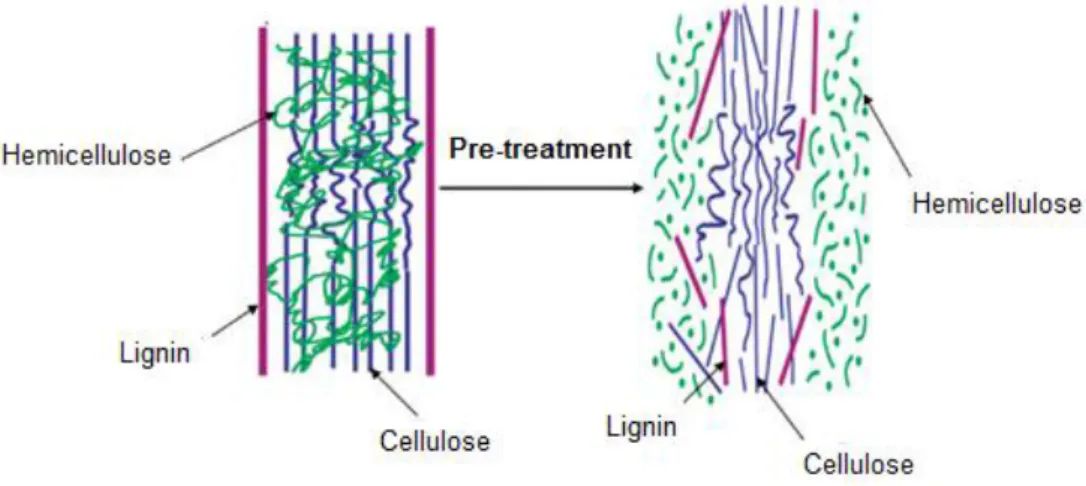
removing hemicellulose and lignin, reducing the surface area, and reducing crystallinity.66 Hence, the pre-treatment step is the central key in a biorefinery to convert lignocellulosic biomass into fuels and chemicals.67 A schematic representation of the goal in biomass pre-treatment is illustrated in Figure 11. Therefore, the selection of an efficient pre-treatment method should take in account various features. Namely, (1) result in high recovery of all carbohydrates; (2) to improve sugar yields; (3) to avoid formation of inhibitory by-products to the subsequent hydrolysis and fermentation process; and, (4) require low capital and operational costs.67-69 Hereafter it is extremely important that all pre-treatment methods must be reassessed at more industrial-like conditions referring to the whole integrated process taking into account the different types of lignocellulosic biomass.68
The pre-treatment methods can be categorized according to various criteria.25, 68-70 Among these pre-treatment criteria they can be divided into conventional and alternative methods. Since this thesis is based on alternative methods, namely ionic liquids and supercritical fluids, just a brief introduction to conventional methods is presented below.
Figure 11 - Schematic of the role of pre-treatment.71
1.6.1 Conventional Methods
Conventional pre-treatment methods can be classified as biological, physical, chemical and physical-chemical. Depending upon the pre-treatment method chosen different effects might be caused. These effects are clearly presented in Table 2. It is important to notice that the selection of the feasible pre-treatment method for a specific process configuration with a certain type of co-products is not necessarily optimal for another process configuration.68
1 - Introduction
Table 2 – Types of pre-treatment methods (Adapted from Mohammad et al.),70 Carolina et al.72 ).
Pre-treatment
Examples of Process Effect
Biological Fungi and actinomycetes Delignification
Physical
Milling Irradiation
Hydrothermolysis
Increase surface area and pores size; Partial depolymerize of lignin;
Disrupts plan cell;
Partial hydrolysis of hemicelluloses.
Chemical
Alkaline Hydrolysis (Na+
, K+, Ca+ and NH4+)
Acid Hydrolysis (H2SO4, HCl and
HNO3)
Organosolv (ethanol, acetone) Wet Oxidation (water/air or O2,
T>120°C) Ozonolysis
Decrease cellulose crystallinity; Partial or complete hydrolysis of
hemicellulose; Delignification. Physical-Chemical Steam Explosion (autohydrolysis, SO2 addition)
Liquid hot water (LHW) Ammonia fiber explosion
(AFEX)
Irradiation (Microwave)
Combination of all effects referred to above.
It is also important to point out that none of these pre-treatments is highly selective and efficient. Also, these methods are frequently environmentally detrimental, creating hazardous pollutants and demanding much energy. Moreover, conventional pre-treatments use severe conditions, such as strong base or mineral acids. Thus, new, less toxic, green methodologies are currently studied. Examples of new methodologies are ionic liquids and SFCs which have already demonstrated promising perspectives against conventional methods.
1.6.2 Alternative Methods
1.6.2.1 Pre-treatment with Ionic LiquidsIn 2002, Rogers and co-workers73 have demonstrated that imidazolium-based ILs can efficiently dissolve cellulose. These ILs show a relatively low viscosity and stronger hydrogen bonding basicity,46 which facilitates the breakdown of inter and intramolecular hydrogen bonds. More specifically Sun et al.74 report the 1-ethyl-3-methylimidazolium acetate ([emim][OAc]) for dissolution of cellulose due to its desirable properties such as low toxicity, viscosity and corrosiveness, low melting point (< -20°C) and favorable biodegradability. The importance of a strong hydrogen bond basicity46 that facilitates the breakdown of inter- and intramolecular hydrogen bonds is commonly known. Imidazolium acetate ILs exhibit a promising dissolution behavior for cellulose, although there is a lack of thermal properties of these ILs. The calorimetric analyses of [emim][OAc] were performed by Wender et al.,75 where a significant mass loss is observed for temperatures close to 200°C. From thermal gravimetric analysis (TGA) measurements it can be concluded that acetate generally decreases the thermal stability, which was reported by Ohno et al.76
ILs are not only capable of dissolving cellulose, but can be good solvent for other biomaterials, such as lignin77 and even wood.78, 79 When wood dissolution was investigated in ILs, the water content and the particle size of wood chip had large effects on the dissolution efficiency. As mentioned before the water content reduces the solubility of carbohydrates. Sun et al.74 investigated the effect of wood chip particle size (0.125 - 1.000 mm) of southern yellow pine (softwood) and red oak (hardwood) in [emim][OAc] and 1-butyl-3-methylimidazolium chloride ([bmim][Cl]) at 110°C for 16h. A 98% of dissolution of southern yellow pine for the smaller particles (<0.125 mm) with [emim][OAc] was obtained. As it was expected, smaller particles have larger surface areas, which cause more efficient dissolution. In the same study the effect of initial wood load was also investigated. It was found that an optimum wood load would be approximately 5 parts of wood added to 100 parts of IL that resulted in 98.5% of wood dissolution. In addition, Zavrel et al.21 performed high-throughput screening systems where six ILs capable to completely dissolve cellulose were identified. Among the studied ILs, [emim][OAc] was the most efficient solvent for cellulose. The same result was reported from Coutinho and co-workers40 where among eight ILs studied [emim][OAc] was the best candidate to dissolve cellulose. In fact the basicity of the acetate anion makes the dissolution more efficient at
1 - Introduction
disrupting the inter- and intramolecular hydrogen bonds.74 However, it should be noted that IL selection for wood dissolution not only depends on water content, wood chip particle size, wood-to-IL ratio, but also on wood type, stirring and dissolution conditions (time and temperature).
1.6.2.1.1 Fractionation of Lignocellulosic Material
One challenge of wood pre-treatment is the recovery of all lignocellulosic materials released from wood. A general procedure is the processing of the biphasic mixture (lignocellulosic material and IL at the certain solid/liquid ratio) at determined temperature and time with rigorous stirring.19 It is important to note that to improve efficiency of the pre-treatment complete dissolution is required. Usually, after the dissolution step the regeneration of biomass with a precipitating solvent addition is performed. Cellulose can be separated from IL by the addition of anti-solvents, such as water,78 acetone/water solution (1:1) (v/v),74 NaOH 0,1M.80 According to Dadi et al.81 the regenerated cellulose is completely modified and its crystallinity matrix is changed to an amorphous structure. The natural crystalline form (Cellulose I) is transformed into Cellulose II, which is more stable. Thus, this amorphous structure allows an enhancement of enzymatic hydrolysis that can produce high sugar yields, and consequently produce biofuels from lignocellulosic biomass with IL pre-treatment.82-85
Lee at al.86 has reported a selective method for lignin extraction from maple wood flour in various ILs at 80°C within 24h. [Emim][OAc] provided a very good extractability of the lignin (4.4 g lignin/kg IL from a 50g/Kg of wood flour/IL solution). Despite wood flour presents a very low solubility in [emim][OAc] (<5 g/kg) compared with the high solubility of free cellulose (>100 g/kg). An interesting compromise between high lignin solubility and low wood flour solubility was achieved in [emim][OAc]. Thus, the removal of lignin increases the access of cellulose fraction, and results in a high amount of available cellulose (in this case, over 90%) for enzymatic hydrolysis.
Up to now only few works report the complete fractionation of biomass into the main constituents.19, 33, 87-89 A pre-treatment of 2% (w/w) sugarcane bagasse with 1-butyl-3-methylimidazolium chloride ([bmim][Cl]) at 110°C for 4h was performed.33 The complete dissolution was achieved followed by precipitation in acetone/water (9:1) (v/v) and extraction with 3% NaOH solution. The biomass was fractionated into 36.78% cellulose, 26.04% hemicellulose and 10.51% lignin, giving 47.17% (w/w) and 33.85% (w/w) of the original polysaccharides and 54.62% (w/w) of the original lignin. About 26.67% of the original bagasse was lost. This fractionation method resulted in a high purity of cellulose fractions (> 92%). In addition,
[bmim][Cl] was easily recycled after concentration (removal of water) and treatment with acetonitrile. Additional research was focused on 1-allyl-3-methylimidazolium chloride ([amim][Cl]) used as solvent to dissolve and fractionate a solution of 5% (w/v) bamboo powder/IL at 100°C for 12h.88 After dissolution, bamboo was regenerated with distilled water, followed by consecutively extraction with 0.5M NaOH solution at 80°C for 3h with a solid-to-liquid ratio (SLR) of 1:30 (g/mL). After that, the obtained solid residue was washed with distilled water and, then cellulose-rich residual was extracted with 70% ethanol containing 1.0M NaOH at 80°C for 3h. Hemicellulose was extracted by the adjustment of the solution to a pH 5.5, followed by concentration (removal of water under reduced pressure) and precipitation with 3 volumes of 95% ethanol. To recover lignin-rich fraction, ethanol was removed under reduced pressure and the remaining solution was acidified to pH 1.5-2. A content of 93.88% and 92.02% wt of glucose was obtained for cellulose and hemicellulose-fractions, respectively, along with a recovery of lignin-fraction containing a small amount of carbohydrates (2.19% wt). However, it was noticed that the lignin and hemicellulose fractions were slightly degraded due to [amim][Cl] treatment. Rice hulls, a biomass rarely investigated with IL pre-treatment was reported by Lynam et al.89 The effect of [amim][Cl], [emim][OAc] and 1-hexyl-3-methylimidazolium chloride ([hmim][Cl]) was investigated in a 10% (w/w) mixture of rice hulls/IL. The effect of temperature (90 or 110°C) and time (4 or 8h) on dissolution were studied. It was found that [emim][OAc] at 110°C within 8h completely removes lignin using 95% ethanol as a precipitating agent. In addition, [emim][OAc] was the only one that gave complete removal of lignin while a solid fraction mainly consisting of cellulose was obtained. However, higher hemicellulose content is removed when the lower temperature (90°C) was used. Another interesting study was reported by Simmons and co-workers87 where it was investigated a mixture for precipitation of cellulose and lignocellulose biomass from solutions with [emim][OAc]. The main goal of this mixture is to prevent the formation of gel phases during precipitation of cellulose or cellulose-rich biomass fractions from concentrated IL solutions. It was defined as an optimum molar ratio composition of acetone: ethanol: IL solvent mixture to be 4:6:1:1. After the dissolution of 10% (w/w) (corn stover/IL) 93% cellulose, 80% hemicellulose and 58% lignin of the initial composition were recovered. Moreover, a novel method to recover IL after pre-treatment without the addition of acid or other catalysts was also studied. Basically, this method comprises an IL-acetone-ethanol-water phase-splitting process where a recovery of 89% from initial IL was achieved. Considering other studies ,33, 74, 80 a new fractionation method was developed to obtain high purity samples.19 A dissolution of 5% (w/w) initial load of wheat straw/[emim][OAc] at 120°C for 6h was performed. Biomass was fractionated into the main components which purities were
1 - Introduction
measured by FTIR (Fourier Transform Infrared Spectroscopy) analysis. It was verified high carbohydrate content in 86% cellulose and 85% hemicellulose samples while 87% of pure lignin was obtained. The recovery of [emim][OAc] was up to 94.9% from the initial mass.
Determining the optimal dissolution conditions, temperature and time, appears to be essential when working with lignocellulosic biomass. The increase in dissolution temperature increases the diffusivity, both adding thermal energy to the system and by decreasing IL’s viscosity. Longer times allows the IL to penetrate farther into the biomass.89 However, higher temperatures and times do not guarantee the efficiency of the pre-treatment. For instance, the effect of pre-treatment’s temperature (50 – 130°C) and time (0.5 – 70h) was reported by Lee at al.86 A higher content of lignin was extracted and lower content of biomass was recovered with increasing pre-treatment temperatures. The increase in pre-treatment time led to increased lignin extraction while little cellulose and hemicellulose was recovered up to a 70h pre-treatment. Regarding IL’s thermostability it was recommended that moderately short dissolution times should be applied for [emim][OAc],74 and that the degradation temperature of [emim][OAc] can be 200°C.75 It is also expected that higher temperatures favor hemicellulose hydrolysis with [emim][OAc].
It is important to emphasize that an ideal set of conditions that is feasible to every aspect probably will not exist. However, it is important to consider that the optimum dissolution conditions should be determined in order to avoid depolymerization as well as formation of low molecular products.90
Concerning to “Biorefinery Concept” the ILs recycle is a crucial aspect related to economical applicability of the IL pre-treatment process, once this novel solvent is more expensive than conventional organic solvents. The effect of IL recycling was analyzed through the pre-treatment of cotton stalk with [emim][OAc], which maintained its effectiveness upon 3 recycles.91 The amount of extracted lignin decreased with an increase of number of cycles due to the continuous accumulation of biomass components, mainly lignin.86 Additionally, it was confirmed that [emim][OAc] could be reused even six times without losses in biomass pre-treatment.19
1.6.2.2 Biomass Pre-treatment with sub-/supercritical CO2 / water
For lignocellulose ethanol bioproduction, hemicelluloses are commonly removed during the initial step of biomass processing in order to destroy the lignocellulosic materials’ complex structure. Cellulose and hemicellulose must be hydrolyzed into their respective monomers (sugars) to enhance enzymatic hydrolysis. Once again the pre-treatment step is crucial in this
process, so that selective fractionation from biomass can be achieved. Different pre-treatment methods towards a selective fractionation of hemicellulose from biomass have been developed covering the use of acids, water (liquid or steam), organic solvents and alkaline agents. The two last methods also remove lignin with hemicellulose which in turn can decrease the bioprocess’ valorization once lignin-derived compounds usually act as microbial growth inhibitors. Therefore, acid/water/steam pre-treatments are usually applied yielding a selective dissolution of hemicelluloses and a production of hemicellulose-rich liquids that can be partially or totally hydrolyzed into oligomeric and monomeric sugars. Moreover, cellulose-rich solids are recuperated for further bioprocessing.46, 71
The autohydrolysis process uses compress hot water (pressure above saturation point) and temperatures usually between 150 – 230°C with reaction times that can vary from seconds up to hours.46 Hydronium ions generated in situ by water autoionization and acetic acid resulting from acetyl substituents of hemicelluloses act as catalysts in this process. Several studies reported a relatively high hemicellulose recovery (55 – 84%) combined with low levels of inhibitory by-products92, 93 although, the dissolved hemicellulose, available mainly in oligomeric form, is a drawback to bioethanol production by autohydrolysis process. Steam explosion process consists of heating the material (preferably below 240°C) using high-pressure steam up to few minutes where this thermomechanochemical process led to a desegregation of lignocellulosic matrix. The steam condenses under the high pressure thereby “wetting” the material, that it is then “exploded” when the pressure within the reactor is rapidly released.46 Similarly to autohydrolysis, steam explosion treatments yielded high solubilized hemicellulose also in oligomeric form. However, slight lignin is present along with dissolution. The addition of acid catalysts, such as H2SO4 or SO2 is known to improve sugar yields.94
Hydrothermal technologies, especially sub- and supercritical treatments have been investigated for lignocellulosic materials pre-treatments. In these treatments sub- (near its critical conditions) or supercritical water and supercritical CO2 are used. Previous studies demonstrated the pre-treatment of cellulose with scH2O followed by enzymatic hydrolysis for biofuel and chemicals production.95 Due to the high solvent and catalytic capacity of scH2O this kind of fluid has been reported to be suitable for processing fermentable hexoses from lignocellulosic materials owing to the efficient lignin separation and cellulose hydrolysis.96, 97 As referred to in section 1.5, water under sub- or supercritical conditions behaves differently that under normal conditions. It is expected that the acidic characteristics developed by scH2O enable the disruption of chemical bonds. Thus, hemicellulose can be separated from the lignocellulose and enzymatic
1 - Introduction
digestibility of cellulose can be increased. However, it was found that the hydrolyzed hemicelluloses monomers can further react to furfural and other toxic by-products.46 Furthermore, in scH2O hexoses generated from cellulose decompose rapidly into non-fermentable fragmentation products mainly erythrose and HMF. Figure 12 illustrates the water phase diagram where the typical ranges for different water-based pre-treatments are presented. In subcritical water the decomposition of hexoses is slower than in scH2O. Thus, several studies were performed in a sub-/supercritical combined process, i.e. lignocelluloses are pretreated and hydrolyzed in scH2O to remove lignin and to produce oligosaccharides from cellulose, followed by a secondary hydrolysis in subcritical water to convert oligosaccharides into fermentable hexoses. Comparatively to the conventional hydrothermal treatments, the combined sub-/supercritical process demonstrates a much higher reaction rate, requires neither the use of additional catalyst, nor inhibits reaction of intermediates.98, 99
Figure 12 - Water phase diagram: (A) Autohydrolysis; (B) Subcritical conditions; (C) Supercritical conditions.46
Supercritical carbon dioxide (scCO2) mostly used as an extraction solvent is studied in lignocellulosic pretreatments. One of the first works reported that the use of scCO2 did not cause significant change in microscopic morphology of wood.100 Kim et al.101 investigated the effect of scCO2 on raw lignocellulose with different moistures contents at various pretreatment conditions (temperature, time and pressure). Within this particular experiment it was found that an increase in moisture content to 73% (w/w) at 214 bar and 165°C resulted in a significant increase of final sugar yields from the enzymatic hydrolysis. Therefore, it was concluded that the moisture content has a pronounced effect in pretreatments with scCO2. A study reported by Van Walsum demonstrated an increase of xylan hydrolysis by the addition of CO2 to a autohydrolysis pre-treatment of beech wood.102 On the other hand, a study showed that the addition of CO2 in autohydrolysis process at 100 bar did not lead to a higher degree of biomass dissolution.103 In this case, the effect of the acidic pH system water/CO2 was not achieved. The employment of CO2
usually decreases the temperature of the process leading to a minor xylose degradation and a higher yield of the reaction.46 Additionally, the use of scCO2 can overcome the drawbacks (corrosion, formation of waste particles) resulted from the conventional pre-treatments with organic acids, once CO2 can be neutralized by a simple pressure reduction.
The present work is devoted to the pre-treatment of lignocellulosic biomass by two alternative solvents – ionic liquids (ILs) and supercritical fluids (SCFs). In Chapter 2 is presented the wheat straw pre-treatment with 1-ethyl-3-methylimidazolium acetate [emim][OAc]. The aim of this study is to present a new methodology where a complete fractionation of the wheat straw biomass into cellulose, hemicellulose and lignin is accomplished. Moreover, the effect of temperature and processing time on the pre-treatment of the wheat straw with [emim][OAc] was studied. To evaluate the efficiency of a new method on the production of cellulose for further potential applications, the enzymatic hydrolysis of cellulose-rich fractions was performed. The dependency of cellulose-rich fractions from the applied conditions was evaluated by a regression analysis concerning the cellulose recovery (% (w/w)) and the glucan content (%w/wbiomass). Additionally, the presence of phenolic compounds in the recovered ILs was investigated through a capillary electrophoresis (CE) methodology. The other part of the work is presented in Chapter 3 which is dedicated to a CO2 assisted autohydrolysis pre-treatment of wheat straw. The objective of this study was to investigate the effect of CO2 addition in an autohydrolysis treatment of wheat straw, in order to selectively dissolve the hemicellulose fraction. Moreover, the effect of temperature and non-isothermal reaction time on the composition of both liquid and solid fractions was evaluated by the severity factor (Log R0). Additionally, the influence of CO2 density was also analyzed through the application of Peng-Robinson Equation of State (PR-EOS).
2 – IL Pre-treatment
2. IL Pre-treatment
2.1 Materials and Methods
2.1.1 Materials
For the pre-treatment experiments [emim][OAc] IL was used (>95% purity, Iolitec GmbH, Heilbronn, Germany). The water content was measured to be 2800 ppm by a volumetric Karl – Fischer titration. Prior to use, [emim][OAc] was dried under vacuum at room temperature for at least 24 hours. Wheat straw was the feedstock material, supplied by Estação Nacional de Melhoramento de Plantas (Elvas, Portugal). The material was ground with a knife mill (IKA® WERKE, MF 10 basic, Germany) to particles smaller than 0.5 mm, and stowed at room temperature. The wheat straw moisture was found to be 8% (w/w).
For the IL pre-treatment experiments the following reagents were used: 1M and 4M HCl aqueous solutions prepared from fuming 37%(w/w) HCl bought from Merck – Darmstadt, Germany; 1M and 3% (w/w) NaOH aqueous solutions prepared from pure (99%) NaOH pellets supplied from Eka Chemicals/Akzonobel - Bohus, Sweden. To prepare HCl and NaOH aqueous solutions, distilled water (17 MΩcm-1) produced by the PURELAB Classic of Elga system was used. From 4M HCl aqueous solution, an acidic water solution (pH 2) was prepared. Ethanol (purity of 96% (v/v)) and acetonitrile were bought from Carlo Erba Group - Arese, Italy. Paper filter membranes (Ø=47 mm, nº 1, 1.2 µm porosity) obtained from Whatman, GE Healthcare Life Generations - Buckinghamshire, United Kingdom, and nylon filters (Ø=47 mm, 0.45 µm porosity) from Merck Millipore, Country Cork, Ireland, were used. For FTIR analysis, all samples were prepared with KBr ( 99% trace metal basis) purchased from Sigma-Aldrich Co. (St. Louis, MO, USA). Deuterium oxide with an isotopic purity > 99.8 % from Fluka, Sigma-Aldrich Química, S.L. Sintra, Portugal, was used to prepare IL samples for NMR analyses.
Enzymatic hydrolysis was performed using a 0,1M sodium citrate buffer (pH 4.8) prepared from citric acid monohydrate (99.7% purity) and tris-sodium citrate (>99% purity), both bought from VWR International Ltd. - Leicester, England; a 2% (w/w) sodium azide solution was prepared from sodium azide (99% purity; Merck - Darmstadt, Germany). Commercial enzymes Celluclast® 1.5L (activity 60 FPU·g-1, 105.89 FPU·mL-1) and β-glucosidase Novozym 188 (activity 64 NPGU·g-1, 797.25 pNPGU·mL-1), both purchased from Novozymes - Bagsvaerd, Denmark, were used in this work.
Capillary electrophoresis (CE) analysis was performed using an electrolyte solution containing 15mM of sodium tetraborate decahydrate (>99.5% from Sigma-Aldrich, Aldrich Co., St. Louis, MO,
USA) in 10% (v/v) methanol (>99,9% from Carlo Erba Group, Arese, Italy). This solution was adjusted to pH 9.13 using 0.1M NaOH.
Nylon syringe filters (Ø=13mm, 0.22µm porosity), purchased from Red® analytical, Cambridgeshire, UK, were used to filtrate all the samples before running on HPLC and CE.
2.1.2 Pre-treatment of the wheat straw using [emim][OAc]
A new methodology was developed based on our previous work dedicated to this subject.104 Various pre-treatment times and temperatures were examined using a constant biomass/IL ratio of 5% (w/w). A schematic presentation of the described method is shown in Figure 13.
Figure 13 - Schematic presentation of the optimized method.
In a 15mL vial [emim][OAc] was mixed with the wheat straw under a continuous stirring for a defined period of time and temperature. The pre-treatment times and temperatures used in this work are shown in Table 3. After dissolution, a 3% NaOH was added until the vial was filled up.
2 – IL Pre-treatment
Next, the mixture was transferred to a 100mL Erlenmeyer flask and a vigorous agitation was applied during 1h. To the formed solution 3% NaOH was added to promote the regeneration of cellulose. The resulting solution was subject to a centrifugation (Digicen 21R centrifuge, Orto Alresa, Madrid, Spain) at 6000rpm, 20°C for 20min. The supernatant was filtrated under vacuum and distilled water was used to wash the cellulose pellet. A new centrifugation step (6000rpm, 20°C for 20min) was performed and both supernatant and cellulose pellet were filtrated. During the vacuum filtration, the cellulose pellet was washed with distilled water until the filtrate demonstrated neutral pH (measured with pH indicator strips from Merck Millipore, Country Cork, Ireland). Subsequently, cellulose was collected and dried in the oven at 60°C for at least 24h.
Table 3 -Pre-treatment temperature and time studied in this work.
T/°C 80 100 120 140
t/h 12 18 6 12 18 2 6 2 6
Water was evaporated under reduced pressure (Rotavapor R-210/215, Büchi, Flawil, Switzerland) from the filtrate to a final volume of 30mL. Then, the solution was adjusted to pH=6.8 (GLP 21 pH meter, Crison, Barcelona, Spain) with 4M and 1M HCl solutions, and hemicellulose was precipitated with 3 volumes of 96% EtOH with the continuous stirring. Once again, the resulting solution was centrifuged at the conditions referred earlier. After the first centrifugation, the liquid fraction was filtrated while the solid fraction (hemicellulose) remained on the centrifugation flasks. This first liquid fraction was kept to further use. Distilled water was added to the centrifugation flasks in order to wash the hemicellulose precipitate and a last centrifugation step was performed. After that, using the same filter, the hemicellulose precipitate was filtrated and continuously rinsed with distilled water. The washing water was also kept to posterior use, and hemicellulose was dried at 60°C for at least 24h in the oven. Ethanol present in the first liquid fraction was evaporated under reduced pressure and the solution was acidified to pH 2, with a 4M HCl solution, to precipitate the lignin material. The solution was heated up to 70°C for 30min and a subsequent filtration was performed without cooling. The lignin material was washed with 10mL of acidified water (pH 2) and dried in the oven at 60°C for at least 24h.
For [emim][OAc] recovery, the washing water from the hemicellulose precipitation step was added to the remaining filtrate (from the lignin filtration) to guarantee that all the IL used is recovered. The solution was then neutralized with the NaOH pellets and water was removed under the reduced pressure resulting in a solid containing NaCl and IL. Subsequently, 130mL of