Vasco Samuel Rodrigues Coelho
Bachelor of Computer Science and EngineeringStudy and optimization of the memory
management in Memcached
Dissertation submitted in partial fulfillment of the requirements for the degree of
Master of Science in
Computer Science and Informatics Engineering
Adviser: Vitor Manuel Alves Duarte, Assistant Professor, NOVA University of Lisbon
Co-adviser: João Carlos Antunes Leitão, Assistant Professor, NOVA University of Lisbon
Study and optimization memory management in Memcached
Copyright © Vasco Samuel Rodrigues Coelho, Faculty of Sciences and Technology, NOVA University Lisbon.
The Faculty of Sciences and Technology and the NOVA University Lisbon have the right, perpetual and without geographical boundaries, to file and publish this dissertation through printed copies reproduced on paper or on digital form, or by any other means known or that may be invented, and to disseminate through scientific repositories and admit its copying and distribution for non-commercial, educational or research purposes, as long as credit is given to the author and editor.
A b s t r a c t
Over the years the Internet has become more popular than ever and web applications like Facebook and Twitter are gaining more users. This results in generation of more and more data by the users which has to be efficiently managed, because access speed is an important factor nowadays, a user will not wait no more than three seconds for a web page to load before abandoning the site. In-memory key-value stores like Memcached and Redis are used to speed up web applications by speeding up access to the data by decreasing the number of accesses to the slower data storage’s. The first implementation of Memcached, in the LiveJournal’s website, showed that by using 28 instances of Mem-cached on ten unique hosts, caching the most popular 30GB of data can achieve a hit rate around 92%, reducing the number of accesses to the database and reducing the response time considerably.
Not all objects in cache take the same time to recompute, so this research is going to study and present a new cost aware memory management that is easy to integrate in a key-value store, with this approach being implemented in Memcached. The new memory management and cache will give some priority to key-value pairs that take longer to be recomputed. Instead of replacing Memcached’s replacement structure and its policy, we simply add a new segment in each structure that is capable of storing the more costly key-value pairs. Apart from this new segment in each replacement structure, we created a new dynamic cost-aware rebalancing policy in Memcached, giving more memory to store more costly key-value pairs.
With the implementations of our approaches, we were able to offer a prototype that can be used to research the cost on the caching systems performance. In addition, we were able to improve in certain scenarios the access latency of the user and the total recomputation cost of the key-value stored in the system.
R e s u m o
No decorrer dos anos a Internet tem ficado cada vez mais popular e as aplicações web como o Facebook e o Twitter que têm cada vez mais utilizadores. Isto, resulta numa constante geração de dados pelos utilizadores que precisam de ser geridas eficientemente, porque a rapidez de acesso é cada vez mais um factor importante a ter em conta hoje em dia, um utilizador não espera mais que três segundos para que uma pagina web recarregue, antes de abandonar o mesmo. Repositórios em memória de chave-valor como o Memcached e o Redis são usados para acelerar aplicações trazendo os dados mais perto do utilizador, diminuindo o número de acessos aos repositórios de dados. A primeira implementação do Memcached no website LiveJournal, mostrou que usando 28 instâncias do Memcached em dezhosts únicos, fazendo caching dos 30GB de dados dos objectos mais
populares conseguiu atingir uma taxa de sucesso de acerca de 92%, reduzindo o número de acessos para a base de dados e reduzindo consideravelmente o tempo de resposta.
Nem todos os objetos em cache têm o mesmo tempo de recomputação, desta forma esta investigação tem como objectivo fazer um estudo e apresentar uma nova abordagem de gestão de memória que seja de fácil de integração num repositório em memória de chave-valor, sendo a implementação desta abordagem feita no Memcached. A nova gestão de memória irá dar prioridade a chaves-valor que demorem mais tempo a ser recompudados.. Em vez de substituirmos ou modificarmos por completo a estrutura de substituição do Memcached e a sua politica de gestão de chaves-valor, nós adicionamos uma camada onde vão ser alocados os chave-valor com maior custo de recomputação. Para além desta nova camada, vamos também apresentar uma nova da política de rebalanceamento dando outra vez prioridade às chave-valor com maior tempo de recomputação, fazendo com que mais memória seja alocada a chaves-valor que tenham um grande custo de recomputação.
Com a implementação destas abordagens de gestão de memória conseguimos assim oferecer um protótipo preparado para investigar o custo da recomputação no desempe-nho dos sistemas de cache, melhorando também em certos casos o tempo de acesso do utilizador a aplicações web e reduzindo o tempo total da recomputação dos objectos que passam a ficar no sistema de cache.
C o n t e n t s
List of Figures xi
List of Tables xiii
1 Introduction 1
1.1 Context Work and Motivation . . . 1
1.2 Problem Statement . . . 3 1.3 Objectives . . . 4 1.4 Contributions . . . 4 1.5 Document Organization . . . 4 2 Related Work 7 2.1 Key-Value Stores . . . 7
2.1.1 Key-value Stores as a Web Cache Server . . . 8
2.2 Memcached . . . 9
2.3 Memcached Components . . . 10
2.3.1 Memory Allocation and Replacement Structure . . . 10
2.4 Memory Management schemes . . . 11
2.4.1 Fixed-size blocks allocation . . . 13
2.4.2 Segmentation Memory Management . . . 14
2.4.3 Slab allocation . . . 16
2.4.4 Summary . . . 18
2.5 Replacement Policies . . . 19
2.5.1 Memcached Replacement Policy. . . 21
2.5.2 Greedy Dual-Size Algorithm . . . 22
2.5.3 GD-Wheel Replacement Policy . . . 22
2.5.4 Summary . . . 23
2.6 Rebalancing Policies. . . 24
2.6.1 Memcached Rebalancing policy . . . 25
2.6.2 Cost-Aware Rebalancing Policy . . . 26
2.6.3 Cost-based Memory Partitioning and Management in Memcached 26 2.6.4 Cliffhanger . . . 27
C O N T E N T S 2.6.6 Summary . . . 29 3 Proposed Solution 33 3.1 Introduction . . . 33 3.2 Replacement policy . . . 34 3.3 Rebalancing policy . . . 38 4 Implementation 41 4.1 Memcached Components . . . 41
4.2 Memcached protocol and metadata . . . 41
4.3 Eviction policy . . . 42
4.3.1 Changes of the LRU structure . . . 42
4.3.2 Priority of the items. . . 43
4.3.3 Eviction and Update of items . . . 44
4.4 Rebalancing Policy . . . 46
5 Evaluation and Analysis 49 5.1 Introduction . . . 49
5.2 Experimental Environment . . . 49
5.3 YCSB benchmark . . . 50
5.3.1 Changes to YCSB benchmark and the Client . . . 50
5.4 Workloads . . . 51
5.4.1 Single size workloads . . . 51
5.4.2 Multiple size workloads . . . 51
5.5 Results . . . 51
5.5.1 Single value Workloads . . . 51
5.5.2 Multiple values workloads . . . 54
5.5.3 Discussion of the Results . . . 58
6 Conclusion 61 6.1 Achievements . . . 61
6.2 Future Work . . . 62
Bibliography 65
L i s t o f F i g u r e s
2.1 Using a Key-Value Store as a Database Query Cache.(taken from [22]). . . 9
2.2 How Memcached works. . . 11
2.3 Example of the memory management of Memcached. . . 12
2.4 Paging model of logical and physical memory. (taken from [32]). . . 15
2.5 Example of segmentation. (inspired by [32]). . . 16
2.6 Slab logical layout. (Taken from [32]). . . 17
2.7 Example of a rebalance of slabs. . . 25
2.8 Talus example.(taken from [4]). . . 28
2.9 Optimal memory allocation equation of Dynacache. (Taken from [12]). . . . 30
3.1 New replacement strategy for a LRU based replacement structure key-value store. . . 35
4.1 Replacement structure of memcached. . . 44
5.1 Average Get Latency (µs) for the baseline single workload for different cache sizes. . . 52
5.2 Average SET Latency (µs) for the baseline single workload for different cache sizes. . . 52
5.3 Average Access Latency (µs) for the single workloads in Memcached 10GB RAM. . . 54
5.4 Average Access Latency (µs) for the single workloads in Memcached 2GB RAM. 55 5.5 Normalized Total Recomputation Cost (µs) for the single workloads in Mem-cached 10GB RAM. . . 55
5.6 Normalized Total Recomputation Cost (µs) for the single workloads in Mem-cached 2GB RAM. . . 56
5.7 Average Access Latency (µs) for the multiple value workloads in Memcached 10GB RAM. . . 57
5.8 Average Access Latency (µs) for the multiple value workloads in Memcached 2GB RAM. . . 57
5.9 Average Access Latency (µs) for the multiple value workloads in Memcached 10GB RAM. . . 58
L i s t o f F i g u r e s
5.10 Average Access Latency (µs) for the multiple value workloads in Memcached 2GB RAM. . . 58
L i s t o f Ta b l e s
5.1 Single value workloads (inspired in [22]). . . 51
5.2 Multiple value workloads (inspired in [22]). . . 51
C
h
a
p
t
e
r
1
I n t r o d u c t i o n
1.1
Context Work and Motivation
Over the years the internet has become more popular than ever and the [7] number of users on it has increased considerably [19]. The World Wide Web is considered to be a large distributed information system that provides access to shared data objects. With its increase in popularity, the percentage of network traffic scaled over time. This popularity has proliferated, possibly because the Web is relatively inexpensive to use and accessing data through it is faster than any other means [40].
Over time there has been a substantial increase of users in social media networks [27,
38]. In the case of Twitter’s users, an average of 58 million tweets is sent every day [37]. This results in millions of page request that the company needs to deal with high speed to satisfy user needs. Studies have shown that a user will wait no more than three seconds for a web page to load before abandoning the site [30]. The traditional disk-based storage systems are not enough to handle this situation due to the fast data access required by users, degrading the overall performance significantly [46]. Since most of these requests are static documents [7] (e.g. HTML pages, pictures, video and audio files), distributed caching can reduce this limitation by bringing the data closer to users, reducing the access latency of content and the number of accesses to the database. [45].
In-memory key-value stores are a type of data storage that is usually designed for read-heavy applications. They work similarly to a commonly known data structure: a dictionary. These in-memory key-value stores are used to implement distributed caches, and they have an essential role in today’s large-scale websites [3]. Memcached [16, 25] and Redis [8,28] are some popular open-source distributed key-value stores being used by large companies and communities. In the specific case of Memcached, it is used by Facebook, Twitter, Wikipedia and many others [16,26,36,47]. Likewise, Github, Flickr,
C H A P T E R 1 . I N T R O D U C T I O N
Stack Overflow and others use Redis as their distributed caching system [15,17,29,35]. The first implementation of Memcached [16], on LiveJournal’s website, showed that by using 28 instances of Memcached on ten unique hosts, caching the most popular 30GB of data can achieve a hit rate around 92%, reducing the number of accesses to the database and response time.
When key-value stores are full of objects, and a new object is to be stored, older objects need to be evicted, i.e. they need to be removed to free space for other objects. Such evictions are decided through replacement policies. Memcached generally uses a trivial Least Recently Used (LRU) decision-making when it comes to evicting objects. Recency is highly used as a replacement policy in caches, and it evicts objects that are less likely to be requested, giving priority to data that is usually used. LRU works well for workloads in which recency gives good predictability on requests. However, like Zaidenberg et al. [44] said, a replacement policy should suit the workload and the infrastructure that is supposed to serve. Factors such as size and latency of the object have an important role in today’s web applications. Web objects are not uniform, they vary in size, and we need to take this factor into consideration because it may be beneficial to store smaller objects that take less space in cache than bigger ones. Accordingly, latency also has an important role in web caching. Web objects may take much time to download or to compute, and it can be beneficial to give priority to objects that have more download latency. If an object has low latency, it is easier to recompute it. The replacement policy can then decide to evict these low latency objects, leaving more costly objects in the cache, providing users with better response when more costly objects are requested.
Some replacement policies combine the size and the cost of recomputing the object (download latency) [7, 22], solving the problem of making decisions for non-uniform objects. The GD-Wheel algorithm [22] is one of the replacement policies that can deal with non-uniform objects. It combines the Greedy Dual algorithm [7] and hierarchical cost wheels, presenting an amortized time complexity per operation. Nevertheless, these policies cannot be easily implemented in Memcached because Memcached presents a particular memory management scheme. This scheme makes Memcached to only perform well with policies that present recency as there decision factor. If other policies would be implemented in Memcached, most likely the memory management scheme would need to suffer a significant change to adapt to the new policy.
Memcached memory management is designed based on the slab allocator of SunOS 5.4 [6]. The memory is partitioned into classes, called slab classes. A slab class is composed of a group of slabs. Each Slab it is divided into equal size blocks of memory called chunks, these chunks store objects of a specific range size and range differ from class to class.
Memcached uses a rebalancing policy based on the eviction rates between slab classes. Rebalancing policies are used to balance slabs between the slab classes to avoid a problem called slab calcification – a problem that arises because most slabs were allocated to former popular slab classes and when those classes stop being popular, the newer more popular slab classes present a low number of slabs and fill up their capacity quickly,
1 . 2 . P R O B L E M S TAT E M E N T
resulting in high eviction rates in the latter classes, and acalcified state on the former, i.e.
most of their memory isn’t used.
Conglong Li et al. [22] replaced Memcached original rebalancing policy with his new cost aware rebalancing policy. This change was necessary in order for him to apply his GD-Wheel algorithm in Memcached. Nonetheless, he assumes that all of the results come from his GD-Wheel replacement policy, ignoring that his new cost aware rebalancing policy may influence on having better results. Some researchers [10,12,13] have stated that by using dynamic management between slabs, Memcached can achieve better results. We believe that by mixing these dynamic management algorithms with some cost aware rebalancing policies it can result in a better performance by increasing the hit ratio on cost aware replacement policies like the GD-Wheel algorithm. A.Cidon [13] referred that if we assume that the cache average read latency is 200µs and the MySQL average read latency is 10ms, increasing the hit rate by 1% would reduce the read latency by over 35%. This means that from 376µs at 98.2% hit rate to 278µss at 99.2% hit rate. If we manage to increase this 1% on the hit ratio by using a dynamic memory allocation algorithm with a cost-aware replacement policy, we can see that we achieve a major contribution allowing to reduce the applications read latency significantly.
1.2
Problem Statement
Cost-aware Replacement policies are arising to tackle systems that benefit from caching non-uniform cost based objects in their key-value stores. These policies are not supported in Memcached for efficiency reasons, this instance of a key-value store presents a specific memory management scheme, and for this reason, Memcached only works well with LRU policies. Cost-Aware replacement policies like the GD-Wheel were implemented into Memcached to prioritize more costly key-value pairs. Nevertheless, solutions like this require a big change in Memcached’s management scheme to adapt to new cost-aware key-value pairs, leading to rough solutions with high complexity. Some cost aware rebalancing policies solutions like the Cost-Aware rebalancing policy [22] were made in the attempt to incorporate their replacement policy in Memcached. This solution allowed Memcached to rebalance its slabs taking into consideration the average cost of each class, making it possible to combine with the GD-Wheel algorithm. However, the authors do not explore in depth their rebalancing policy, ignoring the possibility that it may have some influence on their results. After an object is evicted the Cost-Aware rebalancing policy moves a page from the lowest priority queue to a higher priority queue in Memcached. We believe that by constantly moving the slabs from the lowest priority slab class might not always be beneficial. There could be some classes where the reallocation of their slabs does not increase the miss rate as much as if we constantly take from the low priority queue.
C H A P T E R 1 . I N T R O D U C T I O N
1.3
Objectives
Our objective is to study and come upon a cost-aware memory management solution that can be easily implemented in a key-value store, concentrating on the implementation of our solution in Memcached. By studying how cost aware memory management schemes can influence cost based replacement policies in achieving better results on Memcached, we can see the importance of this memory management when new factors of the objects are taking into account e.g cost and size. Our priority in this study is to show that the client can benefit more if Memcached prioritizes more key-value pairs to stay in cache if they take longer to time to recompute, giving this way faster responses to the requests. This research will also allow us to compare our proposed solutions with another Cost-Aware Replacement and Rebalancing Policy created by Conglong Li et al.
1.4
Contributions
We expect to present a model of a new system that can tackle the memory management of Memcached by turning it cost-aware. The new system would have an instance of Memcached running. We then would modify its default replacement and rebalancing policy. Since Memcached does not present a structure capable of managing its key-value pairs by their recomputation cost, we will modify the default replacement structure to a more cost-aware replacement strategy, capable of constraining the most costly key-value pairs in cache. We plan that this modification can be easily integrated into Memcached with the purpose of serving an easy to implement solution. Additionally, we will replace Memcached’s rebalancing policy for a new dynamic cost-aware rebalancing policy. The new dynamic cost-aware rebalancing policy will give more memory for storing more costly key-value pairs and it will react when the hit-ratio starts to decrease. A prototype will be made to simulate the model of the new system that was planned. Consequently, an analysis and a comparison with GD-Wheel will be made from the gathered data provided by the prototype.
1.5
Document Organization
The next chapters of this document are organized in the following order:
• Chapter 2, presents the related work, first introduces the concept of key-value stores and next a bigger view of Memcached. After this, it focuses on approaches that can be done to optimize Memcache’s memory management, replacement, and rebalancing policies.
• Chapter 3 outlines our proposed solutions, for as cost-aware ready to use memory management for a generic key-value store and Memcached.
1 . 5 . D O C U M E N T O R G A N I Z AT I O N
• Chapter 4 describes the implementation of our proposed replacement and rebal-ancing policies in Memcached.
• Chapter 5 describes our experimental environment and presents the results of our experiments.
• Chapter 6 wraps up the work done in this thesis, presenting some conclusion of our work and some ideas for our future work.
C
h
a
p
t
e
r
2
R e l a t e d Wo r k
2.1
Key-Value Stores
A key-value store as Joe Celko [11] describes in his book, is a collection of pairs of (<Key>,<Value>), that generalize a simple array. The keys are unique, which means the collection only have one pair for each key. The pairs can be represented by any data type that can be tested for equality. Key-value stores can support only four basic operations:
• Insert: stores a pair into the collection.
• Delete: removes a pair from the collection.
• Update: changes the value of the associated key of the pair
• Find: searches in the collection for the value of the associated key. If there is no such value, then an exception is returned.
Key-value stores are vastly used in the cloud community, as the simplest form of NoSQL databases and present an alternative to traditional relational database stores (SQL). This popularity is due to the benefits that key-value stores can bring on scalability that the SQL databases cannot provide. Unlike SQL databases, key-value stores do not necessarily need to have a schema, putting away all of the data integrity in the application. In other words, this means that key-value stores do not rely on formally defined data types, allowing any kind of data in the system.
SQL databases use a process called the normalization of the data. The normalization consists in organizing the data into small logical tables in a way that the results are always unambiguous and ensuring that the data dependencies are clear. This way the SQL databases avoid replication, redundancy, anomalies and can efficiently manage its
C H A P T E R 2 . R E L AT E D WO R K
data, but in exchange, performance is lost when processing the data because sometimes the normalization process can become too complex and it will involve many tables to create a logical meaning. On the other hand, Key-value stores do not usually work with data relations, therefore normalization is rarely used in this NoSQL data model. Taking all this into consideration, key-value stores have a simple structure, and their query speed is higher than relational databases. The possibility of not having a schema or a normalization enables key-value stores to support distributed mass storage and high concurrency easily. Furthermore searching and modifying data operations are more efficient in value stores and can deal with high data values and disks, making key-value stores useful for high read-applications by scaling with more resources. Also Key-value stores can store its data in memory like RAM, or even in solid state drives and even rotating disks. Also it supports the use of eventual consistency models or serializabilitiy. As an example, for eventual consistent key-value stores it exists: Dynamo [14], Oracle NoSQL Database [31], Riak [21]; as for in-memory key-value stores: Memcached [16] and Redis [8].
2.1.1 Key-value Stores as a Web Cache Server
A web cache is a temporary storage that contains web documents and other data like HTML pages, videos and images. The point of using web caches is to reduce the latency of access to the databases or some other sources. Caches can contain a subset of data that is also stored in a database. The goal is to keep the most used web documents in the cache to avoid taking more time to the database or generating content from other sources. When cache fills, replacement policies are used, to replace no longer accessed data with the new data.
In-memory key-value stores1can behave like web caches. The data structure of a key-value store and its capability of storing massive amounts of data in a highly concurrent fashion provide the opportunity for applications like Amazon ElasticCache [42] to be optimised for read-heavy workloads. The data stored in the in-memory key-value stores may be intensive input/output from the database queries and it can also be objects that are computationally intense to calculate.
Typically In-Memory key-Value stores support two operations: GET and SET. The GET operation retrieves the value of the associative key and the SET inserts into the key-value store the key-key-value pair. In figure2.1. we can see an example of a key-value store working as a web page cache. When the application receives an HTTP Request (step 1), it will generate a GET request (step 2) that is sent to the cache (step 3). The key-value store will lookup if there is a match for the key requested and if a match occurs, the key-value store will return the value associated to the requested key. Likewise, when the cache does not find what was requested, it will return a null value to the application (step 4). Depending on the result of the key-value store, if a value was returned, the application
1In-memory key-value refer to a key-value store that resides in central memory (RAM)
2 . 2 . M E M C AC H E D
will jump to (step 7) and generates the response, returning the HTTP Response to the client (step 8). On the other hand, when a null is returned the application tries to access the database (step 5). The database will process the query and will return the result of the execution (step 6). The application then will generate the HTTP page and will return it to the client (step 7 & 8). After the generation of the response, the application can choose to update the new data in the cache (step 9).
Figure 2.1: Using a Key-Value Store as a Database Query Cache.(taken from [22]).
2.2
Memcached
Memcached [16, 25] is a distributed in-memory cache supporting arbitrary chunks of data as its data type. It is multi-threaded, making it ideal for read-only data. Memcached presents to the user an optimised dictionary interface (key-value pair), storing each object in its memory. Several companies used or still use Memcached like Facebook, Twitter, Wikipedia and many others [16,26,36,47].
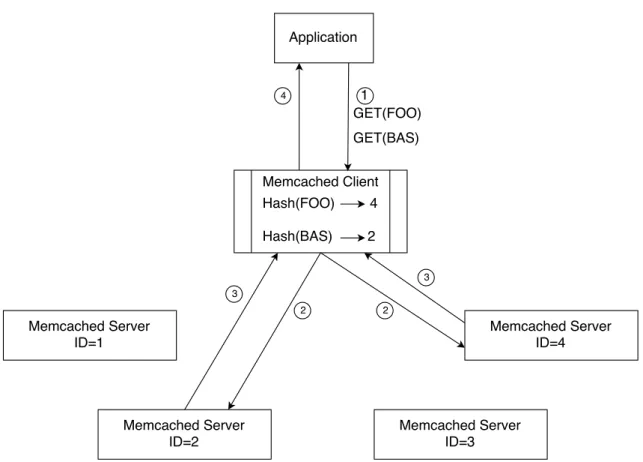
As illustrated in figure 2.2, we can see an example of how Memcached works as a distributed memory caching system, deploying four Memcached servers to store its respective data. In step 1, an application will request for a key FOO and BAS to the Mem-cached Client. The MemMem-cached Client is responsible for sending requests to the correct Memcached Servers. When receiving the application requests, it will hash [34] each key in order to know which Memcached Server should receive requests. In parallel, the Mem-cached Client will send the requests to the intended MemMem-cached Servers as you can see from step 2. The Memcached Servers replies to Memcached Client, step3. In step 4, Mem-cached Client will aggregate the responses and send them to the application. From the example above we can see that Memcached does not provide redundancy but distributes load and achieves better performance. For each key it picks the same Memcache Server
C H A P T E R 2 . R E L AT E D WO R K
consistently because each key is hashed in order to determine which Memcached server should handle the respective keys. We can see also that every instance of Memcached combined represents one big cache. Therefore each distributed Memcached is a fragment of the hypothetical big cache that is consistently dealing with the same set of keys.
Memcached relies on its fast memory management scheme to achieve his greatest local performance. We are going to briefly describe in the respective sections below, how each aspect of the memory management works in Memcached.
2.3
Memcached Components
In the light of what Conglong Li and Alan Cox said [22] there are three major components of Memcached, the hash table, the replacement structure and the memory allocator. The memory allocator is responsible for every memory allocation of a key-value pair in Mem-cached. The replacement structure is responsible for choosing which key-value pairs are going to be evicted, and the hash table is responsible for associating the hash value of the requested key to the place where the key-value pair is stored in memory. Every key-value pair has its metadata, information that tells us for example which are the pointers to the next and previous key-value pairs in a linked list, the expiration time of the key-value pair in cache, the respective key and value of the pair and many others. Thus, when a key-value pair is allocated in memory, what is actually is allocated is the key-value pairs and its respective metadata.
When a key-value pair is going to be stored in Memcached, first the memory allocator will check if there is enough memory to store the key-value pair. If there is no memory, the memory allocator tells the replacement structure to evict a key-value pair. After the eviction, the memory allocator reclaims memory to store the new key-value pair. The replacement structure is composed by a doubly linked list of key-value pairs that will pick the key-value pair to evict with the least priority.
In the case of Memcached receiving a GET request, the requested key is hashed and right after the hash table maps the key-value pair that associates it to the requested key. If the key-value pair is found, it will be returned to the client and the key-value pair is updated in the replacement structure.
2.3.1 Memory Allocation and Replacement Structure
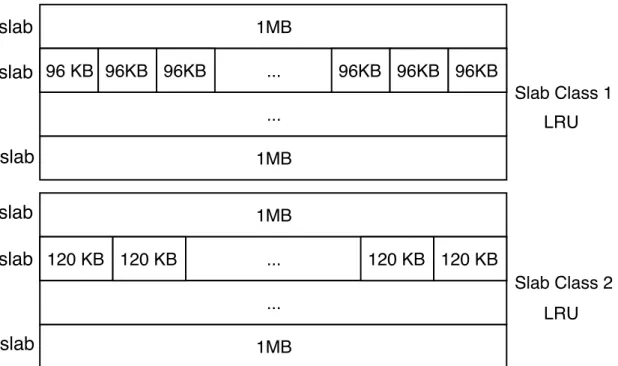
Memcached, for its memory allocator, uses a technique called the Slab Allocator [6] that is described in more detail in section2.4.3. Shortly the slab allocator is a memory man-agement mechanism that is intended to avoid fragmentation. By using the slab allocator, Memcached starts organizing its memory in layers called slab classes. For every slab class, there is a limited size for storing an item. In figure2.3we see that the slab class 1 can take items up to 96 KBs, as for slab class 2 it can take items from 97 to 120 Kbs. This way, Memcached can efficiently manage its memory and reduce internal fragmentation. We
2 . 4 . M E M O RY M A N AG E M E N T S C H E M E S
Figure 2.2: How Memcached works.
can see internal fragmentation as a block of memory assigned to an item that is somewhat larger than needed, leaving some portion of the memory unused by other items. Due to the fact of Memcached constraining the items into specific layers by their size, it can predict how much memory is needed to store an item. Even though the slab allocation technique cannot eliminate all internal fragmentation, it can greatly avoid a big part of it, allowing more items to be stored in Memcached.
To efficiently manage the items that will stay or leave the memory, we mention in section 2.3 that Memcached uses a replacement structure to do so. This structure is a doubly linked list and organizes its items by their recency, meaning that the least recent more popular items tend to be in cache. For every slab class, Memcached has one replacement structure, and the reason for this is that when an item is going to enter cache and memory is needed, Memcached can quickly know which is the least recent item available that will provide with sufficient memory for the newer one. This leads to fast management and allocation of the memory. We will provide more detail information about the replacement structure of Memcached in section2.5.1.
2.4
Memory Management schemes
Operating System memory management focuses on handling the memory at two levels: i) allocating memory to the programs running in the operating system; and ii) the internal
C H A P T E R 2 . R E L AT E D WO R K 1MB
slab
...slab
96 KB 96KB 96KB 96KB 96KB 96KB 1MB ...slab
Slab Class 1 1MBslab
...slab
120 KB 1MB ...slab
Slab Class 2 120 KB 120 KB 120 KB LRU LRUFigure 2.3: Example of the memory management of Memcached.
management dedicated to the kernel. In the first case for a program to execute, it is necessary for the actual program and its data are in memory, and for this reason, memory management handles the blocks of memory for such programs in the operating system in a way that contributes to optimizing the performance of the overall system. As for the kernel, the allocation and freeing of objects are common operations, therefore memory management needs to handle the memory efficiently and quickly, relying on its internal memory allocator to do so.
Web applications require most of the times to access their data in order to achieve fast decisions and to show more quickly what the user wishes. In-memory key-value stores are used to store the data more used, avoiding the intensive access to slower data storage. These in-memory key-value stores are frequently requested due to the needs of several web applications. Since many web applications need their data on the go, it is important that the in-memory of the key-value store has a good management of its memory, because the more data that can be stored, the less likely it will be necessary to access the database or remote resources.
In the following subsections, we are going to explore some memory management schemes that exist for in kernel and process management.
2 . 4 . M E M O RY M A N AG E M E N T S C H E M E S
2.4.1 Fixed-size blocks allocation
A. Silberschatz et al. [32] said that the easiest method for allocating memory is to di-vide the memory into sized partitions. The Fixed-size memory allocation or fixed-partition scheme is mainly used in batch environments and has a straightforward ap-proach when allocating its memory. The memory is divided into fixed blocks, and the operating system has a table which keeps track of the available and occupied blocks. Ini-tially, all of the memory is available and when a process needs to allocate memory, the allocator will search for a block that is sufficiently large for this process. After finding a block big enough, the needed block is allocated, leaving the rest of the unused memory for future requests. Only one process can occupy a block so as an example if we have blocks of 5KB and two processes request to allocate 4KB and 1KB respectively, it will lead to using two 5KB blocks and 5KB are lost with internal fragmentation. When a process terminates, it releases its memory, allowing other processes to allocate that block. Now let us imagine that there are free size blocks of memory and five 1KB objects can be spread in memory. After those objects are freed, it will fragment the memory, causing a 5KB object request not to be satisfied. Although the total free memory is enough to allocate the process of 5KB since it is not contiguous, it can not be used, causing a problem called external fragmentation.
Eventually, the memory will be fragmented, and the processes that are in need of memory must wait in a queue for there turn for some continuous blocks of memory to be available. The allocator needs to know from the set of free blocks which block best satisfies the request of size n. There are some strategies to tackle this problem in which the first-fit, best-fit and worst-fit are the most commonly used.
• First fit. The allocator will allocate the first large enough block that he will find for an in need processor. The disadvantage of using this strategy it is the possibility of a big internal fragmentation occur inside blocks. A processor that needs 200KB and the first large enough block suited for the processor is 600KB the internal fragmentation will be 400KB. Nevertheless, this is generally the faster strategy because we allocate the processor in the first suitable block.
• Best fit. Using this strategy, the allocator will pick the smallest big enough block that the processor could fit in. To do so, the allocator checks the whole list of avail-able blocks, unless the list is ordered by size. Usually, we waste some performance since the whole list of available blocks is iterated, but on the other hand, this strat-egy produces the smallest internal fragmentation
• Worst fit. This strategy iterates the whole list of available blocks and will find the largest big enough block that the process could fit in. It works similarly like Best fit, but it will produce the biggest internal fragmentation possible. A. Silberschatz et al. [32] refer that simulations have shown that First fit and Best fit are better than worse fit in decreasing time and storage utilization.
C H A P T E R 2 . R E L AT E D WO R K
The fixed-size management scheme allocates fixed-size blocks of memory continu-ously and with the allocation and freeing of the memory it will eventually lead to internal and external fragmentation. However, some memory management schemes allow the allocation of the blocks scattered in memory like paging.
Paging memory allocation allows the physical address space of a process to be non-contiguous, avoiding the problem of fitting memory chunks of fixed-size onto the backing store.
There are some ways of implementing paging like shared pages, hierarchical pages, inverted pages and others, but we are going to focus more on the basic method for im-plementing paging. The basic method for imim-plementing paging consists of breaking psychical memory into fixed-sized blocks called frames, also the virtual memory will be broken into blocks of the same size called pages. The hardware defines the size of the pages and the frames have the same size as the pages. Each virtual address generated consists in two parts: page number and a page offset. When processes request memory, they first need to allocate the pages on the virtual memory, for an example if one page is 4MB and a process needs to allocate 6MB then two pages will be allocated to that process. Even though a process does not completely fill a page, it is still allocated to that same process, making it unusable to other processes and creating internal fragmentation. Page table, as we can see from figure2.4 contains the base address of each page in physical memory. Each index represents the number of the page and each page allocates a frame, together with the offset of the page, it is possible to determine where is the page going to be stored in the physical memory.
In the next example based on A. Silberschatz et al. example 2.4 we are going to describe how pages are assigned to physical memory. Let’s Consider that a page is 4 bytes and the physical memory is 32bytes. The virtual address 0 is page 0 and offset 0. Since the page table indicates that the page points to frame 5, it is going to be mapped as follow: ((5 ∗ 4) + 0) = 20. The equation represents the frame associated to the page times the bytes of a page plus the offset of the page. For page 12, the physical address that is going to be map is 8 because ((2 ∗ 4) + 0) = 8.
2.4.2 Segmentation Memory Management
Segmentation is a commonly used memory management that is still used today. A logical address space is a collection of segments. Segmentation can be combined with virtual memory and even paging, but in this subsection, we are going to focus on simple segmen-tation that is not combined with either the above memory management techniques.
Segmentation is a variant of dynamic partitioning where a process is broken into segments. This approach of memory management is visible to the programmer, on the contrary of paging that is entirely handled by hardware and the operating system. A single process is commonly split into three segments: data, code, and stack. The data is where all the variables used in the program; the code is part of the process that is
2 . 4 . M E M O RY M A N AG E M E N T S C H E M E S
la
G
?n
Figure 2.4: Paging model of logical and physical memory. (taken from [32]).
actually executed on the processor; Stack that dynamically tracks the progress of the code. Processes can have more segments, and usually, more complex objects have segments for objects. Segments vary in length and the length of a segment is defined as its purpose in the program. Each segment has a name or number and a length.
Although the user can represent memory with two-dimensional address, memory needs to be mapped to physical memory. To do this, a segment table exists to know each segment base and the segment limit. The segment base tells where the segment starts in the physical memory, and the segment limit is the length of the segment. The index of the table consists of the number of the segment. The offset of the segment must be between 0 and the limit of the segment.
C H A P T E R 2 . R E L AT E D WO R K
Figure 2.5: Example of segmentation. (inspired by [32]).
to three segments from 0 to 2. The segment 0 begins at location 1800 and as a limit of 800 bytes. Therefore a reference to byte 160 of segment 0 is mapped to location 1960 since 1800 + 160 = 1960. However, a reference to 1400 bytes of segment 2 would result in a trap to the operating system, which means the logical addressing attempt is beyond the end of the segment.
2.4.3 Slab allocation
The slab allocator [6] is an object-caching memory allocator used in the kernel and also in some processes malloc/free implementations presented by Jeff Bonwick in 1994. Allocat-ing and freeAllocat-ing objects in memory are common operations in the kernel. When creatAllocat-ing an object, first its memory must be allocated before proceeding with its initialization. After an object is no longer needed, it is destroyed and memory is freed. It is expensive to create and destroy objects and also it can increase the fragmentation of the memory. Therefore slab allocation addresses the problem by caching these objects in its free or in-use state, avoiding the frequent allocation and freeing of objects in memory.
In SunOS 5.4, the Slab allocator works with units called slabs. A slab represents one
2 . 4 . M E M O RY M A N AG E M E N T S C H E M E S
Figure 2.6: Slab logical layout. (Taken from [32]).
or more pages of virtually contiguous memory in which each slab is split into equal sized chunks. The slabs are in the kmem_slab data structure. Like its represented in figure
2.6 we can see that each kmem_slab holds the information of the slab’s linkage in the cache, the reference count and the list of free buffers. The kmem_bufctl structure keeps the free list linkage, the buffer address and a back-pointer to the controlling slab. The slabs are in a circular doubly-linked list, in which the list is partially sorted. First on the list comes the empty slabs (all buffers allocated), then it follows by partially filled slabs(some buffers are allocated and some are free), and then at the end of the list, there are the complete slabs (all buffers are free). The cache contains a free list pointer that points to the non-empty slabs and each slab has its own free list of available buffers. This originates a two-level free list structure, that helps the memory reclaiming because it just simply needs to unlink a slab instead of unlinking every buffer from the cache’s free list. The slab data structure as J.Bonwick [6] said, can bring several advantages when managing the memory:
• Reclaiming unused memory is trivial. As we mentioned above, the cache presents a two-level free list structure, this makes the process of reclaiming unused memory straightforward. By simply putting the slab reference count to zero, the associated pages can be returned to the VM system.
C H A P T E R 2 . R E L AT E D WO R K
these operations we only need to remove or add objects to the free list and update a reference count. Since the free list is implemented with a doubly-linked list, it takes constant time removing or adding objects from the list.
• Severe external fragmentation (unused buffers on the free list) is unlikely. The slab allocator pre-allocates its memory and this way, the external memory is con-trolled. For a sequence of 32byte and 40byte, the biggest external fragmentation is 8byte since we can only allocate 32 byte and 40byte.
• Internal fragmentation (per-buffer wasted space) is minimal. Each buffer is ex-actly the cache object size, therefore the only wasted space is an unused portion at the end of the slab. As an example, a 4096 byte pages and the slabs in a 400 byte object cache would make each slab to have ten buffers, leaving an unused 96 bytes. This results in 9.6 bytes wasted per slab, that represents a 2.4% internal fragmentation.
Memcached inspires in the slab allocation technique for its memory management. In figure 2.3we can see three important components presented in Memcached, similar to the concepts presented above:
• The slab which it is the primary unit of currency, representing blocks of memory that usually are 1MB each.
• The chunks are the result of slicing up a slab. It is in the chunks where the key-value pairs are stored. Every chunk of a slab as the same size.
• The slabs are stored in partitions of the memory depending on their chunk size, these partitions are called slab classes. In essence, slabs that are in different Slab classes contain chunks of different size.
Memcached initially starts by dividing the memory into slabs. The total available memory is allocated in the form of slabs into the slab classes. When a slab is allocated into a slab class, it divides it into chunks of a specific size. The chunks of slabs increase between slab classes by a default factor of 1.25. To know which slab class a key-value pair is going to be stored, Memcached checks the size of the key-value pair and stores it in the slab class with the smallest chunks sufficient to store the key-value pair. If we take as an example figure2.3, when a key-value pair of 92KB is being inserted in Memcached, it will be inserted in Slab Class 1 because it has chunks sufficiently large to store the key-value pair. Hypothetically the key-value pair could be stored in slab class 2, but it would have caused a bigger internal fragmentation of 28KB.
2.4.4 Summary
Memory management schemes were built to handle memory in a way that processes can reach an optimized performance. Like Fixed-Size block allocation, it ensures that the
2 . 5 . R E P L AC E M E N T P O L I C I E S
memory should be allocated in a continuous fashion way, partitioning the memory in various fixed size blocks. This method can bring some disadvantages. The continuously fixed size partition brings internal fragmentation in each block. Occasionally processes request blocks of memory, and most of the times the allocations are bigger than needed, leaving remaining free memory unused.
Paging addresses the memory in a non-continuous way, avoiding the problem of fitting memory chunks of various sizes onto the backing store. It partitions the physical and virtual memory into fixed-size blocks called frames and pages, respectively, reducing external fragmentation and the internal fragmentation. Thanks to the page mapping system, pages are allocated anywhere in the physical memory. The page management is not visible to the user and is controlled by the operating system.
Segmentation, on the other hand of paging, it is a memory management scheme that is visible to the user and segments do not follow a specific fixed size. Segmentation works similarly like paging. It also has a segmentation table, which indicates where the segmen-tation starts and ends. Any process can allocate a segment if there is available memory because a segment does not follow any specific size. For this reason, segmentation avoids internal fragmentation. On the other hand, it has more external fragmentation because freed segments leave empty spaces that fragment the free memory space. Also, since the memory is not partitioned it takes more costly memory management algorithms to allocate segments. Paging and segmentation can be combined to solve problems like the segmentation, external fragmentation and simplifying memory allocations.
All memory management schemes described were generic types of memory allocation. Slab allocation is an object-caching kernel memory allocator that manages objects within the cache. The way slab allocation was designed shows that allocating and freeing objects in cache takes constant time to perform. This is a major advantage because it is common to insert and to delete objects in the cache. Furthermore, the Slab allocator reduces internal fragmentation by pre-allocating most of its memory, at the same time, it can also control its external fragmentation by designating a range of objects sizes to be stored in a particular area of the memory.
2.5
Replacement Policies
When the cache becomes full of objects and it wants to store new objects, it is performed a replacement policy. The replacement process is performed by evicting older objects in order to make space for newer ones. This way, the cache can adapt to the change of new requests pattern achieving better hit rates. To decide which objects are going to be removed, replacement policies take into consideration some factors of the objects. Krishnamurthy and Rexford [41] describe in their book these factors that can influence the decision of replacement policies as:
C H A P T E R 2 . R E L AT E D WO R K
• frequency: number of times the object was requested or accessed.
• size: size of the object.
• cost: this cost refers to the latency of fetching an object from the original source or recalculating the object.
• modification time: last time the object was modified.
• expiration time: time defined for the object to be replaced (this is mostly used as an ageing process to remove objects that were popular once but are not anymore).
There are different replacement policies derived from these factors. Some even com-bine some factors of objects to cover the flaws of other used policies.
Recency aware policies. Most strategies tackle recency by using extensions of the Least Recently Used (LRU) policy [24]. The LRU policy assumes that the least recently accessed object has the least probability to be accessed in the future. The advantage of using this algorithm is that incorporates an ageing mechanism in objects e.g if an object stops being so popular2for a period of time, other recent objects that are starting to get more popular will have more priority of not being evicted. This way, objects that were once popular will eventually be evicted from the cache, giving a chance to more recent stored objects to scale their priority in the cache. The disadvantage of using LRU is that sometimes there are popular objects that can collide with recent objects. The recent ones have more priority because the eviction decision is done within a period of time where the recent objects were more accessed than popular ones.
Frequency aware policies. Frequency policies like The Least Frequently Used (LFU) policy [24], consider frequency when evicting an object. On the contrary of the LRU, LFU ignores recency on eviction and removes the object which has the least hits in the cache. By Ignoring the recency of the object, it can bring some disadvantages to the LFU policy, for example, new objects will not have time to build up their frequency to match older objects. Also, an object that was popular once and received many hits may never leave the cache even if it is no longer popular.
Size aware policies. Size is another factor used when evicting objects from the cache. For example, larger objects can be removed first to make room for more smaller objects. The advantage of this technique is that by removing larger objects, smaller objects can fit in the space left by the larger object. However, some websites can benefit from larger objects because some of them are harder to compute and therefore, it is better to remove the smaller objects first. Since we have the dilemma "Is bigger better?", the size factor is usually combined with other factors like recency, frequency or cost: Greedy Dual [7], LRU-Min [1], PSS [2].
Cost aware policies. Web objects are constantly being recomputed. Some objects, in order to be recompute need to gather information that is stored in databases. The latency
2popular objects are refereed as the objects that are more accessed since the time their are in cache
2 . 5 . R E P L AC E M E N T P O L I C I E S
cost of going to the database and computing the object to deliver to the client can vary in most objects. This cost of recomputing can be essential in some systems. Since most caches use recency as their deciding factor, the cost is usually combined with recency and other factors to prioritize more costly objects to stay in cache. Replacement policies like Greedy Dual [7] and GD-Wheel [22] combine the cost of recomputing objects, size and recency to decide which objects should be evicted from the cache.
Modification time aware policies. When modification time is taken into consider-ation, what is done is to consider the period time since the object was last modified. Although, we can also consider as the eviction decision the last time since the object was accessed. The major disadvantage of this policy is that the objects that are frequently popular can be evicted because the time since the object was last accessed is longer than the time of the other less requested objects. Instead, this factor is used as an ageing mechanism and it is combined with other factors to tackle their disadvantages, like the frequency factor. A policy like Hyperbolic Caching [5] is an example that combines fre-quency and modification time. They use a function for ranking each object in cache, and Hyperbolic Caching based on that rank makes their eviction decisions.
Expiration time aware policies. Some caches have the chance of choosing the possible expiration time for evicting each object. This factor is not directly used in policies. When the object is not evicted by the replacement policy and its time in cache is longer than the defined expiration time, the cache forces an eviction on those objects.
In the following subsections, we are going to first describe in more detail how does the replacement policy works in Memcached, and after, we are going to explore some replacement policies that could benefit from cost factors.
2.5.1 Memcached Replacement Policy
When it comes to decisions to evict key-value pairs, Memcached uses a trivial LRU algo-rithm to pick the key-value pair that is ready to leave [44]. In this context, when we say that the key-value pair is least used in the cache, we mean that the key-value pair is the least recently requested among the other key-value pairs.
In Memcached for every slab class, there is a replacement structure that uses a LRU (Least Recently Used) algorithm as its replacement policy. Every replacement structure is a doubly linked list that can be segmented into three segments: Hot, Warm and Cold LRU. When a key-value pair is inserted, it goes straight to the Hot part of the LRU, giving it a maximum priority to stay in cache. After a time if the key-value pair is not requested often, Memcached sends it to the cold part of the LRU. If a key-value pair is requested more than 2 times in a period of time, it will become an active key-value pair. Active key-value pairs that are in the Hot segment will move to the Warm segment, active key-value pairs that are active in the Warm segment stay in the Warm segment, and finally, if active key-value pairs are active in the Cold segment, it will move to the Warm segment. The cold part of the LRU is the place where key-value pairs are not requested
C H A P T E R 2 . R E L AT E D WO R K
often, and the ones at the bottom of the Cold LRU have the potential to be evicted. To manage the transition between this segmentations, Memcached uses a LRU maintainer. This maintainer will roam through every slab class, and checks in each segmentation of the LRU queue for key-value pairs that have conditions to change between segmentations or even to be evicted.
2.5.2 Greedy Dual-Size Algorithm
Greedy Dual-Size Algorithm [7] integrates recency of access with the cost and size of cached objects when making eviction decisions. P. Cao and S. Irani. introduced a Greedy Dual-Size Algorithm [7] with a more reduced time complexity than the original Greedy Dual from Young et al. [43]. Their solution uses a priority queue to store every cached object. To calculate the priority value H of an objects lets consider that the queue has a global inflation value L, which is added to newer items to allow them to have more priority from older ones. Let also c(p) and s(p) be respectively the cost and the size of the object p. If the object p is already in the memory, it will update the objects H(p), by setting L + c(p)
s(p). When the object is not in memory, and there is no more room to store it,
the global variable L is updated, and it is set with the lowest H(p) in the queue. After the update on L, the object with the lowest H is evicted and p is stored with the priority of the new L + c(p)
s(p). If a key-value store chooses to use Greedy Dual-Size, the insertion or
the access of an object in the key-value store takes logarithmic time to perform(O(log n).) which will affect a lot the performance of the key-value store.
2.5.3 GD-Wheel Replacement Policy
Conglong Li et al. [22] said that if the cost of recomputing cache results varies signif-icantly, then a cost-aware replacement policy will improve the web application perfor-mance.
They also stated [22] that since the GreedyDual requires a priority for each object, building an implementation based on GreedyDual that achieves constant time complexity seems almost impossible, however, if it is possible to restrict the priority range, amortized constant time complexity is achievable. They reduce the time complexity by leveraging the Greedy Dual algorithm with Hierarchical Cost Wheels that were inspired by Varghese and Lauck’s Hierarchical Timing Wheels [39]
The Hierarchical Cost Wheel is a structure with a series of single cost wheels. A cost wheel is an array of queues with a clock hand pointing at one of his queues. We can see a clock hand as a pointer to a queue inside of a cost wheel. The time complexity of this should be logarithmic, but since they restrain the priority of the Hierarchical Cost Wheels, this does not happen. A cost wheel supports k different priorities, with k being the number of queues. When an object is inserted, if the clock hand is pointing at x queue, the object is placed into the ((c+x) mod k) queue where c is the cost of the object. When there is no
2 . 5 . R E P L AC E M E N T P O L I C I E S
room and objects need to be evicted, the clock advances until he finds a non-empty queue. After this step, he will remove the tail from the non-empty queue until the new object is allowed to be instantiated. The new object will be inserted into the head of the queue ((c+x) mod k) which c is the cost of the object and x is the current position of the clock. Since a single cost wheel of size k supports up to k cost. Conglong li et al. efficiently ex-tended the costs along the hierarchical cost wheels. Their fixed number of cost wheels is in a hierarchy that each higher level of cost wheel will support a bigger range of costs. Hierar-chical Cost wheels act like single cost wheels, and objects are inserted or moved to the re-spective queue by adding the cost of the objects plus the current position of the clock hand. Evictions occur in the lowest level cost wheel and not in the higher cost wheels. The clock hand keeps moving until it finds a non-empty queue. When the clock hand completes a whole round, the clock hand from the higher cost wheel advances to the next queue. For example, if the clock hand of the first level cost wheel with size k moves the k positions finishing this way a whole round, the clock hand from the second cost wheel will advance and point to the next queue. After the clock advances in the higher cost wheel, migration
is performed.
A migration consists in moving the objects of the queue that the clock hand of the higher cost wheel is pointing to, to the corresponding queues in the lower cost wheel. Since the objects are moving to a lower cost wheel, their priority needs to change. Let consider c(p) to be the cost of the object p, N Q1 the number of queues of the higher cost wheel, N Q2 the number of queues in the lower cost wheel, C[idx1] the current position of the clock hand in the higher cost wheel and N Q the number of queues in each cost wheel.The new priority queue in the lower cost wheel that the objects will be stored is determined by: (c(p) mod N Q1
N Q2 +C[idx1]) mod N Q.
With this technique, they achieve amortized constant time complexity per operation if using a limited priority range. Since each queue is a doubly linked list, the insertion and reuse of objects take O(1) time. Advancing the clock hand takes constant time because the queues are limited. With this, the eviction takes constant time to take an object in the lowest level cost wheel. If a migration happens, in the worst case, all cached objects are in that queue, and it will take O(n) time. Nevertheless, migrating an object implies removing it from the higher cost wheel and inserting it in the lower cost wheel. These operations take constant time to perform. Taking into consideration the sequence of operations for migrating the objects, the time required to execute such operations is amortized constant time.
2.5.4 Summary
There are many factors that we can take into consideration when choosing the best re-placement policy to optimize the cache of a given system. Some of these policies are combined in an attempt to optimize more complex systems. Although many systems use LRU as their replacement policy, we saw that some more complex systems could benefit
C H A P T E R 2 . R E L AT E D WO R K
if they also took into consideration the cost of latency as their main factor of decision. Few replacement policies use cost as their deciding factor for evicting objects.
Algorithms like the Greedy Dual[7] and GD-Wheel[22] try to use the cost factor by combining other factors such as recency and the size of the object. Taking a more in-depth look into the Greedy Dual, we conclude that it uses a global inflation variable to simulate the recency factor. For each object, the algorithm assigns a priority through the inflation variable based on the object cost and size. All of the objects are stored in a single priority queue. Since every object is stored in a single queue, the time complexity for inserting and accessing an object is O(log k) where k is the number of objects. Key-value stores do GET and SET operations with constant time complexity, and therefore, by incorporating the Greedy Dual it might not be as beneficial as expected. However, GD-Wheel emerged to tackle this problem. Conglong Li et al. combined Greedy Dual and Hierarchical Cost Wheels, distributing objects through many hierarchical wheels. By limiting the hierar-chical wheels, GD-Wheel can achieve constant amortized time complexity per operation. This makes it the best cost-aware replacement policy to choose when the latency is an important factor in the system.
2.6
Rebalancing Policies
Recapping from section 2.4.3, Memcached allocates its memory in the form of slabs, according to the requests distribution, some slab classes will have more memory than others. In a slab class that is more requested, it will have more memory allocated than the other less requested slab classes. Once the available memory of Memcached is assigned to a slab class, it will always remain associated to it. This means that when the request distributions changes in Memcached, some slab classes may not have enough memory to adapt to the new distribution and their replacement structures may be too short, forcing key-value pairs to be evicted too many times lowering the hit-ratio. This happens because the slabs were allocated taking into account the old request distribution, translating in a problem that is called slab calcification. If the distribution of the requests stays uniform, the hit ratio will not change much, and consequently the performance will be similar. However, there are systems whose request are not uniform and change over time, which will degrade performance. [9,18]. To tackle the slab calcification problem, some approaches can be performed.
Cache reset. Every X seconds, all objects are removed from cache. Cache resetting is a manual policy and its not implemented in Memcached. This approach can bring several disadvantages[9] such as leaving client requests hanging, several periods of times to refill the cache with objects, and since the cache is empty, the database will receive many requests.
Rebalancing Policies. These type of policies will auto move slabs between slab classes like in the figure2.7. The policies conditions restrict the movement of slabs to other slab
2 . 6 . R E BA L A N C I N G P O L I C I E S
classes. As an example, Twemcache3[36] has a set of rebalancing policies to avoid the slab calcification.
• Random slab eviction: For every SET operation, if there is not any free chunk or slab in the slab class, Twemcache will randomly pick a slab from any slab class and will remove all objects. Accordingly, it reassigns the empty slab to the class in need by dividing the slab into chunks of the appropriate size.
• Least Recently Accessed Slab: Instead of picking a random slab to evict all objects, Twemcache picks the least accessed slab and removes all its objects reallocating it to the in need class.
Rebalancing policies are a good approach to confront the slab calcification problem. They are dynamic, and if we can detect when the slab calcification occurs as well which the classes will benefit and be harmed from removing slabs, we might reach a near optimal solution to the slab calcification problem.
slab slab slab slab
Slab Class
slab slab slab slab
Slab Class
Figure 2.7: Example of a rebalance of slabs.
2.6.1 Memcached Rebalancing policy
Memcached rebalancing policy will check for the eviction rate of each slab class 3 times per 30 seconds. Once in every 10 seconds, if a slab class has the highest eviction count for
C H A P T E R 2 . R E L AT E D WO R K
three times, it shows that the slab class is more likely to be the most requested of all slabs and for this reasons, it will take one slab from the slab class which had zero evictions. This approach has some inconsistencies, Conglong Li and Alan L. Cox, said that “this policy is very conservative and ineffective” [22].
One problem with this policy is that periodic decisions might be too lazy for fast object requests. Taking into consideration bigger corporations that deal with millions of requests from users per second, waiting 30 seconds for a cache to rebalance their slabs can have a significant impact on their performance. Furthermore, it could be beneficial to move slabs from a slab class with more chunks and a lower eviction rate to a slab class with fewer chunks and higher eviction rate, decreasing the miss rate.
2.6.2 Cost-Aware Rebalancing Policy
Conglong Li and Alan L. Cox [22] present in their paper an alternative to the original rebalancing policy of Memcached. The alternative consists of a cost aware rebalancing policy. Each slab class holds the average cost per byte information. A particular variable was created in Memcached to know which id of the slab class has the lowest average cost. Their policy reacts immediately on eviction. Every time an eviction occurs in a higher slab class, some least recently used slabs are taken from the lowest slab class. The number of slabs that are going to be moved depends on the size of the evicted key-value pair.
One problem with this policy is that it moves all slabs from the lowest slab class. At some point, the lowest slab class can have a lack of slabs. Also, since every slab is taken from the lowest slab class, lower objects will not have time to build up to migrate to other classes. Additionally, by rebalancing a slab on every eviction it can be a demanding process and can be inefficient if the distribution of the objects stays the same.
2.6.3 Cost-based Memory Partitioning and Management in Memcached When using web caching, a big amount of objects are stored in the key-value store. These objects may not only have different sizes, but they may also have different retrieving costs. To deal with this, eviction policies like the Greedy dual algorithm [7] were developed. Nevertheless, solutions like this are not supported by Memcached because Memcached has a particular memory management scheme that works specifically with LRU policies. Introducing these solutions in Memcached would affect its performance. In section2.2, we refer that Memcached partitions memory by the size of its objects. It means that when allocating an object if there is free space, it will first check the object size and allocates it in the memory dedicated to its size. When that part of the memory is full, it will evict one or more objects to make room for the new object.
Carra and Michiardi presented a solution [10] to allow cost-aware solutions to prop-erly work with Memcached memory partition by tackling the memory management of Memcached. They propose an algorithm that evaluates a single slab movement from the class with the lower risk of increasing the number of misses, to the slab with the largest
![Figure 2.1: Using a Key-Value Store as a Database Query Cache.(taken from [22]).](https://thumb-eu.123doks.com/thumbv2/123dok_br/15791174.1078158/23.892.128.766.312.633/figure-using-value-store-database-query-cache-taken.webp)
![Figure 2.4: Paging model of logical and physical memory. (taken from [32]).](https://thumb-eu.123doks.com/thumbv2/123dok_br/15791174.1078158/29.892.124.746.119.819/figure-paging-model-logical-physical-memory-taken.webp)
![Figure 2.5: Example of segmentation. (inspired by [32]).](https://thumb-eu.123doks.com/thumbv2/123dok_br/15791174.1078158/30.892.529.682.137.686/figure-example-of-segmentation-inspired-by.webp)
![Figure 2.6: Slab logical layout. (Taken from [32]).](https://thumb-eu.123doks.com/thumbv2/123dok_br/15791174.1078158/31.892.226.663.152.525/figure-slab-logical-layout-taken-from.webp)

![Figure 2.8: Talus example.(taken from [4]).](https://thumb-eu.123doks.com/thumbv2/123dok_br/15791174.1078158/42.892.132.747.285.639/figure-talus-example-taken-from.webp)
![Figure 2.9: Optimal memory allocation equation of Dynacache. (Taken from [12]).](https://thumb-eu.123doks.com/thumbv2/123dok_br/15791174.1078158/44.892.282.611.145.372/figure-optimal-memory-allocation-equation-dynacache-taken.webp)