U
NIVERSIDADE DE
L
ISBOA
Faculdade de Ciˆencias
Departamento de Inform´atica
RECOMMENDATION SYSTEM FOR MODERN
TELEVISION
Diogo dos Reis Gonc¸alves
TRABALHO DE PROJETO
MESTRADO EM ENGENHARIA INFORM ´
ATICA
Especializac¸˜ao em Sistemas de Informac¸˜ao
Trabalho de Projeto orientado pelo Prof. Doutor Francisco Jos´e Moreira Couto e co-orientado pelo Prof. Doutor Paulo Ricardo Pacheco Rodrigues Trezentos
U
NIVERSIDADE DE
L
ISBOA
Faculdade de Ciˆencias
Departamento de Inform´atica
RECOMMENDATION SYSTEM FOR MODERN
TELEVISION
Diogo dos Reis Gonc¸alves
TRABALHO DE PROJETO
MESTRADO EM ENGENHARIA INFORM ´
ATICA
Especializac¸˜ao em Sistemas de Informac¸˜ao
Dissertac¸˜ao orientada pelo Prof. Doutor Francisco Jos´e Moreira Couto
e co-orientado pelo Prof. Doutor Paulo Ricardo Pacheco Rodrigues Trezentos
Acknowledgements
These nine months wouldn’t be possible without the support of most people in my life. I would like to thank my parents and friends for supporting me and for understanding the reason why I didn’t have time for them. I thank my University colleagues that helped me reach this academic level and every time I needed inspiration for this thesis.
I would like to thank my supervisors for letting me explore this subject and for guiding me through it when necessary.
I would like to thank my colleagues at Caixa M´agica for the opportunity I had to deve-lop my thesis in this interesting subject and all the support given during its devedeve-lopment. Thanks to every family that was excited to share their television consumption habits with me, allowing me to do a whole evaluation step that otherwise wouldn’t be possible.
Finally, I would like to thank everyone who reads my thesis.
Resumo
Atualmente cada vez mais pessoas consomem servic¸os de televis˜ao e de streaming de v´ıdeo, tanto em casa como na rua usando os seus dispositivos m´oveis. Um fornecedor de televis˜ao disponibiliza aos seus clientes milhares de conte´udos cujo acesso est´a limitado no tempo. Assim torna-se necess´ario que o utilizador decida que conte´udos visualizar. V´arios estudos indicam que essa decis˜ao ´e morosa e que os utilizadores tˆem dificuldade em descobrir algo diferente do que est˜ao habituados nos canais que geralmente veem. Os m´etodos habituais para descoberta de novos conte´udos n˜ao s˜ao suficientes.
Os sistemas de recomendac¸˜ao permitem aos utilizadores encontrar conte´udos que sejam do seu interesse, baseando-se nos seus gostos ou nos interesses de determinada populac¸˜ao. Quando os utilizadores entram em contacto com este tipo de sistemas, o seu interesse e satisfac¸˜ao com o servic¸o aumenta, resolvendo-se assim alguns proble-mas de procura de conte´udos. Os atuais fornecedores de televis˜ao apresentam siste-mas de recomendac¸˜ao b´asicos que n˜ao exploram funcionalidades como a explicac¸˜ao das recomendac¸˜oes e a utilizac¸˜ao dos programas vistos pelo utilizador na gerac¸˜ao de recomendac¸˜oes. Estas funcionalidades podem ser encontradas em sistemas de recomend-ac¸˜ao existentes em outras ´areas.
O objetivo deste trabalho foi desenvolver um sistema de recomendac¸˜oes para forne-cedores de televis˜ao que permite aos seus clientes ultrapassar as atuais dificuldades. Foi desenvolvido um sistema de recomendac¸˜oes que utiliza os dados normalmente existentes num servic¸o de televis˜ao, apresentando o resultado numa interface apelativa e adequada para o efeito. As recomendac¸˜oes incluem explicac¸˜oes como tentativa de melhorar o inte-resse do utilizador pelo sistema.
O sistema de recomendac¸˜oes desenvolvido ´e composto por v´arios componentes inde-pendentes que se ligam entre si e que podem ser integrados num sistema existente. O primeiro componente ´e o conjunto de fontes de dados que fornecem o sistema. Estes da-dos incluem informac¸˜ao sobre os programas, os utilizadores e as classificac¸˜oes impl´ıcitas e expl´ıcitas que os mesmos d˜ao aos programas. De seguida, existe um componente que processa as fontes de dados e converte-os num formato unificado usado pelos restantes componentes do sistema. Durante este processo, ´e realizada a convers˜ao de classificac¸˜oes impl´ıcitas para expl´ıcitas, permitindo reaproveitar os algoritmos de recomendac¸˜ao exis-tentes para este tipo de classificac¸˜ao. Esta convers˜ao ´e realizada atrav´es de uma f´ormula
desenvolvida nesta tese que tem em conta a relac¸˜ao que existe entre os programas e os epis´odios vistos pelos utilizadores.
O componente seguinte trata as recomendac¸˜oes. Os dados e as classificac¸˜oes exis-tentes s˜ao processados e s˜ao fornecidos a v´arios tipos de algoritmos de recomendac¸˜ao que geram uma lista de programas recomendados. Os algoritmos usados neste processo baseiam-se em t´ecnicas de recomendac¸˜ao existentes como filtragem colaborativa e base-adas em conte´udo. Por outro lado, foram projetados e testados algoritmos criados com o dom´ınio televisivo em mente usando informac¸˜ao sobre o hor´ario e canal de transmiss˜ao de cada programa e a relac¸˜ao com os programas visualizados anteriormente. Estes algo-ritmos foram agrupados atrav´es de t´ecnicas de recomendac¸˜ao hibridas, em que se junta o melhor de cada um dos algoritmos para melhorar o sistema, ap´os uma avaliac¸˜ao dos mesmos.
Ap´os a gerac¸˜ao das recomendac¸˜oes, existe um componente com o objetivo de adicio-nar explicac¸˜oes a cada um dos programas recomendados e de agrupa-los por temas rela-cionados. Neste processo ´e criado um perfil do utilizador com base nas recomendac¸˜oes, e s˜ao gerados grupos de programas com base em propriedades em comum entre eles, como a sua popularidade, a sua categoria, atores em comum, entre outra informac¸˜ao estruturada que seja disponibilizada na fonte de dados original. Estes grupos s˜ao ordenados conso-ante as preferˆencias do utilizador, atrav´es do perfil do utilizador gerado. Cada programa recomendado ´e associado a uma dessas listas. As explicac¸˜oes individuais consistem na relac¸˜ao dos programas recomendados com esse perfil e com outros programas visualiza-dos anteriormente. O resultado deste componente ´e um conjunto de listas de programas recomendados ao utilizador em que cada programa tem uma explicac¸˜ao associada.
O componente seguinte ´e respons´avel por executar o sistema de recomendac¸˜oes sem-pre que ´e atualizada a lista de programas dispon´ıveis ao utilizador (tipicamente uma vez por dia nos operadores de televis˜ao existentes) e sempre que existe uma nova visualizac¸˜ao por parte do utilizador. O resultado das recomendac¸˜oes ´e guardado em mem´oria estando sempre pronto para ser mostrado ao utilizador. Isto permite que o utilizador tenha sempre acesso `as recomendac¸˜oes e que as mesmas sejam atualizadas sempre que exista necessi-dade. Esta funcionalidade est´a dispon´ıvel atrav´es do componente seguinte, os Web Ser-vices. O objetivo deste componente ´e disponibilizar as func¸˜oes descritas de forma a que possam ser usadas pela interface desenvolvida.
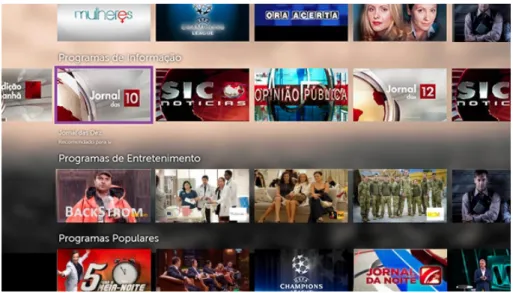
O ´ultimo componente ´e a interface de utilizador. Esta interface gr´afica apresenta, de uma forma simples e semelhante `as interfaces de televis˜ao existentes, as recomendac¸˜oes e as explicac¸˜oes das mesmas ao utilizador. As recomendac¸˜oes est˜ao divididas pelos gru-pos gerados pelo componente das explicac¸˜oes. Este componente foi usado para testar o sistema de recomendac¸˜oes com utilizadores.
Este sistema de recomendac¸˜oes foi avaliado com duas metodologias de avaliac¸˜ao. A primeira foi a avaliac¸˜ao offline. Esta avaliac¸˜ao consiste em testar os v´arios algoritmos
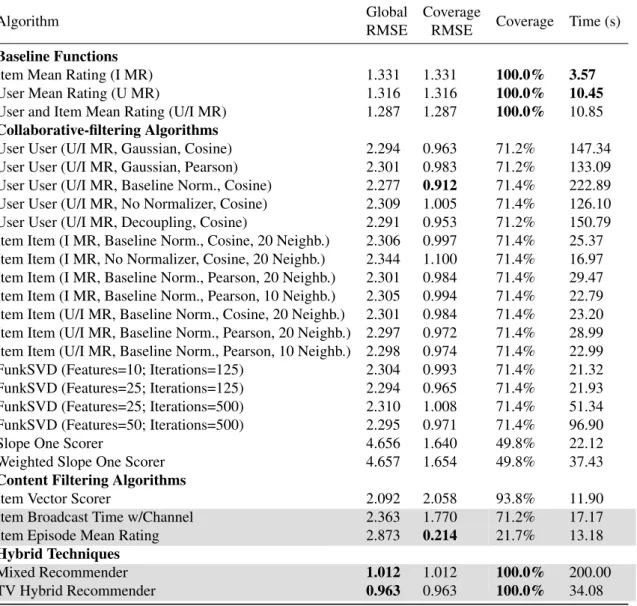
criados e usados nesta tese, usando diferentes m´etricas de avaliac¸˜ao. As m´etricas usadas foram a cobertura dos algoritmos, o tempo de execuc¸˜ao, o erro m´edio quadr´atico glo-bal e o erro m´edio quadr´atico de cobertura. Para este processo de avaliac¸˜ao foi usado um conjunto de dados composto por dados de visualizac¸˜ao de programas e por meta da-dos que descrevem os mesmos. Este conjunto de dada-dos foi dividido em v´arias partes iguais temporalmente de forma a testar a evoluc¸˜ao do sistema ao longo do tempo. A avaliac¸˜ao demonstrou que os melhores resultados globais foram apresentados pelos al-goritmos h´ıbridos. O melhor resultado de cobertura foi um dos alal-goritmos criados espe-cificamente para o dom´ınio televisivo, que apresenta uma diferenc¸a significativa quando comparado com os outros algoritmos. No geral, os algoritmos de recomendac¸˜ao apresen-taram valores semelhantes para as m´etricas avaliadas.
A outra etapa das avaliac¸˜oes tratou os testes com utilizadores. Estes testes tˆem o ob-jetivo de encontrar as preferˆencias dos utilizadores face aos sistemas de recomendac¸˜ao televisivos em geral, validar as recomendac¸˜oes e explicac¸˜oes geradas pelo sistema de recomendac¸˜oes e determinar o interesse dos utilizadores pelos tipos de explicac¸˜oes con-templadas no sistema. Para esta etapa foi utilizado o algoritmo hibrido que apresentou o melhor resultado na etapa anterior. A realizac¸˜ao destes testes implicou o recrutamento de utilizadores que autorizassem a recolha do seu perfil de visualizac¸˜ao televisivo du-rante um per´ıodo alargado de tempo, de forma a ter dados para executar o sistema de recomendac¸˜oes. Durante os testes, o utilizador interagiu com a interface do sistema de recomendac¸˜oes e respondeu a perguntas que lhe foram colocadas. Nestes testes concluiu-se que no geral o utilizador era favor´avel `as recomendac¸˜oes e `as explicac¸˜oes do mesmo, sendo que este aumentava a sua satisfac¸˜ao e eficiˆencia no processo de escolha de um programa para ver.
Neste momento a ´area das recomendac¸˜oes est´a a ter um grande destaque por parte dos operadores de televis˜ao. Neste trabalho prop˜oe-se uma abordagem que apresenta bons resultados por parte da satisfac¸˜ao dos utilizadores e que apresenta t´ecnicas de explicac¸˜ao inexistentes nos sistemas dos operadores existentes. No futuro poder-se-´a melhorar este trabalho com a inclus˜ao de novas t´ecnicas de recomendac¸˜ao, outras m´etricas de avaliac¸˜ao e a realizac¸˜ao de testes integrados num operador real em que se possa avaliar durante um per´ıodo mais alargado a influˆencia das recomendac¸˜oes nos utilizadores.
Palavras-chave: Sistemas de recomendac¸˜ao, Televis˜ao, Explicac¸˜oes, Interfaces de Utilizador
Abstract
Nowadays, people spend more time watching television contents than ever before. Television providers offer their customers thousands of programmes, available for watch-ing for a limited amount of time with recent technologies such as time-shiftwatch-ing, and new ways to watch them such as streaming using their own personal devices. It is impossible for someone to be aware of and to watch every available video, so one has to make the decision on what to watch. Having such a large amount of content available, viewers need to decide on what to watch. Recent research shows that some people get frustrated when searching for something to watch due to the vast amount of programmes which they are presented with.
Recommendation systems enable users to find content which they are interested in through their own preferences while also taking the interests of other users into consider-ation, allowing their customers to overcome their current difficulties.
The goal of this thesis was to develop a modular recommendation system for television providers. This system uses the information generally available in these environments to predict the user’s interest on programmes, including his or her implicit intent. Existing recommendation techniques were studied and evaluated and new TV domain specific al-gorithms were developed. Techniques were combined to form a hybrid algorithm capable of generating predictions for any programme in the system.
An explanations module was built to generate descriptions that define the reason why a specific item or group of items was recommended. It allows users to be more inter-ested in the recommendations given by the system. Predictions and explanations are then displayed on a user interface.
Two evaluation methods were used to validate the produced recommendation system. Offline evaluations were used to compare the algorithms and it was demonstrated that the use of hybrid algorithms improved the system. Controlled evaluations made by users were also an object of study, through which the system was praised for its general quality, as well as for the availability of the previously mentioned explanations. Most users felt there was an improvement in comparison to existing recommendation systems.
Keywords: Recommender Systems, Television, Explanations, User Interfaces ix
Contents
List of Figures xv
List of Tables xvii
1 Introduction 1 1.1 Motivation . . . 1 1.2 Objectives . . . 2 1.3 Contributions . . . 2 1.4 Planning . . . 3 1.5 Document Structure . . . 4 2 Related Work 7 2.1 Recommendation Systems Approaches . . . 7
2.1.1 Recommendation System Model . . . 8
2.1.2 Collaborative filtering . . . 8 2.1.3 Content-based filtering . . . 14 2.1.4 Hybrid filtering . . . 14 2.1.5 User Feedback . . . 15 2.2 Explaining Recommendations . . . 15 2.2.1 Explanation Aims . . . 15 2.2.2 Presenting Recommendations . . . 16 2.2.3 Explanation Styles . . . 17 2.3 Evaluation . . . 17 2.3.1 Evaluation Measures . . . 18 2.3.2 Datasets . . . 19 2.4 User Experience . . . 20 2.4.1 Soliciting Feedback . . . 20 2.4.2 Presenting Recommendations . . . 20 2.4.3 Providing Explanations . . . 20
2.4.4 Big Screen Interface . . . 21
2.5 TV Recommendation Systems . . . 21 xi
2.6 Frameworks . . . 22
2.7 Real World Cases . . . 23
2.8 Challenges . . . 24
2.9 Summary . . . 25
3 Work 27 3.1 A TV Recommendation System Model . . . 27
3.2 System Modules and Pipeline . . . 27
3.2.1 Data Sources . . . 28 3.2.2 Data Preprocessor . . . 29 3.2.3 Recommender Module . . . 31 3.2.4 Explanations Generator . . . 34 3.2.5 Recommendations Dispatcher . . . 38 3.2.6 Web Services . . . 38 3.2.7 Recommendations Frontend . . . 38 3.3 Implementation . . . 39
3.3.1 Data Sources and Data Preprocessor . . . 39
3.3.2 Recommender Module . . . 40 3.3.3 Explanations Module . . . 40 3.3.4 Recommendations Frontend . . . 40 3.4 Summary . . . 41 4 Offline Evaluation 43 4.1 Dataset . . . 43 4.1.1 TV Ratings Dataset . . . 43 4.1.2 Assembled dataset . . . 45 4.2 Evaluated Measures . . . 45 4.3 Results . . . 46 4.3.1 Baseline Functions . . . 46 4.3.2 Collaborative-filtering Algorithms . . . 47 4.3.3 Content-filtering Algorithms . . . 47 4.3.4 Hybrid Algorithms . . . 48 4.3.5 Discussion . . . 48 5 User Studies 51 5.1 Objectives . . . 51 5.2 Evaluation Method . . . 51
5.2.1 User Evaluation Session . . . 52
5.3 Results . . . 52
5.3.1 Sample Characterization . . . 52 xii
5.3.2 Session . . . 54
5.3.3 User Feedback . . . 55
5.3.4 Explanations . . . 56
5.4 Discussion . . . 58
6 Conclusion 61
A User Studies - Questions 65
Bibliography 75
List of Figures
2.1 An example user-item rating matrix. . . 8
3.1 Pipeline Overview . . . 28
3.2 Recommendations Screen . . . 39
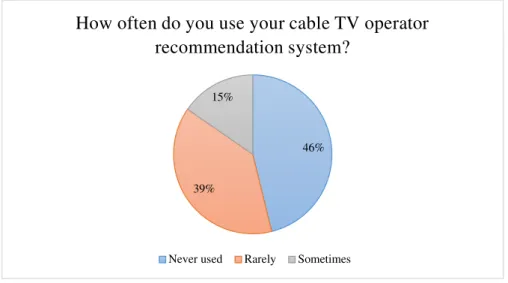
5.1 Results for question ”How often do you use your cable TV operator rec-ommendation system?” . . . 53
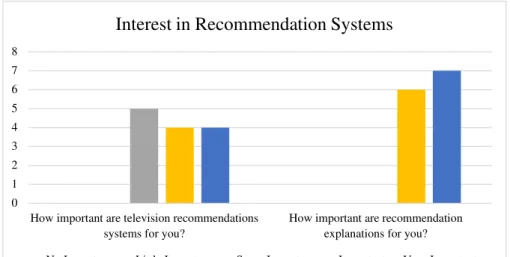
5.2 Results for the questions about recommendation system usage . . . 54
5.3 Results for the question about recommendation system type . . . 54
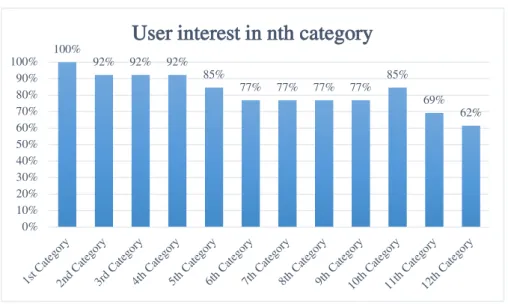
5.4 User interest by category position . . . 55
5.5 User interest in the presented items . . . 55
5.6 User feedback . . . 56
5.7 User sentences . . . 56
5.8 Explanation title results . . . 57
5.9 Explanation details results . . . 57
List of Tables
1.1 Project Milestones and Tasks . . . 4
3.1 Structured data after running the preprocessor module . . . 29
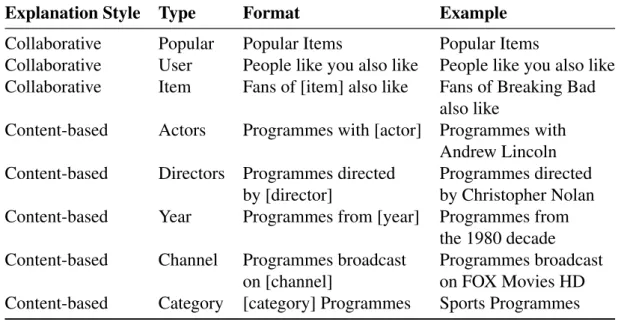
3.2 Possible category titles . . . 36
3.3 Possible item explanations . . . 36
3.4 Methods available for interaction with data . . . 39
3.5 List of used Lenskit algorithms . . . 40
4.1 TV Ratings Dataset count . . . 44
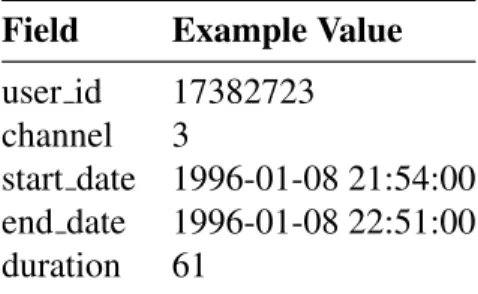
4.2 Example item . . . 44
4.3 Example session of a user that watched a portion of the example item . . 44
4.4 Evaluation Results . . . 46
Chapter 1
Introduction
1.1
Motivation
Today, more than ever, people subscribe to cable TV providers and streaming services [16, 13]. They spend more time watching television contents than before. They watch televi-sion not only at home, in their living room, but also everywhere else using their mobile devices. On a typical cable TV provider, costumers have access not only to live TV but also to VOD (video on demand) services. More recently, cable TV providers started of-fering week-long time-shifting services for several TV channels, allowing customers to watch their favourite shows at a later time. This means costumers are free to choose be-tween 29,000 different video programmes on a given time [31]. It is impossible for a person to watch every video available so they have to choose what to watch. People also have preferences on what they like to watch. With hundreds of different channels and thousands of time-shifted programmes, people might feel lost when assigned the task of finding something interesting to watch. Studies show that nearly half the people spend more than 10 minutes channel surfing or browsing the EPG (Electronic Program Guide) trying to find something to watch and almost 90% feel they watch the same channels over and over again [16]. More than half get frustrated when trying to find something to watch. Nowadays, the typical ways people have available for finding what to watch on a set-top-box like the EPG are not good enough.
Recommendation systems help users finding content they are interested in and can be based on multiple factors like what they previously watched or what they like. Although missing or hidden on most cable TV providers, clients that have access to recommendation systems find the service helpful, tend to be more satisfied with their cable TV provider and also tend to purchase more content [16, 5].
Most current recommendation systems for cable TV providers deliver limited func-tionality [1], missing features such as unobtrusively capturing user feedback [34] and rec-ommendation explanations, which are shown to increase user satisfaction and usage [42].
Chapter 1. Introduction 2
1.2
Objectives
This thesis aims at building an application for set-top boxes or interactive TVs that allows users to quickly and intuitively get recommended TV programmes and movies to watch without requiring any user interaction. It also aims to provide explanations for every rec-ommended programme. Being available directly on the set-top box means users do not need to reach for other sources of information. They can make a choice in the same envi-ronment they use to watch TV. To achieve this goal, the work described in the following sections must be studied, developed and evaluated.
Recommendation Engine
The first aim for this thesis is to build a recommendation engine suited for the cable TV reality. Each item, be it a live programme or a time-shifted one, has metadata attached to it. The system should be able to use information from those items and provide recom-mendations based on that information. Active user interaction with the system like item rating and passive interactions like content watching should also be used as an input to the system. The result will provide the user with a way to find new programmes to watch and new episodes from previously watched programmes.
Explaining Recommendations
Recommendation explanations improve the user’s trust and satisfaction in the system [35, 43]. They allow the user to better understand the reason why an item is recommended and to make a decision based on additional information associated with an item. A module to generate explanations will be made to supplement the recommendation engine. Evalua-tions will be made to find out if the module improves the user’s experience.
User Interface
It is important to have good algorithms for item recommendation but the way they are shown to the user have an equal impact on the effectiveness of the system. An inter-face made to display recommendations in a television environment will be developed and evaluated.
1.3
Contributions
The contributions of this work are:
• A Recommendation System pipeline that can be integrated with a cable TV provider data sources.
Chapter 1. Introduction 3 • An implicit feedback mapping algorithm that converts implicit user watching ses-sions to an explicit rating value, allowing existing explicit rating algorithms to be reused.
• Three recommendation techniques built for the TV domain:
– Item Episode Mean Rating predicts the rating for future programme episodes based on the user’s watching history for past episodes.
– Item Broadcast Time generates predictions based on the time periods when the user watches TV.
– Item Broadcast Channel generates predictions based on the channels the user watches.
• Two hybrid techniques that combine existing algorithms:
– Mixed Recommender predicts the ratings by using the best algorithm that cov-ers each item. The chosen algorithms were those that performed better in the offline evaluation.
– TV Hybrid Recommender uses a set of heuristics that employ different hy-bridization methods that depend on some known properties about the users and the items.
• An explanations design and algorithm for describing a list of recommendations. • Offline evaluations with an implicit dataset were performed. When comparing all
algorithms, it was shown the TV Hybrid Recommender presented the best global RSME value and Item Episode Mean Rating presented the best coverage RMSE. • User Studies were performed with users who provided their TV watching history.
Most users rated the system efficiency and their own satisfaction positively and wished to continue using this recommendation system in the future.
1.4
Planning
Table 1.1 presents the original milestones and tasks defined for this project. The plan was successfully followed on time with some adjustments. Originally both the recommenda-tion engine and explanarecommenda-tions module were under a unique milestone. A new milestone was conceived to allow to better develop a standalone explanations module. Because of this, the interface design milestone was slightly reduced. Finally, the System Evaluation milestone required a preparation phase not contemplated in the original project plan, but that did not affect the defined schedule.
Chapter 1. Introduction 4
Start date End date Duration Task
09/2014 09/2014 2 weeks Define project goals and requirements
09/2014 10/2014 4 weeks Research related work on recommendation engines - Recommendation Algorithms
- Recommendation Frameworks - User Interfaces
- Existing Video/TV providers recommendation services 10/2014 11/2014 3 weeks Research existing datasets
- Build a dataset
11/2014 11/2014 2 weeks Write the preliminary report
12/2014 03/2015 15 weeks Develop a recommendation engine adapted for the cable tv reality
- Choose the appropriate technology and recommendation methods
- Specification and detailed design - Codification of the system - Tests
03/2015 05/2015 9 weeks Design and build an interface to display recommendations
- Specification and detailed design - Codification of the system - Tests
05/2015 05/2015 3 weeks System Evaluation 05/2015 06/2015 4 weeks Write thesis
Table 1.1: Project Milestones and Tasks
1.5
Document Structure
This document is structured as follows:
• Chapter 2 - Related Work - Presents the concepts necessary to understand recom-mendation systems, explanations, recomrecom-mendation system evaluation and other re-lated concepts addressed in this work.
• Chapter 3 - Recommendation System - Describes the developed recommendation system pipeline and implementation.
• Chapter 4 - Offline Evaluation - Presents the evaluation steps and results for offline evaluation
• Chapter 5 - User Studies - Presents the evaluation steps and results for user studies • Chapter 6 - Conclusion - Describes the conclusion and future work.
Chapter 2
Related Work
2.1
Recommendation Systems Approaches
A recommendation system is a tool that assists users by providing suggestions. The user can use that information to make a decision like what products to buy, what books to read or what videos to watch [38, 37]. Generally, a recommendation system suggests items to users. To be able to provide suggestions, the recommendation system needs to predict which items are useful for the user. There are two main types of techniques [2]:
Collaborative filtering is the prediction of what a user likes based on their similarity to other users. A prediction is based on the interactions other similar users had with the system. An item might be recommended to a user as a result of being popular within similar users.
Content-based filtering is based on the analysis of the likeness between the items the user interacts with. The prediction of an item the user might like is related to the similarity with other items the user interacted with.
In addition to these types, some authors [38] also identify other types:
Demographic recommenders provide recommendations based on the demographic pro-file of the user. It’s inspired on the fact that users that share the same demographics might be interested in the same items.
Knowledge-based is a type of recommender that uses a domain knowledge to relate the user requirements with the items properties. This type of recommender is applied in contexts where users typically do not purchase the same items, such as when buying an apartment.
Community-based recommenders make predictions based on data from the friends of the user’s friends. They are inspired on collaborative filtering recommenders but they restrict the users that influence the recommendations.
Chapter 2. Related Work 8 All the mentioned techniques are typically combined to improve the recommendations and to reduce the disadvantages of each individual technique. The resulting method is called the hybrid recommender system. Two or more recommendation methods can be combined to create a hybrid system.
2.1.1
Recommendation System Model
In a typical recommendation system, there are users and items. Let U be the list of participating users and I the list of items the users can interact with. Users can rate items. These ratings are represented in a user-item matrix R. In Figure 2.1, a numeric user-item rating matrix is presented, representing a system where the user would have to rate items with a numeric value from 1 to 5.
I1 I2 I3 I4 I5 I6 . . . In U1 3 5 2 U2 U3 4 2 3 .. . Un 5 2
Figure 2.1: An example user-item rating matrix.
Each row represents a user and each column represents an item. The values represent the rating given by a user to an item, meaning item 5 was rated 5 by user 1 and rated 3 by user 3. Other users did not rate item 5. This matrix is generally sparse, most values are missing. Generally there are users with no ratings associated, meaning they didn’t rate any item, and also items with no user ratings. The objective of the recommendation system is to generate a list of items it predicts the user would be interested in. In other words, a recommendation system should be able to fill the missing values of the matrix. In this example, to predict which value would user n rate the item 5, the system would compare the user current ratings with the ratings of the users that rated item 5.
This is generally known as the top-N recommendation problem [14]. A list of recom-mendations is defined as follows:
Given a user-item matrix R and a set of items I that have been rated by a user, identify an ordered set of items X such that |X| ≤ N and X ∩ I = ∅
2.1.2
Collaborative filtering
Recommendation systems based on collaborative filtering methods allow users to make decisions based on the opinion of other users [36].
Collaborative algorithms depend on the feedback not only from the current active user but also by the users of the system. It is necessary to store the feedback provided by the
Chapter 2. Related Work 9 user. In collaborative algorithms, user ratings are generally represented in a user-item matrix such as the one presented in section 2.1.1.
There are two main types of collaborative filtering algorithms: memory based [15] and model based [7], both detailed in the following sections. But first, baseline techniques are presented and detailed.
2.1.2.1 Baseline Predictors
Baseline techniques provide a way to get non personalized recommendations and to have a base value to compare other algorithms. They can also be used as a fallback when other algorithms of the system are not able to provide a recommendation for the desired user-item pair [19]. The most common techniques use the average user or user-item ratings as the predicted rating.
Item Mean Baseline
This technique returns the mean rating of an item for all predictions, based on the ratings provided by other users. A common implementation [19] defines it as follows:
ru,i = µ + bi
ru,i is the value of the predicted user-item rating. µ is the global mean rating for all
the items in the system, and bi is the item’s average rating, without the global rating. It is
calculated with the following formula: bi =
Pn
k=1xk− nµ
n + γ
The number of existing ratings for item i is n. xkis the value of one of those ratings.
γ is an optional damping factor. User Mean Baseline
A technique similar to the previous one which instead returns the mean user rating for all predictions.
ru,i = µ + bu
Where buis the user’s average rating, defined as
bu =
Pn
k=1xk− nµ
n + γ User and Item Mean Baseline
A generic variation of the previous baseline techniques can be defined as ru,i = µ + bi+ bu
Chapter 2. Related Work 10 This allows the baseline prediction to be calculated using both previously defined formulas, returning a rating that is based on the average user ratings and in the average item ratings from the other users.
2.1.2.2 Memory Based
Memory based algorithms use the entire matrix of ratings directly when calculating rec-ommendations. Their first step is to find the user neighbors, a list of similar users, by correlating user’s ratings on items. Then, they calculate the user preferences over an item comparing the user’s rankings with its neighbors.
An example formula of a memory based implementation for item based filtering: ru,i=
P
j∈Ku(i)wi,jri,j
P
j∈Ku(i)|wi,j|
Ku(i) is the list of items rated by user u similar to the item i. wi,jis the weight the item
has in the calculation. This list can be generated by any similarity computation method presented later in this Section.
Memory based algorithms are typically partitioned in multiple components that have an impact on overall quality of the recommendation system [15]:
Item based and User based filtering
Collaborative filtering can be user based or item based. User based methods are based on the opinion of users with similar tastes when providing a recommendation. Item based methods rely on the ratings given to similar items. Both types are based on similar tech-niques, described in this Section.
[15] identifies five criteria to help to choose between both types of filtering: accuracy, efficiency, stability, justifiability and serendipity. They depend mainly on the number of users and items of the system and the number of ratings pairs.
Rating Normalization
Different users might have the same opinion on an item but assign different ratings to it. A user might only use the positive values on the rating scale and another user might be more open to use the full scale. Although they share the same opinion on a movie, they rate it differently. This discrepancy when rating the same opinion is problematic for recommendation algorithms. The following rating normalization algorithms may be used to overcome this situation:
• Gaussian normalization method
This approach, also known as mean-centering, was proposed by [36]. It suggests a solution to the shift of average rating by subtracting the user ratings from the
Chapter 2. Related Work 11 user averages. It also proposes a solution to the different rating scales problem by dividing the ratings with the variance:
ˆ ru,i =
ru,i− ru
pP
i(ru,i− ru)2
This formula can also be used by item-item collaborative algorithms by replacing the user average ranking with the item’s average.
• Decoupling normalization method
This method, suggested by [25] calculates the probability for the item to be pre-ferred by the user. If there is a high probability the user rates items with a value less or equal than a specific rating, then it is reasonable to assume those items are preferred by the user.
P r(R is pref erred) = P r(Rating ≤ R) − P r(Rating = R)/2
R is a rating value. The first term calculates the probability an item is rated a value less or equal than R. The second term calculates the probability an item is rated R. A value with the majority of ratings means it is not a special rating, so the second term is subtracted to the first term, reducing the preference over values with many ratings.
• Baseline Subtracting User Vector
A baseline function, like the ones identified in Section 2.1.2.1, can be used to nor-malize a user vector [19].
ˆ
ru,i = ru,i− bu,i
The normalized rating is calculated by subtracting the baseline value to the original user rating. Its usefulness depends on the chosen baseline function.
Similarity Computation
Similarity functions are used to calculate how similar two items or two users are. A higher value means they are more related to each other. For example, similarity between two users should be high if both users rated the same items equally, meaning they have identical tastes.
• Cosine-Based Similarity
A similarity measure that transforms each user ratings in a vector and calculates the cosine between both vectors
wu,v = cos(−→u , −→v ) =
P
i∈Iru,irv,i
q P i∈Iur 2 u,i q P i∈Ivr 2 v,i
Each vector contains the ratings the user gave to the items and zero for unrated items. This method does not take into account the effects of mean and variance.
Chapter 2. Related Work 12 • Pearson Correlation Similarity
A correlation-based measure, used by [36], that removes the effects of mean and variance.
wu,v =
P
i∈I(ru,i− ru)(rv,i− rv)
pP
i∈I(ru,i− ru)2
pP
i∈I(rv,i− rv)2
Neighbourhood Selection
A large recommender system might have millions of items and users to use as an input to the recommendations. It is difficult to store all those values in memory. According to [15], there are a number of techniques to filter the number of neighbours used in the computations to the best candidates.
• Top-N Filtering A list of the N nearest neighbours, the most similar, is kept, for each user. The value of N must be carefully selected. [21] found N = 20 is a good starting point with a value up to 50. They found higher values don’t bring better results.
• Threshold filtering Keep a list of all the neighbours with a similarity weight larger than a chosen threshold. A high value means only high quality neighbours are kept. Unfortunately there might not be sufficient users to keep neighbours for every user. The ideal threshold value depends on the data and must be evaluated. [41] evaluated different thresholds values with multiple algorithms.
• Negative filtering Discard negative rating correlation data and only keeps the other values. Negative values generally don’t have a significant impact on the results [15] as. it depends on the dataset.
2.1.2.3 Model Based
Instead of using the full matrix when generating recommendations, user ratings on items can be used as training data to build a model that recognizes patterns and makes predic-tions. Model based algorithms use machine learning and data mining techniques [7] to build such kind of recommender. Predictions are generated based on the previously built model. A common model based algorithm is the SVD factorization technique.
SVD-Based
Singular Value Decomposition (SVD) is a matrix factorization technique. [39] suggested the application of SVD to the collaborative filtering problem. SVD is the factorization of a matrix R in three other matrices:
Chapter 2. Related Work 13 When applied to the collaborative filtering problem, R is the user-item matrix, U and V are the user and the item matrix and S is a diagonal matrix with the rank of matrix R as its side. After doing the factorization this technique allows you to reduce the side size of S and lowering the size of the other matrices U and VT. This means an approximation
of an original matrix R can be stored in much less size. This value is known as the number of features a user and an item are represented. Those features are automatically inferred and denote characteristics that identify the user and the items, such as action movie. Unfortunately, generally it is not possible to identify what the features mean. A prediction is then generated by calculating a dot-product between matrices.
To use SVD it is required that the matrix must be complete, with no missing values. The user-item matrix has to be prepared to work with this technique. [39] suggests to use the averages to fill the matrix missing values. Others suggest alternate algorithms to calculate SVD using only the known values, such as FunkSVD [20].
2.1.2.4 Slope One
Slope One [28] is a fast alternative to the presented memory and model based collaborative filtering schemes. The authors consider it is a fast algorithm and easy to implement. Their tests presented similar results when compared to typical collaborative algorithms.
This method is based on the difference between two items’ ratings. Assuming a user u and a set of items S(u) that represents the items rated by u, they can calculate a prediction for item i. First, they calculate the difference between the ratings the other users made between item i and the other items in S(u). Then, they calculate the average of the sum between the rating u made to each item from S(u) and its respective average.
The formula is defined as: P (u)i = 1 card(Ri) X j∈Ri (devi,j+ uj)
devi, j is the average deviation between the rating of two items i and j, Ri is defined
as Ri = {j|j ∈ S(u), j 6= i, card(Si,j(x)) > 0} and card(Ri) is the number of items in
Ri.
There are two variations of this scheme that try to overcome some limitations: The Weighted Slope One scheme takes into consideration the number of ratings observed for each rating. If an item has more ratings than another, it should be more trusted when calculating the prediction. This variation adds an associated weight to each item. The other variation, Bi-Polar Slope One, adds the concept of liked and disliked items, and takes only into considerations ratings of the same type when calculating the deviation.
Chapter 2. Related Work 14
2.1.3
Content-based filtering
Content-based recommendation systems use the item’s content and metadata to provide recommendations. The recommendation system analyses the items and provides recom-mendations based on the associations between them so it is fundamental to be able to represent the item’s data in a structured way.
A content-based filter is generally structured in three different components, according to [29]:
Content Analyser
The Content Analyser’s purpose is to present the documents in a way suited for processing by the other components. It analyses the unstructured documents and provides them as structured data, e.g. an unstructured text can be converted to a structured keyword list.
Most common content analysers use a Vector Space Model representation and infor-mation retrieval techniques such as word stemming and TF-IDF [29].
Other techniques can be used, [32] compares the usage between Vector Space Model, Random Indexing and Logistic Regression for a TV-show recommender. [29] describes semantic analysis using ontologies.
Profile Learner
This component combines the user feedback with the data provided by the Content Anal-yser to build a user profile. A user profile contains the user preferences in the context of the recommendation system. For example, it can be a list of the TV programme categories with its associated weight.
Filtering Component
This component takes a list of items to recommend and compare them with the user preferences on the user profile. Any algorithm like Cosine Similarity can be used to calculate the similarity between the items and the users.
2.1.4
Hybrid filtering
Hybrid algorithms are used to combine the strengths of multiple recommendation algo-rithms. There are multiple techniques to combine the algoalgo-rithms. [8] identifies the fol-lowing techniques:
Weighted A weighted recommender combines the scores of all algorithms to produce a weighted score. Each algorithm has an associated weight that may be adjusted.
Chapter 2. Related Work 15 Switching This technique decides which algorithm to use depending on some programmed
criteria. For example, a system may use a fallback algorithm if it doesn’t have con-fidence to use the main algorithm.
Mixed A mixed recommender shows recommendations from multiple algorithms at the same time.
Cascade Cascade methods use first a recommender algorithm and then another to refine the recommendation.
Most real world recommendation systems, such as those identified in Section 2.7, use hybrid filtering methods.
2.1.5
User Feedback
Generally, the most common recommendation systems approaches require and assume that the provided user feedback is an explicit intent like an item rating, as shown in the previous sections. Users can explicitly give their opinions on items using a numeric scale ranking [36] or by selecting a binary value such as a “like” or “dislike” [3]. These types of ratings can also appear in other forms, like the user assigning stars to an item instead of assigning a number.
Explicit feedback is not the only approach the system has to get the user interests. When interacting with a system, users also implicitly provide their opinions. This in-formation can be extracted by analysing the user interactions with the system such as purchased items or watched items. This is known as implicit feedback [34]. Collabo-rative algorithms are generally tweaked to work with explicit feedback, but they can be tweaked to work with implicit feedback by value mapping [5, 24].
2.2
Explaining Recommendations
A recommendation system typically generates a list of one or more items to recommend to a user. The user after looking to the information provided by the system has to decide if those items are worth exploring. If the system just provides a list of items, it doesn’t provide any additional information that may help the user decide or known the reason-ing behind the recommendations [22]. Recommendations Explanations try to solve this problem by backing the recommendations with explanatory data.
2.2.1
Explanation Aims
Explanations in recommendation systems are built with different purposes in mind, de-pending on the aims of the system developer. [42] distinguish 7 different aims found in current recommendation systems that identify the purpose of explanations:
Chapter 2. Related Work 16 Transparency An usability principle [33] explaining how the system works. There are critical systems where it is fundamental the user knows and understands how the it works and what it did to provide a recommendation, like medical systems.
Transparency is often discussed as a component of white box and black box [22], or transparency and justification. The black box model supports that explanations are produced independently of the underlying recommendation algorithm. The white box model supports the usage of explanations to represent how the algorithm pro-cessed the items.
Scrutability It allows the users to tell the system it is wrong. The system should provide the necessary means so the user knows the recommendation is wrong and is able to correct it.
Trust Increase users’ confidence in the system. Transparency and interaction with the recommendation system increases users’ trust. Users come back to use the recom-mendation system if they trust the system.
Effectiveness Help the user to take good decisions.
Persuasiveness Convince the users to try or buy. A recommendation system might change the will the user has to consume an item. [22] studied 21 different inter-faces recommending the same movie and ranked them by persuasiveness.
Efficiency Help users to make decisions faster. It is considered to be another usability principle [33].
Satisfaction Increase user enjoyment and ease of use. A recommendation system may be made to be fun to use. Users may like the addition of a recommendation system. A recommendation system can’t do well in the 7 listed criteria so a trade-off has to be made. For example, [42] consider that satisfaction in recommendation systems for TV shows are more important than effectiveness.
2.2.2
Presenting Recommendations
Recommendations can be presented in multiple ways. How they are presented influences the used explanation methods. [42] identify these forms of explanation presentation: Top Item The recommendation system presents and explains just the best item for the
user.
Top N-items Show multiple related items at once. The explanation may be at the level of the group or at the level of each individual item.
Chapter 2. Related Work 17 All items Present every recommended item to the user and allow him to navigate through
them and find why an item has an high or a low rating. Similar items Present a list of similar items when one is selected.
2.2.3
Explanation Styles
As we have seen there are many things that affect the objective of an explanation, so there are many things that can be added to a recommendation system that work as an explana-tion. These explanation styles may be related to the underlying recommendation system, but that is not necessarily true. According to [43] there are the following explanation types:
Collaborative-Based Explanations based on other users’ behaviour. These kind of ex-planations allow the user to find what similar users, or users in the same situation did when interacting with items. In [22], of the 21 different collaborative-based interfaces, the most preferred by the users was a graph that represented the number of similar users that rated the movie positively, neutral or negatively.
Content-Based Explanations based on the content of the recommended items. Although these recommendations can also be based on user similarity, the explanation is based on a property similar between the items rated and recommended items. A movie recommendation system may recommend a movie because the user likes a participating Actor.
Case-Based Reasoning Comparison between recommended items and previously rated items, omitting the similar properties between them.
Knowledge and Utility-Based Explanations based on the similarity between the user needs and the items properties.
Demographic Explanations based on the demographic information about the user.
2.3
Evaluation
Evaluating recommender systems allows to help choosing between multiple candidate algorithms and to analyse if they are improving the user experience. There are multiple evaluation methods available. According to [40], there are three types of evaluation for recommendation systems:
Offline Experiments These kind of experiments typically use previously collected data on the user’s behaviour with the system, so they don’t require real users. This data can be used to determine if the recommendation system can predict the users’
Chapter 2. Related Work 18 behaviour. It is of limited use because it assumes the user will behave or make the same choices with the presence of a recommendation system but it is low cost and easy to use. Generally the collected data is partitioned in a training set that the recommendation system uses to generate predictions and a test set, a portion of the data that is used to compare the predictions with the real user ratings.
User Studies Tests with recruited users. We have them interacting with the system and observing what they do, and then making them questions before, during and after the test. This kind of tests can be used to evaluate the influence of the recommen-dation system and the overall user satisfaction. They give the most granularity of data and feedback but they take much time and are costly, requiring to have a set of users willing to do the tests. Tests with recruited users are effective when study-ing TV recommendation systems. [1] tested their TV recommender interface in a controlled laboratory emulating a living room environment.
Online Evaluation These tests involve deploying the recommendation system to a run-ning service and evaluating how the users behaviour change. We can compare sys-tems and determine which one the users interact with more. Users are normally unaware they are being used for testing. These kind of tests give the best evidence of the usefulness of the system. They require an existing system with real users and we have to be careful how we choose the users and how the changes are displayed, to be sure they represent the whole user base of the system.
2.3.1
Evaluation Measures
Generally, studies assume that a good recommendation system is one that correctly pre-dicts the items the user prefers [23]. Depending on the objective of the recommendation system there are adequate accuracy measures that may be used.
In recommendation experiments the most common objective is measuring the accu-racy of ratings prediction. The most used metrics are based on the Mean Absolute Error (MAE) metric [23]. The successful Netflix contest used the Root Mean Squared Error (RMSE) metric to compare the competing algorithms, and inspired most related research to be based on that metric [4].
• Mean Absolute Error (MAE)
For a recommendation algorithm f and a test set Rtest, MAE is defined as [15]:
M AE(f ) = 1 |Rtest|
X
rui∈Rtest
|f (u, i) − rui|
A lower MAE means the algorithm produced predictions with less error than a higher value
Chapter 2. Related Work 19 • Root Mean Squared Error (RMSE)
RMSE compared to MAE penalizes large errors on predictions. RM SE(f ) = 1 |Rtest| s X rui∈Rtest (f (u, i) − rui)2
Both these metrics are sometimes presented in a variant normalized to the ratings scale.
Multiple TV related studies [24, 5] acknowledge these metrics can be useful but pro-pose alternative metrics they feel are more adequate to implicit TV feedback. An Italian IPTV recommender system [5] was evaluated with a leave-one-out approach. For each user they removed each rated item individually and then checked if it appeared on the newly generated top 5 recommended items. The recall metric was the percentage of hits. To evaluate another recommender system, [24] built a measure named rank, that com-pared the actual watched data with their algorithms proposed ranking. Lower values in this metric meant the watched items were better ranked.
Some studies consider that although accuracy metrics are useful they don’t capture some aspects of user satisfaction [30, 45]. Other fields like items coverage and serendipity should also be considered.
2.3.2
Datasets
Due to the importance of recommendation systems evaluation, there have been multiple efforts in assembling and providing datasets. Such datasets allow to train and validate algorithms.
The most common datasets used in movie recommendation systems are:
MovieLens Collection of datasets by GroupLens with diverse quantities of explicit rat-ings collected through MovieLens from 1995 to 2009.
Netflix This dataset was assembled for the Netflix Prize contest for collaborative filtering algorithms [4]. It contains over 100 million explicit ratings made in the Netflix service between 1998 and 2006.
MovieTweetings Dataset based on explicit public ratings made by Twitter Users in IMDB [17]. This dataset contains data collected since 2013 and it is updated daily. It is possible to extend this dataset with information from Twitter because, unlike the previous datasets, the user identities are public.
Chapter 2. Related Work 20
2.4
User Experience
Users need to have a way to interact with the recommendation system for it to be useful. A recommendation system for set top boxes and smart TVs must have special considera-tions. On one hand, it should be adapted for TV navigability and be usable with a remote control and a big screen. People don’t usually like to waste much time when navigating on TV [16], so on the other hand it needs to display recommendations well so users don’t lose themselves or stop using the system.
There are multiple areas to explore when developing a recommendation system user interface [44, 19]:
2.4.1
Soliciting Feedback
Soliciting feedback in TV recommendation systems should not distract the user from watching TV [44]. As explained earlier, users provide feedback while they are interacting with the system. The system unobtrusively gathers implicit feedback from user interac-tions. Generally recommendation systems ask for explicit feedback. It can be provided by the means of a numeric scale [36] or a discrete scale [3]. When designing its presentation and interaction method, users are influenced by the component’s colour, size, scale range and images [44].
2.4.2
Presenting Recommendations
After generating recommendations, the system must communicate them to the user. Typ-ically the algorithms provide a value of how relevant the recommendation is to the user. That value can be used when presenting the recommendation to the user. Generally it is used to order the ranking showing the most relevant first. Other approaches use it to highlight the most relevant recommendations, by showing it with in a larger space [27]. Presenting recommendations is also related to providing explanations as detailed in Sec-tion 2.2 and in the next SecSec-tion.
2.4.3
Providing Explanations
Explanations, detailed in Section 2.2, influence recommendation presentation. When users ask others for recommendations they can ask why they get those recommenda-tions. Explaining recommendations may improve the users trust and satisfaction in the system [35]. The user interface should be able to show the user why such recommenda-tion is given.
Chapter 2. Related Work 21
2.4.4
Big Screen Interface
Due to the input interface limitations and the typical distance the user has to the TV the interface must respect specific user experience guidelines. There are multiple modern guidelines such as those provided by Google1, Samsung2and Amazon3. These guidelines
suggest how to provide an intuitive navigation
2.5
TV Recommendation Systems
Over the years there have been studies about the implementation of TV recommendation systems.
• TV Advisor [11] was a project that researched the usage of implicit vs. explicit user profiling and what kind of recommendation algorithm fitted the best to the problem of TV programmes recommendations. The service was available as an HTML interface.
• Personal EPG [18] used user profiles to match them with TV programmes. It in-troduced a method to create profiles automatically by observing channel tuning and then by clustering algorithms. The authors built a recommender interface adapted for interactive TV terminals.
• PTV, a personalized TV guide [10] was a recommender system, that the user could interact with in a PC and WAP based devices over the Internet. It collected the user preferences by asking him to fill a form on the first run and then by collecting feedback on the programmes. It included both collaborative and content based algorithms, depending on the context.
• TV Scout [6] was a web based filtering system that solved the cold-start problem by presenting itself as a retrieval system and lowering the user barrier to entry by not asking the users preferences upfront.
• TiVo [3] is a set-top-box that provides TV recommendations based on item-item collaborative filtering algorithms. It provides recommendations by showing a list of programs the user might be interested in and by auto-recording recommender programmes. 1 https://developer.android.com/design/tv/patterns.html 2 http://www.samsungdforum.com/UxGuide/2014/01_principles_for_ designing_applications_for_samsung_smart_tv.html 3https://developer.amazon.com/public/solutions/devices/fire-tv/docs/ design-and-user-experience-guidelines
Chapter 2. Related Work 22 • TV Predictor [27], a recommender application for smart TVs and mobile devices using industry standards to content management. It provided recommendations for both implicit and explicit recommendations. It also contains an auto zapping features, meaning the system will change the channels automatically based on its recommendations.
2.6
Frameworks
There are many appropriate recommendation frameworks to use as a base for a recom-mendation system. They range from a simple algorithms collection to a full system ready to integrate on a current application. This list focus on recently updated and maintained open-source Java tools. In the end some alternative tools are mentioned.
LensKit
LensKit is a framework allowing the construction, testing and evaluation of recommen-dation systems [19]. Its base implementation focuses on collaborative filtering algorithms and ratings but there are some community extensions to add content-based filtering al-gorithms. It is designed to be easily extensible. The system receives user feedback and items as input and returns a Top-N recommendation or a predicted rating. This framework also includes tools to test and evaluate the resulting system and to compare algorithms. Overall, the tool was built with research in mind and it is referenced in many research papers.
easyrec
easyrec4 is a ready to use recommendation system. It integrates with current applications
using a Rest API. One of its main advantages is it does not need an expert on programming or recommendation systems to be used. It includes a graphical user interface to setup the algorithms. It also has features for the advanced users allowing it to be extended with new recommendation methods. This framework works with collaborative filtering meth-ods. It also contains plugins to add basic content-based filtering but it requires manual configuration.
LibRec
LibRec5 is a library for recommendation systems. It contains a collection of
state-of-the-art recommendation algorithms. It is heavily focused on algorithms research. This library contains an evaluator for multiple measures for recommendation systems testing.
4http://easyrec.org/
Chapter 2. Related Work 23
Sifarish
Sifarish6 is a collection of recommendation algorithms and solutions based on Apache Hadoop.
In addition to these Java frameworks there are outdated alternatives and other lan-guages frameworks. Duine framework is similar to LensKit and has an Explanations API, but its last update was in 2009. PredictionIO is similar to easyrec but less modular. Li-bRec is often compared to MyMediaLite, but the programming language is C#. There are also more broad tools like Apache Mahout and Weka.
2.7
Real World Cases
In this Section I present some commercial and research projects that use and depend on recommendation systems.
Netflix
Netflix is one of the most popular online video streaming services for on demand movies and TV series. Content recommendation is a fundamental research area for their busi-ness model. In 2006 they launched the Netflix Prize competition offering prizes to those who build the best collaborative filtering algorithms. This competition has generated an increase in research and innovation in the area. The winner algorithm used hundreds of predictive models to reach the final goal.
The Netflix service is built around recommendations [4]. The home screen, the first screen the user sees, features dozens of personalized recommendations. This emphasis shows not only it is important to have good recommendation algorithms but also a good user interface design. While developing the recommendations system, Netflix took into account several criteria like optimization for accuracy and diversity, knowing that an ac-count can be shared by various family members and people have different moods when using the service at different times. They found it is important that the user is aware of why the contents are recommended through explanations. Items are ranked by weighing popularity of an item with its predicted rating for the user.
YouTube
YouTube is the largest community driven video sharing website. It allows users to watch and upload their own videos. One of the challenges they face is content discovery and
Chapter 2. Related Work 24 recommendation [12]. Users have to find new and interesting videos easily. Their rec-ommendation system is a top-N recommender. It is based on the videos metadata and the user’s interactions with the content. There is implicit interaction like the user video history and explicit like video ratings. The purpose of the system is to recommend high quality videos relevant to the user interests.
Recommended videos are those the user will most probably watch after having watched an initial video. This definition is the base of the recommendation system. They use as-sociation rule mining and co-visitation counts techniques.
User Interfaces are considered very important. Every recommendation contains the videos basic information like the title and the thumbnail. It also contains a basic explana-tion on why the video is being recommended with a link to the previously watched video that triggered the recommendation.
2.8
Challenges
Below is a list of challenges identified in literature and studies about the subject.
1. Implicit Feedback Generally recommendation systems use the user preferences over items to calculate recommendations. For example, a service might ask the user to rate books in order to have data on user preferences. In the context of television, users might be asked to rate TV programmes in order to know their preferences. Unfortunately that would reduce the usefulness of the system because it would only work if the user rated the items and not every user is interested in that cognitive load [34]. It must be identified a way to obtain the user preference without asking for the explicit ranking. An implicit ranking can be calculated using data about the interaction of the user with the system, like how long a user took to watch a program. Such kind of ranking is not perfect, e.g. a user may like a program he didn’t have time to finish. The challenge here is how to take this implicit feedback and transform it on something that reflects the user preference.
2. Sparse Data and Items The items available to the users change daily. A program is only available for a few days unless it is rebroadcast. So it is difficult to have multiple users to give feedback on the same item. The recommendation system should be able to recommend items even if no user watched them.
3. Who’s watching? A television set is normally used by different members of a fam-ily. One member’s preference is different from another. The feedback fed to the rec-ommendation system may refer to the tastes of different users. A recrec-ommendation system should be able to identify the user or be prepared to do recommendations for the whole family.
Chapter 2. Related Work 25 4. Real-time requirements If the user asks the system for recommendations, but it takes much time to answer, his mood will drop and he will not use that function again. Also, the items available change daily. An item today might not be available tomorrow. A recommendation system must be prepared to continuously update the items it recommends and be fast as possible to not bore users.
5. Quality of metadata To recommend programs based on their content there has to be information available about them. It’s not an easy task to classify their content automatically because they are based on video and audio streams and sometimes their content is made live (for live TV programmes). For that reason, the content metadata has to have quality and include information like the program actors, cate-gories, etc.
2.9
Summary
This chapter introduces the necessary concepts to understand this work and used tech-niques. It starts by describing recommendation systems and its types of techtech-niques. Then the two main techniques, Collaborative filtering and Content-based filtering, were de-tailed. These techniques are combined in the next chapter to form a recommendation system.
The steps required to design explanations were introduced in this chapter. In the next chapter they are used to design a new explanations module. User experience for recommendation systems was explored in this chapter and is the basis for the interface developed in the following chapter.
The survey of academic and commercial recommendation systems allows to see what they solve and what can be explored in the next chapter, such as the used algorithms. Some of the presented challenges are developed in this thesis: A mapping function is built to contribute to the Implicit Feedback challenge, content-filtering algorithms were used for the Sparse Data and Items challenge and the Real-time requirements challenge was explored with the development of a dispatcher module.
Offline Evaluation and User Studies were two evaluation techniques presented in this chapter and are used to evaluate the developed system.
Chapter 3
Work
3.1
A TV Recommendation System Model
The recommendation system model used in this thesis is based on the model described in section 2.1.1. In a TV recommendation system, U is the list of participating users and I the list of programmes the users can interact with. A television programme contains one or more episodes E. An episode is a broadcast slot assigned for a programme that is not a repetition. This means a movie would contain one episode and a recurring programme like a TV Series would contain many episodes.
Each user expresses their interest for items by rating them. This rating is expressed on a scale of 0 to 10, meaning that a higher rating means a higher preference on watching an item. The relation between the users and the items is represented in a user-item matrix, as explained previously in Section 2.1.2.
Ratings may be given either explicitly by the users or generated by using implicit data from user interaction with the system. In this context, one possible source for implicit data would be the watched time for each item.
The main objective of a recommendation system for set top boxes is to generate lists of recommendations. The recommendation system generates multiple recommendation lists that are used through the set-top-box application. These lists are dynamic and specific to the user context.
3.2
System Modules and Pipeline
To produce a recommendation system, it is necessary to develop multiple components that will be connected together. The developed components and pipeline is presented in Figure 3.1. This pipeline allows the integration in an existing system by replacing just the input and output components. Its data model is based on the TV Recommendation System model presented in the previous section.
1. Data Sources The source information, also known as dataset, required to generate 27
Chapter 3. Work 28
Data Preprocessor Recommender
Explanations Generator
Recommendations
Dispatcher Web Services
Recommendations Frontend
EPG and Programmes
Users
User Views
User Ratings
Raw Data
Structured Data List of Items
Structured Recommendations Structured Data List of Items Categories and Explanations
Figure 3.1: Pipeline Overview recommendations, detailed in Section 3.2.1.
2. Data Preprocessor This component converts the information provided from the data sources to the format expected by the recommender. It also processes implicit mapping, as detailed in Section 3.2.2.1.
3. Recommender The recommender component uses the algorithms detailed in Sec-tion 3.2.3 to analyse and generate lists of recommendaSec-tions.
4. Explanations Generator This component makes a user profile based on the recom-mended items and organizes the items in personalized lists for the users. It provides an explanation for each recommended item, as described in Section 3.2.4.
5. Recommendations Dispatcher This module, presented in Section 3.2.5, is respon-sible for caching and refreshing user recommendations. It allows the system to provide recommendations even when the recommender component is generating new ones.
6. Web Services Allows the frontend to request user recommendations to the recom-mendations dispatcher component.
7. Recommendations Frontend The frontend where the recommendations are dis-played, presented in Section 3.2.7
3.2.1
Data Sources
Recommending television programmes requires access to multiple types of data. The data can come from one or multiple different data sources. The following list enumerates the required data types and the information expected from them. It is based on the model presented in Section 3.1.
1. EPG and Programmes The list of items to recommend, including programmes which have been or are soon to be broadcast. This kind of data is generally struc-tured as an EPG for live TV and lists for VOD content. These items usually have