arXiv:1202.1408v3 [hep-ex] 21 Mar 2012
CERN-PH-EP-2012-019
Combined search for the Standard Model Higgs boson using up to 4.9 fb
−1of pp collision data at
√
s = 7 TeV with the ATLAS detector at the LHC
The ATLAS Collaboration
Abstract
A combined search for the Standard Model Higgs boson with the ATLAS experiment at the LHC using datasets corresponding to integrated luminosities from 1.04 fb−1 to 4.9 fb−1 of pp collisions collected at √s = 7 TeV is
presented. The Higgs boson mass ranges 112.9–115.5 GeV, 131–238 GeV and 251–466 GeV are excluded at the 95% confidence level (CL), while the range 124–519 GeV is expected to be excluded in the absence of a signal. An excess of events is observed around mH∼126 GeV with a local significance of 3.5 standard deviations (σ). The local
significance of H → γγ, H → ZZ(∗)
→ ℓ+ℓ−ℓ′+ℓ′−and H → WW(∗)→ ℓ+νℓ′−ν, the three most sensitive channels in
this mass range, are 2.8σ, 2.1σ and 1.4σ, respectively. The global probability for the background to produce such a fluctuation anywhere in the explored Higgs boson mass range 110–600 GeV is estimated to be ∼1.4% or, equivalently, 2.2σ.
1. Introduction
The discovery of the mechanism for electroweak symmetry breaking (EWSB) is a major goal of the physics programme at the Large Hadron Collider (LHC). In the Standard Model (SM), EWSB is achieved by invoking the Higgs mechanism, which requires the existence of the Higgs boson [1–6]. In the SM, the Higgs boson mass, mH, is a priori unknown. However,
for a given mH hypothesis, the production cross
sec-tions and branching fracsec-tions of each decay mode are predicted, which enables a combined search with data from several decay channels.
Direct searches at the CERN LEP e+e− collider
ex-cluded the production of a SM Higgs boson with mass below 114.4 GeV at the 95% CL [7]. The combined searches at the Fermilab Tevatron pp collider have ex-cluded the production of a Higgs boson with mass be-tween 156 GeV and 177 GeV at the 95% CL [8].
In 2011, the LHC delivered to ATLAS an integrated
luminosity of 5.6 fb−1of pp collisions at 7 TeV
centre-of-mass energy. The ATLAS experiment collected and analysed an integrated luminosity corresponding to up to 4.9 fb−1of data fulfilling all the data quality
require-ments to search for the SM Higgs boson. In this Letter a combined search using six distinct channels, covering the mass range 110 GeV to 600 GeV, is presented. The Higgs boson is produced primarily through the gluon fu-sion process and the following decay modes are consid-ered: H → γγ, H → ZZ(∗) → ℓ+ℓ−ℓ′+ℓ′−, H → ZZ →
ℓ+ℓ−qq, H → ZZ → ℓ+ℓ−νν, H → WW(∗) → ℓ+νℓ′−ν,
and H → WW → ℓνqq′, where ℓ denotes an electron or
a muon. New limits on SM Higgs boson production are established and the significance of an excess of events observed in the low mass region around mH=126 GeV
2. Search Channels
All search analyses are described in their respec-tive references [9–14] and therefore only the main fea-tures relevant to the statistical combination of the vari-ous channels are summarised here. Two channels, the H → ZZ → ℓ+ℓ−qq and H → ZZ → ℓ+ℓ−νν, have
been updated to a data sample corresponding to an inte-grated luminosity larger than that used in the previously published results and are described in more detail.
The H → γγ search is carried out for mHhypotheses
between 110 GeV and 150 GeV and uses an integrated luminosity of 4.9 fb−1[9]. The analysis in this
chan-nel separates events into nine independent categories of varying sensitivity. The categorisation is based on the direction of each photon and whether it was re-constructed as a converted or unconverted photon, to-gether with the momentum component of the ton system transverse to the thrust axis. The dipho-ton invariant mass mγγis used as a discriminating
vari-able to distinguish signal and background, to take ad-vantage of the mass resolution of approximately 1.4% for mH∼120 GeV. The distribution of mγγ in the data
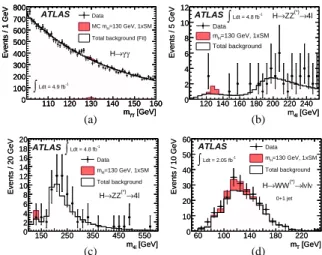
is fit to a smooth function to estimate the background. The inclusive invariant mass distribution of the observed candidates, summing over all categories, is shown in Fig. 1(a).
The search in the H → ZZ(∗)
→ ℓ+ℓ−ℓ′+ℓ′−
chan-nel is performed for mHhypotheses in the full 110 GeV
to 600 GeV mass range using data corresponding to an integrated luminosity of 4.8 fb−1 [10]. The main
ir-reducible ZZ(∗) background is estimated using Monte
Carlo simulation. The reducible Z+jets background, which has an impact mostly for low four-lepton invari-ant masses, is estimated from control regions in the data. The top-quark background normalisation is val-idated in a control sample of events with an opposite sign electron-muon pair with an invariant mass consis-tent with that of the Z boson and two leptons of the same flavour. The events are categorised according to the lep-ton flavour combinations. The mass resolutions are ap-proximately 1.5% in the four-muon channel and 2% in the four-electron channel for mH∼120 GeV. The
four-lepton invariant mass is used as a discriminating vari-able. Its distribution for events selected after all cuts is displayed in Fig. 1(b) for the low mass range and Fig. 1(c) for the full mass range.
The H → WW(∗)
→ ℓ+νℓ′−νsearch is performed as
an event counting analysis for mH hypotheses between
110 GeV and 300 GeV, using an integrated luminos-ity of 2.05 fb−1 [11]. The main background
contribu-tion, from non-resonant WW produccontribu-tion, is estimated
[GeV] γ γ m 110 120 130 140 150 160 Events / 1 GeV 0 100 200 300 400 500 600 700 800 [GeV] γ γ m 110 120 130 140 150 160 Events / 1 GeV 0 100 200 300 400 500 600 700 800 -1 Ldt = 4.9 fb ∫ ATLAS Data =130 GeV, 1xSM H MC m Total background (Fit)
γ γ → H [GeV] γ γ m 110 120 130 140 150 160 Events / 1 GeV 0 100 200 300 400 500 600 700 800 [GeV] 4l m 120 140 160 180 200 220 240 Events / 5 GeV 0 2 4 6 8 10 12 [GeV] 4l m 120 140 160 180 200 220 240 Events / 5 GeV 0 2 4 6 8 10 12 -1 Ldt = 4.8 fb ∫ ATLAS Data =130 GeV, 1xSM H m Total background 4l → (*) ZZ → H (a) (b) [GeV] 4l m 150 250 350 450 550 Events / 20 GeV 0 2 4 6 8 10 12 14 16 18 20 [GeV] 4l m 150 250 350 450 550 Events / 20 GeV 0 2 4 6 8 10 12 14 16 18 20 -1 Ldt = 4.8 fb ∫ ATLAS Data =130 GeV, 1xSM H m Total background 4l → (*) ZZ → H [GeV] T m 60 100 140 180 220 Events / 10 GeV 0 10 20 30 40 50 60 [GeV] T m 60 100 140 180 220 Events / 10 GeV 0 10 20 30 40 50 60 -1 Ldt = 2.05 fb ∫ ATLAS Data =130 GeV, 1xSM H m Total background ν l ν l → (*) WW → H 0+1 jet (c) (d)
Figure 1: Distributions of the reconstructed invariant or transverse mass for the selected candidate events and for the total background and signal (mH=130 GeV) expected in the H → γγ (a), the H → ZZ(∗) → ℓ+ℓ−ℓ′+ℓ′−in the low mass region (b) and the entire mass
range (c), and the H → WW(∗)→ ℓ+νℓ′−ν(d) channels.
from the data using control regions based on the dilep-ton invariant mass mℓℓ. The analysis is separated into
0-jet and 1-jet categories as well as according to lep-ton flavour. In the 1-jet category, a b-jet veto is applied to reject events from top-quark production. The rela-tive fractions of the background contributions expected in the signal and control regions are taken from Monte Carlo simulation. The transverse mass distribution of events for both jet categories is displayed in Fig. 1(d).
The H → WW → ℓνqq′analysis covers m
H
hypothe-ses in the 240 GeV to 600 GeV range and is carried out using data corresponding to an integrated luminosity of 1.04 fb−1 [12]. This channel is also separated
accord-ing to lepton flavour and into 0-jet and 1-jet categories, where the number of jets refers to those in addition to the jets selected as originating from the W-boson de-cay. Events with at least one b-tagged jet are rejected to reduce backgrounds from top-quark production. The
ℓνqq′mass is reconstructed using a constraint to the ℓν
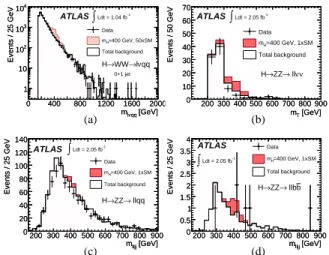
system to W-boson mass. It is used as a discriminating variable and its distribution is illustrated in Fig. 2(a).
The search in the H → ZZ → ℓ+ℓ−ννchannel is
per-formed in the 200 GeV to 600 GeV range of mH. The
analysis described in Ref. [13] is based on data corre-sponding to an integrated luminosity of 1.04 fb−1. It
has been updated using a dataset corresponding to an integrated luminosity of 2.05 fb−1. The main change in
the event selection is the use of an improved b-tagging algorithm [15] to veto events with jets likely to have originated from b-quarks. The analysis is tuned for two search regions with mH hypotheses above and below
[GeV] qq ν l m 0 400 800 1200 1600 2000 Events / 25 GeV 1 10 2 10 3 10 4 10 Data =400 GeV, 50xSM H m Total background -1 Ldt = 1.04 fb ∫ ATLAS qq ν l → WW → H 0+1 jet [GeV] qq ν l m 0 400 800 1200 1600 2000 Events / 25 GeV 1 10 2 10 3 10 4 10 [GeV] T m 200 300 400 500 600 700 800 900 Events / 50 GeV 0 10 20 30 40 50 60 70 Data =400 GeV, 1xSM H m Total background -1 Ldt = 2.05 fb ∫ ATLAS ν ν ll → ZZ → H [GeV] T m 200 300 400 500 600 700 800 900 Events / 50 GeV 0 10 20 30 40 50 60 70 (a) (b) [GeV] lljj m 200 300 400 500 600 700 800 900 Events / 25 GeV 0 20 40 60 80 100 120 140 Data =400 GeV, 1xSM H m Total background -1 Ldt = 2.05 fb ∫ ATLAS llqq → ZZ → H [GeV] lljj m 200 300 400 500 600 700 800 900 Events / 25 GeV 0 20 40 60 80 100 120 140 [GeV] lljj m 200 300 400 500 600 700 800 900 Events / 25 GeV 0 0.5 1 1.5 2 2.5 3 3.5 4 Data =400 GeV, 1xSM H m Total background -1 Ldt = 2.05 fb ∫ ATLAS b llb → ZZ → H [GeV] lljj m 200 300 400 500 600 700 800 900 Events / 25 GeV 0 0.5 1 1.5 2 2.5 3 3.5 4 (c) (d)
Figure 2: Distributions of the reconstructed invariant or transverse mass, in analyses relevant for the search of the Higgs boson at high mass, for selected candidate events, the total background and the signal (mH=400 GeV) expected for the given value of mH in the H → WW → ℓνqq′channel (a), the H → ZZ → ℓ+ℓ−ννchannel
(b) and the H → ZZ → ℓ+ℓ−qq channel for events selected in the
b-jet untagged (c) and the tagged (d) categories. The signal distribution is displayed in a lighter red colour in the H → WW → ℓνqq′channel
where it has been scaled up by a factor 50.
280 GeV and separated into lepton flavour categories. The ℓ+ℓ− pair invariant mass is required to be within
15 GeV of the Z-boson mass. The reverse requirement is applied to same flavor leptons in the H → WW(∗)→ ℓ+νℓ′−νchannel to avoid overlaps. The transverse mass
is used as a discriminating variable. Its distribution is shown in Fig. 2(b) for the high mHsearch. In total 175
events are selected in the low mH search and 192 ± 23
are expected from the background. Similarly, the high-mass search selects 89 events, while 100 ± 11 are ex-pected from the background. The exex-pected number of signal events in the low mass search for mH=200 GeV
is 9.9 ± 1.8 and 19.6 ± 3.4 for the high-mass selection for mH=400 GeV.
The analysis of the H → ZZ → ℓ+ℓ−qq channel,
carried out in the mHrange from 200 GeV to 600 GeV
using data corresponding to an integrated luminosity of 1.04 fb−1, is described in Ref. [14]. It has been updated
using a dataset corresponding to an integrated luminos-ity of 2.05 fb−1, taking advantage of the improved
b-tagging algorithm and of the larger sample of data to better constrain systematic uncertainties on the back-ground yield. The analysis is separated into search re-gions above and below mH=300 GeV, where the event
selections are independently optimised. The dominant background arises from Z+jets production, which is normalised from data using the sidebands of the dilep-ton invariant mass distribution. To profit from the
siz-able branching fraction of the Z decaying into a pair of b-quarks in the signal, the analysis is divided into two categories, the first containing events where the two jets are b-tagged and the second with events with fewer than two b-tags. Using the Z boson mass constraint im-proves the mass resolution of the ℓℓqq system by ap-proximately 10%. The number of events selected in the data with the low mH(high mH) untagged search is
21000 (851) where 21370±310 (920±100) are expected from the background, and 67±11 (21.1±0.8) from a sig-nal with mH=200 GeV (mH=400 GeV). For the tagged
search, the number of observed events in the data with the low mH(high mH) selection is 145 (6), in reasonable
agreement with the 165 ± 22 (11.6 ± 1.9) expected from the background, while 4.4 ± 1.2 (2.1 ± 3.4) are expected from a signal with mH=200 GeV (mH=400 GeV). The
invariant mass is used as the discriminating variable and its distribution is shown in Figs. 2(c) and 2(d) for the two categories.
3. Systematic Uncertainties
The sources of systematic uncertainties, and their ef-fects on the signal and background yields and shapes in each individual channel, are described in detail in Refs. [9–14]. In the combination, systematic uncertain-ties are considered either as fully correlated or uncor-related. Partial correlations are treated by separating a given source into correlated and uncorrelated compo-nents. The effect of each uncertainty is estimated in-dependently for each channel. The dominant correlated systematic uncertainties are those on the measurement of the integrated luminosity and on the theoretical pre-dictions of the signal production cross sections and cay branching fractions, as well as those related to de-tector response that impact the analyses through the re-construction of electrons, photons, muon, jets, magni-tude of the missing transverse momentum (Emiss
T ) and
b-tagging.
The uncertainty on the integrated luminosity is con-sidered as fully correlated among channels and ranges from 3.7% to 3.9% depending on the data-taking period of the samples used in each specific channel [16, 17]. The uncertainty is larger for the last part of the 2011 data due to an increase in the average number of proton-proton interactions occurring in the same bunch cross-ing (pileup events).
The Higgs boson production cross sections are computed up to Next-to-Next-to-Leading Order (NNLO) [18–23] in QCD for the gluon fusion (gg → H) process, including soft-gluon resummations up to Next-to-Next-to-Leading Log (NNLL) [24, 25]
and Next-to-Leading Order (NLO) electroweak (EW) corrections [26, 27]. These results are compiled in Refs. [28–30]. The cross section for the vector-boson fusion (qq′→ qq′H) process is estimated at NLO [31–
33] and approximate NNLO QCD [34]. The associated W H/ZH production processes (q ¯q → WH/ZH) are computed at NLO [35, 36] and NNLO [37]. The associated production with a t¯t pair (q ¯q/gg → t¯tH) is estimated at NLO [38–41]. The Higgs boson produc-tion cross secproduc-tions, decay branching ratios [42–45] and their related uncertainties are compiled in Ref. [46]. The QCD scale uncertainties for mH=120 GeV amount
to +12
−8 % for the gg → H process, ±1% for the
qq′ → qq′H and associated W H/ZH processes, and +3
−9% for the q ¯q/gg → t¯tH process. The uncertainties
related to the parton distribution functions (PDF) for low mH hypotheses typically amount to ±8% for the
predominantly gluon-initiated processes gg → H and q ¯q/gg → t¯tH, and ±4% for the predominantly quark-initiated qq′ → qq′H and W H/ZH processes [47–50].
The theoretical uncertainty associated with the ex-clusive Higgs boson production process with one additional jet in the H → WW(∗)
→ ℓ+νℓ′−νchannel
amounts to ±20% and is treated according to the prescription of Refs. [51–53]. Additional theoretical uncertainty on the signal normalisation, to account for effects related to off-shell Higgs boson production and interference with other SM processes, is assigned at high Higgs boson masses (mH & 300 GeV) as
150%×(mH/TeV)3[53–56].
The detector-related sources of systematic uncer-tainty are modelled using the following classification: trigger and identification efficiencies, energy scale and energy resolution for electrons, photons and for muons; jet energy scale (JES) and jet energy resolution, which include a specific treatment for b-jets; contributions to the Emiss
T uncertainties uncorrelated with the JES;
b-tagging and b-veto. The effect of these systematic un-certainties depends on the topology of each final state, but is typically small compared to that from the theo-retical prediction of the production cross section. The only exception is the jet energy scale uncertainty which can reach ∼20% on the signal yield in channels such as H → WW → ℓνqq′and H → ZZ → ℓ+ℓ−qq. The
elec-tron and muon energy scales are directly constrained by Z → e+e− and Z → µ+µ− events; the impact of the
resulting systematic uncertainty on the four-lepton in-variant mass is of the order of ∼0.5% for electrons and negligible for muons. The impact of the photon energy scale systematic uncertainty on the diphoton invariant mass is approximately 0.6%. 4. Exclusion Limits 200 300 400 500 µ 9 5 % C L L im it o n -1 10 1 10 Observed Bkg. Expected σ 1 ± σ 2 ± ATLAS 2011 =7 TeV s -1 L dt ~ 1.04-4.9 fb
∫
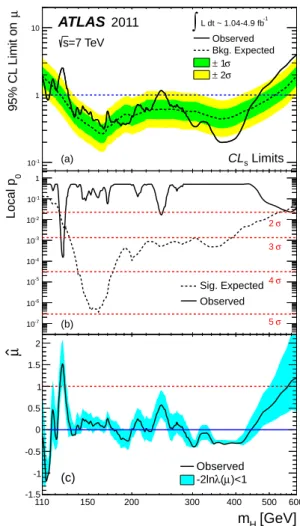
Limits s CL (a) 200 300 400 500 0 Local p -7 10 -6 10 -5 10 -4 10 -3 10 -2 10 -1 10 1 Sig. Expected Observed (b) σ 2 σ 3 σ 4 σ 5 [GeV] H m µ -1.5 -1 -0.5 0 0.5 1 1.5 2 Observed )<1 µ ( λ -2ln (c) 110 150 200 300 400 500 600Figure 3: (a) The combined 95% CL upper limits on the signal strength as a function of mH; the solid curve indicates the observed limit and the dotted curve illustrates the median expected limit in the absence of a signal together with the ±1σ (dark) and ±2σ (light) bands. (b) The local p0 as a function of the mH hypothesis. The dashed curve indicates the median expected value for the hypothesis of a SM Higgs boson signal at that mass. The four horizontal dashed lines indicate the p0values corresponding to significances of 2σ, 3σ, 4σ and 5σ. (c) The best-fit signal strength as a function of the mH hypothesis. The band shows the interval around ˆµ corresponding to region where −2 ln λ(µ) < 1.
The signal strength, µ, is defined as µ = σ/σSM,
where σ is the Higgs boson production cross section being tested and σS M its SM value; it is a single
fac-tor used to scale all signal production processes for a given mH hypothesis. The combination procedure of
Refs. [52, 57, 58] is based on the profile likelihood ratio test statistic λ(µ) [59], which extracts the information on the signal strength from the full likelihood including all the parameters describing the systematic
uncertain-ties and their correlations. Exclusion limits are based on the CLsmethod [60] and a value of µ is regarded as
excluded at the 95% (99%) CL when CLs takes on the
corresponding value.
The combined 95% CL exclusion limits on µ are shown in Fig. 3(a) as a function of mH. These results
are based on the asymptotic approximation [59]. The observed and expected limits using this procedure have been validated using ensemble tests and a Bayesian cal-culation of the exclusion limits with a uniform prior on the signal cross section. These approaches agree with the asymptotic median results to within a few per-cent. The expected 95% CL exclusion region cov-ers the mH range from 124 GeV to 519 GeV. The
ob-served 95% CL exclusion regions are from 131 GeV to 238 GeV and from 251 GeV to 466 GeV. The regions between 133 GeV and 230 GeV and between 260 GeV and 437 GeV are excluded at the 99% CL. A deficit of events is observed in two mH regions. At very low
masses a local deficit in the diphoton channel allows an additional small mass range between 112.9 GeV and 115.5 GeV to be excluded at the 95% CL. Small deficits in various high-mass channels lead to observed limits for masses between 300 GeV and 400 GeV that are stronger than expected. The local probability of such a downward fluctuation of a background-only experiment corresponds to a significance of approximately 2.5σ. The probability to observe such a downward fluctuation over the full inspected mass range in the absence of a signal, using the method described in Section 5 [61], is estimated to be approximately 30%.
The observed exclusion covers a large part of the ex-pected exclusion range, with the exception of the low and high mH regions where excesses of events above
the expected background are observed in various chan-nels, and in a small mass interval around 245 GeV, which is not excluded due to an excess mostly in the H → ZZ(∗)→ ℓ+ℓ−ℓ′+ℓ′−channel.
5. Significance of the Excess
An excess of events is observed near mH∼126 GeV
in the H → γγ and H → ZZ(∗) → ℓ+ℓ−ℓ′+ℓ′−channels,
both of which provide a high-resolution invariant mass for fully reconstructed candidates. The H → WW(∗)→ ℓ+νℓ′−νchannel as well has a broad excess of events in
the transverse mass distribution as seen in Fig. 1(d). The significance of an excess is quantified by the probability (p0) that a background-only experiment is
more signal-like than that observed. The profile like-lihood ratio test statistic is defined such that p0 cannot
exceed 50% [52, 58, 59].
The local p0 probability is assessed for a fixed mH
hypothesis and the equivalent formulation in terms of number of standard deviations is referred to as the lo-cal significance. The probability for a background-only experiment to produce a local significance of this size or larger anywhere in a given mass region is referred to as the global p0. The corresponding reduction in
the significance is referred to as the look-elsewhere ef-fect and is estimated using the prescription described in Refs. [52, 61].
The observed local p0 values, calculated using the
asymptotic approximation [59], as a function of mHand
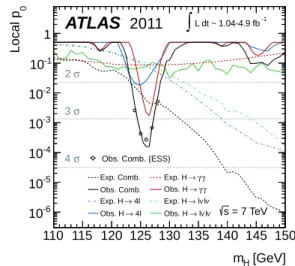
the expected value in the presence of a SM Higgs boson signal at that mass, are shown in Fig. 3(b) in the entire search mass range and in Fig. 4 for the individual chan-nels and their combination in the low mass range. Nu-merically consistent results are obtained using ensemble tests.
The largest local significance for the combination is achieved for mH=126 GeV, where it reaches 3.6σ with
an expected value of 2.5σ for a SM signal. The ob-served (expected) local significance for mH=126 GeV is
2.8σ (1.4σ) in the H → γγ channel, 2.1σ (1.4σ) in the H → ZZ(∗) → ℓ+ℓ−ℓ′+ℓ′−channel, and 1.4σ (1.4σ) in the H → WW(∗)→ ℓ+νℓ′−νchannel. [GeV] H m 110 115 120 125 130 135 140 145 150 0 Local p -6 10 -5 10 -4 10 -3 10 -2 10 -1 10 1 Exp. Comb. Obs. Comb. 4l → Exp. H 4l → Obs. H γ γ → Exp. H γ γ → Obs. H ν l ν l → Exp. H ν l ν l → Obs. H
Obs. Comb. (ESS)
ATLAS
2011 σ 2 σ 3 σ 4 -1 L dt ~ 1.04-4.9 fb∫
= 7 TeV sFigure 4: The local probability p0for a background-only experiment to be more signal-like than the observation. The solid curves give the individual and combined observed p0, estimated using the asymptotic approximation. The dashed curves show the median expected value for the hypothesis of a SM Higgs boson signal at that mass. The three horizontal dashed lines indicate the p0corresponding to significances of 2σ, 3σ, and 4σ. The points indicate the observed local p0estimated using ensemble tests and taking into account energy scale systematic uncertainties (ESS).
The significance of the excess is mildly sensitive to systematic uncertainties on the energy scale (herein
re-ferred to as ESS) and resolution for photons and elec-trons. The muon energy scale systematic uncertainties are smaller and therefore neglected. The presence of these uncertainties, which affect the shape and position of the signal distributions, lead to a small deviation from the asymptotic approximation. The observed p0
includ-ing these effects is therefore computed usinclud-ing ensemble tests. The results are displayed in Fig. 4 as a function of mH. The observed effect of the ESS uncertainty is small
and reduces the maximum local significance from 3.6σ to 3.5σ.
The global p0of a local excess depends on the range
of mH and the channels considered. The global p0
as-sociated with a 2.8σ excess anywhere in the H → γγ search domain 110–150 GeV is approximately 7%. A 2.1σ excess anywhere in the H → ZZ(∗)
→ ℓ+ℓ−ℓ′+ℓ′−
search range 110–600 GeV corresponds to a global p0
of approximately 30%. The global p0 for a combined
3.5σ excess to be found anywhere in the range from 114 GeV to 146 GeV is 0.6% (2.5σ). This mass inter-val corresponds to the region not excluded at 99% CL by the combination of Higgs boson searches at LEP [7] and the first LHC combined search [54]. For the full mass range from 110 GeV to 600 GeV, the global p0is
1.4% (2.2σ).
The best-fit value of µ, denoted ˆµ, is displayed in Fig. 3(c) as a function of the mH hypothesis. The
bands around ˆµ illustrate the µ interval corresponding to
−2 ln λ(µ) < 1 and represent an approximate ±1σ
varia-tion. When evaluating exclusion limits and significance,
µis not allowed to be negative; however, this restriction is not applied in Fig. 3(c), in order to illustrate the pres-ence and extent of downward fluctuations. Neverthe-less, the µ parameter is still bounded to prevent negative values of the probability density functions in the indi-vidual channels, and for negative ˆµ values close to the boundary, the −2 ln λ(µ) < 1 region does not always re-flect a 68% confidence interval. The excess observed for mH = 126 GeV corresponds to ˆµ of approximately
1.5+0.6
−0.5, which is compatible with the signal expected
from a SM Higgs boson at that mass (µ = 1).
6. Conclusions
A dataset of up to 4.9 fb−1 recorded in 2011 has
been used to search for the SM Higgs boson with the ATLAS experiment at the LHC. Higgs boson masses between 124 GeV and 519 GeV are expected to be ex-cluded at the 95% CL. The observed exclusion at the 95% CL ranges from 112.9 GeV to 115.5 GeV, 131 GeV to 238 GeV and 251 GeV to 466 GeV. An exclusion of the SM Higgs boson production at the 99% CL is
achieved in the regions between 133 GeV and 230 GeV and between 260 GeV and 437 GeV.
An excess of events is observed in the H → γγ and H → ZZ(∗)
→ ℓ+ℓ−ℓ′+ℓ′− channels, for mH close to
126 GeV, which is also supported by a broad excess in the H → WW(∗) → ℓ+νℓ′−ν channel. The observed
local significances of the individual excesses are 2.8σ, 2.0σ and 1.4σ, respectively. The expected local sig-nificances of these channels, for a 126 GeV SM Higgs boson are, coincidentally, all ∼1.4σ. The combined lo-cal significance of these excesses is 3.6σ. When the energy scale uncertainties are taken into account, the combined local significance is reduced to 3.5σ. The expected combined local significance in the presence of a SM Higgs boson signal at that mass is 2.5σ. The global probability for such an excess to be found in the full search range, in the absence of a signal, is approxi-mately 1.4%, corresponding to 2.2σ.
7. Acknowledgments
We thank CERN for the very successful operation of the LHC, as well as the support staff from our institu-tions without whom ATLAS could not be operated effi-ciently.
We acknowledge the support of ANPCyT, Ar-gentina; YerPhI, Armenia; ARC, Australia; BMWF, Austria; ANAS, Azerbaijan; SSTC, Belarus; CNPq and FAPESP, Brazil; NSERC, NRC and CFI, Canada; CERN; CONICYT, Chile; CAS, MOST and NSFC, China; COLCIENCIAS, Colombia; MSMT CR, MPO CR and VSC CR, Czech Republic; DNRF, DNSRC and Lundbeck Foundation, Denmark; ARTEMIS and ERC,
European Union; IN2P3-CNRS, CEA-DSM/IRFU,
France; GNAS, Georgia; BMBF, DFG, HGF, MPG and AvH Foundation, Germany; GSRT, Greece; ISF, MINERVA, GIF, DIP and Benoziyo Center, Israel; INFN, Italy; MEXT and JSPS, Japan; CNRST, Mo-rocco; FOM and NWO, Netherlands; RCN, Norway; MNiSW, Poland; GRICES and FCT, Portugal; MERYS (MECTS), Romania; MES of Russia and ROSATOM, Russian Federation; JINR; MSTD, Serbia; MSSR, Slo-vakia; ARRS and MVZT, Slovenia; DST/NRF, South Africa; MICINN, Spain; SRC and Wallenberg Foun-dation, Sweden; SER, SNSF and Cantons of Bern and Geneva, Switzerland; NSC, Taiwan; TAEK, Turkey; STFC, the Royal Society and Leverhulme Trust, United Kingdom; DOE and NSF, United States of America.
The crucial computing support from all WLCG part-ners is acknowledged gratefully, in particular from CERN and the ATLAS Tier-1 facilities at TRIUMF
(Canada), NDGF (Denmark, Norway, Sweden), CC-IN2P3 (France), KIT/GridKA (Germany), INFN-CNAF (Italy), NL-T1 (Netherlands), PIC (Spain), ASGC (Tai-wan), RAL (UK) and BNL (USA) and in the Tier-2 fa-cilities worldwide.
References
[1] F. Englert, R. Brout, Broken symmetry and the mass of gauge vector mesons, Phys. Rev. Lett. 13 (1964) 321–323.
[2] P. W. Higgs, Broken symmetries, massless particles and gauge fields, Phys. Lett. 12 (1964) 132–133.
[3] P. W. Higgs, Broken symmetries and the masses of gauge bosons, Phys. Rev. Lett. 13 (1964) 508–509.
[4] G. S. Guralnik, C. R. Hagen, T. W. B. Kibble, Global conser-vation laws and massless particles, Phys. Rev. Lett. 13 (1964) 585–587.
[5] P. W. Higgs, Spontaneous symmetry breakdown without mass-less bosons, Phys. Rev. 145 (1966) 1156–1163.
[6] T. W. B. Kibble, Symmetry breaking in non-Abelian gauge the-ories, Phys. Rev. 155 (1967) 1554–1561.
[7] ALEPH collaboration, DELPHI collaboration, L3 collaboration, OPAL collaboration and the LEP Working Group for Higgs bo-son searches, Search for the standard model Higgs bobo-son at LEP, Phys. Lett. B565 (2003) 61–75.
[8] TEVNPH (Tevatron New Phenomena and Higgs Working Group), Combined CDF and D0 Upper Limits on Standard Model Higgs Boson Production with up to 8.6 fb−1 of Data,
(2011) arXiv:1107.5518.
[9] ATLAS Collaboration, Search for the Standard Model Higgs bo-son in the diphoton decay channel with 4.9 fb−1of ATLAS data
at√s = 7 TeV, CERN-PH-EP-2012-013 (2012).
[10] ATLAS Collaboration, Search for the Standard Model Higgs boson in the decay channel H → ZZ(∗)→ 4ℓ with 4.8 fb−1of pp
collisions at √s = 7 TeV, CERN-PH-EP-2012-014 (2012). [11] ATLAS Collaboration, Search for the Higgs boson in the H →
WW(∗)→ ℓνℓν decay channel in pp collisions at √s = 7 TeV with the ATLAS detector, submitted to Phys. Rev. Lett. , CERN-PH-EP-2011-190 (2011).
[12] ATLAS Collaboration, Search for Higgs Boson Production in pp Collisions at √s = 7 TeV using the H → WW → ℓνqq Decay Channel and the ATLAS Detector, Phys. Rev. Lett. 107 (2011) 231801.
[13] ATLAS Collaboration, Search for a Standard Model Higgs bo-son in the H → ZZ → ℓ+ℓ−ν¯ν decay channel with the ATLAS
detector, Phys. Rev. Lett. 107 (2011) 221802.
[14] ATLAS Collaboration, Search for a heavy Standard Model Higgs boson in the channel H → ZZ → ℓℓqq using the ATLAS detector, Phys. Lett. B707 (2012) 27–45.
[15] ATLAS Collaboration, Commissioning of the ATLAS high-performance b-tagging algorithms in the 7 TeV collision data, ATLAS-CONF-2011-102 (2011).
[16] ATLAS Collaboration, Luminosity Determination in pp Colli-sions at √s = 7 TeV using the ATLAS Detector in 2011, Eur. Phys. J. C71 (2011) 1630.
[17] ATLAS Collaboration, Luminosity Determination in pp Col-lisions at √s = 7 TeV using the ATLAS Detector in 2011 (ATLAS-CONF-2011-116).
[18] A. Djouadi, M. Spira, P. Zerwas, Production of Higgs bosons in proton colliders: QCD corrections, Phys. Lett. B264 (1991) 440–446.
[19] S. Dawson, Radiative corrections to Higgs boson production, Nucl. Phys. B359 (1991) 283–300.
[20] M. Spira, A. Djouadi, D. Graudenz, P. M. Zerwas, Higgs boson production at the LHC, Nucl. Phys. B453 (1995) 17–82. [21] R. V. Harlander, W. B. Kilgore, Next-to-Next-to-Leading
Or-der Higgs Production at Hadron ColliOr-ders, Phys. Rev. Lett. 88 (2002) 201801.
[22] C. Anastasiou, K. Melnikov, Higgs boson production at hadron colliders in NNLO QCD, Nucl. Phys. B646 (2002) 220–256. [23] V. Ravindran, J. Smith, W. L. van Neerven, NNLO corrections
to the total cross section for Higgs boson production in hadron hadron collisions, Nucl. Phys. B665 (2003) 325–366. [24] S. Catani, D. de Florian, M. Grazzini, P. Nason, Soft-gluon
resummation for Higgs boson production at hadron colliders, JHEP 07 (2003) 028.
[25] D. de Florian, G. Ferrera, M. Grazzini, D. Tommasini, Transverse-momentum resummation: Higgs boson production at the Tevatron and the LHC, JHEP 11 (2011) 064.
[26] U. Aglietti, R. Bonciani, G. Degrassi, A. Vicini, Two-loop light fermion contribution to Higgs production and decays, Phys. Lett. B595 (2004) 432–441.
[27] S. Actis, G. Passarino, C. Sturm, S. Uccirati, NLO electroweak corrections to Higgs boson production at hadron colliders, Phys. Lett. B670 (2008) 12–17.
[28] C. Anastasiou, R. Boughezal, F. Petriello, Mixed QCD-electroweak corrections to Higgs boson production in gluon fu-sion, JHEP 04 (2009) 003.
[29] D. de Florian, M. Grazzini, Higgs production through gluon fu-sion: Updated cross sections at the Tevatron and the LHC, Phys. Lett. B674 (2009) 291–294.
[30] J. Baglio, A. Djouadi, Higgs production at the lHC, JHEP 03 (2011) 055.
[31] M. Ciccolini, A. Denner, S. Dittmaier, Strong and Electroweak Corrections to the Production of a Higgs Boson+2Jets via Weak Interactions at the Large Hadron Collider, Phys. Rev. Lett. 99 (2007) 161803.
[32] M. Ciccolini, A. Denner, S. Dittmaier, Electroweak and QCD corrections to Higgs production via vector-boson fusion at the LHC, Phys. Rev. D77 (2008) 013002.
[33] K. Arnold, et al., VBFNLO: A parton level Monte Carlo for processes with electroweak bosons, Comput. Phys. Commun. 180 (2009) 1661–1670.
[34] P. Bolzoni, F. Maltoni, S.-O. Moch, M. Zaro, Higgs Boson Pro-duction via Vector-Boson Fusion at Next-to-Next-to-Leading Order in QCD, Phys. Rev. Lett. 105 (2010) 011801.
[35] T. Han, S. Willenbrock, QCD correction to the pp → WH and ZH total cross- sections, Phys. Lett. B273 (1991) 167–172. [36] M. L. Ciccolini, S. Dittmaier, M. Kr¨amer, Electroweak
radia-tive corrections to associated WH and ZH production at hadron colliders, Phys. Rev. D68 (2003) 073003.
[37] O. Brein, A. Djouadi, R. Harlander, NNLO QCD corrections to the Higgs-strahlung processes at hadron colliders, Phys. Lett. B579 (2004) 149–156.
[38] W. Beenakker, et al., Higgs Radiation Off Top Quarks at the Tevatron and the LHC, Phys. Rev. Lett. 87 (2001) 201805. [39] W. Beenakker, et al., NLO QCD corrections to t¯tH production
in hadron collisions, Nucl. Phys. B653 (2003) 151–203. [40] S. Dawson, L. H. Orr, L. Reina, D. Wackeroth, Next-to-leading
order QCD corrections to pp → tth at the CERN Large Hadron Collider, Phys. Rev. D67 (2003) 071503.
[41] S. Dawson, C. Jackson, L. Orr, L. Reina, D. Wackeroth, Associ-ated Higgs production with top quarks at the Large Hadron Col-lider: NLO QCD corrections, Phys. Rev. D68 (2003) 034022. [42] A. Djouadi, J. Kalinowski, M. Spira, HDECAY: a program for
Higgs boson decays in the Standard Model and its supersym-metric extension, Comput. Phys. Commun. 108 (1998) 56–74. [43] A. Bredenstein, A. Denner, S. Dittmaier, M. M. Weber, Precise
predictions for the Higgs-boson decay H → WW/ZZ → 4 lep-tons, Phys. Rev. D74 (2006) 013004.
[44] A. Bredenstein, A. Denner, S. Dittmaier, M. Weber, Radiative corrections to the semileptonic and hadronic Higgs-boson de-cays H → WW/ZZ → 4 fermions, JHEP 0702 (2007) 080. [45] S. Actis, G. Passarino, C. Sturm, S. Uccirati, NNLO
computa-tional techniques: the cases H → γγ and H → gg, Nucl. Phys. B811 (2009) 182–273.
[46] LHC Higgs Cross Section Working Group, S. Dittmaier, C. Mar-iotti, G. Passarino, R. Tanaka (Eds.), Handbook of LHC Higgs cross sections: 1. Inclusive observables, CERN-2011-002 (2011). arXiv:1101.0593.
[47] M. Botje et al., The PDF4LHC Working Group Interim Recom-mendations, (2011). arXiv:1101.0538.
[48] H.-L. Lai, M. Guzzi, J. Huston, Z. Li, P. M. Nadolsky, et al., New parton distributions for collider physics, Phys. Rev. D82 (2010) 074024.
[49] A. D. Martin, W. J. Stirling, R. S. Thorne, G. Watt, Parton dis-tributions for the LHC, Eur. Phys. J. C63 (2009) 189–285. [50] R. D. Ball, V. Bertone, F. Cerutti, L. Del Debbio, S. Forte, et al.,
Impact of heavy quark masses on parton distributions and LHC phenomenology, (2011) arXiv:1101.1300.
[51] I. W. Stewart, F. J. Tackmann, Theory uncertainties for Higgs mass and other searches using jet bins, Phys. Rev. D 85 (2012) 034011.
[52] ATLAS and CMS Collaborations, LHC Higgs Combination Working Group Report, ATL-PHYS-PUB-2011-011, CERN-CMS-NOTE-2011-005 (2011).
[53] LHC Higgs Cross Section Working Group, S. Dittmaier, C. Mariotti, G. Passarino, R. Tanaka (Eds.), Handbook of LHC Higgs Cross Sections: 2. Differential Distributions (2012). arXiv:1201.3084.
[54] ATLAS and CMS Collaborations, Combined Standard Model Higgs boson searches with up to 2.3 fb−1 of pp collisions at
√s=7 TeV at the LHC, ATLAS-CONF-2011-157,
CMS-PAS-HIG-11-023, (2011).
[55] G. Passarino, C. Sturm, S. Uccirati, Higgs Pseudo-Observables, Second Riemann Sheet and All That, Nucl. Phys. B834 (2010) 77–115.
[56] C. Anastasiou, S. Buehler, F. Herzog, A. Lazopoulos, Total cross-section for Higgs boson hadroproduction with anomalous Standard Model interactions, JHEP 1112 (2011) 058. [57] ATLAS Collaboration, Limits on the production of the Standard
Model Higgs Boson in pp collisions at √s = 7 TeV with the ATLAS detector, Eur. Phys. J. C71 (2010) 1728.
[58] L. Moneta, K. Belasco, K. S. Cranmer, S. Kreiss, A. Lazzaro, et al., The RooStats Project, PoS ACAT2010 (2010) 057. [59] G. Cowan, K. Cranmer, E. Gross, O. Vitells, Asymptotic
formu-lae for likelihood-based tests of new physics, Eur. Phys. J. C71 (2011) 1554.
[60] A. L. Read, Presentation of search results: The CL(s) technique, J. Phys. G28 (2002) 2693–2704.
[61] E. Gross, O. Vitells, Trial factors for the look elsewhere effect in high energy physics, Eur. Phys. J. C70 (2010) 525–530.
The ATLAS Collaboration
G. Aad48, B. Abbott110, J. Abdallah11, S. Abdel Khalek114, A.A. Abdelalim49, A. Abdesselam117, O. Abdinov10,
B. Abi111, M. Abolins87, O.S. AbouZeid157, H. Abramowicz152, H. Abreu114, E. Acerbi88a,88b, B.S. Acharya163a,163b,
L. Adamczyk37, D.L. Adams24, T.N. Addy56, J. Adelman174, M. Aderholz98, S. Adomeit97, P. Adragna74, T. Adye128,
S. Aefsky22, J.A. Aguilar-Saavedra123b,a, M. Aharrouche80, S.P. Ahlen21, F. Ahles48, A. Ahmad147, M. Ahsan40,
G. Aielli132a,132b, T. Akdogan18a, T.P.A. Åkesson78, G. Akimoto154, A.V. Akimov93, A. Akiyama66, M.S. Alam1,
M.A. Alam75, J. Albert168, S. Albrand55, M. Aleksa29, I.N. Aleksandrov64, F. Alessandria88a, C. Alexa25a,
G. Alexander152, G. Alexandre49, T. Alexopoulos9, M. Alhroob20, M. Aliev15, G. Alimonti88a, J. Alison119,
M. Aliyev10, B.M.M. Allbrooke17, P.P. Allport72, S.E. Allwood-Spiers53, J. Almond81, A. Aloisio101a,101b,
R. Alon170, A. Alonso78, B. Alvarez Gonzalez87, M.G. Alviggi101a,101b, K. Amako65, P. Amaral29, C. Amelung22,
V.V. Ammosov127, A. Amorim123a,b, G. Amor´os166, N. Amram152, C. Anastopoulos29, L.S. Ancu16, N. Andari114,
T. Andeen34, C.F. Anders20, G. Anders58a, K.J. Anderson30, A. Andreazza88a,88b, V. Andrei58a, M-L. Andrieux55, X.S. Anduaga69, A. Angerami34, F. Anghinolfi29, A. Anisenkov106, N. Anjos123a, A. Annovi47, A. Antonaki8, M. Antonelli47, A. Antonov95, J. Antos143b, F. Anulli131a, S. Aoun82, L. Aperio Bella4, R. Apolle117,c, G. Arabidze87, I. Aracena142, Y. Arai65, A.T.H. Arce44, S. Arfaoui147, J-F. Arguin14, E. Arik18a,∗, M. Arik18a, A.J. Armbruster86,
O. Arnaez80, V. Arnal79, C. Arnault114, A. Artamonov94, G. Artoni131a,131b, D. Arutinov20, S. Asai154,
R. Asfandiyarov171, S. Ask27, B. Åsman145a,145b, L. Asquith5, K. Assamagan24, A. Astbury168, A. Astvatsatourov52,
B. Aubert4, E. Auge114, K. Augsten126, M. Aurousseau144a, G. Avolio162, R. Avramidou9, D. Axen167, C. Ay54,
G. Azuelos92,d, Y. Azuma154, M.A. Baak29, G. Baccaglioni88a, C. Bacci133a,133b, A.M. Bach14, H. Bachacou135,
K. Bachas29, M. Backes49, M. Backhaus20, E. Badescu25a, P. Bagnaia131a,131b, S. Bahinipati2, Y. Bai32a,
D.C. Bailey157, T. Bain157, J.T. Baines128, O.K. Baker174, M.D. Baker24, S. Baker76, E. Banas38, P. Banerjee92,
Sw. Banerjee171, D. Banfi29, A. Bangert149, V. Bansal168, H.S. Bansil17, L. Barak170, S.P. Baranov93, A. Barashkou64,
A. Barbaro Galtieri14, T. Barber48, E.L. Barberio85, D. Barberis50a,50b, M. Barbero20, D.Y. Bardin64, T. Barillari98,
M. Barisonzi173, T. Barklow142, N. Barlow27, B.M. Barnett128, R.M. Barnett14, A. Baroncelli133a, G. Barone49,
A.J. Barr117, F. Barreiro79, J. Barreiro Guimar˜aes da Costa57, P. Barrillon114, R. Bartoldus142, A.E. Barton70, V. Bartsch148, R.L. Bates53, L. Batkova143a, J.R. Batley27, A. Battaglia16, M. Battistin29, F. Bauer135, H.S. Bawa142,e, S. Beale97, T. Beau77, P.H. Beauchemin160, R. Beccherle50a, P. Bechtle20, H.P. Beck16, S. Becker97,
M. Beckingham137, K.H. Becks173, A.J. Beddall18c, A. Beddall18c, S. Bedikian174, V.A. Bednyakov64, C.P. Bee82, M. Begel24, S. Behar Harpaz151, P.K. Behera62, M. Beimforde98, C. Belanger-Champagne84, P.J. Bell49, W.H. Bell49, G. Bella152, L. Bellagamba19a, F. Bellina29, M. Bellomo29, A. Belloni57, O. Beloborodova106, f, K. Belotskiy95, O. Beltramello29, O. Benary152, D. Benchekroun134a, M. Bendel80, N. Benekos164, Y. Benhammou152,
E. Benhar Noccioli49, J.A. Benitez Garcia158b, D.P. Benjamin44, M. Benoit114, J.R. Bensinger22, K. Benslama129,
S. Bentvelsen104, D. Berge29, E. Bergeaas Kuutmann41, N. Berger4, F. Berghaus168, E. Berglund104, J. Beringer14,
P. Bernat76, R. Bernhard48, C. Bernius24, T. Berry75, C. Bertella82, A. Bertin19a,19b, F. Bertinelli29,
F. Bertolucci121a,121b, M.I. Besana88a,88b, N. Besson135, S. Bethke98, W. Bhimji45, R.M. Bianchi29, M. Bianco71a,71b,
O. Biebel97, S.P. Bieniek76, K. Bierwagen54, J. Biesiada14, M. Biglietti133a, H. Bilokon47, M. Bindi19a,19b, S. Binet114,
A. Bingul18c, C. Bini131a,131b, C. Biscarat176, U. Bitenc48, K.M. Black21, R.E. Blair5, J.-B. Blanchard135,
G. Blanchot29, T. Blazek143a, C. Blocker22, J. Blocki38, A. Blondel49, W. Blum80, U. Blumenschein54,
G.J. Bobbink104, V.B. Bobrovnikov106, S.S. Bocchetta78, A. Bocci44, C.R. Boddy117, M. Boehler41, J. Boek173,
N. Boelaert35, J.A. Bogaerts29, A. Bogdanchikov106, A. Bogouch89,∗, C. Bohm145a, J. Bohm124, V. Boisvert75,
T. Bold37, V. Boldea25a, N.M. Bolnet135, M. Bomben77, M. Bona74, V.G. Bondarenko95, M. Bondioli162, M. Boonekamp135, C.N. Booth138, S. Bordoni77, C. Borer16, A. Borisov127, G. Borissov70, I. Borjanovic12a, M. Borri81, S. Borroni86, V. Bortolotto133a,133b, K. Bos104, D. Boscherini19a, M. Bosman11, H. Boterenbrood104, D. Botterill128, J. Bouchami92, J. Boudreau122, E.V. Bouhova-Thacker70, D. Boumediene33, C. Bourdarios114, N. Bousson82, A. Boveia30, J. Boyd29, I.R. Boyko64, N.I. Bozhko127, I. Bozovic-Jelisavcic12b, J. Bracinik17,
A. Braem29, P. Branchini133a, G.W. Brandenburg57, A. Brandt7, G. Brandt117, O. Brandt54, U. Bratzler155, B. Brau83, J.E. Brau113, H.M. Braun173, B. Brelier157, J. Bremer29, K. Brendlinger119, R. Brenner165, S. Bressler170,
D. Britton53, F.M. Brochu27, I. Brock20, R. Brock87, T.J. Brodbeck70, E. Brodet152, F. Broggi88a, C. Bromberg87,
J. Bronner98, G. Brooijmans34, W.K. Brooks31b, G. Brown81, H. Brown7, P.A. Bruckman de Renstrom38,
D. Bruncko143b, R. Bruneliere48, S. Brunet60, A. Bruni19a, G. Bruni19a, M. Bruschi19a, T. Buanes13, Q. Buat55,
I.A. Budagov64, B. Budick107, V. B¨uscher80, L. Bugge116, O. Bulekov95, M. Bunse42, T. Buran116, H. Burckhart29, S. Burdin72, T. Burgess13, S. Burke128, E. Busato33, P. Bussey53, C.P. Buszello165, F. Butin29, B. Butler142,
J.M. Butler21, C.M. Buttar53, J.M. Butterworth76, W. Buttinger27, S. Cabrera Urb´an166, D. Caforio19a,19b, O. Cakir3a,
P. Calafiura14, G. Calderini77, P. Calfayan97, R. Calkins105, L.P. Caloba23a, R. Caloi131a,131b, D. Calvet33, S. Calvet33,
R. Camacho Toro33, P. Camarri132a,132b, M. Cambiaghi118a,118b, D. Cameron116, L.M. Caminada14, S. Campana29,
M. Campanelli76, V. Canale101a,101b, F. Canelli30,g, A. Canepa158a, J. Cantero79, L. Capasso101a,101b,
M.D.M. Capeans Garrido29, I. Caprini25a, M. Caprini25a, D. Capriotti98, M. Capua36a,36b, R. Caputo80,
R. Cardarelli132a, T. Carli29, G. Carlino101a, L. Carminati88a,88b, B. Caron84, S. Caron103, E. Carquin31b,
G.D. Carrillo Montoya171, A.A. Carter74, J.R. Carter27, J. Carvalho123a,h, D. Casadei107, M.P. Casado11,
M. Cascella121a,121b, C. Caso50a,50b,∗, A.M. Castaneda Hernandez171, E. Castaneda-Miranda171,
V. Castillo Gimenez166, N.F. Castro123a, G. Cataldi71a, A. Catinaccio29, J.R. Catmore29, A. Cattai29,
G. Cattani132a,132b, S. Caughron87, D. Cauz163a,163c, P. Cavalleri77, D. Cavalli88a, M. Cavalli-Sforza11,
V. Cavasinni121a,121b, F. Ceradini133a,133b, A.S. Cerqueira23b, A. Cerri29, L. Cerrito74, F. Cerutti47, S.A. Cetin18b, F. Cevenini101a,101b, A. Chafaq134a, D. Chakraborty105, K. Chan2, B. Chapleau84, J.D. Chapman27, J.W. Chapman86, E. Chareyre77, D.G. Charlton17, V. Chavda81, C.A. Chavez Barajas29, S. Cheatham84, S. Chekanov5,
S.V. Chekulaev158a, G.A. Chelkov64, M.A. Chelstowska103, C. Chen63, H. Chen24, S. Chen32c, T. Chen32c,
X. Chen171, S. Cheng32a, A. Cheplakov64, V.F. Chepurnov64, R. Cherkaoui El Moursli134e, V. Chernyatin24, E. Cheu6,
S.L. Cheung157, L. Chevalier135, G. Chiefari101a,101b, L. Chikovani51a, J.T. Childers29, A. Chilingarov70,
G. Chiodini71a, A.S. Chisholm17, R.T. Chislett76, M.V. Chizhov64, G. Choudalakis30, S. Chouridou136,
I.A. Christidi76, A. Christov48, D. Chromek-Burckhart29, M.L. Chu150, J. Chudoba124, G. Ciapetti131a,131b,
A.K. Ciftci3a, R. Ciftci3a, D. Cinca33, V. Cindro73, M.D. Ciobotaru162, C. Ciocca19a, A. Ciocio14, M. Cirilli86,
M. Citterio88a, M. Ciubancan25a, A. Clark49, P.J. Clark45, W. Cleland122, J.C. Clemens82, B. Clement55,
C. Clement145a,145b, R.W. Clifft128, Y. Coadou82, M. Cobal163a,163c, A. Coccaro171, J. Cochran63, P. Coe117,
J.G. Cogan142, J. Coggeshall164, E. Cogneras176, J. Colas4, A.P. Colijn104, N.J. Collins17, C. Collins-Tooth53,
J. Collot55, G. Colon83, P. Conde Mui˜no123a, E. Coniavitis117, M.C. Conidi11, M. Consonni103, S.M. Consonni88a,88b,
V. Consorti48, S. Constantinescu25a, C. Conta118a,118b, G. Conti57, F. Conventi101a,i, J. Cook29, M. Cooke14, B.D. Cooper76, A.M. Cooper-Sarkar117, K. Copic14, T. Cornelissen173, M. Corradi19a, F. Corriveau84, j, A. Cortes-Gonzalez164, G. Cortiana98, G. Costa88a, M.J. Costa166, D. Costanzo138, T. Costin30, D. Cˆot´e29, R. Coura Torres23a, L. Courneyea168, G. Cowan75, C. Cowden27, B.E. Cox81, K. Cranmer107, F. Crescioli121a,121b, M. Cristinziani20, G. Crosetti36a,36b, R. Crupi71a,71b, S. Cr´ep´e-Renaudin55, C.-M. Cuciuc25a, C. Cuenca Almenar174, T. Cuhadar Donszelmann138, M. Curatolo47, C.J. Curtis17, C. Cuthbert149, P. Cwetanski60, H. Czirr140,
P. Czodrowski43, Z. Czyczula174, S. D’Auria53, M. D’Onofrio72, A. D’Orazio131a,131b, P.V.M. Da Silva23a,
C. Da Via81, W. Dabrowski37, A. Dafinca117, T. Dai86, C. Dallapiccola83, M. Dam35, M. Dameri50a,50b,
D.S. Damiani136, H.O. Danielsson29, D. Dannheim98, V. Dao49, G. Darbo50a, G.L. Darlea25b, W. Davey20,
T. Davidek125, N. Davidson85, R. Davidson70, E. Davies117,c, M. Davies92, A.R. Davison76, Y. Davygora58a,
E. Dawe141, I. Dawson138, J.W. Dawson5,∗, R.K. Daya-Ishmukhametova22, K. De7, R. de Asmundis101a,
S. De Castro19a,19b, P.E. De Castro Faria Salgado24, S. De Cecco77, J. de Graat97, N. De Groot103, P. de Jong104,
C. De La Taille114, H. De la Torre79, B. De Lotto163a,163c, L. de Mora70, L. De Nooij104, D. De Pedis131a,
A. De Salvo131a, U. De Sanctis163a,163c, A. De Santo148, J.B. De Vivie De Regie114, G. De Zorzi131a,131b, S. Dean76,
W.J. Dearnaley70, R. Debbe24, C. Debenedetti45, B. Dechenaux55, D.V. Dedovich64, J. Degenhardt119,
M. Dehchar117, C. Del Papa163a,163c, J. Del Peso79, T. Del Prete121a,121b, T. Delemontex55, M. Deliyergiyev73,
A. Dell’Acqua29, L. Dell’Asta21, M. Della Pietra101a,i, D. della Volpe101a,101b, M. Delmastro4, N. Delruelle29, P.A. Delsart55, C. Deluca147, S. Demers174, M. Demichev64, B. Demirkoz11,k, J. Deng162, S.P. Denisov127, D. Derendarz38, J.E. Derkaoui134d, F. Derue77, P. Dervan72, K. Desch20, E. Devetak147, P.O. Deviveiros104, A. Dewhurst128, B. DeWilde147, S. Dhaliwal157, R. Dhullipudi24,l, A. Di Ciaccio132a,132b, L. Di Ciaccio4, A. Di Girolamo29, B. Di Girolamo29, S. Di Luise133a,133b, A. Di Mattia171, B. Di Micco29, R. Di Nardo47, A. Di Simone132a,132b, R. Di Sipio19a,19b, M.A. Diaz31a, F. Diblen18c, E.B. Diehl86, J. Dietrich41, T.A. Dietzsch58a, S. Diglio85, K. Dindar Yagci39, J. Dingfelder20, C. Dionisi131a,131b, P. Dita25a, S. Dita25a, F. Dittus29, F. Djama82,
T. Djobava51b, M.A.B. do Vale23c, A. Do Valle Wemans123a, T.K.O. Doan4, M. Dobbs84, R. Dobinson29,∗,
D. Dobos29, E. Dobson29,m, J. Dodd34, C. Doglioni49, T. Doherty53, Y. Doi65,∗, J. Dolejsi125, I. Dolenc73,
Z. Dolezal125, B.A. Dolgoshein95,∗, T. Dohmae154, M. Donadelli23d, M. Donega119, J. Donini33, J. Dopke29,
Z. Drasal125, J. Drees173, N. Dressnandt119, H. Drevermann29, C. Driouichi35, M. Dris9, J. Dubbert98, S. Dube14, E. Duchovni170, G. Duckeck97, A. Dudarev29, F. Dudziak63, M. D¨uhrssen29, I.P. Duerdoth81, L. Duflot114, M-A. Dufour84, M. Dunford29, H. Duran Yildiz3a, R. Duxfield138, M. Dwuznik37, F. Dydak29, M. D¨uren52,
W.L. Ebenstein44, J. Ebke97, S. Eckweiler80, K. Edmonds80, C.A. Edwards75, N.C. Edwards53, W. Ehrenfeld41,
T. Ehrich98, T. Eifert142, G. Eigen13, K. Einsweiler14, E. Eisenhandler74, T. Ekelof165, M. El Kacimi134c, M. Ellert165,
S. Elles4, F. Ellinghaus80, K. Ellis74, N. Ellis29, J. Elmsheuser97, M. Elsing29, D. Emeliyanov128, R. Engelmann147,
A. Engl97, B. Epp61, A. Eppig86, J. Erdmann54, A. Ereditato16, D. Eriksson145a, J. Ernst1, M. Ernst24, J. Ernwein135,
D. Errede164, S. Errede164, E. Ertel80, M. Escalier114, C. Escobar122, X. Espinal Curull11, B. Esposito47, F. Etienne82,
A.I. Etienvre135, E. Etzion152, D. Evangelakou54, H. Evans60, L. Fabbri19a,19b, C. Fabre29, R.M. Fakhrutdinov127,
S. Falciano131a, Y. Fang171, M. Fanti88a,88b, A. Farbin7, A. Farilla133a, J. Farley147, T. Farooque157, S. Farrell162,
S.M. Farrington117, P. Farthouat29, P. Fassnacht29, D. Fassouliotis8, B. Fatholahzadeh157, A. Favareto88a,88b,
L. Fayard114, S. Fazio36a,36b, R. Febbraro33, P. Federic143a, O.L. Fedin120, W. Fedorko87, M. Fehling-Kaschek48,
L. Feligioni82, D. Fellmann5, C. Feng32d, E.J. Feng30, A.B. Fenyuk127, J. Ferencei143b, J. Ferland92, W. Fernando108, S. Ferrag53, J. Ferrando53, V. Ferrara41, A. Ferrari165, P. Ferrari104, R. Ferrari118a, D.E. Ferreira de Lima53,
A. Ferrer166, M.L. Ferrer47, D. Ferrere49, C. Ferretti86, A. Ferretto Parodi50a,50b, M. Fiascaris30, F. Fiedler80, A. Filipˇciˇc73, A. Filippas9, F. Filthaut103, M. Fincke-Keeler168, M.C.N. Fiolhais123a,h, L. Fiorini166, A. Firan39,
G. Fischer41, P. Fischer20, M.J. Fisher108, M. Flechl48, I. Fleck140, J. Fleckner80, P. Fleischmann172,
S. Fleischmann173, T. Flick173, A. Floderus78, L.R. Flores Castillo171, M.J. Flowerdew98, M. Fokitis9,
T. Fonseca Martin16, D.A. Forbush137, A. Formica135, A. Forti81, D. Fortin158a, J.M. Foster81, D. Fournier114,
A. Foussat29, A.J. Fowler44, K. Fowler136, H. Fox70, P. Francavilla11, S. Franchino118a,118b, D. Francis29, T. Frank170,
M. Franklin57, S. Franz29, M. Fraternali118a,118b, S. Fratina119, S.T. French27, F. Friedrich43, R. Froeschl29,
D. Froidevaux29, J.A. Frost27, C. Fukunaga155, E. Fullana Torregrosa29, J. Fuster166, C. Gabaldon29, O. Gabizon170,
T. Gadfort24, S. Gadomski49, G. Gagliardi50a,50b, P. Gagnon60, C. Galea97, E.J. Gallas117, V. Gallo16, B.J. Gallop128,
P. Gallus124, K.K. Gan108, Y.S. Gao142,e, V.A. Gapienko127, A. Gaponenko14, F. Garberson174, M. Garcia-Sciveres14,
C. Garc´ıa166, J.E. Garc´ıa Navarro166, R.W. Gardner30, N. Garelli29, H. Garitaonandia104, V. Garonne29, J. Garvey17,
C. Gatti47, G. Gaudio118a, B. Gaur140, L. Gauthier135, P. Gauzzi131a,131b, I.L. Gavrilenko93, C. Gay167, G. Gaycken20, J-C. Gayde29, E.N. Gazis9, P. Ge32d, C.N.P. Gee128, D.A.A. Geerts104, Ch. Geich-Gimbel20, K. Gellerstedt145a,145b, C. Gemme50a, A. Gemmell53, M.H. Genest55, S. Gentile131a,131b, M. George54, S. George75, P. Gerlach173,
A. Gershon152, C. Geweniger58a, H. Ghazlane134b, N. Ghodbane33, B. Giacobbe19a, S. Giagu131a,131b,
V. Giakoumopoulou8, V. Giangiobbe11, F. Gianotti29, B. Gibbard24, A. Gibson157, S.M. Gibson29, L.M. Gilbert117, V. Gilewsky90, D. Gillberg28, A.R. Gillman128, D.M. Gingrich2,d, J. Ginzburg152, N. Giokaris8, M.P. Giordani163c, R. Giordano101a,101b, F.M. Giorgi15, P. Giovannini98, P.F. Giraud135, D. Giugni88a, M. Giunta92, P. Giusti19a,
B.K. Gjelsten116, L.K. Gladilin96, C. Glasman79, J. Glatzer48, A. Glazov41, K.W. Glitza173, G.L. Glonti64,
J.R. Goddard74, J. Godfrey141, J. Godlewski29, M. Goebel41, T. G¨opfert43, C. Goeringer80, C. G¨ossling42,
T. G¨ottfert98, S. Goldfarb86, T. Golling174, A. Gomes123a,b, L.S. Gomez Fajardo41, R. Gonc¸alo75,
J. Goncalves Pinto Firmino Da Costa41, L. Gonella20, A. Gonidec29, S. Gonzalez171, S. Gonz´alez de la Hoz166,
G. Gonzalez Parra11, M.L. Gonzalez Silva26, S. Gonzalez-Sevilla49, J.J. Goodson147, L. Goossens29,
P.A. Gorbounov94, H.A. Gordon24, I. Gorelov102, G. Gorfine173, B. Gorini29, E. Gorini71a,71b, A. Goriˇsek73,
E. Gornicki38, V.N. Goryachev127, B. Gosdzik41, M. Gosselink104, M.I. Gostkin64, I. Gough Eschrich162,
M. Gouighri134a, D. Goujdami134c, M.P. Goulette49, A.G. Goussiou137, C. Goy4, S. Gozpinar22, I. Grabowska-Bold37,
P. Grafstr¨om29, K-J. Grahn41, F. Grancagnolo71a, S. Grancagnolo15, V. Grassi147, V. Gratchev120, N. Grau34,
H.M. Gray29, J.A. Gray147, E. Graziani133a, O.G. Grebenyuk120, T. Greenshaw72, Z.D. Greenwood24,l, K. Gregersen35, I.M. Gregor41, P. Grenier142, J. Griffiths137, N. Grigalashvili64, A.A. Grillo136, S. Grinstein11, Y.V. Grishkevich96, J.-F. Grivaz114, M. Groh98, E. Gross170, J. Grosse-Knetter54, J. Groth-Jensen170, K. Grybel140, V.J. Guarino5, D. Guest174, C. Guicheney33, A. Guida71a,71b, S. Guindon54, H. Guler84,n, J. Gunther124, B. Guo157, J. Guo34, A. Gupta30, Y. Gusakov64, V.N. Gushchin127, P. Gutierrez110, N. Guttman152, O. Gutzwiller171, C. Guyot135, C. Gwenlan117, C.B. Gwilliam72, A. Haas142, S. Haas29, C. Haber14, H.K. Hadavand39, D.R. Hadley17, P. Haefner98, F. Hahn29, S. Haider29, Z. Hajduk38, H. Hakobyan175, D. Hall117, J. Haller54, K. Hamacher173, P. Hamal112,
M. Hamer54, A. Hamilton144b,o, S. Hamilton160, H. Han32a, L. Han32b, K. Hanagaki115, K. Hanawa159, M. Hance14,
C. Handel80, P. Hanke58a, J.R. Hansen35, J.B. Hansen35, J.D. Hansen35, P.H. Hansen35, P. Hansson142, K. Hara159,
G.A. Hare136, T. Harenberg173, S. Harkusha89, D. Harper86, R.D. Harrington45, O.M. Harris137, K. Harrison17,
D. Hauff98, S. Haug16, M. Hauschild29, R. Hauser87, M. Havranek20, B.M. Hawes117, C.M. Hawkes17,
R.J. Hawkings29, A.D. Hawkins78, D. Hawkins162, T. Hayakawa66, T. Hayashi159, D. Hayden75, H.S. Hayward72, S.J. Haywood128, E. Hazen21, M. He32d, S.J. Head17, V. Hedberg78, L. Heelan7, S. Heim87, B. Heinemann14,
S. Heisterkamp35, L. Helary4, C. Heller97, M. Heller29, S. Hellman145a,145b, D. Hellmich20, C. Helsens11,
R.C.W. Henderson70, M. Henke58a, A. Henrichs54, A.M. Henriques Correia29, S. Henrot-Versille114,
F. Henry-Couannier82, C. Hensel54, T. Henß173, C.M. Hernandez7, Y. Hern´andez Jim´enez166, R. Herrberg15,
A.D. Hershenhorn151, G. Herten48, R. Hertenberger97, L. Hervas29, G.G. Hesketh76, N.P. Hessey104,
E. Hig ´on-Rodriguez166, D. Hill5,∗, J.C. Hill27, N. Hill5, K.H. Hiller41, S. Hillert20, S.J. Hillier17, I. Hinchliffe14,
E. Hines119, M. Hirose115, F. Hirsch42, D. Hirschbuehl173, J. Hobbs147, N. Hod152, M.C. Hodgkinson138,
P. Hodgson138, A. Hoecker29, M.R. Hoeferkamp102, J. Hoffman39, D. Hoffmann82, M. Hohlfeld80, M. Holder140,
S.O. Holmgren145a, T. Holy126, J.L. Holzbauer87, Y. Homma66, T.M. Hong119, L. Hooft van Huysduynen107,
T. Horazdovsky126, C. Horn142, S. Horner48, J-Y. Hostachy55, S. Hou150, M.A. Houlden72, A. Hoummada134a,
J. Howarth81, D.F. Howell117, I. Hristova15, J. Hrivnac114, I. Hruska124, T. Hryn’ova4, P.J. Hsu80, S.-C. Hsu14, G.S. Huang110, Z. Hubacek126, F. Hubaut82, F. Huegging20, A. Huettmann41, T.B. Huffman117, E.W. Hughes34, G. Hughes70, R.E. Hughes-Jones81, M. Huhtinen29, P. Hurst57, M. Hurwitz14, U. Husemann41, N. Huseynov64,p, J. Huston87, J. Huth57, G. Iacobucci49, G. Iakovidis9, M. Ibbotson81, I. Ibragimov140, R. Ichimiya66,
L. Iconomidou-Fayard114, J. Idarraga114, P. Iengo101a, O. Igonkina104, Y. Ikegami65, M. Ikeno65, Y. Ilchenko39,
D. Iliadis153, N. Ilic157, M. Imori154, T. Ince20, J. Inigo-Golfin29, P. Ioannou8, M. Iodice133a, V. Ippolito131a,131b,
A. Irles Quiles166, C. Isaksson165, A. Ishikawa66, M. Ishino67, R. Ishmukhametov39, C. Issever117, S. Istin18a,
A.V. Ivashin127, W. Iwanski38, H. Iwasaki65, J.M. Izen40, V. Izzo101a, B. Jackson119, J.N. Jackson72, P. Jackson142,
M.R. Jaekel29, V. Jain60, K. Jakobs48, S. Jakobsen35, J. Jakubek126, D.K. Jana110, E. Jansen76, H. Jansen29,
A. Jantsch98, M. Janus48, G. Jarlskog78, L. Jeanty57, K. Jelen37, I. Jen-La Plante30, P. Jenni29, A. Jeremie4, P. Jeˇz35,
S. J´ez´equel4, M.K. Jha19a, H. Ji171, W. Ji80, J. Jia147, Y. Jiang32b, M. Jimenez Belenguer41, G. Jin32b, S. Jin32a,
O. Jinnouchi156, M.D. Joergensen35, D. Joffe39, L.G. Johansen13, M. Johansen145a,145b, K.E. Johansson145a,
P. Johansson138, S. Johnert41, K.A. Johns6, K. Jon-And145a,145b, G. Jones117, R.W.L. Jones70, T.W. Jones76,
T.J. Jones72, O. Jonsson29, C. Joram29, P.M. Jorge123a, J. Joseph14, K.D. Joshi81, J. Jovicevic146, T. Jovin12b, X. Ju171, C.A. Jung42, R.M. Jungst29, V. Juranek124, P. Jussel61, A. Juste Rozas11, V.V. Kabachenko127, S. Kabana16,
M. Kaci166, A. Kaczmarska38, P. Kadlecik35, M. Kado114, H. Kagan108, M. Kagan57, S. Kaiser98, E. Kajomovitz151, S. Kalinin173, L.V. Kalinovskaya64, S. Kama39, N. Kanaya154, M. Kaneda29, S. Kaneti27, T. Kanno156,
V.A. Kantserov95, J. Kanzaki65, B. Kaplan174, A. Kapliy30, J. Kaplon29, D. Kar43, M. Karagounis20, M. Karagoz117, M. Karnevskiy41, V. Kartvelishvili70, A.N. Karyukhin127, L. Kashif171, G. Kasieczka58b, R.D. Kass108,
A. Kastanas13, M. Kataoka4, Y. Kataoka154, E. Katsoufis9, J. Katzy41, V. Kaushik6, K. Kawagoe66, T. Kawamoto154,
G. Kawamura80, M.S. Kayl104, V.A. Kazanin106, M.Y. Kazarinov64, R. Keeler168, R. Kehoe39, M. Keil54,
G.D. Kekelidze64, J.S. Keller137, J. Kennedy97, M. Kenyon53, O. Kepka124, N. Kerschen29, B.P. Kerˇsevan73,
S. Kersten173, K. Kessoku154, J. Keung157, F. Khalil-zada10, H. Khandanyan164, A. Khanov111, D. Kharchenko64,
A. Khodinov95, A.G. Kholodenko127, A. Khomich58a, T.J. Khoo27, G. Khoriauli20, A. Khoroshilov173,
N. Khovanskiy64, V. Khovanskiy94, E. Khramov64, J. Khubua51b, H. Kim145a,145b, M.S. Kim2, S.H. Kim159,
N. Kimura169, O. Kind15, B.T. King72, M. King66, R.S.B. King117, J. Kirk128, L.E. Kirsch22, A.E. Kiryunin98,
T. Kishimoto66, D. Kisielewska37, T. Kittelmann122, A.M. Kiver127, E. Kladiva143b, M. Klein72, U. Klein72,
K. Kleinknecht80, M. Klemetti84, A. Klier170, P. Klimek145a,145b, A. Klimentov24, R. Klingenberg42, J.A. Klinger81,
E.B. Klinkby35, T. Klioutchnikova29, P.F. Klok103, S. Klous104, E.-E. Kluge58a, T. Kluge72, P. Kluit104, S. Kluth98,
N.S. Knecht157, E. Kneringer61, J. Knobloch29, E.B.F.G. Knoops82, A. Knue54, B.R. Ko44, T. Kobayashi154, M. Kobel43, M. Kocian142, P. Kodys125, K. K ¨oneke29, A.C. K ¨onig103, S. Koenig80, L. K ¨opke80, F. Koetsveld103, P. Koevesarki20, T. Koffas28, E. Koffeman104, L.A. Kogan117, F. Kohn54, Z. Kohout126, T. Kohriki65, T. Koi142, T. Kokott20, G.M. Kolachev106, H. Kolanoski15, V. Kolesnikov64, I. Koletsou88a, J. Koll87, M. Kollefrath48, S.D. Kolya81, A.A. Komar93, Y. Komori154, T. Kondo65, T. Kono41,q, A.I. Kononov48, R. Konoplich107,r,
N. Konstantinidis76, A. Kootz173, S. Koperny37, K. Korcyl38, K. Kordas153, V. Koreshev127, A. Korn117, A. Korol106, I. Korolkov11, E.V. Korolkova138, V.A. Korotkov127, O. Kortner98, S. Kortner98, V.V. Kostyukhin20, M.J. Kotam¨aki29,
S. Kotov98, V.M. Kotov64, A. Kotwal44, C. Kourkoumelis8, V. Kouskoura153, A. Koutsman158a, R. Kowalewski168,
T.Z. Kowalski37, W. Kozanecki135, A.S. Kozhin127, V. Kral126, V.A. Kramarenko96, G. Kramberger73,
M.W. Krasny77, A. Krasznahorkay107, J. Kraus87, J.K. Kraus20, A. Kreisel152, S. Kreiss107, F. Krejci126,