EUROPEAN ORGANIZATION FOR NUCLEAR RESEARCH (CERN)
CERN-EP/2016-040 2016/08/18
CMS-SUS-13-023
Search for direct pair production of supersymmetric top
quarks decaying to all-hadronic final states in pp collisions
at
√
s
=
8 TeV
The CMS Collaboration
∗Abstract
Results are reported from a search for the pair production of top squarks, the super-symmetric partners of top quarks, in final states with jets and missing transverse mo-mentum. The data sample used in this search was collected by the CMS detector and
corresponds to an integrated luminosity of 18.9 fb−1 of proton-proton collisions at a
centre-of-mass energy of 8 TeV produced by the LHC. The search features novel back-ground suppression and prediction methods, including a dedicated top quark pair reconstruction algorithm. The data are found to be in agreement with the predicted backgrounds. Exclusion limits are set in simplified supersymmetry models with the top squark decaying to jets and an undetected neutralino, either through a top quark or through a bottom quark and chargino. Models with the top squark decaying via a top quark are excluded for top squark masses up to 755 GeV in the case of neutralino masses below 200 GeV. For decays via a chargino, top squark masses up to 620 GeV are excluded, depending on the masses of the chargino and neutralino.
Published in the European Physical Journal C as doi:10.1140/epjc/s10052-016-4292-5.
c
2016 CERN for the benefit of the CMS Collaboration. CC-BY-3.0 license ∗See Appendix A for the list of collaboration members
1
1
Introduction
The standard model (SM) of particle physics is an extremely powerful framework for the de-scription of the known elementary particles and their interactions. Nevertheless, the existence of dark matter [1–3] inferred from astrophysical observations, together with a wide array of theoretical considerations, all point to the likelihood of physics beyond the SM. New physics could be in the vicinity of the electroweak (EW) scale and accessible to experiments at the CERN LHC [4]. In addition, the recent discovery of a Higgs boson [5–7] at a mass of 125 GeV [8–10] has meant that the hierarchy problem, also known as the ‘fine-tuning’ or ‘naturalness’ problem [11–16], is no longer hypothetical.
A broader theory that can address many of the problems associated with the SM is supersym-metry (SUSY) [17–21], which postulates a symsupersym-metry between fermions and bosons. In partic-ular, a SUSY particle (generically referred to as a ‘sparticle’ or ‘superpartner’) is proposed for each SM particle. A sparticle is expected to have the same couplings and quantum numbers as its SM counterpart with the exception of spin, which differs by a half-integer. Spin-1/2 SM fermions (quarks and leptons) are thus paired with spin-0 sfermions (the squarks and slep-tons). There is a similar, but slightly more complicated pairing for bosons; SUSY models have extended Higgs sectors that contain neutral and charged higgsinos that mix with the SUSY partners of the neutral and charged EW gauge bosons, respectively. The resulting mixed states
are referred to as neutralinosχe
0and charginos
e
χ±.
Supersymmetry protects the mass of the Higgs boson against divergent quantum corrections associated with virtual SM particles by providing cancellations via the corresponding correc-tions for virtual superpartners [22–25]. Since no sparticles have been observed to date, they are generally expected to be more massive than their SM counterparts. On the other hand, sparti-cle masses cannot be arbitrarily large if they are to stabilise the Higgs boson mass without an unnatural level of fine-tuning. This is particularly important for the partners of the third gen-eration SM particles that have large Yukawa couplings to the Higgs boson [26–29]. The top and
bottom squarks (et and eb), are expected to be among the lightest sparticles and potentially the
most accessible at the LHC, especially when all other constraints are taken into consideration [27, 30]. With conservation of R-parity [31, 32], SUSY particles are produced in pairs and the
lightest SUSY particle (LSP) is stable. If the lightest weakly interacting neutralino (χe
0
1) is the stable LSP, it is a leading candidate for dark matter [33]. Based upon these considerations, it is
of particular interest at the LHC to look for evidence of the production ofetet with decay chains
of theet andet ending in SM particles and LSPs. The latter do not interact with material in the
detector and so must have their presence inferred from missing transverse momentum~pTmiss,
which in each event is defined as the projection of the negative vector sum of the momenta of all reconstructed particles onto the plane perpendicular to the beam line. Its magnitude is
referred to as Emiss
T .
Within the Simplified Model Spectra (SMS) framework [34–36] the study presented here
con-siders two broad classes of signals that lead to a bbqqqq+EmissT final state via decay modes
denoted T2tt and T2bW. These are defined, respectively, as (i)et decay to a top quark: et →
tχe 0
1 → bW+χe
0
1, and (ii)et decay via a chargino: et → bχe
+ → bW+
e
χ01. Figure 1 shows the
diagrams representing these two simplified models. The two decay modes are not mutually exclusive, and it is possible for one of the top squarks to decay as in T2tt and the other as in T2bW. However, such a scenario is not considered in the analysis presented here.
Only the lightestet mass eigenstate is assumed to be involved, although the results are
prop-2 1 Introduction
erties of the SUSY model, such as the left and rightet mixing [37, 38]. Instead of choosing a
specific model, each SMS scenario is assumed to have unpolarized decay products and has a 100% branching ratio to the final state under consideration. As such, the results can be inter-preted, with appropriately rescaled branching fractions, in the context of any SUSY model in which these decays are predicted to occur.
P
1P
2¯
t
˜
χ
0 1˜
χ
0 1t
˜
t
−˜
t
P
1P
2˜
t
˜
χ
−W
−˜
χ
+W
+b
˜
χ
0 1˜
χ
0 1b
− −˜
t
Figure 1: Diagrams representing the two simplified models of direct top squark pair production considered in this study: T2tt with top squark decay via a top quark (left) and T2bW with top squark decay via a chargino (right).
With event characteristics of these signals in mind, we have developed a search for pair pro-duction of top squarks with decays that result in a pair of LSPs in the final state in addition to SM particles. Two selection criteria address the desire to extract a potentially very small signal
from a sample dominated by top quark pair events. The first criterion comes from the EmissT
signature associated with the LSPs, which motivates the focus on all-hadronic final states, as
this eliminates large sources of SM background events with genuine EmissT from neutrinos in
leptonic W decays. The all-hadronic final state with ETmissconstitutes 45% of the signal because
W bosons decay to quarks with a 67% branching ratio. For the same reason this final state makes up an even higher proportion of the subset of events with high jet multiplicity
includ-ing many jets with high transverse momentum, pT, that is often required in SUSY searches to
eliminate SM backgrounds. The second criterion relies upon the identification of top quark de-cay products to eliminate such backgrounds as SM production of W bosons in association with jets. Together, these criteria define a preselection region consisting of events that pass stringent
vetoes on the presence of charged leptons, and are required to have large EmissT , two tagged b
quark jets, and four additional jets from the hadronisation and decay of light quarks.
In spite of these stringent requirements, the low production cross sections of new physics sig-nals mean that they are easily overwhelmed by SM backgrounds. In the case of SUSY, for
exam-ple, the cross section for the production of top squark pairs with met = 800 GeV is predicted to
be nearly five orders of magnitude smaller than that of top quark pairs [39]. For this reason, this analysis focuses heavily on background suppression, employing several new methods that im-prove sensitivity to signal. The relevant SM processes contributing to this analysis fall into four main categories: (i) top quark and W boson events where the W decays leptonically, thereby
contributing genuine Emiss
T , but the lepton is not successfully reconstructed or identified, or it
is outside the acceptance of the detector; (ii) invisible decays of the Z boson when produced
in association with jets, Z+jets with Z → νν; (iii) QCD multijet production, which, due to its
very high rate, can produce events with substantial EmissT in the very rare cases of either
ex-treme mismeasurements of jet momenta or the leptonic decay of heavy-flavour hadrons with
large neutrino pT; and (iv) ttZ production (with Z→ νν), which is an irreducible background
to signals with top squark decays via on-shell top quarks. The ttZ process has a small cross
3
respectively.
The first step in developing the search is the construction of a set of optimised vetoes for all three lepton flavours that reduce SM backgrounds for both signal types. Next, specific fea-tures of each signal type are exploited by combining several variables in a multivariate anal-ysis (MVA) based upon Boosted Decision Trees (BDT). For T2tt, a high performance hadronic top quark decay reconstruction algorithm is developed and used to facilitate discrimination of signal from background by using details of top quark kinematics.
Previous searches in the leptonic as well as the hadronic channels place limits on models with m
et < 750 GeV for mχe
0
1 < 100 GeV and have sensitivity to some models with mχe
0 1 < 280 GeV [42, 43]. Previous searches for top and bottom squark pair production at the LHC are presented in Refs. [42–60]. Previous searches at the Tevatron are presented in Refs. [61–68]. The analysis reported here significantly extends the sensitivity of a previous CMS analysis [57] using this dataset by means of more refined background controls and enhanced signal retention techniques.
This paper is organised as follows: Section 2 describes the CMS detector, while Section 3 dis-cusses event reconstruction, event selection, and Monte Carlo (MC) simulations of signal and background. The top quark pair reconstruction algorithm and lepton vetoes are described in Sections 4 and 5, respectively. The search regions are discussed in Section 6, and the evalu-ation of backgrounds is presented in Section 7 along with a discussion of the method of MC reweighting. Final results and their interpretations are presented in Section 8, followed by a summary in Section 9.
2
CMS detector
The central feature of the CMS apparatus is a superconducting solenoid of 6 m internal diame-ter, providing a magnetic field of 3.8 T. Within the solenoid volume are a silicon pixel and strip tracker, a lead tungstate crystal electromagnetic calorimeter (ECAL), and a brass and scintilla-tor hadron calorimeter (HCAL), each composed of a barrel and two endcap sections. Extensive forward calorimetry complements the coverage provided by the barrel and endcap detectors. Muons are measured in gas-ionization detectors embedded in the steel flux-return yoke outside the solenoid.
The silicon tracker measures charged particles within the range |η| < 2.5. Isolated particles
of pT = 100 GeV emitted with|η| < 1.4 have track resolutions of 2.8% in pT and 10 (30) µm
in the transverse (longitudinal) impact parameter [69]. The ECAL and HCAL measure
en-ergy deposits in the range |η| < 3. Quartz-steel forward calorimeters extend the coverage
to |η| = 5. The HCAL, when combined with the ECAL, measures jets with a resolution
∆E/E ≈ 100%/√E[GeV] ⊕10% [70]. Muons are measured in the range |η| < 2.4.
Match-ing muons to tracks measured in the silicon tracker results in a relative pTresolution for muons
with 20 < pT < 100 GeV of 1.3–2.0% in the barrel and better than 6% in the endcaps. The pT
resolution in the barrel is better than 10% for muons with pTup to 1 TeV [71].
The events used in the search presented here were collected using the CMS two-tiered trigger system: a hardware-based level-1 trigger and a software-based high-level trigger. A more com-plete description of the CMS detector, together with a definition of the coordinate system used and the relevant kinematic variables, can be found in Ref. [72].
4 3 Data sample and event selection
3
Data sample and event selection
This search uses data corresponding to an integrated luminosity of 18.9±0.5 fb−1 collected
at a centre-of-mass energy of 8 TeV [73]. Events are reconstructed with the CMS particle-flow (PF) algorithm [74, 75]. Each particle is identified as a charged hadron, neutral hadron, pho-ton, muon, or electron by means of an optimised combination of information from the tracker, the calorimeters, and the muon systems. The energy of a photon is obtained from the ECAL measurement, corrected for zero suppression effects. For an electron the energy is determined from a combination of its estimated momentum at the primary interaction vertex as deter-mined by the tracker, the energy of the corresponding ECAL cluster, and the energy sum of all bremsstrahlung photons spatially compatible with originating from the electron track [76]. Muon momentum is obtained from the curvature of the corresponding track. The energy of charged hadrons is determined from a combination of the momentum measured in the tracker and the matching ECAL and HCAL energy deposits, corrected for zero-suppression effects and for the response function of the calorimeters to hadronic showers. Charged hadrons associated with vertices other than the primary vertex, defined as the pp interaction vertex with the largest
sum of charged-track p2Tvalues, are not considered. Finally, the energies of neutral hadrons are
obtained from the corresponding corrected ECAL and HCAL energies.
Particles reconstructed with the CMS PF algorithm are clustered into jets by the anti-kT
algo-rithm [77, 78] with a distance parameter of 0.5 in the η-φ plane. For a jet, the momentum is determined as the vectorial sum of all associated particle momenta and is found from MC sim-ulated data to be within 5–10% of the true momentum of the generated particle from which
the jet originates over the whole pT spectrum and detector acceptance. An offset correction
determined for each jet via the average pT density per unit area and the jet area is applied to
jet energies to take into account the contribution from pileup, defined as the additional proton-proton interactions within the same or adjacent bunch crossings [70]. Jet energy corrections are derived from simulated events and are confirmed with in situ measurements of the energy balance in dijet and photon+jet events. Additional selection criteria are applied to each event to remove spurious jet-like features originating from isolated noise patterns in certain HCAL regions [79].
Jets referred to as ‘picky jets’ are the input to the Comprehensively Optimised Resonance Re-construction ALgorithm (CORRAL) for top quark reRe-construction. The picky jet reRe-construction algorithm is not constrained to any fixed characteristic width or cutoff and therefore is opti-mized for clustering the particles associated with the b quark and quarks from the W boson. This leads to an improvement in the reconstruction of top quark decays with a wide range of
Lorentz boosts, as expected in signal events. The CORRAL and picky jet algorithms are
de-scribed in Section 4.
Jets are identified as originating from the hadronisation of a bottom quark (b-tagged) by means of the CMS combined secondary vertex (CSV) tagger [80, 81]. The standard CMS “tight” oper-ating point for the CSV tagger is used [80], which has approximately 50% b tagging efficiency, 0.1% light flavour jet misidentification rate, and an efficiency of 5% for c quark jets.
Several simulated data samples based on MC event generators are used throughout this
analy-sis. Signal samples are produced using the MADGRAPH(version 5.1.3.30) [82] event generator
with CTEQ6L [83] parton distribution functions (PDFs). For both the T2tt and T2bW signals,
the top squark mass (met) is varied from 200 to 1000 GeV, while the LSP mass (m
e
χ01) is varied
from 0 to 700 GeV for T2tt and 0 to 550 GeV for T2bW. The masses are varied in steps of 25 GeV in all cases. For the T2bW sample the chargino mass is defined via the fraction x applied to
5
the top squark and neutralino masses as follows: mχe± =x met+ (1−x)mχe
0
1. We consider three
fractions for x : 0.25, 0.50, and 0.75.
Standard model backgrounds are generated with MADGRAPH,POWHEG(version 1.0 r1380) [84–
88],PYTHIA(version 6.4.26) [89], orMC@NLO(version 3.41) [90, 91]. The MADGRAPHgenerator
is used for the generation of Z and W bosons accompanied by up to three additional partons as well as for diboson and ttW processes, while the single top quark and tt processes are
gen-erated withPOWHEG. Multijet QCD events are produced in two samples, one generated with
PYTHIA and the other with MADGRAPH. Two ttZ event samples are used. One is generated
with MC@NLO and the other with MADGRAPH. The decays of τ leptons are simulated with
TAUOLA(version 27.121.5) [92].
The PYTHIA generator is subsequently used to perform parton showering for all signal and
background samples, except for theMC@NLOttZ sample, which usesHERWIG(version 6.520) [93].
The detector response for all background samples is simulated with GEANT4 [94], while the CMS fast simulation package [95] is used for producing signal samples in the grid of mass points described earlier. Detailed cross checks are performed to ensure that the results
ob-tained with the fast simulation are in agreement with those obob-tained with the GEANT-based
full simulation.
Events are selected online by a trigger that requires EmissT > 80 GeV and the presence of two
central (|η| <2.4) jets with pT >50 GeV. Offline, a preselection of events common to all search
samples used in the analysis has the following requirements:
• There must not be any isolated electrons, muons, or tau leptons in the event. This
requirement is intended mainly to suppress backgrounds with genuine Emiss
T that
arise from W boson decays. The high efficiency lepton selection criteria used in the definitions of the lepton vetoes are described in detail in Section 5.
• There must be ETmiss >175 GeV and at least two jets with pT>70 GeV and|η| <2.4,
such that the online selection is fully efficient.
• The azimuthal angular separation between each of the two highest pTjets and~pTmiss
must satisfy|∆φ| >0.5, while for the third leading jet, the requirement is|∆φ| >0.3.
These criteria suppress rare QCD multijet events with severely mismeasured high-pTjets.
Baseline selections for the two targeted signal types are then defined by the following addi-tional requirements. The T2tt baseline selection requires one or more b-tagged picky jets with
pT > 30 GeV and|η| < 2.4, and at least one pair of top quarks reconstructed by the CORRAL
algorithm. The T2bW baseline selection requires at least five jets (pT > 30 GeV and|η| < 2.4)
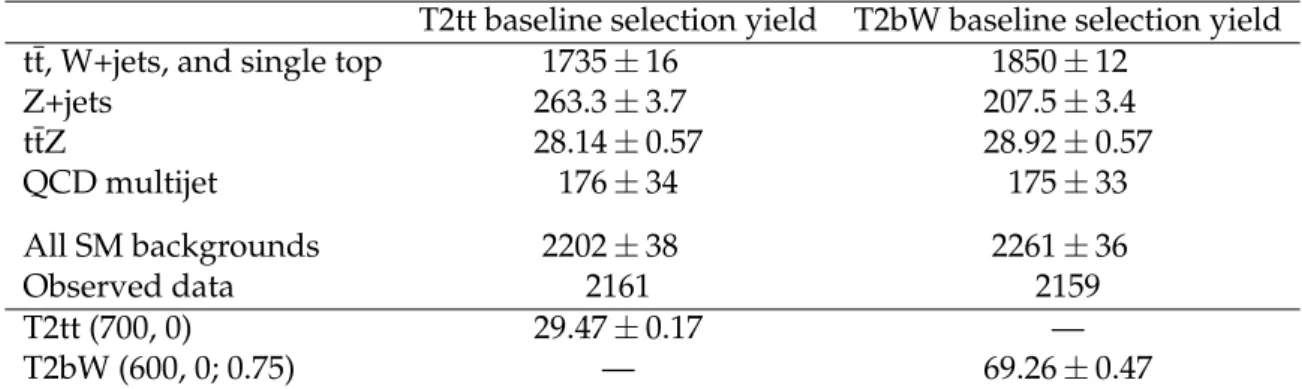
of which at least one must be b-tagged. SM background yields, estimated as described in Sec-tion 7, and signal yields after the baseline selecSec-tions are shown in Table 1. The trigger efficiency is measured to be greater than 95% for events passing these baseline selections.
A number of data control samples are used to derive corrections to reconstructed quantities and to estimate SM backgrounds. There are four control samples involving at least one well-identified lepton and two that are high purity QCD multijet samples. The leptonic control samples are used to understand tt and vector boson plus jets backgrounds and are named ac-cordingly, as indicated below. The data are drawn from samples collected online with triggers that require the presence of at least one charged lepton. The standard CMS lepton identifica-tion algorithms operating at their tightest working points [71, 76] are then applied offline. Each
event must have at least one selected muon with pT >28 GeV and|η| < 2.1 or a selected
6 4 Top quark pair reconstruction for the T2tt simplified model
Table 1: Estimated SM background yields as obtained with the methods described in Section 7, and the observed data yields for the T2tt and T2bW baseline selections. The T2bW yield
cor-responds to the simplified model point with(met, m
e
χ01; x) = (600 GeV, 0 GeV; 0.75), and the T2tt
yield is for the simplified model point with (met, m
e
χ01) = (700 GeV, 0 GeV). The uncertainties
listed are statistical only.
T2tt baseline selection yield T2bW baseline selection yield
tt, W+jets, and single top 1735±16 1850±12
Z+jets 263.3±3.7 207.5±3.4 ttZ 28.14±0.57 28.92±0.57 QCD multijet 176±34 175±33 All SM backgrounds 2202±38 2261±36 Observed data 2161 2159 T2tt (700, 0) 29.47±0.17 — T2bW (600, 0; 0.75) — 69.26±0.47
Selected leptons are not included in the jet collection. Sample names and distinguishing char-acteristics are as follows:
• The inclusive tt control sample: At least one identified lepton and three or more jets,
of which at least one must be b-tagged.
• The high purity tt control sample: This is the subset of the inclusive tt control sample
for which the selected lepton is a muon and there are at least two b-tagged jets.
• The inclusive W+jets control sample: There must be one identified muon. In
ad-dition, the transverse mass mT formed from~pTmiss and the muon momentum is
re-quired to be≥40 GeV in order to reduce QCD multijet contamination.
• The inclusive Z+jets control sample: There must be two identified leptons of the
same flavour with an invariant mass in the range 80 < m`` < 100, consistent with
the mass of the Z boson.
The two additional data control samples selected to be pure in QCD mulitjet events are defined as follows:
• The inclusive QCD multijet control sample: Events are required to have HT, the
scalar sum of jet pT,>340 GeV and are collected with a set of HTtriggers.
• The high EmissT QCD multijet control sample: Events are selected with the same
trig-ger used for the baseline selection. All events must satisfy EmissT > 175 GeV and
have at least two jets with pT > 70 GeV in order to be fully efficient with respect
to the online selection. The QCD multijet purity is increased by vetoing any events with isolated electrons, muons, or tau leptons and by inverting the baseline selection
requirement on the angular separation between the three leading jets and~pmiss
T .
4
Top quark pair reconstruction for the T2tt simplified model
The T2tt and T2bW signal modes involve the same final-state particles but differ in that only T2tt involves the decays of on-shell top quarks. The only SM background with potentially large Emiss
T and a visible component that is identical to that of T2tt is ttZ, with the tt pair decaying
hadronically and the Z boson decaying invisibly to neutrinos. Efficient identification of a pair
7
suppressing most other backgrounds. As mentioned in the previous section, we developed the
CORRAL dedicated top quark reconstruction algorithm for this purpose. Kinematic properties
of the top quark candidates reconstructed with CORRALare exploited to further improve the
discrimination of signal from background.
Top quark taggers are typically characterized by high efficiencies for the reconstruction of all-hadronic decays of top quarks that have been Lorentz boosted to sufficiently high momentum for their final state partons and associated showers to form a single collimated jet. Such taggers are not ideal for the regions of parameter space targeted by this search because the top quarks from top squark decays can experience a wide range of boosts in these regions and it is not uncommon for one of the top quarks to have a boost that is too low to produce such a coales-cence of final-state objects. An additional problem arises with traditional jet algorithms that do not always distinguish two separate clusters of particles whose separation is smaller than their
fixed distance parameter or cone radius. In addition, for low-pTjets and those originating from
hadronisation of b quarks, it is not unusual for algorithms with fixed distance metrics to miss some of the particles that should be included in the jet. These issues are addressed by making use of a variable jet-size clustering algorithm that is capable of successfully resolving six jets in the decays of top quark pairs with efficiency ranging between 25% in the case of signal with
compressed mass splitting (met = 400 GeV ≈ mt+mχe01 +75 GeV) to 40% in the case of large
mass splitting (met=750 GeV≈mt+mχe01 +550 GeV).
The algorithm starts by clustering jets with the Cambridge–Aachen algorithm [96, 97] with a distance parameter of 1.0 in the η-φ plane to produce what will be referred to as proto-jets. Studies based on MC simulation show that this parameter value is large enough to capture
partons with pT as low as 20 GeV. Each proto-jet is then considered for division into a pair
of subjets. The N-subjettiness metric [98], τN, is used to determine the relative compatibility
of particles in a proto-jet with a set of “N” jet axes. It is defined as the pT-weighted sum of
the distances of proto-jet constituents to the nearest jet axis, resulting in lower values when the particles are clustered near jet axes and higher values when they are more widely dispersed. As
discussed in Ref. [98], the exclusive two-jet kT algorithm [99, 100] can be used to find an initial
pair of subjet axes in the proto-jet that approximately minimizes the τ2 metric. The exclusive
two-jet algorithm differs from the inclusive kT algorithm in that it does not have a distance
parameter. It simply clusters a specified set of particles into exactly two jets. In our case, the
axes are varied in the vicinity of the initial set until a local minimum in the value of τ2is found.
This defines the final set of axes and each particle in the proto-jet is then associated with the closest of the two axes, resulting in two candidate subjets.
An MVA ‘picky’ metric is then used to determine if it is more appropriate to associate the
particles with two subjets than with the original proto-jet. The input variables include the τ1
and τ2 subjettiness metrics, the mass of the proto-jet, the (η,φ) separation of the two subjets,
and a profile of the proto-jet’s energy deposition. An MVA discriminator working point is defined as the threshold value at which the efficiency to correctly split proto-jets into distinct constituent subjets of top quark decays is 95%, while incorrectly splitting fewer than 10% of jets that are already distinct constituents. If the discriminator value doesn’t meet or exceed the threshold, the proto-jet is treated as a single jet and added to the final jet list, otherwise the two subjets enter the proto-jet list to be considered for possible further division. The algorithm runs recursively until there are no remaining proto-jets, yielding a collection of variable-size jet clusters known as ‘picky’ jets.
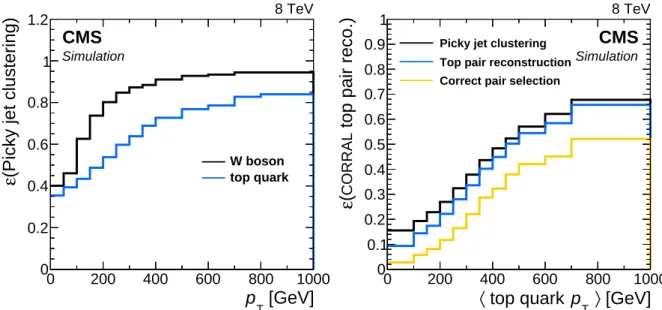
The efficiency to correctly cluster W bosons (top quarks) into two (three) picky jets satisfying
8 4 Top quark pair reconstruction for the T2tt simplified model
of generated particle (top quark or W boson) pTin all-hadronic T2tt events with met =600 GeV
and m e
χ01 = 50 GeV. In each event the six quarks arising from the hadronic decays of the two
top quarks are matched to reconstructed picky jets by means of ghost association [101]. This technique associates particles produced in the fragmentation and hadronization of the quark prior to detector response simulation. The ‘generator-level’ particles are clustered together with the full reconstructed particles used to form the picky jets as described above, but the momentum of each of the generator-level particles is scaled by a very small number so that the picky jet collection is not altered by their inclusion. A quark is then determined to be matched to the picky jet that contains the largest fraction of the quark’s energy if it is greater than 15% of the quark’s total energy. In the case that two or more quarks are associated with the same picky jet, the picky jet is matched to the quark with the largest clustered energy in that jet.
[GeV]
T
p
0 200 400 600 800 1000
(Picky jet clustering)
ε 0 0.2 0.4 0.6 0.8 1 1.2 W boson top quark 8 TeV CMS Simulation [GeV] 〉 T p top quark 〈 0 200 400 600 800 1000
top pair reco.)
CORRAL ( ε 0 0.1 0.2 0.3 0.4 0.5 0.6 0.7 0.8 0.9 1
Picky jet clustering Top pair reconstruction Correct pair selection
8 TeV
CMS
Simulation
Figure 2: Efficiency as a function of generator level pT for picky jet clustering and CORRAL
top quark pair reconstruction in all-hadronic T2tt events with met =600 GeV and m
e
χ01 =50 GeV.
left: The efficiency to correctly cluster final state particles from each W boson and top quark de-cay into two and three picky jets, respectively, as a function of particle (top quark or W boson)
pT. right: The efficiency at each stage of theCORRAL algorithm to reconstruct a hadronically
decaying top quark pair as a function of the average pT of the two top quarks. They are the
efficiency to correctly cluster the final state particles from top quark decays into six picky jets, labelled “Picky jet clustering”; the efficiency to both carry out picky jet clustering and recon-struct the top quark pair with these six picky jets, labelled “Top pair reconrecon-struction”; and finally the efficiency to carry out picky jet clustering, top pair reconstruction, and then correctly select the reconstructed top quark pair for use in the analysis, labelled “Correct pair selection”. The energy of each resulting picky jet is corrected for pileup by subtracting the measured en-ergy associated with pileup on a jet-by-jet basis by means of a trimming procedure similar to the one discussed in Ref. [102]. The procedure involves reclustering of the particles
associ-ated with the jet into subjets of radius 0.1 in η-φ and then ordering them by decreasing pT.
The lowest pT subjets are removed one-by-one until the summed momentum and mass of the
remaining subjets have minimal differences with the same quantities after subtracting an esti-mate of the pileup contribution [103]. The reconstructed W boson and top quark masses as a function of the number of reconstructed primary vertices are shown in Fig. 3 in all-hadronic
T2tt events with met = 600 GeV and m
e
χ01 = 50 GeV. The reconstructed mass values are seen to
9
scale corrections, other than those mentioned below, have been derived to remove the
remain-ing 5-10% bias in the reconstructed mass values. The CORRALalgorithm is optimized for the
uncorrected top quark and W boson mass values.
Number of primary verticies
0 5 10 15 20 25 30 35 40 [GeV] 〉 reconstructed mass 〈 60 80 100 120 140 160 180 200 220 240
260 Top quark, before PU corr. Top quark, after PU corr. W boson, before PU corr. W boson, after PU corr.
8 TeV
CMS
Simulation
Figure 3: Masses of the top quarks and W bosons reconstructed with picky jets that are matched
at particle level in simulation, as discussed in the text, in all-hadronic T2tt events with met =
600 GeV and m e
χ01 = 50 GeV. The labels “before PU corr.” and “after PU corr.” refer to results
obtained before and after application of the trimming procedure used to correct for pileup effects.
The pT spectra of picky jets in MC data are corrected to match those observed in data in the
inclusive tt and Z+jets control samples by rescaling of individual picky jet pT values. The
rescaling factors are derived separately for each of the two processes and for the flavour of parton that initiated the jet. They are found to be within 2–3% of unity. Picky jets can also be b-tagged with the CSV algorithm by considering the tracks that have been used in their formation.
A candidate for a hadronically decaying top quark pair is a composite object constructed from
six picky jets that passes every step of theCORRALalgorithm, which will now be described. To
reduce the number of jet combinations that must be considered, the algorithm involves several stages, with progressively tighter selection criteria at each stage. First, BDTs are trained to
discriminate the highest pT jet coming from a top quark decay from all other jets in the event
using input variables related to jet kinematics, b tagging discrimination and jet composition information. Jets are labelled as seed jets if they have an associated discriminator value that exceeds a high efficiency cutoff value. Three-jet top quark candidates are then constructed from all combinations of three jets in the event that include at least one seed jet. High quality top quark candidates are those that pass one of two MVA working points chosen to identify 97–99% of those cases in which the jets are correctly matched to top quark decays and to reject 60–80% of the candidates that are not correctly matched. The most important input variables are the W boson and top quark invariant masses and the picky jet b tagging discriminator value. Other variables such as the angular separations of the jets are included for additional discrimination. A final list of top quark pairs contains all combinations of two high quality top quark candidates with distinct sets of three jets. The final reconstructed top quark pair used in the analysis is the one with the highest discriminator value from a BDT that is trained with variables similar to those used in the candidate selection but also including information on the
10 5 Rejection of isolated leptons
correlations between the top quark candidates.
The CORRALalgorithm reconstructs at least one top quark pair in nearly every event that has
six or more picky jets. However,CORRALis not strictly a top quark tagger that must distinguish
events with top quarks from events without top quarks. It is designed to reconstruct top quark pairs in data samples that are predominantly made up of top quark events, as is the case for the T2tt part of this analysis. In Fig. 2, the efficiency for correctly resolving the top quark pair is shown at each stage of the algorithm. These efficiencies are calculated for T2tt events
with met = 600 GeV and m
e
χ01 = 50 GeV, but they do not depend strongly on the signal mass
parameters. The two hadronic top quark decays are each resolved into three distinct picky jets in 15–70% of events, depending on the boost of the quarks. In nearly all of these events the
correct six jets pass the CORRAL jet seeding and top quark candidate selection requirements
and are used to form the correct top quark pair among a number of top quark pairs found in the event. The correct pair is then chosen to be used in the analysis in 30–80% of events. Properties of the reconstructed top quark pairs used in the analysis are compared to true top quark pair quantities in Fig. 4 for signal events with at least one reconstructed top quark pair. The events in which the true top quark pair is chosen are categorized separately in the figure. In the fully resolved and selected case the reconstructed separation in φ between the two top quarks agrees with the true separation within 0.1 in over 80% of events. Even in the case of the reconstructed top quark pair not being fully resolved or selected, there is reasonable agreement because the top quark pair is constructed with five of the six correct jets in the majority of these events.
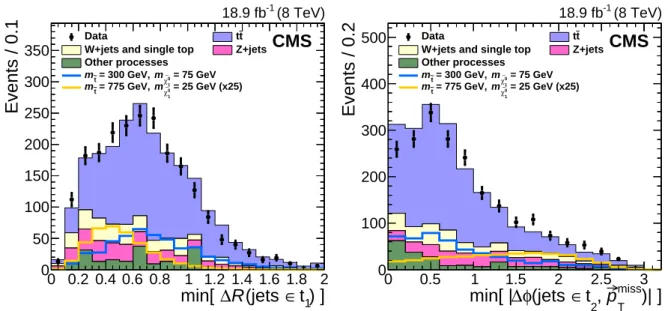
The signal discrimination that is achieved by exploiting differences in the kinematics of the reconstructed top quark pairs in simulated signal samples and those in simulated SM back-ground samples is illustrated in Fig. 5. The left plot shows the minimum separation in the η-φ plane between any two jets in the reconstructed top quark candidate with the highest
discrimi-nator value, labelled t1. The separation tends to be smaller in T2tt signal events because the top
quarks with the highest discriminator value are more likely to be boosted. Similarly, the right
plot shows the distribution for the separation in φ between the jet direction and~pTmiss for the
jet with the smallest such separation from the sub-leading reconstructed top quark, labelled
t2. The distribution for the semileptonic tt background, involving tt events in which one W
boson decays leptonically, is shifted to low values of∆φ because the t2top quark candidates in
tt events typically use the b jet from the leptonically decaying top quark, which is correlated in
angle with the~pmiss
T from the leptonically decaying W boson.
5
Rejection of isolated leptons
The main backgrounds for this analysis arise from events with lost or misidentified leptons. Sensitivity to signal is therefore improved by identifying and rejecting events with charged leptons originating from prompt W boson decays as efficiently as possible. On the other hand, signal events often contain charged leptons that arise from decays of heavy flavour hadrons or charged hadrons that have been misidentified as charged leptons. It is advantageous to retain
these events in order to achieve high signal efficiency. In events with EmissT > 175 GeV and
five or more jets, the standard CMS lepton identification algorithms operating at their tightest working points [71, 76] can identify semileptonic tt events with efficiencies of 54% and 60% for final states involving electrons and muons, respectively. This analysis makes use of MVA techniques to achieve higher efficiencies for the identification and rejection of semileptonic tt events, while retaining high signal efficiency.
11 )| 2 ,t 1 (t y ∆ )| - true | 2 ,t 1 (t y ∆ reco. | 2 − −1.5 −1 −0.5 0 0.5 1 1.5 2 Arbitrary units 0 0.1 0.2 0.3 0.4 0.5 0.6
Correct pair selection or pair selection Incorrect clustering 8 TeV CMS Simulation )| 2 ,t 1 (t φ ∆ )| - true | 2 ,t 1 (t φ ∆ reco. | 2 − −1.5 −1 −0.5 0 0.5 1 1.5 2 Arbitrary units 0 0.1 0.2 0.3 0.4 0.5 0.6
Correct pair selection or pair selection Incorrect clustering 8 TeV CMS Simulation ) 1 (t T p )/ 2 (t T p ) - true 1 (t T p )/ 2 (t T p reco. 1 − −0.8−0.6−0.4−0.2 0 0.2 0.4 0.6 0.8 1 Arbitrary units 0 0.05 0.1 0.15 0.2 0.25 0.3
Correct pair selection or pair selection Incorrect clustering
8 TeV
CMS
Simulation
Figure 4: Properties of the reconstructed top quark pair used in the analysis are compared to
their true properties in all-hadronic T2tt events with met = 600 GeV and m
e
χ01 = 50 GeV. The
label “Correct pair selection” corresponds to events in which the two top quark decays are each resolved into three distinct picky jets and these jets are used to reconstruct the two top quarks. The label “Incorrect clustering or pair selection” is used for all other events. The top two figures show comparisons of the angular separation between the two top quarks in
rapid-ity, y≡ −(1/2)ln[(E+pz)/(E−pz)], and azimuthal angle φ. The bottom figure compares the
relative pTof the two top quarks. In all cases, t1refers to the top quark with the highest pT.
The MVAs used here combine a number of moderately discriminating quantities into a single metric that can be used for electron and muon identification. Electrons and muons must have
pT >5 GeV,|η| <2.4, and are required to satisfy the conditions for the loose working point of
the standard CMS identification algorithms, for which the efficiencies for electrons and muons in the tracker acceptance are above 90%. The discriminating variables used in the training of
the muon identification BDT are the pT of the muon, its track impact parameter information,
relative isolation in terms of charged and neutral particles, and the properties of the jet nearest to the muon. Isolation in terms of charged and neutral hadrons is defined by means of separate
12 5 Rejection of isolated leptons ) ] 1 t ∈ (jets R ∆ min[ 0 0.2 0.4 0.6 0.8 1 1.2 1.4 1.6 1.8 2 Events / 0.1 0 50 100 150 200 250 300 350 Data tt
W+jets and single top Z+jets Other processes = 75 GeV 1 0 χ∼ m = 300 GeV, t ~ m = 25 GeV (x25) 1 0 χ∼ m = 775 GeV, t ~ m (8 TeV) -1 18.9 fb CMS )| ] miss T p , 2 t ∈ (jets φ ∆ min[ | 0 0.5 1 1.5 2 2.5 3 Events / 0.2 0 100 200 300 400 500 Data tt
W+jets and single top Z+jets Other processes = 75 GeV 1 0 χ∼ m = 300 GeV, t ~ m = 25 GeV (x25) 1 0 χ∼ m = 775 GeV, t ~ m (8 TeV) -1 18.9 fb CMS
Figure 5: Distributions of properties of reconstructed top quark pairs for data together with
signal and background MC data samples after the baseline selection for two choices of metand
m e
χ01. For the case met = 775 GeV, mχe
0
1 = 25 GeV the expected signal is multiplied by a factor
of 25. The left plot shows the minimum separation in the η-φ plane between any two jets in the leading reconstructed top quark, defined as the one with the highest discriminator value,
while the right plot shows the separation in φ between~pTmiss and the jet in the sub-leading
reconstructed top quark for which this separation is the smallest. Both variables are inputs to the T2tt search region BDT discriminators, which are described in Section 6.
sums of the pT of charged and neutral PF particles, respectively, in a region near the lepton,
divided by the lepton pT. The properties of the nearest jet that are used include the separation
from the lepton in the η-φ plane, the momentum of the lepton relative to the jet axis, and the CSV b tagging discriminator value for the jet. For electron identification, the variables include all of those used for the muon, plus several electron-specific variables that are used in the standard CMS electron identification MVA [76].
The BDTs are trained using simulated event samples with electrons or muons. In particu-lar, single-lepton tt events are the source of prompt leptons, while electrons or muons in all-hadronic tt events are used for non-prompt leptons. The non-prompt lepton selection efficiency in signal events is similar to that in tt events. The left plot in Fig. 6 shows the selection effi-ciency, by lepton type, for non-prompt leptons as a function of that for prompt leptons in the BDT training samples. The curves are obtained by varying the cutoff on the corresponding BDT discriminator value above which events are accepted. In this analysis, the discriminator values that are chosen have efficiencies of 98% for events with electrons and muons from W boson decays that pass the preselection requirements, while incorrectly selecting no more than 5% of all-hadronic tt events. The latter gives some indication of the expected loss of all-hadronic top squark signal events. Upon including reconstruction and acceptance inefficiencies, these
requirements eliminate 80% of single-electron and single-muon tt events with ETmiss>175 GeV
and five or more jets.
A similar approach is used to identify hadronically decaying tau leptons originating from semileptonic tt decays. The τ identification algorithm focuses on decays involving a single charged hadron in conjunction with neutral hadrons because the majority of hadronic τ decays are to final states of this type, which are often referred to as ‘one-prong’ decays. No attempt
13 (Prompt) ε 0.3 0.4 0.5 0.6 0.7 0.8 0.9 1 (Nonprompt) ε 3 − 10 2 − 10 1 − 10 1
MVA electron disc. MVA muon disc.
lepton disc. τ MVA 8 TeV CMS Simulation ) [GeV] miss T p (Candidate, T m 0 20 40 60 80 100 120 140 160 180
Arbitrary units / 3 GeV
0 0.01 0.02 0.03 0.04 0.05 0.06 lepton candidates τ Nonprompt candidates 8 TeV CMS Simulation
Figure 6: left: Comparison of BDT discriminator selection efficiencies for non-prompt and prompt leptons. Prompt leptons are those matched to lepton candidates in semileptonic tt events whereas non-prompt leptons are those that are matched to lepton candidates in all-hadronic tt in the case of electrons and muons, or all-all-hadronic T2tt signal events in the case of τ leptons. It follows that the non-prompt category includes misidentified charged hadrons
and leptons from decays of hadrons. right: The mT calculated from~pTmiss and the momentum
of the visible τ lepton decay products, for τ lepton candidates matched to τ lepton decays in semileptonic tt events, and all τ lepton candidates in a simulated all-hadronic T2tt signal
sample (met=620 GeV, m
e
χ01 =40 GeV).
is made to specifically reconstruct the sub-dominant ‘three-prong’ decays. A τ candidate is thus defined by a track and a nearby electromagnetic cluster produced by the photons from
π0 → γγ decay, if present, in order to include more of the visible energy from the τ lepton
decay. Since every charged particle with pT > 5 GeV and|η| <2.4 could be considered to be a
τcandidate, we reduce the pool of candidates by using mTcalculated from~pTmiss and the
mo-mentum of each candidate. As seen in the right plot in Fig. 6, the mTdistribution for genuine τ
candidates has an endpoint at the mass of the W boson for semileptonic tt events, reflecting the fact that the neutrinos associated with W boson and τ lepton decays are the largest source of
ETmissin these events. Fully hadronic signal events with large ETmissdo not have this constraint,
and so each τ candidate is required to have mT <68 GeV.
The variables used in a BDT discriminator for the identification of the τ candidate are the track
pT,|η|, and distance of closest approach to the primary vertex, as well as the isolation quantities
and general properties of the jet in which the τ candidate is contained. The isolation variables include the separate sums of the transverse momenta of charged and neutral PF particles, in cones of radii 0.1, 0.2, 0.3, and 0.4 centered on the candidate, and the distance between the candidate and the nearest track. The jet variables used are the separation in the η-φ plane between the track and the jet axis, and the b tagging discriminator value for the jet. This BDT is trained with hadronically decaying τ candidates originating from semileptonic tt decays in MC
simulation for prompt candidates, while all τ candidates in all-hadronic T2tt events with met =
620 GeV and m e
χ01 = 40 GeV are used for the non-prompt candidates. The samples produced
with these T2tt mass parameters are not included in the final array of T2tt samples used in the later stages of this analysis. The T2bW baseline selection is applied to all events in order to have training samples whose kinematic selection criteria are consistent with those used to select the
14 6 Search regions
data samples used for the search. The mT cutoff value and the BDT discriminator value are
chosen to keep losses below 10% in the all-hadronic signal samples targeted by this analysis. The efficiency for correctly selecting the background of semileptonic tt events with hadronically decaying tau leptons is 65%. This efficiency is defined relative to events for which the τ lepton
decay products include at least one reconstructed charged particle with pT >5 GeV.
The efficiencies for selecting leptons in simulation are corrected to match those measured in data after applying the T2bW baseline selection criteria. The multiplicative correction factors
applied to the simulated electron and muon selection efficiencies for this purpose are 0.95±
0.03 and 1.01±0.03, respectively. The corrections to the simulated τ selection efficiency are
1.30±0.10 for τ candidates with pT <10 GeV and 0.98±0.04 for all other candidates.
6
Search regions
As discussed above, this analysis makes use of MVA techniques based on BDTs to achieve sensitivity to direct production of top squark pairs in the all-hadronic final states of the T2tt and T2bW simplified models in the presence of three main classes of much more copiously produced SM backgrounds. The signal space of the T2tt simplified model is parameterised by the masses of the top squark and the neutralino. The T2bW simplified model also includes an intermediate chargino, and is therefore parameterised by three masses. For each model, a large set of simulated event samples is prepared, corresponding to a grid of mass points in two dimensions for T2tt, and in three dimensions for T2bW. A large set of moderately to strongly discriminating variables, discussed in more detail below, serves as input to each BDT to yield
a single discriminator value ranging between−1.0 and+1.0 for each event considered. Events
with values closer to 1 (−1) are more like signal (background).
Since there are potentially significant differences in the kinematic characteristics of signal sam-ples at different points in the mass grids described above, it is not known a priori what is the minimum number of distinct BDTs that are needed to achieve the near optimal coverage of the signal spaces. To this end, a minimum number of BDTs that provides sufficient coverage of each signal space is selected from a larger superset that includes BDTs that are each uniquely
trained on grid points separated by≈100 GeV in top squark mass and≈50 GeV in neutralino
mass for both signal types. For T2bW, there are also 3 different values of chargino mass that are
considered, corresponding to x= 0.25, 0.5, and 0.75. Sensitivity to signal is probed by varying
discriminator thresholds from 0.5 to 1.0 in steps of 0.01. Ultimately it is determined that four BDTs for T2tt and five for T2bW are adequate to cover the largest possible parameter space with near optimal signal sensitivity. Each BDT tends to cover a specific portion of signal space, referred to as a search region. The optimisation of the overall search does not depend strongly on the specific signal points that are used to train individual BDTs. Moreover, adding more regions is not found to increase the sensitivity of the analysis. Table 2 lists the search regions for both signal types, the mass parameter points used to train each BDT, and the optimal BDT discriminator cutoffs that are used to define the final samples. Figure 7 displays the most sen-sitive search regions in T2tt and selected T2bW mass planes. The colour plotted in any given partition of the plane corresponds to the search region BDT with the strongest expected limit on the signal production cross section.
For the T2tt search a total of 24 variables are used. They can be divided into variables that do
or do not rely upon top quark pair reconstruction by theCORRALalgorithm. The latter include
Emiss
T , jet multiplicity, and mT calculated with~pTmiss and the~pTof the b-tagged picky jet that is
closest to~pTmissin φ. Of these, the most important variables for tt suppression are ETmissand mT.
15
all of the EmissT originates from the leptonic W decay, and the corresponding lepton is usually
soft. On the other hand, there is no peak in the distribution for fully hadronic signal events. One variable suppresses SM background by exploiting the higher probability for jets in SM events, particularly Z+jets and W+jets, to originate from gluons. It is the product of the quark-gluon likelihood values [104] that are computed for each jet in the event. Two additional variables, the
ηof the peak in jet activity and the∆η between two peaks in jet activity, provide a measure of
the centrality of the event activity. They are obtained by a kernel density estimate (KDE) [105,
106] of the one dimensional jet pTdensity. The KDE uses the jet η as input with a jet pTweighted
gaussian kernel function and a bandwidth parameter optimized on an event by event basis such that two peaks in the KDE are found. Another variable counts the number of unique combinations of jets that can form reconstructed top quark pairs. The remaining seventeen variables are all built with information pertaining to the candidate top quark pair obtained from
CORRAL. The invariant mass of the top quark pair and the relative pTof the two reconstructed
top quarks are used to take into account correlations between the two top quark candidates that generally differ for signal and background. The degree of boost or collimation of each top quark candidate is measured with three variables, including the minimum cone size in the η-φ plane that contains all of the reconstructed particles from the top quark decay. Two variables
use theCORRALdiscriminator value for each of the two top quarks as a measure of the quality
of the reconstruction. Two other variables measure the angular correlation with~pTmiss for the
lower-quality member of the top quark pair. The last eight variables are the pTvalues for the
six jets in the top quark pair and two CSV b jet discriminator values that each correspond to the highest b tagging discriminator value obtained for the three jets that make up each of the two top quark candidates. While the properties of the reconstructed top quark pairs differ between signal events with two hadronic top decays and all SM background events with one or no hadronic top decays, the variables measuring the quality of the reconstruction are particularly useful for the suppression of Z+jets and W+jets since no reconstructed top quark candidates originate from hadronic top decays. A similar situation occurs for the variables utilizing b jet discriminator values since these processes typically have fewer jets that originate from b quarks than signal processes. As explained in Section 4, the kinematics of the reconstructed top quarks,
such as their angular correlation with~pmiss
T , are used for tt suppression.
There are 14 variables used to train the BDTs that target the T2bW final state, half of which are the same or very similar to those used for the T2tt final state. Four of these are commonly used
to distinguish SM background from SUSY signals. They are ETmiss, jet multiplicity,
multiplic-ity of jets passing the CSV b tagger medium working point, and the azimuthal separation of
the third-leading jet from~pmiss
T . Variables that are sensitive to correlations between b jets and
the rest of the event are the invariant mass formed with the two highest pT b-tagged jets; mT
formed with~pmiss
T and the nearest b-tagged jet; and the standard deviation of the separation
in pseudorapidity between the b-tagged jet with the highest pT and all other jets in the event.
Three additional variables make use of quark-gluon likelihood values for the jets in the event, and a further set of three make use of jet kinematics. Of the last the most important is the scalar
sum over pT of jets whose transverse momenta are within π/2 of the direction of~pTmiss, (i.e.
∆φ(~pTjet,~pTmiss) <π/2) divided by the corresponding sum for all jets that do not meet this
crite-rion. This variable is particularly useful for suppression of Z+jets and W+jets since the jets and
~pTmissin these events are typically opposite in φ. This is not the case for signal events, for which
the direction of~pmiss
T and hadronic activity is less correlated. For the calculation of the final
variable, jets are first grouped into unique pairs by requiring the smallest separation distances
in η−φspace. Of these, the invariant mass of the pair with the highest vector sum pTis found
in simulation to have a high probability to correspond to the decay of a W boson and is used to
16 7 Estimation of SM backgrounds
Table 2: Search regions for the T2tt and T2bW channels. The table lists the SUSY particle masses used for the training of the BDTs, the cutoff on the BDT output, and the efficiency for the signal to pass the BDT selection relative to the baseline selection. The event counts of the T2bW discriminator training samples are limited and so four nearby mass points were used. They are
the four combinations of the twoet and twoχe
0
1masses listed. The signal efficiency in each row
of the table is then that of the best case of the four, which in every case is the point with the largest m
etand smallest mχe
0
1 values of those indicated.
Search region m
et[GeV] mχe
0
1 [GeV] x Cutoff Signal efficiency [%]
T2tt LM 300 25 — 0.79 8 T2tt MM 425 75 — 0.83 16 T2tt HM 550 25 — 0.92 25 T2tt VHM 675 250 — 0.95 19 T2bW LX 550 & 575 175 & 200 0.25 0.94 25 T2bW LM 350 & 375 75 & 100 0.75 0.73 10 T2bW MXHM 550 & 575 125 & 150 0.50 0.92 14 T2bW HXHM 400 & 425 25 & 50 0.75 0.82 10 T2bW VHM 550 & 575 25 & 50 0.75 0.93 12
7
Estimation of SM backgrounds
We divide the important SM backgrounds into three classes. The first class, referred to as EW backgrounds, includes semileptonic and dileptonic decays of tt, W+jets, single top, and
Z+jets with Z→νν. The second class of backgrounds originates from high-EmissT QCD multijet
processes, and the third arises from associated production of ttZ with Z → νν and both top
quarks decaying to hadrons. The latter produces a final state that is extremely similar to that of the signal but is fortunately very rare. The diboson contributions to search regions are studied in simulation and found to be negligible.
The estimation of the EW and QCD multijet backgrounds is based on MC samples in which the events have been reweighted by scale factors with values that are generally within a few percent of unity. As discussed in Section 7.1, the scale factors are extracted from data-MC com-parisons in control regions. The reweighting of the events assures that the simulation samples match data samples with regard to distributions of quantities that are relevant to the selec-tion of events in the signal regions. However, it is important to note that the reweighted MC samples are not used directly to estimate backgrounds in the signal region. Rather, the search region yields and uncertainties are estimated by comparing the reweighted MC samples to data in background-specific control regions that differ from the search regions only in that they are obtained with selection criteria that simultaneously increase the purity of a single background and reduce any potential signal contamination. In the case of the EW backgrounds the con-trol regions are selected by requiring one or more isolated leptons, while for the QCD multijet
background it is selected by requiring~pTmissto be aligned with one of the leading jets.
The ttZ background is estimated directly from a sample of next-to-leading-order (NLO) MC
simulation events generated with MC@NLO. This procedure is motivated by the fact that ttZ
has a much lower cross section than other SM processes, making it impossible to define control regions that are both kinematically similar to the search regions and sufficiently well-populated to enable the extraction of scale factors.
7.1 EW and QCD background estimates with MC reweighting 17 1 2 1 1 1 1 2 2 2 2 2 2 3 3 3 3 4 4 4 4 4 4 4 4 4 4 4 4 4 4 4 4 4 1 2 1 1 1 1 2 2 2 2 2 2 3 3 3 4 4 4 4 4 4 4 4 4 4 4 4 4 4 4 4 4 4 1 1 1 1 1 1 2 2 2 2 2 2 2 3 3 4 4 4 4 4 4 4 4 4 4 4 4 4 4 4 4 4 4 1 2 1 1 1 1 1 2 2 2 2 2 2 3 3 3 4 4 4 4 4 4 4 4 4 4 4 4 4 4 4 4 4 1 1 1 1 1 1 2 2 2 2 2 2 3 3 3 4 4 4 4 4 4 4 4 4 4 4 4 4 4 4 4 4 1 1 1 1 1 1 2 2 2 2 2 2 3 3 3 4 4 4 4 4 4 4 4 4 4 4 4 4 4 4 4 1 1 1 1 1 1 1 2 2 2 2 2 3 3 4 4 4 4 4 4 4 4 4 4 4 4 4 4 4 4 4 1 1 1 1 1 1 2 2 2 2 2 2 3 3 4 4 4 4 4 4 4 4 4 4 4 4 4 4 4 4 1 1 1 1 1 1 2 2 2 2 2 3 3 3 4 4 4 4 4 4 4 4 4 4 4 4 4 4 4 1 1 1 1 1 1 2 2 2 2 2 3 3 4 4 4 4 4 4 4 4 4 4 4 4 4 4 4 1 1 1 1 1 1 2 2 2 2 2 3 3 4 4 4 4 4 4 4 4 4 4 4 4 4 4 3 1 1 1 1 1 2 2 2 2 2 3 3 4 4 4 4 4 4 4 4 4 4 4 4 4 4 2 1 1 1 2 2 2 2 2 3 3 4 4 4 4 4 4 4 4 4 4 4 4 4 1 3 2 1 1 2 2 2 2 2 3 3 4 4 4 4 4 4 4 4 4 4 4 4 2 2 1 1 1 2 2 2 2 2 3 3 4 4 4 4 4 4 4 4 4 4 4 2 1 2 1 1 2 2 2 2 2 3 3 4 4 4 4 4 4 4 4 4 4 1 1 2 1 1 2 2 2 2 2 3 4 4 4 4 4 4 4 4 4 4 [GeV] t ~ m 200 300 400 500 600 700 800 900 1000 [GeV]0χ1 ∼ m 0 50 100 150 200 250 300 350 400 (8 TeV) -1 18.9 fb CMS 1 0 χ∼ t + → t ~ ; t ~ t ~ → pp 1 1 3 1 1 3 3 1 1 1 1 1 1 1 1 1 1 1 1 1 1 1 1 1 1 2 1 1 1 1 1 1 31 1 1 1 1 1 1 1 1 1 1 1 1 1 1 1 3 3 1 1 1 1 1 1 1 1 1 1 1 1 1 1 1 1 1 1 1 1 1 3 3 5 5 1 1 3 1 1 1 1 1 1 1 1 1 1 1 1 1 1 1 1 1 1 3 3 2 2 2 1 1 1 1 1 1 1 1 1 1 1 1 1 1 1 1 1 1 1 1 1 3 1 5 1 1 3 5 1 1 1 1 1 1 1 1 1 1 1 1 3 31 1 3 3 4 2 3 21 1 1 1 1 1 1 1 1 1 1 1 1 1 3 1 3 3 3 5 3 5 3 3 1 1 1 1 1 1 1 1 1 1 1 3 3 3 3 3 3 3 3 3 3 31 3 1 1 1 1 1 1 1 3 3 3 3 1 3 3 4 2 3 3 1 3 1 1 1 1 1 1 1 1 1 3 3 3 1 3 4 3 3 5 3 3 1 31 1 1 1 1 1 1 3 3 3 3 2 5 4 3 3 3 3 3 31 1 1 3 3 3 3 3 3 2 3 4 2 3 1 1 31 1 1 1 3 3 3 3 3 2 5 3 3 3 3 3 3 3 31 3 1 3 3 3 4 3 4 3 3 3 3 3 3 3 1 3 3 3 3 4 5 3 4 3 3 3 3 3 1 1 3 3 3 2 5 4 4 3 3 3 3 31 3 3 3 [GeV] t ~ m 200 300 400 500 600 700 800 [GeV]0χ1 ∼ m 0 50 100 150 200 250 300 350 400 (8 TeV) -1 18.9 fb CMS = 0.25 x 1 0 χ∼ + + W → + χ∼ ; + χ∼ b + → t ~ ; t ~ t ~ → pp 5 2 5 1 1 1 1 1 1 1 3 3 3 3 3 3 3 3 3 3 3 3 3 3 3 2 1 3 1 1 1 3 3 3 3 3 3 3 3 3 3 3 3 3 3 3 3 3 3 5 5 5 5 5 3 5 1 3 1 3 3 3 3 3 3 3 3 3 3 3 3 3 3 3 1 4 5 1 2 2 1 1 1 3 3 3 3 3 3 3 3 3 3 3 3 3 3 3 4 5 21 2 5 5 5 1 3 3 3 3 3 3 3 3 3 3 3 3 3 3 3 3 3 2 3 1 2 5 5 1 5 3 3 3 3 3 3 3 3 3 3 3 3 3 3 3 4 1 3 3 2 2 2 5 5 3 3 3 3 3 3 3 3 3 3 3 3 3 3 2 5 3 5 5 5 2 3 5 3 3 3 3 3 3 3 3 3 3 3 3 3 5 2 5 1 2 1 2 5 5 3 3 3 3 3 3 3 3 3 3 3 3 5 3 1 5 5 2 2 5 3 3 3 3 3 3 3 3 3 3 3 3 2 2 5 2 1 5 5 5 3 3 3 3 3 3 3 3 3 3 3 2 2 4 5 5 2 5 3 3 3 3 3 3 3 3 3 3 3 5 1 3 3 2 5 5 5 3 3 3 3 3 3 3 3 3 2 4 5 5 5 5 5 3 3 3 3 3 3 3 3 3 2 2 5 2 5 2 5 5 3 3 3 3 3 3 3 4 4 5 5 2 3 5 3 3 3 3 3 3 3 2 5 5 4 5 5 5 5 3 3 3 3 3 [GeV] t ~ m 200 300 400 500 600 700 800 [GeV]0χ1 ∼ m 0 50 100 150 200 250 300 350 400 (8 TeV) -1 18.9 fb CMS = 0.50 x 1 0 χ∼ + + W → + χ∼ ; + χ∼ b + → t ~ ; t ~ t ~ → pp 2 2 2 2 2 2 2 2 5 5 5 5 5 4 4 4 4 4 4 4 4 4 4 4 4 2 2 2 2 2 2 5 2 5 5 5 5 5 4 4 4 4 4 4 4 4 4 4 4 4 4 3 2 2 2 2 2 2 5 5 5 5 4 4 4 4 4 4 4 4 4 4 4 4 5 2 2 2 2 2 2 5 5 5 5 5 4 4 4 4 4 4 4 4 4 4 4 4 5 2 2 2 2 2 2 5 5 5 5 5 4 4 4 4 4 4 4 4 4 4 4 5 2 2 2 2 2 2 2 5 5 5 5 4 4 4 4 4 4 4 4 4 4 4 2 2 2 2 2 2 2 2 2 5 5 5 5 4 4 4 4 4 4 4 4 4 4 2 2 2 2 2 2 5 2 5 5 5 4 4 4 4 4 4 4 4 4 4 2 5 2 2 2 5 5 5 5 5 4 4 4 4 4 4 4 4 4 4 2 2 2 2 2 2 2 2 5 5 5 5 4 4 4 4 4 4 4 4 5 2 5 2 2 2 2 2 5 5 4 4 4 4 4 4 4 4 4 4 1 2 2 2 5 2 2 5 5 4 5 4 4 4 4 4 4 2 4 2 2 2 2 2 5 5 5 4 4 4 4 4 4 4 3 2 2 2 2 2 2 5 5 4 5 4 4 4 4 4 2 2 2 2 2 2 2 2 5 5 5 4 4 4 4 2 2 2 2 2 2 2 2 5 5 5 4 4 4 2 5 2 2 2 5 5 5 5 5 4 4 4 [GeV] t ~ m 200 300 400 500 600 700 800 [GeV]0χ1 ∼ m 0 50 100 150 200 250 300 350 400 (8 TeV) -1 18.9 fb CMS = 0.75 x 1 0 χ∼ + + W → + χ∼ ; + χ∼ b + → t ~ ; t ~ t ~ → pp
Figure 7: Search regions providing the most stringent limits in the met-m
e
χ01 plane in the T2tt
signal topology (top left) and the T2bW signal topologies for mass splitting parameter values x = 0.25, 0.50, 0.75. The T2tt LM, T2tt MM, T2tt HM, and T2tt VHM search regions are num-bered 1, 2, 3, and 4, respectively. The T2bW LX, T2bW LM, T2bW MXHM, T2bW VHM, and T2bW HXHM search regions are numbered 1, 2, 3, 4, and 5 respectively. In some regions, par-ticularly with m
e
χ01 similar to met, the different search regions can have similar sensitivity, which
can lead to the fluctuations in choice of search regions in neighboring bins that is seen in some areas.
7.1 EW and QCD background estimates with MC reweighting
This analysis uses MC samples as the basis for the estimation of SM backgrounds in signal regions. These simulations have been extensively tested and tuned in CMS since the start of LHC data taking in 2009. As a result, they accurately reproduce effects related to the detailed geometry and material content of the apparatus, as well as those related to physics processes such as initial-state and final-state radiation. Nevertheless, the MC samples are not assumed to be perfect, discrepancies being observed with data in some kinematic regions. Comparisons between data and MC simulation are therefore performed to derive scale factors in order to reduce the observed discrepancies.
18 7 Estimation of SM backgrounds
The scale factors fall into two conceptually different categories. The first category involves effects associated with detector modelling and object reconstruction that are manifested as
dis-crepancies in jet and EmissT energy scales and resolutions, lepton and b jet reconstruction
effi-ciencies, and trigger efficiencies. The second category corresponds to discrepancies associated with theoretical modelling of the physics processes as represented by differential cross sec-tions in collision events. The scale factors in this category are estimated separately for each SM background process. The main sources of discrepancy here are finite order approximations in matrix element calculations and phenomenological models for parton showering and hadro-nisation. Scale factors are parameterised as a function of generator-level quantities controlling post-simulation event characteristics relevant to the final selection criteria used in the analysis. The scale factors are derived by comparing distributions of variables after full reconstruction that are particularly sensitive to these generator-level quantities, as seen in comparisons of MC with data. D’Agostini unfolding with up to four iterations [107], implemented with RooUn-fold [108], is used to determine the correct normalization of the generator-level quantities such that the distributions agree after full reconstruction. The scale factors are defined as the ratio of the corrected values of generator-level quantities to their original values. The MC events are reweighted by these scale factors, thereby eliminating any observed discrepancies with data. The scale factors are generally found to be close to unity as a result of the high quality of the MC simulation. The inclusive kinematic scale factors lead to no more than 10% shifts in any
regions of the distributions of HTand number of jets that are relevant to this analysis.
7.1.1 Detector modelling and object reconstruction effects
The detector modelling and object reconstruction scale factors are grouped into the following
categories: lepton identification efficiency, jet flavour, jet pT, and~pTmiss.
For the lepton identification efficiency, the event yields of simulated data passing the lepton ve-toes in the search regions are corrected by scale factors as described in Section 5. The associated uncertainties in the search region predictions are denoted as “MVA lepton sel. scale factors” in Tables 3 and 4. Similarly, in the control regions defined by the presence of a single lepton as described in Section 3, scale factors are applied to the simulated electron and muon recon-struction, identification, and trigger efficiencies. These scale factors are measured by applying a “tag-and-probe” technique to the pairs of leptons coming from Z boson decays [71, 76, 109].
Identification of jet type via b tagging is important for theCORRALtop reconstruction algorithm
and the signal discriminator used in the T2tt search. Both use the CSV b tagging algorithm out-put values directly rather than setting a particular cutoff value as is done for standard CMS loose, medium, and tight working points [80]. It is therefore important that the CSV discrimi-nator output distributions in simulated event samples match those seen in corresponding data samples. To this end, the CSV discriminator output of each picky jet is corrected so that the CSV output distributions for simulated tt and Z+jets event samples match those observed in the inclusive tt and Z+jets control samples, respectively. Similarly, the quark-gluon likelihood distribution for jets is corrected to match data. The jet energy scale is corrected as described in
Section 3, and the simulated picky jet pTspectrum is corrected as described in Section 4.
The rejection of SM backgrounds in this analysis is very much dependent on the
measure-ment of~pTmiss and its resolution, which is not modelled perfectly in simulation. Corrections
are therefore applied to MC simulated samples of EW and QCD multijet processes in order to obtain good agreement with data in search region variables that depend on the correlation of
event activity with~pTmiss. There are three separate corrections [110] applied for EW processes