Conceptualizing the Challenges and Success Factors
to Born Global Startups
A work project, presented as part of the requirements for the award of a Master’s degree in Management from the NOVA – School of Business and Economics.
Name: Diarra Rother Student No.: 2822
Directed Research
A project carried out on the Master in Management Program, under the supervision of: Miguel Muñoz Duarte, Professor at the Nova School of Business and Economics
Abstract
Since the 1970’s a growing number of companies appear to internationalize at inception or shortly after. As international markets gradually interconnect, smaller and younger businesses are also becoming more global. Early internationalization of startups is often perceived as having a vast number of obstacles. In fact, however, all challenges connected to early internationalization can be tackled with specific success factors. While previous research typically focuses on the reasons why BGs have emerged, this thesis focuses on strategies of overcoming challenges connected to early internationalization. To illustrate this further, a framework was developed.
Keywords: early internationalization, born global Startups, globalization, international entrepreneurship
List of Abbreviations
BG – Born GlobalSME – Small and Medium-sized Enterprises MNE – Multinational Enterprises
SEO – Search Engine Optimization INV – International New Venture
Table of Content
List of Abbreviations ________________________________________________________ 2 1. Introduction ___________________________________________________________ 4 1.2. Research Objective and Importance of the Study ___________________________ 5 1.3. Defining the term Born Global __________________________________________ 5 2. Methodology __________________________________________________________ 6 3. Literature Review _______________________________________________________ 8 3.1. Challenges to Internationalization _______________________________________ 8 3.2. Success Factors ______________________________________________________ 10 4. Findings from Empirical Research _________________________________________ 12 4.1. Challenges ____________________________________________________________ 13 4.2. Success Factors ________________________________________________________ 15 5. Discussion & Implications _______________________________________________ 19 6. Limitations & Future Research ___________________________________________ 21 7. Conclusion ___________________________________________________________ 22 Bibliography ______________________________________________________________ 22 Appendices _______________________________________________________________ 26 Appendice I: Challenges Identified in the Literature Review ________________________ 26 Apendice II: Success Factors Identified in the Literature Review ____________________ 27 Appendice III: Interview Guidelines ___________________________________________ 29 Appendice IV: Startups and Respective Interviewees _____________________________ 31 Appendice V: Empirical Findings on the Success Factors and Challenges ______________ 31 Appendice VI: Notes from the Interviews _______________________________________ 341. Introduction
The rapid development of the Internet and the increasing interconnectedness have strongly accelerated the internationalization processes of firms. Rasmussen and Madsen (2002) found that global market conditions, recent developments in transport and communication, as well as a growing number of people that gain international experience early on, greatly impact the way businesses internationalize. Rennie discovered in 1993 that a large number of Australian companies internationalize at inception or shortly after. This characteristic was coined ‘Born Globals’ (BGs). BGs are emerging worldwide and have challenged traditional international business theory that was long dominated by large well-resourced multinational enterprises (MNE’s) (Eurofound, 2012; Knight & Cavusgil, 2004; Madsen & Servais, 1997; OECD, 2013). This theory is based on the Uppsala Model (Johanson &Vahlne, 1977), which is considered as the most accepted paradigm of internationalization. It is accepted as a step-by-step way of internationalization. Contrarily to this, BGs internationalize much more rapidly, as they leapfrog some traditional steps. Moreover, BGs are typically small in size, more agile and consider the whole world as their market place (Oviatt and McDougall, 1994). BGs cannot be perceived as equivalent to MNEs since they are structurally different from large corporation. As a fairly new trend, academic research that exists on this topic today is incomplete, focusing mainly on the reasons for internationalization rather than identifying strategies to achieve successful internationalization. This thesis therefore addresses the following question:
What are the key success factors that help BGs overcome challenges of early internationalization?
In order to develop findings, this thesis is structured into six parts: 1. Introduction & Research Objective, 2. Methodology, 3. Literature Review, 4. Empirical Findings, 5. Discussion & Implications, 6. Limitations & Conclusion.
1.2. Research Objective and Importance of the Study
The majority of previous studies on BGs focus on the reasons leading to their emergence (Rennie, 1993; Oviatt & McDougall, 1994; Robert & Senturia, 1996, Knight & Cavusgil, 1996). The objective of this research project, however, lies in conceptualizing successful early internationalization. The framework developed based on this study, identifies obstacles of early internationalization, outlines key success factors, and acts as the basis for early internationalization strategy.
The trend of BGs internationalizing early on is likely to accelerate further. Startups are emerging in sizeable numbers worldwide and keep challenging traditional views on internationalization (Eurofund, 2015; Knight & Cavusgil, 2004; OECD, 2016). Rennie (1993) argued that this trend also has a positive impact on the national economy, by increasing export numbers and furthering job growth. In order for countries, entrepreneurs and managers to exploit full benefits, successful BG internationalization is essential.
1.3. Defining the term Born Global
In academic literature definitions on the term “Born Global” lack precision and are not clearly defining specific characteristics. Most academics do not address important aspects that should be measured when defining BGs, such as size, age and the pace of internationalization. Therefore, for the purpose of this study, a more precise definition of BGs is adopted: “A born global is a firm that has reached a share of foreign sales of at least 25% after having started export activities within three years of its foundation” (Knight & Cavusgil, 2004; Kuvalainen et al., 2012).
With increasing research on the BG phenomenon, terminology to define the new type of firm increased as well: Global Start-Ups (Oviatt & McDougall, 1995), Global High-Tech Firms (Roberts & Senturia, 1996), or International New Ventures (INVs) (Oviatt & McDougall, 1994,
McDougall et al., 1994; Oviatt and McDougall, 1997; Servais & Rasmussen, 2000) are common terminology.
While there is disagreement on the term, there is general agreement that the product or service offered by the BG should be unique and incorporate a high degree of added value (Knight & Cavusgil, 1996; Schmidt-Buchholz, 2001, p.163). BGs often follow niche market strategies which results in rather standardized products and high degrees of specialization (Madsen, Rasmussen & Servais, 2000).
The term “Born Global” was defined in a general manner to determine the specific characteristics underlying in this type of business. However, this paper solely focuses on the startup phase of a BG and more specifically on its early internationalization. Therefore, in the following the term “Born Global” is used as an equivalent to Startups characterized as BGs.
2. Methodology
Academic research is based on two approaches; the inductive and the deductive one. The prior involves the development of a theoretical framework, the formulation of a hypothesis based on the framework and the testing of the hypothesis through the means of research (Veal & James, 2005, p.26). The latter, the inductive approach, is a method used to reach a conclusion that is based on the set of observations that were made during the research process and its analysis. The inductive approach serves as the adequate approach, as this research is qualitative in nature and allows to take information from different domains to finally draw a conclusion.
For this study, the qualitative research method was used, as this type of research explores the success factors and challenges to BGs and hence concentrates on factors that are subjective and not numbers-driven. The inductive approach moreover allows the development of a new model based on the empirical and literary findings. While the deductive approach merely tests the applicability of an existing theory or model to empirical evidence and does not serve the purpose of this research (Bryman & Bell, 2003).
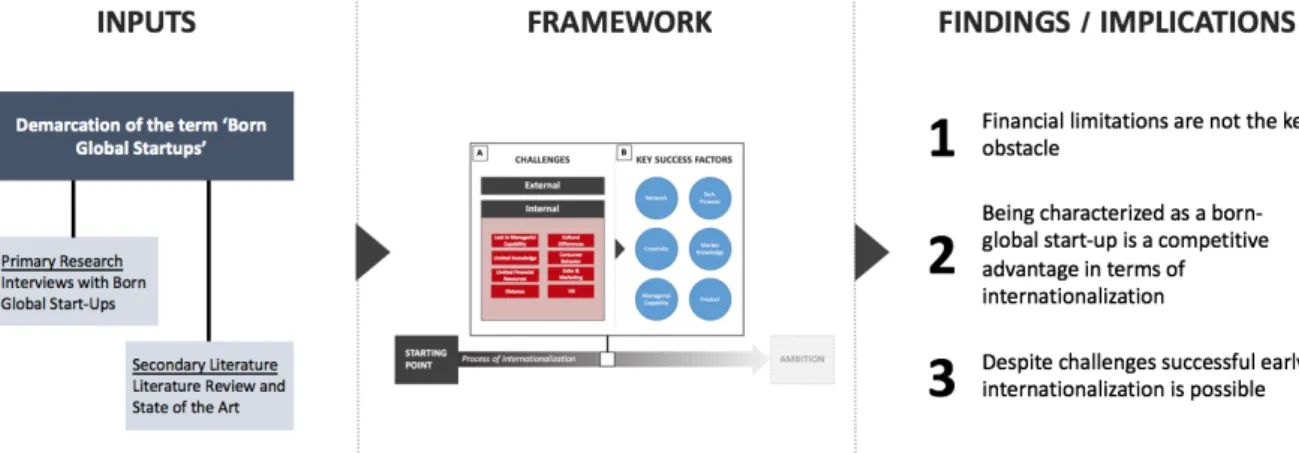
The selected research approach is depicted below in Figure 1. Based on the demarcation of the term “Born Global”, primary and secondary research has been conducted. The primary research consisted of interviews with BGs, while satisfying the criteria depicted in Table 1. The secondary research, consisted of an extensive literature review.
Figure 1: Selected Research Approach
Table 1: Criteria to select Born Global Startups
Key Criteria Age of the business Founded after 2010
Stage of the life cycle Startup
Minimum Number of foreign destinations 3
Minimum % of revenue from foreign markets 25%
The BGs selected for interviews, were recruited through public data bases on current Startup initiatives, online newspapers (e.g. Gründerszene, Austrian Born Global Awards, European
Startup Monitor etc.), and through a personal network. The interview candidates were either
founders or part of the managerial staff (employed since business inception), to ensure that the early internationalization process has been witnessed firsthand.
The interviews were conducted as semi-structured individual interviews. The BGs were mainly approached via Email and cold calls and then invited to interviews held via skype or to meet in person. In total, a number of more than 50 companies have been contacted and a total of nine interviews have been conducted. An interview guide was prepared (cf. Appendix III) which contains an interview framework, including a set of questions divided into three parts: 1.
General Information on the BG Startup, 2. Internationalization Process, 3. The Management Team. This was further supported by a list of topics that should be discussed during the interview. All themes comprised in the interview guide, are the result of academic research on the challenges and success factors of BGs. The interviews were recorded and lasted approx. 40 minutes each. The evaluation of the information retrieved in the interviews was achieved by applying a qualitative content analysis. The aim of the analysis was to filter the challenges and success factors related to early internationalization and to categorize them into coherent groups. The literature considered was retrieved through bibliographic databases, such as Emerald, the Staatsbibliothek zu Berlin academic database or the Nova SBE online library including SAGE, Science Direct, JSTOR etc. Amongst others, keywords used during the research were “born-global”, “international new ventures”, “international entrepreneurship”, “global start-ups”. This way several literary contributions were identified whose main findings are presented in the following part.
3. Literature Review
The critical success factors analyzed in the realm of this work are overall in line with Evers (2011) who coined the definition of “strategic attributes”, which are to be understood as “resources and capabilities that enable the firm to develop and sustain competitiveness on international markets at an early stage in its life cycle”. This definition suits the purpose of this research well as it is the intent to analyze the internal factors that promote successful internationalization for BGs. Critical success factors are those elements necessary for a company or organization to achieve its mission. In this context, the mission of the BG is to achieve successful early internationalization.
3.1. Challenges to Internationalization
According to Rennie (1993) BGs can face internal and external challenges. He claims that the main challenges derive from a lack of resources, a lack of managerial capabilities, access to
finance, a knowledge lack on market issues and a lack in innovation. Ultimately, each of these challenges are the result of a lack in financial means which lead to a lack of human resource capabilities, further resulting in little market knowledge and a lack in innovation. Innovation is essential for the business to innovate and differentiate the service or product. However, limited resources imply a limited budget to spend on innovation which disables a steady flow of innovation to support successful internationalization. Oviatt and McDougall (1994) argue that the challenges to BGs are mainly deriving from being small in size and inexperienced. While large corporations form mergers and acquisitions to offset inexperience, BGs do not have the means to form international subsidiaries (Oviatt & McDougall, 1994). Madsen and Servais (1997) have identified the main challenge stemming from an unskilled workforce, which is a result of limited resources and leads to cheap human resources. Moen (2002) identified various challenges in different business domains and explains they are ultimately the result from a lack in experience.
Lousterinen and Gabrielsson (2002) put a strong focus on the managerial challenges of BGs and limited resources. They have divided the challenges into four separate groups: 1) financial challenges, 2) sales and marketing challenges, 3) Research and development challenges, and 4) managerial challenges. Each of these challenges ultimately root in lack of resources and a lack in experience. The managerial challenge is attained as the most crucial one, as the BG has to form international networks early on and international marketing and sales has to be arranged in the early stages of business. Freeman, Edwards and Schroder (2006), identified challenges deriving from a lack in economies of scale, lack in resources – financially and knowledge-based – and an aversion to risk taking.
Knowledge about the market is a crucial concept which has been set in context to internationalization already by Penrose in 1959. Penrose distinguished between knowledge that can be learnt and then be transmitted. And knowledge that is obtained through experience and not possible to transfer. Johanson and Vahlne (1997) similarly focused on knowledge obtained
through experience. The absence of knowledge gained through experience marks an important managerial challenge to successful internationalization.
Overall 21 different challenges have been identified in the literature which have been subdivided into six clusters.
• Lack of financial resources
• Lack in knowledge and experience • Managerial challenge
• External challenges • Human resources • Cultural differences
Appendice I, summarized the findings on the challenges identified in the literature.
3.2. Success Factors
A growing number of academics that study the phenomenon of early internationalization have referred to different success factors for BGs. According to a study by Crick (2009) on 21 British firms, it was observed that product uniqueness and technological sophistication, new product development competences, listening to the customer and meeting their specific desires, as well as company reputation were crucial indicators for young internationalizing companies to succeed in international markets. Crick has further observed that the management team is crucial as mixed skills and experiences anchored within the management team positively influence the internationalization behavior of a BG.
Another study by Knight et al. (2004) has shown that marketing competences and the ability to differentiate the product, effective pricing and distribution are key success factors when studying Danish BGs. While studying American BG’s, Knight et al. observed that product quality and differentiation were key factors. The study has concluded that the major success factors lie in superior product quality and customer focus.
Oviatt and McDougall (1995) identified a set of six patterns that lead to the successful internationalization of BGs: 1. A global vision from inception, 2. Managers have international experience, 3. Entrepreneurs pertain a strong international business network, 4. preemptive
technology and marketing is exploited, 5. Product and service extensions are closely linked, 6. business is closely coordinated worldwide.
Coviello and Munro (1995) draw upon the network theory. They argue that the basis of internationalization success lies in the availability of a well-developed international network, as it supports successful marketing activities. Robert & Senturia (1996) explain that the success is strongly linked to the strong allocation of resources to the development of international operations. Madsen, Rasmussen & Servais (2000) studied Danish BGs and their behavior and found that a high degree of specialization and niche market orientation are key drivers to successful internationalization. Thereby, a narrower customer group which may be located in many different geographical places as much as a marketing and a sales network with external partners were key characteristics. On a similar note, Servais and Rasmussen (2000) elaborated that global and local networks are decisive for the success of BGs. Larimo (2001) further focused on the importance of fast decision-making, fast reaction and the willingness to take greater risk. Thereby, he directly focuses on the competences of the founder and the management of a BG.
Mort and Weerawardena (2006) have further underlined the role of the BG founder, “the attractiveness of the innovation, proactiveness and risk taking of entrepreneurs as the “main determinants of building network relations” (Falahat et al., 2015).
While success factors are internal in nature, some external factors have been identified during the research process which positively influence the BGs success and are shortly outlined. Increasing homogeneity of the markets and the greater mobility of the customer with regards to the needs and sales structures in many areas have been named. This, as a result leads to decreasing costs for equalizing products and allows BGs to sell standardized products in international markets (Rasmussen et al., 2001). The reduction of transportation costs and the elimination of trade barriers (e.g. through trade agreements) supports cheaper and easier exports. One of the most crucial factors is the internet, as small businesses are enabled to market
their services and products through international boundaries and build a brand without huge marketing budgets. Globalization hence supports the internationalization of BGs remarkably as it decreases the many obstacles in the border related traffic of products and services. While these also constitute the reasons for increasing the emergence of BGs they also stipulate the success factors to a large extent.
In total 29 different success factors have been identified that can be clustered into five overall categories. • Product uniqueness • Technological sophistication • Managerial competences • Network • Market knowledge
Appendice II summarizes the findings on the identified success factors from the literature review. The next part presents the results from the primary research pursued with BGs. Both the secondary (the literature review) and the primary research (BG interviews) are later on merged to develop a framework conceptualizing the process of BG early internationalization.
4. Findings from Empirical Research
The BG Startups interviewed correspond to the criteria outlined in the methodology and match the definition which was adopted for this research. The Startups operate in differing industries: travel technology, communication service, cosmetic services and food. The BGs international operation vary from three foreign destinations up to a number of 144 countries. The percentage revenue gained internationally lays at a minimum of 25% and at a maximum of 100%. The number of employees varies between four employees to an estimated 1100 employees. The majority of the BGs selected however are characterized as small businesses. The BGs are all from EU-origin as their home countries are: Portugal, Germany and Austria. None of the them was founded before 2014. The table below summarizes the most crucial details on each participant. To review the notes on the conducted interviews, see Appendice VI.
Table 2: Eligibility Criteria for the Identification as Born Global Startups Startup Founded in Country of Origin No. of Countries Revenue from abroad No. of Employees Business/Industry
ALLDSGN 2015 Austria 15 50% 4 Communication service
Climbers 2015 Portugal 3 25% 8 Travel Technology Home24 2010 Germany 10 40% 65 E-Commerce
Furniture Nu3 2015 Germany 8 47% 15 E-Commerce,
Nutrition Vaniday 2015 none 6 100% 100 Cosmetic,
Tech Service Foodora 2014 Germany 10 84% Approx.
1100
Food Services Tripaya 2015 Portugal >100 40% 4 Travel Technology Inviita 2015 Portugal 144 83% 4 Travel Technology Xtourmaker 2014 Portugal 15 Approx.
45%
8 Travel Technology
4.1. Challenges
A total of 22 different challenges were identified during the interviews which have been clustered into seven categories.
• Lack in financial resources (limited marketing capabilities, lack of innovation funds)
• Managerial challenges (limited knowledge, limited experience, lack of a strong network, logistics)
• External challenges (government regulation, different technological standards in e.g. emerging markets, competition, currency)
• Cultural difference (language barrier, different business practices, customer taste) • Human resource challenge (hiring new employees, education standards)
• Distance (time-zone, customer service, physical distance to customers) • Consumer behavior (price sensitivity, consumer taste, brand recognition)
Interesting to note is that the challenges perceived by the interviewees have been clustered into the same categories as deriving from the literature review with the exception that two categories have been added: distance and consumer behavior.
The first category, is a lack in financial resources. As a result of limited financial funds, limited budget for marketing and advertisement, the hiring of high level employees is perceived as difficult. Limited financial resources are typical to BGs as they are in their initial phase of setup.
On a similar note Andres Fredes, Strategist and Design Accelerator at ALLDSGN said “The
financial part is always an issue in a Startup” (2016).
The category lack in managerial capabilities comprises sub-challenges such as developing or maintaining a strong network locally and internationally or to implement the right internal policies that support learning processes within the sBG. A lack in knowledge about international markets can be the result of a lack in managerial capabilities. This can be noticeable by choosing the wrong foreign market as was the case at Vaniday: “We tried to go
to Russia, which was a rather unglamorous intent as we had to withdraw due to government intervention” (Kachab, CEO of Vaniday, 2016). As a result of rather sloppy research on the
Russian market, the BG started to set up its Russian location, to find out that Russian law requires the setup of the entire business operation including servers etc. locally, which finally led to the withdrawal from the Russian market, as it would have required exorbitant resources. This example illustrates a twofold challenge and taps upon the next category: external challenges. Government intervention and national legislation can constitute critical challenges as in the case of Vaniday internationalizing to Russia. Different technological standards globally can constitute a further external challenge, which is specifically valid for internationalizing to emerging markets e.g. Brazil, as it might require the adaptation of the product. A challenge deriving from different currencies, was identified by four out of nine interviewees, as it can lead to heavy financial losses and hence fuel a lack in financial resources. The last sub-challenge was identified as competition. While it can constitute as a driver, fierce competition can also be a major disadvantage as it is difficult in the early days of a BG to participate in price wars (Tripaya, 2016). Cultural difference is the next category and comprises language barriers, different business practices and varying customer tastes. Daniel Kachab, CEO of Vaniday said “It is very difficult to match the differing tastes of people,
therefore sales and marketing can be incredibly different in Sao Paulo than in Sydney which again requires resources” (2016). This not only affects the type of marketing applied to the
international destination, but may also require the adaptation of the product or service to the customer taste. Which may further imply the need to hire additional employees.
The human resource challenge exacerbates the hiring of new employees that can bring knowledge, experience, language skills or a network. The human resource challenge mainly results from the lack in financial resources, but may also stem from a lower educational level in e.g. emerging markets.
The category physical distance is an interesting parameter, as it was mentioned by four out of nine BGs. Specific challenges derive from differences in the time-zone, as it complicates customer services, and a physical distance towards the customers often stokes on the credibility of the SBG. This distance is closely related to the final category: consumer behavior. Brand recognition has been related to this category as, the acceptance towards certain brands coming from specific countries can be better or worse. The International Roll-Out Manager at Nu3 for instance said that, it was an advantage to be a German brand and to be perceived as such (2016). Contrarily, the CEO at Inviita said “Brazil has proven to be difficult {…}. Brazilians tend not
to interact with companies that don’t speak Brazilian Portuguese” (2016). While this might
also be perceived as a language barrier problem, the attitude prevails in this regard and has hence a direct impact on the consumer’s behavior. Moreover, price sensitivity is defined as the degree to which a consumer’s behavior is a result of the price for a product or a service. In price sensitive industries, this can represent an important challenge to Startups.
Overall, the interviews were closely in line with the findings from the literature. Nevertheless, some challenges were put forth that were not explicitly mentioned in the literature and hence supported the adding of two additional categories: distance and consumer behavior.
4.2. Success Factors
While the challenges differed more remarkably from one BG to another, it was striking to note that a great part of the success factors were mentioned by almost all interviewees. All in
all, 32 different success factors were identified. These factors have been further categorized into seven categories:
• Global vision from inception (internationalization strategy formulated prior to foundation, a global founder visionary)
• Niche market orientation (product differentiation, small customer segment) • Managerial competences (different TMT backgrounds, languages, strong focus on
internal communication and reporting, listening to the customer, adapting to outside changes, closely connecting the international activities, flexibility, the willingness to fail)
• Network (locally and globally, VC network, marketing network, partnering with competitors)
• Technological prowess (knowledge about digital businesses, social media usage, online marketing)
• Product (quality, uniqueness)
• Government support (providing a network, funds, trade agreements, fairs and conferences)
A global vision from inception of the BGs business was mentioned by all of the participants. This means that nine out of nine Startups said the formulation of an internationalization strategy was formulated before or during the setup of the business. In most cases, this was accompanied by a global founder visionary. CEO and Managing Director from Climbers said: “We don’t
want to be a Portuguese company, we don’t want to be a European company, we launched the first product with the goal to hit the world” (Climbers, 2016). This view was shared by most
interviewees who further explained that having a global vision right from the start is crucial in order to make sure business operations are tailored right from the beginning towards international scale (Kachab, CEO of Vaniday, 2016). It is an important factor as it underlines that none of the BGs, accidently became a Born Global in a gradual manner, rather that it is each of their intents to become a globally renown brand.
A further success factor shared by seven out of nine Startups was the niche market orientation. It specifically describes how BGs focus on addressing rather small market segments to meet customer demands. This way the BG has the chance to offer their product or service to a small customer segment but in many different destinations globally.
The category managerial competence comprises the largest number of success factors perceived. Many of the interviewees named important managerial competences as key drivers to their internationalization success. Amongst these are the strong focus on internal communication and reporting. At Foodora for instance, the management requires employees in sales, operations and marketing to have international “knowledge calls” in order to achieve that all offices have the same level of knowledge (Growth Manager, 2016). Another important success factor named multiple times, is the ability to adapt to outside changes, which can only be safeguarded by a management that is willing to quickly adapt and shows a high degree of flexibility. The ability to speak several languages and have different personal and work-related international experiences anchored in the management team is crucial to “prevent from cultural shock” (Fredes, ALLDSGN, 2016). Another factor that has not been mentioned in the literature was identified as the willingness to fail:
“The big difference to large corporations is the willingness to fail, to fall and to try again. At big companies you don’t have that mentality. People there don’t want you to try because they don’t want you to fail. But here in a Startup its completely the opposite. You are encouraged to try, encouraged to fail, because that’s how you learn. And that is how the Startup learns.” (Tripaya, 2016).
A well-developed international network also constitutes a crucial success factor in the day-to-day business of BGs. The networks were mainly gained through personal or work-related experiences, through venture capitalists or investors, who extended the network substantially by providing professional linkages. Daniel Kachab from Vaniday said: “Via Rocket internet1
we already had a very good network in all of the countries we are currently operating in” (2016). The interviewees especially, draw on the importance of a network to achieve easier
market entry and extend the knowledge on foreign markets. Therefore, a network on a local and
1 Rocket Internet is a German internet company which builds online Startups and owns shareholdings on various models of the internet retail businesses.
a global level is crucial. Inviita has strategically partnered with their strongest competitors and hence increased its knowledge portfolio.
Technological prowess relates to the capabilities within the BG towards technology. This capability has been mentioned to be especially relevant with regards to the usage of online marketing, the knowledge on digital businesses and the use of social media. CMO at Home24 said: “Why do you need to be in the country to do marketing in? My personal opinion is that
you can do a lot from here in terms of marketing and market understanding. Google SEO is very powerful and has facilitated the operations to a great extent” (2016). He implies, that for
their business, it was a huge success factor to make use of online marketing tools to reach people internationally. This way resources could be saved as it is not necessary to setup a marketing team in all foreign destinations.
Concerning the product, the uniqueness of the product to four out of five interviewed Startups is a crucial factor to gain competitive advantage. Closely followed by the importance of product differentiation. Finally, a success factor that has been mentioned and been underlined several times during the interviews is creativity. The common saying: Necessity is the mother of
inventions seems to hold truth for BGs. Co-Founder and CEO at Vaniday said: “When you have limited financial resources, you stop solving issues with cash and you start solving issues with brain” (Kachab, 2016).
Similar as found in the literature review, government support has been named three times. However, it is not considered as a success factor as the BGs cannot exercise any influence on the framework provided by governments and it is hence perceived as an external precondition. Fredes exemplified this by saying:
“We are very luck as there is a lot of support. The government preconditions for international business to cooperate and innovate are very good in the EU. The government creates the frame. Creates the environment. Government structures are necessary to enable the businesses to create a network on their own. There are of course private organizers taking care of such things, but of course a Startup does not have the means to pay for such private agents.” (Fredes, ALLDSGN, 2016)
The quote shows how positively the government can influence the development of a BG to succeed internationally by e.g. organizing fairs and conferences. The next part discusses the interconnectedness of the challenges and success factors in the literature and the cases by presenting the framework developed. For a summary of the identified findings stemming from the interviews conducted see Appendice V.
5. Discussion & Implications
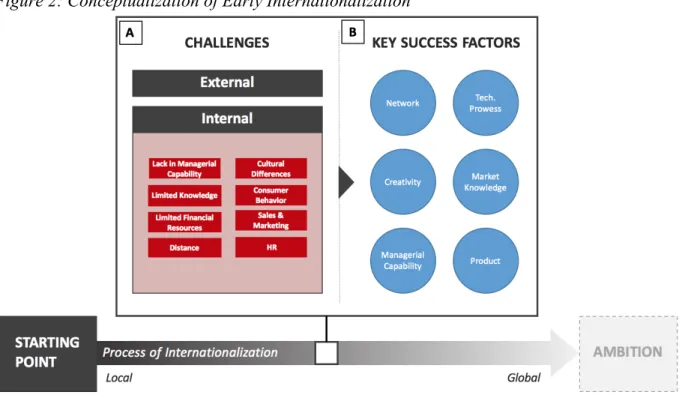
Based on the research conducted (primary and secondary) for the study, the framework in Figure 2 was developed. This framework illustrates the types of challenges that BGs encounter on their path to internationalization. The framework also highlights key success factors that help tackle these challenges.
Figure 2: Conceptualization of Early Internationalization
The framework shows on the X-axis the process of internationalization from the starting point (the local presence) towards the mission: achieving early internationalization. Along the way there are Box A, exemplifying the challenges that might be encountered and Box B outlining the key success factors that can help overcome the challenges along the process of internationalization.
Figure 1: Box A
While external challenges exist, the focus was put on internal challenges as they overtake a more crucial role in driving BG strategy towards internationalization. The most common internal challenges are: limited knowledge, limited financial resources, cultural differences, consumer behavior, sales and marketing, human resources and a lack in managerial capability. Figure 1: Box B
The key success factors from literature review and empirical findings are: a well-developed network, technological prowess, creativity, market knowledge, managerial capability and the product offered.
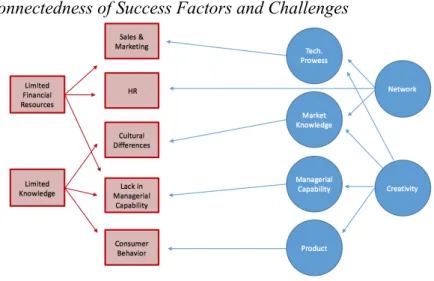
Figure 3 depicts a more precise framework, which show how specific success factors are linked to certain challenges.
Figure 3: Interconnectedness of Success Factors and Challenges
As can be seen in Figure 3, all challenges can be overcome with the identified key success factors. This means that despite common doubts, early internationalization is possible and can be achieved even by small companies (Startups). One of the most surprising findings is that while being often identified as typical challenge, financial constraints are not described as the most difficult obstacle to overcome. In fact, this challenge can act as an engine for creative processes. As Daniel Kachab highlighted in his interview: “When you have limited financial
resources, you stop solving issues with cash and you start solving issues with brain” (Kachab,
2016). For example, some BGs showed creativity leveraging their network and entering collaborative arrangements to overcome limited financial resources (Freeman et al., 2006, Gleason & Wiggenhorn, 2007). Outlining this more tangibly, Mouraz said: “We need to be very
creative in a way that we sell our value proposition to partners, investors, and to people we are recruiting. For example, if there is a guy I want to recruit but he is unsure and we cannot pay a lot. We fight on the cultural part of our company. Selling him the vision of our future. The same way we sell ourselves to partners and investors. It is makes a big difference.” (2016).
Concluding, the development of an infrastructure in which BGs can thrive for example organization network events or mentorship programs can kickstart internationalization for BGs. Internally, the management of BGs should be aware of the challenges connected to early internationalization and the various success factors that are tied to them.
6. Limitations & Future Research
This type of study has various limitations. Some of these include:
• the absence of a commonly accepted definition of a BG (including agreement on what internationalization means)
• A small sample size
• A lack of a global study (as this was a Eurocentric study and it is valuable to learn from BGs in other continents
• Limit on one rather short period within the life-cycle of a business (as long-term success of internationalization is unclear)
For future research it is recommended to conduct a global quantitative study to validate the findings of this research. Going deeper industry-specific research could yield interesting additional findings. Also, a study focusing on the long-term behavior and development of
BGs can be interesting in order develop a comprehensive approach on maintaining successful operations within a BG. Furthermore, it appears that the criteria identifying a firm as a BG itself are stipulating success factors to some extent which generally allows to question whether BGs have a competitive advantage to internationalization incorporated in their organizational upset.
7. Conclusion
This research has shown that the challenges to early internationalization can be overcome by exploiting the identified success factors. The overall obstacles faced by BGs during early internationalization amount to total of seven challenges: A lack in financial resources, a lack in knowledge, lack in managerial capabilities, distance, consumer behavior, cultural differences, human resources and challenges in sales and marketing. Each of these challenges can be overcome by exploiting the success factors specific to born global companies. These key success factors stem from: technological prowess, market knowledge, managerial capabilities, the product, a well-developed network and creativity. This has shown, that there is a discrepancy between the literature and the real-life cases especially coming from the weight that was put on each of the factors. While limited financial resources overtake the largest role in the literature, empirical research has shown that it is not entirely seen as a challenge but also as an engine to enhance BG internal creativity and support the differentiation of products or services, and the way a BG achieves its missions.
Bibliography
Aspelund, A., & Moen, O. (2001) A generation perspective on small firms’
internationalization- from traditional exporters and flexible specialists to born globals. In C.N. Axinn and P. Matthyssens, (eds.), Reassessing the internationalization of the firm, (Advances in International Marketing, 11) (pp. 197-225). Amsterdam:
JAI/Elsevier Inc.
international growth of technology-based new firms. Frontiers of Entrepreneurship Research, Center for Entrepreneurial Studies, Babson College, 413-424.
Autio, E., Sapienza, H.J., & Almeida, J.G. (2000). Effects of age at entry, knowledge intensity, and imitability on international growth. Academy of Management Journal, 43/5, 909-924.
Andersson, S., Gabrielsson, J., & Wictor, I. (2006). Born Globals' foreign market channel strategies. International Journal of Globalisation and Small Businesa, 1 (4), 356-373. Bryman, A., & Bell, E. (2007). Buiness Research and Methods. New York: Oxford University Press.
Cavusgil, S. T. (1994). A quiet revolution in Australian exporters. Marketing News, 18- 21. Coviello, N.E. & Munro, H.J. (1995). Growing the entrepreneurial firm: networking for international market development. European Journal of Marketing, 29/7, 49-61. Coviello, N.E. & McAuley, A.
(1999). Internationalisation and the smaller firm: a review of contemporary empirical research. Management International Review, 39/3, 223-256.
Freeman, S., Edwards, R., & Schroder, B. (2006). How Smaller Born-Global Firms Use Networks and Alliances to Overcome Constraints to Rapid Internationalization. Journal of International Marketing , 33–63.
Johanson, J., and J. E. Vahlne. 2009. The Uppsala internationalization process model revisited: From liability of foreignness to liability of outsidership. Journal of International Business Studies 40: 1411–1431.
Johanson, J., and J. E. Vahlne. 1977. The internationalization process of the firm: A model of knowledge development and increasing foreign market commitment. Journal of International Business Studies 8(1): 23–32.
Madsen, T.K. & Servais, P. (1997). The internationalization of born globals: an evolutionary process?. International Business Review, 6/6, 561-583.
Madsen, T.K., Rasmussen, E.S., & Servais, P. (2000) Differences and similarities between born globals and other types of exporters. In A. Yaprak & J. Tutek, (eds.)
Globalization, the multinational firm, and emerging economies, (Advances in International Marketing, 10) (pp. 247-265). Amsterdam: JAI/Elsevier Inc. McDougall, P. P., and B. M. Oviatt. 2005. Defining International
Entrepreneurship and Modeling the Speed of Internationalization Entrepreneurship Theory and Practice (September): 537–553.
McDougall, P. P., and B. M. Oviatt. 1999. A framework for understanding accelerated
international entrepreneurship. In A. M. Rugman and R. W. Wright (Eds.) Research in global strategic management 7: 23–40.
McDougall, P.P., B.M. Oviatt, and S. Shane. 1994. Explaining the formation of international new ventures: the limits of theories from international business research. Journal of
Business Venturing 9(6): 469–487.
Knight, G., & Cavusgil, T. (2005). A Taxonomy of Born-global firms. Management International Review , 4 (35), 15-35.
Knight, G., & Cavusgil, T. (2004). Innovation, Organizational Capabilities, and the Born Global Firm. Journal of International Business Studies, 124-141.
Knight, G., & Cavusgil, T. (1996). The Born Global firm: a challenge to traditional internationalization theory. Advances of International Marketing, 8, 11-26. Larimo, J. (2001). Internationalization of SMEs – two case studies of Finnish born global firms. Paper presented at the CIMaR Annual Conference in Sydney, Australia (November 20th), 1-21.
Luostarinen, R., & Gabrielsson, M. (2002). Globalization and Global Marketing Strategies of Born Globals in SMOPECs. Annual Conference of the European International
Business Academy. Athens.
Madsen, T. K., & Servais, P. (1997). The Internationalization of Born Globals – an Evolutionary Process? International Business Review , 6 (4), 561-583. Moen, Ø. (2002). The Born Globals: A new generation of small European exporters. International Marketing Review , 19 (2), 156-175.
Moen, O., & Servais, P. (2002). Born Global or Gradual Global? Examining the Export Behavior of Small and Medium Sized Enterprises. Jounral of International Marketing, 49-72.
Moen1, Ø., Sørheim, R., & Erikson, T. (2008). Born Global Firms and Informal Investors: Examining Investor Characteristics. Journal of Small Business Management , 46 (4), 536-549.
Oviatt, B. M., & McDougall, P. P. (1995). Global Start-ups: Entrepreneurs on a Worldwide Stage. Academy of Management Executive , 30-43.
Oviatt, B. M., & McDougall, P. P. (1994). Toward a Theory of International New Ventures. Journal of International Business Studies , 25 (1), 45-64.
Penrose, E. (1959). The Theory of The Growth of The Firm. New York: Oxford University Press.
Rasmussen, E., & Madsen, T. (2002). The Born Global Concept. EIBA Conference. Rennie, M. W. (1993). Born global. The McKinsey Quarterly, 4.
Rialp, A. & Rialp, J. (2001) Conceptual frameworks on SMEs’ internationalization: past, present, and future trends of research. In C.N. Axinn, & P. Matthyssens, (eds.)
Reassessing the internationalization of the firm, (Advances in International Marketing, 11) (pp. 49-78). Amsterdam: JAI/Elsevier Inc.
Wickramasekera, R. & Bamberry, G. (2001). Born globals within the Australian wine industry: an exploratory study. Working- Paper No. 1/01, Charles Sturt University,
Wagga Wagga.
Zahra, S.A., Ireland, R.D., & Hitt, M.A. (2000). International expansion by new venture firms: international diversity, mode of market entry, technological learning, and performance. Academy of Management Journal, 43/5, 925-950.
Zahra, S.A. & George, G. (2002) International entrepreneurship: the current status of the field and future research agenda. In M. Hitt, R. Ireland, M. Camp, & D. Sexton, (eds.) Strategic leadeship: creating a new mindset (pp. 255- 288). London, UK: Blackwell.
Oral References
Fredes, A., Strategist and Design Accelarator at ALLDSGN, interviewed, November 10th,
2016
Mouraz, M. Co-Founder and CEO at Climbers, interviewed November 15th, 2016 Chief Marketing Officer at Nu3, interviewed November 21st, 2016
Kachab, D. Co-Founder and CEO at Vaniday, interviewed November 13th, 2016 Growth Manager at Foodora, interviewed December 5th, 2016
Ramos, A., Founder at Tripaya, interviewed December 17th, 2016
Vestia, B., Head of Marketing and Growth at Inviita, interviewed December 21st, 2016 Major, E., CO-Founder and CEO at Xtourmaker, interviewed December 14th, 2016 International Roll-Out Manager at Home24, interviewed on November 8th, 2016