Corporate Partnership Board
CPB
Challenges for
Accessibility Planning
and Research in the
Context of Sustainable
Mobility
Discussion Paper
Cecília Silva
Faculty of Engineering of the University of Porto & Research Centre for Territory, Transport and Environment, Porto
Anders Larsson
Corporate Partnership Board
CPB
Challenges for
Accessibility Planning
and Research in the
Context of Sustainable
Mobility
Discussion Paper
Cecília Silva
Faculty of Engineering of the University of Porto & Research Centre for Territory, Transport and Environment, Porto
The International Transport Forum
The International Transport Forum is an intergovernmental organisation with 59 member countries. It acts as a think tank for transport policy and organises the Annual Summit of transport ministers. ITF is the only global body that covers all transport modes. The ITF is politically autonomous and administratively integrated with the OECD.
The ITF works for transport policies that improve peoples’ lives. Our mission is to foster a deeper understanding of the role of transport in economic growth, environmental sustainability and social inclusion and to raise the public profile of transport policy.
The ITF organises global dialogue for better transport. We act as a platform for discussion and pre-negotiation of policy issues across all transport modes. We analyse trends, share knowledge and promote exchange among transport decision-makers and civil society. The ITF’s Annual Summit is the world’s largest gathering of transport ministers and the leading global platform for dialogue on transport policy.
The Members of the Forum are: Albania, Armenia, Argentina, Australia, Austria, Azerbaijan, Belarus, Belgium, Bosnia and Herzegovina, Bulgaria, Canada, Chile, China (People’s Republic of), Croatia, Czech Republic, Denmark, Estonia, Finland, France, Former Yugoslav Republic of Macedonia, Georgia, Germany, Greece, Hungary, Iceland, India, Ireland, Israel, Italy, Japan, Kazakhstan, Korea, Latvia, Liechtenstein, Lithuania, Luxembourg, Malta, Mexico, Republic of Moldova, Montenegro, Morocco, the Netherlands, New Zealand, Norway, Poland, Portugal, Romania, Russian Federation, Serbia, Slovak Republic, Slovenia, Spain, Sweden, Switzerland, Turkey, Ukraine, the United Arab Emirates, the United Kingdom and the United States.
International Transport Forum 2 rue André Pascal F-75775 Paris Cedex 16
[email protected] www.itf-oecd.org
ITF Discussion
Papers
ITF Discussion Papers make economic research, commissioned or carried out in-house at ITF, available to researchers and practitioners. They describe preliminary results or research in progress by the author(s) and are published to stimulate discussion on a broad range of issues on which the ITF works. Any findings, interpretations and conclusions expressed herein are those of the authors and do not necessarily reflect the views of the International Transport Forum or the OECD. Neither the OECD, ITF nor the authors guarantee the accuracy of any data or other information contained in this publication and accept no responsibility whatsoever for any consequence of their use. This document and any map included herein are without prejudice to the status of or sovereignty over any territory, to the delimitation of international frontiers and boundaries and to the name of any territory, city or area. Comments on Discussion Papers are welcome.
Cite this work as: Silva, C. and A. Larsson (2018), “Challenges for Accessibility Planning and Research in the context of Sustainable Mobility”, Discussion Paper, International Transport Forum, Paris.
Acknowledgements
The author is grateful to the contribution of a broad group of researchers in the field of accessibility planning who have directly contributed to the development of the discussion in the last years. First, we are grateful to the research group of the COST Action TU1002 amongst which this discussion was started and to the COST Office for funding Action TU1002. We are also grateful to the researchers who participated in the questionnaire collecting first opinions on specific question of maximum and minimum accessibility levels and to the researchers and practitioners who participated in one or both of the two workshops organised around the same theme, and also all other researchers who have commented this discussion in recent years. Thank you all for your valuable contributions and for your support. Among these we would like to highlight the relevance of the ATLOT group (AESOP Transport Laboratory of Thought) who provided the right setting for putting this discussion into a more formal format and provided the conditions for the workshops.
Table of contents
Introduction ... 5
Lack of implementation ... 6
Conceptual ambiguity ... 8
What accessibility?... 9
How much accessibility? ... 12
Final remarks ... 15
References ... 18
Introduction
In the last decades, awareness of the importance of mobility management has slowly, but steadily found its way into public opinion and political agendas. Managing mobility has been recognised as much more than an optimisation exercise of the transport systems, leading many cities worldwide to develop innovative initiatives in order to come to terms with the vicious cycle of urban sprawl, speed-based mobility solutions and hence an ever increasing car-dependency.
From a planning perspective, the concept of accessibility has increasingly been recognised as an alternative approach. Accessibility measures are believed to provide a promising background for a more holistic approach to urban development and mobility management. Authors such as Bertolini et al. (2005), Halden et al. (2000) and Straatemeier and Bertolini (2008) believe that accessibility measures provide a useful framework for the design of integrated land use and transport policies. A framework enabling the search for an improved balance between solutions increasing mobility (transport solutions) and solutions increasing proximity (land-use solutions). Thus, accessibility enables us to move away from the traditional segregate approach which has been considered to be at the heart of the vicious land use and transport feedback cycle (adapted from Wegener and Fürst, 1999). In this, “transport planning” is mainly concerned with increasing speed while “urban planning” concentrates on attracting population, leading to increasingly unsustainable urban settlement and mobility patterns (e.g. urban sprawl, dispersion of housing and activities, loss of local activities, car-dependency, and loss of relative competitiveness of public transport, to name only a few).
Arguments for a shift towards accessibility-based planning have thus been put forward by several authors (Handy, 2002, 2005; Bertolini et al., 2005; Ferreira and Batey, 2007; Curtis and Scheurer, 2010; Coppola and Papa, 2012; Ferreira et al., 2012) particularly in the context of sustainable development. Regardless of the potential advantages for this shift, current practice has revealed a number of challenges.
This paper will propose any new accessibility instruments or measures. Instead it will share a reflection that has been developing with the collaboration of several other scholars on the challenges facing accessibility planning and research. We have been concerned with the un-reflected use of accessibility, both as a concept as well as a measure. We have developed an expert questionnaire and discussed the issues at two separate workshops. These activities have helped us move forward in our reflection and hopefully we can contribute to move the debate even further. One important starting point of this reflection was the COST Action TU2001 which concluded in 2014 and was concerned with the lack of implementation of accessibility instruments in practice. This will indeed be one of the challenges raised in this paper. However, the project started to unravel a much more complex set of challenges facing accessibility planning which are deeply rooted into the conceptual ambiguity of the accessibility concept. It is a fact that the word accessibility appears with an increasing frequency in the political discourse which could be seen as a positive element in the bridging of the implementation gap. However, does this mean that the policy agenda has effectively assumed accessibility concerns? In particular, has the political agenda grasped the meaning of accessibility-based planning in the context of sustainability? Or
could it be that an un-reflected use of accessibility concepts and measures may in fact create an illusion of change while actually continuing the current practice, focused on increasing speed and providing more infrastructure? And by doing so, fuel the unsustainable travel and location patterns it aimed to avoid in the first place.
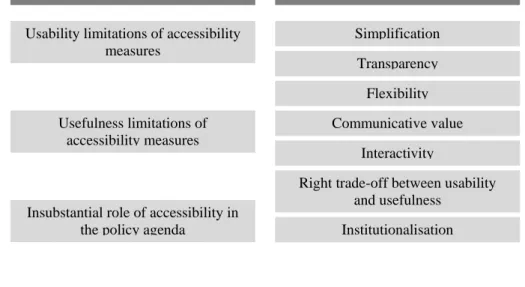
In Figure 1, this is framed as two main challenges which by themselves are also apparently contradictory: first, the lack of implementation of accessibility measures in planning practice and, second, the conceptual ambiguity frequently found in the current use of accessibility measures. On the one hand, regardless of the potential of accessibility measures, they are scarcely put into practice. Adding to this, many examples of the few practical implementations of the accessibility concept are ill-reflected being unable to bring about any of the potential advantages referred to above or even having a direct contribution to decreasing sustainability (e.g. by providing incentive for urban sprawl). The paper will present arguments for each challenge and how these create risks in the context of sustainable development (such as following the traditional “predict and provide” paradigm of transport planning). At the end of each challenge, the paper will define ideas for a research and policy agenda.
Figure 1. Outline of challenges discussed in this paper
Lack of implementation
In recent decades, literature on accessibility measures has grown and a number of accessibility instruments have been developed. In spite of theoretical evidence and the believed added value for planning, accessibility instruments are scarcely put into practice to support land use and/or transport planning (Handy and Niemeier, 1997; Geurs and Wee, 2004; Bertolini et al., 2005; te Brömmelstroet
Lack of implementation
Usability limitations of accessibility measures
Usefulness limitations of accessibility measures
Insubstantial role of accessibility in the policy agenda
Challenges
Conceptual ambiguity
What accessibility? How much accessibility? Ill conception
Lack of appropriation
Partial implementation Low adherence to real-life concerns
Identifying accessibility needs
Defining sufficient accessibility
Loss of meaning of accessibility Standardisation
2010; te Brömmelstroet and Bertolini, 2010; Hull et al., 2012; te Brömmelstroet et al., 2014; Silva et al., 2017a), particularly in comparison to more conventional transport instruments (ex. Four-step model). A review of 23 accessibility instruments developed in Europe revealed that less than 40% had already been used as part of a planning process (of which only two had an actual track record of applications) while the large majority worked primarily as research tools (Hull et al., 2012). The implementation gap has been widely researched together with that of other planning support systems (PSS).
This research field suggests that a dichotomy between supply and demand of PSS could be the main reason for this phenomenon (see for instance Geertman, 2006; te Brömmelstroet, 2010; Vonk et al., 2005). Emphasis is put on different aspirations and concerns of PSS developers and potential users (planning practitioners) in addition to the general unawareness of the needs of the planning process by developers and of accessibility measures by planning practitioners. Concerns with the pursuit of rigour in PSS and a raised awareness of their implementation gap, have led to the development of a vast research on the usability (also named “user-friendliness” in more recent literature, such as te Brömmelstroet, 2017a;b)1 of PSS in practice. More recently, a new research branch added the need to explore usefulness2 of PSS in the search for a broader understanding of the implementation gap. Earlier research has exposed the dilemma between rigour and relevance, or what Bertolini et al. (2005) has also named “soundness and plainness” of accessibility measures. The right balance between the two has been referred to as a key issue in overcoming the implementation gap (Silva, 2013). Several authors have focussed on the usability of PSS assessing the role of issues such as transparency, communicability, clarity, credibility, comprehensiveness, detail, ease of use and understanding, time, etc. (Vonk et al., 2005; Geertman, 2006; Te Brömmelstroet, 2010; Te Brömmelstroet, 2017a). te Brömmelstroet (2017b) suggest that these studies point towards three main directions in improving usability: simplification of the underlying models, increasing transparency, and increasing flexibility.
Research on accessibility-based PSS has found similar results. In their summary paper on an European- and Australian-wide research on accessibility instruments, Silva et al. (2017) refer the importance of providing real-time interaction capabilities (by speeding up calculations and allowing participants to sketch and analyse) and of strengthening the communicative value (by better visualisation and spatialisation) of accessibility-based PSS. This research showed that accessibility instrument developers were more concerned with visual representation, transparency, ease to play with, ease of collecting data and flexibility, after interacting with planning practitioners (Silva et al., 2017; Papa et al., 2017). By analysing both, accessibility instrument developers’ perception of user-friendliness and experienced usefulness of planning practitioners’, te Brömmelstroet et al. (2016) conclude that there seems to be a trade-of between user-friendliness and usefulness and that the right balance needs to be found to bridge the implementation gap. In other words, “the right tool for the specific aim (regarding the content) and the specific setting (regarding the process)”. Another paper stemming from this research, found evidence that the rigour-relevance dilemma was in fact not enough to explain the implementation gap (Silva et al., 2017). In fact, developers were not as positive about the user-friendliness of their AIs as expected, while planning practitioners actually revealed quite positive evaluations on the usefulness of AIs in planning practice. While being aware of the limited generalisability from this very specific sample, these findings support exploring rival explanations for the AI implementation gap. One such explanation as suggested by both developers and practitioners are the persistence of organisational barriers, mainly due to the insubstantial role of accessibility in the policy agenda, and the lack of institutionalisation of accessibility planning. Silva et al. (2017) even go so far as to state that these barriers are at the heart of the implementation gap and that the gap may not be bridged if these are not addressed.
The insubstantial role of accessibility in the policy agenda was clearly revealed by this research project through the 16 local workshops with planning practitioners of European countries and Australia. Not only
through the limited understanding of the accessibility concept, frequently used synonymously with mobility (but still meaning mobility or at most to achieve accessibility through mobility), but also in the limited evidence found of real accessibility-based policies or actions or integrated approach to land use and transport planning as reported by participating practitioners. Geurs and Wee (2004) argue that accessibility is often misunderstood, poorly defined and measured, and if this is true in research it is even more so in practice (te Brömmelstroet, 2016) where the term has become fashionable. This issue will be further discussed in the following section (more specifically regarding “What accessibility”).
Regarding the lack of institutionalisation, the study found that only three of the 16 countries involved defined legal requirements to use accessibility assessment, namely, the UK, Norway and Germany. Of these only one (the UK) defines legal requirements for accessibility thresholds although many define non-binding accessibility thresholds, according to a survey conducted by Silva and Larsson (forthcoming). Learning from the UK experience, it is clear that institutionalisation could bring about a clearer role of accessibility in planning and help to bring about understanding and political debate (taking into account that one also can learn from the mistakes of this pioneer system). It is however vital that understanding and political debate is involved in the process to tap the potential of use of such measure in practice (as will be discussed in the following sections).
Figure 2. Summary of challenges leading to lack of implementation and potential approaches
Conceptual ambiguity
In addition to the lack of implementation, using accessibility-based planning without thorough reflection also limits the potential for sustainable urban development and mobility behaviour. This section raises a number of challenges for accessibility planning and research in the context of sustainability due to problems and shortcomings related to the definition of the concept. As with the previous section, it intends to raise awareness of some of the main challenges rather than provide an exhaustive account of all possible issues. It focuses on two main questions which have generally remained unanswered: “What accessibility?” and “How much accessibility?”
Challenges Potential approaches
Usability limitations of accessibility measures
Usefulness limitations of accessibility measures
Insubstantial role of accessibility in the policy agenda
Simplification Transparency Flexibility Communicative value
Interactivity
Right trade-off between usability and usefulness
What accessibility?
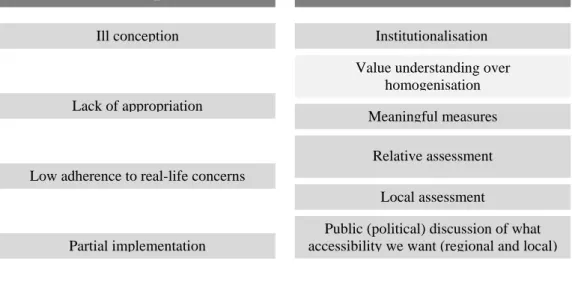
Exactly what accessibility we want and need is a fundamental question which has largely stayed unanswered and mostly even unasked. Three main challenges stand out at this level: he broad-band ill conception of accessibility; the lack of appropriation of the concept and its concerns by planning practitioners and policy makers; and the partial implementation in practice.
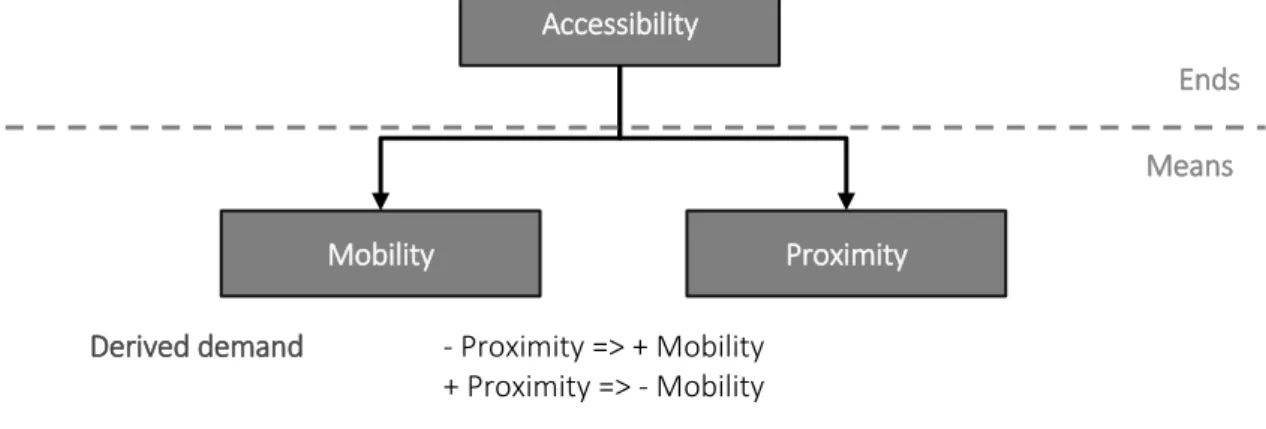
The ill conception of accessibility has already a long tradition. Almost 50 years ago, Gould (1969; p. 64) referred to accessibility as “a slippery notion […] one of those common terms that everyone uses until faced with the problem of defining and measuring it”. One might expect that half a century later this situation should have changed but in fact the concept of accessibility is mostly still regarded as new. As referred to in the previous section, the term is often used interchangeably with the term of mobility as if one and the same thing, or even in combination (“mobility and accessibility”) as if one could not exist without the other. The reason for this mismatch is rooted in the traditional segregated approach in the transport planning field. Transport planning recognised mobility as a derived demand (demand derived from the need to participate in specially dispersed activities) but focussed on this rather than on accessibility (real demand) assuming that improving mobility would necessarily improve accessibility in return. In addition, it is mostly assumed that accessibility can in fact only be improved by means of mobility improvements. In this context, and also by being a more objective concept, mobility became the chosen proxy for accessibility.
However, it is now recognised that increasing mobility does not always result in increased accessibility. In fact, it may even result in reduced accessibility levels. On the one hand we have witnessed unprecedented increases in metropolitan/regional accessibility, mainly based on car mobility. On the other, we have also witnessed the disappearance of local activities (public and private) and continued urban sprawl (of more or less alarming dimensions) and consequently the loss of neighbourhood level accessibility. In addition, we have also witnessed the loss of relative competitiveness of public transport in comparison to the car. According to the European Commission “traffic induction cycle” (EC, 2004), these effects are the result of short-term changes in mobility behaviour, medium-term changes in destination choices and destination location choices, and long-term changes in household location choices resulting of regional accessibility improvements. As such, increased regional accessibility has fuelled unsustainable travel and settlement patterns (such as car dependency and urban sprawl). These arguments reveal the importance of considering both mobility and proximity to bring about accessibility. Without solving the conceptual mismatch between the accessibility and mobility concepts and without breaking the assumption that accessibility can only, or will necessarily, be improved by mobility improvement, we will continue on the “predict and provide” paradigm of traditional transport planning. And the shift to more sustainable urban development and travel behaviour will be nothing more than a mere mirage. As referred to in the previous section, institutionalisation may provide the necessary conditions to minimize the conceptual ambiguity and un-reflected uses of the term but only if contributing to enhanced understanding. Institution such as the ITF and the EC have particular responsibilities in this, as regulators and observers, making sure that understanding is valued over homogenisation (which could bring new challenges in the future).
Figure 3. Accessibility, mobility and proximity
It is important to point out that the broad-reaching conceptual mismatch is in fact the root for an extensive unawareness of what accessibility planning entails and how it is different from traditional transport planning. In this context the lack of implementation referred to above it is hardly surprising and unbridgeable. It also leads to another problem deeply connected to the question of “How much accessibility”, namely the lack of appropriation of the concept by policy makers. Being a slippery notion, highly dependent on the objectives defined (Geurs and Ritsema van Eck, 2001) and entailing a vast number of concerns (Handy and Niemeier, 1997; Liu and Zhu, 2004), its operationalisation requires a public and/or political debate on “What accessibility” is desired. In other words, what kind of accessibility do we want to provide, why, when, for whom, how much and how, etc. (similar to the five W’s of journalistic writing). The conceptual mismatch confuses this awareness and as such the appropriation of the accessibility concept as a strategic objective.
If one asks planners or politicians in local authorities if accessibility is important they will most likely respond: yes; and if asked if they are interested in improving it, the answer will probably be the same. However, if one asks how much accessibility they want to provide their citizens, most will not have an answer or simply answer “as much as possible”. This illustrates the lack of reflection behind the practical implementation of accessibility concerns. Also contributing to this is the use of accessibility measure with low adherence to problems and people’s needs every-day life, such as the commonly used indicator of “number of jobs accessible in a certain time threshold”. Using such a measure in practice may reveal that, from home, a certain person can reach 20 000 jobs in 10 minutes. An investment in new infrastructure will improve this value to 25 000 jobs. Although these are straightforward numbers which are highly useful in the political agenda they are very hard to interpret by the inhabitants. For example, if the measure found a 25% increase in jobs accessible in 10 minutes, does that mean accessibility increased 25% (or in other words, does that mean the household would recognise a 25% increase in its accessibility)? There is clearly a need for a higher adherence to real life and real needs in people’s every-day life of accessibility measures (Silva and Larsson, forthcoming), which would also contribute to better understanding and appropriation3
.
So far we have discussed the conceptual mismatch and the lack of appropriation of accessibility in practice. One further challenge is the partial implementation of accessibility measures used in planning practice and research. A number of partial implementations can be found. We do not present an
Mobility Accessibility Proximity - Proximity => + Mobility + Proximity => - Mobility Ends Means Derived demand Real demand
extensive review but will only raise awareness of two frequently used partial implementations of the concept which may develop biased understandings and even bring us back to a mobility-oriented planning based on the “predict and provide” paradigm. These partial implementations may in fact be a reflection of how deep-rooted traditional transport planning principles are, supporting the potential misuse of accessibility measure to justify solutions based on infrastructure provision (particularly road infrastructure).
The first example of such a partial implementation is the assessment of accessibility by one single mode4 disregarding the relative competitiveness of other modes. There are many examples of the use of accessibility assessment by one single mode (the most common is used to assess the impact of a new motorway). While using one single mode in an accessibility assessment might be more than enough for certain objectives, such as comparing different distance decay functions or defining benchmarks, it clearly provides a biased vision, if concerns about sustainability of mobility are taken seriously. For instance, when using accessibility measures to assess the impact of a new motorway, assessing only accessibility by road will evidently provide positive impacts (and only positive impacts if this new motorway doesn’t imply any cuts in the existent road network). Although such maps can be relevant to understanding spatial inequalities they will still sketch out general and significant accessibility gains for the region as a whole. It is thus natural to assume that maps like these have been used to provide arguments in favour of motorway expansions in practice. But what about the impact on the sustainability of mobility? What about the impact of such investment on the loss of competitiveness of public transport (not because it becomes slower but because the car becomes faster)? And what about the potential loss of local activities and the continuing of urban expansion (and consequent loss of accessibility at the neighbourhood scale) due to car-based speed gains? The partial implementation examples continue, in practice, to follow the traditional “predict and provide” paradigm, unilaterally solving mobility problems through transport provision. If we refer to the previous discussion on the use of measures with low adherence to real life concerns, this is an example of the use of an accessibility measures which a limited understanding to justify a direct incentive on car mobility without any idea on the impact on the sustainability of mobility. There is clearly a need for the development and use of more meaningful accessibility measures in analysis but also to enable the assessment of the relative competiveness of different transport modes.
The second example we would like to discuss here is how focus on the regional scale of accessibility disregards local accessibility effects. In fact, most implementation of accessibility assessment in practice focuses on regional accessibility unwillingly ignoring the local accessibility losses which have followed the improved mobility levels of the last decades. This is because regional assessments are generally focussed on the maximum distance reachable (fastest modes available). It does not however look at accessibility, nor at what you can reach without having to travel further than roughly 1.5 km (neighbourhood level accessibility), which is the one having losses (for an example see Elldér et al., 2017). There is a need for planning practice to recognise that short-term regional accessibility gains may induce long-term local accessibility losses and that there is a need to discuss the accessibility we want and need (not just any accessibility but the one that fulfils higher objectives such as sustainability – further discussed below) at both regional and local levels. Furthermore, we need to develop local assessment of accessibility in addition to regional assessments.
Figure 4. What accessibility: Summary of challenges and potential approaches
How much accessibility?
So far we can conclude that the concept of accessibility is complex and context-dependent and as such open to misconceptions and un-reflected use. One important aspect of potential misconceptions is its historical “heritage” supporting a transport-biased framing of problems and solutions. This includes conceptual confusion with mobility measures and a potential risk of adopting a more-is-better logic to accessibility measures. Several authors have pointed to the fact that useful accessibility measures need to take into account that individuals and policy contexts and perceptions are different (Hodge, 1997; Ferreira and Batey, 2007). If the concept is applied in an un-reflected way (Qviström, 2015) there is an obvious risk of sustaining traditional planning ideals. In a recent attempt to promote accessibility in planning (Gutman and Tomer, 2016) there is a growing recognition of the fact that better accessibility might not be an objective in itself. Instead we need to learn more about accessibility needs, and preferences of individuals and social groups in different contexts (Duranton and Guerra, 2016; Venter, 2016).
The second example we would like to discuss here is how focus on the regional scale of accessibility disregards local accessibility effects. In fact, most implementation of accessibility assessment in practice focuses on regional accessibility unwillingly ignoring the local accessibility losses which have followed the improved mobility levels of the last decades. This is because regional assessments are generally focussed on the maximum distance reachable (fastest modes available). It does not however look at accessibility, nor at what you can reach without having to travel further than roughly 1.5 km (neighbourhood level accessibility), which is the one having losses (for an example see Elldér et al., 2017). There is a need for planning practice to recognise that short-term regional accessibility gains may induce long-term local accessibility losses and that there is a need to discuss the accessibility we want and need (not just any accessibility but the one that fulfils higher objectives such as sustainability – further discussed below) at both regional and local levels. Furthermore, we need to develop local assessment of accessibility in addition to regional assessments.
Challenges
Potential approachesIll conception
Lack of appropriation
Partial implementation
Institutionalisation Value understanding over
homogenisation
Public (political) discussion of what accessibility we want (regional and local)
Meaningful measures Relative assessment
Local assessment Low adherence to real-life concerns
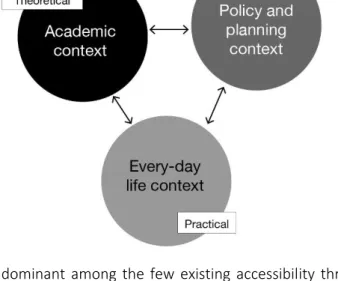
Figure 4 illustrates three important and commonly cited contexts in which accessibility issues are encountered. The point to be made here is that depending on context we tend to see accessibility from very different perspectives. For the planning practitioner, political goals have to be converted into normative goals (for what is good/bad accessibility) and at the same time implemented in a specific organisational setting where transport and land use often is separated. These measures would ideally be based on theoretically founded and objective academic research. However, in order to successfully incorporate accessibility measures in planning and policy-making there is a basic need to understand how people (including the scientists and policy makers) perceive what is good and bad accessibility when solving practical problems in their every-day life.
In order to address this issue, we have involved accessibility scholars to employ a group reflection approach with the aim to challenge the view on accessibility measures by asking if there is such a thing as good enough accessibility (Silva and Larsson, forthcoming)? We use the AESOP Thematic group on transport planning and policy5 as a sounding board to reflect on the use and usefulness of upper and lower limits and thresholds in accessibility planning. An open-ended questionnaire formed the basis for a half-day workshop in January 2017, completed by a session at the AESOP conference in July 2017 involving participants who reflected on accessibility thresholds and limits.
Figure 5. Different contexts and use/perception of the accessibility concept
Minimum levels seem to be dominant among the few existing accessibility thresholds reported in the workshops. One explanation is that minimum accessibility thresholds are generally interrelated with concerns of social and economic equity, focussed on levelling minimum requirements for all. Equity discussions have become increasingly frequent among accessibility researchers at the same time as accessibility measures have been introduced to equity and social exclusion research (Martens and Di Ciommo, 2017; El-Geneidy et al., 2016; Grengs, 2015, 2012; van Wee and Geurs, 2011; Perreira, Schwanen and Banister, 2017). In accordance, equity and social inclusion are among the most referred advantages of the existence of minimum accessibility thresholds referred in the survey.
In addition to social equity, the survey revealed a number of other advantages of having minimum accessibility thresholds in place, such as avoiding hyper-concentration of service (e.g. one big central school replacing several smaller local schools) and supporting policies for generally better quality of life for all (coming back to the issue of equity). In this context there was a general agreement on the
importance of defining accessibility limits for different transport modes, instead of one generalised measure supporting the fastest mode. In addition, thresholds by transport mode were also referred to as an incentive for mixed development revealing the importance of proximity in achieving accessibility when slower modes, such as walking and cycling, are involved.
A large majority of participants recognised that ever-increasing accessibility is not an obvious positive or even desirable goal. Many pointed to the fact that the added value of increasing accessibility depends on the balance between costs and gains. This involves the complex trade-off between higher level social goals, such as, sustainable development or high quality of life, on the one hand, and costs for society on the other. Some replies went as far as to put forward the idea of “sufficient accessibility” as a baseline for everyone.
Over both workshops a general reflection can be made on the often taken-for-granted link between accessibility planning and sustainability. A large number of the participants made a direct association between accessibility as a concept and strategies for slow modes, proximity and mixed urban land use. This is an illustration of the inherent problems of different contexts and perceptions both within academics and in relation to planning practice; a reminder that an accessibility measure or threshold is never just an (objective) accessibility measure. It needs to be understood relative to a specific problem, scale, social context and mode(s) of transport.
Several workshop participants reported that accessibility limits (especially maximum levels) are potentially prone to negative interpretation. If compared with limits on mobility, travel needs are easy to conceptualise under more resource-rational thinking. Curtailing accessibility provides, on the other hand, a week argument for planners, especially if the accessibility-minimum-needs argument has been used to discourage the mobility-needs argument. This highlights a problematic relationship between accessibility thresholds and policy goals and resonates well with current research in Swedish municipalities where the lack of standards/policy-limits was found to be a major hurdle for the implementation of accessibility planning (Gil Solá, Vilhelmson and Larsson, subm.). Also referred to was the risk of using superimposed accessibility thresholds (or general thresholds for all regions), which may become an objective in itself (or a simple number-crunching exercise) leading to further loss of meaning of what is meant by providing accessibility. The development of thresholds as a process can support the development of understanding and meaning around accessibility needs and even sufficient levels. However, if planning is based on general standards we may instead run the risk of reducing the level of understanding around accessibility concerns.
Summing up so far, it is obvious that the definition of accessibility thresholds or sufficient levels is a highly political issue and context dependent choice aimed at bringing about a particular chain of values and socio-economic and environmental objectives. Useful thresholds need to be defined locally taking into account the obvious but challenging fact that good or bad accessibility is perceived very differently depending on contextual factors such as scale, gender, social situation and preferred mode of transport. Aiming at generalised thresholds will ultimately risk playing against the idea of accessibility planning as integrative and place sensitive. This points to the need for a political and social discussion of accessibility levels (involving the political arena but also the wider society) at different scales. There is a need to have public reflection on how much accessibility we need and what are the higher objectives and values we aim to fulfil by bringing it about. Considering the political nature and local dimension of such thresholds we would suggest moving the focus away from finding the ultimate thresholds towards the process of creating/defining thresholds. In light of the different spheres of interest in Figure 5, it would require participation from a broad set of actors and groups including the general public. This process can be a potentially useful tool to strengthen the link between a broad spectrum of stakeholders and hence
create better institutional acceptance, supporting accessibility planning to find its place on the agenda. Reflection in itself then becomes a key to avoiding future misuses of accessibility concepts and measures. Even if the suggested process helps us in creating more commonly accepted accessibility thresholds, there is at least one further hurdle to overcome, namely the previously discussed lack of implementation of “real” accessibility planning. Planning practice needs to take into consideration both the contributions of the transport system and of the land-use system in order to reach certain accessibility needs, and as such, also recognise mobility and proximity as equal dimensions of accessibility. Even defining accessibility thresholds by mode is not enough to bring about more sustainable urban development and mobility patterns, if policy makers do not recognise that the problem should not solely be solved by the transport system.
Figure 6. How much accessibility: Summary of challenges and potential approaches
Final remarks
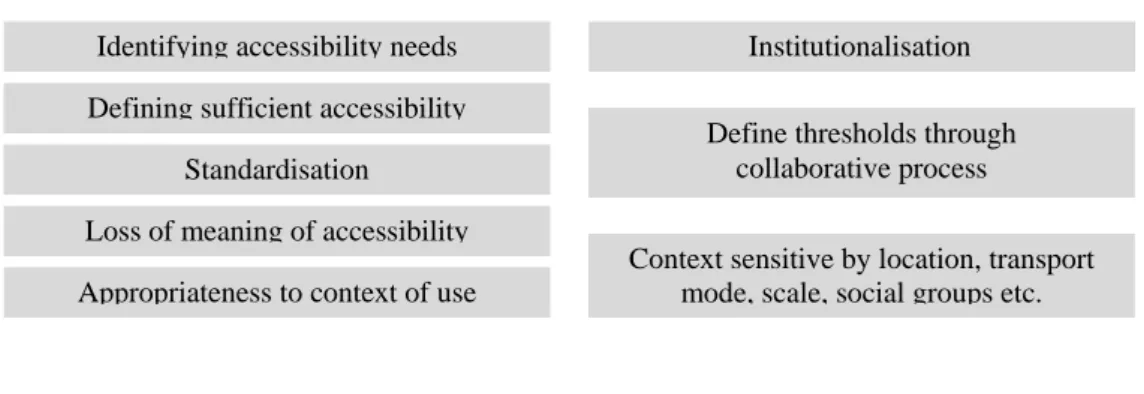
Regardless of the potential advantages of a shift toward accessibility-based planning, current practice has revealed a number of challenges to this shift. This paper reflects on two of these challenges: the lack of implementation and the conceptual ambiguity of the concept. These challenges have limited the potential advantages of accessibility-based planning and may even have had a direct contribution to decrease sustainability (ex. by providing incentive for urban sprawl). The paper has presented a number of arguments behind each challenge, explored the potential risks they bring, particularly in the context of sustainable development, and identified ideas for research and policy agendas to overcome or avoid these risks. Figure 7 summarises the challenges and related approaches for addressing them.
Challenges Potential approaches
Identifying accessibility needs Defining sufficient accessibility
Loss of meaning of accessibility
Institutionalisation
Define thresholds through collaborative process Standardisation
Appropriateness to context of use
Context sensitive by location, transport mode, scale, social groups etc.
Figure 7. Summary of challenges and potential approaches
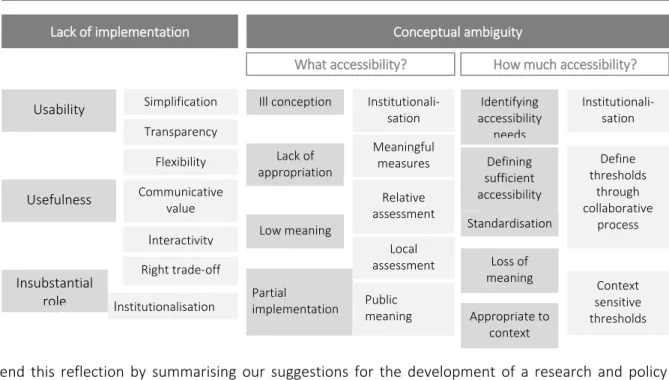
We end this reflection by summarising our suggestions for the development of a research and policy agenda aiming to contribute to overcoming or avoiding issues associated with the above-mentioned challenges. Suggestions developed for the research agenda aim to develop more meaningful accessibility measures (linking measures and specific planning objectives), which may develop understanding and support the political and public debate, and to provide support for the institutionalisation of accessibility-based planning (and the new challenges and risk opened in the process). Suggestions developed for the policy agenda share the same aims as those of the research agenda, adding focus on the building of understanding, and on moving away from the traditional “predict and provide” paradigm.
Lack of implementation Usability Usefulness Insubstantial role Simplification Transparency Flexibility Communicative value Interactivity Right trade-off Institutionalisation Challenges Conceptual ambiguity
What accessibility? How much accessibility?
Ill conception
Lack of appropriation
Partial
implementation Public meaning Meaningful measures Relative assessment Local assessment Low meaning Institutionali-sation Identifying accessibility needs Defining sufficient accessibility Loss of meaning Define thresholds through collaborative process Context sensitive thresholds Standardisation Institutionali-sation Appropriate to context
Table 1. Suggestions for a research and policy agenda
Change
Recognise that accessibility or mobility problems should not necessarily be solved by transport solutions.
Acknowledge that accessibility gains at the regional level tend to bring accessibility losses at the local level (there is a need to develop local in addition to regional accessibility assessments).
Acknowledge that improving car accessibility will reduce the relative competitiveness of more sustainable modes (there is a need to develop relative in addition to absolute accessibility assessments).
Cre at e mea n ing
Political and public debate of what accessibility we need (minimums) and what would be enough (maximums) to overcome the “more is better” logic, at different scales and for each specific context.
Clarify the link between accessibility (concepts and concerns) and sustainability policy.
Action
Institutionalisation of accessibility-based planning (focussed on building contextual understanding and avoiding standardisation).
Creating supra-national observers and regulators (such as the EC, ITF, OECD, etc.) of the institutionalisation of accessibility-based planning.
Research agenda
Fundame
nta
l resea
rch Research on the meaning of accessibility (from different perspectives, such as, individuals, households and for the society as a whole, and contexts) including the underlying value chain and priorities.
Explore the usefulness of different accessibility measures (and typologies) for different planning purposes and concerns, with specific focus on sustainable development.
Research the definition and processes of identifying accessibility thresholds, including the understanding of basic needs and “sufficient” levels for a good quality of life. Specific focus on processes and measures designed to capture context as alternative to generic and standardised procedures.
Dev elopm ent of access ibilit y measures
Developers of accessibility instruments should be aware of the need for simplification, transparency, flexibility, communicative value and interactivity. Specifically taking into consideration the balance between the development of the instrument’s capabilities and the needs of the intended users.
Development of relative accessibility measures (or measures which are at least comparable between modes). Development of local accessibility measures (at the neighbourhood level).
Actions
Accessibility instrument developers should maintain active engagement with planners throughout the entire process, especially before and during the development of an accessibility measure.
References
Bertolini, L., F. Clercq and L. Kapoen (2005), “Sustainable accessibility: a conceptual framework to integrate transport and land use plan-making. Two test-applications in the Netherlands and a reflection on the way forward”. Transport Policy.Vol. 12/3, pp. 207-220.
te Brömmelstroet, M. (2010), “Equip the warrior instead of manning the equipment: land use and transport planning support in the Netherlands”. Journal of Transport and Land Use. Vol. 3/1, pp. 25-41. DOI: http://dx.doi.org/10.5198/jtlu.v3i1.99
te Brömmelstroet, M. (2017a), “PSS are more user-friendly, but are they also increasingly useful?”
Transportation Research A, Vol. 104, pp. 77-83.
te Brömmelstroet, M. (2017b), “Towards a pragmatic research agenda for the PSS domain”.
Transportation Research A, Vol. 104, pp. 96-107.
te Brömmelstroet, M.,C. Curtis, A. Larsson and D. Milakis (2016), "Strengths and weaknesses of accessibility instruments in planning practice: technological rules based on experiential workshops."
European Planning Studies. http://dx.doi.org/10.1080/09654313.2015.1135231.
te Brömmelstroet, M. and L. Bertolini (2010), “Integrating land use and transport knowledge in strategy-making”. Transportation. Vol. 37/1, pp. 85-104. DOI: 10.1007/s11116-009-9221-0
te Brömmelstroet, M., C. Silva and L. Bertolini (eds.) (2014), Assessing usability of accessibility instruments. Amsterdam: COST Office, Amsterdam.
Curtis C. and J. Scheurer (2010), “Planning for sustainable accessibility: developing tools to aid discussion and decisionmaking”, Progress in Planning, Vol. 72/2, pp. 53-106.
Duranton, G. and E. Guerra (2016), “Developing a Common Narrative on Urban Accessibility: An Urban Planning Perspective”. Moving to Access. Brookings Institution, Washington, D.C.
El-Geneidy, A., D. Levinson, E. Diab, G. Boisjoly, D. Verbich and C. Loong (2016), “The cost of equity: Assessing transit accessibility and social disparity using total travel cost”. Transportation Research Part A:
Policy and Practice, Vol. 91, pp. 302-316. DOI:10.1016/j.tra.2016.07.003
Elldér, E., A. Larsson, A. Gil Solá and B. Vilhelmson (2017), “Proximity changes to what and for whom? Investigating sustainable accessibility change in the Gothenburg city region 1990–2014”, International
Journal of Sustainable Transportation, DOI: 10.1080/15568318.2017.1363327
European Commission (2004), Reclaiming city streets for people — Chaos or quality of life? European Commission.
Ferreira, A. and P. Batey (2007), “Re-thinking accessibility planning: a multi-layer conceptual framework and its policy implications”. Town Planning Review, Vol. 78, pp. 429–458.
Ferreira A, E. Beukers and M. te Brömmelstroet (2012), “Accessibility is gold, mobility is not: A proposal for the improvement of Dutch transport-related cost–benefit analysis”. Environment and Planning B:
Planning and Design, Vol. 39/4, pp. 683–697.
Geertman, S. (2006), “Potentials for planning support: a planning-conceptual approach”. Environment
Geurs, K. and J. Ritsema van Eck (2001), Accessibility measures: review and applications. Evaluation of accessibility impacts of land-use-transport scenarios, and related social and economic impacts. National Institute of Public Health and the Environment, Bilthoven.
Geurs, K. and B. Wee (2004), “Accessibility evaluation of land-use and transport strategies: review and research directions”. Journal of Transport Geography, Vol. 12, pp. 127–140.
Gil Solá, A., B. Vilhelmson and A. Larsson (submitted, under review), Understanding sustainable accessibility in urban planning: Themes of consensus, themes of tension.
Gould, P. (1969), Spatial Diffusion, Commission on College Geography, Association of American Geographers. Washington, D.C
Grengs, J. (2012), “Equity and the social distribution of job accessibility in Detroit”. Environment and
Planning B: Planning and Design, Vol. 39/5, pp 785-800. DOI:10.1068/b36097
Grengs, J. (2015), “Nonwork accessibility as a social equity indicator”. International Journal of Sustainable
Transportation, Vol. 9/1, pp. 1-14. DOI:10.1080/15568318.2012.719582
Gutman, J. and A. Tomer (2016), Developing a Common Narrative on Urban Accessibility: Overview.
Moving to Access. Brookings Institution, Washington, D.C.
Halden, D. and D. McGuigan (2000), Accessibility: review of measuring techniques and their application. Scottish Executive Central research Unit.
Handy, S. (2002), Accessibility- vs. Mobility-enhancing strategies for addressing automobile dependence in the U.S. Prepared for the European Conference of Ministers of Transport.
Handy, S. (2005). “Planning for Accessibility: in Theory and in practice”, in Levinson, D. and K. Krizek (eds.) Access to Destinations, Elsevier.
Handy, S. and D. Niemeier (1997), “Measuring accessibility: an exploration of issues and alternatives”.
Environment and Planning A, Vol. 29/7. Pp. 1175-1194.
Hodge, D. (1997), “Accessibility-related issues”. Journal of Transport Geography. Vol. 5/1, pp. 33-34. Hull, A., C. Silva and L. Bertolini (eds) (2012), Accessibility Instruments for Planning Practice. COST Office. Liu, S. and X. Zhu (2004), “Accessibility Analyst: an integrated GIS tool for accessibility analysis in urban transportation planning”. Environment and Planning B: Planning and Design, Vol. 31, pp. 105-124. Martens, K. and F. Di Ciommo (2017), “Travel time savings, accessibility gains and equity effects in cost– benefit analysis”. Transport Reviews, Vol. 37/2, pp. 152-169. DOI:10.1080/01441647.2016.1276642 Papa, E., P. Coppola, G. Angiello and G. Carpentieri (2017), “The learning process of accessibility
instrument developers: Testing the tools in planning practice”. Transportation Research A, Vol. 104, pp. 108-120.
Papa, E., C. Silva M. te Brömmelstroet and A. Hull (2016), “Accessibility instruments for planning practice: a review of European experiences”. Journal of Transport and Land Use, Vol. 9/3, pp. 1-20.
Pereira, R. et al. (2017), “Distributive justice and equity in transportation”. Transport Reviews, Vol. 37/2, pp. 170-191.
Qviström, M. (2015), “Putting accessibility in place: A relational reading of accessibility in policies for transit-oriented development”. Geoforum, Vol. 58, pp. 166-173.
Silva, C. (2013), “Structural accessibility for mobility management”. Progress in Planning, Vol. 81, pp. 1– 49.
Silva, C., L. Bertolini, M. te Brömmelstroet, D. Milakis and E. Papa (2017b), “A Accessibility instruments in planning practice: Bridging the implementation gap”. Transport Policy, Vol. 53, pp. 135-145.
Silva, C. and A. Larsson (forthcoming), “Is there such a thing as good enough accessibility?” …
Silva, C., T. Patatas and A. Amante (2017a), “Evaluating the usefulness of the structural accessibility layer for planning practice – Planning practitioners’ perception”. Transportation Research A, Vol. 104, pp. 137-149.
Straatemeier, T. and L. Bertolini (2008), Joint Accessibility Design: a framework developed for and with practitioners to stimulate the integration of regional land-use and transport strategies in the
Netherlands. Proceeding of the TRB 2008. Washington D.C.
Venter, C. (2016), Developing a Common Narrative on Urban Accessibility: A Transportation Perspective.
Moving to Access. Brookings Institution, Washington, D.C..
Vonk, G., S. Geertman and P. Schot (2005), “Bottlenecks blocking widespread usage of planning support systems”. Environment and Planning A, Vol. 37, pp. 909-924.
van Wee, B. and K. Geurs (2011), “Discussing equity and social exclusion in accessibility evaluations”.
European Journal of Transport and Infrastructure Research, Vol. 11/4, pp. 350-367.
Wegner, M. and F. Fürst (1999), “Land-Use Transport Interaction: State of the art”. Deliverable 2a of the European Project TRANSLAND. European Commission.
Notes
1 Usability is understood here as the (perceived) ease of use of a functionality for the intended end-user (Silva et al., 2017b).
2 Usefulness is understood here as the added value for the quality of the tasks that the planning practitioners have (Silva et al., 2017b).
3 Not to say that other measures are not meaningful in other circumstances, such as temporal analysis of accessibility evolution or benchmarking across cities.
4 The focus here is not in the absence of multimodal accessibility assessments, where accessibility is measured using a multimodal trip. Although this could also be explored as a challenge in accessibility planning and research, the focus here is the absence of comparative assessments between modes which are essential for the understanding of modal choice and as such also essential in understanding sustainability.
on K
anuman/|Shutterstock
and Research in the Context of
Sustainable Mobility
Accessibility has become a fashionable concept both in the research
and policy arena. There has been a growing interest and attention
on accessibility measures and on the potential of accessibility based
planning as means to invert the growing unsustainability of urban
settlement and mobility patterns. Regardless of the potential advantages,
current practice has revealed a number of challenges facing accessibility
planning and research.
This paper presents a reflection on two of these challenges: lack of
implementation and conceptual ambiguity of accessibility measures in
planning practice. After presenting the main arguments for each challenge,
the paper explains how they create risks in the context of sustainable
development, namely, by creating biased understandings which prevent
authorities and practitioners from shifting away from the traditional
“predict and provide” paradigm for transport planning. At the end of each
reflection, the paper suggests a research and policy agenda to overcome
the challenges supported by the institutionalisation of accessibility
planning.
International Transport Forum
2 rue André Pascal F-75775 Paris Cedex 16 T +33 (0)1 45 24 97 10