https://periodicos.ifal.edu.br/diversitas_journal/
© Diversitas Journal
Página | 2102 Página | 2102
Development of Blended Learning Model in Subject Fundamental
Automation and Control System Technology for Electro Technical
Cadets of Surabaya Merchant Marine Polytechnic
Desenvolvimento do Modelo de Blended Learning em Tecnologia de
Sistemas de Controle e Automação Fundamental para Cadetes
Eletécnicos da Politécnica de Marinha Mercante de Surabaya
Faris Nofandi1, Upik Widyaningsih2, Hariyono3
(1)ORCID: https://www.orcid.org/0000-0003-0058-0909; (2)ORCID: https://orcid.org/0000-0002-5388-4394; (3)ORCID: https://orcid.org/0000-0003-3215-5667. Surabaya Merchant Marine Polytechnic, Surabaya, Address: Jl. Gunung Anyar Lor No.1, Mt. Anyar, Kec. Mt. Anyar, Kota SBY, East Java 60294; Phone : 08197275999; INDONESIA. E-mail: [email protected]
Recebido em: 27 de maio de 2020; Aceito em: 12 de junho de 2020; publicado em 10 de 07 de 2020. Copyright© Autor, 2020.
ABSTRACT: This study aims to formulate planning, implement, and test the effectiveness of learning with a blended learning model in the basic courses of automation and control system technology. The method used in this study is the ADDIE Research and Development model. The research population is level II electro cadets. While the research sample is a class A and class B electrical cadets selected by cluster sampling technique. Data collection methods include documentation, observation, tests and questionnaires. The results showed that (1) learning planning with a blended learning model is fit to be used as a guideline for implementing learning in the classroom; (2) blended learning, learning model can be implemented according to planning which includes orientation, organization, investigation, presentation, analysis, and evaluation; (3) learning with a blended learning model is proven effective in terms of (a) basic learning outcomes of automation and control system technology that uses a blended learning model> 75 and there are significant differences in learning outcomes between groups that use the blended learning model and groups that do not use blended learning model; (b) the process of increasing activeness and motivation to learn cadets better. From the results of this study it is suggested the need for the development of a blended learning model as a supplement to face-to-face learning in the basic subjects of automation and control system technology and others.
KEYWORDS: Development, Learning, Blended Learning Model.
ABSTRACT: Este estudo tem como objetivo formular o planejamento, implementar e testar a eficácia do aprendizado com um modelo de aprendizado combinado nos cursos básicos de automação e tecnologia de sistemas de controle. O método usado neste estudo é o modelo de Pesquisa e Desenvolvimento ADDIE. A população pesquisada é de eletro cadetes de nível II. Enquanto a amostra da pesquisa é composta por cadetes elétricos de classe A e classe B selecionados pela técnica de amostragem por agrupamento. Os métodos de coleta de dados incluem documentação, observação, testes e questionários. Os resultados mostraram que (1) o planejamento da aprendizagem com um modelo de aprendizagem combinada é adequado para ser usado como orientação para a implementação da aprendizagem na sala de aula; (2) aprendizagem combinada, o modelo de aprendizagem pode ser implementado de acordo com o planejamento, que inclui orientação, organização, investigação, apresentação, análise e avaliação; (3) a aprendizagem com um modelo de aprendizado misto é comprovadamente eficaz em termos de (a) resultados básicos de aprendizado da tecnologia do sistema de automação e controle que usa um modelo de aprendizado misto> 75 e há diferenças significativas nos resultados de aprendizado entre grupos que usam o aprendizado misto modelo e grupos que não usam modelo de aprendizado misto; (b) o processo de aumentar a atividade e a motivação para aprender melhor os cadetes. A partir dos resultados deste estudo, sugere-se a necessidade do desenvolvimento de um modelo de aprendizado misto como complemento ao aprendizado presencial nas disciplinas básicas de automação e tecnologia de sistemas de controle e outras. PALAVRAS-CHAVE: Desenvolvimento, Aprendizagem, Modelo de Aprendizagem Combinada.
Página | 2103 INTRODUCTION
Lectures held at Surabaya Shipping Polytechnic are very lecturer oriented, namely learning that places cadets as objects in learning and learning activities are classic. In this approach the lecturer places himself as the most knowledgeable, most understanding and as the only source of learning (Allen, Seaman and Garrett, 2007). The instructional approach that is centered on lecturers has the characteristic that management and management of learning are determined entirely by the lecturer. The role of cadets in this learning activity is only in accordance with the instructions of the lecturer(Arend, 2008). Cadets have almost no opportunity to carry out activities according to their interests and desires, resulting in a lack of independence and motivation to learn independently, all depending on the instructor's orders. As a result of boarding school life affects the central learning in the hands of lecturers and trainers also carried into the lecture hall, which of course can have an impact on the lack of independence and creativity of cadets, because everything is carried out according to orders.
Low motivation to learn cadets From observations made by researchers of the Surabaya Sailing Polytechnic cadets, specifically for the Electro shipping Study cadets that will be used as research objects, an information picture is obtained that reflects the low motivation of cadets to learn (Suharsimi Arikunto, 1993). From the background above, it can be formulated the problems, that are how is the planning of the blended learning model in the basic subjects of the automation of the control system technology for the shipping electro cadets of Surabaya Merchant Marine Polytechnic, how is the implementation of the blended learning, learning model in the basic courses of the automation of control system technology for the shipping electro cadets of Merchant Marine Polytechnic, and what is the effectiveness of the blended learning model in the basic subject of the automation of the control system technology for the Electro shipping cadets of Surabaya Merchant Marine Polytechnic(Garrison and Kanuka, 2004). The research objective are planning a blended learning model in the basic courses of the automation of the control system technology for the shipping electro cadets of Surabaya Merchant Marine Polytechnic, knowing the implementation of the blended learning, learning model in the basic subject of the control system technology
Página | 2104
automation for the shipping electro cadets of Surabaya Merchant Marine Polytechnic, knowing the effectiveness of the blended learning, learning model in the basic courses of the automation of the control system technology for the Electro shipping cadets of Surabaya Merchant Marine Polytechnic.
LITERATURE REVIEW
The term use of learning models according to (Arends, 1997) in (Trianto, 2007) is based on two important reasons, namely
(1) The model has a broader meaning than strategy, method, or procedure;
(2) as an important means of communication, what is said about teaching in the classroom, or the practice of supervising children. The choice of terms of this learning model serves to provide guidelines for instructor designers and educators in implementing learning
Rusman (2013: 133) in (Miarso, 2007) states that there are several things that need to be considered by educators in choosing learning models, including: 1) Consideration of the objectives to be achieved. 2) Considerations relating to learning materials, 3) Considerations from the point of view of students or students, including: a) Does the learning model match the level of student maturity? b) Does the learning model fit the interests, talents, and conditions of students? c) Does the learning model fit the learner's learning style? 4) Other non-technical considerations, including: a) Is it enough to reach the goal with just one model? b) Is the learning model that we set the only model that can be used? c) Does the learning model have a value of effectiveness or efficiency? Etymologically the term blended learning consists of two words, namely blended and learning. The word blend means mixture, and learning has a general meaning, namely learning. Thus, blended learning implies learning patterns that contain elements of mixing or merging between one patterns with another pattern. (Cheung and Hew, 2011) explains blended learning as a combination of face to face learning and online learning. In line with the above definition, Elenena Mosa (2006) in (Riyana, 2009) said that what was mixed in blended learning were two main elements, namely classroom learning with online learning.
Página | 2105 METHOD
Implementation of Learning Models Design development at the implementation stage of the blended learning model is carried out by experiments using a randomized control pattern pretest-posttest design. This pattern was designed by taking samples of subjects involving control samples as a comparison. As for each sample subject is subject to two treatments, namely before the implementation of learning (pretest) and after using learning (posttest) (Yuniar, 2008).
Table 4.1 Research Design Group Technique
taking Pretest Treatment Posttest
E R O1 X O2
K R O2 O4
Information: R: random sampling (random)E: experimental group K: control group X: Treatment: O1: Pretest the experimental group; O2: Posttest the experimental group; O3: Pretest the control group; O4: Posttest control group
The implementation design pattern above illustrates the comparison of experimental groups using blended learning models and control groups that do not use blended learning models (conventional models only). This difference is done to determine the extent of implementation of learning with the model of blended learning in the subject of automation can be implemented. The population used in this study was all second semester ETO cadets in Surabaya Merchant Marine Polytechnic. The sample in this study was 48 people. This sample was taken from ETO A and ETO B class Polbit. ETO A as an experimental class and ETO B as a class of control(Yendri, 2011).
RESULTS AND DISCUSSION
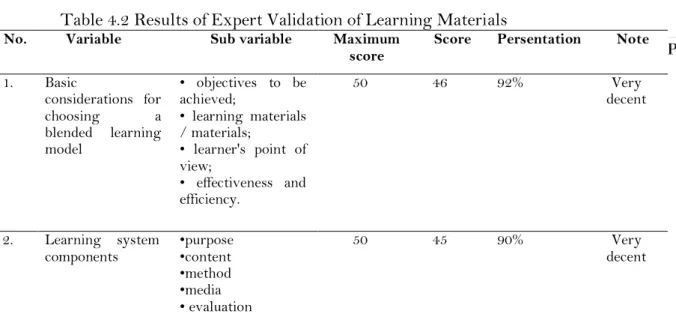
After seeing and considering learning planning with a blended learning model on the basic material of automation and control systems, the following validation results are obtained.
Página | 2106
Table 4.2 Results of Expert Validation of Learning Materials
No. Variable Sub variable Maximum
score Score Persentation Note 1. Basic considerations for choosing a blended learning model • objectives to be achieved; • learning materials / materials; • learner's point of view; • effectiveness and efficiency. 50 46 92% Very decent 2. Learning system
components •purpose •content •method •media
• evaluation method• media• evaluation method• media• evaluation
50 45 90% Very
decent
After seeing and considering learning planning with the blended learning model, the following validation results are obtained.
Table 4.3. Expert Learning Model Validation Results
No. Variable Sub variable Maximum
score
Score Persentation note 1. Components of
learning tools with a blended learning model
subject identity; competency standards; basic competencies; Indicators of Competence Achievement; learning objectives; teaching material; Time Allocation; learning methods; Learning Activities; assessment of learning outcomes; Learning Resources; completeness of learning
devices Indicators
of Competence Achievement;• learning objectives;• teaching material;• Time Allocation;• learning methods;• Learning Activities;• assessment of learning outcomes;• Learning Resources;• completeness of learning devices
60 53 88% Very decent
2. The key to the blended learning model
live events (face to face learning); self-paced learning (independent learning); collaboration (collaboration); assessment (assessment / measurement of learning outcomes); performance support materials (learning material support)
50 42 84% Very decent
Based on observations of the implementation of learning with the blended learning model for 4 meetings, the discussion of each meeting is described as follows:
Página | 2107 IMPLEMENTATION OF BLENDED LEARNING LEARNING MODEL AT
MEETING 3
The results of the implementation of the blended learning model at meeting 3 examined the subject of simple editing to make presentations, especially the subject matter of hyperlinks, insert pictures, and diagrams. The learning implementation is carried out through (1) synchronous learning (face-to-face learning in the form of constructive lectures, practices, and presentations) and synchronous independent / online in the form of chat) and (2) asynchronous learning (asynchronous independent / online in the form of independent learning with e-material and asynchronous collaborative / online discussion forums online) with a constructive approach. Synchronous learning is carried out together in a computer laboratory room and at the same time, while asynchronous learning is carried out independently by tarunakapan anywhere and anywhere (Moestofa, 2013). From the description above, it shows that the implementation of learning with the blended learning model at the 3rd meeting is in accordance with the theory of (Chaeruman, 2011)
In his theory, (Chaeruman, 2011) states that blended learning as learning that combines synchronous and asynchronous learning settings appropriately in order to achieve learning objectives. Based on the implementation of learning at meeting 3 shows the existence of learning that combines synchronous and asynchronous learning with a constructive approach to construct student knowledge(Naidu, 2006). The implementation of learning with the blended learning model is done face-to-face in the computer laboratory room and online with e-learning access. This is in accordance with the theory of Cheung and Hew (Cheung, Fok and Fang, 2014) which states that blended learning is a combination of face to face learning and online learning. In line with the theory of (Cheung and Hew, 2011), the implementation of learning with the blended learning model at the 3rd meeting is in accordance with the theory of Elenana Mosa (2006) in (Riyana, 2009) which means that learning already contains 2 main elements of blended learning, namely classroom learning and online learning.
The activity of constructing new knowledge at the 3rd meeting also spurred cadets to think abstractly, logically, and be able to draw conclusions from available information. This is in accordance with Piaget's theory in (Rifai, 2009) where learning
Página | 2108
activities are emphasized in the internal process of thinking, namely processing information in the form of age-based understanding of tarunet construction. While organizational activities, investigations, presentations, analysis and evaluation show that students are active in exploring information related to hyperlinks, pictures and diagrams through chat, online discussion, and presentations. Tarunaini learning activities are in accordance with Vygotsky's constructivist theory (1978) in (Rifai, 2009) which states that cognitive abilities originate from social and cultural relations, where social interaction with others can spur the construction of new ideas and enhance students' intellectuals. The average implementation of learning activities at the 3rd meeting was 83 with a good category. This shows that learning activities can be implemented well and in accordance with the blended learning model(Pribadi, 2010).
IMPLEMENTATION OF BLENDED LEARNING LEARNING MODEL AT MEETING 3
The results of the implementation of the blended learning model at meeting 3 examined the subject of simple editing to make presentations, especially the subject matter of hyperlinks, insert pictures, and diagrams(Purwanto, 2011). The learning implementation is carried out through (1) synchronous learning (face-to-face learning in the form of constructive lectures, practices, and presentations) and synchronous independent / online in the form of chat) and (2) asynchronous learning (asynchronous independent / online in the form of independent learning with e-material and asynchronous collaborative / online discussion forums online) with a constructive approach. Synchronous learning is carried out together in a computer laboratory room and at the same time, while asynchronous learning is carried out independently by tarunakapan anywhere and anywhere(Sjukur, 2012).
From the description above, it shows that the implementation of learning with the blended learning model at the 3rd meeting is in accordance with the theory of (Chaeruman, 2011) In his theory, (Chaeruman, 2011)states that blended learning as learning that combines synchronous and asynchronous learning settings appropriately in order to achieve learning objectives. Based on the implementation of learning at
Página | 2109
meeting 3 shows the existence of learning that combines synchronous and asynchronous learning with a constructive approach to construct student knowledge. The implementation of learning with the blended learning model is done face-to-face in the computer laboratory room and online with e-learning access. This is in accordance with the theory of (Cheung and Hew, 2011) which states that blended learning is a combination of face to face learning and online learning. In line with the theory of (Cheung and Hew, 2011), the implementation of learning with the blended learning model at the 3rd meeting is in accordance with the theory of Elenana Mosa (2006) in (Riyana, 2009) which means that learning already contains 2 main elements of blended learning, namely classroom learning and online learning.
The orientation activities at the 3rd meeting were carried out with constructive lecture activities that spur cadets to use their knowledge in constructing understanding independently. This is in accordance with the theory of Jean Piaget (1963) in (Huda, 2013) which means that he can construct his own understanding by finding a balance between the structure of knowledge he already has and the new knowledge he has gained through assimilation and accommodation. The activity of constructing new knowledge at the 3rd meeting also spurred cadets to think abstractly, logically, and be able to draw conclusions from the available information (Seels and Richey, 1994).
This is in accordance with Piaget's theory in (Rifai, 2009) where learning activities are emphasized in the internal process of thinking, namely processing information in the form of age-based understanding of tarunet construction. While organizational activities, investigations, presentations, analysis and evaluation show that students are active in exploring information related to hyperlinks, pictures and diagrams through chat, online discussion, and presentations. Tarunaini learning activities are in accordance with Vygotsky's constructivist theory (1978) in (Rifai, 2009) which states that cognitive abilities originate from social and cultural relations, where social interaction with others can spur the construction of new ideas and enhance students' intellectuals. The average implementation of learning activities at the 3rd meeting was 83 with a good category. This shows that learning activities can be implemented well and in accordance with the blended learning model.
Página | 2110
Table 4.4. Comparison of Learning Implementation with Blended Learning Models and Conventional Meeting Models 3.
No. Aspect Blended Learning Model Conventional Model
1 Orientation 90 83 2 Organization 85 80 3 Investigation 72,5 55 4 Presentation 80 80 5 Analysis & evaluation 87 80 Average 83 75
IMPLEMENTATION OF THE BLENDED LEARNING LEARNING MODEL AT THE MEETING 4
The results of the implementation of the blended learning model at meeting 4 examined the subject of simple editing to make presentations, especially the subject matter of sound and film. The implementation of learning with the blended learning model at meeting 4 has been carried out in accordance with the theory of (Chaeruman, 2011) which combines(1) synchronous learning (face-to-face learning in the form of constructive lectures, practices, and presentations) and synchronous independent / online in the form of chat) and (2) asynchronous learning (asynchronous independent / online in the form of independent learning with e-material and collaborative / online asynchronous in the form of online discussion forum) with a constructive approach. The implementation of the learning model with blended learning at meeting 4 was conducted face-to-face in the computer laboratory room and online with e-learning access (Subkhan, 2013).
The implementation of the learning process which includes: preliminary activities, core activities, and closing activities. In the preliminary, core, and closing activities, it is elaborated in depth on the steps of orientation, organization, investigation, presentation, analysis and evaluation in accordance with the theory of (Arend, 2008) that uses a problem based learning approach (problem based learning). Related to the implementation of learning with the blended learning model at meeting 4 that uses a constructive approach, the learning is in accordance with the Dian Wahyuningsih's blended learning model (Wahyuningsih, 2013) in which there is blended learning (mixed learning) and constructive approach (constructive approach).
Página | 2111
The learning activities are in accordance with the theory of Jean Piaget (1963) in (Huda, 2013) which states that the task of constructing its own understanding is by looking for a balance between the structure of the knowledge it already has with the new knowledge it has gained through assimilation and accommodation. In addition, learning activities in orientation are also in accordance with Piaget's theory in (Rifai, 2009) where learning activities are emphasized in the internal process of thinking, namely information processing in the form of constructing taruna based understanding based on age. (Wisnu, 2009)This can be seen from the activities of tarun who are actively involved in constructing understanding independently and thinking abstractly, logically, and being able to draw conclusions from information conveyed by educators. While the activities of the organization's activities, investigations, presentations, analysis and evaluation showed that students learned actively in gathering information related to video and sound material through chatting, online discussions, and presentations (Sudjana, 2009).
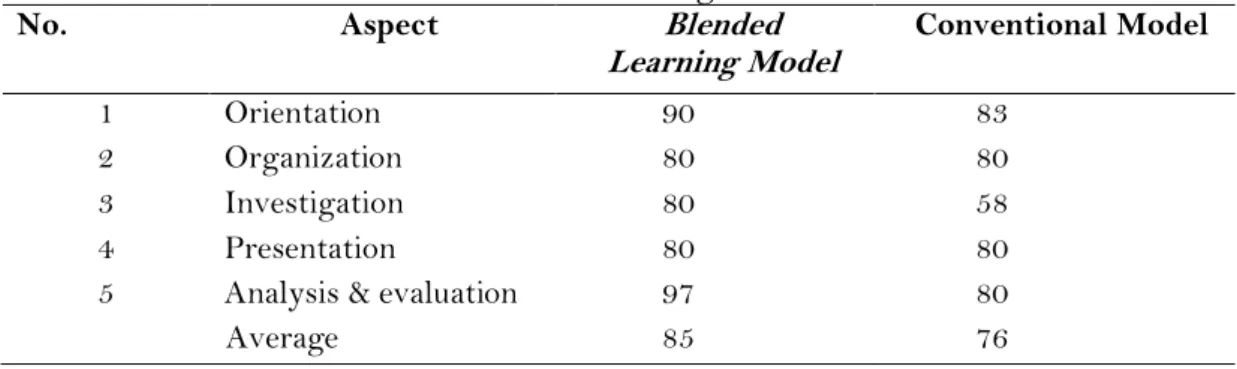
Cadets learning activities show the existence of social interaction with others, so it is in accordance with the theory of constructivism Vygotsky (1978) in (Rifai, 2009) (Achmad Rifai 2009: 34). This can spur the construction of new ideas and enhance students' intellectuals. Based on observations made by researchers, the average implementation of learning activities at meeting 4 is 85 with good category. This shows that the learning activities at the 4th meeting can be implemented well and in accordance with the blended learning model. The fundamental difference from meetings 3 and 4 is that at meeting 3 a pretest is held at the beginning of the meeting, whereas at meeting 4 a posttest is held at the end of the meeting (Sugiyono, 2010).
Table 4.5. Comparison of Learning Implementation with Models Blended Learning and Conventional Model Meetings 4.
No. Aspect Blended
Learning Model Conventional Model
1 Orientation 90 83
2 Organization 80 80
3 Investigation 80 58
4 Presentation 80 80
5 Analysis & evaluation 97 80
Página | 2112
Implementation of the Blended Learning Learning Model at the 5th Meeting Based on the results of the implementation of the learning model blended learning at meeting 5 examines the subject of interesting effects on the presentation file, especially the subject matter of slide lay-out, slide design, and animation text. The implementation of learning with the blended learning model at meeting 5 has referred to the theory of (Chaeruman, 2011) which combines (1) synchronous learning (face-to-face learning in the form of constructive lectures, group discussions, practices, and presentations) and independent / online synchronization in the form of chat) and (2) asynchronous learning (asynchronous independent / online in the form of independent learning with e-material and asynchronous collaborative / online in the form of project work) with a constructive approach. The combination of synchronous and asynchronous learning shows collaboration between the two learning in accordance with the appropriate setting of the blended learning model to achieve learning objectives (Wahyuningsih, 2013).
At this 5th meeting, a pre-test was given to determine the students' initial abilities. Related to the implementation of learning with the problem based learning approach shows learning at meeting 5 is in accordance with (Wahyuningsih, 2013) blended learning model which includes blended learning and constructive approach (constructive approach). The learning activities are in accordance with the theory of Jean Piaget (1963) in (Huda, 2013) which states that the task of constructing its own understanding is by looking for a balance between the structure of the knowledge it already has with the new knowledge it has gained through assimilation and accommodation.
In addition, the existence of tarun activities which are actively involved in constructing understanding by thinking abstractly, logically, and being able to draw conclusions from information conveyed by educators, shows learning activities in orientation in accordance with Piaget's theory in (Rifai, 2009) based on age. While the activities of the organization, investigation, presentation, analysis and evaluation showed that students were active in gathering information about slide lay-out material, slide design, and animation text through group discussions, practices, presentations, and project work. This cadet learning activity shows the existence of social interaction with others, so that it is in accordance with the theory of constructivism Vygotsky (1978) in (Rifai, 2009) which stimulates the construction of new ideas and improves students'
Página | 2113
intellectuals. Based on the observation of researchers, the average implementation of learning activities obtained at meeting 5 is 90 with a very good category. This shows that the learning activities at meeting 5 with the blended learning model can be implemented very well.
Table 4.6. Comparison of Learning Implementation with Blended Learning Models and Conventional Meeting Models 5
IMPLEMENTATION OF THE BLENDED LEARNING LEARNING MODEL AT THE MEETING 6
In the implementation of the blended learning learning model meeting 6 examines the subject of interesting effects on the presentation file, specifically the subject matter of custom animation, and slide transitions(Trianto, 2007). This learning implementation combines (1) synchronous learning (face-to-face learning in the form of constructive lectures, group discussions, practices, and presentations) and synchronous independent / online in the form of chat) and (2) asynchronous learning (asynchronous independent / online in the form of independent learning with e- material and asynchronous collaborative / online project work) with a constructive approach. This shows the implementation of learning meeting 6 has been referring to the theory of(Chaeruman, 2011). Learning settings in the form of a combination of synchronous and asynchronous learning are carried out precisely in order to achieve learning objectives. The basic difference at meetings 5 and 6 is that at meeting 5 a pre-test is given, whereas at meeting 6 a final test (post-test) is given at the end of the meeting to determine the ability of the competition after treatment.The implementation of learning with the blended learning model at meeting 5 is done face-to-face in the computer
No. Aspect Model Blended Learning Model Conventional
1 Orientation 96 84
2 Organization 82 82
3 Investigation 86 63
4 Presentation 88 82
5 Analysis & evaluation 98 81
Página | 2114
laboratory room and online with e-learning access. This shows learning in accordance with the theory of blended learning from (Cheung and Hew, 2011) which combines face to face and online learning.
This is in accordance with the theory of Jean Piaget in(Huda, 2013) (Miftahul Huda, 2013.p. 43). The existence of tarun activities which are actively involved in constructing understanding by thinking abstractly, logically, and able to draw conclusions from the information conveyed by educators, shows learning activities in orientation in accordance with the characteristics of tarunabased on age in Piaget's theory in (Rifai, 2009). While the activities of the organization's activities, investigations, presentations, analysis and evaluation showed that students learned actively in gathering information about custom animation material and slide transitions through group discussions, practices, presentations, and project work. Tarunaini learning activities show the existence of social interaction with others, so that it is in accordance with the theory of constructivism Vygotsky in(Rifai, 2009) which stimulates the construction of new ideas and improves students' intellectuals. Based on the observation of researchers, the average implementation of learning activities obtained at meeting 6 is equal to 90 with a very good category. This shows that the learning activities at meeting 6 with the blended learning model can be implemented very well (Uno, 2011).
Table 4.7 Comparison of Learning Implementation with Models Blended Learning and Conventional Model Meetings 6.
No. Aspect Blended Learning
Model Conventional Model
1 Orientation 98 83 2 Organization 85 80 3 Investigation 88 60 4 Presentation 85 80 5 Analysis & evaluation 97 80 Average 90 77
Página | 2115 CONCLUSION
Based on the results of research and discussion that has been done, the following conclusions can be drawn: Learning courses in fundamental automation and control system technology with the blended model are appropriate to be used as guidelines in the implementation of learning.
Blended learning learning models can be implemented according to learning planning which includes: orientation, organization, investigation, presentation, analysis, and evaluation as well as combining synchronous and asynchronous learning settings. As for the implementation of the blended learning model in accordance with the proportion of content delivered online blended / hybrid class types with a combination of face-to-face and online learning in the range of 30-79%.
REFERENCE
1. Allen, I. E., Seaman, J. and Garrett, R. (2007) ‘Blending in: The extent and promise of blended education in the United States’, The Sloan Consortium. doi: 10.1007/s00170-005-0274-8.
2. Arend, R. I. (2008) Learning to Teach. New York: McGraw Hill Companies. 3. Arends, R. (1997) Classroom instruction and management. McGraw-Hill
Companies.
4. Chaeruman, U. A. (2011) ‘Implementing Blended Learning in Higher Education’, in INTERNATIONAL SEMINAR OF EDCUATIONAL TECHNOLOGY: Learning, Community and Technology. Jakarta.
5. Cheung, L. T. O., Fok, L. and Fang, W. (2014) ‘Understanding geopark visitors’ preferences and willingness to pay for global geopark management and
conservation’, Journal of Ecotourism. Taylor & Francis, 13(1), pp. 35–51. 6. Cheung, W. S. and Hew, K. F. (2011) ‘Design and evaluation of two blended
learning approaches: Lessons learned’, Australasian Journal of Educational Technology. doi: 10.14742/ajet.896.
Página | 2116
transformative potential in higher education’, Internet and Higher Education. doi: 10.1016/j.iheduc.2004.02.001.
8. Huda, M. (2013) Model-model Pengajaran dan Pembelajran. Yogyakarta: Pustaka Pelajar.
9. Miarso, Y. (2007) Menyemai Benih Teknologi Pendidikan, Computer. doi: 10.1038/cddis.2011.1.
10. Moestofa, M. dan M. S. S. (2013) ‘Penerapan Model Pembelajaran Berdasarkan Masalah pada Standar Kompetensi Memperbaiki Radio Penerima di SMK Negeri 3 Surabaya’, Jurnal Pendidikan Teknik Elektro, 2(1).
11. Naidu, S. (2006) Learning A Guidebook of Principles, Procedures and Practices, E-learning.
12. Pribadi, B. A. (2010) Model Desain Sistem Pembelajaran. Jakarta: Dian Rakyat. 13. Purwanto (2011) Evaluasi Hasil Belajar. Yogyakarta: Pustaka Pelajar.
14. Rifai, A. dan C. T. A. (2009) Psikologi Pendidikan. Semarang: Unnes Press. 15. Riyana, C. (2009) Teknologi Informasi dan Komunikasi dalam Pembelajaran
Pedoman Bagi Pendidik, kurtek.upi.edu. Available at:
https://kurtek.upi.edu/tik/content/blended.pdf (Accessed: 27 October 2013). 16. Seels, B. and Richey, R. C. (1994) ‘Instructional technology: The definition and
domains of the field’, Association for Educational Communications and Technology. 17. Sjukur, S. B. (2012) ‘Pengaruh Blended Learning Terhadap Motivasi Belajar Dan
Hasil Belajar Siswa Tingkat Smk the Effects of Blended Learning on the Learning Motivation and Achievement Students Level Smk’, Jurnal Pendidikan Vokasi. doi: 10.21831/JPV.V2I3.1043.
18. Subkhan, E. (2013) Pengantar Teknologi Pendidikan Perspektif Paradigmatik dan Multidimensional. Yogyakarta: DeePublish.
19. Sudjana, N. (2009) Penilaian Hasil Proses Belajar Mengajar, Sinarbaru. 20. Sugiyono, P. D. (2010) Metode penelitian pendidikan, Alfabeta. Bandung.
21. Suharsimi Arikunto (1993) ‘Prosedur Penelitian: Suatu Pendekatan Penelitian’, Rineka Cipta. doi: 10.1021/ol7029646.
22. Trianto (2007) ‘Model Pembelajaran Terpadu dalam Teori dan Praktek’, Jakarta, Prestasi Pustaka.
Página | 2117
Pendidikan. Jakarta: Bumi Aksara.
24. Wahyuningsih, D. (2013) Implementasi Blended Learning By The Constructive Approach (BLCA) untuk Meningkatkan Pemahaman Konsep dan Kemandirian Belajar Mahasiswa dalam Matakuliah Interaksi Manusia dam Komputer Prodi Teknologi Pendidikan FIP UNY. State University Yogyakarta.
25. Wisnu, A. (2009) Pengertian KKPI, blogspot.com. Available at: http://achmad-wisnu.blogspot.com/2009/11/kkpi.html (Accessed: 9 September 2013).
26. Yendri, D. (2011) ‘Blended Learning: Model Pembelajaran Kombinasi E-learning dalam Pendidikan Jarak Jauh.’, Universitas Andalas. Available at:
http://fti.unand.ac.id/images/BlendedLearning.pdf .