Rev. Caatinga
IDENTIFICATION AND QUANTIFICATION OF PHENOLIC COMPOUNDS AND
ANTIOXIDANT ACTIVITY IN COWPEAS OF BRS XIQUEXIQUE CULTIVAR
1REGILDA SARAIVA DOS REIS MOREIRA-ARAÚJO2*, GENI RODRIGUES SAMPAIO3, ROSANA APARECIDA
MANÓLIO SOARES3, CÍNTIA PEREIRA DA SILVA4, MARCOS ANTONIO DA MOTA ARAÚJO5, JOSÉ ALFREDO
GOMES ARÊAS3
ABSTRACT - Cowpea (Vigna unguiculata [L.] Walp.) is one of the most important legumes produced in
tropical and subtropical regions throughout the world, especially in the developing countries in Africa, Latin America, and Asia. It is the main source of protein, calories, dietary fiber, minerals, and vitamins for a large segment of the world population. Cowpea is also a potential functional food with a range of bioactive compounds, including phenolic compounds. This legume is grown mainly in the North and Northeast regions of Brazil, but is also consumed in other regions, and is thus important for the farmers who depend on this crop for income. This study identified and quantified phenolic compounds in the cowpea cultivar BRS Xiquexique. Such quantification reveals the functional characteristics of cowpeas, mainly as a source of antioxidants, which will be essential to add value to this food and to expand its forms of consumption. The extracts were analyzed
using an HPLC model LC-20AT, equipped with a manual injector. For the HPLC analysis, standard solutions
were prepared with pure phenolic acids such as gallic acid, quercetin, caffeic acid, chlorogenic acid, ferulic
acid, p-coumaric acid, catechin, and epicatechin. The major phenolic compounds identified were catechin
(2.07±0.329mg100g-1), epicatechin (0.48±0.130mg100g-1), gallic acid (67.19±6.200mg100g-1), ferulic
acid (32.07±0.753mg100g-1), and chlorogenic acid (3.08 ±0.489mg100g-1). We observed that the BRS
Xiquexique cultivar contains functional phenolic compounds, especially gallic acid and ferulic acid, demonstrating the antioxidant potential of cowpea.
Keywords: Vigna unguiculata. Bioactive. Chemical composition.
IDENTIFICAÇÃO E QUANTIFICAÇÃO DE COMPOSTOS FENÓLICOS E DA ATIVIDADE ANTIOXIDANTE NO FEIJÃO-CAUPI EM GRÃOS DA CULTIVAR BRS XIQUEXIQUE
RESUMO - O feijão-caupi (Vigna unguiculata [L.] Walp.) é uma das mais importantes leguminosas
produzidas em regiões tropicais e subtropicais do mundo, principalmente nos países em desenvolvimento da África, América Latina e Ásia. Para um grande segmento da população mundial é a principal fonte de
proteínas, calorias, fibras alimentares, minerais e vitaminas. Possui ainda compostos bioativos, destacando-se
os compostos fenólicos. É produzido no Norte e Nordeste, consumido também em outras regiões do país e apresenta grande importância para os agricultores que sobrevivem desta cultura. O objetivo do presente estudo
foi identificar e quantificar os compostos fenólicos no feijão-caupi, cultivar BRS Xiquexique. Tal determinação
permitirá conhecer características funcionais do feijão-caupi, como fonte de antioxidantes, o que será de
primordial importância para agregar valor funcional e nutricional a este alimento e ampliar as formas de
consumo. Os extratos foram analisados por CLAE em equipamento modelo LC-20AT, com injetor manual.
Para as análises foram preparadas soluções padrões com os ácidos fenólicos puros, tais como: ácido gálico,
quercetina, ácido cafeico, ácido clorogênico, ácido ferúlico, ácido p-cumárico, catequina e epicatequina. Foram
identificados catequina (2,07 ± 0,329 mg 100 g-1), epicatequina (0,48 ± 0,130 mg 100 g-1), ácido gálico (67,19
± 6,200 mg 100 g-1), ácido ferúlico (32,07 ± 0,753 mg 100 g-1) e ácido clorogênico (3,08 ± 0,489 mg 100 g-1)
em concentrações importantes. Concluiu-se que a cultivar BRS Xiquexique contêm compostos funcionais,
destacando-se o ácido gálico e o ácido ferúlico com maiores teores, comprovando o potencial antioxidante do
feijão-caupi.
Palavras-chave: Vigna unguiculata. Bioativos. Composição química.
____________________ *Corresponding author
1Received for publication in 08/14/2016; accepted in 05/17/2017. Paper approved from IV CONAC 2016.
Paper extracted from the postdoctoral Internship of the first author.
2Department of Nutrition, Universidade Federal do Piauí, Teresina, PI, Brazil; [email protected].
INTRODUCTION
Studies of antioxidants in foods are currently widespread because of their action in delaying or inhibiting oxidative damage to cells. Given the magnitude of antioxidants preventing diseases and promoting health, it is of utmost importance to identify these compounds for use.
The increasing demand for means that favor a healthy life has driven the research of new substances that satisfy these needs. Consumption of vegetables has been associated with a healthy diet. In addition to their nutritional potential, these foods contain different phytochemicals, many of which perform biological functions, especially those capable of antioxidant action (LIMA et al., 2004).
Antioxidants are substances that can delay or inhibit oxidative damage, preventing the initiation or propagation of oxidation chain reactions, thereby preventing diseases caused by free radicals in the
body (SILVA; ROCHA; CANNIATTI-BRAZACA,
2009). These radicals are unstable and highly reactive molecules, produced naturally via metabolic processes or biological dysfunction, which are combated by antioxidants, such as phenolic compounds and flavonoids (BARREIROS; DAVIS, 2006), which are produced in the body or obtained through the diet.
Several sources of natural antioxidants exist, and some are widely found throughout the plant kingdom. Phenolic compounds originate from secondary metabolism of plants, being essential during their growth and reproduction. In addition, they are also formed under stress conditions such as infections, injuries, and UV radiation. (ANGELO; JORGE, 2007).
The cowpea (Vigna unguiculata [L.] Walp.) is an important legume produced in largely in Africa, Latin America, and Asia. It is a rich source of proteins, calories, dietary fiber, minerals, and vitamins for a large number of people globally (PHILLIPS et al., 2003; CARVALHO et al., 2012). Although it is primarily produced in limited regions in Brazil, it is consumed throughout the country, and is therefore important for farmers. Identification of antioxidant compounds in cowpea will reveal its functional characteristics, which will be of paramount importance to add value to this crop for increasing its consumption.
MATERIAL AND METHODS
SamplesThe BRS Xiquexique cowpea cultivar was provided from the Brazilian Agricultural Research
Company (Embrapa Meio Norte), Teresina - PI,
Brazil, which is 72 meters high, 5 ° 5 ' South
Latitude and 42 ° 48' of West Longitude.
Preparation of gallic acid standard curve
For preparation of the stock solution, 0.125 g of gallic acid (vacuum oven dried) was diluted in a volumetric flask with deionized water. One milliliter (50 ppm), 2 mL (100 ppm), 3 mL (150 ppm), 5 mL (250 ppm), 10 mL (500 ppm) and blank (0 ppm) of the mixture were further diluted in with deionized water such that the final volume was 100 mL. Then,
100 μL of each solution was pipetted into a 10 mL
volumetric flask, 0.5 mL of Folin-Ciocalteu reagent
was added, and the solution was stirred. After 5 minutes, 1.5 mL of 20% sodium carbonate solution was added, shaken, and the volume was made up to 10 mL with deionized water. After incubating for 2 hours at 24 °C, protected from light with aluminum foil, absorbance values at 765 nm were measured in a 10 mm cuvette. Data are presented as a plot graph
(mg L-1) of gallic acid versus absorbance.
Extraction of phenolic compounds for analysis
The extracts were obtained according to the methodology of Rufino et al. (2010). To obtain the acetonic extract (A), 0.2 g of the sample was weighed and crushed in a mortar after drying in an oven at 50 °C. Then, 8 mL of 80% acetone was added to the sample, treated with ultrasound for 1 hour, followed by centrifugation of the homogenate at 4,000 rpm for 15 minutes. The supernatant was collected, and the volume was made up to 10 mL with deionized water.
Determination of total phenolics
To determine the total phenolics, 2 mL of deionized water was added to a 10 mL volumetric
flask, followed by addition of 100 μL of the extract
and 0.5 ml of the Folin-Ciocalteu reagent. The
solution was stirred, and incubated for 5 minutes. Then, 1.5 mL of 20% sodium carbonate was added, the mixture was shaken, and was diluted with deionized water to a final volume of 10 mL. After incubating for 2 hours at room temperature and protecting from light with aluminum foil, the absorbance at 765 nm was measured in a 10 mm cuvette according to the methodology of Singleton and Rossi (1965).
Determination of total flavonoids
For the determination of total flavonoids, the method described by Kim, Jeong and Lee (2003) and modified by Blasa et al. (2006) was employed. One milliliter of the extract was mixed with 0.3 mL of
5 % m/v sodium nitrite (NaNO2). After 5 minutes,
0.3 mL of 10% m/v aluminum chloride (AlCl3) was
Rev. Caatinga
1 M sodium hydroxide (NaOH) were added, and
absorbances of the samples were measured at 425 nm in a spectrophotometer (BEL 1102, Monza, Milan, Italy). Different concentrations of quercetin
(0 to 100 mg L-1) were used for obtaining a standard
curve, and the results were expressed in milligrams
equivalent to quercetin (mg EQ 100 g-1 sample).
Determination of antioxidant activity
- ABTS
Firstly, 2,2'-azino-bis-3-ethylbenzothiazoline
-6-sulphonic acid (ABTS) radical was prepared. For
this preparation, 0.0384 g of the ABTS reagent was weighed and dissolved in 10 ml of deionized water. Subsequently, the potassium persulfate solution (2.45 mM) was prepared by dissolving 0.0331 g of potassium persulfate in 25 mL of deionized water. Then, 5 mL of the ABTS solution and 5 mL of the persulfate solution were mixed, homogenized, and transferred to an amber flask, and kept protected from light for 16 hours at room temperature.
After activation of the ABTS+ radical, an
aliquot of 1 mL of the formed radical was diluted in 50 mL of ethanol. Absorbance measurements were performed in 10 mm cuvettes at 734 nm, until the absorbance stabilized at 0.700 (for absorbance value of less than 0.700, more radical was added; for higher values, more ethanol was added). After adjustment, an aliquot of 2.9 mL of the solution was
transferred to a cuvette. Immediately, 60 μL of the
sample extract were added, and absorbance was again measured after 7 minutes. The results were
expressed in μM TEAC (Trolox equivalent
antioxidant capacity) per 100g of sample. For this, a
standard Trolox curve (standard antioxidant) was prepared, and the absorbance values of the extracts were plotted against this curve to obtain the results in
μM TEAC/100g, according to the method of Re et
al. (1999).
- DPPH
DPPH (0.0394 g) was dissolved in 10 mL of methanol. Then, the solution was diluted to 1:100 using 80% v/v methanol solution to adjust the initial absorption to 0.800. An aliquot of 2.9 mL of this adjusted solution was pipetted into a 10 mm cuvette.
The initial absorbance was measured, 100 μL of the
extract was added, and the cuvette was incubated for 30 minutes in the dark. The results were compared to the standard antioxidant, Trolox, and were expressed
in μM TEAC/100 g of sample, according to method
given by Kim et al. (2006).
Determination of anthocyanins
The total anthocyanin content was determined using the pH difference method (GIUSTI;
WROLSTAD, 2001). To a 0.2 mL aliquot of diluted sample, 1.8 mL of potassium chloride solution (pH 1.0) was added, homogenized, and stored for 10 minutes in the absence of light, and an equivalent procedure was performed in a solution of sodium acetate (pH 4.5). The absorbance was measured using a spectrophotometer (BEL 1102, Monza, Milan, Italy) at the maximum wavelength of each sample and at 700 nm in buffer solutions of pH 1.0 and pH 4.5. The blank used was distilled water. The absorbance was measured at the maximum absorption wavelength (420 nm) and at 700 nm.
Absorbance was calculated as follows: A= (Amáx.vis – A700nm) pH 1.0 – (Amáx.vis – A700nm) pH 4.5
The concentration of monomeric pigments can be calculated from this absorbance and
expressed as cyanidin-3-glycoside (MW = 449.2, and
ε = 26,900).
Monomeric anthocyanins (mg/100g) = (A ×
MW × DF × 100)/(ε × 1).
A = Absorbance; MW = molecular weight;
DF = dilution factor; ε = molar absorptivity.
Identification and quantification of phenolics compounds using HPLC
The extracts were analyzed using high performance liquid chromatography (HPLC), according to Pereira et al. (2004) and Tiberti et al. (2007). Analyses of the phenolic compounds were carried out using a Shimadzu chromatograph, model
LC-20AT, equipped with manual injector SIL-20AC,
CBM-20ª controller and SPD-M20A diode array
detector. The column used was a C18 stationary
phase, Shim-Pack VP-ODS-2 (25 cm x 0.5 cm, with
a 5 μm particle, Shimadzu).
Trifluoroacetic acid (0.1% v/v) was used as the mobile phase in deionized water as eluent A, and acetonitrile was used as eluent B. Prior to the analysis, the system was equilibrated with a mixture of 9.5:0.5 eluents A and B, respectively. The gradient
was as follows: 5% B (10 minutes), 5-100% B
(40 minutes), 100% B (5 minutes), and 5% B (5 minutes). The temperature was maintained at
35 °C, and the eluent flow was maintained at
1 mL.min-1 during the analysis. Detection was
performed from 190 nm to 400 nm.
For the analyses, standard solutions were prepared using pure phenolic acids, such as gallic acid, quercetin, caffeic acid, chlorogenic acid, ferulic
acid, p-coumaric acid, catechin, and epicatechin. One
milligram of each standard acid was diluted in
mobile phase (0.1% Milli-Q water of ATF) to make
up to 10 mL volume, then the samples were filtered and injected into the chromatograph. Two milliliters of sample were collected and placed in glass tubes, where they were evaporated in Centrivap for 3 hours at 40 °C. After evaporation, the compounds were resuspended in the mobile phase (1 mL), the material was filtered, and then injected into the chromatograph. The analyses were done in quadruplicate, 60 minutes for each sample. The results were expressed in mg per 100 g of dry matter.
Data analyses
A database was developed. The
determinations were performed in triplicate or quadruplicate (determinations by HPLC), and the
data obtained were presented as means and standard deviation.
RESULTS AND DISCUSSION
Total phenolic, flavonoid, and total anthocyanin concentrations
Table 1 shows the content of total phenolic compounds, flavonoids, and anthocyanins obtained from the cowpea cultivar. Data are means of three replicates in acetone extracts, expressed in dry basis.
The cultivar BRS Xiquexique presented
199.05 ± 1.98 mg equivalent of gallic acid-GAE
100 g-1. Based on a study by Marathe et al. (2011),
which classified legumes such as common bean, cowpea, chickpeas, soybeans, and peas into three different groups according to their phenolic compound content, the raw cowpea cultivar analyzed in the present work can be classified under moderate
phenolic content (> 100 and <200 mg GAE 100g-1).
Table 1. Total phenolics, flavonoids, and total anthocyanins from cowpea cv BRS Xiquexique.
Bioactive Compound (GAE 100 g-1)*
Total phenolics 199.05 1.98
Flavonoids 67.96 0.54
Anthocyanins Nd**
*Gallic acid (GAE) equivalents. **Nd – not detected. Means of three repetitions + SD.
Giami (2005) analyzed four strains of cowpea, and obtained levels ranging from 99 to
196 mg 100 g-1, which are in agreement with
those obtained in the present study. In a study by
Zia-Ul-Haq et al. (2013), higher levels of phenolic
compounds (1,190 - 1,620 mg GAE 100 g-1) were
observed in the flours of four cultivars of raw cowpea consumed in Pakistan.
Several factors may interfere with the content of phenolic compounds in legumes, such as genetic and environmental factors, as well as factors inherent in the extraction conditions of these compounds, such as the type of solvent used. Thus, this may justify the differences observed in the content of these compounds, as compared to those observed in other studies.
The cultivar BRS Xiquexique presented high
flavonoid content (67.96 mg 100 g-1). Behling et al.
(2004) reported that flavonoid content in foods consumed daily as 44 mg in cereals, 79 mg in potatoes, 45 mg in grains and nuts and 162 mg in vegetables and herbs. The cultivars of cowpea presented high levels of these compounds. Compared with Brazilian fruits, the cowpea cultivars evaluated
were higher than the levels observed by Barreto, Benassib and Mercadante (2009) for
jackfruit (22.3 ± 0.2 mg EQ 100 g-1), for nectarine
(23.7 ± 1.2 mg EQ 100 g-1) and for star fruit
(42.6 ± 2.3 mg EQ 100 g-1).
Wang et al. (2008) analyzed 40 selected legumes, including cowpea, and verified high levels
of total flavonoids for cowpea (44.19 mg 100 g-1)
and (25.29 mg 100 g-1). Cowpea contains high levels
of flavonoids, myricetin, and quercetin, and low levels of genistein, kaempferol, and daidzein.
Anthocyanins were not detected in the cowpea cultivar BRS Xiquexique. Previous reports in literature that aimed at identifying and quantifying anthocyanins, flavonoids, and condensed tannins in cowpea samples were performed in cultivars with dark seed coat, as these bioactive compounds are concentrated in this grain region (HA et al., 2010; OJWANG; DYKES; AWIKA, 2012; OJWANG et al., 2013). Our study confirms the statements of Akond et al. (2011) on the direct relationship between the bean tegument color and the anthocyanin levels, as the cultivar BRS Xiquexique
presents a light-colored tegument and no detectable
anthocyanin.
Similar results were reported by Huber (2012) on evaluation of common beans of the cultivars
BRS9435-comet (brown), Xamego (black), and the
G-2358 (white) lineage. Highest tannin content was
observed in the Xamego crude cultivar (11.21 mg g-1
catechin), but the presence of such compounds in the
Rev. Caatinga
tannins were detected in cooked black and brown beans in a study by Ranilla, Genovese and Lajolo (2009), suggesting that formation of insoluble complexes between proteins and tannins and between carbohydrates and tannins in whole grains inhibited extraction of the compounds by the solvent,
and therefore, the non-detection thereof in the
method using the vanillin reagent. Analyzing six distinct genotypes of cowpea, Ojwang et al. (2013)
did not identify these compounds using the
HCl-vanillin test in white or green tegument grains.
They suggested genetic control over the accumulation of tannins or proanthocyanidins.
Antioxidant activity
The antioxidant activity in the cowpea
cultivar analyzed using the DPPH and ABTS free radical capture method is shown in Table 2.
Xu and Chang (2012) analyzed the health promotion effects related to the antioxidant activity of 13 legumes consumed in the United States, including peas, lentils, soybeans, chickpeas, cowpea beans, and common beans, showed using the DPPH method that the antioxidant activities of yellow
soybean and black beans were 107 μmol TEAC
100 g-1 and 1940 μmol TEAC 100 g-1, respectively.
The values obtained in the present research using the DPPH method were higher than those
reported for yellow peas (358 μmol TEAC 100 g-1),
chickpeas (294 μmol TEAC 100 g-1), green peas
(277 μmol TEAC 100 g-1), and yellow soybean
(107 μmol TEAC 100 g-1), and lower than those for
cowpeas (707 μmol TEAC 100 g-1).
Table 2. Antioxidant activities of the cowpea cultivar BRS Xiquexique determined using DPPH and ABTS methods.
Method (μmol TEAC* g-1)
DPPH 575.4 2.98
ABTS 608.5 2.09
*Trolox equivalent antioxidant capacity (TEAC). Means of three tests + standard deviation (SD).
Results for antioxidant capacity and phenolic contents higher than those obtained in the present study were verified by Deng et al. (2013), who analyzed cowpea marketed in China. They observed antioxidant activity between 1727 and
2312 μmol TEAC 100 g-1 using the ABTS method
between 1357–1924 μmol Fe (II) 100 g-1 using the
ferric reducing antioxidant power (FRAP) method, and total phenolic content of
717–939 mg GAE 100 g-1. Marathe et al. (2011) also
found different results than those observed in the present study for cowpeas with brown and red teguments. They reported antioxidant activities
higher than 12.0 μmol TEAC g-1 using the ABTS
method and higher than 400 μmol TEAC g-1 using
the DPPH method. These high contents of phenolic compounds reported in this work can be explained by color of the tegument, which influences the antioxidant capacity. Therefore, the observed antioxidant values were lower in the present research because the beans showed lighter tegument colors (white and green).
However, antioxidant activities observed in the present study were higher than those reported by Oboh (2006), who evaluated the ability of raw cowpea samples (two of white and three of brown tegument) to sequester the DPPH free radical, obtaining percentages of free radical inhibition in the range of 5.5–29.9%. In the present study, higher percentages of DPPH radical inhibition were observed, ranging from 40–50% for the cultivars.
It is worth noting that the in vitro antioxidant activity measured in the present study suggests
bioactivity, but does not determine it. Moreover, antioxidant activity is related to the phenolic content, to the configuration of hydroxyl groups, and to the conjugated double bounds.
Identification and quantification of phenolic compounds
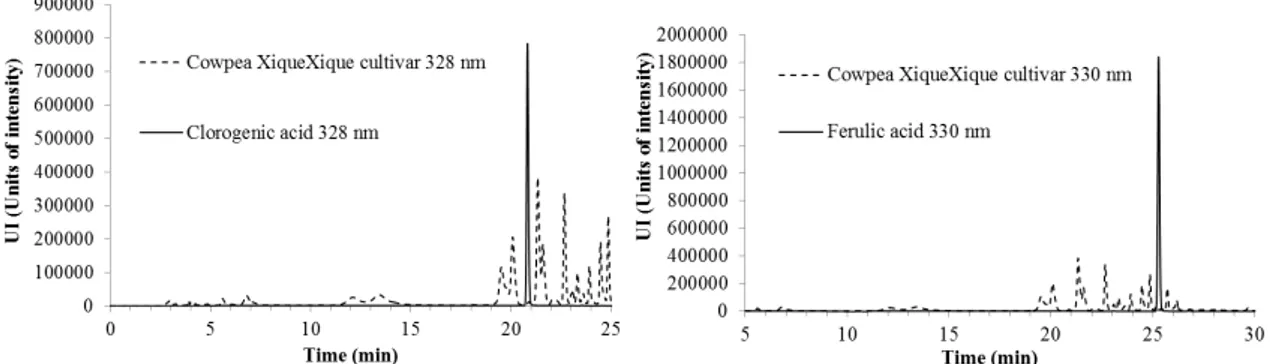
The HPLC chromatograms of phenolic compounds identified in the BRS Xiquexique cultivar and the standards of epicatechin, gallic acid, chlorogenic acid, and ferulic acid are presented in Figures 1 and 2.
As shown in Table 3, gallic acid showed the highest phenolic compound, followed by ferulic acid. Epicatechin and chlorogenic acid were identified at lower concentrations. In a study by Nderitu et al. (2013), ferulic acid was identified in cowpea, a result consistent with that observed in this research. It can be inferred that the high content of ferulic acid in higher content can be expected in a legume.
According to Yao et al. (2013) and Zhang et
al. (2013), cowpea has an anti-glycemic and
anti-inflammatory effect, potentially useful in
reducing the complications in diabetic people. Its antioxidant action due to its bioactive compounds is also an important feature of its functionality.
The present study showed that because of the presence of bioactive compounds in BR Xiquexique of cowpea, this cultivar can be used as a source of compounds like gallic acid and ferulic acid for the
control of chronic non-communicable diseases, such
Figure 1. HPLC chromatograms of cowpea BRS cultivar Xiquexique extracts and the standards, epicatechin (measured at 279 nm) and gallic acid (measured at 270 nm).
Figure 2. HPLC chromatograms of cowpea BRS cultivar Xiquexique extracts and the standards, chlorogenic acid (measured at 328 nm) and ferulic acid (measured at 330 nm).
Table 3. Identification and quantification of the phenolics compounds detected in the extracts of cowpea cultivar BRS Xiquexique.
Phenolic compound (mg 100 g-1)
epicatechin 0.48±0.130
gallic acid 67.19±6.200
ferulic acid 32.07±0.753
chlorogenic acid 3.08±0.489
Means of four tests + standard deviation (SD).
CONCLUSION
It was concluded from the results that the cultivar BRS Xiquexique contains bioactive compounds, containing gallic acid and ferulic acid at high levels, proving the antioxidant and functional potential of cowpea.
ACKNOWLEDGEMENTS
The authors are grateful for the grants from the National Council of Scientific and Technological Development (CNPq) and to the Coordination for the Improvement of Higher Education Personnel
(CAPES) PROCAD/CASADINHO – CNPq-CAPES,
Process nº 552239/2011-9, of the Brazilian
Agricultural Research Corporation (Embrapa)
Process PQ 10/2012 nº 301939/2012-8 and Process
165188/2014-6, and of the São Paulo Research
Foundation (FAPESP) Process 2016/08758-8.
REFERENCES
AKOND, G. M. et al. Minerals (Zn, Fe, Ca and Mg) and antinutrient (phytic acid) constituents in
common bean. American Journal of Food
Technology, New York, v. 6, n. 3, p. 235-243, 2011.
ANGELO, P. M.; JORGE, N. Compostos fenólicos
em alimentos – Uma breve revisão. Revista do
Instituto Adolfo Lutz, São Paulo, v. 66, n. 1, p. 1-9, 2007.
ASSOCIATION OF OFFICIAL ANALYTICAL
CHEMISTS - AOAC. Official Methods of Analysis
of AOAC International. 18. ed. Gaithersburg: AOAC International, 2005.
Rev. Caatinga
oxidativo: relação entre geração de espécies reativas
e defesa do organismo. Química Nova, São Paulo, v.
29, n. 1, p. 113-123, 2006.
BARRETO, G. P. M.; BENASSIB, M. T.; MERCADANTE, A. Z. Bioactive compounds from several tropical fruits and correlation by multivariate
analysis to free radical scavenger activity. Journal
of the Brazilian Chemical Society, São Paulo, v.
20, n. 10, p. 1856-1861, 2009.
BEHLING, E. B. et al. Flavonóide quercetina:
aspectos gerais e ações biológicas. Alimentos e
Nutrição, Araraquara, v. 15, n. 3, p. 285-292, 2004.
BLASA, M. et al. Raw Millefiori honey is packed
full of antioxidants. Food Chemistry, Barking, v.
97, n. 2, p. 217-222, 2006.
CARVALHO, A. F. U. et al. Nutritional ranking of 30 Brazilian genotypes of cowpeas including determination of antioxidant capacity and vitamins.
Journal of Food Composition and Analysis, San
Diego, v. 26, n. 1-2, p. 81-88,2012.
DENG, G. et al. Antioxidant capacities and total
phenolic contents of 56 vegetables. Journal of
Functional Foods, London, v. 5, n. 1, p. 260-266,
2013.
GIAMI, S. Y. Compositional and nutritional properties of selected newly developed lines of
Cowpea (Vigna unguiculata L. Walp). Journal of
Food Composition and Analysis, San Diego, v. 18,
n. 7, p. 665-673, 2005.
GIUSTI, M. M.; WROLSTAD, R. E. Anthocyanins.
characterization and measurement with UV-Visible
Spectroscopy. In: WROLSTAD, R. E. (Ed.).
Current Protocols in Food Analytical Chemistry. New York: John Wiley & Sons, 2001. v. 1, cap. 2, p. 1-13.
HA, T. J. et al. Identification and characterization of
anthocyanins in yard-long beans (Vigna unguiculata
ssp. sesquipedalis L.) by high-perfomance liquid
chromatography with diode array detection and electrospray ionization/mass spectrometry (HPLC –
DAD – ESI/MS) analysis. Journal of Agricultural
and Food Chemistry, Washington, v. 58, n. 4, p.
2571- 2576, 2010.
HUBER, K. Evidências da interação entre
proteínas e taninos de feijão comum e seus efeitos na digestibilidade proteica. 2012. 109 f.
Dissertação (Mestrado em Ciências) - Escola
Superior de Agricultura Luiz de Queiroz
-Universidade de São Paulo, Piracicaba, 2012.
KIM, D.; JEONG, S. W.; LEE, C. Y. Antioxidant capacity of phenolic phytochemicals from various
cultivars of plums. Food Chemistry, Barking, v. 81,
n. 3, p. 321-326, 2003.
KIM, Y. N. et al. Nonsupplemented children of Latino immigrants have low vitamin E intakes and plasma concentrations and normal vitamin C, selenium, and carotenoid intakes and plasma
concentrations. Journal of the American Dietetic
Association, Chicago, v. 106, n. 3, p. 385-91, 2006.
LIMA, V. L. A. G. et al. Fenólicos totais e atividade
antioxidante do extrato aquoso de feijão-mungo
(Vigna radiata). Revista de Nutrição, Campinas, v. 17, n. 1, p. 53-57, 2004.
MARATHE, S. A. et al. Comparative study on antioxidant activity of different varieties of
commonly consumed legumes in India. Food and
Chemical Toxicology, Oxford, v. 49, n. 9, p. 2005
-2011, 2011.
NDERITU, A. M. et al. Phenolic composition and inhibitory effect against oxidative DNA damage of cooked cowpeas as affected by simulated in vitro
gastrointestinal digestion. Food Chemistry,
Barking, v. 141, n. 3, p. 1763–1771, 2013.
OBOH, G. Antioxidant properties of some commonly consumed and underutilized tropical
legumes. European Food Research Technology,
London, v. 224, n. 1, p. 61-65, 2006.
OJWANG, L. O.; DYKES, L.; AWIKA, J. M. Ultra perfomance liquid chromatography – tandem quadrupole mass spectrometry profiling of
anthocyanins and flavonols in cowpea (Vigna
unguiculata) of varying genotypes. Journal of
Agricultural and Food Chemistry, Washington, v.
60, n. 4, p. 3735-3744, 2012.
OJWANG, L. O. et al. Proanthocyanidin profile of
cowpea (Vigna unguiculata) reveals catechin-O
-glucoside as the dominant compound. Food
Chemistry, Barking, v. 139, n. 1-4, p. 35-43, 2013.
PEREIRA, C. A. et al. HPTLC densitometric
determination of flavonoids from Passiflora alata, P.
edulis, P. incarnata and P. caerulea and comparison
with HPLC method. Phytochemical Analysis,
Chichester, v. 15, n. 4, p. 241-8, 2004.
PHILLIPS, R. D. et al. Utilization of cowpeas for
human food. Field Crops Research, Amsterdam, v.
82, n. 2-3, p. 193–213, 2003.
some selected Brazilian bean (Phaseolus vulgaris L.)
cultivars. Journal of Agricultural and Food
Chemistry, Washington, v. 57, n. 13, p. 5734–5742, 2009.
RE, R. et al. Antioxidant activity applying an improved ABTS radical cation decolorization assay.
Free Radical Biology & Medicine, New York, v.
26, n. 9-10, p. 1231-1237, 1999.
RUFINO, M. S. M. et al. Bioactive compounds and
antioxidant capacities of 18 non-traditional tropical
fruits from Brazil. Food Chemistry, Barking, v. 121,
n. 4, p. 996–1002, 2010.
SILVA, A. G.; ROCHA, L. C.; CANNIATTI
-BRAZACA, S. G. Caracterização físico-química,
digestibilidade protéica e atividade antioxidante de
feijão comum (Phaseolus vulgaris L.). Alimentos e
Nutrição, Araraquara, v. 20, n. 4, p. 591-598, 2009.
SINGLETON, V. L.; ROSSI, J. A. Jr. Colorimetry of
total phenolics with phosphomolybdic
-phosphotungstic acid reagents. American Journal
of Enology and Viticulture, Davis, v. 16, n. 3, p.
144-158, 1965.
TIBERTI, L. A. et al. Identification of flavonols in
leaves of Maytenus ilicifolia and M. aquifolium
(Celastraceae) by LC/UV/MS analysis. Journal of
Chromatography B, Amsterdam, v. 846, n. 1, p.
378-384, 2007.
WANG, M. L. et al. Flavonoid content in different
legume germplasm seeds quantified by HPLC. Plant
Genetic Resources: Characterization and Utilization, Wallingford, v. 6, n. 1, p. 62-69, 2008.
XU, B.; CHANG, S. K. C. Comparative study on antiproliferation properties and cellular antioxidant activities of commonly consumed food legumes
against nine human cancer cell lines. Food
Chemistry, Barking, v. 134, n. 3, p. 1287-1296,
2012.
YAO, Y. et al. Antioxidant and Antidiabetic
Activities of Black Mung Bean (Vigna radiata L.).
Journal of Agricultural and Food Chemistry, Washington, v. 61, n. 34, p. 8104−8109, 2013.
ZHANG, X. et al. Chemical composition and
antioxidative and anti-inflammatory properties of ten
commercial mung bean samples. LWT - Food
Science and Technology, London, v. 54, n. 1, p.
171-178, 2013.
ZIA-UL-HAQ, M. et al. Antioxidant activity of the
extracts of some cowpea (Vigna unguiculata (L)
Walp) cultivars commonly consumed in Pakistan.