www.ccarevista.ufc.br ISSN 1806-6690
Phytoremediation of lowland soil contaminated with a formulated
mixture of Imazethapyr and Imazapic
1Fitorremediação de solo de terras baixas contaminado com mistura formulada de
imazetapir + imazapique
Kelen Müller Souto2*, Luis Antonio de Avila3, Guilherme Vestena Cassol4, Sérgio Luiz de Oliveira Machado4 e
Enio Marchesan4
ABSTRACT -The use of plants to decontaminate water and soil contaminated with both organic and inorganic pollutants is a promising technology for sustainable agriculture. The aim of this work was to evaluate the efficiency of plant species in the remediation of formulated mixtures of imazethapyr and imazapic, using the irrigated rice cultivar IRGA 417 as bioindicator. The treatments consisted of the combination of 13 plant species with seven rates of a formulated mixture of imazethapyr and Imazapic (75+25 g e.a. L-1 respectively): 0, 200, 300, 400, 500, 1000 and 4000 mL ha-1. To evaluate the potential for
phytoremediation in these species, symptoms of injury and plant height were measured in rice plants at 7, 14, 21 and 28 days after emergence and shoot dry weight at 28 days after emergence.Glycine max,Lolium multiflorumand Lotus corniculatus
are potentially promising species in the phytoremediation of soils contaminated with the herbicide imazethapyr and imazapic (up to 4000 mL ha-1), due to being more adapted to hydromorphic environments, which is a feature found in soils cultivated
with irrigated rice. Crotalaria juncea, Canavalia ensiformis, Stizolobium aterrimum, Vicia sativa, Raphanus sativus and Triticum aestivum are species capable of the phytoremediation of soils contaminated with imazethapyr + imazapic, however
the occurrence of anoxia in hydromorphic soils reduce the establishment and development of these plants.
Key words: Rice. Phytoremediation. Soil decontamination.
RESUMO - O uso de plantas para descontaminar água e solo contaminados com poluentes orgânicos e inorgânicos é uma tecnologia promissora para a agricultura sustentável. Este trabalho teve como objetivo avaliar a eficiência de espécies vegetais na remediação da mistura formulada de imazetapir + imazapique, utilizando a cultivar de arroz irrigado IRGA 417 como planta bioindicadora. Os tratamentos foram compostos pela combinação entre 13 espécies vegetais e sete doses da mistura formulada de imazetapir + imazapique (75 + 25 g e.a. L-1, respectivamente): zero, 200; 300; 400; 500; 1.000 e 4.000 mL ha-1. Para a avaliação do pontecial fitorremediador
dessas espécies foram avaliadas a altura e sintomas de fitointoxicação nas plantas de arroz irrigado, aos 7; 14; 21 e 28 dias após a emergência, e massa seca da parte aérea aos 28 dias após a emergência.Glycine max,Lolium multiflorume Lotus corniculatuspor serem mais adaptadas a ambientes hidromórficos, característica essa encontrada em solos cultivados com arroz irrigado, são espécies potencialmente promissoras em fitorremediar solos contaminados com o herbicida imazetapir + imazapique (até 4.000 mL ha-1). Crotalaria juncea, Canavalia ensiformis,Stizolobium aterrimum, Vicia sativa, Raphanus
sativuse Triticum aestivum são espécies capazes de fitorremediar solos contaminados com imazetapir + imazapique, porém a ocorrência de anoxia em solos hidromórficos dificultam o estabelecimento e desenvolvimento das plantas.
Palavras-chave:Arroz. Fitorremediação. Descontaminação de solo.
*Autor para correspondência
1Recebido em 07/11/2012; aprovado em 09/11/2014
Trabalho realizado como parte da Dissertação de Mestrado da primeira autora, apresentado ao programa de Pós-graduação em Agronomia da Universidade Federal de Santa Maria, Santa Maria- RS, Brasil
2Departamento de Defesa Fitossanitária, Universidade Federal de Santa Maria, Santa Maria-RS, Brasil, [email protected] 3Departamento de Fitossanidade, Universidade Federal de Pelotas, Pelotas-RS, Brasil, [email protected]
4Departamento de Fitotecnia, Universidade Federal de Santa Maria, Santa Maria-RS, Brasil, [email protected]; [email protected];
INTRODUCTION
Long-term persistence of herbicides in the soil can limit the rotation of crops and potentiate environmental contamination (DANet al., 2011). Among these compounds
are the herbicides imazethapyr and imazapic, which belong to the imidazolinone group of chemicals, widely used in irrigated rice fields as the main alternative in controlling red rice. The herbicide imazethapyr has a pKa of 2.1 and 3.9 and imazapic of 2.0, 3.9 and 11.1, which characterises them as weak acids (SENSEMAN, 2007), having a half-life (t1/2) of from 60 to 90 days, and 120 days respectively (SENSEMAN, 2007). They also have high solubility in water, 1400 mg L-1 for imazethapyr
and 2200 mg L-1 for imazapic. These characteristics among
others, cause the compounds to be highly influenced by the surrounding environment.
One of the characteristics most looked for in a herbicide is that it remain active in the environment long enough for effective weed control; however, the presence of the herbicide in the soil can become undesirable, and may result in problems with non-tolerant crops that may
be grown later (PROCÓPIOet al., 2008). For herbicides
of the imidazolinone group of chemicals, research shows that their continuing presence in the soil causes a smaller stand of plants in non-tolerant rice due to the residual effect of the association of imazethapyr with imazapic, but without any effect on productivity
(VILLAet al., 2006). Marchesan et al. (2011) found
however that the residual effect of these herbicides caused losses in production of 19% for imazethapyr and 30% for imazapic in genotypes of sensitive rice.
Studies show that cultivation of certain plant species can decontaminate areas where xenobiotics are present, such as herbicides with a long residual effect
on the soil (D’ANTONINO et al., 2009). This process
is known as phytoremediation (SULMON et al., 2007)
and can shorten the time needed to free the area for the cultivation of plant species which are non-tolerant to the more persistent herbicides.
Compared with the selection of plants in the decontamination of trace elements, the limitations encountered in selecting plant species for the remediation of herbicides are complex, as these display great molecular diversity in the face of the constant
changes they are subject to (PIRES et al., 2003).
Furthermore, there is the drawback of the contaminant (herbicide) having been developed to control the contanimator, in this case, the weeds. Given that not all plant species are able to develop in contaminated environments, the first step is the identification of those species which are not only suitable for the local conditions, but are also tolerant of the contaminant
(MARQUESet al., 2011).
The next step is to evaluate the capacity of the tolerant plant to promote decontamination of the soil. Efficiency of the phytoremediation process is generally measured by the reduction of the contaminant in the soil to concentrations below the required reference values
and time (MARQUES et al., 2011). When a plant is
used which is capable of reducing the concentration of herbicides in the soil, what is achieved is to bring forward the production of crops of economic interest which were previously not able to be grown in certain
areas (DAN et al., 2011). In view of the above, the
aim of this work was to evaluate the efficiency of plant species in the remediation of lowland soil contaminated with a formulated mixture of imazethapyr and imazapic (75+25 g a.e. L-1).
MATERIAL AND METHODS
The experiments were carried out in a plastic greenhouse with no air conditioning, at two times, according to the growing season (autumn-winter and spring-summer), in the crop years of 2009/2010. The A-horizon of the soil was used as substrate, classified as a hydromorphic eutrophic arenic Planosol (EMPRESA BRASILEIRA DE PESQUISA AGROPECUÁRIA, 2006), from the experimental area of the Palma Agricultural Centre, at the Federal University of Pelotas (UFPel), Capão-do-Leão Campus, in the state of Rio Grande do Sul, Brazil (RS). The soil is of a silty-loam texture with the following characteristics: pH water (1:1) = 6.2, clay content = 200 g kg-1, organic matter
content = 32 g kg-1, P = 16.2 mg dm-3, K = 180 mg dm-3, Ca
= 5.5 cmolc dm-3, Mg cmol
c = 3.2 dm-3, Al = 0.0 cmolc dm-3
and SMP index = 6.6.
The autumn-winter experiment was carried out from April to July of 2009 in a randomised block design with an 8 x 7 factorial scheme and four replications. The treatments consisted of a combination of
cool-season plant species: Avena strigosa (oat), Lolium
multiflorum (ryegrass), Lotus corniculatus (birdsfoot
trefoil),Raphanus sativus (wild radish),Secale cereale
(rye), Triticum aestivum (wheat) and Vicia sativa
(common vetch), and a control treatment with no prior cultivation; seven doses of herbicide, made up from the formulated mixture of imazethapyr and imazapic (75+25 g a.e. L-1) at rates of 0, 200, 300, 400, 500, 1000
and 4000 mL ha-1 in polyethylene pots, 13 cm in diameter
and 9.5 cm in height, at the density recommended for each crop for a soil volume of 1.0 dm3. Choice of the species
Application was performed 48 hours before seeding, using a precision pipette to add the solutions with the herbicide to the soil surface. After application, the soil was turned, and then received a sufficient volume of water to reach field capacity, thereby allowing homogeneous distribution of the herbicide throughout the experimental unit. The pots were maintained under daily irrigation, in order to keep the soil moisture at around 80% of field capacity.
At 60 days after emergence, the plants were removed from the pots by cutting the stems at surface height, without removing the roots. The genotype IRGA 417, not resistant to the herbicide, was sown in each pot and used as a test with the intention of evaluating the potential for phytoremediation of each species previously grown in the soil contaminated by the herbicide.
After emergence of the rice, the plants were thinned, leaving four plants per pot. To determine the potential for phytoremediation of each species, injury (PT) was evaluated and the plant height (ALT) and dry weight (DM) of the shoots were determined. Symptoms of injury were evaluated by comparison with the control treatment, assigning scores from 0 to 100, corresponding respectively to the absence of symptoms to death of
the plant (FRANS et al., 1986). The plant height was
evaluated by measuring the plants from the surface of the soil to the insertion point of the highest leaf. Both assessments were carried out at 7, 14, 21 and 28 days after emergence (DAE), when the rice plants were cut close to the ground to determine the dry weight , obtained by weighing the harvested material after drying in a forced circulation oven (70 ± 2 °C) for 72 hours.
The spring-summer experiment was carried out from October of 2009 to January of 2010 in an experimental design of randomised blocks in a 5 x 7 factorial scheme with four replications. The treatments consisted of a
combination of warm-season plant species: Canavalia
ensiformis (jack bean), Crotalaria juncea (sunn hemp), Glycine max (soybean) andStizolobium aterrimum (velvet
bean), plus a control treatment with no prior cultivation; seven doses of herbicide, made up from the formulated mixture of imazethapyr and imazapic (75+25 g a.e. L-1)
at dosages of 0, 200, 300, 400, 500, 1000 and 4000 mL ha-1, following the same methodology used in the
autumn-winter experiment.
The data were tested for assumptions for the mathematical model and subjected to procedures of variance analysis and polynomial regression, using the SAS software for statistical analysis and SigmaPlot® for elaboration of the dose-response curves, determined by the three-parameter log-logistic model (SEEFELDT; JENSEN; FUERST, 1995), as below (Equation 1):
(1)
where: y = percentage of control; x = herbicide dosage; and a, x0 and b = parameters of the equation, with a being the difference between the maximum and minimum points of the curve, x0 being the dosage giving a 50% response for the variable, and b the slope of the curve.
The logistic model has advantages, since one of the terms of the equation is an estimate of the value of
GR50 (growth reduction by 50%), which is the dosage
of herbicide which gives a biological effect of 50% (CHRISTOFFOLETI; LOPEZ-OVEJERO, 2004).
From the values for GR50, the remediation factor
(FRem) was obtained for each combination of species being studied.
The FRem was calculated by dividing the values for GR50 (PT50, ALT50, DM50) of the irrigated rice plants, grown in soil with residual herbicide which received the potentially phytoremediative plant species, by those obtained in soil that received no plant species during crop succession and that also received no applications of herbicide (control), according to a methodology adapted from Hall, Strome and Horsman (1998).
RESULTS AND DISCUSSION
Through the analysis of the dose-response curves of the species under study, an interaction was seen between the factors plant species and dosages of the herbicide mixture, a significant effect being noted (P 0.05) from the residual of the formulated mixture of imazethapyr and imazapic (75+25 g a.e. L-1) on the variables plant height,
injury and dry weight, analysed in the non-tolerant rice
plants, IRGA 417, sown in succession to the species A.
strigosa, L. multiflorum, S. cereale, L. corniculatus, C. juncea,V. sativa,C. ensiformis,S. aterrimum,R. sativus, G. max,T. aestivum, and also when there was no previous
crop (control) (Table 1).
It was seen that an increase in herbicide dosage resulted in plants of lesser height (Figure 1) and shoot dry weight (Figure 3) and more intense symptoms of injury (Figure 2), varying with the species being
tested. Similar results were found by Madalão et al.
(2013) withCrotalaria juncea,Canavalia ensiforrmis
and Stizolobium aterrimum grown in five dosages of
Table 1 - Variance analysis of the variables plant height, injury and dryweight, analysed in the non-tolerant rice plants, IRGA 417, sown in succession to the species under test
*significance level of 5% by F-test
Sources of variation GL ---Square
Mean---Plant Height Injury Dry Weight
Blocks 3 43.27 (0.0001)* 53.14 (0.0842) 553.02 (0.0000)
Crops 7 333.28 (0.0000) 2,955.45 (0.0000) 5,615.90 (0.0000)
Rates 12 4,624.99 (0.0000) 60,626.07 (0.0000) 50,879.06 (0.0000)
Rates x crops 72 42.35 (0.0000) 389.98 (0.0000) 457.80 (0.0000)
Residual 269 5.65 (0.0000) 23.73 (0.0000) 23.98 (0.0000)
CV (%) 13.01 11.74 10.13
Figure 1 - Dose-response curves of cool-season (a) and warm-season species (b) to a formulated mixture of imazethapyr and imazapic (75+25 g a.e. L-1), evaluated through the reduction in plant height of non-tolerant rice (IRGA 417) at 21 days after
emergence (DAE), compared to the control. Santa Maria, RS
Figure 2 - Dose-response curves of cool-season (a) and warm-season species (b) to a formulated mixture of imazethapyr and imazapic (75+25 g a.e. L-1), evaluated through the injury of non-tolerant rice plants (IRGA 417) at 21 days after emergence
Figure 3 - Dose-response curves of cool-season (a) and warm-season species (b) to a formulated mixture of imazethapyr and imazapic (75+25 g a.e. L-1), evaluated through the shoot dry matter of non-tolerant rice plants (IRGA 417) at 21 days after emergence (DAE),
compared to the control. Santa Maria, RS
As different species are high lighted for each dependent variable analysed, results were evaluated for the remediation factor of each species on the dependent
variable shoot dry weight (DM50). This variable was
used as a basis because rice-grain production is related to the production of shoot dry weight, through organic farming and the harvest index, HI (YOSHIDA, 1981).
The estimated values of GR50 for shoot dry
weight therefore show that the cool-season species, L.
corniculatus,L. multiflorum,A. sativum,V. sativa andT. aestivum, present a potential for the phytoremediation of
soil contaminated with the herbicide mixture employed,
since the values observed for GR50 were significantly
higher than those obtained with the treatment with no prior cultivation in the winter (control), there being no overlap between the confidence intervals, demonstrating the effect of these species in reducing the residual herbicide.
Similarly, the warm-season species, C. juncea, C. ensiformis,S. aterrimum andG. max, demonstrated a potential
for the phytoremediation of the herbicide employed, since values for GR50for shoot dry weight were seen which were higher than the control (without cultivation in the summer); whereas the speciesA. strigosa andS. cereale did not differ
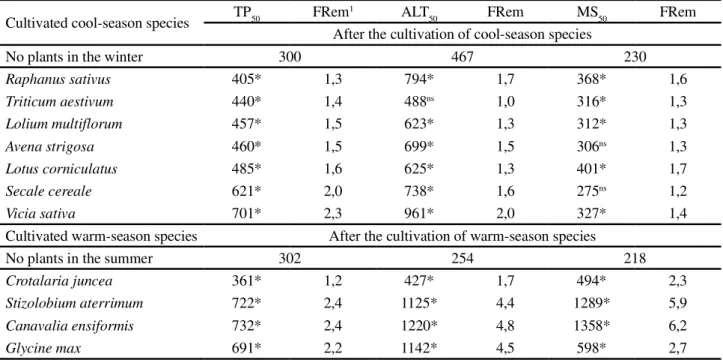
significantly from the treatment used as control (soil without cultivation in the winter) (Table 2). In general, the results make it possible to infer that C. juncea, C. ensiformis, S. aterrimum,V. sativa,R. sativus andT. aestivum are species
which are potentially capable of the phytoremediation of soils contaminated with imazethapyr and imazapic, however the anoxia occurring in hydromorphic soils impedes the establishment and development of plants. Similar results were found by Procópioet al. (2005a), where the species,
V. sativa, exposed to treatment with the herbicide,
trifloxysulfuron-sodium, despite not having provided a
shoot dry weight in beans equal to that ofS. aterrimum
andC. ensiformes, was superior to the other treatments.
The results seen in this study also confirm the
findings of Correa et al. (2008), who claim that the
speciesC. ensiformis andS. aterrimum are plants with a
potential for the phytoremediation of areas treated with
the herbicide diclosulam. For Procópio et al. (2005a),
prior cultivation withS. aterrimum at any of the tested
population densities, prevented reduction in the shoot dry weight of bean plants, caused by the presence of trifloxysulfuron-sodium in the cultivated soil.
The values for MS50 ranged from 275 to 1,358 mg ha
-1, demonstrating that the rate required to cause a 50%
reduction in the dry matter of rice plants was from one to six times higher when compared to the soil with no previous cultivation (Table 2). According to Spilborghs and Casarini (1998), places with vegetation exhibit complete and more rapid biodegradability compared to non-vegetated areas, due to the expansion of the active population of soil microorganisms (rhizosphere) which use the fraction exuded from the roots (rhizodeposition) as a source of food. Also according to the same authors, the increase in the biodegradability of herbicide molecules can take place because some plants have the ability to produce enzymes that metabolically convert organic contaminants, contributing to their faster oxidation by the microorganisms present in the soil.
According to Pires et al. (2003), the use of
Cultivated cool-season species TP50 FRem1 ALT50 FRem MS50 FRem
After the cultivation of cool-season species
No plants in the winter 300 467 230
Raphanus sativus 405* 1,3 794* 1,7 368* 1,6
Triticum aestivum 440* 1,4 488ns 1,0 316* 1,3
Lolium multiflorum 457* 1,5 623* 1,3 312* 1,3
Avena strigosa 460* 1,5 699* 1,5 306ns 1,3
Lotus corniculatus 485* 1,6 625* 1,3 401* 1,7
Secale cereale 621* 2,0 738* 1,6 275ns 1,2
Vicia sativa 701* 2,3 961* 2,0 327* 1,4
Cultivated warm-season species After the cultivation of warm-season species
No plants in the summer 302 254 218
Crotalaria juncea 361* 1,2 427* 1,7 494* 2,3
Stizolobium aterrimum 722* 2,4 1125* 4,4 1289* 5,9
Canavalia ensiformis 732* 2,4 1220* 4,8 1358* 6,2
Glycine max 691* 2,2 1142* 4,5 598* 2,7
Table 2 - Effect of the cultivation of plants in the off season, at a herbicide rate causing 50% injury (PT50), 50% reduction in plant height (ALT50) at 21 DAE, and 50% reduction in shoot dry weight (DM50) at 28 DAE, in non-tolerant rice plants (IRGA 417), and the respective remediation factors (FRem). Santa Maria, RS
ns Value for GR
50 does not differ from the control (no plant) by overlapping of the confidence intervals for the values at 95% probability. *Value for
GR50 differs from the control (no plant) by non-overlapping of the confidence intervals for the values at 95% probability
tolerance that some species exhibit to certain types of compounds or action mechanisms. It can thus be inferred that the results obtained in this study may be explained by the capacity the plants have to metabolise (phytodegradation) the herbicide in question into compounds which are non-toxic (or less non-toxic) to the plant and the environment, or simply their ability to compartmentalise the molecules of the herbicide. As the mass of the shoots of previously grown plants was removed, the herbicide could have been removed too, either compartmentalised in some reserve-storage organ, or adhering to the lignin of the cell wall, thus allowing the normal development of the rice plants.
Another possibility is phytostimulation, in which there is stimulation of microbial activity promoted by the release of root exudates that act by degrading the compound in the soil, which in some plants characterizes a rhizospheric aptitude for bioremediation (PIRESet al.,
2003). Some studies indicate that S. aterrimum and C.
ensiformis are effective in decontaminating soils containing
residues of the herbicides, trifloxysulfuron-sodium and tebuthiuron; and that the probable mechanism involved in decontamination is the interaction between phytostimulation
and phytodegradation (PROCÓPIOet al., 2005b).
In another study in an area contaminated with sodium trifloxysulfuron, maintaining or removing the
shoots ofC. ensiformis andS. aterrimum after the period of
phytoremediation, did not affect the subsequent development of bean plants, indicating a possible internal degradation of the product in the tissues (phytodegradation), or desactivation by other rhizospheric mechanisms, probably phytostimulation of the microbiota associated with the rhizosphere (PROCÓPIO
et al., 2006). Souto et al. (2013) proved that plants of Stizolobium aterrimum release rhizodeposits that stimulate
existing microbial activity in the rhizosphere upon degrading molecules of a formulated mixture of imazethapyr and imazapic present in soil under rice cultivation.
Each species has specific characteristics for removing, immobilising or transforming certain contaminants. In the present study, it can be seen that the plants which displayed more intense remediation factors were leguminous; and probably the greater contribution of nitrogen to the soil provided by these species
compared to species of grass (CARVALHO et al., 2010),
In experiments conducted with rice, Martiniet al.
(2011) found that after harvesting the rice, the amount of the formulated mixture of imazapic and imazethapyr (75+25 g a.e. L-1) in the soil ranged from 190 to 500 mL
ha-1. From this it can be inferred that all species with
a GR50 equal to or greater than these values have the
capacity for the phytoremediation of soils contaminated with these herbicides.
CONCLUSIONS
1.Glycine max,Lolium multiflorum andLotus corniculatus,
due to being more adapted to hydromorphic environments, a feature found in soils cultivated with irrigated rice, are potentially promising species in the phytoremediation of soils contaminated with the herbicide imazethapyr + imazapic (up to 4,000 mL ha-1);
2. Crotalaria juncea, Canavalia ensiformis, Stizolobium aterrimum,Vicia sativa,Raphanus sativus andTriticum aestivum are species capable of the phytoremediation
of soils contaminated with imazethapyr + imazapic, however the occurrence of anoxia in hydromorphic soils reduce the establishment and development of these plants.
REFERENCES
CARVALHO, A. M.et al.Teores de hemiceluloses, celulose e lignina em plantas de cobertura com potencial para sistema plantio direto no Cerrado. Embrapa Cerrados, 2010. (Boletim de pesquisa e desenvolvimento, 290).
CORREA, M. et al. Seletividade da soja transgênica
tolerante ao glyphosate e eficácia de controle deCommelina benghalensis com herbicidas aplicados isolados e em misturas.Bragantia, v. 67, n. 3, p. 663-671, 2008.
CHRISTOFFOLETI, P. J.; LÓPEZ-OVEJERO, R. F. Definições e situação da resistência de plantas daninhas aos herbicidas no Brasil e no mundo.In: CHRISTOFFOLETI, P. J. (Coord.).
Aspectos de resistência de plantas daninhas a herbicidas. 2. ed. Campinas: Associação Brasileira de Ação a Resistência de Plantas aos Herbicidas, 2004. p. 3-22.
DAN, H. A. et al. Atividade residual de herbicidas pré-emergentes aplicados na cultura da soja sobre o milheto cultivado em sucessão.Planta Daninha, v. 29, n. 2, p. 437-445, 2011.
D’ANTONINO, L.et al. Efeitos de culturas na persistência
de herbicidas auxínicos no solo.Planta Daninha, v. 27, n. 2, p. 371-378, 2009.
EMPRESA BRASILEIRA DE PESQUISA AGROPECUÁRIA.
Sistema Brasileiro de Classificação de Solo. 2. ed. Rio de Janeiro: EMBRAPA, 2006. 306 p.
FRANS, R.et al.Experimental design and techniques for measuring and analysing plant responses to weed control practices. In: CAMPER, N. D. (Ed.) Research methods in
weed science. 3 ed. Champaign: Southern Weed Science Society, 1986. 37 p.
FUKUSHIMA, R. S.; SAVIOLI, N. M. F. Correlação entre digestibilidade In vitro da parede celular e três métodos analíticos para a avaliação quantitativa da lignina.Revista Brasileira de Zootecnia, v. 30, n. 2, p. 302-309, 2001.
HALL, L. M.; STROME, K. M.; HORSMAN, G. P. Resistance to acetolactate synthase inhibitors and quinclorac in a biotype of false clover (Gallium spurium).Weed Science, v. 46, n. 1, p. 390-396,
1998.
MADALÃO, J. C. et al. Susceptibilidade de espécies de
plantas com potencial de fitorremediação do herbicida sulfentrazone.Revista Ceres, v. 60, n. 1, p. 111-121, 2013. MARCHESAN, E.et al. Arroz tolerante a imidazolinonas: banco
de sementes de arroz-vermelho e fluxo gênico.Planta Daninha,
v. 29, p. 1099-1105, 2011. Número Especial.
MARQUES, M. Desafios técnicos e barreiras sociais, econômicas e regulatórias na fitorremediação de solos contaminados.Revista Brasileira de Ciência do Solo, v. 35,
n. 1, p. 1-11, 2011.
MARTINI, L. F. D. et al. Lixiviação de imazethapyr + imazapic em função do manejo de do arroz.Planta Daninha, v. 29, n. 1, p.185-193, 2011.
PIRES, F. R.et al. Fitorremediação de solos contaminados com herbicidas.Planta Daninha, v. 21, n. 2, p. 335-341, 2003. PROCÓPIO, S. O. et al. Potencial de espécies vegetais para
a remediação do herbicida trifloxysulfuron-sodium. Planta Daninha, v. 23, n. 1, p. 9-16, 2005a.
PROCÓPIO, S. O. et al. Fitorremediação de solo
contaminado com trifloxysulfuron-sodium por mucuna-preta (Stizolobium aterrimum).Planta Daninha, v. 23, n. 4,
p. 719-724, 2005b.
PROCÓPIO, S. O.et al. Fitorremediação de solo contaminado
com trifloxysulfuron-sodium por diferentes densidades populacionais de feijão-de-porco (Canavalia ensiformis (L).
DC.). Ciência e Agrotecnologia, v. 30, n. 3, p. 444-449, 2006.
PROCÓPIO, S.O. et al. Fitorremediação de solo contaminado
com picloram por capim-pé-degalinha-gigante (Eleusine coracana).Revista Brasileira de Ciência do Solo, v. 32, n. 6, p. 2517-2524, 2008.
SEEFELDT, S. S; JENSEN, J. E; FUERST, P. Log-logistic analysis of herbicide dose-response relationships. Weed Technology, v. 9, n. 2, p. 218-225, 1995.
SENSEMAN, S. A. (Ed.).Herbicide handbook. 9. ed. Lawrence:
Weed Science Society of America, 2007. p. 82-89.
SOUTO, K. M.et al. Biodegradação dos herbicidas imazetapir
e imazapique em solo rizosférico de seis espécies vegetais.
SPILBORGHS, M. C. F.; CASARINI, D. C. P. Biorremediação do solo contaminado com compostos orgânicos.Revista Meio Ambiente Industrial, v. 8, n. 12, p. 66-69, 1998.
STEELE, G. L. et al. Control of redrice (Oryza sativa) in
imidazolinone-tolerant rice (Oryza sativa).Weed Technology,
v. 16, n. 3, p. 627-630, 2002.
SULMON, C. et al. Sucrose amendment enhances
phytoaccumulation of the herbicide atrazine in Arabidopsis thaliana. Environmental Pollution, v. 145, n. 2, p. 507-515, 2007.
VILLA, S. C. C. et al. Arroz tolerante a imidazolinonas: controle do arroz-vermelho, fluxo gênico e efeito residual do herbicida em culturas sucessoras não-tolerantes. Planta Daninha, v. 24, n. 4, p. 761-768, 2006.
WEBSTER, E. P.; MANSSON, J. A. Acetolactate synthase-inhibiting herbicides on imidazolinonas-tolerant rice. Weed Science, v. 49, n. 5, p. 652-657, 2001.