Obtaining interspecific hybrids, and molecular
analysis by microsatellite markers in grapevine
Mariane Ruzza Schuck(1), Luiz Antonio Biasi(1), Ada Michele Mariano(1), Bernardo Lipski(1), Summaira Riaz(2) and Michael Andrew Walker(2)
(1)Universidade Federal do Paraná, Departamento de Fitotecnia e Fitossanitarismo, CEP 80035‑050 Curitiba, PR, Brazil. E‑mail: [email protected], [email protected], [email protected], [email protected] (2)University of California, Department of Viticulture and Enology, Davis, CA 95616, USA. E‑mail: [email protected], [email protected]
Abstract – The objective of this work was to assess the potential of interspecific hybridization of Vitis labruscana and Muscadinia rotundifolia by using artificial cross‑pollinations. Microsatellite markers were used to confirm interspecific hybridizations and the identity of the parental genotypes. In crosses in which M. rotundifolia was used as the female parent, no true hybrids were obtained. In the reciprocal crosses, 114 seedlings were identified as true V. labruscana x M. rotundifolia hybrids. Self‑pollination occurred in direct and in reciprocal crosses. The crossings between 'Bordo' x 'Carlos', 'Magnolia', 'Regale' and 'Roanoke', and between 'Isabel' x 'Bountiful', 'Carlos', 'Magnolia', 'Regale' and 'Roanoke' were confirmed. The 15 markers evaluated showed that two M. rotundifolia parental genotypes had the same fingerprint profile, indicating a likely planting error. The success of hybridization
depends mainly on the species and on the cultivar used as the female parent. Microsatellite markers are efficient to confirm the paternity of interspecific F1 hybrids and to determine the correct identity of M. rotundifolia cultivars.
Index terms: Muscadinia rotundifolia, Vitis labruscana, hybrid identification, interspecific crosses, SSRs.
Obtenção de híbridos interespecíficos e análise molecular
por marcadores microssatélites em videira
Resumo – O objetivo deste trabalho foi avaliar o potencial da hibridação interespecífica entre Vitis labruscana e Muscadinia rotundifolia por meio de polinizações cruzadas artificiais. Marcadores microssatélites foram utilizados para confirmar as hibridizações interespecíficas e a identidade dos parentais. Nos cruzamentos em que M. rotundifolia foi utilizada como parental feminino, nenhum híbrido verdadeiro foi obtido. Nos cruzamentos recíprocos, 114 plântulas foram identificadas como verdadeiros híbridos de V. labruscana x M. rotundifolia. Ocorreu autopolinização nos cruzamentos diretos e nos recíprocos. Foram confirmados os cruzamentos 'Bordo' x 'Carlos', 'Magnolia', 'Regale' e 'Roanoke', e 'Isabel' x'Bountiful', 'Carlos', 'Magnolia', 'Regale' e 'Roanoke'. Os 15 marcadores avaliados revelaram que dois parentais de M. rotundifolia apresentaram o mesmo perfil genético, o que indica provável erro de plantio. O sucesso da hibridização depende principalmente da espécie e da cultivar utilizada como parental feminino. Os marcadores microssatélites são eficientes para confirmar a paternidade de híbridos interespecíficos F1 e para determinar a correta identidade de cultivares de M. rotundifolia.
Termos para indexação: Muscadinia rotundifolia, Vitis labruscana, identificação híbrida, cruzamentos interespecíficos, SSRs.
Introduction
The use of rootstocks in viticulture is a widespread practice. Since the invasion by phylloxera [Daktulosphaira vitifoliae (Fitch, 1856)], grape growers began grafting susceptible Vitis vinifera L. fruiting cultivars onto rootstocks bred from resistant North American Vitis species, particularly V. rupestris Scheele, V. riparia Michx., V. berlandieri Planch. and V. labruscana L.H. Bailey. However, in addition to phylloxera resistance, a good rootstock must show adaptability to the local climate and soil conditions, besides easy rooting, affinity with the scion, good
vegetative growth, longevity and resistance or tolerance to pests and pathogens (Reynolds & Wardle, 2001).
the Brazilian ground pearl [Eurhizococcus brasiliensis Hempel (Hemiptera: Margarodidae)] (Botton & Colleta, 2010; Botton et al., 2010).
The muscadine genotypes [V. rotundifolia Michx. Syn. M. rotundifolia (Michx.) Small] are resistant to the Brazilian ground pearl (Botton & Colleta, 2010). This species has been classified as having the highest level of resistance to grape pests and disease (Kellow et al., 2002) and has consequently been used in many breeding programs worldwide to create resistant rootstocks. Although M. rotundifolia (2n = 40) is not used as a rootstock, due to its graft incompatibility with commercial cultivars of Vitis species (2n = 38) and to its inability to form roots from dormant cuttings (Goldy & Onokpise, 2001), interspecific hybrids showing compatibility were created with Vitis species (Olmo, 1986). Some hybrids from these crosses, including VR039‑16 and VR043‑43 (V. vinifera x M. rotundifolia), released by the grape breeding program at the University of California, Davis, CA, USA (Walker et al., 1991), are currently the main rootstocks used for management of the Brazilian ground pearl (Dalbó et al., 2007). However, 'VR043‑43' is no longer recommended for use in phylloxera‑infested sites, since the resistance of its rootstock to Brazilian ground pearl was recently placed in doubt (De Césaro, 2008). Its full sibling 'VRO39‑16' is only recommended for use in grapevine fanleaf virus‑infected sites, as its long‑term resistance to phylloxera is also questionable (Smith, 2010). Therefore, given that phylloxera resistance should be in the background of all new rootstocks and that the use of V. vinifera in rootstock development has almost invariably been disappointing, it is important to develop rootstocks with broader Brazilian ground pearl resistance and durable resistance to phylloxera, which can be obtained through breeding.
The hybridization of North American species with M. rotundifolia is an alternative to hybridization with V. vinifera. Among the many North American species, V. labruscana hybrids are well adapted to the wine regions of Southern Brazil. These hybrids are commonly planted with their own roots and show some resistance to soil pathogens, such as F. oxysporum (Garrido et al., 2004), besides adequate phylloxera resistance. However, these hybrids do not exhibit the high level of resistance to E. brasiliensis that M. rotundifolia cultivars do.
In breeding, molecular markers have been used as a tool to reduce the time required to develop a new cultivar. Among the various uses of molecular markers, the identification of true hybrids is an extremely useful tool in breeding programs. Therefore, the use of molecular markers to identify plants from crosses is highly important, so that plants from self or undesirable crosses can be identified and discarded in the F1 generation (Cordeiro et al., 2006).
The objective of this work was to assess the potential of interspecific hybridization of V. labruscana and M. rotundifolia by using artificial cross‑pollinations.
Materials and Methods
All crosses were done at the Estação Experimental do Canguiri, of Universidade Federal do Paraná, Pinhais, PR, Brazil (25°25'S, 49°08"W, at 930‑m altitude), and at the Estação Experimental de Videira, Videira, SC, Brazil (27°0'5"S, 51°7'60"W, at 750‑m altitude) and at the Estação Experimental de Campos Novos, Campos Novos, Santa Catarina, Brazil (27°23'60"S, 51°12'0"W, at 947‑m altitude), of Empresa de Pesquisa Agropecuária e Extensão Rural de Santa Catarina (Epagri). The controlled crosses were made in both directions between M. rotundifolia cultivars: Bountiful, Carlos, Magnolia, Magoon, Regale and Roanoke, and V. labruscana cultivars: Bordo, Goethe, Isabel, Marta and Niagara Rosada, in 2008 and 2009. Sixty crosses were made. The number of controlled artificial pollinations varied among the crosses depending on the availability of flowers (Tables 1 and 2). Simple sequence repeat (SSR) markers were used to confirm the paternity of the putative hybrids and to authenticate the identity of the parental genotypes.
parents were receptive, and the inflorescences were covered with paper bags.
Due to uneven maturation, the berries were harvested individually from January to April in both years. The seeds were extracted by forcing the fruits through a sieve, washed with water to remove the pulp, treated with a fungicide solution of Cercobin 2 g L-1 and then
placed in moist media of sterilized vermiculite in petri dishes and stratified at 4°C for a period of 75 days to break dormancy. Seeds were planted in seedling trays containing a steam‑sterilized commercial substrate of Plantmax. When the first true leaves of seedlings appeared, they were transferred to individual pots (125 cm3), containing a mixture of 2 Plantmax:1 soil :1
humus:1 vermiculite, and kept in the greenhouse. Lyophilized leaf tissue of the parental genotypes and putative F1 hybrids was homogenized with DNA extraction buffer in plastic bags using a Homes 6 mechanical homogenizer (Bioreba, Longmont, CO, USA). DNA was extracted with a modified CTAB (hexadecyltrim ethylammonium bromide) procedure (Riaz et al., 2004). In the final step, DNA pellets were suspended in 100 μL 1X Tris‑EDTA buffer and stored at ‑20°C. The integrity of the DNA was visualized on 1.2% agarose gel.
To analyze the extent of polymorphism of SSR markers in the parental genotypes, a set of 20 SSRs were tested on the M. rotundifolia and V. labruscana cultivars. A quality score, A, B, C or D, was given to each marker: Score A was given to four primer pairs (UDV41, UDV43, VrZAG62 and VVIN75) of good quality, displaying clear single band patterns easily scorable in both parents; score B to four medium quality markers (VVIM11, VVIC72, VVMD5 and VVMD31), displaying smears and fainter bands occasionally difficult to read; score C to three markers (UDV76, UDV111 and VVIP16), displaying multiband profiles; and score D to ten markers (UDV35, UDV111, VVIV05, VVIV21, UDV32, UDV35, UDV67, UDV124, VVIB68 and NVMCNG), producing smears, non‑reproducible bands or no products. The four markers with score A were run on the entire populations to confirm the hybrid origin of the progenies. To verify the identity of the parental genotypes used in the crosses, the molecular profile of five M. rotundifolia cultivars was compared to the Grape DNA Identification Reference Database (Founda tion Plant Services, University of California, Davis, CA, USA) with 15 SSR markers.
However, 'Roanoke' was not analyzed due to its absence in the reference database. DNA fingerprinting of the V. labruscana cultivars was done in a previous study by Schuck et al. (2009). The SSR markers used in the present study were VVS2, VVMD5, VVMD7, VVMD27, VVMD31, VVMD32, VrZag62, VrZag79, VMC4f3.1, VMC8g9, VMC7f2, VMC3df, VMC5a1, VMC5h2 and UDV108. PCR conditions used were described by Riaz et al. (2004). PCR reactions were carried out in 10 µL reaction mixtures containing 5 pmol of each primer, 2.5 mmol L-1 of each dNTP,
1 µL 10X gold PCR buffer (Perkin Elmer Inc., Wellesley, MA, USA), 0.5 unit AmpliTaq Gold DNA polymerase (Perkin Elmer Inc., Wellesley, MA, USA), 2 mmol L-1 of MgCl
2 solution and 10 ng of genomic
DNA. Temperature cycling for PCR was carried out on either a Peltier Thermal Cycler‑200 (MJ Research, Inc., Waltham, MA, USA) or on a Bio‑Rad iCycler (Bio‑Rad Laboratories, Hercules, CA, USA). The following cycling program was used: denaturation of DNA and activation of Taq DNA polymerase at 95°C for 10 min; 35 cycles of amplification distributed in 45 s at 94°C, 45 s at 56°C and 1 min at 72°C; final extension of 10 min at 72°C; and cooling at 4°C. To separate amplification products, PCR reactions were mixed with denaturing dye (98% formamide, 10 mmol L-1 EDTA, 0.05% bromophenol blue and
xylene cyanol) and heated at 94°C for 2 min before loading on a 5% polyacrylamide sequencing gel. Gels were run at constant 70 W for 2–3 hours depending on allele sizes. Samples were visualized by silver staining with a commercial kit (Promega, Madison, WI, USA). Assuming Mendelian inheritance of the SSR loci, each of the analyzed progeny genotypes was considered to be a hybrid when one of the two SSR alleles amplified with each locus was common to the alleles in the maternal genotype and the other was the same as one of the SSR alleles found in the paternal genotype. All gels were scanned and stored in a digital archive.
Results and Discussion
Table 1. Number of pollinated flowers, fruit set and number of surviving seedlings from the crosses between six Muscadinia rotundifolia cultivars, as the female parent, and five Vitis labruscana cultivars, as the male parent, at the Estação Experimental do Canguiri, Pinhais, PR, Brazil, and at the Estação Experimental de Videira, SC, Brazil, in 2008.
Vitis labruscana cultivar
as male parent N
o of
emasculations N
o of berries
Fruit set (%) N
o of
seeds N
o of
seedlings
M. rotundifolia 'Bountiful' as female parent
Bordo 720 16 2.2 39 32
Goethe 560 1 0.2 1 1
Isabel 560 22 3.9 47 38
Marta 720 12 1.7 29 25
Niagara Rosada 560 7 1.3 13 10
M. rotundifolia 'Carlos' as female parent
Bordo 50 0 0.0 0 0
Goethe 300 6 2.0 17 14
Isabel 150 0 0.0 0 0
Marta 100 4 4.0 8 6
Niagara Rosada 100 3 3.0 10 5
M. rotundifolia 'Magnolia' as female parent
Bordo 1,200 13 1.1 12 1 Goethe 1,100 7 0.6 11 9
Isabel 1,300 10 0.8 13 2
Marta 1,000 6 0.6 19 9
Niagara Rosada 1,300 12 0.9 8 3
M. rotundifolia 'Regale'(1) as female parent
Bordo 780 33 4.2 74 31
Goethe 645 6 0.9 12 4
Isabel 720 19 2.6 37 13
Marta 630 15 2.4 31 12
Niagara Rosada 480 10 2.1 14 5
M. rotundifolia 'Roanoke' as female parent
Bordo 360 4 1.1 8 3
Goethe 360 2 0.6 3 1
Isabel 360 1 0.3 2 2
Marta 360 6 1.7 14 4
Niagara Rosada 360 2 0.6 5 6 Total 14,775 217 1.5 427 236
(1)The results obtained in the crosses between Vitis labruscana cultivars and 'Magoon' were added to those of 'Regale', since the genetic profile of 'Magoon' matched with 'Regale' at all 15 markers, indicating that the genotype was misnamed at the time of introduction and that the same genotype was planted with different names.
Table 2. Number of pollinated flowers, fruit set and number of surviving seedlings from the crosses between five Vitis labruscana cultivars, as the female parent, and six Muscadinia rotundifolia cultivars, as the male parent, at the Estação Experimental de Campos Novos and Videira, SC, Brazil, in 2008 and 2009.
Muscadinia rotundifolia
cultivar as male parent N
o of
emasculations N
o of berries
Fruit set (%) N
o of
seeds N
o of
seedlings
V. labruscana 'Bordo' as female parent
Bountiful 65 0 0.0 0 0
Carlos 325 21 6.5 48 7 Magnolia 520 52 10.0 120 54 Regale(1) 625 55 8.8 114 52 Roanoke 715 10 1.4 35 30
V. labruscana 'Goethe' as female parent
Bountiful 94 0 0.0 0 0
Carlos 105 0 0.0 0 0
Magnolia 119 0 0.0 0 0
Regale(1) 143 0 0.0 0 0
Roanoke 86 0 0.0 0 0
V. labruscana 'Isabel' as female parent
Bountiful 250 4 1.6 5 1
Carlos 300 33 11.0 71 16 Magnolia 550 70 12.7 135 31 Regale(1) 1,501 41 2.7 87 21
Roanoke 450 7 1.6 16 9
V. labruscana 'Marta' as female parent
Bountiful 150 0 0.0 0 0
Carlos 150 0 0.0 0 0
Magnolia 100 0 0.0 0 0
Regale(1) 150 1 0.6 2 1
Roanoke 100 2 2.0 4 0
V. labruscana 'Niagara Rosada' as female parent
Bountiful 150 0 0.0 19 0
Carlos 525 25 4.8 145 62 Magnolia 450 52 11.6 110 36 Regale(1) 675 45 6.6 129 22
Roanoke 100 0 0.0 0 0
Total 9,398 416 4.4 1,040 342
(1)The results obtained in the crosses between Vitis labruscana cultivars and 'Magoon' were added to those of 'Regale', since the genetic profile of 'Magoon' matched with 'Regale' at all 15 markers, indicating that the genotype was misnamed at the time of introduction and that the same genotype was planted with different names.
(1.5% fruit set) were obtained. From these berries, 427 seeds were extracted and 236 germinated (Table 1). The number of berries obtained compared to the total flowers pollinated was extremely low, indicating that the crosses were very inefficient. Therefore, crosses using M. rotundifolia as the seed parent were not repeated in 2009. In 2008 and 2009, the reciprocals V. labruscana x M. rotundifolia were also made, and 9,398 V. labruscana flowers were pollinated producing
416 berries (4.4% fruit set), 1,040 seeds and 342 seedlings (Table 2).
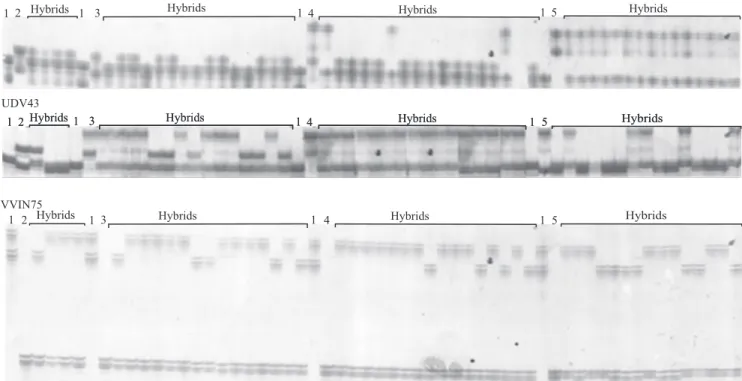
different crosses, were identified at all four markers as true V. labruscana x M. rotundifolia hybrids (Table 3).
In the crosses in which 'Isabel' was the female parent, 65 true hybrids were identified (Figure 1). All the M. rotundifolia cultivars used to pollinate 'Isabel'
generated true hybrids, except 'Magoon'. The largest population of V. labruscana x M. rotundifolia consists of 27 seedlings (87.1% true hybrids) and is a cross of 'Isabel' x 'Magnolia'. From the cross 'Isabel' x 'Regale', 20 seedlings were evaluated and 17 F1 hybrids were confirmed. The cross 'Isabel' x 'Carlos' yielded 16 seedlings, of which 11 were true hybrids (68.8%). The highest percentage of hybrid formation was observed in the crosses 'Isabel' x 'Roanoke' and 'Isabel' x 'Bountiful', with 100% true hybrids. From these crosses, only nine and one seedlings were analyzed, respectively (Table 3).
The crosses between the female parent 'Bordo' with M. rotundifolia cultivars produced 49 true hybrids (43.4%) (Figure 2). Of the six cultivars used as the male parent with 'Bordo', two ('Bountiful' and 'Magoon') did not produce progenies with the SSR profile expected for F1 interspecific hybrids. The percentage of hybrid formation was highest in the crosses 'Bordo' x 'Regale' and 'Bordo' x 'Roanoke', with 68.9 and 50% true hybrids, respectively. The lowest percentage (29.6%) of true hybrids originated from the cross 'Bordo' x 'Magnolia'. Out of the 54 individuals analyzed, 16 were confirmed as true hybrids. From the cross 'Bordo'
Table 3. Percentage of interspecific Vitis hybrids from the
crosses between two Vitis labruscana cultivars, as female parent, and five Muscadinia rotundifolia cultivars, as male parent, confirmed by SSR markers (UDV41, UDV43, VrZAG62 and VVIN75).
Muscadinia rotundifolia
cultivar as male parent N
o of plants
evaluated N
o of true
hybrids hybrids (%)True
V. labruscana 'Bordo' as female parent
Carlos 7 3 42.9
Magnolia 54 16 29.6
Regale 22 15 68.9
Roanoke 30 15 50.0
Total 113 49 43.4
V. labruscana 'Isabel' as female parent
Bountiful 1 1 100
Carlos 16 11 68.8
Magnolia 31 27 87.1
Regale 20 17 85.0
Roanoke 9 9 100.0
Total 77 65 84.4
Total 190 114 60
x 'Carlos', seven F1 plants were evaluated and three hybrids were confirmed (42.9%) (Table 3).
Though only five V. labruscana genotypes were used as female parents in the present study, a marked difference was observed between them in their crossability with M. rotundifolia. These results clearly indicate that the success of the interspecific crosses depends not only on the species and on the direction of the cross, but also on the genotypes of the species involved in the hybridization. Other authors showed that the V. vinifera cultivars used as the female genotype influenced the crossability with M. rotundifolia (Bouquet, 1980).
The chromosome difference between Vitis spp. (2n = 38) and M. rotundifolia (2n = 40) is considered the main reason for the low success of the crosses in both directions (Goldy & Onokpise, 2001). However, in crosses involving M. rotundifolia as the maternal parent, the difficulties in obtaining hybrids are higher than in the reciprocal (Bouquet, 1980; Olmo, 1986). The failure in obtaining hybrid seedlings when M. rotundifolia serves as the female parent can be attributed to the inability of Vitis spp. pollen tubes to successfully penetrate M. rotundifolia styles and to fertilize the egg cells (Lu & Lamikanra, 1996).
In addition to the genetic incompatibility between the species, phenological factors also limit the success of reciprocal crosses. In Southern Brazil, V. labruscana blooms from September to October, and M. rotundifolia from November to January. Because of this difference, in the present study, V. labruscana cultivars were double pruned, during their regular blooming period, to force them to bloom again so that fresh pollen from M. rotundifolia could be used in the flowers of V. labruscana.
Although fresh pollen was used to make these 60 crosses, crosses in both directions produced a high proportion of non‑hybrids, all of which were the result of self‑fertilization. Even though paper bags were placed over the pollinated flower clusters and the adjacent clusters on the same plant were eliminated to avoid contamination from unwanted pollen, wind could have deposited pollen on the emasculated clusters during the few seconds that the protective bags were removed to perform pollination. Therefore, bagging of flowers does not guarantee the lack of undesired pollinations (Neal & Anderson, 2004). Moreover, shoot position and bunch location on the shoot in the developing canopy also influence flowering (Vasconselos et al.,
2009). In the present study, the inflorescences used in the crosses were from the mid cane of the shoots.
The average high temperatures reported for both years (2008/2009) in the three regions where the crosses were made (Pinhais, PR – 31°C; Campos Novos, SC – 26.5°C; and Videira, SC – 31°C) may have induced early pollen maturation of the flower clusters near the end of the canes of the same plant and in the neighboring inflorescences of the same vine located a few meters away. This could have accelerated pollen drying and increased the chances of pollen being carried by the wind and being deposited on unprotected flowers of M. rotundifolia and V. labruscana before they bloomed. In addition, the role of insects as pollination agents cannot be rejected.
The use of microsatellite markers for the identification of true hybrids in the early stage of the selection process has shown to be a very useful tool. A high proportion of selfed plants were identified, which were discarded in the F1 generation, allowing for significant savings in resources, particularly time and space. In species with long breeding cycles, such as Vitis spp., the conventional process of hybrid identification by morphological differences is slow. Molecular tools may overcome these difficulties and open the way to new strategies for more efficient breeding.
The identification of the V. labruscana genotypes was part of a previous study, and the SSR profiles of
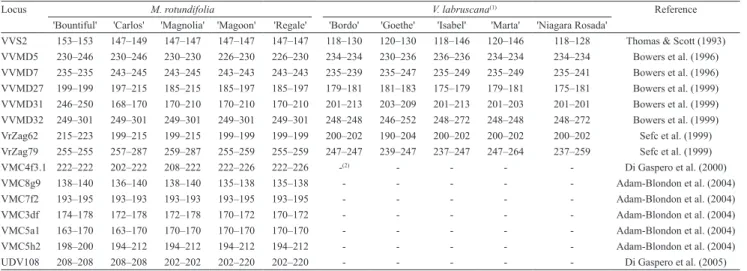
the cultivars Bordo, Goethe, Isabel, Niagara Rosada and Marta were the same as those available in the data banks for the same cultivars using SSR markers VVS2, VVMD5, VVMD7, VVMD27, VrZag62 and VrZag79. Therefore, these cultivars were correctly identified (Table 4) (Schuck et al, 2009).
To confirm the identity of the M. rotundifolia parental genotypes, five cultivars were genotyped at 15 SSR loci. Consistent and reliable profiles were obtained for the five cultivars at all SSR markers. The genetic profile of the M. rotundifolia cultivars Bountiful, Carlos, Magnolia and Regale were identical to those of the reference database at all 15 SSR loci. However, 'Magoon' did not match the reference profile at the same SSR loci, but matched with 'Regale', indicating that the genotype was misnamed at the time of introduction and that the same genotype was planted under different names (Table 4).
The correct identification of accessions is a basic require ment for the coherent management of germ‑ plasm reposito ries and for the use of the germplasm in ongoing breeding programs. It is essential to identify the existence of synonyms, homonyms and naming errors to avoid future propagation and breeding errors. These mistakes are difficult to detect based on morphological descriptors, since they are highly influenced by environmental and developmental factors (Sefc et al., 2001). In contrast, SSRs markers have been used to solve problematic naming and for genetic diversity assessment (Leão & Motoike,
Table 4. Allele sizes (bp) of Muscadinia rotundifolia and Vitis labruscana cultivars used as parents.
Locus M. rotundifolia V. labruscana(1) Reference
'Bountiful' 'Carlos' 'Magnolia' 'Magoon' 'Regale' 'Bordo' 'Goethe' 'Isabel' 'Marta' 'Niagara Rosada'
VVS2 153–153 147–149 147–147 147–147 147–147 118–130 120–130 118–146 120–146 118–128 Thomas & Scott (1993) VVMD5 230–246 230–246 230–230 226–230 226–230 234–234 230–236 236–236 234–234 234–234 Bowers et al. (1996) VVMD7 235–235 243–245 243–245 243–243 243–243 235–239 235–247 235–249 235–249 235–241 Bowers et al. (1996) VVMD27 199–199 197–215 185–215 185–197 185–197 179–181 181–183 175–179 179–181 175–181 Bowers et al. (1999) VVMD31 246–250 168–170 170–210 170–210 170–210 201–213 203–209 201–213 201–203 201–201 Bowers et al. (1999) VVMD32 249–301 249–301 249–301 249–301 249–301 248–248 246–252 248–272 248–248 248–272 Bowers et al. (1999) VrZag62 215–223 199–215 199–215 199–199 199–199 200–202 190–204 200–202 200–202 200–202 Sefc et al. (1999) VrZag79 255–255 257–287 259–287 255–259 255–259 247–247 239–247 237–247 247–264 237–259 Sefc et al. (1999)
VMC4f3.1 222–222 202–222 208–222 222–226 222–226 -(2) - - - - Di Gaspero et al. (2000)
VMC8g9 138–140 136–140 138–140 135–138 135–138 - - - Adam‑Blondon et al. (2004)
VMC7f2 193–195 193–193 193–193 193–195 193–195 - - - Adam‑Blondon et al. (2004)
VMC3df 174–178 172–178 172–178 170–172 170–172 - - - Adam‑Blondon et al. (2004)
VMC5a1 163–170 163–170 170–170 170–170 170–170 - - - Adam‑Blondon et al. (2004)
VMC5h2 198–200 194–212 194–212 194–212 194–212 - - - Adam‑Blondon et al. (2004)
UDV108 208–208 208–208 202–202 202–220 202–220 - - - Di Gaspero et al. (2005)
2011), for parentage analysis (Tapia et al., 2007) and to develop genetic maps (Riaz et al., 2004).
Conclusions
1. The hybridization success between V. labruscana and M. rotundifolia depends on the species and on the cultivar used as the female parent.
2. Cultivars of V. labruscana can be successfully crossed with pollen from M. rotundifolia cultivars, but all reciprocal combinations fail to produce true hybrids.
3. Crosses between V. labruscana cultivar Isabel x M. rotundifolia cultivars Bountiful, Carlos, Magnolia, Regale and Roanoke are possible, as well as crosses between V. labruscana cultivar Bordo x M. rotundifolia cultivars Carlos, Magnolia, Regale and Roanoke, indicating that these species can be used in breeding programs.
4. SSR markers are efficient to confirm the paternity of interspecific F1 hybrids and to determine the correct identity of M. rotundifolia cultivars.
Acknowledgments
To Conselho Nacional de Desenvolvimento Científico e Tecnológico, for financial support; to Programa de Apoio a Planos de Reestruturação e Expansão das Universidades Federais and to Coordenação de Aperfeiçoamento de Pessoal de Nível Superior, for scholarships granted; to Empresa de Pesquisa Agropecuária e Extensão Rural de Santa Catarina and to Universidade Federal do Paraná, for support; and to Rong Hu, from the University of California, for assistance with the SSR analysis.
References
ADAM‑BLONDON, A.‑F.; ROUX, C.; CLAUX, D.; BUTTERLIN, G.; MERDINOGLU, D.; THIS, P. Mapping 245 SSR markers on
the Vitis vinifera genome: a tool for grape genetics. Theoretical
and Applied Genetics, v.109, p.1017‑1027, 2004.
BOTTON, M.; COLLETA, V.D. Avaliação da resistência de cultivares de Vitis rotundifolia à pérola‑da‑terra (Hemiptera:
Margarodidae) na região sul do Brasil. Acta Scientiarum. Agronomy, v.32, p.213-216, 2010.
BOTTON, M.; MELO, G.W.B. de; OLIVEIRA, O.L.P. de; ONZI, I. Efeito da cobertura vegetal sobre a pérola‑da‑terra (Hemiptera: Margarodidae) na cultura da videira. Acta Scientiarum. Agronomy, v.32, p.681-684, 2010.
BOUQUET, A. Vitis x Muscadinia hybridization: a new way in grape
breeding for disease resistance in France. In: INTERNATIONAL SYMPOSIUM ON GRAPE BREEDING, 3., 1980, Davis. Proceedings. Davis: University of California, 1980. p.42‑61. BOWERS, J.E.; DANGL, G.S.; MEREDITH, C.P. Development and characterization of additional microsatellite DNA markers
for grape. American Journal of Enology and Viticulture, v.50, p.243‑246, 1999.
BOWERS, J.E.; DANGL, G.S.; VIGNANI, R.; MEREDITH, C.P. Iso lation and characterization of new polymorphic simple sequence
repeat loci in grape (Vitis vinifera L.). Genome, v.39, p.628‑633, 1996.
CORDEIRO, M.C.R.; PINTO, A.C. de Q.; RAMOS, V.H.V.; FALEIRO, F.G.; FRAGA, L.M.S. Utilização de marcadores RAPD e outros parâmetros na determinação de genitores em híbridos de mangueira. Revista Brasileira de Fruticultura, v.28, p.164‑167,
2006.
DALBÓ, M.A.; PERUZZO, E.L.; SCHUCK, E. Alternativas de manejo para o controle do declínio da videira. Agropecuária Catarinense, v.20, p.58‑61, 2007.
DE CÉSARO, A. Caracterizações histológica e fisiológica do ataque de pérola‑da‑terra (Eurhizococcus brasiliensis Wille, 1922) (Hemiptera: Margarodidade) em videiras. 2008. 89p. Dissertação (Mestrado) – Universidade Federal do Rio Grande do
Sul, Porto Alegre.
DI GASPERO, G.; CIPRIANI, G.; MARRAZZO, M.T.; ANDREETTA, D.; PRADO CASTRO, M.J.; PETERLUNGER, E.; TESTOLIN, R. Isolation of (AC)n‑microsatellites in Vitis
vinifera L. and analysis of genetic background in grapevines under
marker assisted selection. Molecular Breeding, v.15, p.11‑20, 2005.
DI GASPERO, G.; PETERLUNGER, E.; TESTOLIN, R.; EDWARDS, K.J.; CIPRIANI, G. Conservation of microsatellite
loci within the genus Vitis. Theoretical and Applied Genetics, v.101, p.301-308, 2000.
GARRIDO, L. da R.; SÔNEGO, O.R.; GOMES, V.N. Fungos associados com o declínio e morte de videiras no Estado do Rio Grande do Sul. Fitopatologia Brasileira, v.29, p.332‑324, 2004. GOLDY, R.; ONOKPISE, O.U. Genetics and breeding. In: BASIOUNY, F.M.; HIMELRICK, D.G. (Ed.). Muscadine grapes.
Blacksburg: ASHA, 2001. p.51‑90.
KELLOW, A.V.; MCDONALD, G.; CORRIE, A.M.; HEESWIJCK, R.V. In vitro assessment of grapevine resistance to two populations of phylloxera from Australian vineyards. Australian Journal of Grape and Wine Research, v.8, p.109‑116, 2002.
LEÃO, P.C. de S.; BORGES, R.M.E. Melhoramento genético da videira. Petrolina: Embrapa Semiárido, 2009. 61p. (Embrapa Semiárido. Documentos, 224).
LEÃO, P.C. de S.; MOTOIKE, S.Y. Genetic diversity in table grapes on RAPD and microsatellite markers. Pesquisa Agropecuária Brasileira, v.46, p.1035‑1044, 2011.
LU, J.; LAMIKANRA, O. Barriers to intersubgeneric crosses
MERDINOGLU, D.; BUTTERLIN, G.; BEVILACQUA, L.; CHIQUET, V.; ADAM‑BLONDON, A.F.; DECROOCQ, S. Development and char acterization of a large set of microsatellite markers in grapevine (Vitis vinifera L.) suitable for multiplex
PCR. Molecular Breeding, v.15, p.349‑366, 2005.
NEAL, P.R.; ANDERSON, G.J. Does the ‘old bag’ make a good ‘wind bag’?: comparison of four fabrics commonly used
as exclusion bags in studies of pollination and reproductive
biology. Annals of Botany, v.93, p.603‑607, 2004.
OLMO, H.P. The potential role of (vinifera x rotundifolia)
hybrids in grape variety improvement. Experientia, v.42,
p.921‑926, 1986.
REYNOLDS, A.G.; WARDLE, D.A. Rootstocks impact vine performance and fruit composition of grapes in British
Columbia. HortTechnology, v.11, p.419‑427, 2001.
RIAZ, S.; DANGL, G.S.; EDWARDS, K.J.; MEREDITH, C.J. A microsatellite marker based framework linkage map of
Vitis vinifera L. Theoretical and Applied Genetics, v.108,
p.864‑872, 2004.
SCHUCK, M.R.; MOREIRA, F.M.; GUERRA, M.P.; VOLTOLINI, J.A.; GRANDO, M.S.; SILVA, A.L. da. Molecular characterization of grapevine from Santa Catarina, Brazil, using
microsatellite markers. Pesquisa Agropecuária Brasileira, v.44,
p.487‑495, 2009.
SEFC, K.M.; LEFORT, F.; GRANDO, M.S.; SCOOT,
K.D.; STEINKELLNER, H.; THOMAS, M.R.
Microsatellite markers for grapevine: a state of the art. In: ROUBELAKIS‑ANGELAKIS, K.A. (Ed.). Molecular biology and biotechnology of the grapevines.Netherlands: Kluwer, 2001. p.433-463.
SEFC, K.M.; REGNER, F.; TURETSCHEK, E.; GLÖSSL, J.; STEINKELLNER, H. Identification of microsatellite sequences in
Vitis riparia and their applicability for genotyping of different Vitis
species. Genome, v.42, p.367‑373, 1999.
SMITH, B.P. Genetic and molecular mapping studies on a population derived from Vitis vinifera x Muscadinia rotundifolia and genetic diversity of wild Muscadinia rotundifolia. 2010.
277p. Dissertation (Doctor) – University of California, Davis. TAPIA, A.M.; CABEZAS, J.A.; CABELLO, F.; LACOMBE, T.; MARTÍNEZ‑ZAPATER, J.M.; HINRICHSEN, P.; CERVERA, M.T. Determining the Spanish origin of representative ancient American grapevine varieties. American Journal of Enology and Viticulture, v.58, p.242‑251, 2007.
THOMAS, M.R.; SCOTT, N.S. Microsatellite repeats in grapevine reveal DNA polymorphisms when analysed as sequence‑tagged sites (STSs). Theoretical and Applied Genetics, v.86, p.985‑990, 1993.
VASCONCELOS, M.C.; GREVEN, M.; WINEFIELD, C.S.; TROUGHT, M.C.T.; RAW, V. The flowering process of Vitis
vinifera: a review. American Journal of Enology and Viticulture,
v.60, p.411‑434, 2009.
WALKER, M.A.; LIDER, L.A.; GOHEEN, A.C.; OLMO, H.P. VR O39‑16 grape rootstock. HortScience, v.26, p.1224‑1225, 1991.