Repositório ISCTE-IUL
Deposited in Repositório ISCTE-IUL:
2019-01-08
Deposited version:
Post-print
Peer-review status of attached file:
Peer-reviewed
Citation for published item:
Renzi, M. F., Loureiro, S. M. C., Toni, M. & Panchapakesan, P. (2018). Relationship between
destination affect and intention to visit: the case of destination dislike. In Kathy Hamilton, Matthew Alexander, Spiros Gounaris, Maria Karampela and Ewelina Lacka (Ed.), 47th International EMAC conference-People Make Marketing. Glasgow
Further information on publisher's website:
--Publisher's copyright statement:
This is the peer reviewed version of the following article: Renzi, M. F., Loureiro, S. M. C., Toni, M. & Panchapakesan, P. (2018). Relationship between destination affect and intention to visit: the case of destination dislike. In Kathy Hamilton, Matthew Alexander, Spiros Gounaris, Maria Karampela and Ewelina Lacka (Ed.), 47th International EMAC conference-People Make Marketing. Glasgow. This article may be used for non-commercial purposes in accordance with the Publisher's Terms and Conditions for self-archiving.
Use policy
Creative Commons CC BY 4.0
The full-text may be used and/or reproduced, and given to third parties in any format or medium, without prior permission or charge, for personal research or study, educational, or not-for-profit purposes provided that:
• a full bibliographic reference is made to the original source • a link is made to the metadata record in the Repository • the full-text is not changed in any way
The full-text must not be sold in any format or medium without the formal permission of the copyright holders.
Serviços de Informação e Documentação, Instituto Universitário de Lisboa (ISCTE-IUL) Av. das Forças Armadas, Edifício II, 1649-026 Lisboa Portugal
Phone: +(351) 217 903 024 | e-mail: [email protected] https://repositorio.iscte-iul.pt
Relationship between destination affect and intention to visit: the case of
destination dislike
Maria Francesca Renzi, Department of Business Studies - University of Roma Tre Via Silvio D'Amico 77, Rome, Italy, email: [email protected]
Sandra Maria Correia Loureiro,
Instituto Universitário de Lisboa (ISCTE-IUL) and Business Research Unit (BRU/UNIDE), Lisbon, Portugal email:[email protected]
Martina Toni, Department of Business Studies - University of Roma Tre Via Silvio D'Amico 77, Rome, Italy
Padma Panchapakesan, Instituto Universitário de Lisboa (ISCTE-IUL), Lisbon, Portugal, email: [email protected]
Abstract
This paper builds on consumer-brand relationships with an application in the destination context. By analysing the main theoretical contributions, we propose a model in order to shed light on the antecedents of Destination Loyalty in two countries: Portugal and Italy. A
proposed model has been tested through a quantitative survey, by administering a questionnaire to an Italian and a Portuguese sample. The two samples were selected
consistently with the proportions (in terms of gender and age) of in each city population. The PLS approach was employed to test the model with a twofold objective: assessing the
adequacy of the measurements by evaluating the reliability of the individual measures and the discriminant validity of the constructs; appraising the structural model. Although the majority of the hypotheses have been confirmed for both the samples, our findings underline
differences among the two nationalities and proposes further field of investigations.
Keywords: Destination affect; loyalty; tourism Track: Tourism Marketing
EMAC 2018 : Relationship between destination affect and intention to visit:
the case of destination dislike
1. Introduction
This paper builds on consumer-brand relationships in the destination context. In this regard, we propose that destination loyalty is influenced by place attachment-aversion, which is similar to brand attachment-aversion proposed by Park et al. (2010). However, in this model, we have introduced a new variable ‘irritation’ which adversely influences the loyalty intentions. This concept of irritation has been studied so far in advertising and probably the first time, it is being examined in the context of destination loyalty. By building a model focused on destination dislike, the main objective of this paper is to empirically examine place attachment-aversion, destination affect, irritation as predictors of intention to visit a place. The rest of the paper is organized as follows: a literature review with hypotheses to be tested, methodology explaining constructs in the study, their measurement and analysis and results, and finally, conclusion.
2. Literature Review
This section illustrates the relevant literature that represents the foundation of our proposed model applied to Tourism Destination context. First, Brand self-expansion theory is
examined, followed by the constructs of Place Self-distance and Place Prominence, Brand Affect, Irritation and Intention to Visit.
In this study, Brand self-expansion theory has been applied to explain destination attachment-aversion. According to the brand self-expansion theory, close relationships are motivated by desire for self-expansion (Aron, Norman, C., and Aron, 1998). It is natural to move close towards people or objects which aid in one’s self-expansion. People initiate and continue close relationship with the ‘brand’ and add resources or characteristics of the brand, in order to achieve one’s goals (Aron Tudor, and Nelson, 1991). When a person feels attached to the brand and perceives it as a means of self-expression, the connection is called brand attachment. However, if the person perceives the brand as a threat to the self-expansion, the relationship is called brand aversion (Park Eisingerich, and Park, 2013). It is possible for a person to transition from brand attachment to brand aversion, which represent the opposite ends of the consumer-brand relationship spectrum. In fact, there are many research studies on positive relationships, culminating in the concepts of brand attachment and brand love. It is also true that self-contraction results in people moving away from the other (which can be a person or object). There are also studies reporting negative relationships on brands failing to meet customer needs and the incompatibility between the values of brands and consumers (Elsbach & Bhattacharya, 2001).
Brand Attachment-Aversion construct is conceptualized by Brand Self-distance and Brand Prominence. Brand self-distance is the perceived distance between the brand and the self. If
the distance is far, valence of the relationship is negative (Park, Eisingerich, and Park, 2013). When one does not perceive self-relevant memories of the brand, one may be either
indifferent or be far from the brand. Brand prominence is the extent of accessibility of brand memories. When the relevant memories about the brands are highly accessible, one may perceive psychologically close relationship with the brand (Collins, 1996). A brand which is highly accessible based on one aspect may not be accessible for another reason (Markus & Nurius, 1986). In the current study, Place attachment-aversion concept is derived based on brand aversion and is a second order construct which is measured by two first order constructs, such as Place self-distance and Place prominence.
Brand affect is the ability of a brand to elicit positive emotional response in the average consumer due to its use (Chaudhuri & Holbrook, 2001). Consumers experience many affective feelings during the purchase and use of a brand (Schmitt, 2009). A self-expressive brand has a greater ability to develop an emotional response in a consumer (Carroll & Ahuvia, 2006). When consumers’ identity is congruent with a brand’s identity, they experience
positive affect such as friendliness, happiness, comfort, etc. (Batra, Ahuvia, and Bagozzi, 2012). Dick and Basu (1994) argued that brand loyalty is higher under the conditions of positive affect. The positive influence of brand affect on loyalty is also confirmed by Sung, Kim, and Jung (2010).
Irritation is a concept which has been studied in the area of advertising. It is an emotional reaction to the advertisements (Tripathi & Siddiqui, 2008; and Xu, Oh, and Teo, 2009). Irritation has been determined to be an antecedent to attitude formation (Aaker, Stayman, and Hagerty, 1986) and is considered to be an essential reaction towards mobile advertising (Van der Waldt, Rebbello, and Brown, 2009). The existing literature shows that irritation exerts significant negative influence on attitude towards mobile advertisements (Tsang, Ho, and Liang, 2004). This result has been validated in the case of teenagers also by Grant and O’Donohoe (2007). Baek and Morimoto (2013) found that irritation had a direct positive influence on advertisement avoidance. In a more recent study by (Neyheim, Xu, Zhang, and Mattila, 2015) on personalised advertising avoidance among millennials in the USA, it was determined that advertisement irritation was a strong emotional driver of the avoidance. Though the concept of irritation is not researched in the area of destination, this study
considers irritation as one of the antecedents of destination avoidance. Behavioral intention in the literature is an individual’s readiness to engage in a certain behaviour (Ajzen, 1991).
Consumer’s behavioural intention indicated by the likelihood of purchasing plays a central role in understanding consumer decision making (Park et al., 2010). Han and Ryu (2007) defined behavioural intention as the stated likelihood of purchase in the service context. In the literature, the intention to purchase is considered as a proxy measure for the actual loyalty. Thus, in the current study, loyalty is measured as the intention to visit a destination. Based on the above discussion, we propose to test the following hypotheses:
H1: Place Attachment-Aversion is a second order construct measured by Place Self-distance
and Place Prominence
H2: Place Attachment (Place Aversion) is positively (negatively) related to Destination Affect
H3: Place Attachment (Place Aversion) is positively (negatively) related to Intention to Visit
H4: Irritation is negatively related to Destination Affect
H5: Irritation is negatively related to Intention to Visit
Figure I - The proposed model 3. Methodology
In this study, a questionnaire survey - accurately translated in the related native language - focused on destination disliked by the travelers was conducted to validate the hypotheses. On this strength two countries have been involved, since people from different countries of origin tend to differently evaluate the same service (Pantouvakis & Renzi, 2015); indeed societal cultures reside in (often unconscious) values, in the sense of broad tendencies to prefer certain states of affairs over others (Hofstede, 2011). The sampling technique used is a quota sampling from the population in Rome and population in Lisbon (a panel sample of these two cities that represents the proportion of population in each city). The construct, Destination Affect has been measured using the scale developed by Chaudhuri and Holbrook (2001). Similarly, place self-connection and place distance are measured by Park et al. (2010) and Park, Eisingerich, and Park et al. (2013). Irritation and intention to visit are measured by Fennis and Bakker (2001) and Han, Ham, Yang, and Baek (2012) respectively.
4. Results
Regarding the Portuguese (Lisbon residents) sample, the majority of respondents were males (45% of the sample) and most were between 18 and 20 years old (36%). In what concerns to Italian participants (Roman residents) the sample was composed of 125 people 61% were females and 39% males and the age was distributed in the following way: 18-20 (12%), 21-30 (17,8%), 31-40 (18,6%), 41-50 (21%), 51-60 (16,9%), over 60 (13,7%).
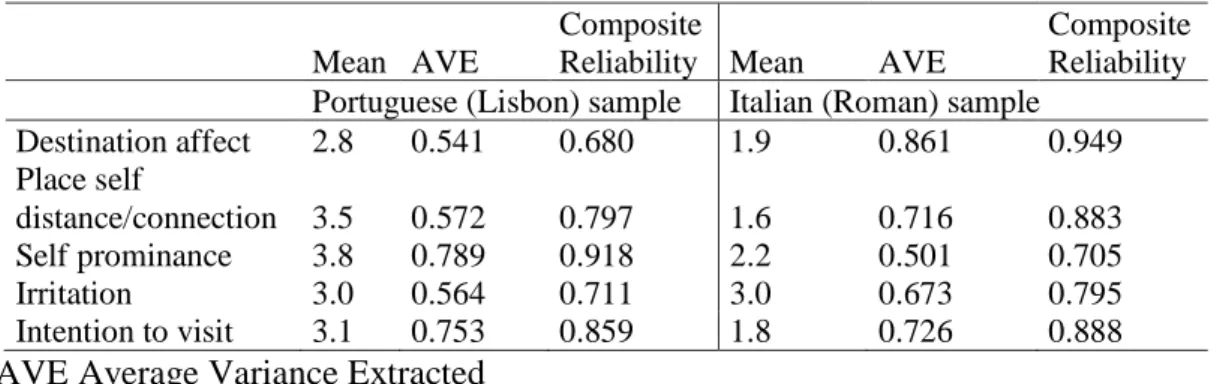
The PLS approach was employed to test the model. The reason lies in the fact that the model has second order formative constructs (the repeated indicators method) and we do not have a large sample size (Chin, Marcolin, and Newsted, 2003; Kleijnen, de Rutyer, and Wetzel, 2007; Vinzi, Chin, Henseler, and Wang (2010). The PLS model is analyzed and interpreted in two stages. First, the adequacy of the measurements is assessed by evaluating the reliability of the individual measures and the discriminant validity of the constructs (Hulland, 1999). Then, the structural model is appraised. All items have item loading values above 0.7 and all constructs are reliable since the composite reliability values exceed the 0.7 threshold and even the strictest one of 0.8 (Nunnally, 1978). The measures demonstrated convergent validity as the average variance of manifest variables extracted by constructs (AVE) was at least 0.5. The criterion used to assess discriminant validity was proposed by Fornell and Larcker (1981), suggesting that the square root of AVE should be higher than the correlation between the two constructs in the model. This criterion was met.
Table 1. Measurement Results.
PLACE SELF DISTANCE SELF PROMINENCE PLACE ATTACHMENT-AVERSION IRRITATION DESTINATION AFFECT INTENTION TO VISIT H6 H2 H3 H4 H5 H1
Mean AVE
Composite
Reliability Mean AVE
Composite Reliability Portuguese (Lisbon) sample Italian (Roman) sample
Destination affect 2.8 0.541 0.680 1.9 0.861 0.949 Place self distance/connection 3.5 0.572 0.797 1.6 0.716 0.883 Self prominance 3.8 0.789 0.918 2.2 0.501 0.705 Irritation 3.0 0.564 0.711 3.0 0.673 0.795 Intention to visit 3.1 0.753 0.859 1.8 0.726 0.888 AVE Average Variance Extracted
The structural results are presented in Table 2. All path coefficients were found to be significant at the 0.001 or 0.05 levels for both samples, except the causal orders including the constructs Place attachment/aversion→Destination affect supported only for Italian sample; Irritation→Destination affect supported only for Portuguese sample; and Irritation→Intention to visit supported only for Portuguese sample. The Q2 is positive, so the relations in the model have predictive relevance. The model also demonstrated a good level of predictive power (R2) as the modelled constructs explained 22.6% of the variance in Intention to visit for Portuguese sample and 29.2% of the variance in Intention to visit for Italian sample. In fact, the median level of predictive power (R2) reveals a good overall fit of the structural model (see Table 2).
Table 2: Structural results. Path Coefficient Beta t value Coefficient Beta t value Hypothesis Portuguese sample Italian sample
Destination affect →
Intention to visit -0.198** 3.476 0.390*** 6.366
H6 supported for both
Portuguese and Italian sample
Place
attachment/aversion →
Destination affect 0.093 ns 1.297 0.453*** 12.722
H2 supported only for
Italian sample Place
attachment/aversion →
Intention to visit 0.479*** 8.731 0.231*** 3.871
H3 supported for both
Portuguese and Italian sample
Irritation → Destination
affect -0.453*** 8.387 -0.079 ns 1.527
H4 supported only for
Portuguese sample Irritation → Intention to
visit -0.146* 2.277 -0.022 ns 0.448
H5 supported only for
Portuguese sample H1
Second order formative construct for Portuguese
sample First order formative constructs Weight
t-value
Place
attachment/aversion Place self-distance/connection 0.473***
21.139 Self prominence 0.597*** 28.350 Second order formative
construct for Italian
sample First order formative constructs Weight
t-value
Place
attachment/aversion Place self-distance/connection 0.779*** 39.208 Self prominence 0.307*** 12.995 Note: *p<0.05; ***p<0.001; ns - not significant.
5. Discussion and Conclusions
The results shows satisfactory preliminary insights about the model design and the
questionnaire structure. The questionnaire used for collecting data is confirmed to be reliable. The Portuguese and Italian samples show differences in testing the proposed hypotheses. Indeed the hypotheses H1, H2, H3, H6 have been tested for the Italian sample, whereas the H1, H3, H4, H5, H6 in the Portuguese one. The relation between Place attachment/Aversion and Destination Affect is validated only for the Italian sample; the Irritation construct is an antecedent of Destination Affect and intention to visit for what that concerns the Portuguese sample. Nevertheless the two sample have three relations in common that are H1, H3, H6. Place Attachment-Aversion is a second order construct measured by Place Self-distance and Place Prominence; Place Attachment (Place Aversion) is positively related to Intention to Visit; Destination Affect is positively related to Intention to Visit.
6. Theoretical Contribution
This research analyses the application of consumer-brand relationships in the destination context. Moreover it represents the first step in implementing the Irritation construct -
typically applied to advertisement theory - on tourism context and specifically in Destination Image. The model confirms existing and newest hypotheses and relations, highlighting the appearance of differences among the two nationalities involved. Indeed, although the majority of the hypotheses have been confirmed for both the samples, the new construct of irritation seems to be relevant only for the Portuguese one, whereas the place attachment/aversion shows significant relation with destination affect in the Italian case. As highlighted in the literature, these differences can be due to nationality issues and specifically different constructs can be involved in shaping destination Image and the consequent behavioral intentions.
7. Limitations and Future Scope
Since this paper represents a preliminary study, only two nationality have been involved with two sample characterized of a small size. In the next stage, the proposed model will embed other cultures representative at international level, by enlarging the number of respondents in order to clarify and confirm cultural similarities and differences. In this way it will shed light on the application of the proposed model and self-expanded theory on destination context, providing further details about the way in which nationality contributes in shaping Destination Image.
References
Aron, A., Tudor, E. N., & Nelson, G. (1991). Close relationships as including other in the self. Journal of Personality and Social Psychology, 60(2), 241–253.
Aron, A., Norman, C., & Aron, E. (1998). “The self-expansion model and motivation”.
Representative Research in Social Psychology, vol. 22 pp. 1–13
Aaker, D.A., Stayman, D.M., & Hagerty, M.R.(1986). Warmth in advertising: Measurement, impact and sequence effects. Journal of Consumer Research, 12 (4), 365 – 381.
Ajzen, I. (1991), “The theory of planned behaviour”, Organizational Behavior and Human
Decision Processes, 50, 2, 179-211.
Baek, T. H., & Morimoto, M. (2013), “Stay away from me”, Journal of Advertising, 41(1), http://dx.doi.org/10.2753/JOA0091-3367410105
Batra, R., Ahuvia, A., & Bagozzi, R. P. (2012). Brand love. Journal of marketing, 76(2), 1-16.
Carroll, B. A., & Ahuvia, A. C. (2006). Some antecedents and outcomes of brand love.
Marketing letters, 17(2), 79-89.
Carroll, Barbara A., & Ahuvia, Aaron C. (2006), “Some antecedents and outcomes of brand love”, Marketing Letters, 17, 79-89.
Chaudhuri, A., & Holbrook, M. B. (2001). The chain of effects from brand trust and brand affect to brand performance: The Role of Brand Loyalty. Journal of Marketing, 65,81–93. Chin, W.W., Marcolin, B.L., & Newsted, P.R. (2003). A partial least squares latent variable
modelling approach for measuring interaction effects: results from a MonteCarlo
simulation study and an electronic mail adoption study. Information Systems Research, 14 (2), 189–217.
Collins, N. L. (1996).Working models of attachment: Implications for explanation, emotion, and behavior. Journal of Personality and Social Psychology, 71(4), 810–823.
Dick, A. S., & Basu, K. (1994). Customer loyalty: Toward an integrated conceptual framework. Journal of the Academy of Marketing Science, 22 (2), 99-113.
Elsbach, K. D., & Bhattacharya, C. B. (2001). Defining who you are by what you're not: organizational disidentification and the National Rifle Association. Organization Science, 12(4), 393–413.
Fennis, B., & Baker, A. (2001). Stay tuned: We will be back right after these messages: Need to evaluate moderates the transfer of irritation in advertising. Journal of Advertising. 30, p. 16-25.
Fornell, C., & Larcker, D.F. (1981). Evaluating structural equation models with unobservable variables and measurement error. Journal of Marketing Research, 18(1), 39–50.
Grant, I., & O'Donohoe, S. (2007), 'Why young consumers are not open to mobile marketing communications'. International Journal of Advertising, vol 26, no. 2, pp. 223-246.
Han, H., & Ryu, K. (2007). Moderating role of personal characteristics in forming restaurant customers’ behavioral intentions: An upscale restaurant setting . Journal of Hospitality &
Leisure Marketing, 15(4), 25-54.
Han, S. , Ham, S. , Yang, I., & Baek, S. (2012), “Passengers' perceptions of airline lounges: importance of attributes that determine usage and service quality measurement”, Tourism
Management, Vol. 33 No. 5, pp. 1103-1111.
Hofstede, G. (2011). Dimensionalizing cultures: The Hofstede model in context. Online
readings in psychology and culture, 2(1), 8.
Hulland, J. (1999). Use of partial least squares (PLS) in strategic management research: a review of four recent studies. Strategic Management Journal, 20, 195–204.
Kleijnen, M., Ruyter, K., &Wetzels, M. (2007). An assessment of value creation in mobileservice delivery and the moderating role of time consciousness. Journal of
Retailing, 83 (1), 33–46.
Markus, H., & Nurius, P. (1986). Possible selves. American Psychologist, 41(9), 954–969. Neyheim, P, Xu, S., Zhang, L., & Mattila, A. S. (2015) Predictors of avoidance towards
personalization of restaurant smartphone advertising: A study from the Millennials’ perspective. Journal of Hospitality and Tourism Technology, Vol. 6, No. 2, pp. 145-159. Nunnally, J. (1978). Psychometric Theory (second ed.) New York: McGraw-Hill.
Oliver, R. L., Rust, R. T., & Varki, S. (1997). Customer delight: Foundations, findings, and managerial insight. Journal of Retailing, Volume 73, Issue 3, 311-336.
Pantouvakis, A., & Renzi, M. F. (2016). Exploring different nationality perceptions of airport service quality. Journal of Air Transport Management, 52, 90-98.
Park, C. W., Maclnnis, D. J., Priester, J. R., Eisingerich, A. B., & Iacobucci, D. (2010). Brand attachment and brand attitude strength: Conceptual and empirical differentiation of two critical brand equity drivers. Journal of Marketing, 74(6), 1–17.
Park, C. W., Eisingerich, A. B., & J. W. Park (2013) “Attachment-aversion model of customer-brand relationships”. Journal of Consumer Psychology, 23, 2, 229–248. Schmitt, B. (2009). The Concept of Brand Experience. Journal of Brand
Management, 16 (7), 417-419. http://dx.doi.org/10.1016/j.ism.2015.09.003
Sung, Y., Kim, J., & Jung, J. H. (2009). The predictive roles of brand personality on brand trust and brand affect: A study of Korean consumers. Journal of International Consumer
Marketing, 22(1), 5-17.