Repositório ISCTE-IUL
Deposited in Repositório ISCTE-IUL: 2018-06-20
Deposited version: Post-print
Peer-review status of attached file: Peer-reviewed
Citation for published item:
Baumgarten, B. (2017). The global justice movement: resistance to dominant economic models of globalization. In Stefan Berger, Holger Nehring (Ed.), The history of social movements in global perspective. (pp. 647-676). London: Palgrave Macmillan.
Further information on publisher's website: 10.1057/978-1-137-30427-8_22
Publisher's copyright statement:
This is the peer reviewed version of the following article: Baumgarten, B. (2017). The global justice movement: resistance to dominant economic models of globalization. In Stefan Berger, Holger Nehring (Ed.), The history of social movements in global perspective. (pp. 647-676). London: Palgrave Macmillan., which has been published in final form at https://dx.doi.org/10.1057/978-1-137-30427-8_22. This article may be used for non-commercial purposes in accordance with the Publisher's Terms and Conditions for self-archiving.
Use policy
Creative Commons CC BY 4.0
The full-text may be used and/or reproduced, and given to third parties in any format or medium, without prior permission or charge, for personal research or study, educational, or not-for-profit purposes provided that:
• a full bibliographic reference is made to the original source • a link is made to the metadata record in the Repository • the full-text is not changed in any way
The full-text must not be sold in any format or medium without the formal permission of the copyright holders.
Serviços de Informação e Documentação, Instituto Universitário de Lisboa (ISCTE-IUL) Av. das Forças Armadas, Edifício II, 1649-026 Lisboa Portugal
Phone: +(351) 217 903 024 | e-mail: [email protected] https://repositorio.iscte-iul.pt
1
The Global Justice Movement - Resistance to Dominant Economic Models of
Globalisation
Britta Baumgarten CIES Lisbon
Resistance to dominant economic models of globalisation has a long history that reaches back to various movements, protests and campaigns, as for example the Tupac Amaro uprising (1780/81) or the anti-slave trade movement (which peaked between 1787 and 1807.1 This chapter focuses on one
of the most recent incarnations, the “global justice movement” (GJM). The recent mobilisations by the Indignados and the Occupy movements do not form part of this movement . These current movements entered the scene in 2011 and became prominent for their large street protests and occupations of public spaces are mainly directed towards their respective national governments, claiming for democracy and against austerity programmes. According to Dieter Rucht in this volume "a social movement can be defined as a network of individuals, groups and organizations that, based on a sense of collective identity, seek to bring about social change (or resist social change) primarily by means of collective public protest."2 In order to speak about a movement as an entity, there has
to exist a certain degree of consensus of what activists perceived as a grievance and how problems and solutions are defined. The actors within a movements also need to be related to each other, at least in the sense that they consider their struggles as related. Similarities in action forms and internal practices also have to exist in a meaningful way in order for observers to be able to talk about movements. These criteria are also important when we decide whether to consider a movement as a new movement or as a continuity of an existing movement. Although some claims and practices are very similar to the GJM's, the organizational structure of the current protests differs and there are the international ties of the GJM are almost not used at all by these new movements. As the current mobilisations have a lot in common with the global justice movement and as there already exists some comparative research on these movements that reveals the continuities between the GJM and the current mobilisations,3 this chapter will occasionally highlight
connections, similarities, as well as also differences and discontinuities between these movements. It is not easy to define the global justice movement: its diversity and its global scope resist any straightforward classification. Researchers discuss whether the label of what I call here "global justice movement" is appropriate. In the literature we find also find the terms “no-global movement“, “antiglobalisation movement“, “alter-globalisation movement“, or “alternative globalisation
movement“, “movement for a globalisation from below“. These terms are contested because there is disagreement about the main objectives of the movement. These have been described as “anti-capitalist”, “anti-corporate”, or “anti-globalisation” 4. In light of the great diversity of actors and aims
2 some authors speak about global justice movements in the plural.5 The great variety of labels
illustrates the difficulties of social science research to classify the GJM.6 In face of the same difficulty
the labels for the actual mobilizations are labelled in broad terms, such “Indignados” (referring to Stéphane Hessels essay "Indignez-vous",7 “Occupy” referring to action forms, or “Arab Spring”
referring to regions. It is also important to bear in mind that he activists themselves label their events in a all-encompassing way. For example, 15M was chosen as a name for the occupation of Puerta del Sol in Madrid referring only to the date of the event (15 May 2011), similarly the worldwide protests 15O (15 October 2011).8
A major slogan of the GJM is “unity in diversity”, which indicates a common identity and the
valuation of internal differences within the movement. The GJM consists of various actors around the globe, including NGOs, grassroots organisations, political parties and individuals. During its time of existence it launched different campaigns from debt relief over the Tobin tax to environmental issues. The description “movement of movements”9 fits the GJM well, because many movements like
ecological, women’s or indigenous movements played an important role in the GJM. Indeed, many activist groups that played a role in other social movements presented in this volume have also been part of the GJM, although the main part of their activities have not been related to it. The global justice movement developed out of a great variety of earlier movements and shares most of their claims and values. Breno Bringel has developed five characteristics for the GMJ, apart from its diversity: 1) the spectacular character of many of its action forms, 2) its use of internet based communication technologies, 3) its horizontal structure of decision making that goes along with a decentralized network-like structure, 4) the principle of “think global act local” and 5) the
movement´s radical claims against the prevailing socio-economic models. It unites various sectors of the political and social Left and uses the prominent slogan “Another World is Possible” to confront Margaret Thatcher´s often repeated “There is No Alternative”.10 What is new about the movement
since the 1990s is a more dense co-operation and the orientation of events towards the large
international meetings of the political and economical elite. The movement became publicly visible in counter protests and the Social Forum Process: events around which the international cooperation within the movement is structured. “Many of the most visible civil society gatherings have been explicitly, and often antagonistically, related to events of the global elite”.11 The Social Forum Process
consists of various large international meetings of activists that meet to debate alternatives to the current economic and political system, to network and to jointly protest against this system. An important question of definition that has an impact on the functioning of the Social Forum Process remains unresolved, however: "is it an event or a movement?".12
3 In what follows I will describe the GJM in more detail, taking into consideration the driving forces for this kind of activism and the key conflicts. Moreover, I outline the actors, their action forms, debates and framings. The main movement events will be described from a chronological and from a
geographical perspective.
The Development of the GJM in Different Phases
There is no consensus about when the global justice movement actually began: “Many say that it started in Seattle. Others maintain that it began five hundred years ago, when colonialists first told indigenous peoples that they were going to have to do things differently if they were to ‘develop’ or be eligible for ‘trade’. Others argue that the movement began on 1 January 1994 when the Zapatistas launched their uprising with the words “Ya basta!” on the nights NAFTA [North American Free Trade Association] became law in Mexico. It all depends on whom you ask ”.13
Resistance against economic globalisation, however, goes back several centuries.14 For example,
Zahara Heckscher mentions the cases of the Tupac Amaro uprising (1780/81), the anti-slave trade movement (which peaked between 1787 and 1807), the campaign against the colonisation of the Congo, the First International Workingmen's Association (founded 1866) and the anti-imperialist movement. 15 These examples are connected to today's GJM, but they were not part of the
movement. They were single-issue campaigns and movements. And although we can find
organisation and protest with a global perspective, the degree of globalisation was far lower than in today's movements.
According to Elizabeth Smythe, the establishment of free trade agreements across the Americas and Asia were a starting point for the movement to become global. For example, in 1985 Canada and the USA signed a free trade agreement, followed by a trilateral free trade agreement with Mexico in 1991.16 The counter- summit protests started around the same time as protests "outside the closed
doors of inter-governmental decision making on global issues".17 In this first phase activists struggled
for access to intergovernmental organisations.18
The activism of the 1990s was closely connected to hope that various UN would help to solve the global problems that the movements sought to address. Examples include the UN conferences on environment and development in 1992, on human rights in 1993, on population in 1994, on social development in 1995, and on housing in 1997. In this period, the movements argued for the strengthening multilateral agreements and of regulatory mechanisms; they aimed to expand attention to social concerns, to establish information regimes and to defend, and to expand access into global arenas.19 In these years early anti-free trade networks became active, which are
important for the later WSF process. There were e.g. the European farmer`s association, the Hemispheric Social Alliance (HSA) or the International Forum on Globalization (IGFG) 1993.20 These
4 early anti-free trade networks held international meetings long before the first World Social Forum, e.g. the meeting to form the International Forum on Globalization (IFG) in 1994, the 1996 Zapatistas' "meeting for Humanity and Against Neoliberalism", and meetings following their example in Spain (1997) and in Brazil (1999).21 People’s Global Action (PGA), a network to facilitate organising across
borders, grew out of a 1998 meeting in Geneva of over 400 representatives of grassroots organizations and NGOs from 71 countries".22 The contemporary activist practices in the global
north, as part of the AGM, in some respects, emanated from the Zapatistas in the global south, a movement that became publicly visible in January 1994 when NAFTA took effect.23 In these period
also falls the WB/IMF fiftieth anniversary party that gave rise to campaign Fifty Years is Enough.24
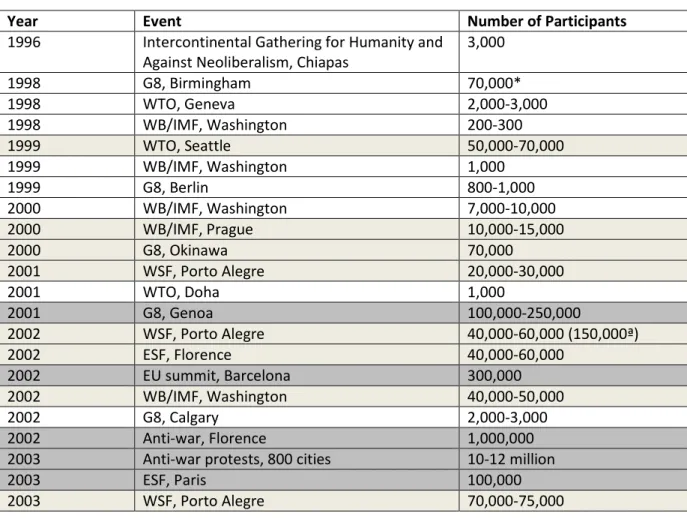
The movement's milestones have been the G8, IMF, and WTO summits. The GJM attended (and disrupted or influenced to differing degrees) the summits in Birmingham in 1998, in Seattle in 1999, in Prague in 2000, in Genoa in 2001. Each of these events was accompanied by a panoply of fringe events and protests.25 Table 1 shows an overview over the biggest events related to the GJM (events
with more than 50 000 participants are marked grey, those with more than 100 000 are marked in a darker grey) :
Table 1: GJM Events
Year Event Number of Participants
1996 Intercontinental Gathering for Humanity and Against Neoliberalism, Chiapas
3,000 1998 G8, Birmingham 70,000* 1998 WTO, Geneva 2,000-3,000 1998 WB/IMF, Washington 200-300 1999 WTO, Seattle 50,000-70,000 1999 WB/IMF, Washington 1,000 1999 G8, Berlin 800-1,000 2000 WB/IMF, Washington 7,000-10,000 2000 WB/IMF, Prague 10,000-15,000 2000 G8, Okinawa 70,000 2001 WSF, Porto Alegre 20,000-30,000 2001 WTO, Doha 1,000 2001 G8, Genoa 100,000-250,000 2002 WSF, Porto Alegre 40,000-60,000 (150,000ª) 2002 ESF, Florence 40,000-60,000 2002 EU summit, Barcelona 300,000 2002 WB/IMF, Washington 40,000-50,000 2002 G8, Calgary 2,000-3,000 2002 Anti-war, Florence 1,000,000
2003 Anti-war protests, 800 cities 10-12 million
2003 ESF, Paris 100,000
5
2003 WTO, Cancun 2,000-3,000
2003 WB/IMF, Doha Demonstrations banned by law
2003 G8, Evian 50,000-100,000
2004 WSF, Mumbay 80,000-90,000 (115,000ª)
2004 WB/IMF, Washington 2,000-3,000
2004 G8, Savannah 1,000-2,000
2005 WSF, Porto Alegre 155,000-200,000
2005 WTO Meeting, Hong Kong 5,000-10,000
2005 WB/IMF, Washington 200 2005 G8, Edinburgh 225,000 2006 WSF Caracas WSF Bamako WSF Karachi 80,000 11,000 20,000
2006 WB/IMF, Singapore Demonstrations banned by law
2006 G8, St. Petersburg 150-300
2007 WSF Nairobi 66,000 (57,000ª)
2007 WB/IMF, Washington 300
2007 G8, Heiligendamm 25,000-80,000
2009 WSF, Belem 100,000ª
2011 WSF, first in 35 places, then centralized in Dakaº
70.000º Source: Paczynska; except: * Smith; ª Rucht and º Scerri 26
The counter summit protests are the starting point of a new phase of activism of the GJM. These massive protests against the WTO meeting in Seattle 1999 were the most outstanding event in terms of media attention and impact on further global meetings.27 After Seattle, the world summits were
organised in more remote places. In contrast to these increasingly secretive meetings that were protected from any large-scale protests, the WSF process was initiated as an alternative, participative way of joint debate about solutions. It aimed at creating alternatives to formal politics, changing values of the predominant sociopolitical order, and wanted to provide alternative venues for global problem solving.28 The Jubilee 2000 campaign was a major campaign run during these years in order
to campaign for debt relief.29
In 2001, the ‘Social Forum Process’ began in Porto Alegre. In opposition to world Economic Forum that meets every year since 1971 in Davos, it emphasizes on social issues, is hosted in countries of the Global South and thought of as a meeting of people instead of elites. The first World Social Forum was organised by 8 founding organizations and hosted by the Workers' Party (PT) in Porto Alegre. There were around 20 000 participants from 100 countries, amongst them also 436 members of parliament. The number of participants grew rapidly to 150 000 participants at the World Social Forum the following year, which was organised by more or less the same actors.30 Thereafter, the
World Social Forum was organised by a broader and more international team and moved away from Porto Alegre, leaving many organizational tasks to local committees. Another important event for the GJM was 11 September 2001. "Both activists and observers agree that a fundamental turning point in the evolution of the global justice movement were the attacks on the Twin Towers and the Pentagon
6 on September 11, 2001. [...] Although large scale demonstrations have faded in the United States, the global justice movement rather than disintegrating and fading into oblivion has developed a variety of other tactics and strategies to push forward its agenda.".31 Parallel to the War on terror
peace becomes more important in the Social Forums after 2002.32 There were WSFs in Mumbai
(2004), Caracas (Venezuela), Bamako (Mali) and Karachi (Pakistan) (all 2006), Nairobi (Kenya) (2007), Belem (Brazil) (2008) and in Dakar (Senegal) (2011).33 After the first World Social Forum, national
forums rapidly spread especially in the South.34
The most recent phase of the movement so far is characterised by a focus on work at the local level and enhanced coordination via internet, including various blogs and sites dedicated to counter information, for example the Indymedia pages that were broadly used as a way of information independent from the mainstream media. The increasing commercialization, the establishment and bureaucratization of the Social Forums lead to the creation of counter forums that were run parallel to the forums and served as a space for the more radical groups.35
There is disagreement among scholars about how to evaluate the current state of the global justice movement. On the one hand, scholars such as Breno Bringel argue that the GJM has died as a unitary actor but nonetheless enjoys good health; it merely no longer has the basic characteristics that it had at the beginning. Identities have become more diverse, and not many activists today no longer define themselves as part of the GJM. Its ideas and practices, however, continue to be relevant, such as the global-local connection of transnational collective action and a broad repertoire of action that has been developed by the movement over the past decades.36 The global-local connection has also
gained new prominence: "activists want to change the world starting locally with their neighborhood assemblies”.37 Scholars such as Dieter Rucht, on the other hand, do not regard the GJM as dead. On
the contrary, he mentions factors that have contributed to strengthening the movement: the growing relevance of transnational problems, the vast potential of movements in the global south, the availability of the internet as a tool for co-ordination and communication, and the past processes of learning from mistakes and negative experiences.38 The GJM has lost some of its force during the
last five years for several reasons. It is difficult to sustain a movement in the high intensity the GJM had between 1999 and 2006.39 Global summits involve a substantial amount of personal and material
resources and are therefore hard to sustain by actors that are usually not well endowed with such resources. Every day practices at the local level are also not without limits, however. They are less resource intensive, but "most of the time, they have scarcely any impact on public debate”.40
Especially in the United States the developments after 9/11 hampered activists.41 Nevertheless,
counter summits and the Social Forum Process continue to the present day. The tenth European Social Forum took place in Florence in November 2012. The movement relates to the new wave of protest and probably regains force due to the new worldwide protests. In February 2012, it was
7 decided to locate the WSF2013 in Tunis, Tunisia.42 Some authors go as far as to see Occupy as a part
of the GJM.43 Although many activists OWS have experiences in the GJM, the new waves of protests
are not a simple continuation of the GJM.44
The GJM's Critique of Globalisation
In spite of its diversity, the GJM has common aims and opponents. According to Ulrich Brand neoliberal globalisation is the defining context for the GJM: "a competitive strategy to restore economic growth and strengthen the power of capital on the local, national and international levels".45 Lauren Langman highlights five major dysfunctions of the global economy that gave rise to
the GJM: the ongoing redistribution of wealth from poor to rich countries; the erosion of the autonomy of state policy;, the universalisation of a homogenised popular culture that increasingly serves economic interests; the destruction of the environment; and continuing human rights violations.46 These problems, all attributed to the global economic system, are also a reason for the
GJM’s broad nature , encompassing various single issue groups. The movement holds a specific way of economic globalisation responsible for social, environmental, political and other problems. This way of "economic integration goes back centuries, and so do critiques claiming the negative social, economic and environmental impacts, resistance and the development of alternatives".47 Important
parts of this way of economic integration are institutions, like the World Bank, the International Monetary Fund, and the World Trade Organization that all emerged from the Bretton Woods meeting in 1944.48 But those institutions alone cannot be regarded as driving forces behind the
movement. Rather the crisis of the economic and social system that these institutions could not prevent, but rather intensified, are regarded as grievances49 related to the movement. "During the
last few decades, policies and reforms have been guided by the neoliberal agenda of efficiency, competitiveness and world market orientation, transformation of the state, and the partial
privatization of public services and social welfare programs such as pension insurance. [...] Thus, the essentially state-mediated wage relation is eroded and devolved back to the firmlevel, resulting in a massive loss of power for wage-earners and organized labor".50 A growing distance between the
citizens and the centres of political decision making, not only resulting from the loose of power of the nation state, but also from negative experiences with political decision makers, is one of the driving forces for the GJMs search for a more participatory democracy.51 “Many critiques of global capitalism
point to the fact that it prevents citizens from participating in the most crucial decisions that affect their lives”.52 Representative democratic institutions have lost legitimacy as they "have become
8 At the level of the economy, according to Duncan Green and his colleague several events have fostered the development of the GJM "the oil crisis and the suspension of dollar convertibility in 1972 marked the end of the 'long boom' of post-1945 Keynesianism. They also triggered the meteoric rise of the global capital markets which made earning and keeping 'market confidence' an increasingly important determinant of government policies". Mexico’s near-default on its foreign debt in 1982 and the collapse of Soviet communism (since 1989) were two important events that marked the end of the post-war era of import-substituting industrialization. Several developing countries suffered from large foreign indebtedness. The Asian crisis of 1997 (caused in part by excessive liberalization of financial markets which was then misdiagnosed, aggravated and perpetuated by the IMF) was perhaps the most significant event to undermine neo-liberal theory. But the Mexican peso crisis of 1994 and the catastrophe of free market reform in Russia. The political influence of the IMF, World Bank and the international capital markets increased and the idea of downsizing the state gained importance. There was a certain "consensus over the model of global economic and political management promoted by global institutions and the most powerful state players-a model variously titled 'neoliberalism' or the 'Washington consensus'".54 To put these ideas
into practice, there were various attempts to deregularisation and promotion of free trade, like the General Agreement on Tariffs and Trade (GATT) that started in 1986 by negotiations on agriculture, trade-related aspects of intellectual property rights (TRIPS), trade related investment measures (TRIMs), and General Agreement on Trade Services (GATS). In 1995 the Organization for Economic Cooperation and Development (OECD) launched negotiations on a multilateral investment
agreement that were linked to GATT negotiations and the North American Free Trade Agreement (NAFTA).55
In terms of events, the big international summits and negotiations to create the large free trade zone NAFTA and the Multilateral Agreement on Investment were a mayor driving force behind the GJM. "The movement gathered momentum as the secret negotiations between members of the
Organization for Economic Cooperation and Development (OECD) on Multilateral Agreement on Investment became public in early 1997".56 “Social movements and NGOs recognized the need to
create and strengthen global networks to challenge international trade and investment agreements, the key drivers of global neoliberal policies”.57 But it was not only the international economic
summits that gave force to the GJM. Further the failure of the UN summits and the loose of confidence in NGOs to resolve the problem of growing worldwide inequality, called for alternative approaches.58 With regard to organizational infrastructure and international cooperation it is
important to note that the NGO sector grew very much. NGOs were "increasingly funded by international organizations, such as private foundations, the United Nations and the World Bank".59
9 The development of infrastructure including offices and resources for travel, supported the rise of long-term cooperation at the international level. Since the mid-nineties cooperation became once more easier through the rise of internet-based communication.
The Key Social, Political, Economic and Cultural Conflicts Addressed and Framed by the GJM Against this structural backdrop, GJM activists framed their campaign against developments that redefine the function of national governments in the sense of reducing distributive functions of the welfare state and their capacity to control multinational companies, as well as marginalising welfare-and human rights- oriented international organisations, especially those connected to the UN. It is also against a culture-ideology based on a certain type of consumerism favouring big business and delegitimizing opponents of neoliberalism.60 In face of the developments described above, “Social
movements and NGOs recognized the need to create and strengthen global networks to challenge international trade and investment agreements, the key drivers of global neoliberal policies”.61
The fields of activity of the GJM are very broad. The different actors within the movement have different thematic foci, but the issues are far more than loosely connected. There is a quite coherent framework of ideas about grievances and responsibilities. "Development, economic issues and democracy continue to characterise the main field of activities of the organisations involved in the organisation of global events [...]. Labour and trade unions, environment, human rights and peace follow".62 Trade liberalisation has been one of the major issues in the WSF since 2001 , but perhaps
the most important issue at stake is the nature of democracy and political representation. The WSF challenges the “loss of legitimacy of representative democratic institutions, which have become increasingly ineffective at representing and responding to popular interests under neoliberalism”.63
In this issue it is very close to the demands of the current movement in Spain that also connects various issues under the main claim for democracy from below. Besides the Social Forums that usually embrace a broad collection of issues, there have been several thematic forums, e.g. on education, health, democracy and human rights.64
Social movements ”frame, or assign meaning to and interpret events and conditions in ways that are intended to mobilize potential adherents and constituents, to garner bystander support, and to demobilize antagonists“.65 In terms of diagnostic framing, neoliberalism by the GJM is defined as the
main cause of various grievances. The GJM argue that the “dominant form of economic globalization is not inevitable. But Guigni et al. 2006 argue that neoliberalism for many of the groups within the GJM is not enough to mobilise. They "suggest ’mid-range‘ or intermediate-level frames that link the struggle against neoliberalism to more specific issues and claims and which allow for the mobilization of many different kinds of networks.66 Moreover, many of the groups protesting are not generally
10 against capitalism. They aim at reducing "some of the perceived harmful effects of policies and practices by global political institutions and corporations".67 Economic globalization is framed as a
force that leads to a "race to the bottom" with regard to labour standards, provision of welfare or ecological issues, to name but a few concerns. Further global economy is accused to undermine democratic institutions.68 The rejection of global neoliberalism, however, does not mean a rejection
of globalization. According to Mario Pianta and his colleagues most actors in the GJM favour
alternative forms of "globalisation from below" or "humanised globalisation", placing civil society and human beings centre stage. Only four per cent call themselves "anti-globalisation".69
Finding solutions to the problems caused by neoliberalism is more complicated. A large part of the movement favours "transformation instead of revolution".70 One partial solution practised is to
defend established rights. This, however, is not enough. "Parallel to the struggle against
neoliberalism, the GJM calls for greater participation of citizens in decision-making processes and arenas, both at the local and global level.71 The movement claims "more people-centered than
market-centered forms of global governance" and deglobalization.72 This concept of deglobalization
involves: "reducing dependence on foreign investment, redistribution of income and land, de-emphasizing growth and maximising, abandoning market governance, constant monitoring of state and market by civil society, reorient production towards away from remote goods".73 Most activists
favour the idea to “shrink or sink global financial institutions to eliminate unfair advantage of rich countries and cooperations […] strengthen economic governance at global level through , for example tobin tax […] debt relief for poor countries […] strengthen state sovereignty […]emphasize local economic empowerment […] promote human rights”.74 Local grievances and local resistance are
always connected to economic neoliberal policies and to global processes.75
Comparing the GJM to other movements, we see that the values and issues of the GJM do not differ fundamentally from those of the wave of contention that has preceded it, namely those of the new social movements.76 They for example all claim for equality, democracy from below, or an alternative
ecologically sound way of living. With regard to the claim for more participatory democracy, the Indignados77 and Occupy movements also employ new forms of participatory decision-making and
techniques of deliberative democracy.78
Forms of Protest
GJM activists’ framing of the issues at stake also has implications for the forms of protest they have adopted. The GJM is characterised by two large forms of protest events: "mass demonstrations and protest activities addressed against major international governmental or private institutions or
11 organizations on the one hand, and social forums on the other".79 Both of these most visible forms of
the GJMs were mainly organised in the shape of large counter-summits, at least timely related to global summits, but often organised nearby the places of the summits.80
Pianta's study about global civil society events included the share of such events in 2003 and 2004: 30 per cent of all events were social forums, 26 per cent were parallel summits with regional
conferences (European Union, American, or Asian government meetings), 21 per cent were meetings organised independently from official summits, 9 per cent were parallel events to UN conferences, and 7 per cent each were counter protests to IMF, World Bank or WTO meetings and to G8
summits.81 About 50% of protest events take place around such meetings. Taking into consideration
the novelty and impact of these meetings, Rucht has therefore argued that “the World Social Forum (WSF) process is the most important manifestation of the contemporary global justice movements (GJMs)”.82 As for the most common forms of activism, survey data shows that demonstrations and
petitions are very common, "while confrontational tactics such as blockade and occupation have been applied by roughly one-quarter of them [...] GJMOs do not fall into groups using moderate forms of action and other groups using radical means. Instead, confrontational action forms are appended to the moderate repertoire.83
While large and visible events contributed to the fame of the GJM, these events are just one part of the movement. Rucht describes the WSF as “not an event but a global communication network resting only in part on a visible infrastructure”.84 Similarly, Jackie Smith states: “The notion of the
WSF as a ‘process’ signals the idea that the meetings themselves are not the main purpose. Instead, the goal of most organizers is to facilitate the exchange of ideas, to expand and deepen activist networks, and to provide new spaces in which people can reflect on and help realize alternatives to neoliberal globalization”.85 The Social Forums are open to everybody who opposes global
neoliberalism, except for right-wing extremists and groups using violence. Further political parties and elected government officials in their official capacity are in principle excluded, a practice not consistently followed. The idea of the forums is to give voice to every participant. Due to its prominence, however, there have been many prominent speakers who naturally attract a greater audience. This star cult is criticised and the WSFs 2005 and 2007 avoided promoting prominent speakers.86 “The basic format of the forum itself resembled in many ways the civil society
conferences that paralleled UN global conferences of the 1990s. It also mirrors a model forged by feminist activists in Latin America, who gathered in what they called encuentros”.87 The Social
Forums do also have a lot in common with the actual assemblies of the 15M in Spain the assemblies as well as the Social Forums are open to different ideas which are regarded as enriching. The
12 groups and networks of cooperation with a constant change in positions and no spokespersons. The local and the global level are connected in a framework and there is a rather pragmatic between different types of organizations that takes into consideration the different possibilities of each actor.88
There is a divide between deliberation versus struggle: some actors of the GJM put deliberation in first place.89 They usually favour a WSF that is as open as possible to new ideas, values and debate for
its own sake. For the groups that favour struggle, open debates are not enough, they are aiming to construct a counter power. The positions are two extremes in a continuum. “The most vibrant debates have occurred over the WSFs inability or rather its unwillingness to take strategic decisions. To see the forum as a place for debate instead of an unified actor avoids building common positions and statements. Thus while an open structure is usually praised, there was an increasing
dissatisfaction with the movements failure to generate political decisions or actions.90
Key Actors and Movements of the GJM
The diversity of the key actors and movements that make up the GJM reflect the movements‘ diversity in terms of its aims and forms of protests.
The GJM comprises a broad variety of activists and their groups and organisations. They do not only meet at Social Forums and counter summits, but also launch independent political campaigns.91
Marco Guigni et al. "distinguish between two basic types of mobilizing structures: (i) formal
organizations— for example, the Association for the Taxation of Financial Transactions for the Aid of Citizens (ATTAC); and (ii) informal networks—that is, the web of interpersonal contacts and
exchanges among movement activists and participants".92 Jackie Smith further distinguishes various
streams of organization: anti-free trade activism, transnational labour, transnational environmentalism, women's rights, tobin tax, peace.93
There is already some substantial research on the actors who are involved in the organisation of Social Forums. "The first WSF was organised by a group of seven representatives of the groups that launched the events. From 2002 onwards, the WSF is organized by the International Council that meets a few times but coordinates the WSF mainly via the Internet. Local committees handle logistical and technical questions and set the programme. The International Council includes several hundred groups and networks (e.g. 100 in 2003 and 156 in 2010)".94 "In a few cases, typically, World
Social Fora, there are more than 400 organisations are involved [in the organization of the events]. Generally, however, the number of organisations working together has more manageable size, below 24 in a quarter of cases, between 25 and 49 in 30 per cent of cases, between 50 and 199 in 23 per cent of cases".95
13 Within the GJM are many different types of actors e.g. non-governmental organizations, anarchist groups, environmental groups, actor networks, like PGA, autonomists, indigenous movements, Socialist, anti-corporate and anti-war groups.96 These actors vary not only in terms of their political
orientation, preferred action forms, or access to resources and alliances; they also can also be distinguished by the nature of their organizational structures has often grown over years. We can distinguish two main types of organisational structure, the horizontal and vertical.97 Groups with a
more vertical structure (such as trade unions) typically practise elections and have hierarchies, while the more horizontal groups are against such hierarchical organisational structures and practices. "Old Left organizations were predominantly founded before 1968 and tend to have more than 100,000 individual members. Most New Left, anarchist, or autonomous groups were founded between 1969 and 1989 and are more likely to have between 100 and 1000 members. Most new social movement groups were founded in the same period, but have a larger membership (1000 – 10,000 members). Solidarity, peace, or human rights organisations were predominantly founded between 1990 and 1999 (a considerable number, however, also before 1968 or between 1969 and 1989) and tend to have between 1000 and 10,000 members. Finally, new groups acting primarily on the global level were founded in the years 2000 and after, and are mostly small (with up to 100 individual members)".98 A closer look at the structure of the participants of the Social Forums shows the
importance of activist groups and organisations: “the bulk of participants are members or formal delegates of political or social groups such as Indigenous associations, farmer's movements, trade unions, and NGOs. In addition, independent activists, intellectuals, artists, and unaffiliated young people take part”.99 Amongst the European Social Forum in Florence (2002) participants 34.6%
belonged to a political party, 36.6% were tied to unions, 52,7 to social movements, and 41.5% to NGOs.100
Apart from the large visible forums and protest events, there are various important, albeit less visible, groups working at the local level all over the world. Geoffrey Pleyers subsumes this main organisational principle of the GJM as follows: “Activists want to change the world starting locally with their neighborhood assemblies”.101 Alternative solutions are practised in these small scale
groups and projects. This principle is repeated within the actual assemblies, such as when the Spanish 15M that after the central occupation of Puerta del Sol spread to the "Bairros".102
Looking at the organizational structure of the movements we find a lot of continuities, e.g. an "overlap between the WSF International Council and Our World network, the network that first protested against WTO".103 According to Hayduk many activists OWS come "directly out of the
Anti-Globalization movement".104 The 15M in Spain is connected to the Spanish anarchist movements. My
own observations in Portugal, by contrast, show very little connection of the current anti-austerity movements to the GJM, especially to the Social Forum processes. Although transnational
co-14 operation was regarded as important, almost all movements during their first year of existence did not have institutionalised transnational ties. Exchange of ideas was mainly done via personal
contacts, Erasmus students and with well known groups via the Internet. In my study about Portugal I did not find the use of earlier ties from the GJMs.105 The recent Spanish 15M movement also involved
a large number of people without experience in civil society groups and organizations. Further many of the groups involved in organising are new.106 So although some groups and activists have been
involved in earlier struggle, in terms of actors the recent movements are not simple continuities of the GJM.
Key Geographical Areas of the GJM
The GJM is a very globalized movement with actors and events placed all over the world. It is based on transnational networks of transnational, national and local actors. There are, however, some especially important spaces that shaped the movement. The counter summits have always taken place near the summits of the World Bank, the WTO or the IMF. In spite of all difficulties connected to places such as Davos or Doha, including banishment of protest, high police presence or difficulties to reach remote places, the activists protested as close as possible to the places of the respective summit. In terms of the Social Forums, Porto Alegre in the South of Brazil plays an important role. The WSF process started here and was shaped especially by Brazilian and French actors. In contrast to the counter summit protests the place was chosen because of its favourable infrastructure. Even though the movement is global, the networks of actors involved in the movements are embedded into national contexts. Their daily work takes place in the local arenas, often targeting local and national politics. Participants in global protest events and Social Forums come
predominantly from the country the event takes place in. The geographical distribution of
participants of the WSF in Porto Alegre 2005 illustrates this nicely: 80% of the participants came from Brazil, 8.8 % from other Latin American countries and 4.5% from Europe.107 The counter summit
protest in Seattle in 1999 was dominated by US American activists and the largest contingent of participants in any WSF from the respective host country.108 "National associations and NGOs always
are key actors in the organisation of global civil society events, joining in most cases with
international NGOs and networks. Still, local groups continue to play a key role in most events".109
If local and national actors play a greater role in events, then it is worth looking at the distribution of events to map the key geographical areas of the movement also for a global movement. Based on an analysis of 43 civil society events in 2003 and the first six month of 2004, Pianta and colleagues count one third of the events in Latin America, one quarter in Europe, one fifth in Asia and Oceania, 12 per cent in North America and 7 per cent in Africa. In a larger study focused on Social Forum events, Smith counts 600 events between 2001 and 2006.110 More than half of them (306) took place in
15 Europe, 70 in South America, 38 in Africa, 28 in North America, and 5 in Oceania. The distribution of organisations involved in the organization of the events in this time period are also unequally
distributed: 354 come from Europe, 125 from South America, 62 from Africa, 39 from North America, and 15 from Oceania. These differences are caused mainly by the local and national Social Forums in that time period that predominantly took place in Europe. The European Social Forum is the biggest Social Forum after the WSF.111 Further between 2001 and 2004 there were about 183 local Social
Forums in Italy and about the same number in Greece.112 The two countries thus were the most
important places for local Social Forum activism. Regarding events thus the movement has an emphasis in Latin America and Europe.
During its time of existence the movement became more decentralised.113 The organisational
structure of the WSF shifted especially between 2003 and 2005. It not only grew in size, but also developed a more horizontal design. With technical innovations of the internet some of the preparatory processes were shifted to this arena.114
From 2005 onwards, there we can observe a process of deregionalising away from Brazil. This process was accompanied by the emergence of a self-organising structure, a more open consultation process with regard to the themes the protests should address. These processes have led to more co-operation and networking before the Forum. By decentralising, the movement is following the idea of the Zapatistas to "resist wherever you are".115 Decentralisation was also initiated by the organisers
of the forums who aimed at a broader participation, especially of those people who cannot effort to travel long distances.116 To make participation for those people easier who are not used to
international events, furthermore the language question became important. Already in 2005 WSF there were 16 official languages and 533 official interpreters.117
The tension between "the global" and "the local", as Tejerina puts it, is not only a tension within the GJM but also in the actual movements, although these are not so globalized yet.118 According to
Tejerina: "the alter-global movement has opted for pursuing “glocal” actions. As a consequence, it has been in permanent oscillation between the fixed (here and now) and the mobile (there and before-after). This option has defined the alter-global movement and given it specificity when
compared to previous processes of mobilization. Many 15M militants, particularly the youngest ones, have shown a global or “international vocation”; they are aware of the importance of raising support in other countries".119
Impact and outcomes
Outcomes of social movements are difficult to measure. They do not only include political impact, but also e.g. long-term cultural shifts and movement internal developments. In general outcomes develop in complex processes and thus often cannot be attributed to a single movement or
16 campaign. Compared to other movements of this volume, the GJM is still quite young. Its impact and outcomes are already in evidence, however. The first phase of the GJM in particular contributed to the strengthening of multilateral institutions and to the democratization of the global politics.120 “The
extraordinary success of the WSF lies in the fact that it emerged from an extensive history of transnational activism that had built a foundation of network ties capable of spreading the word about the initiative and of providing resources and motivation for participants”.121
On the discursive level there is an important impact of various campaigns of the movement visible: "growing numbers of public officials are echoing claims of social movement actors to demand efforts to strengthen democracy". In recent years the current system is criticized even from important spokespersons “who were once (and may still be) sympathetic to the neoliberal agenda”.122
The GJM was not only successful in changing discourses but also left its imprint on politics. "The GJM are, and have been, able to politicize certain aspects of capitalist globalization, but by and large they have been unable to intervene in those power relations. The power of capital and its allies in the political system, science and the media still seems too strong for the broader societal alternatives to be born".123 Nevertheless, the protests had a tangible political impact: "Politicians recognized a need
to respond to public disquiet, for example in the G8's decision to put debt on the agenda at its 1998 Birmingham summit, or of when Chancellor Schröder and Prime Minister Jospin ordered a study of the put Tobin Tax in 2001. In I999, the IMF committed itself to the 2015 targets for halving world poverty, drawn up by the OECD and agreed at the UN Millennium Summit in Geneva in June 2000".124
Debt relief as a political issue was mainly introduced to the world by the Jubilee 2000 campaign. The idea of debt relief became prominent as well as the practices of codes of conduct, e.g. promoted in the movements Clean Clothes Campaigns. Business practices are more under close observation by the public and the consumers and exploitation and inequalities became more visible - also because of the various campaigns by the GJM.125 The campaign against the Multilateral Agreement on
Investment was successful. The Agreement was rejected. Furthermore the idea of corporate social responsibility126 has gained importance during the last years. Those partial successes have
strengthened the reformists within the movement.
At a fundamental level, the GJM also contributed to the democratisation of society: not only by its demands but moreover by its own practices of organization and meetings.127 Especially the Social
Forums helped to spread of the model of participatory budget assemblies which was already practiced in Porto Alegre before the World Social Forum. In terms of internal outcomes the movement has developed practices if decision making and participation. Bonds between various types of activists groups all over the world were strengthened. The GJM has developed an infrastructure as a "node of information, communication, and organization of different kinds of
17 movements acting on different levels".128 It remains a question for further research, however, to
what extent this infrastructure serves the actual movements. A lack of international contacts in the first phase of the actual movements in some countries rather suggests that these could not easily be taken up. Between the actors of the GJM, however, there are many long term and often
institutionalized contacts, that e.g. resulted in joint campaigns and international NGOs and associations.
Conclusion
This chapter has shown that the GJM is extremely difficult to conceptualise. Due to its great diversity, many boundaries that define a social movement are blurred. Its inner coherence can also not be easily to discovered. The movement includes actors that are not usually part of social movements, such as party politicians and state actors at the Social Forums. Furthermore, as the movement is made of a conjuncture of earlier movements, it is a question of definition to identify the beginning of the movement. While the counter protests belong to the classical repertoire of social movements, Social Forums are described as "autonomous gathering".129 This issue gives rise to the question
whether a Social Forum can still meaningfully analysed under the rubric of ‘social movements’. I regard the Social Forums as events organised by a social movement. There is, however, no consensus in the literature as to whether to regard the WSF as an arena or as an actor.130 In practice, this
problem is connected to the question whether the Social Forum should communicate a position on political issues, or whether it should just be a meeting place where diverse opinions are debated. Despite its great diversity of actors and aims, this chapter has shown how the GJM can be
conceptualised as one movement. There is a feeling of belonging to this global movement amongst its actors. Joint events and campaigns are important to keep the co-operation between actors alive, but the movement has also developed an infrastructure of cooperation that includes not only informal contacts, but also long-term cooperation and global networks of the GJM actors. Some of the GJM’s main characteristics can also be found within the new Indignados and Occupy movements .They have in common the spectacular character of action forms, internet- based
communication and the radical claims against the system. The new movements, nevertheless, do not share the GJM‘s orientation towards counter events. They are also far less globalised in their
organisational structure and their claims. The GJM has developed a global network over time, including a high frequency of contacts, meetings and joint events. The activists of the current
movements do not use this network. They keep informed about what happens in other countries and plan global days of action via the internet, but do not have this structure of regular global meetings and joint activities of the GJM. Although the new protest movements refer to each other, each movement also is much more embedded into its national context.
18 In terms of issues and their framing, the GJM is closely related to the Indignados and the Occupy movement. The GJM and these movements, however, are not connected by a common identity, and the key actors are for the most part not the same. These new movements profited to some extent from the experiences of the GJM. The practices of deliberation, open meetings, the ideas of unity in diversity and to "walk slowly because it is a long way to go" were taken over from the GJM. Some groups of the GJM played an important role, especially in the US Occupy movement and in Spain. The current movements, however, did not so much profit from established transnational contacts. Cooperation at the transnational level is still in its beginning and mainly restricted to joint days of action, exchanging information via Facebook and mailing lists, personal contacts and some instances of inviting speakers from abroad.131 The detailed analysis of the GJM’s impact of on these
contemporary movements, their similarities and differences remains a question for future research.
Commented Bibliography
Broad, Robin(ed.) Global Backlash. Citizen Initiatives for a Just World Economy (Lanham, MD: Rowman & Littlefield, 2002) provides an overview over the GJM including its historical rootes. Della Porta, Donatella (ed.) Democracy in Social Movements (Basingstoke: Palgrave Macmillan, 2009) is dedicated to the question how democracy is practised within the GJM.
Reydams Luc (ed.) Global activism reader (New York: Continuum, 2009) is an edited collection on global activism that covers various the areas of the GJM: global labour, human rights, women's rights, environment, peace, social justice and democracy.
Smith, Jackie Social movements for global democracy (Baltimore, MD: Johns Hopkins University Press, 2008) focuses on transnational networks and their diverse struggles.
Smith, Jackie, Scott Byrd, Ellen Reese and Elizabeth Smythe (eds.) Handbook on World Social Forum Activism (Boulder, CO: Paradigm Publishers, 2011) provides very recent and detailed information on the Social Forum Process.
19
1 Heckscher, Z. (2002) ‘Long before Seattle. Historical Resistance to Economic Globalization‘ in R. Broad (ed.) Global
Backlash. Citizen Initiatives for a Just World Economy (Lanham: Rowman & Littlefield).
2 Rucht, D. ‘Social Movements. Some conceptual challenges‘. In this volume.
3 Hayduk, R. (2012) ‘Global Justice and OWS. Movement Connections‘, Socialism and Democracy, 26, 2, 43–50. Romanos, E.
(2013) ‘Collective Learning Processes within Social Movements. Some Insights into the Spanish 15M/Indignados Movement‘ in C. Flesher Fominaya, L. Cox (eds.) Understanding European Movements. New Social Movements, Global
Justice Struggles (New Yourk/ Oxford: Routhledge).
4 Giugni, M., Bandler Marko and Nina Eggert (2006) The Global Justice Movement. How Far Does the Classic Social
Movement Agenda Go in Explaining Transnational Contention?, date accessed 27 August 2009 (here 2). Ibrahim, Y. (2009)
‘Understanding the Alternative Globalisation Movement‘, Sociology Compass, 3, 3, 394–416 (here 397).
5 Brand, U. ,‘Contradictions and crises of neoliberal–imperial globalization and the political opportunity structures for the
Global Justice Movements‘, Innovation: The European Journal of Social Science Research, 25, 3 (2012), 283–298. Rucht, D. (2011) ‘Social Forums as Public Stage and Infrastructure of Global Justice Movements‘ in J. Smith, S. Byrd, E. Reese, E. Smythe (eds.) Handbook on World Social Forum Activism (Boulder, CO: Paradigm Publishers).
6 Bringel, B. and E. Muñoz (2010) ‘Dez anos de Seattle, o movimento antiglobalização e a ação coletiva transnacional‘,
Ciências Sociais Unisinos, 46, 1, 28–36 (here 30).
7 Hessel, S. and M. Duvert (2011) Time for outrage! (New York: Twelve).
8 Baumgarten, Britta ‘Geração à Rasca and Beyond. Mobilizations in Portugal after 12 March 2011‘, Current Sociology,
(2013), 61, 4, July (forthcoming). Tejerina, B. and I. Perrugorra (2012) ‘Continuities and Discontinuities in Recent Social Mobilizations. From New Social Movements to the Alter-Global Mobilizations and the 15M‘ in B. Tejerina, I. Perrugorra (eds.) From Social to Political. New Forms of Mobilization and Democratization, (Bilbao: Bizkaia Aretoa), 89-107.
9 Giugni, M., Bandler Marko and Nina Eggert, 2006.
10 Bringel, B. and E. Muñoz, 2010 (here 30). Pleyers, G. (2010) Alter-globalization. Becoming actors in the global age
(Cambridge: Polity).
11 Teivanen, T. (2002) ‘The World Social Forum and Global Democratisation. Learning from Porto Allegre‘, Third World
Quarterly, 23, 4, 621–632 (here 622).
12 Scerri, A. (2012) ‘The World Social Forum. Another World Might Be Possible‘, Social Movement Studies, 1–10 (here 6). 13 Klein, N. (2011) ‘Reclaiming the Commons‘ in L. Reydams (ed.) Global activism reader (New York: Continuum) (here 341). 14 Giugni, Bandler and Eggert, 2006 (here 4). Broad, R., ‘The Historical context‘ in idem (ed.) Global Backlash. Citizen
Initiatives for a Just World Economy (Lanham, MS: Rowman & Littlefield, 2002), 65–76
15 Heckscher, 2002. See also the chapter on moral movements in this volume.
16 Smythe, E. (2011) ‘Our World is not for Sale! The WSF Process and Transnational Resistance to International Trade
Agreements‘ in J. Smith, S. Byrd, E. Reese, E. Smythe (eds.) Handbook on World Social Forum Activism (Boulder, CO: Paradigm Publishers) (here 168).
17 Pianta, M., F. S. Silva and D. Zola (2004) ‘Global Civil Society Events. Parallel Summits, Social Fora, Global Days of Action
(Update)‘ in H. Anheier, M. Glasius, M. Kaldor (eds.) Global Civil Society 2004/5 (London: Sage) (here 2).
18 Smith, J. (2008) Social movements for global democracy (Baltimore: Johns Hopkins University Press) (here 97). 19 Smith, 2008 (here 95-97).
20 Smythe, 2011 (here 168). Smith, 2008 (here 100–101).
21 Paczynska, A. (2008) ‘Turtles, Puppets and Pink Ladies. the Global Justice Movement in a Post-9/11 World‘ Working
Papers in Global Studies: No.1, August (here 4). Rucht, 2011 (here 13).
22 Hayduk, 2012 (here 45). 23 Ibrahim, 2009 (here 395). 24 Smith, 2008 (here 100–101).
25 Green, D. and M. Griffith (2002) ‘Globalization and Its Discontents‘,International Affairs,78, 1, 49–68 (here 53). 26 Paczynska, 2008 (here 9-12). Smith, 2008 (here 101). Rucht, 2011 (here 14). ,º Scerri, 2012.
27 Giugni, Bandler and Eggert, 2006 (here 3). Smith, J. (2001) ‘Globalizing Resistance. The Battle of Seattle and the Future of
Social Movements‘, Mobilization, 6,1, 1-19.
28 Smith, 2008 (here 97). 29 Smith, 2008 (here 100–101). 30 Rucht, 2011 (here 13–14). 31 Paczynska, 2008 (here 1). 32 Pianta, Silva and Zola, 2004. 33 Rucht, 2011 (here 14).
34 Pianta, Silva and Zola, 2004 (here 3). 35 Bringel, B. and E. Muñoz, 2010 (here 32-34). 36 Bringel, B. and E. Muñoz, 2010 (here 35). 37 Pleyers, 2010 (here 52).
38 Rucht, 2011) (here 27).
39 Bringel, B. and E. Muñoz, 2010 (here 34). 40 Pleyers, 2010 (here 87).
20 41 Hayduk, 2012 (here 49). 42 Scerri, 2012 (here 6). 43 Brand, 2012 (here: 295). 44 Hayduk, 2012) (here 43). 45 Brand, 2012 (here 287).
46 Langman, L. (2005) ‘From Virtual Public Spheres to Global Justice:. A Critical Theory of Internetworked Social
Movements‘, Sociological Theory, 23, 1, 42–74.
47 Broad, R. (ed.) (2002a) Global Backlash. Citizen Initiatives for a Just World Economy (Lanham: Rowman & Littlefield). 48 Smith, 2008 (here 55).
49 Brand, 2012. McAdam, D. (1996) ‘Conceptual origins, current problems, future directions‘ in D. McAdam, J. D. McCarthy,
M. N. Zald (eds.) Comparative perspectives on social movements. Political Opportunities, Mobilizing Structures, and
Cultural Framings (Cambridge: Cambridge Univ. Press) (here 25).
50 Brand, 2012 (here 287)
51 Bringel, B. and E. Muñoz, 2010 (here 31). 52 Smith, 2008 (here 220).
53 Smith, J. and N. Doerr (2011) ‘Democratic Innovation in the U.S. and European Social Forums‘ in J. Smith, S. Byrd, E.
Reese, E. Smythe (eds.) Handbook on World Social Forum Activism (Boulder, CO: Paradigm Publishers) (here 343).
54 Green, D. and M. Griffith (2002) ‘Globalization and Its Discontents‘,International Affairs,78, 1, 49–68 (here 51–52). 55 Smythe, 2011 (here 169).
56 Paczynska, 2008 (here 4). 57 Smythe, 2011 (here 167).
58 Bringel, B. and E. Muñoz, 2010 (here 31). 59 Paczynska, 2008 (here 3–4).
60 Smith, 2008 (here 69). 61 Smythe, 2011 (here 167).
62 Pianta, Silva and Zola, 2004 (here 3–4).
63 Smythe, 2011 (here 167). Smith and Doerr, 2011 (here 343).
64 Glasius, M. and J. Timms (2006) ‘The Role of Social Forums in Global Civil Society. Radical Beacon or Strategic
Infrastructure‘ in M. Glasius, M. Kaldor, H. Anheier (eds.) Global Civil Society 2005-2006 (London: Sage) (here 205).
65 Snow, D. and R. Benford (1988) ‘Ideology, Frame Resonance, and Participant Mobilization‘ in B. Klandermans, H. Kriesi, S.
Tarrow (eds.) From Structure to Action: Comparing Social Movement Research Across Cultures. International Social
Movement Research. Volume 1 (London: JAI Press) (here 198).
66 Giugni, Bandler and Eggert, 2006 (here 15). 67 Ibrahim, 2009 (here 398).
68 Smith, 2008 (here 6).
69 Pianta, Silva and Zola, 2004 (here 6). 70 Pleyers, 2010 (here 91).
71 Giugni, Bandler and Eggert, 2006 (here 6). 72 Smith, 2008 (here 4).
73 Smith, 2008 (here 205). 74 Smith, 2008 (here 6). 75 Paczynska, 2008 (here 4).
76 Giugni, Bandler and Eggert, 2006 (here 15). 77 Romanos, 2013.
78 Hayduk, 2012 (here 44).
79 Giugni, Bandler and Eggert, 2006 (here 7). 80 Rucht, 2011 (here 12).
81 Pianta, Silva and Zola, 2004 (here 3). 82 Rucht, 2011) (here 11).
83 Rucht, D. and S. Teune (2009) ‘Forms of Action of Global Justice Movement Groups. Do Conceptions and Practices of
Democracy Matter?‘ in D. Della Porta (ed.) Democracy in Social Movements (Basingstoke: Palgrave Macmillan) (here 177– 178).
84 Rucht, 2011 (here 16).
85 Smith, J. G., S. Byrd, E. Reese and E. Smythe (2011) ‘Introduction‘ in J. Smith, S. Byrd, E. Reese, E. Smythe (eds.) Handbook
on World Social Forum Activism (Boulder, CO: Paradigm Publishers).
Smith, J., S. Byrd, E. Reese and E. Smythe (eds.) (2011b) Handbook on World Social Forum Activism (Boulder, CO: Paradigm Publishers) (here 2).
86 Rucht, 2011 (here 18–19). 87 Smith, 2008 (here 208).
88 Nistal, T. A. (2012) ‘Antecedents, Achievements and Challenges of the Spanish 15M Movement‘ in B. Tejerina, I.
Perrugorra (eds.) From Social to Political. New Forms of Mobilization and Democratization (Bilbao: Bizkaia Aretoa) 74-88 (here 84).
21
90 Rucht, 2011 (here 20–21). 91 Brand, 2012 (here 290).
92 Giugni, Bandler and Eggert, 2006 (here 8). 93 Smith, 2008 (here 102–103).
94 Rucht, 2011 (here 19).
95 Pianta, Silva and Zola, 2004 (here 3). 96 Ibrahim, 2009 (here 397).
97 Rucht, 2011 (here 22). Glasius and Timms, 2006 (here 222).
98 Reiter, H. (2009) ‘Participatory Traditions within the Global Justice Movement‘ in D. Della Porta (ed.) Democracy in Social
Movements (Basingstoke: Palgrave Macmillan) (here 50–51).
99 Rucht, 2011 (here 14–15).
100 Della Porta, D. (2005) The Social Bases of the Global Justive Movement. Some Theoretical reflections and Empirical
Evidence from the First European Social Forum (New York: UNRISD/UN Publications) (here 11).
101 Pleyers, 2010 (here 41). 102 Nistal, 2012 (here 76). 103 Smythe, 2011 (here 172). 104 Hayduk, 2012 (here 43). 105 Baumgarten, 2013.
106 Romanos, 2013. Fuster Morell, M. (2012) ‘The Free Culture and 15M Movements in Spain: Composition, Social Networks
and Synergies‘, Social Movement Studies, DOI:10.1080/14742837.2012.710323, 1–7 (here 3). Baumgarten, 2013.
107 Smith, P. J. and E. Smythe (2011) ‘(In)Fertile Ground? social Forum Activism in its Regional and Local Dimensions‘ in J.
Smith, S. Byrd, E. Reese, E. Smythe (eds.) Handbook on World Social Forum Activism (Boulder, CO: Paradigm Publishers9 (here 31).
108 Giugni, Bandler and Eggert, 2006 (here 13). 109 Pianta, Silva and Zola, 2004 (here 3).
110 Smith, J. G. (2011) ‘Creating Spaces for Global Democracy: The World Social Forum Process in L. Reydams (ed.) Global
activism reader (New York: Continuum) (here 33).
111 Glasius and Timms, 2006 (here 205). 112 Smith, 2008 (here 212).
113 Bringel, B. and E. Muñoz, 2010 (here 34).
114 Byrd, S. C. and L. Jasny, ‘Transnational Movement Innovation and Collaboration. Analysis of World Social Forum
Networks‘, in J. Smith, S. Byrd, E. Reese, E. Smythe (eds.), Handbook on World Social Forum Activism (Boulder, CO: Paradigm Publishers, 2011), 355–372 (here 362–363).
115 Pleyers, 2010 (here 93). 116 Smith, 2008 (here 212).
117 Glasius and Timms, 2006 (here 199). About the issue of language in the WSFs and ESFs see: Doerr, N. (2008) ‘Deliberative
Discussion, Language, and Efficiency in the World Social Forum Porcess ‘, Mobilization, 13, 4, 395–410.
118 Baumgarten, 2013.
119 Tejerina, Perrugorra, 2012 (here 100). 120 Smith, 2008 (here 14).
121 Smith, 2008 (here 207). 122 Smith, 2008 (here 11 and 58). 123 Brand, 2012 (here 295–296).
124 Green, D. and M. Griffith (2002) ‘Globalization and Its Discontents‘,International Affairs,78, 1, 49–68 (here 60–61). 125 Paczynska, 2008 (here 15).
126 Green, D. and M. Griffith (2002) ‘Globalization and Its Discontents‘,International Affairs,78, 1, 49–68 (here 54–55). 127 Giugni, Bandler and Eggert, 2006 (here 6).
128 Rucht, 2011 (here 24). 129 Smith, 2011 (here 348). 130 Teivanen, 2002 (here 624). 131 Baumgarten, 2013.