M
ASTER
I
NTERNATIONAL
D
EVELOPMENT AND
COOPERATION
D
ISSERTATION
N
AME:
MARIANA ANTONSEPTEMBER 2012
The U.S. economic, political and
geostrategic response to
China s presence in Africa
M
ASTER
I
NTERNATIONAL
D
EVELOPMENT AND
COOPERATION
D
ISSERTATION
N
AME:
MARIANA ANTON
S
UPERVISOR:
PROF. DR. MANUEL ANTÓNIO DE MEDEIROS ENNES FERREIRA
SEPTEMBER 2012
The U.S. economic, political and
geostrategic response to
China s presence in Africa
ABSTRACT
Africa has recently become a region of strategic importance for both the U.S. and
China, which has resulted in what some have called The third scramble for Africa. Both countries are actively competing for Africa's natural resources, for markets and for
political influence, using several strategies and tactics to ensure and expand their
interests. This dissertation aims to analyse the main actions and reactions taken by the
U.S. in Africa, regarding China's presence on the continent. It examines the two
countries cooperation policy and their interests in Africa as well as the measures that
have been taken by the U.S. to strengthen its strategic policy in Africa. It concludes that,
even though the U.S. is using diplomatic, military and economic instruments to counter
China's influence on the continent, it doesn't intend to attack China directly. Instead, the
U.S. is employing a "smart power" policy characterized by cautiousness.
R
ESUMOA África tornou-se mais recentemente uma região de grande importância estratégica
para os EUA e a China, resultando, na visão de alguns autores, numa nova corrida pela
África. Ambos os países estão activamente a competir por recursos naturais, por
mercados económicos e por influência política, no continente Africano, utilizando
várias estratégias para assegurar e expandir os seus interesses. A presente dissertação
tem como principal objectivo apresentar as principais acções e reacções desenvolvidas
pelos EUA no continente africano, assumindo a presença cada vez mais forte da China
em África. A dissertação analisa a política de cooperação dos dois países e os seus
interesses no continente, bem como as medidas tomadas pelos EUA para reforçar a sua
política estratégica no continente, como resposta às acções desenvolvidas pela China. A
partir da analise realizada pode-se concluir que, apesar dos EUA utilizarem vários
instrumentos diplomáticos, militares e económicos para conter a influência da China no
continente, a intenção de Washington não é atacar a China directamente. Em vez disso,
os EUA estão a empregar uma política de "smart power" caracterizada essencialmente pela cautela e prudência.
ACKNOWLEDGEMENTS
I would like to take this opportunity to thank a few people who made this work possible.
My parents, Valentina and Gheorghe, for having faith in me and encouraging me in
every decision I have made so far. Thanks to their love, affection and financial support,
I arrived to this level of instruction. I will be forever grateful.
I wish to express my deepest gratitude to my principal supervisor, Prof. Dr. Ennes
Ferreira, for his help, support and patience. Without his inspirational guidance and
encouragement I wouldn't have successfully finished this thesis.
My gratitude also goes to my boyfriend, Richard, for his continued support, love,
patience and his willingness to proofread the thesis, and for giving me advice on
English grammar.
I would also like to thank my friends, Giulia Ferrari, Kris Severino and Raquel Sobral,
TABLE OF CONTENTS
INTRODUCTION ... 1
CHAPTER I: THEORETICAL FRAMEWORK... 3
CHAPTER II: U.S. INTERESTS AND FOREIGN POLICY TOWARDS AFRICA: FROM BACKWATER TO STRATEGIC IMPORTANCE... 7
1. U.S. FOREIGN POLICY TOWARDS AFRICA...7
2. U.S. INTERESTS TOWARDS AFRICA...9
2.1. Economic Interests...9
2.2. Geopolitical Interests ...10
2.3. Geostrategic and security interests... 11
CHAPTER III: CHINA’S PRESENCE IN AFRICA ...13
1. CHINA’S FOREIGN POLICY TOWARDS AFRICA...13
2. CHINA’S INTERESTS IN AFRICA ...15
CHAPTER IV: U.S. RESPONSES TO CHINA’S PRESENCE IN AFRICA ...18
1. ECONOMIC DIMENSION ...18
2. SECURITY AND MILITARY DIMENSION ...20
3. POLITICAL DIMENSION... 22
CONCLUSION ...26
BIBLIOGRAPHY ...29
APPENDIX ...33
INTRODUCTION
Over the last decade, Africa has become a strategic region for new emerging
powers, such as China, Brazil, India, Russia, for the European countries that once
dominated the continent and also for the U.S. Not since the end of the Cold War has the
U.S. been so actively involved in a scramble over political, economic and geostrategic
interests on the distant continent. What’s more, the opponent, as with the ex-USSR, is
another communist state: China.
The key reason for Africa’s growing importance on the international scene is quite
obvious: Africa is home to some of the largest deposits of natural resources in the
world, from rare metals, rare earth, non-ferrous and ferrous metals, to fossil fuel such as
oil and gas.1 Its impressive natural heritage has been the main reason for what some
have called The Third Scramble for Africa - “competition for control of strategic resources” (YI-CHONG, 2008.p16) - with China, the U.S. and the European countries actively competing against each other for Africa’s natural resources, for markets and for
political influence.
The increasing presence of China in Africa has drawn a lot of controversy and strong
criticism among some Western countries2, which perceive Chinese foreign policy for
Africa as a growing threat to their own interests. It is increasingly evident that Chinese
economic involvement in several African countries has forced the traditional African
partners, particularly Europe and the U.S., to reassess its strategic political cooperation
with the continent. Therefore, taking into account China's influence on the continent, in recent years the U.S. has shown a growing interest in Africa in order to ensure access to
energy resources, gain a geostrategic position and political influence in African
countries, using several strategies and tactics to achieve its objectives.
This dissertation seeks to provide a basis for reflection and discussion regarding the
main actions and reactions taken by the U.S. in Africa, regarding China's presence on
the continent. More significantly, it aims to answer the following question: Has Chinese
1
Figure No.1 and No.2
2
presence in Africa prompted an increase in American involvement on the continent, and
if so, in what way?
Besides this, there are a set of other objectives to support this overall aim: (i) to
understand the U.S. and China cooperation policy and their interests in Africa, (ii) to
analyse how the "soft power" policy employed by China undermines the U.S. strategic
plans in Africa; (iii) to examine what measures have been taken to strengthen the U.S.
strategic policy in Africa as a response to China’s presence in Africa and comprehend if
there is an action - reaction effect. These objectives will help to test the central
hypothesis: China is one of the main reasons that led the U.S. to engage with key
African countries over securing its strategic interests, controlling China’s growing
international stature on the continent.
In terms of methodology, this study will follow the deductive approach based on the
observation of empirical reality, taking into account a variety of disciplines such as
History, Geopolitics, Political Science, International Relations and Economics.
The dissertation is divided into four chapters: the paper begins by exploring the
theoretical basis for the research topic presented here, based on the theory of IR. The
second chapter examines the U.S.’s foreign policy towards Africa and its interests on
the continent. Chapter three describes the Chinese foreign policy and geo-economic
strategy for the continent, exploring at the same time its interests in Africa. Chapter four
addresses the implications of China's initiatives for the U.S. foreign policy in Africa.
The chapter will also discuss various U.S. political, economic and military/security
reactions to China's presence in Africa. Finally, the dissertation presents the main
conclusions arising from the work and suggests some topics for future research.
It should also be noted that the research topic presented here, which has raised a number
of political, economic, and geostrategic questions among academics, politicians,
analysts and observers, is also an important issue for the international balance of power
whose implications are still far from known.
Furthermore, it’s important to acknowledge that the dissertation is not exempt from
imperfections and criticism, nor can it be seen as complete.
CHAPTER I
THEORETICAL FRAMEWORK
By analysing the main paradigms of international relations (IR) theory, this chapter
attempts to provide a relevant framework about the political relations between states and
their behaviour in international context.
Since the beginning of International Relations, which is often thought to be marked by
the Treaty of Westphalia3, many scholars have tried to develop a wide variety of
theories that could contribute to a better understanding of the international environment.
Taking into account the great variety of theoretical perspectives, the existence of five
major conceptions of IR it is often accepted: realism; idealism/ liberalism; society of
states; pluralist – interdependent and neo-Marxism. There are, however, other authors
who consider other main paradigms.4
The idealism approach of IR, that dominated the period between the two World Wars,
underlies the belief that IR should be governed by certain ethical principles to achieve
peace and harmony between independent entities. The idealists share a common interest
for peace and for an international balance of power. They believe that international
behaviour can be ordered through the use of rational mechanisms and legal institutions.
Furthermore, idealists hold that cooperation is the central feature of international
activity, which can control the warring passions of the states. The revival of
idealism/liberalism thinking about international politics was accelerated by the
development of neo-liberalism in the 80’s. Neo-liberalism seeks to understand the
behaviour of states through the institutions. Keohane believes that "the behaviour of states is highly conditioned (but not determined) by the institutions" (KEOHANE, 1989, p.2). 5 The International Institutions are seen as purely utilitarian, being able to reduce
the hostile international environment and allowing states to pursue common interests.
Regarding states’ interests, some authors like Joseph Nye, argue that in order to achieve
their goals, states should use “soft power” 6 - the ability of a country to persuade others
3
According to the international relations theorists the Treaty of Westphalia established the system of sovereign states with equal rights and protection from the intrusion of other states.
4
See for instance EVANS and NEWHAM,(1998); JACKSON and SORENSEN,(2007). Due to the space limitation I decided to focus only on the realism and liberalism approach.
5
KEOHANE, Robert, O., (1989), International Institutions and State Power: Essays in International Relations Theory, Boulder, Co., Westview Press in CRAVINHO, (2006, p. 223)
6
to do what it wants without force or coercion and without having to use “hard power”
based on “military intervention, coercive diplomacy, and economic sanctions” (NYE, 1990, p. 166). In Nye’s opinion, sometimes a nation can achieve its goals only “by employing the attractiveness of nation’s foreign policy, values and culture” (NYE, 2004). He also argues that because the results of “soft power” are more diffuse and
harder to achieve, states could also use a combination of hard and soft power – a
synergy that leads to “smart power”. “Power in the global information age” Nye asserts
“will include a soft dimension of attraction as well as the hard combinations of coercion and inducement” (NYE, 2008, p. 107).
On the other hand, the realist theory of IR, introduced mainly by Carr7 and
Morgenthau8, arises in contrast to the idealist school of thought, which, according to the
realists, failed to understand the international system leading to the Second World War.
The main premise of realism is that there are fixed rules, which regulate individual and
state behaviour: states, like man, are by nature self-interested and aggressive and will
pursue their interests to the detriment of others. Inspired by Machiavelli (16th century),
but essentially by Hobbes (17th century)9, realism’s point of departure is that the
structure of the international system explains the behaviour of states and the aspects of
IR. According to both classical and contemporary realists, the absence of a central
authority is the essential feature of the contemporary international system. The idea of
international anarchy10, is based on Thomas Hobbes concept of state of nature,
according to which the “life” between all men is a permanent war of “all against all”,
since states will use all their political power to promote their interests and there’s no one
else that they can depend on but themselves. Furthermore, since states naturally seek to
maximize their power in order to intimidate the weaker states, the level of mutual
suspicion is constantly high.11
The aggressive intent of states combined with the lack of world government, means that
conflict is an unavoidable and ever-present reality of IR, meaning that we live in - what
Aron called - “the shadow of war” (ARON, 2002, p. 54). Classical realists generally
7
(CARR, 1981) 8
(MORGENTHAU and THOMPSON, 1985) 9
It is also important to mention the Greek historian Thucydides, who was one of earliest scholars to reflect on the conflict dimension of IR, especially on Peloponnesian Wars between Sparta and Athens (431-404. BC).
10
Anarchy is seen as formal and it should be understood as order, stability and as a form of regulating the interactions among independent units.
11
assume that states12 are the central players in the international system, which has its
roots in “human natures”. According to Morgenthau“political realism believes that politics, like society in general, is governed by objective laws that have their roots in human nature”.13 The interaction between the “egoistic passions” and international anarchy marks the concept of “power” as the theoretical core of IR. Thus, international
politics is a game consisting of the use of power and the demand of power (“power”
being the instrument and the goal of participation in the international system). The
assumption behind this premise is that the accumulation of “power” is the states’
foremost foreign policy objective. In addition, Morgenthau believes that states have
irreconcilable interests and each seeks to promote its interests in the most convenient
way.14
Classical realism has been the dominant model of IR during the past six decades.
Nevertheless, the classical version has received a lot of critical scrutiny. One of the most
important approaches that redesigned the view of classical realism was neo-realism
thought. Neo-realism shares many core assumptions of classical realism; however its
defenders argue that it is the nature of the anarchic structure that explains the units’
behavior. That is, the neo-realists believe that only a systemic theory can explain the
nature of international context (WALTZ, 2002).
The beginning of neo-realism was marked by Kenneth Waltz’s book A Theory of International Politics (1979). Neo-realism seeks to identify the structure of international anarchy in order to create explanatory theories of international behavior, considering
many system-level theories as reductionists. In contrast to classical realism, neo-realists
dismiss the role of human nature, focusing instead on a “top-down” approach where the
“structure” of the international system plays the leading role in the relationships
between states rather than the nature of the individual (DONNELLY, 2004, p. 24).
According to Waltz, the contemporary system is anarchic and decentralized rather than
hierarchical. Order is not imposed by a supreme authority “but arises from the interactions of formally equal political actor” (DONNELLY, 2004, p. 17).
Furthermore, in anarchic environments in Waltz’s view “each unit’s incentive is to put itself in a position to be able to take care of itself since no one else can be counted on to
12
Note that states are seen as the dominant and unitary units because they act uniformly in the international system, and rational because they pursue to protect their national interests.
13
(MORGENTHAU and THOMPSON, 1985, p. 4) See also (NIEBUHR, 1932). 14
do so”. 15 The main difference between states is “of capabilities, not function”. Waltz argues that states differ not so much in what they seek to achieve, but in their
capabilities to achieve goals that are largely shared. Moreover, in an anarchic order, the
most important thing is how the states’ capabilities are distributed among themselves,
and how much power a particular state has in relation to others. The desire of each state
to maximize relative power16 constrains each other, resulting in a “balance of power”.
This situation gives rise to the “security dilemma” 17 which all nations face.
Furthermore, for neo-realists although material power matters, it is not an end to itself,
but an instrument. As Zakaria notes, states seek to maximize influence, not power, or to
put it differently “states seek to maximize opportunities for implementing their preferences”.18 That is why states should seek to distribute the power between allies to ensure its leadership for longer. Regarding the balance of power, defensive realists
agree that states have every interest in maintaining the existing balance of power that
provides stability with survival being the main motive of states. Thus, the state’s foreign
policy should be characterized by “cautiousness, alliance building, and interest-based interaction with other states” (KHALID, 2007, p. 46)
On the other hand, offensive realists argue that states are not often satisfied with the
simple balance of power. According to Mearsheimer, “a state's ultimate goal is to be the hegemon in the system".19 Since global hegemony is “almost impossible”, a great power has two goals: to dominate its region and prevent other powers from dominating
other regions. 20
Concluding, both classical and contemporary realism are adequate tools to help us
understand the state’s behaviour and motivations. Although often considered too
simplistic and pessimistic, the realism approach provides us a guide on how states
actually try to survive in a world whose nature is unlikely to change. It is worth noting
that this framework will serve as a background for the analysis I intend to pursue.
15
WALTZ, Kenneth, (1979), Theoryof International Politics, Reading, MA: Addison–Wesley Pub. Co., p.107, in DONNELLY (2004, p.17)
16
Relative power is the perceived amount of power that a state has in relation to other state. 17
This means that each state acts diplomatically and militarily to ensure its security and by acting in this way, the other states interpret its action as threatening.
18
ZAKARIA, F., (1998), From Wealth to Power: The Unusual Origins of America’s World Role,
Princeton: Princeton University Press,inTELBAMI (2002, p. 160). 19
MEARSHEIMER, Jonh J. (2001), The tragedy of Great Power Politics, New York: W.W. Norton, in KHALID (2007, p. 46).
20
CHAPTER II
U.S INTERESTS AND FOREIGN POLICY TOWARDS AFRICA: FROM
BACKWATER TO STRATEGIC IMPORTANCE
Taking into consideration the power relations between the States there is a clear
difference of how China and the U.S. are engaging with Africa. The foreign policies
adopted by each country fit within a large context of national interests, and the way
these policies are implemented generate different results for each country.
1. THE U.S. FOREIGN POLICY TOWARDS AFRICA
The end of the Cold War marked a major challenge for American policy towards Africa.
The difficulty in defining a set of national interests in the region which could make a
more proactive foreign policy, made Africa to be seen as a national interest backwater,
not deserving the attention from the top decision makers -“Africa was never really a big part of the strategic plan”.21 As Chris Alden notes, traditionally US-Africa relations have been “characterized in the main by indifference and neglect, punctuated by flurries of interest and action” (ALDEN C. , 2000, p. 355).
After the Second World War, U.S. African policy was determined by a continuous
effort to impose American values of democracy and human rights, constituting the base
of the U.S. “rhetorical Commitments to Africa”. However, the manner in which these
objectives were pursued generally remained shaped by U.S. geo-strategic interests –
“containing the Soviet/Communism expansionism on the continent and building ideological affiliations with African countries” (SIMEON, 2010, p. 58).
It wasn’t until the second term of the Clinton Administration (1997-2001) that Africa
started to gain a new significance, “even if was still seen through the lens of ad hoc humanitarianism, rather than in a strategic manner” (LYMAN, 2006).22 The increasing emphasis on economic links to Africa and its integration into global economy, have
been the main principles of Clinton’s foreign policy towards Africa. In order to
21
Statements of General Charles Wald, U.S. National Security Interests in Africa event, 2004. Available
at http://www.c-spanvideo.org/appearance/480375388
22
encourage trade and investment, the Clinton administration adopted a trade bill, The
African Growth and Opportunity Act (AGOA) (2000), designed to liberalise the trade
between the U.S. and eligible African countries. 23 Besides this, high priority was given
to security issues and to the promotion of democratic enlargement.24 In spite of the
continuing efforts of President Clinton to create a more effective African policy, the
truth is that it was never defined in the context of a long-term strategy.
Over the course of the Bush administration (2001-2009), Africa was perceived as being
“a scar” on the conscience of the world. Thus, because of moral imperative obligation of
the U.S., the grants for humanitarian intervention associated with poverty reduction and
aid driving, rather than investment, have substantially increased.25 Nevertheless, the
events of 9/11 led the Bush administration to engage with Africa from a “war on terror”
perspective, increasing the foreign aid and its military presence in various regions,
especially in the Sahel and East Africa. However, despite the adoption of a large
number of new development programs26 African policy under the Bush administration
continued with the failures of previous administrations. The absence of a careful
strategic vision and lack of coordination between the different agencies prevented the
establishment of a coherent and articulated policy in the African countries (WALLE,
2009, p. 11). Only by the end of his second term (2004-2009) and due to the potential
growing importance of African oil, did Africa become a new strategic importance for
U.S. interests. Coincidently, it was then that the U.S. seemed to finally understand the
growing magnitude of Chinese influence in Africa.
The mandate of President Obama brought high expectation, even if unrealistic. Early in
his term, Obama indicated that he planned to develop a set of more comprehensive and
effective policies towards Africa attempting to mix the economic and security interests
in the region with some adjustments to the development agenda. On his visit to Ghana
in 2009, Obama highlighted the importance of good governance arguing
23
Currently covering 39 countries, AGOA’s main aim was to encourage trade with sub-Saharan countries providing trade preferences for quota and duty-free for about 1800 products expanding the benefits under the Generalized System of Preferences.
24
Democratic enlargement represents the link between the expansion of democracy and the spread of market economies. About the spread of democracy in Africa see also COHEN H.J. (2011), “Democratizing Africa: Two decades of U.S. Policy”, American Foreign Policy Interests, Vol.33, No.5; and BRINKLEY, D. (1997), “Democratic enlargement: The Clinton Doctrine”, Foreign Policy, 116.
25
U.S. aid to SSA grew from $2.3 billion in the fiscal year 2002 to $10.7 billion in 2008 (see figure No.3).
26
that“Development depends upon good governance.[…]And that is a responsibility that can only be met by Africans". 27 The visit of the Secretary of State, Hillary Clinton (2009), on the other hand, was directed to more specific economic issues. As Johnnie
Carson puts it“In this time of economic crisis, it is important that the United States and Africa work cooperatively as a major trading partners” (cited in ORI, 2009)
While U.S. African policy under the Obama administration seems to be more engaging,
it is also clear that it has stayed consistent with the long-term trend and interests.
Numerous programs from the Bush administration have been kept in place, such as
Africa Command (AFRICOM), and key allies on the continent have not changed much
(WHITE, 2010, p. 27). In reality Obama's strategy in Africa is a solidification of
existing policy rather than a statement of new policy. 28 Nevertheless, today more than
ever Africa is becoming a priority region for U.S. interests.
2. U.S. INTERESTS TOWARDS AFRICA
The U.S. interests in Africa can be classified into three main groups: (i) economic
interests; (ii) geopolitical interests; (iii) geostrategic and security interests.
2.1. Economic Interests
There is no doubt that natural resources, especially oil, are the key motives that brought
together the U.S. and China in getting involved in Africa. As Walter Kansteiner, the
assistant secretary of State for Africa noted, “African oil is of national strategic interest to us”.29 This growing importance of oil was highlighted as top priority for the U.S. due to some factors that should be mentioned: “(i) the rising domestic energy demand, (ii) new discoveries and production of oil in Africa, (iii) and new players moving into the continent” (YI-CHONG, 2008, p. 19); (iv) the growing instability from traditional American suppliers, such as Middle East. Currently more than 20% of the U.S.’
imported oil has its origins in Africa.30 New oil and gas discoveries, especially in West
African countries, such as Nigeria, and Angola, have made the continent more attractive
to the U.S.31 In addition to oil and gas interests, there are many other natural resources
27
Accra International Conference Center, 2009. See text at
http://www.whitehouse.gov/the_press_office/Remarks-by-the-President-to-the-Ghanaian-Parliament/ 28
About U.S. policy in Africa under the Obama Administration see also WALLE (2009). 29
Quoted in (CRAWLEY, 2002) 30
See Figure No.4 31
of extremely high importance to the U.S. economy, such as raw gems, and precious
metals and minerals. Besides this, the U.S. is also seeking to expand its trade and
investments in Africa and this is illustrated, in part by the expansion of total U.S. trade
(imports plus exports) with sub-Saharan-Africa (SSA). Since 2000 U.S.-Africa trade has
increased 221% growing from $29.4 billion in 2000 to over $94 billion in 2011.32 In the
year 2000, trade with Africa made up 1,5 % of total U.S. global trade, and Africa’s
share had grown to 2,6% by 2011 (JONES and WILLIAMS, 2012, p. 8) However,
unlike China, which is engaging with Africa by using economic instruments, the U.S. is
less involved in promoting strong business ties in Africa. In fact, Foreign Direct
Investment (FDI) has been largely stagnant. SSA countries are relatively minor
destination of U.S. FDI. Africa, as a whole hosts about 1% of total U.S. FDI33 being
largely concentrated in mining and extractive industries, which together comprise some
$29 billion of the $54 billion total stock of U.S. FDI in Africa.34
2.2. Geopolitical Interests
Beyond the economic interests, the U.S. is increasingly seeking political and diplomatic
support of African countries in the UN and WTO willing at the same time to counter
attempts by others to do so. However due to the lack of a comprehensive diplomatic
representation in Africa states,35 the U.S. has had difficulty in getting political support
from African governments. The emergence of a proactive Chinese policy in the region,
the disastrous effects of the Iraq war, and the Bush administration’s rhetorical
commitment to unilateralism, weakened the U.S.’ reputation in the region (WALLE,
2009, p. 14). Many countries prefer China as a partner, since it does not interfere in the
affairs of other countries. There is also some evidence that by increasing their presence
on the African continent, the U.S. is trying to reduce China’s growing international
influence, since the U.S. acknowledges China as having the capability to threaten its global dominance and unipolarity (SIMEON, 2010, p. 63).36
32
See figure No.6 33
See figure No.7 34
See figure No. 8 35
According to Walle the U.S. diplomatic presence in Africa has declined due to the ”worsening institutional fragmentation in the foreign policy apparatus, contradictions in policy and the decline in the state Department’s institutional capacity” (WALLE, 2009, p.3)
36
2.3. Geostrategic and security interests
A number of security issues, especially counterterrorism, became priority in the list of
U.S. interests in Africa. After the bombing of U.S. embassies in Nairobi (Kenya) and
Dar es Salam (Tanzania) in 1998 and the attacks of 9/11 the United States realized that
Africa posed a serious security threat.37 The “war on terrorism”, based on the idea that
weak states can bring instability to Africa nations and the fear that al-Qaeda-type
organizations could become established in African failed states, has been Washington’s
rhetoric to justify its growing military presence in Africa. The National Security
Strategy of 2002 is an example of these terrorist concerns: “In Africa promise and opportunity sit side by side with disease, war and desperate poverty. This threatens both a core value of the United States – preserving human dignity – and our strategic priority – combating global terror” (THE WHITE HOUSE, 2002). Under these circumstances the U.S. considers to have the moral obligation to ensure stability in
Africa, leading it to install military programs in several countries. In 2007, in an attempt
to find an appropriate response in fighting terrorism, the Bush administration announced
the creation of AFRICOM38 aimed to protect and defend the national security interests of the United States by strengthening the defense capabilities of African states in order to deter and defeat transnational threats and to provide a security environment conducive to good governance and development.39 More recently, the deployment of approximately 100 American military personnel to Uganda, to advise military units in
capturing or killing the Lord’s Resistance Army leader, Joseph Kony, can’t hide the
purpose of containing the spread of terrorism in that region. A key question, for some, is
whether the response to fight this small radical organization has an ulterior motive to
achieve strategic interests, since this is a region that is becoming a new oil producing
spot.
According to some authors, such as Michael Klare and Daniel Volman, the
establishment of U.S. military bases in strategic African regions also seeks to help to
ensure the access to natural resources and “fight indigenous forces that might threaten
37
Pham, Peter, J. (2007), “Next Front? Evolving U.S.-African Strategic Relations in the “War on Terrorism” and Beyond”, Comparative Strategy, 26, pp.39-54, cited in CRUZ and STEPHENS (2010, p. 199)
37
Prior to AFRICOM’s establishment, U.S. military involvement on the continent was divided among three commands: U.S. European Command (EUCOM), U.S. Central Command (CENTCOM), and U.S. Pacific Command (PACOM). The command’s area of responsibility (AOR) includes all African countries except Egypt.
39
the free flow of oil exports and other minerals” (KLARE and VOLMAN, 2006, p. 303). Additionally, many American and African observers believe that this new political
enhancement is the beginning of a longer U.S. military presence in Africa, in order to
indirectly ensure free access to strategic resources; to observe China’s rise closely on
the continent; and to create a secure environment for oil companies.40 I will return on
this topic in the next sections.
40
CHAPTER III
CHINA’S PRESENCE IN AFRICA
1. CHINA’S FOREIGN POLICY TOWARDS AFRICA
Unlike the U.S., which presents a short-term strategy for Africa, China’s
engagement with Africa has evolved and expanded significantly over the last five
decades. It was after the Second World War that China started to develop a strong
political engagement with African countries, providing ambiguous support to the
independence and liberation movements, in order to affirm itself as the leader of the
Non-Aligned Movement41 and hoping to strengthen international alliances against the
capitalist West and the revisionist communist Soviet Union.42 Throughout the 1960’s
and 1970’s China provided financial aid, technological assistance, medical support and
scholarships to the African countries.43 However, the aid program was different from
western approaches, by being based on bilateral and South–South cooperation (POWER
and MOHAN, 2008, p. 10).
After a period of relative neglect during the 80’s and 90’s, the turning point was the
beginning of the century. The year 2000 witnessed an upgrade in Sino-African relations,
especially with the institutionalization of the Forum on China-Africa Cooperation
(FOCAC). This forum, based on the Five Principles of Peaceful Coexistence44, has been
an effective instrument of soft power to establish a fair and mutually beneficial
cooperation and a mechanism through which China is coordinating its activities in
Africa. The various summits held every three years45 are expected to promote political
41
Created in 1961, the Non-Aligned Movement includes 120 countries which advocate a struggle against imperialism, neo-colonialism, and all forms of foreign aggression and pursue to protect the sovereignty and territorial integrity.
42
KANZA, T.M., (1975), “Chinese and Soviet Aid to Africa; An African View” in VAN DE LOOY, (2006, p. 1)
43
For instance, China’s aid program in Guinea (1960 -1969). Also a total of $120 million in aid was committed to Congo-Brazzaville, Ghana, Kenya, Mali, Tanzania between 1963-1964. Other projects can be mentioned such as: the rail-way that connects Lusaka and Dar es Salaam, the construction of the stadium "Friendship" in Benin, Zambia - Tanzania rail-way.
44
(i)mutual respect for sovereignty and territorial integrity; (ii) mutual aggression; (iii) non-interference in each other’s internal affairs; (iv) equality and mutual benefit; and (v) peaceful coexistence. 45
dialogue and economic co-operation, with the long-term aim of common economic
development and prosperity.46 Thus, the Sino-African relations, defined by the President
Zeming are based on the principles of: ‘‘sincere friendship, equality, solidarity and cooperation, common development and being oriented to the future’’.47
It is also worth noting the great emphasis that China has given to the historical context
and to the evocation of political solidarity in its relationship with Africa, which are
carefully employed to suggest a shared sense of identity as fellow third world states and
also to present the “Chinese model” of development as a successful one (ALDEN and
ALVES, 2008).48 The Chinese model, known also as "Beijing Consensus", tends to serve as an example for many countries seeking development and maintaining their
self-determination. China’s aid and economic cooperation differ, from the Traditional
Western models, both in their content and in the norms of aid practice. China’s policy
towards Africa is premised on respect for sovereignty and “non-interference” in national
affairs, which differentiates it from western approaches that inevitably come with
conditions (POWER and MOHAN, 2008, p. 17). Thus, its development assistance and
economic support are apparently unconditional and does not require the respect for
western values of good governance or human rights like the Washington Consensus
does. 49
Furthermore, authors like Chris Patten argue that while the western approach is based
on an idealistic view of good intentions, the Chinese paradigm is much more objective,
pragmatic, flexible and effective (PATTEN, 2009). While the West determines what
Africa needs, adopting general plans with little adjustment to demand, Chinese strategy
is based on research providing what local people need, and adopting plans to local
conditions, which “gives it a great deal of credibility as a partner with relevant recent experience”. (BRAUTIGAM, 2009, p. 11)
46
(FOCAC, 2009) 47
Ministry of Foreign Affairs of the People’s Republic of China, 2002. 48
About China’s model of development see also (COUNCIL, 2011) http://english.gov.cn/official/2011-09/06/content_1941354.htm 49
2. CHINA’S INTERESTS IN AFRICA
From a materialistic point of view, the discourse of mutual interdependence reveals
at the same time the economic and commercial nature of China’s foreign policy towards
Africa. This relates to the idea that Africa’s resources are important to China’s growth
and that the engagement with Africa is a win-win situation for both parties (ANSHAN,
2006).50
This renewed attention towards Africa was driven by a set of strategic interests. Firstly,
like the U.S., China needs to ensure the access to energy resources, minerals and
agricultural products, which are essential for its economic growth. After the U.S., China
is the second largest oil consumer in the world and the importance of Africa as a top oil
supplier for China has grown exponentially, as shown by figures No.10 and No.11, with
Angola being at the moment, the main supplier of China’s oil imports.
Secondly, China seeks to expand its economic relations with Africa. The favorable
conditions with access to the African markets, and in some cases the weaknesses of
some African states is extremely attractive for China’s economic expansion. China’s
economic engagement with African countries combines three main elements: aid, trade
and investment. Chinese aid, which consists of grants, zero-interests loans, debt relief
and concessional loans, is mostly perceived as development projects to produce quick
and tangible results, which enable China to gain political influence in African
countries.51
Nevertheless, it is the trade transactions between China and Africa that provide the most
powerful evidence of China’s emerging economic interests on the continent.
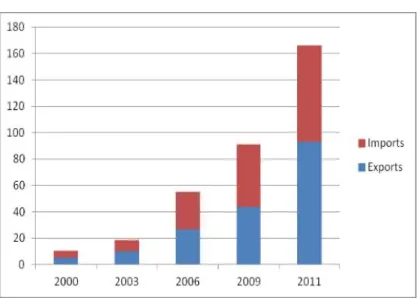
Chinese-African trade has grown rapidly since 2000, reaching $160 billion in 2011 from just $9
billion in 2000, surpassing the U.S.52 China’s share in Africa’s total trade has also been
extraordinary, increasing to 13% from 3% a decade ago (JONES and WILLIAMS,
2012). Moreover, China’s FDI stock in Africa in 2010 reached more than $13 billion.53
China is also Africa’s largest single source of imports, while the U.S. is its largest
50
Anshan, L. (2006) “The Emergence of China in the China-Africa Relations Context: Criticism of Three International Perspectives”, Journal of World Economics and Politics, cited in POWER and MOHAN, (2008, p. 17).
51
See figure No.12. See also SAMY, 2010 52
See figure No.13 53
export destination.54 This economic trend in China’s relationship with Africa is built
upon its need for natural resources. The evidence of this is that fossil fuels and raw
materials represent roughly 4/5 of Chinese imports originating from Africa and there are
around ten African countries which account for 76% of all trade relations with China.55
Moreover, the financial support from Chinese banks, including China Export-Import
Bank has had a vital role in strengthening its economic relations with Africa. It provides
loans to governments and supports Chinese companies, which are normally
state-owned, to invest in Africa through export credits, loans for overseas projects and
international guarantees.56 Furthermore, in order to take full advantage of the
Sino-African cooperation, China has also established commercial and investment hubs called
Special Economic Zones (SEZ), "which provide “infrastructure corridors” that link African producers and markets in China" (SHINN and EISENMAN, 2008, p. 5). Its low interest loans and its funding mechanism of exchange, known as the Angola Mode,57 have received strong criticisms among American officials, who argue that by pursuing this policy China allows countries to escape IMF and World Bank58
regulations and also restricts the access of U.S. companies in Africa.
Thirdly, China seeks to become a major international player promoting a multi-polar
world, in contrast to the American “bipolar system” (XU YI-CHONG, 2008), and at the
same time wants to develop good relationships with all African countries to gain
political support in regional and international forums. And lastly, China is seeking to
end Taiwan’s international recognition and replacing it with the recognition of Beijing.
Generally speaking, Chinese interests in Africa are both economic and political
interests.
Concluding, over the past decade while the U.S. has all too often ignored SSA in its
policies, Beijing has quietly established relationships with the continent’s political and
business elites. The pursuit of its national and international interests instigate a more
active and globally orientated foreign policy based on its historical traditions with
54
About China’s trade in Africa see also RENARD, M.F. (2011), “China’s trade and FDI in Africa”,
African Development Bank Group, Working Paper, No. 126, May. 55
See figure No.15 56
See also (SHINN and EISENMAN, 2008) 57
This is an exclusive economic funding mechanism in Sino-African cooperation: the payment of the loan for infrastructure projects is made in terms of natural resources.
58
African countries and to a certain point on ideational factors59 operated under the
framework of a win-win cooperation.
59
CHAPTER IV
U.S. RESPONSES TO CHINA’S PRESENCE IN AFRICA
After a brief review of the U.S. and China's foreign policy and interests in Africa,
this chapter will analyze: (i) the implications of Chinese initiatives to U.S. foreign
policy in Africa and; (ii) the various American responses to China's presence on the
continent. The analysis of these parameters will be based on three main dimensions:
economic, security and political. So far, it seems that the United States doesn’t have an
effective strategy to counter China’s influence in Africa. What can be seen is rather an
assembled set of measures aimed to limit China’s dominance. Moreover, U.S.-China
interaction on the continent can be viewed as an action-reaction sequence.60
1. ECONOMIC DIMENSION
The Chinese initiatives and economic successes discussed in the previous chapter
have been followed closely by the U.S. In 2000, the same year that China established
the FOCAC, the Clinton Administration introduced a comprehensive U.S. trade and
investment policy for the African continent - the African Growth and Opportunity Act
(AGOA). Since then, AGOA has been the main economic act to strengthen the
U.S.-Africa relationship, and the only successful economic response to China in U.S.-Africa and it
also has had a predominant role in acquiring oil and natural resources. In fact, energy
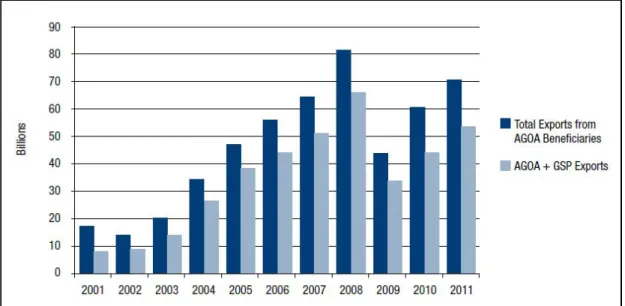
resources have dominated the products imported from Africa under AGOA. Since 2000
exports under AGOA have increased from $8.15 billion in 2001 to $53 billion in
201161, 90% of which have been energy related products.62 Also, during the first term of
the Bush Administration (2001-2004), the Millennium Challenge Corporation (MCC)
(2004), a multi-billion dollar program which provides assistance for “compact
agreements” to reduce poverty and stimulate the economic growth, was established.63
60
I want to use this term, used mainly in physics, to better illustrate the American-Sino interaction on African continent. Based on Newton's Third Law of physics: "Every Action has an equal and opposite reaction". There is a great similarity between Newtonian force and diplomatic action. As in physics, every action in bilateral and multilateral relations (for instance: China’s relation with African countries) can produce a response from the political elite of another country which is pursuing similar interests (in this case the U.S.) which is pursuing similar interests.
61
See figure No. 16 62
See figure No.17. About US energy security see also GROUP, (2001) 63
The Obama Administration has also been involved in promoting a more proactive U.S
economic response to China in Africa. Like his predecessors G.W.Bush and Bill
Clinton, Obama has embraced AGOA to demonstrate that the U.S. commitment is more
than just foreign aid, military ties, and special bilateral deals. It is a partnership in
building the capacity for transformational change. On his official visits to Africa in
2009, Obama has clearly expressed his wish to help African states to develop
economically and treat them as potential valuable international partners. Furthermore,
Hillary Clinton also visited Africa in 2011, voicing U.S. desire for sustainable
investments in Africa: “We want a relationship of partnership not patronage, of sustainability, not quick fixes. We want to establish strong foundation to attract new investment” (SECRETARY OF STATE, 2011).
It is important to note, the official visits have been a mechanism used by the U.S.
leaders to contribute to a greater U.S. engagement in Africa. However, the number of
U.S. official visits to Africa in contrast with the Chinese has been highly inferior,
showing once again how different methods drive different foreign policies.64
Although AGOA has contributed to increase US-Africa trade, “the achievements of AGOA have by and large been below expectations” (BROOKINGS, 2011, p. 3). In particular, it has not contributed to any visible economic transformation of African
economies and has not been able to stimulate American investments in Africa.65
More recently, in an attempt to encourage the U.S. and Africa to do business together,
the White House has announced a new U.S. Strategy for Sub-Saharan Africa.66 In an
attempt to spread the pillars of this new strategy, on July 31st 2012, the Secretary of
State Hillary Clinton embarked on an official journey to several African countries.
Apart from strengthening the U.S.–Africa commercial relations, Clinton’s visit has also
been interpreted as an attempt to counter China’s influence in Africa. According to
Viano, “The U.S. wants to use this visit as a manoeuvre to limit the influence of China […] cautioning African leaders not to strike deals too easily with China” (VIANO, 2012).67 This strategy comes only a few weeks after the Forum on China-Africa
Cooperation (FOCAC) in Beijing. However, coming a bit too late in the game, only six
64
Figures No.18 and No.19 65
See also CARGILL, T., and VINES, A., (2010), “Sub-Saharan Africa: Providing strategic vision or fire-fighting?”
66
About U.S. strategy for SSA see (THE WHITE HOUSE, 2012, (a)). 67
Interview available at
months left in his term, Obama’s strategy is rather a solidification of existing policy
than a new policy, and it doesn’t really establish new economic initiatives and major
innovations in US-Africa trade relations.
It’s evident that the visits, speeches and meetings haven’t resulted in delivering major
economic agreements and diplomatic initiatives, apart from small programs, grants and
loans. The institutional fragmentation and the lack of coordination between many
American agencies deeply contrasts with the Chinese way of acting, making it difficult
for the U.S. to achieve concrete economic objectives, especially as China gives African
countries an alternative way of doing business and more bargaining power.
2. SECURITY AND MILITARY DIMENSION
Apart from economic responses, the U.S. has also been using military initiatives
and tactics, aimed mainly at combating terrorism and containing local threats to try to
secure the safe flow of natural resources from Africa. The U.S. has used a variety of
security assistance programs and established military bases in Africa to enhance its
military influence68. As a result, the U.S. is now involved directly and indirectly in
military and surveillance operations against an expanding list of regional enemies. They
include: al-Qaeda in the Maghreb in North Africa; the Islamist movement Boko Haram
in Nigeria; possible al-Qaeda-linked militants in post-Qaddafi Libya; Mali’s Islamist
rebels of the Ansar Dine, al-Shabaab in Somalia; Joseph Kony Lord’s Resistance Army
(LRA) in the Central African Republic and Uganda; and guerrillas from al-Qaeda in the
Arabian Peninsula across the Gulf of Aden in Yemen (TURSE, 2012). However, the
fight against terrorism can be seen as a strategic tactic whose goals go beyond mere
"war on terrorism".
Many authors69 argue that at a strategic level by increasing military presence in Africa
the U.S. may target the access to natural resources and indirectly China’s intensive
presence in Africa. Although empirically it is more difficult to examine this, China is at
least one of the potential reasons for U.S. military presence in Africa, and the US Africa
Command (AFRICOM), seen by China as “unpleasant and out of sorts”70, has been the main instrument in achieving this goal. Peter Pham stated in 2007 that AFRICOM’s
main objective is “protecting access to hydrocarbons and other strategic
68
About the U.S. Military Programs in Africa see also VOLMAN, 2006. 69
For instance HUNT (2007); PHAM J.P. (2008); HABIYAREMYE (2011) 70
"U.S. Embarrassment in Africa,”
resources…ensuring that no other interested third parties, such as China, India, Japan, or Russia, obtain monopolies or preferential treatment”.71By using U.S. troops as part of the new African Command, some authors argue that the U.S. is intending to increase
its presence in certain oil-rich areas, such as Sudan, Libya, Angola, Nigeria, Uganda,
Kenya, ensuring in this way a beneficial investment climate for American oil firms and
weaking China’s relations with African governments.Moreover, AFRICOM’s presence
may threaten the political influence that China has established both on the continent and
in international bodies.
Another consideration in the implementation of AFRICOM is to help to control
strategic waterways and important ports around the continent. Since mid-2000 the U.S.
Navy has significantly increased its presence in African waters, especially on the West
African coast. In addition to other goals, such as combating piracy, illegal fishing and
illegal trafficking,the fact remains that oil forms the primary interest and determines the
nature of U.S. policy towards West Africa (and AFRICOM activities)72. In 2011 the Ambassador J. Anthony Holmes argued that the U.S. wants to “ensure that the system operates without disruption”.73 Thus, some authors believe that “U.S. navy ships patrolling these areas could help reestablish maritime security” (CRUZ and STEPHENS, 2010), and enable Washington to secure its strategic interests. On the other
hand, some analysts argue that by expanding its military “arsenal” in African waters, the
U.S. Navy is strategically trying to control in the future the transportation of oil and
other minerals from Africa to China.74
U.S. Officials claim that their increasing military engagement in Africa is a strategic
partnership for cooperation, development and support for fighting terrorism. By incorporating military and security interests with development, the U.S. aims to
embrace a strategy different than former policy mainly focused on a “hard power”
policy. According to some authors, “AFRICOM could be part of a greater U.S. foreign policy strategy for “smart power” in the developing world” in order to win trust among African countries (CRUZ and STEPHENS, 2010, p. 195). The activities intended to
fight terrorism and provide security could be classified as ‘hard power’, whereas other
programs, such as military training and education programs, and humanitarian projects,
71
Cited in (WILLIAM, 2008) 72
See also (KLARE and VOLMAN, 2006) 73
(US AFRICOM Public Affairs, 2011) 74
are intended to build ‘soft power’. As Nye observes, “the military can sometimes play an important role in the generation of soft power” (NYE, 2008, p. 106). However, the AFRICOM military programs don’t seem to generate soft power, since suspicions and
skepticism has been raised regarding its main motives, making it harder to find partners
for the implementation of the program.75 The diminished credibility of American policy
as a result of the Iraq war, as well as the incapacity of the Department of Defense in
adequately explaining how the command will help African countries, aroused a fear that
the U.S. was militarizing its foreign policy in Africa.76 As Michelle Ruiters, a senior
researcher at the Institute for Global Dialogue puts it “AFRICOM would destabilize an already fragile continent and region, which would be forced to engage with U.S. interests on military matters”. 77 China, on the other hand, at the moment does not use military pressure to achieve agreements with African countries; it uses a “soft power”
policy based on flexibility, consistency and pragmatism, which in turn provides
transparency, legitimacy, accountability, visibility and recognition among African
countries.
In spite of the attempts of U.S. efforts in projecting a soft power message, its military
presence in Africa is still questionable.
3. POLITICAL DIMENSION
In order to better understand U.S. actions in Africa, it is important to acknowledge
the rivalry between the U.S. and China in the international context. Since the late 80’s,
China’s rise has being viewed with uncertainty and anxiousness in the U.S. Its rapid
economic growth, its rising power and influence in the world, “raised the specter of a new global rivalry for power and influence (FRIEDBERG, 2005, p. 7). The U.S. prevalent debate has focused on two main schools of thoughts: liberalism - essentially
optimistic - and realism - distinctly pessimistic. The main opinion in the U.S. is that a
rising China has reshaped the existing global order and challenged the global leadership
of the U.S. (ZHOU, 2011, p. 626). American pessimists from the realist school argue
that China possesses a “big challenge”78 for the U.S. and a great power rivalry between China and the U.S. is inevitable. Additionally, realists defend that China’s growing
75
At the moment AFRICOM is located in Stuttgart, Germany. 76
See Warner Jason, (2011), “Neo-Imperialistic and Anti-Security Blanket in Africa: The need for Nuance on the Debate about AFRICOM”, Yale Journal of International Affairs, 105.
77
Michelle Ruiters, “Why U.S.’s Africom Will Hurt Africa” cited in CRUZ and STEPHENS (2010, p. 204)
78