Escola de Engenharia
Inês Carlos Alves
Biodiesel by-product as an
admixture for cement-based materials:
an experimental study
Msc Dissertation
Integrated Master in Civil Engineering
Supervised by:
Professor Miguel Azenha
Professor Cândida Lucas
Escola de Engenharia
Inês Carlos Alves
Biodiesel by-product as an
admixture for cement-based materials:
an experimental study
AKNOWLEDGEMENTS
At the end of the process that led to this work, I would like to express my recognition to all of those who, in a more direct way, have been involved.
First of all, my acknowledge to Professor Miguel Azenha and to Professor Cândida Lucas, on the professionalism, scientific rigor, availability and encouragement that they have demonstrated in the orientation of this work, which have allowed my intellectual growth.
To Professors Aires Camões and José Barroso Aguiar, for having provided all the material and equipment of the Building Materials Laboratory.
To José Granja, for the indispensible help in the treatment of the data related to the EMM-ARM test and to Christoph, by the teachings.
To the lab technicians, for the availability and help that have proved, especially to Engineer Carlos Jesus, without whom the development of the experimental study would have never been possible.
To Engineer Miguel from the Mechanical Department, for the help with handling and setup of the thermostat.
To Pakril, for the availability, to Prio, that provided the crude purified glycerol and to Sika, which has supplied the antifreeze admixture.
To DST, in the person of my dear friend Pedro Teixeira, for the cement.
To my fellows Paula Neto, Vanessa Sequeira and Margarida Vieira.
To all of my friends, remarkably, to Filipa Machado, Isa Ferreira and Catarina Alves for, each one his or her own way, giving me support and for having encouraged me. To Maria João
To Miguel Souto, for the complicity and longstanding friendship and for this five-year trip.
At last, but not least
To my parents and sisters, to whom I owe part of what I am, I appreciate the permanent encouragement of my professional and human valorization.
To Mário and Pedro, for making part of my path.
ABSTRACT
The incorporation of admixtures or additions into concrete mixtures is extremely generalized owing to their ability to confer numerous advantageous effects on concrete. However, because admixtures are frequently expensive and may carry relevant ecological footprints, there is an increasingly higher necessity and interest in finding cheaper and more sustainable admixtures in otherwise useless by-products generated by industrial processes.
Biodiesel production in one of such industries, which by-product is the crude glycerol that is produced in a 1:10 mass ratio in relation to biodiesel production, and it generally has 80%-88% of purity, thus containing various impurities, such as ash, soap, chloride and residual methanol. In order to make crude glycerol a useful product for general industry processing, it is necessary to upgrade it to glycerol of high purity. Nonetheless, at intermediate levels of purity, crude glycerol might be usable for concrete industry. In fact, because of its physical-chemical properties and compounds, it is plausible to suspect that there might be a potential synergy between the crude purified glycerol with cement-based materials by applying this treated by-product to the mixture as an admixture. As such evaluation is not yet reported in the literature, the corresponding research opportunity is identified and followed in this work.
Thus, the main objective of this dissertation is to understand the effects of the addition of crude purified glycerol obtained from biodiesel production into cementitious materials. For this purpose, an experimental program has been carried out on several mixtures of cement pastes and mortars regarding the incorporation of crude purified glycerol, but also reference materials such as synthetic glycerol and a commercial antifreeze admixture. The analysis of the obtained results allowed the evaluation of the incorporation of crude purified glycerol over the fresh and hardened properties of cement-based materials. As main conclusions, it is possible to highlight that the inclusion of crude purified glycerol caused a reduction of the initial and final setting times of the cement paste samples and a significant increase in the pace of stiffness/strength evolution in the cement paste samples since early ages. Therefore, there is a strong potential to further study crude purified glycerol as an accelerating admixture.
RESUMO
A incorporação de aditivos ou adições no betão está muito generalizada devido às suas capacidades de conferir diversos efeitos vantajosos no betão. Contudo, as misturas são, por vezes, caras e podem implicar impactos ambientais negativos, pelo que aumenta a necessidade e o interesse em encontrar soluções mais baratas e mais sustentáveis, suportadas no aproveitamento de subprodutos de outras indústrias.
A produção de biodiesel é uma dessas indústrias, cujo subproduto é o glicerol bruto, produzido num rácio de 1:10, em relação à produção de biodiesel e tem, normalmente, um grau de pureza de entre 80%-88%, sendo, portanto, constituído por diversas impurezas, tais como ash, soap and chloride and residual methanol. Para possibilitar a sua utilidade na generalidade das indústrias, é necessário purificá-lo previamente de modo a torna-lo num glicerol com elevado grau de pureza. No entanto, o glicerol bruto purificado a níveis intermédios pode ser útil para a indústria do cimento. De facto, devido à sua composição e às suas propriedades físicas e químicas, é expectável que possa existir uma potencial sinergia entre o glicerol bruto purificado e os materiais cimentícios, quando incorporado na mistura como um aditivo. Face ao exposto, esta investigação constitui uma avaliação desta problemática, que ainda não está reportada na literatura.
Assim, o objetivo principal deste estudo é o de compreender os efeitos da incorporação do glicerol derivado da produção do biodiesel em materiais cimentícios. Para tal, desenvolveu-se um programa experimental a partir da realização de diferentes misturas de pastas de cimento e de argamassas que compreenderam a incorporação não só do glicerol bruto purificado, mas também do glicerol sintético e de uma mistura comercial com propriedades anticongelantes.
A análise dos resultados possibilitou a avaliação dos efeitos da incorporação do glicerol bruto nas propriedades frescas e endurecidas dos materiais cimentícios. Como principais conclusões, é possível afirmar que a incorporação do glicerol provocou uma redução do início e fim de presa e que causou um aumento no grau de aquisição de rigidez/resistência dos referidos materiais. Consequentemente, há um forte potencial para estudar mais
Palavras-chave: Materiais cimentícios; aditivos; sub-produto do biodiesel; glicerol; testes
LIST OF SYMBOLS AND ABBREVIATIONS
In the name of the intelligibility, the description of each notation or symbol used in the present dissertation is made upon its first appearance in the text.
Roman Letters
a Antifreeze admixture A Cross section
b Flank of the square section of the prism d Dimension of the transversal section
dk Arithmetical mean of the mean carbonation depth of two specimens dk, face Mean depth of carbonation for each exposed face of a specimen dk, spec Mean depth of carbonation for each specimen
dp Depth of penetration F Maximum load
Fc Maximum load by the time of the rupture fct Tensile splitting strength
Ff Load applied at the center span
g Crude purified glycerol or acceleration of gravity G Nominal gage length
h Height of water kG Permeability
Kw Permeability Coefficient
kw Permeability coefficient to the water l Distance between supports
l/c liquid to cement ratio
L is the length of the contact line of specimen; is the change in length at x age, %; L3 Thickness of the specimen (m);
Li Initial comparator reading of specimen minus comparator reading of reference bar at the same time, in mm;
m1 Mass of the specimen saturated in the air; m2 Hydrostatic mass of the saturated specimen; m3 Mass of the dry specimen;
Rc Compressive strength Rf Flexural Strength s Sand
sg Synthetic glycerol
t Length of time it took to penetrate until the dp depth w Mass of free water (not chemically bound)
w/c Water to cement ratio
Greek Letters
δ Specimen porosity; η Dynamic viscosity ηw Water viscosity at 20ºC ν Flow of the fluid
ρ Density of water ρ1 Inlet gas pressure ρ2 Outlet gas pressure
TABLE OF CONTENTS
Aknowledgements ... I Abstract ... III Resumo ... V List of symbols and abbreviations ... VII Table of contents ... IX List of figures ... XII List of tables ... XV
1 Introduction ... 1
1.1 Scope and motivation ... 1
1.2 Research objectives and methods ... 2
1.2 Dissertation outline ... 3
2 Construction materials ... 5
2.1 Introduction ... 5
2.2 Brief history of cement and concrete ... 10
2.3 From concrete to modern concrete ... 11
2.4 Admixtures, Additives and Additions ... 12
2.4.1 Accelerators ... 14
2.4.2 Retarders ... 18
2.4.3 Water-reducing/plasticizers admixtures ... 20
2.4.4 Antifreezing admixtures ... 20
2.4.5 Shrinkage reducing admixtures ... 23
2.4.5.1 Shrinkage admixtures ... 26
3 Biodiesel ... 28
3.1 Introduction ... 28
3.2 Biodiesel production ... 29
3.2.1 Direct use and blending ... 29
3.2.2 Microemulsions ... 30
3.2.3 Thermal cracking (pyrolysis)... 30
3.2.4 Transesterification ... 30
3.3 Catalysts ... 32
3.6 Glycerol ... 37
3.7 Crude glycerol as a by-product and an admixture for cement ... 39
4 Experimental program ... 41
4.1 Introduction ... 41
4.2 Overview ... 41
4.3 Materials ... 44
4.3.1 Ordinary Portland cement ... 44
4.3.2 Sand ... 45
4.3.3 Synthetic glycerol ... 46
4.3.4 Crude purified glycerol ... 46
4.3.5 Antifreeze ... 48
4.3.6 Water ... 48
4.4 Mixes and general procedure ... 49
4.4.1 Compositions of cement pastes and mortars under study ... 49
4.4.2 Mixing, casting and curing ... 53
4.5 Experimental techniques... 55
4.5.1 Marsh Cone – flowability determination ... 55
4.5.2 Vicat’s needle – set time determination ... 56
4.5.3 Flexural strength ... 56
4.5.4 Compressive strength ... 57
4.5.5 Tensile splitting strength ... 58
4.5.6 Shrinkage ... 59
4.5.7 Elasticity modulus evaluation - EMM-ARM methodology ... 61
4.5.8 Carbonation ... 63
4.5.9 Water absorption through immersion ... 64
4.5.10 Permeability ... 65
4.5.11 Freezing points determination ... 68
5 Tests results and discussion ... 70
5.1 Introduction ... 70
5.2 Presentation and analysis of the results ... 70
5.2.1 Flowability ... 70
5.2.4 Flexural Strength ... 76
5.2.5 Tensile Splitting Strength ... 80
5.2.6 Shrinkage ... 81
5.2.7 Elasticity Modulus ... 82
5.2.8 Water absorption through immersion ... 85
5.2.9 Oxygen and Water Permeability... 87
5.2.10 Carbonation ... 89
5.2.11 Freezing points evaluation ... 91
6 Conclusion ... 93
6.1 General remarks ... 93
6.2 Prospects for future developments ... 95
LIST OF FIGURES
Figure 2.1 - Pictorial representation of a cross-section of a cement grain (Barron, 2010) ... 6
Figure 2.2 - Schematic representation of anhydrous cement (a) and the effect of hydration after (b) 10 minutes, (c) 10 hours, (d) 18 hours, (e) 1-3 days, and (f) 2 weeks. Adapted from Taylor (1990b) ... 8
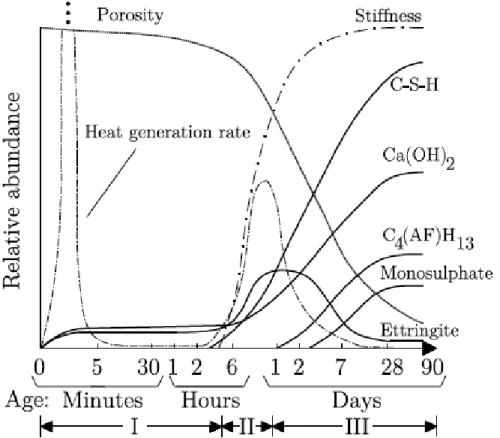
Figure 2.3 - Formation of several hydration products with time, together with porosity and heat generation rate evolution (Azenha, 2009) ... 9
Figure 2.4 – Schematic comparison of strength development with hardening accelerator and flash-setting (set accelerating) admixtures (Hewlett, 1987) ... 15
Figure 2.5– (a) General hydration curve from conduction calorimetry and (b) possible accelerative effects on hydration curve (Hewlett, 1988) ... 16
Figure 2.6 – Compressive strength results for control admixtures, admixtures with calcium nitrate (Nitrate), admixtures containing triethanolamine (TEA), admixtures with triisopropanolamine (TIPA), admixtures with Nitrate+TEA and admixtures with Nitrate+TIPA (Aggoun et al., 2008) ... 16
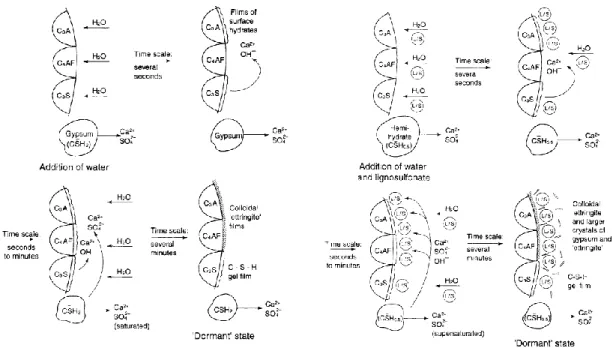
Figure 2.7 – Early hydration reactions of Portland cement: normal behavior with no admixture present (a) and behavior in the presence of lignosulfate (L/S) (Edmeades, 1984) ... 19
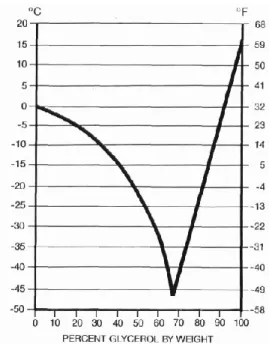
Figure 2.8 – Freezing Points of Glycerol-Water Solutions (Lane, 1925)... 21
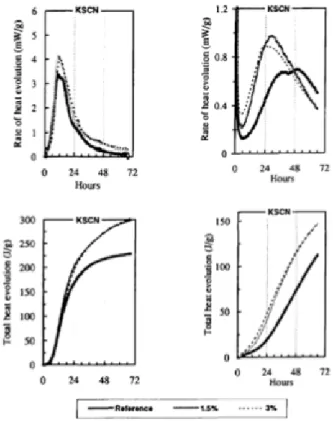
Figure 2.9 - Heat of hydration of cement paste with salts of different concentrations at 20°C and 0ºC, respectively (Wise et al. (1995)) ... 22
Figure 2.10 – Effect of pore meniscus and surface tension on the drying shrinkage of mortar (Balogh, 1996) ... 24
Figure 3.1 - Transesterification Reactions ... 31
Figure 3.2 - Granulometry and performance properties of three cement clinkers with addition of pure or raw glycerol (Pagliaro, 2008a)... 40
Figure 4.1 Overview of the experimental program ... 43
Figure 4.2 - Sample of Crude Purified Glycerol ... 47
Figure 4.3 - Photo of specimens from mixtures 5 and 7 upon unmoulding after 20h ... 51 Figure 4.4 - Two halves of the specimen to be used for compressive strength testing after the
Figure 4.5 - Indirect Tensile Strength Procedure ... 59 Figure 4.6 – Detail of the plug embedded in each extremity of the specimen ... 60 Figure 4.7 – (a) Measure of the length change of the reference bar; (b) Measure of the length change of the specimen... 60 Figure 4.8 - Estimated Ec for plain pastes (P5.1), and for pastes with retarding (P5.r) or accelerating (P5.a) admixtures (Azenha et al., 2011)... 62 Figure 4.9 – a) Acrylic tube; b) Detail of the lid; and c) Experimental setup in the measuring position for the EMM-ARM and the accelerometer (Azenha et al., 2011) ... 63 Figure 4.10 - Scheme of the experimental setup (plan view) (adapted from (Azenha et al., 2011)) ... 63 Figure 4.11 – Example of a typical result of a carbonated specimen adapted from (Kim et al., 2009) ... 64 Figure 4.12 - Leeds unit permeability and its constituents ... 67 Figure 4.13 – Deepfreeze used (a) and detail of thermostat with the probe (b) ... 69 Figure 5.1 - Flowability results of cement pastes (each result corresponds to the average of 3 tests) ... 71 Figure 5.2 - Compressive strength results of pastes cured at room temperature (each result corresponds to the average of 3 specimens) and percentage differences of average compressive strength, in regard to the reference mixture ... 73 Figure 5.3 - Compressive strength results of pastes cured at -1ºC (each result corresponds to the average of 3 specimens) and percentage differences of average compressive strength, in regard to the reference mixture ... 75 Figure 5.4 - Flexural strength results of pastes cured at room temperature (each result corresponds to the average of 3 specimens) and percentage differences of average compressive strength, in regard to the reference mixture ... 77 Figure 5.5 - Flexural strength results of pastes cured at -1ºC (each result corresponds to the average of 3 specimens) and percentage differences of average compressive strength, in regard to the reference mixture ... 79 Figure 5.6 – Average cumulative drying shrinkage results of three replicate specimens for each mixture ... 82 Figure 5.7 – E-modulus evolution for mixtures P_R, P_1%g, P_3%g and P_1%sg, regarding the EMM-ARM methodology ... 83 Figure 5.8 – Overlapped results of EMM-ARM and set time tests ... 85
Figure 5.10 – Oxygen permeability results obtained for the both tested specimens, by the age of 28 days ... 87 Figure 5.11 - Water permeability results obtained for the both tested specimens, by the age of 28 days ... 88 Figure 5.12 – Specimen after the curing period ... 89 Figure 5.13 – Specimen appearance after vaporization of phenolphthalein solution ... 90 Figure 5.14 – Average carbonation results of three tested specimens by 56, 63 and 70 days . 91 Figure 5.15 – Freezing points water-glycerol (in crude an synthetic form) and water-antifreeze admixtures solutions ... 92
LIST OF TABLES
Table 2.1 - Chemical formulae and cement nomenclature for major constituents of Portland
cement. Abbreviation notation: C = CaO, S = SiO2, A = Al2O3, F = Fe2O3 (Barron, 2010) ... 5
Table 2.2 - Nomenclatures and respective definitions according to each institution/standard 12 Table 2.3 – List of some admixtures and additions for concrete (Chan, 1999, Hewlett, 1988, Hewlett, 2004b, Nagataki, 1994b, Ramachandran, 1996, Rixom, 1999) ... 25
Table 3.1 - Biodiesel production Techniques ... 31
Table 3.2 - Catalysts Categories ... 33
Table 3.3 - Types of Vegetable Oils used in biodiesel production... 35
Table 3.4 - Quality parameters of different categories of glycerol (partially based in Hazimah AH (2003) and in Mohtar Y (2001)) ... 38
Table 3.5 - List of currently available and predicted outlets for crude glycerol (Ayoub and Abdullah, 2012) ... 39
Table 4.1- Specimens used in this research ... 43
Table 4.2 - Physical and mechanical properties of CEM I 42,5R (SECIL, 2004) ... 45
Table 4.3 - Chemical Composition (%) and fineness of CEM I 42,5R (Azenha, 2009) ... 45
Table 4.4 - physical and chemical properties of the Standard Sand (SNL, 2007)... 45
Table 4.5 - Synthetic glycerol properties (HIMEDIA, 2013) ... 46
Table 4.6 – Crude Purified Glycerol Analysis Report (PRIO, 2012) ... 47
Table 4.7– Sika Antigel properties (SIKA, 2011) ... 48
Table 4.8 - Mixtures Performed ... 49
Table 4.9 – List of mixtures submitted to the different tests ... 50
Table 4.10 - Tests and Standards ... 52
Table 4.11 - Curing Conditions in compliance with each test performed ... 54
Table 5.1 - Overall results of flowability, including average flow time, standard deviation and coefficient of variation... 71
Table 5.2 - Initial and Final Setting Times ... 72
Table 5.3 - Average compressive strength, standard deviation and coefficient of variation at each corresponding age, of pastes cured at room temperature ... 74
Table 5.5 - Average flexural strength, standard deviation and coefficient of variation at each corresponding age, of pastes cured at 20ºC ... 78 Table 5.6 - Average flexural strength, standard deviation and coefficient of variation at each corresponding age, of pastes cured at -1ºC ... 80 Table 5.7 - Overall results of tensile splitting strength, including the value obtained for each specimen, average, standard deviation and coefficient of variation ... 81 Table 5.8 - Compressive strength regarding mixtures P_1%g, P_3%g and P_1%sg, comparatively to the reference mixture, together with the values obtained for the elasticity modulus ... 84 Table 5.9 – Water absorption results for both specimens tested, together with the average, standard deviation and coefficient of variation ... 86 Table 5.10 – Oxygen permeability results for both specimens tested, together with the average, standard deviation and coefficient of variation ... 87 Table 5.11 - Water permeability results for both specimens tested, together with the average, standard deviation and coefficient of variation ... 89
1 INTRODUCTION
1.1 Scope and motivation
The incorporation of admixtures or additions into concrete mixtures is as generalized as the use of hydraulic binders owing to their ability to confer numerous advantageous effects on concrete (Hewlett, 2004a), such as: increased workability, controlled setting, accelerated hardening, reduction of water necessity, improved strength/ductility, damp proofing, permeability reduction, corrosion inhibition, shrinkage reduction, freeze-thaw resistance, reduced carbonation, etc (Ramachandran, 1996). However, because admixtures are often expensive (Lachemi et al., 2004) and may carry relevant ecological footprints, there is an increasing necessity and interest in finding cheaper and more sustainable admixtures in otherwise useless by-products generated by industrial processes. One such type of by-product is ground granulated blast furnace slag (GGBS), which is produced from the blast-furnaces of iron and steel industries, and is very useful in the production of high quality cement paste/mortar and concrete (Siddique and Bennacer, 2012). Several other by-products could be named such as: fly ash, condensed silica fume and rice husk ash (Nagataki, 1994a, Mehta, 1989).
Biodiesel is a clean, non-toxic, biodegradable and renewable burning fuel (Santacesaria et al., 2012). Its worldwide production is rapidly increasing and so is the resulting by-product: crude glycerol, which generally has 80%-88% purity (Ayoub and Abdullah, 2012), and constitutes approximately 10% of the weight of the total biodiesel production. Pure glycerol is a colourless, viscous, and odourless metabolic intermediate and structural component of the major classes of biological lipids, triglycerides and phosphatidyl phospholipids (Rahmat et
al., 2010), usually derived from both natural and petrochemical feedstocks (Ayoub and
Abdullah, 2012). It is completely soluble in water, in alcohols and hardly at all in many common solvents, with the exception of hydrocarbons (Pagliaro, 2008b). It is a hygroscopic liquid with a high boiling point which is also virtually nontoxic to human health and to the environment (Pagliaro, 2008b). Crude glycerol resulting from biodiesel industry contains various impurities, such as ash, soap and chloride and residual methanol (Ayoub and Abdullah, 2012). Even though pure glycerol has many industrial applications (in areas such as food, livestock feed, biotechnology, pharmaceutical, cosmetics or drug industries (Ayoub and Abdullah, 2012)), the presence of impurities in crude glycerol resulting from biodiesel
production render it a low economic value. In fact, in order to purify crude glycerol associated to biodiesel production (80%-88% purity) (Ayoub and Abdullah, 2012) and make it a useful product for general industry processing, it is necessary to upgrade it to highly pure glycerol (up to 98% of purity) (Rahmat et al., 2010). Currently, many processes have been developed to refine/purify crude glycerol and most of them are based on the simple distillation of glycerol, because that can produce a high yield of high-purity glycerol. Other possible processes for crude glycerol purification are based upon chemical and physical treatments and in innovative ion-exchange techniques (Manosak et al., 2011). After being refined, this glycerol finds applications in a broad diversity of end users as mentioned before.
In terms of terminology, it is hereby defined that, in this work, crude glycerol pertains to the glycerol originated from biodiesel production before purification, whereas crude purified glycerol corresponds to the same glycerol with subsequent purification (with a content of glycerol of 90,4%) and synthetic glycerol to the glycerol reagent grade, in its pure form (with a glycerol content of at least 99,5%), produced hydrolytically from fats and oils during soap and fatty acid manufacture (Pagliaro, 2008a).
Studies concerning the incorporation of crude glycerol with 5% of NaCl in clinker during milling have already been performed successfully, with observed improvements of the energy efficiency in handling and grinding processes, thus enhancing cement strength, while the environmental impact was eased (Rossi et al., 2008). Nonetheless, except for this application of crude glycerol in cement production, no other applications were found for this by-product in the industry of cement and concrete.
Because of its physical-chemical properties and compounds, it is plausible to suspect that there might be a potential synergy between the crude purified glycerol with cement-based materials by applying this by-product to the mixture as an admixture. As such evaluation is not yet reported in the literature, the corresponding research opportunity is identified and followed in this work.
1.2 Research objectives and methods
further intended to understand if there is an optimum quantity of crude purified glycerol in regard to the benefits that can be harvested from its inclusion in cement-based mixtures. A comparison of performance of crude purified glycerol and synthetic glycerol was also carried out in order to ascertain the influence of impurities. It is finally remarked that the use of crude glycerol was not considered in this research due to its high level of uncontrolled impurities (namely of organic nature) and the results on preliminary tests conducted at the University of Minho that revealed unsatisfactory behaviour (unpublished results).
So that the objectives could be fulfilled, a comprehensive experimental program took place, focusing mainly at the cement paste level. Cement paste specimens containing different percentages of glycerol in two different forms (crude purified and synthetic glycerol) were produced and submitted to tests in their fresh and hardened states, covering the following properties: flowability, set time, compressive, flexural and indirect tensile strengths, shrinkage, elasticity modulus, oxygen and water permeability, water absorption through immersion, carbonation and freezing points. For reference, cement pastes containing a commercial antifreeze admixture were also studied in regard to flexural and compressive strength. In regard to permeability studies, and due to the size of the necessary test specimens, the experiments were carried out in mortars constituted by cement, water, normalized sand and crude purified glycerol.
1.2 Dissertation outline
This dissertation is structured in a total of 6 Chapters, including the present introduction.
The second and third chapters are focused on a literature review. The history and concepts of concrete, cement and admixtures are discussed in the second chapter, followed sequentially, in the third chapter, by a detailed explanation about biodiesel production, as well as the catalysts and feedstock used for its development. The challenges of biodiesel manufacture, concerning the production of crude glycerol are also addressed. Moreover, a review of the aplications of crude glycerol in the manufacture of cement and of synthetic glycerol as an admixture for cement based materials is carried out.
The experimental program is explained in chapter four, through a convenient description of the materials and equipment used, as such as a detailed explanation about each test performed.
The corresponding results are analysed and thoroughly discussed in chapter 5, with inferences being made in regard to the actual behaviour of crude purified glycerol as an admixture for cement-based materials.
At last, a summary of the work developed is presented in chapter six, where the most important conclusions are highlighted. Additionally, in the referred chapter, further developments are suggested to complement the study started in the present dissertation.
2 CONSTRUCTION MATERIALS
2.1 Introduction
Construction materials represent a significant market share in current human commercial activities. Among the construction materials, hydraulic cements, which are produced by calcining a mixture of calcareous and argillaceous materials, are employed in a huge amount and their global consumption is expanding rapidly (Pagliaro, 2008a). It is also stated that, out of the hydraulic binders, the artificial Portland ones are by far the most significant in terms of production volume (Pagliaro, 2008a). In fact, Portland cement has remained a very successful building material since its advent in the nineteenth century (Shi et al., 2011). This type of cement is made by heating a mixture of calcareous materials, such as limestone, and clay or other materials of similar mass composition and plenty reactivity (Taylor, 1990b) ultimately to a temperature of about 1450ºC, which is termed the sintering temperature of cement (Azenha, 2009). At this stage, partial fusion occurs, and ball shaped particles called clinker are produced. Through the addition of a portion of gypsum, which is able to control the rate of set, this clinker is then finely ground to produce cement (Taylor, 1990b). In the anhydrous state, there are four chief minerals present in a Portland cement grain, namely the tricalcium silicate (Ca3SiO5), the dicalcium silicate (Ca2SiO4), the tricalcium aluminate (Ca3Al2O6) and the calcium aluminoferrite (Ca2AlFeO5) (Taylor, 1990a). The formula of each of these minerals can be broken down into the basic calcium, silicon, aluminum and iron oxides (Barron, 2010). Hence, traditional cement nomenclature abbreviates each oxide as shown in Table 2.1 (Barron, 2010).
Table 2.1 - Chemical formulae and cement nomenclature for major constituents of Portland cement. Abbreviation notation: C = CaO, S = SiO2, A = Al2O3, F = Fe2O3 (Barron, 2010)
Mineral Chemical
formula Oxide composition Abbreviation
Tricalcium silicate (alite) Ca3SiO5 3CaO.SiO2 C3S
Dicalcium silicate (belite) Ca2SiO4 2CaO.SiO2 C2S
Tricalcium aluminate Ca3Al2O6 3CaO.Al2O3 C3A
A typical cement contains 50–70% C3S, 15–30% C2S, 5–10% C3A, 5–15% C4AF, and 3–8% other additives or minerals (such as oxides of calcium and magnesium) (Taylor, 1990b). Figure 2.1 shows a typical cement grain.
Figure 2.1 - Pictorial representation of a cross-section of a cement grain (Barron, 2010)
The addition of water to dry cement powder, while creating an exothermic reaction, results in a thin cement slurry that sets and develops strength through a series of hydration reactions, which are not linear through time. Instead, cement hydration progresses very slowly at the beginning, allowing the mixture to be appropriately retained before hardening. It is the hydration of the calcium silicate, aluminate and alumina-ferrite minerals the responsible for the hardening of cement (Barron, 2010). The ratio of C3S to C2S helps to determine how fast the cement will set, with faster setting occurring with higher C3S contents. In fact, it is of common knowledge that C3S is the most important phase in cement for strength development during the first month, while C2S reacts much more slowly, and contributes to the long-term strength of the cement (Taylor, 1990b). Both the silicate phases react with water to form calcium hydroxide and a rigid calcium-silicate hydrogel, CSH.
The hydration of cement, which may be defined as the combination of all chemical and physical processes that occur after contact of the anhydrous solid with water (Stark, 2011), can be broken down into three distinct stages, known as the early period of hydration, the middle period of hydration and the late period of hydration (Taylor, 1990b), which are schematically represented in Figure 2.2 and whose evolution of hydration products is depicted in Figure 2.3. The process may also be divided into five stages, according to some authors,
being them the initial reaction, induction, acceleratory and decelerator periods and the final period of slow reaction.
Stage I – Early period of hydration – Almost immediately after adding water to cement, during the first few minutes of hydration (Figure 2.2(b)), the C3A phase (the most reactive of the four main clinker minerals) reacts with gypsum and water to form an amorphous, aluminate-rich gel at the surface of the cement grains and small rod-like crystals of ettringite are developed (Winter, 2009). C3A reaction with water is strongly exothermic but does not last long, typically only a few minutes (five or less) and the heat generation rate curve attains very high values. This initial part of the early period is usually termed as pre-induction and is followed by a period of a few hours of relatively low heat evolution, where cement hydration slows down, that is called the dormant, or induction period. The formation of a protective layer around cement particles, which prevents temporarily further reactions, may be the reason for this dormant period. During this period the material remains workable, i.e., it exhibits negligible mechanical stiffness (Azenha, 2009).
Stage II – Middle period of hydration - During this period, which begins at about 3h (after disruption of the protective layer) and ends at about 24h (Taylor, 1990b), the cement reacts. It coincides with that of strong heat evolution and is characterized by the rapid formation of amorphous calcium silicate hydrate, CSH (Taylor, 1990b) and crystalline calcium hydroxide (Ca(OH)2) (Azenha, 2009). The development of CSH in this period occurs in 2 phases (Barron): After 10 hours of hydration (Figure 2.2 (c)), C3S has produced CSH, which grows out from the ettringite rods. Therefore, in the initial phase of the reaction, the silicate ions must migrate through the aluminium and iron rich phases to form the CSH. In the latter part of the acceleratory period, after 18 hours of hydration, C3A continues to react with gypsum, forming longer ettringite rods (Figure 2.2 (d)). This network of ettringite and CSH appears to form a hydrating shell and a small amount of inner CSH forms inside this shell. This coincides with the maximum rate of heat release (Taylor, 1990b) and to a sudden and strong increase in stiffness, with the transition of the material from a fluid-like behaviour to a porous solid, usually attaining stiffness (i.e., Young’s modulus, also known as E-modulus) of over 50% of the value at 90 days by the end of this stage (Azenha, 2009). Along with the entire process, porosity of the material begins to diminish in resemblance to the growing formation of solid material (Azenha, 2009).
Stage III - Late period of hydration – After 1-3 days of hydration, reactions slow down and the decelerator period begins (Figure 2.2 (e)). C3A reacts with ettringite to form some monosulfate and inner CSH continues to grow near the C3S surface (Barron). In this stage, hydration reactions proceed, but at lower reaction rates owing to the progressive thickening of the hydrated products nearby the cement particles, which strongly reduce the heat generation rate (Azenha, 2009). After 2 weeks of hydration (Figure 2.2 (f)), the gap between the hydrating shell and the grain is totally occupied with CSH and the original outer CSH becomes more fibrous (Barron).
Figure 2.2 - Schematic representation of anhydrous cement (a) and the effect of hydration after (b) 10 minutes, (c) 10 hours, (d) 18 hours, (e) 1-3 days, and (f) 2 weeks. Adapted from
Figure 2.3 - Formation of several hydration products with time, together with porosity and heat generation rate evolution (Azenha, 2009)
One should bear in mind that the set of chemical reactions involved in cement hydration are highly dependent on the composition of the original binder, on the water-to-cement ratio, on the temperature of hydration and on the absence or presence of admixtures (Hewlett, 1987). Therefore, the average timings for the hydration product formation, the heat generation and the porosity evolution illustrated in Figure 2.3 are purely indicative for an ordinary Portland cement at a room temperature of ~20ºC (Azenha, 2009).
By way of conclusion, it is possible to define cement as an adhesive matter, which is proficient in bonding particles of solid substance into an entire compact one, when creased with water (Hewlett, 2004b). The hardening of the paste is due to the chemical reaction between the thin powders that are in their constitution and the water (Ramachandran, 1996), a process that is associated with both chemical and physical-mechanical changes, in particular with setting and hardening, as already mentioned (Hewlett, 2004b).
glues them together (Mindess, 2003b). The cement paste comprehends the active constituent of concrete, and its properties and performance are fundamentally determined by the properties of the cement paste (Ramachandran, 1996).
2.2 Brief history of cement and concrete
The first calcareous materials to be used as cements in mortars were gypsum and lime. These non-hydraulic materials have been used in Egypt (~3000 B.C.) and even earlier in Crete, Cyprus, Greece and in the Middle East (6000-12000 B.C.) (Mindess, 2003b). Hydraulic limes have also been produced by Greeks and Romans, through calcination of limestone containing argillaceous impurities. It is of common knowledge that Romans used animal fat, milk and blood to improve the quality of their binding mixtures. It is believed that they used this sort of materials to enhance workability, and, in fact, blood is a very efficient air-entraining agent and, moreover, it is able to improve concrete’s durability (Hewlett, 2004b). As well as Romans, other civilizations also impregnated admixtures into their mixtures of concrete-like materials: In the middle ages, in Europe, eggs were used; the Chinese made use of Rice paste, lacquer, tung oil, molasses and boiled bananas and in Mesoamerica and Peru, Cactus juice and latex were materials that were commonly used as admixtures for concrete (Mindess, 2003b). Furthermore, these civilizations realized that mixing certain volcanic deposits with lime and sand yielded stronger mortars, which were also resistant to water (Mindess, 2003b). Whereas Greeks used a volcanic ash from the island of Santorini, Romans used a similar one, denominated by them as pozzolana, from the Bay of Naples. In the Middle Ages, the practice of introducing ash was relegated to oblivion and thus, the quality of the cementitious materials declined. High-quality mortars only emerged again by the fourteenth century, when the pozzolans where reintroduced, whereas scientific studies on this subject only started in the eighteenth century (Mindess, 2003b). It was in this epoch that the Portland cement appeared and its usage spread rapidly across Europe and North America (Mindess, 2003b).
Mortar and concrete made with Portland cement have been popular constructions materials in the world for the past 170 years or more (Ohama, 1995). The reasons for concrete’s supremacy are mostly related to its properties, the economic aspect and the widespread availability of its constituents (Mindess, 2003b).
2.3 From concrete to modern concrete
Concrete and also cement mortar do have some disadvantages, such as delayed hardening, low tensile strength, low ductility, volume instability, low strength-to-weight ratio, large drying shrinkage, and low chemical resistance (Mindess, 2003b). In order to overcome these disadvantages, admixtures can be used. Admixtures can be defined as those ingredients in concrete, other than Portland cement, water and aggregates that are added to the mixture immediately before or during mixing, with the purpose of modifying the properties of mortar or concrete to make them more suitable for a particular work or for economy or for saving energy (Ramachandran, 1996). Admixtures have been used in the production of concrete for at least two millennia (Cheung et al., 2011), but their systematic study for cement-based materials began in the 1930s (Mindess, 2003b) and their application has accelerated greatly in the last four decades (Cheung et al., 2011). Since then, admixtures are widely accepted as materials that contribute to the production of durable and cost-effective concrete structures and, in fact, almost all modern concretes contain one or more admixture in their formulations, as they confer some beneficial effects due to their action on cement (Ramachandran, 1996). Admixtures’ contributions include improving the handling properties of fresh concrete and the physic and mechanic properties of the hardened concrete, being the major reasons for using admixtures the following:
i. To reduce the cost of concrete construction (Rixom, 1998);
ii. To achieve certain properties in concrete more effectively than by other means (Mindess, 2003b);
iii. To maintain the quality of concrete during the stages of mixing, transporting, placing, and curing in adverse weather conditions (Mindess, 2003b);
iv. To overcome certain emergencies during concreting operations (Mindess, 2003b).
In fact, “modern concrete” is beyond a mere mixture of cement, water and aggregates; it contains increasingly mineral admixtures that have even extra specific effects, as a result from the development of a new science of concrete and a new science of admixtures (A tcin, ). In fact, cement and concrete ought to evolve in the regard of the environment within a sustainable development perspective, meaning that more mineral components and chemical admixtures will be combined with clinker and water/cement ratios will be lowered in order to
increase the life cycle of concrete structures and reduce as much as possible the use of hydraulic binders and aggregates.
2.4 Admixtures, Additives and Additions
This section begins with a general review of the classification of admixtures with reference to North America and RILEM (Reunion Internationale des laboratoires d’Essais et de Recherches sur les Materiaux et lea Constructions) and to the European Standards. The North American sources include American Concrete Institute (ACI), American Society for Testing Materias (ASTM) and Canadian Standards (CSA). Table 2.2 summarizes the different nomenclatures and corresponding definition in accordance to each institution/standard.
Institution /Standard Nomenclature Definition
ACI 116R (2005) and
ASTM C 125 (2006) Admixture
A material other than water, aggregate, hydraulic cement, and fiber reinforcement used as an ingredient of concrete or mortar which is added to the batch immediately before or during its mixing, including both finely divided solids (mineral admixtures) and water-soluble compounds (chemical admixtures).
ASTM C 219 (2007) Addition
Material that is interground or blended in limited amounts into a hydraulic cement during manufacture either as a processing addition to aid in manufacturing and handling the cement or as a functional addition to modify the properties of the finished product.
RILEM (1992) Admixture
Inorganic (including minerals) or organic materials in solid or liquid state, added to the normal components of the mixture, in most cases up to a maximum of 5% by weigth of the cement or cementitious materials. Materials such as fly ash, slag, pozzolans or silica fume are not classified as admixtures, although they can be constituents of cement or concrete and also products acting as reinforcement.
BS EN 934-2 (2001) Admixture
Materials added during the mixing process of concrete in a quantity not more than 5% by mass of the cement content of the concrete, to modify the properties of the mixture in the fresh and/or hardened state
EN 206-1 (2005)
Admixture
Materials added during the mixing process of concrete in small quantities related to the mass of cement to modify the properties of fresh or hardened concrete.
Addition
Finely divided material used in concrete in order to improve certain properties or to achieve special properties. This standard deals with two types of inorganic additions: – Nearly inert additions (type I);
– Pozzolanic or latent hydraulic additions (type II).
Among the scientific world, there is no consensual definition about the terms admixtures, additives and additions. According to Mindess (2003a), the term “additive” lies into a mature phraseology used interchangeably with “admixture”. However, concurring to Hewlett (2004a), “admixtures should be distinguished from additives and additions in that these materials (additives and additions) are usually solids and are added to the cement during its manufacturing, (…), or as a major component in the manufacture of concretes and mortars (…)”. Besides, according to Coutinho (1988), it is possible to define admixtures as all the substances which are introduced in a percentage less than 5% of the cement weight and which are added during the mixing in order to modify certain properties of the mortars, concrete or cement paste when these materials are in the liquid or solid state and even between the transition of those states. This definition does not encompass grinding mineral substances, such as pozzolans, slags, etc., which are added in larger proportions than 5%. Still according to Coutinho (1988), an additive must be said to be all the substance which is added to cement, in a mortar or concrete, in a higher quantity than 5% of cement weight, or, when added in a smaller quantity, does not perform any action in liquid or solid state or even between the transition of these states (Coutinho, 1988).
In the scope of the present thesis, the adopted definition of admixture is the one embraced by the European Standard BN EN 934-2, i.e., “materials added during the mixing process of concrete in a quantity not more than 5% by mass of the cement content of the concrete, to modify the properties of the mixture in the fresh and/or hardened state” (CEN, 2001). Moreover, fly ash, granulated blast furnace slag and silica fume will be referred as additions, i.e., finely divided inorganic materials used in concrete in order to improve certain properties or to achieve special properties, as this is the accepted definition in Europe. However, a special focus will be given to admixtures, as the aim of the present investigation is to understand the effects of the incorporation of a by-product of an industry as a potential admixture.
Admixtures can be classified by function, as follows (Rixom, 1999, Mehta, 2006, Ramachandran, 1996, Hewlett, 2004b, Hewlett, 1988, Mindess, 2003b):
i. Accelerating admixtures; ii. Retarding admixtures;
iii. Water-reducing admixtures; iv. Air-entraining admixtures;
v. Anti-freezing admixtures; vi. Shrinkage Admixtures; vii. Corrosion inhibitors; viii. Multifunction admixtures;
ix. Hydration-control admixtures; x. Alkali-silica reactivity inhibitors; xi. Coloring admixtures;
xii. Miscellaneous admixtures, such as waterproofing admixtures, antiwashout admixtures, shotcrete admixtures, flocculating admixtures, pumping aids, damppprofing, foaming admixtures, bonding, permeability reducing, grouting, gas-forming and foaming.
As the aim of this investigation consists in understanding the effects of the incorporation of a industrial by-product (crude purified glycerol) as a potential admixture, a convenient description of some of these types of admixtures follows, focusing particularly on the potentially expectable effects of glycerol.
2.4.1 Accelerators
Accelerator admixtures are used to reduce the setting times and to increase the rate of hardening of cement and concrete mixtures. They comprise chemicals that are capable of affecting the rate of cement hydration, thus decreasing the setting time and, in many cases, increasing the rate of early strength development (Paglia, 2001). According to BS EN 934-2 (CEN, 2001) there are two types of accelerators, namely:
1. Set accelerating admixtures, which constitute those that decrease the time to commencement of transition of the mixture from the plastic to the rigid state;
2. Hardening accelerating admixtures, which increase the rate of development of early strength in concrete, with or without affecting the setting time.
Figure 2.4 – Schematic comparison of strength development with hardening accelerator and flash-setting (set accelerating) admixtures (Hewlett, 1987)
Actually, there might be some overlap between these two main subdivisions, but while the first group affects mainly the tricalcium aluminate phase, the second group acts both in tricalcium aluminate phase and in the tricalcium silicate (alite) phase (Paglia, 2001), but mainly in the last one, resulting in an increase in heat evolution and C-S-H- gel formation at an early age (Hewlett, 1987).
In Figure 2.5 a possible effect of a hardening accelerator admixture on the heat evolution of the mixture is shown. The effect of some hardening accelerator admixtures in the compressive strength of cement pastes is shown in Figure 2.6.
Figure 2.5– (a) General hydration curve from conduction calorimetry and (b) possible accelerative effects on hydration curve (Hewlett, 1988)
Figure 2.6 – Compressive strength results for control admixtures, admixtures with calcium nitrate (Nitrate), admixtures containing triethanolamine (TEA), admixtures with triisopropanolamine (TIPA), admixtures with Nitrate+TEA and admixtures with
In what concerns the set-accelerating group, which may also be referred as flash or false setting admixtures, they are mainly consist of by highly alkaline chemicals, such as carbonates, silicates, aluminates and alkali metal hydroxides. The second group is mostly constituted by soluble salts of alkali and alkaline earth metals, such as halide, nitrate, nitrite, formate, thiosulfate, thiocyanate, calcium, magnesium, barium, ferric, aluminum, sodium, potassium and ammonium (Hewlett, 2004b).
According to their chemical composition, accelerating admixtures for concrete can be split into three major groups, specifically (Mindess, 2003b): i) soluble inorganic salts that include chlorides, bromides, fluorides, carbonates, thiocyanates, nitrites, nitrates, thiosulfates, silicates, aluminates and alkali hydroxides ii) soluble organic compounds that include triethanolamine, calcium formate, calcium acetate, calcium propionate and calcium butyrate; and iii) miscellaneous solid materials as calcium aluminate, seeds of finely divided portland cement, silicate minerals, finely divided magnesium carbonate and calcium carbonate. The performance of accelerators on the effects of the early strength depends fundamentally on their dosage, chemical base, temperature and to the cement employed (chemical composition and fineness) (Prudêncio Jr, 1991).
A study conducted by Heikal (2004), where calcium formate (CF), which is a by-product of the manufacture of polyhydric alcohol, was introduced in normal Portland cement in order to evaluate its effects on the setting times, the compressive strength, between others and he reported that initial and final setting times are accelerated with the addition of CF and that CF increases the early and later strength values and accelerates C-S-H formation (Heikal, 2004).
Various admixtures have been used as set and/or hardening accelerators: calcium chloride was the most widely used set accelerator admixture (Aggoun et al., 2008) owing to its ready availability, low cost, predictable performance characteristics and successful application over several decades. However, one of the limitations to the wider use of calcium chloride in reinforced concrete is the danger of inducing corrosion in reinforced concrete when large quantities of admixture are used (Wise et al., 1995). For this reason, the field of the chloride-free admixtures started being studied and it was found that calcium formate and calcium nitrate gave good results as set accelerators whereas triisopropanolamine proofed to give good results as a hardening accelerator. In some cases, admixture ’ s effectiveness in
accelerating/retarding setting depends upon the concentration of the admixture in the cement paste and also on the type of cement used. For example, triethanolamine can produce either set acceleration or retardation, depending on the cement type and addition rate (Aggoun et al., 2008).
These admixtures bring about a number of benefits including reduced bleeding, earlier finishing, improved protection against early exposure to freezing and thawing, earlier use of structure and reduction of protection time to achieve a given quality (ACI, 2003). Besides, accelerators can also play a role as water-reducing admixtures, as actually defined in BSEN 934-2 (CEN, 2001): a set accelerating/water reducing/plasticizing admixture is one that produces the combined effects of water reducing/plasticizing admixture (primary function) and a set accelerating admixture (secondary function). This standard also sets the definition of primary and secondary functions as a single function of a multifunction admixture designated by the manufacturer and a function of a multifunction admixture which is additional to the primary function, respectively.
2.4.2 Retarders
Retarders comprise the admixtures that possess the capability of lengthening the hydration induction period, thus extending the setting times (Ramachandran, 1996). According to BS EN 934-2 (CEN, 2001), set retarding admixtures are those capable of extending the time to commencement of transition of the mixture from the plastic to the rigid state. Some authors refer that there are to types of retarding admixtures. They can either be materials that reduce the solubility of the hydrating components in cement, and so are solubility reducers, as gypsum, for example, or they can be materials that react with a component to form a precipitate on the cement particles, imparting a low-permeability coating on the grains, consequently slowing down the hydration (Hewlett, 1987). The second type of these sort of admixtures generally work by enhancing the early hydration sheath that surrounds cement grains and they can be sugars, heavy metal salts of tin, lead and zinc. Figure 2.7 shows the early hydration reactions of Portland cement with no admixture and in the presence of lignosulfate.
Figure 2.7 – Early hydration reactions of Portland cement: normal behavior with no admixture present (a) and behavior in the presence of lignosulfate (L/S) (Edmeades, 1984)
Retarders can be applied whenever it is desirable to counteract unwanted effects of high temperature that decrease setting times, to retain concrete workable during the placing and consolidation periods, to sidestep complications when some delays may happen between mixing and placing, to resist craking due to form deflection (indeed, if the plastic period is prolonged, concrete can adjust to form deflections without cracking) or even to reduce the 28-day compressive strength (Khan, 2004).
These admixtures can be classified according to their chemical constitution, that is: lignosulfonic acids and their salts; hydroxycarboxylic acids and their salts; sugars and their derivatives; phosphates and organic phosphonate salts and salts of amphoteric metals (zinc, lead and tin); carbohydrates (glucose, sucrose or hydroxylated polymers) and some organic compounds, such as polyvinyl alcohol, sodium aluminomethylsiliconate or sulphanilic acid. Some of these chemicals also own reducing capacities and can be classified as water-reducing, set-retarding admixtures (ACI, 2003, Ramachandran, 1996, Mehta, 2006, Mindess, 2003b). Actually, the standard BS EN 934-2 (CEN, 2001) sets out a definition for set retarding/water reducing/plasticizing admixture as one which produces the combined effects of water reducing/plasticizing admixture (primary function) and a set retarding admixture (secondary function). Moreover, it also sets out a definition for set retarding/high range water reducing/superplasticizing admixture as one which produces the combined effects of high
range water reducing/superplasticizing admixture (primary function) and a set retarding admixture (secondary function).
2.4.3 Water-reducing/plasticizers admixtures
The water-reducing admixtures, as the name implies, are the group of admixtures which possess as their primary function the capability to produce concrete of a given workability and slump, at a lower water-cement ratio, that is, they reduce the water demand of concrete (Ramachandran, 1996). BS EN 934-2 (CEN, 2001) defines two types of water-reducing admixtures: water reducing/plasticizing admixtures and high range water reducing/superplasticizing admixtures. The first group are those admixtures which without affecting the consistency, permit a reduction in the water content of a given concrete mixture, or which, without affecting the water content increase the slump/flow or produce both effects simultaneously. The second group possesses the exactly same function, but they permit a high reduction in the water content. That said, one may say that this admixture can be hold as a cement saver.
The water reducing/plasticizing admixtures include lignosulfonates acids and their salts, hydroxy-carboxylic acids and their salts and hydroxylated polymers derived from hydrolyzed starch (polysaccharides) (Chan, 1999), while the high range water reducing/superplasticizing admixtures are constituted by low molecular-weight synthetic polymers containing oxyacid groups attached to the carbon backbone at regular intervals and they can be sulfonated naphthalene or melamine formaldehyde condensates, purified lignosulfonates and carboxylated acrylic ester copolymers (polyether-polycarboxylates) (Ramachandran, 1996).
2.4.4 Antifreezing admixtures
Antifreezing admixtures represent those that allow concrete to achieve acceptable strength when cured in cold environments and they can be added to lower the freezing point or to accelerate the release of heat of hydration while giving smaller reductions in the freezing points of water (Mindess, 2003b).
The efficiency of antifreeze admixtures for decreasing the freezing point of water is linked to its eutectic point, which corresponds to lowest temperature below which additional quantities
of antifreeze will not depress the freezing point further (Korhoken, 1991). The temperature of the eutectic point varies depending on which compound is used (Karagöl et al., 2013). In Figure 2.8 are represented the freezing points of glycerol-water solutions.
Figure 2.8 – Freezing Points of Glycerol-Water Solutions (Lane, 1925)
Figure 2.9 shows calorimetric curves of solutions containing 0%, 1,5 % and 3% of potassium thiocyanate (KSCN) by weight of cement that were added at a water-to-cement-ratio of 0,25, for the rate of heat development and the total heat evolved at 20ºC and 0ºC, respectively (Wise et al., 1995) and it may be clearly observed that the addition of KSCN the rate of heat evolution at both temperatures.
Figure 2.9 - Heat of hydration of cement paste with salts of different concentrations at 20°C and 0ºC, respectively Wise et al. (1995)
When temperatures fall below 5ºC, chemical reactions between cement and water drastically decrease, and consequently, the setting time becomes longer. As low hydration speed decelerates the formation of calcium-silicate-hydrate (CSH) gels, which is the most important component of hydration and detains a bonding property, it results in a delayed resistance acquisition, thus affecting the properties of concrete and delaying the time taken for formwork/propping removal (Turkel, 2003). When the water that exists in concrete freezes without setting, there will be not enough water for hydration, as hydration completely stops and concrete volume expands. If temperature rises and the ice inside the concrete melts turning into water, concrete can set and harden. However, since void volume that arises due to melting of ice is quite large, the products of hydration will not be able to fill the voids adequately, causing a reduction in the resistance of the concrete and an increase of water permeability (Turhan, 2003).
Therefore, when concreting is done under cold weather conditions, it is imperative to ensure that it will not freeze while it is in the plastic state (Rixom, 1999).
The chemical materials used with this purpose can be classified into two categories (Ramachandran, 1996). The first ones encompass materials whose freezing points are lower than that of water, thus having negligible effect on hydration kinetics (i.e. nor acceleration, nor retardation effect). This includes sodium nitrite, sodium chloride, weak electrolytes and non-electrolytic organic compounds such as high-molecular-weight alcohols and carbamide. The second category comprises binary or ternary admixture systems that contain potash and additives based on calcium chloride and a mixture between calcium chloride, sodium nitrite, calcium nitrite-nitrate, calcium nitrite-nitrate-urea and other chemicals. These chemicals hold the capability of providing anti-freezing action and of accelerating the set and hardening (Ramachandran, 1996). Some formulations will give protection against freezing to concrete placed in sub-freezing ambient temperatures (ACI, 2003). They contribute to the rapid formation of a dense micro capillary cement structure (Ramachandran, 1996). Conventional non-chloride accelerating admixtures are used in cold weather concreting to offset the retarding effects of slow hydration on the rate of strength development. Such admixtures however do not permit concreting at or below freezing temperatures (Rixom, 1999).
2.4.5 Shrinkage reducing admixtures
Shrinkage admixtures are used to offset shrinkage that may occur in both fresh and hardened concrete (Mindess, 2003b). Some of the procedures adopted to reduce shrinkage cracking are related to the use of high-range water reducers to accomplish very low water-to-cement ratios, the use of expansive admixture, the use of shrinkage compensating cements or the use of admixtures capable of reducing the surface tension effects that contribute to drying shrinkage (Rixom, 1999).
One of the key causes of drying shrinkage is the surface tension developed in the small pores of the cement paste of concrete (Rixom, 1999). When these pores lose moisture, a meniscus forms at the air/water interface, thus creating internal forces that tend to contract the matrix. If the surface tension of water in the capillary pores of concrete is reduced, the tendency to shrink will also be reduced. Figure 2.10 represents a schematic example of the effect of pore meniscus and surface tension on the drying shrinkage of mortar (Balogh, 1996).
Figure 2.10 – Effect of pore meniscus and surface tension on the drying shrinkage of mortar (Balogh, 1996)
Propylene glycol, polyoxyalkylene alkyl ether, glycol ether and calcium sulphoaluminate and lime based materials are also some examples of materials used to offset shrinkage effects (Chan, 1999). Studies concerning the incorporation of ground granulated blast-furnace slag (GGBS) (Li and Yao, 2001), which is a by-product produced from the blast-furnaces of iron and steel industries (Siddique and Bennacer, 2012) have already been performed and it has been realized that GGBS was able to reduce shrinkage (Li and Yao, 2001).
These sort of admixtures hold the purpose of counterweighing the shrinkage of concrete in plastic and hardening states by an expansion yielding effect. The addition of certain water-soluble organic compounds to the fresh concrete decreases the shrinkage by 30-50% (Mindess, 2003a).
Table 2.3 – List of some admixtures and additions for concrete (Chan, 1999, Hewlett, 1988, Hewlett, 2004b, Nagataki, 1994b, Ramachandran, 1996, Rixom, 1999)
Admixtures
Type of admixture/addition Desired effect Typical Chemicals
Accelerators Accelerate setting and/or early-strength development.
Calcium chloride; Triethanolamine; Sodium thiocyanate; Calcium formate;
Calcium nitrite.
Air-entraining
Improve durability in freeze-thaw, deicer, sulfate, and alkali-reactive environments.
Improve workability.
Salts of wood resins; Some synthetic detergents;
Salts of sulfonated lignin; Salts of petroleum acids; Salts of proteinaceous material; Fatty and resinous acids and their salts;
Alkylbenzene sulfonates; Salts of sulfonated hydrocarbons.
Anti-freezing
Lower the freezing point of water in concrete, allowing it to obtain the necessary strength to withstand the effects of
freezing and accelerates the heat of hydration.
Sodium nitrite; Sodium chloride; Weak electrolytes and non-electrolytic organic
compounds (high-molecular-weight alcohols and carbamide);
Binary or ternary admixture systems that contain potash;
Additives based on calcium chloride and a mixture between calcium chloride, sodium nitrite, calcium nitrate, calcium
nitrite-nitrate-urea and other chemicals.
Multi-function Admixtures that play more than one role. Plasticizers; Superplasticizers;
Water reducers.
Retarders Retard setting time.
Lignosulfonic acids and their salts; Hydroxycarboxylic acids and their salts;
Borax;
Phosphates and organic phosphonate salts and salts of amphoteric metals (zinc, lead and tin);
Sugars and their derivatives; Tartaric acid and salts.
2.4.5.1 Shrinkage admixtures Offset shrinkage that may occur in both fresh and hardened concrete.
Propylene glycol; Polyoxyalkylene alkyl ether; Glycol ether; Calcium sulphoaluminate
and Lime based materials.
Water-reducers Reduce water content.
Lignosulfonates acids and their salts; Hydroxy-carboxylic acids and their salts;
Hydroxylated polymers derived from hydrolyzed starch (polysaccharides); Sulfonated naphthalene or melamine
formaldehyde condensates; Purified lignosulfonate; Carboxylated acrylic ester copolymers
(polyether-polycarboxylates).
Miscellaneous
Waterproofing admixtures Block or impede the flow of water through the natural capillaries in hardened
concrete.
Water repelling materials including soaps and fatty acids and wax emulsions;
Methyl siliconates. Antiwashout admixtures Cohesive concrete for underwater
placements.
Cellulose; Acrylic polymer.
Shotcrete admixtures Reduce/Increase setting;
Act as air-entraining agents.
Strong alkalis; Organic bases
Flocculating admixtures Reduce the type of bleeding from a destructive form to a more gradual seepage in mixtures.
Polyelectrolytes; Wax emulsions;
Aqueous suspensions of clay materials; Natural water soluble gums.
Pumping aids Improve pumpability.
Organic and synthetic polymers; Organic flocculents; Hydrated lime; Organic emulsions of paraffin, coal tar,
asphalt and acrylics; Bentonite and pyrogenic silicas. Damppprofing admixtures Retard moisture penetration into dry concrete.
Soaps of calcium or ammonium stearate or oleate;
Butyl stearate; Petroleum products.
Foaming admixtures Produce lightweight, foamed
concrete with low density.
Cationic and anionic surfactants; Hydrolized protein.
Polyvinyl acetate; Acrylics;
Butadiene-styrene; Copolymers. Gas-forming and foaming
admixtures. Cause expansion before setting. Aluminum powder.
Grouting Adjust grout properties for specificapplications.
Air-entraining admixtures; Accelerators;