
Fábio Manuel Nunes Branco
Licenciado em Ciências de Engenharia Electrotécnica e de
Computadores
Framework for the Semantic Alignment
of Enterprise’s Domain Knowledge
Dissertação para obtenção do Grau de Mestre em Engenharia Electrotécnica e de Computadores
Orientador: Ricardo Luís Rosa Jardim Gonçalves,
Professor Associado com Agregação, Faculdade de
Ciências e Tecnologia da Universidade Nova de Lisboa
Co-orientador: João Filipe dos Santos Sarraipa,
Investigador, Uninova
Júri:Presidente: Prof. Doutor João Francisco Alves Martins Arguente(s): Prof. Doutora Teresa Cristina de Freitas Gonçalves
Framework for the Semantic Alignment of Enterprise’s Domain Knowledge
Copyright © Fábio Manuel Nunes Branco, Faculdade de Ciências e Tecnologia, Universidade Nova de Lisboa.
iii
First of all, I would like to express my sincere gratitude to Professor Ricardo Jardim-Gonçalves for the opportunity to do this work. I also would like to thank this research group and JoãoSarraipa for all their encouragement and guidance during the time-line of this thesis.
Nowadays, the consumption of goods and services on the Internet are increasing in a constant motion. Small and Medium Enterprises (SMEs) mostly from the traditional industry sectors are usually make business in weak and fragile market sectors, where customized products and services prevail. To survive and compete in the actual markets they have to readjust their business strategies by creating new manufacturing processes and establishing new business networks through new technological approaches. In order to compete with big enterprises, these partnerships aim the sharing of resources, knowledge and strategies to boost the sector’s business consolidation through the creation of dynamic manufacturing networks.
To facilitate such demand, it is proposed the development of a centralized information system, which allows enterprises to select and create dynamic manufacturing networks that would have the capability to monitor all the manufacturing process, including the assembly, packaging and distribution phases. Even the networking partners that come from the same area have multi and heterogeneous representations of the same knowledge, denoting their own view of the domain. Thus, different conceptual, semantic, and consequently, diverse lexically knowledge representations may occur in the network, causing non-transparent sharing of information and interoperability inconsistencies. The creation of a framework supported by a tool that in a flexible way would enable the identification, classification and resolution of such semantic heterogeneities is required. This tool will support the network in the semantic mapping establishments, to facilitate the various enterprises information systems integration.
Hoje em dia tem-se verificado uma tendência para consumo de bens e serviços disponíveis através da Internet. Os pequenos produtores ou as pequenas e médias empresas, sobretudo dos sectores tradicionais da indústria, normalmente atuam em sectores de mercado frágeis, onde imperam produtos ou serviços personalizados. Para sobreviverem e poderem competir no mercado atual têm que adaptar a sua estratégia empresarial, criando novos processos de fabrico e parcerias através de novas abordagens ao mercado voltado para as novas tecnologias. Estas parcerias visam a criação de redes dinâmicas de negócios através da partilha de recursos, conhecimentos e estratégias de forma a conseguirem consolidar-se no seu sector ou domínio empresarial para fazer face às grandes empresas.
Respondendo a esta necessidade, propõe-se desenvolver um sistema centralizado de informação, que permita às empresas, escolher e criar parceiros para o estabelecimento de redes dinâmicas de manufactura, que possam responder às suas necessidades de produção e que ao mesmo tempo, de uma forma fácil tenham capacidade de monitorização todo o processo de fabrico, incluindo as fases de montagem, embalagem e de distribuição. Os parceiros resultantes da rede criada, mesmo que provenientes da mesma área de negócio, têm uma visão própria do seu domínio acomodando caracterizações múltiplas e heterogéneas de uma área comum de conhecimento. Esta corresponde a representações particulares de conhecimento ao nível conceptual, semântico e de léxico, pelo que é espectável que a informação partilhada não seja transparente ou interoperável em toda a rede, havendo portanto a necessidade de projetar uma plataforma suportada por uma ferramenta que de uma forma flexível, possibilite a identificação, classificação e resolução de tais heterogeneidades semânticas. Esta ferramenta suportará a rede no estabelecimento de mapeamentos semânticos, cujos permitam a integração dos sistemas de informação das empresas..
1. INTRODUCTION ... 1
MOTIVATIONS AND CONTEXT ... 2
1.1 RESEARCH METHOD ... 2
1.2 RESEARCH QUESTIONS AND PROBLEMS ... 4
1.3 HYPOTHESIS ... 4
1.4 DISSERTATION OUTLINE ... 4
1.5 2. KNOWLEDGE BASED SOLUTIONS ... 7
KNOWLEDGE MANAGEMENT ... 7
2.1 KNOWLEDGE REPRESENTATION ... 8
2.2 2.2.1 Ontology ... 8
2.2.1.1 Operations ... 10
2.2.2 Taxonomy ... 11
2.2.3 Thesaurus... 11
2.2.4 Dictionary ... 12
VISUALIZATION TOOLS ... 12
2.3 2.3.1 Webprotégé ... 12
2.3.2 OntoStudio ... 13
2.3.3 oBrowse ... 14
2.3.4 jOWL ... 15
2.3.5 AlloyUI ... 15
2.3.6 OWLGrEd ... 16
VISUALIZATION TOOLS COMPARATIVES ... 17
2.4 CONCLUDING REMARKS ... 18
2.5 3. DYNAMIC MANUFACTURING NETWORKS ... 21
OVERVIEW CONCEPT ... 21
3.1 BENEFITS AND RISKS... 23
3.2 THE DMNLIFE-CYCLE ... 24
3.3 BLUEPRINTS ... 25
3.4 INFORMATION TECHNOLOGY (IT) PLATFORM ... 26
3.5 CONCLUSION REMARKS ... 28
3.6 4. SEMANTIC ALIGNMENT FOR SEAMLESS KNOWLEDGE INTEROPERABILITY ... 31
INTRODUCTION ... 31
4.1 HETEROGENEITY ... 33
4.2 SAMPOLFRAMEWORK ... 34
4.3 4.3.1 Repository Ontology for Mapping Establishment ... 36
SEMANTIC ALIGNMENT RELATED WORK ... 38
4.4 CONCLUDING REMARKS ... 39
4.5 5. PROOF-OF-CONCEPT IMPLEMENTATION ... 41
USED TECHNOLOGIES ... 41
5.1 5.1.1 Liferay Portal ... 41
5.1.2 Java ... 42
5.1.3 Java Server Pages (JSP) ... 42
5.1.5 MySQL ... 42
5.1.6 Protégé-OWL API ... 42
5.1.7 Service Oriented Architectures... 43
5.1.7.1 Web Services ... 43
NETWORK AGENTS ... 43
5.2 ADAPTER FOR ENTERPRISE’S LEGACY SYSTEM INTEGRATION ... 44
5.3 MAPPING TOOL ARCHITECTURE ... 46
5.4 5.4.1 Reference Ontology ... 48
5.4.2 Support Database ... 51
5.4.3 Information Ontology ... 53
5.4.4 Information Control Module ... 53
APPLICATION SCENARIO ... 54
5.5 IMPLEMENTED STEPS ... 56
5.6 5.6.1 Step 1 – Management and Monitoring of Mappings & Resources ... 57
5.6.2 Step 2 - Client side Control ... 59
5.6.3 Step 3 – Mapping update & submission ... 60
6. MAPPING TOOL DEMONSTRATION ... 61
IDENTIFIED CHALLENGES AND PROPOSED FUNCTIONALITIES ... 61
6.1 SEMANTIC ALIGNMENT DEMONSTRATION ... 62
6.2 6.2.1 Client side Control Demonstration ... 63
6.2.2 Temporary Stored Mapping Demonstration ... 65
6.2.3 Mapping update and Management Mappings Demonstration ... 65
6.2.4 Mapping Submission Demonstration... 68
HYPOTHESIS VALIDATION ... 69
6.3 INDUSTRY CONTRIBUTION ... 70
6.4 7. CONCLUSIONS AND FUTURE WORK ... 71
FUTURE WORK ... 72
7.1 8. BIBLIOGRAPHY ... 73
9. APPENDIX ... 79
Figure 1.1 – Phases of the Classical Research Method (Source: [4]) ... 2
Figure 2.1 - The mapping ontology operation (a, b); the result merged ontology ( c)... 11
Figure 2.2 - Webprotégé layout page (Source: [25]) ... 13
Figure 2.3 - OntoStudio ontology visualizer (Source: [26]) ... 14
Figure 2.4 - oBrowse visualization tool ilustration... 14
Figure 2.5 - An ilustration of the jOWL visualization tool (Source: [27]) ... 15
Figure 2.6 - AUI TreeView example screenshot (Source: [29]) ... 16
Figure 2.7 - OWLGrEd visualization tool screenshot (Souce: [30]) ... 17
Figure 3.1 - Dynamic Manufacture Lifecyle phases (Adapted: Source [36]) ... 25
Figure 3.2 - IMAGINE blueprint model (Source: [38] ) ... 26
Figure 3.3 - Schematic of DMN platform modules (Source: [39]) ... 27
Figure 3.4 - Proposed UML diagram of the DMN methodology (Source:[39]) ... 28
Figure 4.1 - WSMO conceptual schema (Adapted: Source [43]) ... 32
Figure 4.2 - The SAMPOL framework ... 35
Figure 4.3 - Knowledge Mapping Chart (Adapted: Source:[51]) ... 37
Figure 4.4 - Structure of knowledge base for mapping repository (Source: [51]) ... 38
Figure 5.1 - IMAGINE Adapter screenshot (Adapted: Source: [38]) ... 45
Figure 5.2 - Mappings establisment between enterprises legacy and the BP data models (Source: [72]) .. 46
Figure 5.3 - Client-Server mapping tool architecture model ... 47
Figure 5.4 - Knowledge modelling ontology for enterprise’s resource categorization (Source: [38]) ... 49
Figure 5.5 – Reference ontology screenshot ... 50
Figure 5.6 - The integration database enhanced entity-relationship model ... 52
Figure 5.7 - Information control module phases workflow ... 53
Figure 5.8 - Furniture production operations diagram (Source: [38]) ... 56
Figure 5.9 - Mapping tool architecture lifecycle ... 57
Figure 5.10 - Load mapping information diagram ... 58
Figure 5.11 - An example of the developed tree object ... 59
Figure 6.1 - Enterprises Data Categorization portlet ... 63
Figure 6.2 - Enterprise and category selection (a) without enterprise; (b) with enterprise selected ... 63
Figure 6.3 - Seating Design Material resources and the material refrence tree ... 64
Figure 6.4 - Selection of a new mapping establishment (a) selected invalid node; (b) a valid correspondence ... 64
Figure 6.5 - The stored data in the mapping table (mySQL Workbench screenshot) ... 65
Figure 6.6 - Updating a mapped resource ... 66
Figure 6.7 - The updated data in the mapping table (mySQL Workbench screenshot) ... 66
Figure 6.8 - The warning message to alert user to a mapped concept ... 67
Figure 6.9 - Reference node to be selected ... 67
Figure 6.10 - Category resources submission message ... 68
Figure 6.11 - The resulted SOAP message ... 69
Table 2.1 - Ontology categories and their descriptions ... 9
Table 2.2 - Tree knowledge visualization comapratives ... 18
Table 3.1 - Dynamic Manufacturing Network benefits and risks (Adapted: Source [34]) ... 24
Table 4.1 - Semantic heterogeneity conflicts ... 33
Table 4.2 - Structural heterogeneity conflicts (Adapted: Source [46]) ... 34
API Application Programming Interface
ASMOV Automated Semantic Matching of Ontologies with Verification
CAD Computer Aided Design
CAM Computer Aided Manufacturing
CN Collaborative Networks
COMA COmbination of schema Matching Approaches
CSS Cascading Style Sheets
DKM Distributed Knowledge Management
DMNs Dynamic Manufacturing Networks
FoF Factories of the Future
HTML HyperText Markup Language
HTTP Hypertext Transfer Protocol
IF-MAP Information-Flow-based method of ontology MAPping
IMAGINE Innovative end-to-end Management of Dynamic Manufacturing Networks
IT Information Technologies
JSP JavaSever Pages
JSR Java Specification Request
KB KnowledgeBase
NOKMS Negotiation process which uses Ontology-based Knowledge Management System
KPI Key Performance Indicators
MENTOR Methodology of Enterprise Reference Ontology development
MES Manufacturing Execution Systems
MG Multiple Globalizations
MO Mediator Ontology
MRDs Machine-Readable Dictionaries
OASIS Organization for the Advance of Structural Information Standards
OEM Original Equipment Manufacturers
OWL Web Ontology Language
PLM Product Lifecycle Management
SMART Semi-autoMatic Approach to ontology meRging and alignmenT
RDF Resource Description Framework
RDFS Resource Description Framework Schema
RPC Remote Procedure Call
SAMPOL Semantic AlignMent of enterPrise’s dOmain knowLedge
SMEs Small and Medium Enterprises
SOA Service-Oriented Architecture
SOAP Simple Object Acess Protocol
SOCOM Semantic-Oriented Croos-Lingual Ontology Mapping
SQL Structured Query Language
SWS Semantic Web Services
UML Unified Modelling Language
URL Uniform Resource Locator
VE Virtual Enterprise
VO Virtual Organization
WAR Web Application ARchive
WSMO Web Service Modelling Ontology
Xmap eXtensible Mapping
1
Introduction
Introduction
The recent development of new technologies has improved the quality of life of the general
population, but also lead to an increase of consumption of customised goods and services acquired through the Internet. Due to such kind of requests, small manufacturers or Small and
Medium Enterprises (SME) have to embrace the end-to-end philosophy, which intend to reduce
as many middle steps as possible to reach the final customer, enhancing the performance and productivity in their business supply chain or manufacturing process.
Thus, to maintain the sustainability of their business, SME should have the capability of
answering all their clients’ product requests. To reach such goal, all the SME even from industry’s traditional sectors need to adopt new business strategies through new assembly processes and new market approaches with reference to state-of-the-art innovations [1].
Despite having small structure, a SME employs more people in European Union comparatively to other type of enterprises [2].
Consequently to this and to the economical status of the countries in 2008, the European Union
committed to increase production performance by starting an initiative to promote effectiveness collaboration of SME designed Factories of the Future (FoF)s [3]. As a result, FoF has been
promoting the development of a set of centralized systems, to enable companies to choose and
create in an easy way, partner alliances. These alliances will have the capability to monitor not only the assembly process, but also the packaging and shipment phases.
Even if all the enterprises of a business network alliance come from the same business area,
each one has its own view or perspective of its domain knowledge. Thus different conceptual, semantic and lexical knowledge representations may occur and therefore it is expected to
1. Introduction
This research work proposes a framework supported by a web user interface component (tool)
to facilitate the identification of possible semantic heterogeneities between two information
systems in a flexible way, which would end up in the development or definition of applications able of heterogeneous information systems integration in architectures able of business
networks establishment.
Motivations and Context
1.1
The assembly methods used today in SME do not meet the necessary requirements to answer the client’s product specifications. Enterprises have been aware about a lack of productivity and competitiveness conducted by persisting and maintaining a traditional manufacturing process ideology. To overcome this, each single enterprise exchange data raising potential semantic
interoperability inconsistencies, due to the different knowledge representations exchanged
through out the process. For this reason, one of the motivations for this dissertation work has to
do with an adequate maintenance on conceptual alignment between various ERP’s (Enterprise Resource Planning) from different legacy systems.
The Semantic alignment research focuses on designing an ontology-based tool that aims to
classify resource concepts used by such ERP systems in a fast, flexible and effective manner, in relation to reference concepts existing in a reference ontology of the domain.
Therefore this work aims to provide a possible solution in the field of semantic interoperability,
with focus on the semantic alignment of information. Its main focus is to propose a framework to serve as a backbone and guideline to then develop a proper tool, flexible and portable enough
to be deployed in a central and collaborative platform enabling seamless interoperability
communication to support the development of business networks establishment solutions.
Research Method
1.2
The research method used in this dissertation is inspired on the classical method proposed by
Camarinha-Matos [4]. The traditional seven steps of the classical method plus the “industrial
application” step composes the followed research method (Figure 1.1).
–
•Research Question/ Problem
1
•Background/ Observation
2
•Formulate Hypothesis
3
•Design Experiment
4
•Test hypothesis / Collect data
5
•Interpret / Analyze results
6
•Publish findings
7
•Industrial Application
1. Research Question/ Problem: This is the most important step in research. It is a period of study that intends to define the area of interest of the research. The research
question must be optimized according to the field of study in such a way that it could be validated or refuted. The main question may be supplemented with secondary questions
to support the main idea of the research study
.
2. Background / Observation: This step contemplates the study of the work already done by other researchers about the same research area. In other words, this is where the state
of the art research takes place. This accomplishes the reviewing of general scientific literature and specific research project results reports. Furthermore it is important to
have a big variety of documents for searching information on the area of interest,
because some of the literature even being recent and having ground-breaking ideas, can
be out-dated or of low reliability. Finally, it is also in this step that the researcher defines what from his work would differ from existent one.
3. Formulate Hypothesis: As its name indicates, in this step the researcher formulates the hypothesis in order to make the research simpler to understand, stating the ambitions to
accomplish at the end of the project. The hypothesis states the plausible arrangements to answer the research question.
4. Designed Experiment: The designed experiment step aims to design a prototype architecture capable of supporting the previous denied hypothesis. The section 4 and 5
present the design of a prototype and the proof-of-concept, respectively.
5. Teste Hypothesis: This step comprehends the implementation of the designed prototype and the evaluation of the obtained results. A large amount of tests (especially in different scenarios) should be done in order to test effusively the outcomes given by
the system. These outcomes are supposed to be collected for later analyses.
6. Interpret/ Analyses Results: After the batteries of tests have been made to the system it is the time to evaluate and analyse the achieved results. At this point the veracity and confidence in the hypothesis are put to the test. A number of outcomes are possible, the
results can be satisfactory, providing the author right, or they can be missing the initial
idea. If the initial point straights to the hypothesis, then it is reasonable to say that a good prevision was made and it is possible to consider what comes after, making some
recommendations for further research. But even if the results are not what was expected
it should not be taken as a failure, but as an opportunity to improve the original
1. Introduction
7. Publish Findings: The final results, if consistent, must end up in valuable contribution to the scientific community as scientific papers. These papers can be then presented in
conferences, where the author has the chance to show in person his ideas for research, presenting the results and answer questions of others researchers to prove the efficiency
of the results.
8. Transition to Industry: Upon the validation from the scientific community, the conducted work should be analysed for a possible industrial application in order to capitalize from it and contribute to the entrepreneurial world. This can be accomplished
by passing the developed work from a prototype stage to a fully functional industry
application, which can be applied to various enterprises and businesses.
Research Questions and Problems
1.3
Can a technological solution capable of formal semantic mapping representations supports the
establishment of interoperable communications in a manufacturing network?
Hypothesis
1.4
If a framework to establish the semantic alignment of enterprise’s domain knowledge is defined supported by an organized knowledge management approach capable of semantic mappings
definition and representation, then the establishment of dynamic manufacturing network is facilitated.
Dissertation Outline
1.5
The first section of this work is the Introduction, which addresses the purpose of this research
work, as well as the main ideas that led to the creation of this dissertation. It also presents the
thesis context and motivations. Finally, it identifies the research questions and problems that this dissertation addresses and the hypothesis followed for attempting to solve them.
Section 2 is named Knowledge Based Solutions and addresses the background research that was conducted. It covers the main tools for managing, maintain and the knowledge representation
tools with a special focus on ontology tree visualization tools.
Section 3 is named Dynamic Manufacturing Networks starts with an overview of the end-to-end
and Future of Factories concepts. Furthermore this section introduces and explores the
properties beyond an innovative enterprise collaborative environment, which will be the building block for the proposed framework.
knowledge mapping type operations. Furthermore, this chapter also presents the proposed
framework as a solution to the semantic alignment between different enterprises for a specific
knowledge domain within a detail description of the involved modules in the system, namely the MO (Mediator Ontology), the Support Database and the Furniture Reference Ontology.
Section 5 is called Proof-of-Concept Implementation featuring the architecture of the
developed prototype. The technologies used to develop it and reason why they were chosen.
Furthermore, it presents the implementation steps flow of the prototype to serve as a complement to the architecture in the sense that it shows in detail the flow of the system.
The following section is the Mapping Tool Demonstration chapter which shows the results of the implemented prototype by featuring some execution examples of the developed prototype.
This section also has the hypothesis validation, regarding the Research Questions and Problems
present in section 1.3.
The last Section contains the Conclusions and Future Work chapter where the concluding
2
Knowledge Based Solutions
Knowledge Based Solutions
Section 2 starts with an introduction of the knowledge management between different
enterprises and the potential benefits and risks addressed. Further, it will present a description of most common knowledge representations used on a knowledgebase system, with a special focus
on ontologies. Finally, there were presented a set of visualization tools, which could be adequate
for the development of the proposed tool.
Knowledge Management
2.1
Thanks to technological development, traditional key sector companies adopted to the new demands of the market by changing how a product is produced and manufactured. The
diversity of a product inside a company comes not only with creativity, but also with a new re-thinking on assembly process itself.
The effective management of an organization’s knowledge assets is recognized to be a critical success factor in business performance [5]. Even in the same business area, different
enterprises have different perspectives regarding their own business sector. Studies inferred that the integration of knowledge management (KM) into business process is one of the keys on the
future core of the knowledge management [6].
A centralized management perspective could be an indicator for the inability to recognize the mission critical knowledge resources and the ways in which knowledge collect,
analyse and evaluated information [5]. A Proposed solution [7], tries to deal exactly with this problems.
Today, more than ever enterprises and organizations should reinforce assets in order to
2. Knowledge Based Solutions
prompt and economical acceptable manner [8]. Furthermore, the way how enterprises exchange
information varies according to the adopted protocol establishment. Traditional solutions
typically relied on a more centralized schemes in terms of knowledge sharing, however recently approaches seems to follow a more dispersed solution. In an effort to achieve knowledge
sharing sustainability, Bonifacio et.al. [9] introduced the concept of Distributed Knowledge Management (DKM) that relates to, a self-sustainable knowledge node organization cluster.
Schmücker & Müller [10] highlight some advantages by using a DKM system comparatively to
the centralized solutions:
The partner’s information is constantly accessible and updated
It is cheapest to maintain since its information is available in a single place
The assembly methods practiced today on a small enterprise do not meet all the necessary requirements to answer the client’s product specifications. Enterprises have been conscious about a lack of productivity and competitiveness conducted by persisting and maintaining a
traditional manufacturing process ideology. Alternatively the enterprises exchange knowledge
with a network of partners to acquire knowledge that is not available in their own organization. Thus, the knowledge sharing could present risk if it is not properly managed [11].
Knowledge Representation
2.2
Section 2.1 presented the reasons why enterprises need to share its knowledge and the adopt
strategies to management of the exchanged data. It is pointless to achieve such organizational form if it is any way to sustain, organize, represent and share the knowledge without an
adequate repository. A knowledge base enables the specification of such conceptualization, even if it’s original from explicit or implicit knowledge [12].
Similar to tacit knowledge, implicit knowledge it is a knowledge that contains often, a non-clear
and straightforward definition by its own but it is the knowledge type that people understand
and have in their mind. On the other hand, the explicit knowledge is the formal knowledge that is in some way represented in any representation code as an ontology, system, book, etc.
The universe of discourse it is the set of concepts or elements that enables knowledge to be
represented in a declarative formalism. Knowledge software solutions enable knowledge representation formalism among such concepts or elements and their inerrant relations [13].
The next sub-sections describe the fundamentals behind ontologies, taxonomies, thesaurus and
dictionaries.
2.2.1
Ontology
Traditionally speaking, ontology have been used in distinct educational areas, from philosophy
relations [14]. Such characteristics, help the acquisition and consolidation of domain knowledge
and enables the semantic integration of heterogeneous and disturbed knowledge [7].
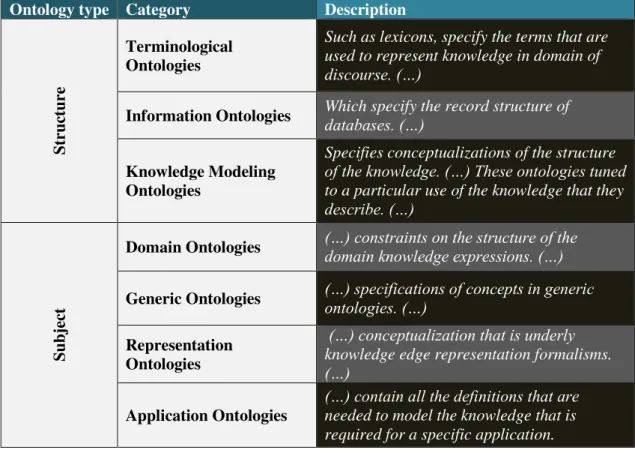
Ontology is “an explicit specification of a shared conceptualization” [15]. This remains today as the best acceptable definition of an ontology. Heijst et. al. [16], identified two ontology
dimensions (structure of the conceptualization and the subject of the conceptualization) with the
correspondent seven ontology categories showed in table 2.1. According to its needs and applications, usually an ontology shares a common understanding of the structure of
information among people or software agents, enabling the reuse of domain knowledge, making domain assumptions explicit [17].
The traditional database solution has exploited the ability to store and maintain a
considerable number of data [18] nonetheless it absences from the fact that concepts has special semantic hierarchical relations, like disjoint, less-General or more-General associations , which
are not covered by this kind of systems [19]. Instead, more suitable semantic engines are used,
for instance, mediators and ontologies that have the capability to share common understanding of
the structure of information among people or software agents, enables the splitting of domain knowledge from the operational knowledge to analyse contextual situations [17].
Table 2.1 - Ontology categories and their descriptions
Ontology type Category Description
Str
uc
ture
Terminological Ontologies
Such as lexicons, specify the terms that are used to represent knowledge in domain of
discourse. (…)
Information Ontologies Which specify the record structure of databases. (…)
Knowledge Modeling Ontologies
Specifies conceptualizations of the structure
of the knowledge. (…) These ontologies tuned
to a particular use of the knowledge that they
describe. (…)
Su
bje
ct
Domain Ontologies (…) constraints on the structure of the domain knowledge expressions. (…)
Generic Ontologies (…) specifications of concepts in generic ontologies. (…)
Representation Ontologies
(…) conceptualization that is underly
knowledge edge representation formalisms.
(…)
Application Ontologies
(…) contain all the definitions that are
2. Knowledge Based Solutions
2.2.1.1 Operations
The Oxford English Dictionary defines mathematical operation as a process in which a number,
quantity or even an expression, is changed or manipulated according to a set of formal rules, such as addition, multiplication and differentiation [20].
Analogously, an ontology operation can be seen as a relational manipulation of concepts,
properties or even attributes, origination the same or even a number of independent ontologies. The ontologies have three different operations and can be divided as follows:
Ontology Mapping– This operation establish a one-to-one or a one-to-many relation with a number of concepts under two or more ontologies which create new concepts and
relationships that match semantically with each other, present in several dissimilar ontologies. It does not change the meaning and the structure of the ontology [21]. The
concepts must have a semantic connection or same connotation that enables to form the
paired matches.
Ontology Alignment – This operation is similar to ontology mapping, except that the involving ontologies (in the same domain) must agree conceptually with each other, affecting
the outcome result of the final(s) ontology(ies).
a)
Animal
b) c)
Dog Cat
Pet
FoxTerrier
CairnTerrier Pet
Dog
FoxTerrier CairnTerrier
Figure 2.1 illustrates an ontology mapping between two ontologies. The first ontology O1 (the
leftmost ontology in the figure) shows a possible chunk of the “Animal” tree of life domain and O2 (the central ontology in the figure) within a possible domain description of the “Pet” concept.
The orange line which links the concepts “Animal” and “Pet” represents a direct ontology mapping establishment. Further, the orange line curves represents the possible “is-a” alignment operation of the two illustrated ontologies, where the O1 concept “Dog” has a direct relation
with its species “Fox Terrier” and “Cairn Terrier” on the O2 ontology. Finally on the rightmost
of the figure, identifies a possible merging of the resulted ontology alignment.
2.2.2
Taxonomy
Taxonomies have a parent-child and siblings relations. They represent any structure in tree that
relates concepts. These structures can be, as an example, of “is-a” kind characteristic’s relation.
Thus, the concepts are organized in a tree relation kind, where all their domain characterization is centralized in a single main root concept. Any of its central nodes, contains a generalization
description of its concept’s domain, where its children must have a lower level of abstraction.
2.2.3
Thesaurus
Thesaurus is a particular case of a taxonomy. It represents a “is-a” kind relation in tree that relates concepts about a domain. It is like a glossary, which concepts were structured in a
tree, still containing their descriptions. A thesaurus in a domain, works as a basis (starting point)
for the building of an ontology on that domain..
2. Knowledge Based Solutions
2.2.4
Dictionary
Dictionary contains an alphabetic list of concepts, with definitions, synonyms and antonyms for
each single listed word. It can use only one language (monolingual) or it could relate the concepts and the meanings (descriptions) between two different languages (bilingual).
Visualization tools
2.3
A proper visualization mechanism is essential to work and extract information from a
knowledge-based system point-of-view. The visualization’s tool varies according to the user perspective’s application needs and can come in different shapes and sizes. Some make a focus on the class relationship, showing the siblings and parent relations, others may include property descriptions and individual’s links, making the knowledge description more explicit. In the opposite side, a large amount of detail in a visualization tool could lose its primarily objective, which is for the user perspective, to clearly transmit and identify the conceptual knowledge on a
representational form. For instance, the information contained in an ontology model needs to be
organized in such a way, that researchers actually could read and extract information besides the present raw data. This could be accomplished by using graphs, maps, for instance tree maps or
other techniques.
The Web Ontology Language (OWL) is a specific ontology language designed for Semantic Web recommended by the W3C1 that enables representation of concepts and concept’s relations. Regarding with the motivations of this thesis, this section will focus primarily on tree visualization mechanisms which looks after simplicity and flexibility, in particularly those read OWL files.
2.3.1
Webprotégé
Webprotégé2 is a “free, open source, lightweight ontology editor and knowledge
acquisition tool for the Web” [22], initially designed to better support the collaborative development in web. It allows client-to-client communication without compromise individual
user changes that is working in same ontology model either directly inside the platform or in a
collaborative desktop client in a real time communication environment [23]. This behavior could also be found in collaborative web tools, like Google Docs3.
In order to work properly, the client side affords one user friendly and familiar interface
provided by Google Web Toolkit4 (GWT), the ontology model and a Remote Procedure Call56
(RPC) module to interact with the server [22].
The interface layout arrangement builds on top of tab concept, enabling user
customization appearance by drag-n-drop tabs from the toolbar, as illustrated in Figure 3.1.
In Section 5 will present the portlet concept, but for now let’s assume that the portlet resembles
a window interface which enables the display of personalized content. The class portlet is a
tree-based visualization module [24] that allows user to create, delete and also control the class relations.
The application offers the possibility to choose working directly online or deploys it in a
servlet container.
Figure 2.2 - Webprotégé layout page (Source: [25])
2.3.2
OntoStudio
OntoStudio is of the most popular ontology visualization management and ontology
visualization tools in service. It stands out due to its comprehensive functions in intuitive
ontology modeling. Some of OntoStudio’s most important functions are the mapping tool, which can be used to match heterogeneous structures. It also has a graphic editor which allows
users to edit and create rules for each single ontology model [26]. The relations are indicated by
2. Knowledge Based Solutions
Figure 2.3 - OntoStudio ontology visualizer (Source: [26])
2.3.3
oBrowse
The oBrowse it is an open-project ontology visualization tool for the web located in
Sourceforge7 that displays an OWL in tree form of any browser, as illustrated in Figure 2.4. It explorers the OWL-API built on top of Java allowing the class manipulations and extraction of
the class model relations.
2.3.4
jOWL
In an effort to migrate to the web 3.0, David Decraene designed the OntologyOnline [27]. The
project aims to get a visualization tool on web semantic applications. The jOWL it is a tree visualization plugin tool built on top of jQuery8 that read OWL-RDFS files which is cable of
showing one navigation bar, a direct individuals and a Tree view containers and a search bar
(bellow the navigation bar), as illustrated in Figure 2.5.
Figure 2.5 - An ilustration of the jOWL visualization tool (Source: [27])
The project also contains a 3D sphere peripheral visualization perspective view of the ontology model, called Hyperbolic Tree.9
2.3.5
AlloyUI
AlloyUI (known as AUI) is a framework built on top of JavaScript and CSS (Cascading Style
Sheets) libraries providing a consistent and simple API for building web applications across all three levels of the browser: structure, style and behaviour [28]. The project contains one
dedicated API for tree manipulation. This particular tree component was not initially design to
8
http://jquery.com/
9
2. Knowledge Based Solutions
ontology visualization, thus it is has the ability to represent the information regardless its
origins. Besides its independency, in a semantic web point-of-view; it helps who wants a better
taxonomy management of its concepts thanks to its collapsible and expandable features. The API also contains a function which, allows semi-automatic children attachment of its root node,
saying the last selected node; search a node by name, telling the node relations (parents, children and siblings). Regarding the node tree, it can be also define as a radio, task and check
type.
Among the other visualization tools the AUI stands out for its versatility and compatibility with
the Liferay10 portal.
Figure 2.6 - AUI TreeView example screenshot (Source: [29])
2.3.6
OWLGrEd
OWLFrEd is a visualization tool recommended by W3C, project of Institute of Mathematics
and Computer Science, University of Latvia. The tool contains an online version that allows users to view and interact directly with ontologies. It also has a more complete desktop version,
which allows users to create their own ontology from scratch and customize the background and
line colours and node shapes. A particular interesting feature of this tool is the ability to export the ontology diagram with the other users through an export mechanic, which creates a SVG
(Scalable Vector Graphics) to be placed in any web browser. The resulting view perspective
offers a tree that resembles a UML (Unified Modeling Language) diagram. Figure 2.6 shows the koala11 OWL. The classes represented with yellow colour, the class hierarchical relations in
10
http://www.liferay.com/
11
purple, the constraints in red and the properties marked in black lines. Besides those
characteristics the OWLGrEd also provides a plugin for Protégé platform.
Figure 2.7 - OWLGrEd visualization tool screenshot (Souce: [30])
Visualization tools comparatives
2.4
The Section 2.3 the tree visualization tools were presented. It is time to now take a close look of
all tools and make some cooperation between them and take some conclusions.
A proper visualization mechanism (with a tree kind of representation feature) is essential to
work and extract information from a knowledge-based system point-of-view. The visualization’s tool varies according to the user perspective’s application needs and can come in different shapes and sizes. Some make a focus on the class relationship, showing the siblings and parent relations, others may include property descriptions and individual’s links, making the knowledge description more explicit. Table 2.2 resumes the characteristics and the assigned classification of a set analysed visualization tools. It addressed the following characteristics:
personalization (the ability to customize and adapt the information according the desired needs); a developer’s friendly (the ability for who intends to use the tool and deploy in a web environment); the collaborative environment (ability to work remotely); the online interaction
(the possibility to view an ontology without a desktop environment); and finally the mapping
2. Knowledge Based Solutions
Table 2.2 - Tree knowledge visualization comapratives
Visualization tool Personal content Developer’s friendly Collaborative Environment Online Interaction Mapping Tool Webprotégé
OntoStudio N.D. N.D
oBrowse
jOWL Demo
AlloyUI Demo
OWLGrEd
From the defined characteristics is possible to state different statements. If the goal is to get a
tool that has flexibility in how it shows the content, having a clearer view, the best option is OWLGrEd. On the other hand, only OntoStudio and OWLGrEd should not be considered for
the purpose of developing a web kind application. The Webprotégé will be the ideal choice if
what is required is a tool to access a remote knowledge-base (server). Additionally, there are other visualization tools without integrated specific knowledge base handlers or engines (e.g.
OWL API), which requires a specific handling of the managed information as in specifc HTML
or flash graphic elements. In this case, it will be possible to resort to WebProtégé or jOWL or even to OWLGrEd.
If is required a tool able to maximize user and developer interaction easiness, the AlloyUI
stands out for its versatility and compatibility with as an example a Liferay portal, which would facilitate the integration to other existent components of a specific platform.
Concluding Remarks
2.5
The visualization tools should describe effectively its domain knowledge. Thus, a set of tools
are available to help maintain, edit and share the information among different entities.
The ontology offers the most complete mechanism available that reaches maximum description
of a knowledge base system. However, other representation forms could be more suitable,
depending on the type of system application in use. Furthermore, taxonomy will be perfectly suitable for instance, if the intended information system only has to deal with a set of concepts
linked to each other. On the other hand, if a definition of terms is needed the best option passes
through the use of a dictionary.
Nevertheless, the information presented on such manage tools must be accompanied with a proper visualization to allow data extraction and manipulation. Under the different possibilities
Enterprises that exchange information must have an adequate management system to work
collaboratively not fearing a leak of its market strategies to potential alliance partners. Besides
the attempts to turn the network more independent and trusted, the adopted distributed mechanism do not cover yet the necessary requirements to overcome the potential risks of its
3
Dynamic Manufacturing Networks
Dynamic Manufacturing Networks
This chapter has the following structure: firstly, an introduction and overview of the Dynamic
Manufacturing Networks (DNMs) is presented, which briefly explores the traditional manufacturing model concepts and reasons are given for the newest approaches; followed by
the benefits and risks adopted; the lifecycle and blueprints modification. Furthermore, it is also
presented the state-of-the art Dynamic Manufacturing Network platform. Finally, the identified conclusions of this chapter will be addressed in the concluding remarks section.
Overview concept
3.1
The end-to-end concept introduced by Saltzer et.al. [31] can be seen as two processes
communicating with each other aiming consistency if they are less dependent of their intermediate’s nodes. In other perspective, the probability of error in a message being transported in a communication channel raises with the number of intermediate nodes on the
network configuration. Following the same idea, an end-to-end manufacture could be seen as a constant change to reach reliability on partner coalition in an enterprise network environment.
Multiple Globalizations (MG) concept has been recently emerging. Manufacturing industries no
longer stay a local clustering nest. Recently economic crisis lead manufactures to adapt effectiveness to the changing of the new global economy [32], specially for those who have to
constantly change their products and processes to survive in this new market paradigm. To
overcome this problem, companies and organizations joined forces, working together reusing resources and capabilities in a sustainable economic collaborative environment, organized in a
Collaborative Network (CN) schema [8].
Launched in 2008, concerned with the economical state of its countries and committed to increase production performance, the European Union started an initiative to promote
3. Dynamic Manufacturing Networks
effectiveness collaboration of Small and Medium Enterprises named Factories of the Future
(FoF) [3].
Collaborative forms, with similar properties, such as virtual organization (VO), virtual
Enterprise (VE), dynamic supply chain do not have straight well-defined definitions.
Nevertheless some acceptable definitions could be found by Jeong et. al [33] for example, a VO
as comprising a set of (legally) independent organizations that share resources and skills to achieve its mission/goal, which is not limited to an alliance to profit enterprises. A Virtual
Enterprise is a particular case of virtual organizations, where a temporary alliance is made to
share skills or core competencies and resources in order to better respond to business opportunities, whose cooperation is supported by computer networks. A Virtual Manufacturing
Networks (VMN) is a manufacturing network usually built with the use of Information and
Communications Technology bringing together different suppliers and alliance partners to create a virtual a collaborative network which is able to operate, as a solely owned supply
network [34].
A different set of attribute criteria, like quantity, price, raw material, could compromise the establishment of a new network alliance, so in order to be competitive, innovative and more
complex products must pass through a state-of-the-art hybrid materials and assembly processes implementation with a high degree of automation and quality control [35].
The adaptation of a centralized scheme increases the exchanged resources between
different organizations, thus raising the total maintenance costs of the established network. Additionally, traditional collaborative schemes do not have monitor mechanisms, which enables
an adequate and fast response to a non-predicted network configuration changes, such as
unexpected production, packing and shipment delays.
Nowadays, some of the identified configurations are obsolete, thus it is time to get and design a new approach. The Dynamic Manufacturing Networks is defined as “coalition, either
permanent or temporal, comprising production systems of geographically dispersed SME and/or Original Equipment Manufacturers (OEMs) that collaborate in a shared value-chain to conduct
joint manufacturing” [36]. This concept although not being new is now emerging as a norm
solution.
Moreover, the beyond idea of a DMN is to enable specialized people or agents to collaborate and integrate, spread goods and services globally from a set of independent sources.
Additionally, as the name suggests, a DNM must be cable of change its own defined
Benefits and Risks
3.2
Partnership collations between manufacturing networks face a variety of heterogeneous systems
to manage their processes and their data. A majority of benefits must be previously obtained to justify the effort. However, adopting new innovations always come with risks that must not be
neglected [37]. This is the particular case of the acquisition VE models, like Dynamic
Manufacturing Networks opposed to the traditional ones [36]. Some of the benefits and risks are identified as follows [34]:
Firstly, to succeed, a DMN should reach a consensus configuration to optimize the design and
the development of new products and components, thus at the same time avoiding unexpected flaws and minimizing time waste consumption during the design phase of a product lifecycle.
This reduces inventory costs (each selected product has a specific price according to the desired
configuration), optimizing the selection of new partners and helps to maintain a healthy
competitive sector. Regarding knowledge acquisition and security threats, a DMN will have to implement a confidential system that differentiates access rights and contractual agreements of
the exchanged information and therefore avoiding malicious attacks that could compromise the trust of the engaged enterprises.
Moreover, the partner data has to be constantly available, therefore allowing organizations to
define product specifications in prompted and efficient manner, independently of the enterprise
localization. It is also important to have a system that rapidly adapts to production delays, by identifying alternative partners for instance, in case of an eventual production line failure.
Nevertheless, it is expected some resistance by employees during the transition phase of the
recent implemented collaborative manufacturing model system. This risk can be resolved by introducing a set of adapters that interconnects the data of all DMN members to the DMN
platform, ensuring thereby smooth transition for all involved entities. The platform will be further explained in Section 3.5.
Additionally, a DMN promotes the opportunity for partners to work with more intelligent and
experienced organizations by exchanging and offering an opening for the birth of new
technological innovations. Consequently, out-dated information during the formation of a new alliance configuration of a dynamic network could represent a serious risk for the network
maintenance; weaken quality standards and thereby jeopardizing its own life expectancy. To
avoid such undesirable setup, it is crucial to have accurate information on the actual manufacturing and delivery capability of each DMN across the whole assigned partners.
To sum up, there were identified three main benefits: time savings, cost reduction, operations’
3. Dynamic Manufacturing Networks
Table 3.1 - Dynamic Manufacturing Network benefits and risks (Adapted: Source [34])
Feature Description
B
enef
it
s
Time Savings
Regarding DMN visibility, each configuration will have an efficient and suggestible partner selection during its creation. Further, the products and
components are optimized individually for each case. It is also important to consider the planning and scheduling costs, possible reconfigurations, the exchange time between client and partners are saved.
Cost Reduction
DMN enables customized costs during partner selection and production. This helps to reducing the market expenses of the managed resources.
Operations’ Enhancement
The gains that come from the relation
between a single enterprise and the rest of the partners in the network.
R
isks
Information Security and trust
Deliverable or indirect knowledge leaks between enterprises.
Poor configuration Outdated information that could jeopardize the lifetime of the DMN system.
DMN dissolution Unexpected partners that give up to collaborate with the rest of the network.
Competitive threats Competitive threats after the exiting of a partner or the dissolution of the DMN
Loss of partner’s reputation
Partners that do not achieve its own
expectations, damaging the reputation of the rest of the other DMN members.
The DMN Life-Cycle
3.3
The DMN Lifecycle is an innovative method, including all supporting tools, such as
Service-oriented and Business Process Management technologies, which allows the
management of the entire lifespan of a manufacturing network, from planning and sourcing, to manufacturing and delivery [36]. The Manufacture Network Lifecycle encompasses the
following three main phases, as illustrated in Figure 3.1:
Phase 1: Network analyses and configuration. It’s when Partner selection and DNM construction occurs. It is “one of the most critical phases in the lifecycle of a supply network” [8]. The DMN shows the available configurations, identifies knowledge breakings, thus allowing the partners to select the best resources for the requested
alliance [34].
Phase 2: Network design. The definition of the end-to-end process of the DMN.
Phase 3: Network execution Management and Monitoring. The phase where DMN tracks its resources by producing constant reports of material consumption, production, packaging and shipment progress.
Figure 3.1 - Dynamic Manufacture Lifecyle phases (Adapted: Source [36])
Blueprints
3.4
The objective target of the Blueprint Model is to aggregate the necessary knowledge for
managing enterprise resources, product life cycles, supply chains, partner relationships,
operational planning, manufacturing process execution, compliance regulations and safety issues for the DMN Lifecycle [36], thus it helps to reduce the time of a product production
process, avoids shipment delays and maintain an accurate production [34].
The DMN Blueprint Model was designed in several blueprint branches and extensions, thus optimizing the manufacture process, as it can be seen in the Figure 3.2.
Adminstration & On Boarding
DMN Analyses & Configuration
DMN Design DMN execution
3. Dynamic Manufacturing Networks
Figure 3.2 - IMAGINE blueprint model (Source: [38] )
Partner Blueprint: It helps to set a new network configuration and makes the captured
skills and capabilities available in DMN to potential partners.
Product Blueprint: It enables companies to create, maintain, re-use and share the
product information of the entire manufacturing network.
End-to-End Blueprint: It ties together the unobtrusive processes associated with all
aspects of manufacturing and product development while providing the ability to adapt
to changing environments.
Quality Assurance Blueprint: It is intended to collect and maintain the resulted
production information and monitor the defined DMN configuration.
The blueprint was designed to be a cross sector independent which means that several branches’ extensions could be adjustable and to fit and fulfil to the desired needs. In the Figure 3.2 it is
illustrated three possible extension combinations, each one representing its own sector of
activity.
Information Technology (IT) platform
3.5
The constant market floatation and product competition force manufactures to have a promptly
response mechanisms. The DMN platform illustrated in Figure 3.3 is a crucial component that
helps manufactures to re-adjust their production when, for instance a supplier has a delay shipment or a non-mismatch requirement to the initial products specifications.
approach and the steps followed from the order arrival to the order dispatch are illustrated in
Figure 3.4.
Figure 3.3 - Schematic of DMN platform modules (Source: [39])
The process starts within an arrival of a new order. The requested product is analysed
by the system, which has to find among those available partners which one matches to the required product’ specification.
The DMN process begins with the simulation of all network configurations and
analyses which one will maximize a set of performance indicators. Consequently, constant
information12 through the portal is necessary and the best node with all the profile requirements is granted as the chosen competitor among the network.
However, an inconsistency may occur if one of the criteria fails, leading the network to
re-adjust, look for new potential partners and select once again a new desired configuration. In the end, if the platform does not detect any more inconsistencies, then it will end the
DMN lifecycle and dispatch the product to its client.
12
3. Dynamic Manufacturing Networks
Figure 3.4 - Proposed UML diagram of the DMN methodology (Source:[39])
Special adapters are used for interfacing the platform with existing data sources and Information
Technologies (IT) systems, such as Enterprise Resource Planning (ERP) systems, Manufacturing Execution Systems (MES), Product Lifecycle Management (PLM) systems and
Computer Aided Design (CAD) and Manufacturing (CAM) tools.
Conclusion Remarks
3.6
The twenty-first century has been characterized by the rapidly growth of new technologies that
inevitably triggered an increase consumption of new personalized products, which lead enterprises to change its market strategies.
Consequently, each small and medium enterprise stopped to work against its direct competitors
and started to collaborate with each other by addressing new manufacturing networks to promote a more dynamic knowledge exchanged to fill the technological gaps characterized by
traditional approaches.
This chapter introduced the notion of a new collaborative scheme: Dynamic Manufacturing Network which invites enterprises and manufactures to work and share knowledge in an
end-end fashion.
to select and choose products that maximize quality/price relation and, at the same time, capable
of managing partners dissolutions threats regarding security leaks and trustless configurations.
4
Semantic Alignment for Seamless Knowledge Interoperability
Semantic Alignment for Seamless Knowledge
Interoperability
This chapter provides a context description of the proposed semantic alignment framework and
its components. It will also be presented the related work regarding mapping concepts and knowledge alignment.
Introduction
4.1
Electronic commerce (e-commerce) strongly influences the way how enterprises exchange
information, trade products and services with other organizations. The Dynamic Manufacturing
Networks addresses the opportunity for manufactures to communicate with its partners and exchange information in a transparent and efficient manner.
In terms of Dynamic Manufacturing Networks interoperability concerns on the specifications
that support seamless connectivity between allied partners by monitoring a set of defined performance indicators. Connections along different partners bring forth a considerable amount
of data that has to be properly maintained in future integration for those who need to share their
acquired knowledge [40]. The mechanism for exchanging information on the Web may contain a diversity of knowledge, each one with its enterprise resource planning (ERP) and enterprises’
legacy systems for the same-shared collaborative network configuration. Thus, it is expected to find semantic heterogeneity inconsistencies during the establishment of a new DMN.
The Semantic Web is a vision for the future of the Web in which information is given explicit
meaning, making it easier for machines to automatically process and integrate information
available on the Web [41]. Semantic web services (SWS) technology aims to add sufficient semantics to the specifications and implementations of web services to make possible the
4. Semantic Alignment for Seamless Knowledge Interoperability
automatic integration of distributed autonomous systems, with independent designed data and
behaviour models [42].The web service modelling ontology (WSMO) [43] initiative defines the
inter-related semantic support modules of the web services. Figure 4.1, illustrates three branch point-actions of the project:
Figure 4.1 - WSMO conceptual schema (Adapted: Source [43])
Concerning about heterogeneity problems and following the WSMO initiative, this dissertation
proposes the SAMPOL (Semantic AlignMent of EnterPrise’s dOmain knowleLge ) framework to map every company resource concept according with a reference ontology and further fill the
result matches on an information ontology. SAMPOL selects each company’s information and
divides its resources, allowing user categorization of the in-game information, thus helping the harmonization of the synchronized shared information. The SAMPOL has a support database
that stores the partner data. Every time a new company joins the network manufacture, the
SAMPOL will check the income information and will classify it as data to be aligned with the reference concepts. Goals Web Services Mediators Ontologies
Objectives that a client may have when consulting a Web Page
Semantic description of the Web Services -Capability -Interfaces Provide the formally specified Technology of the information used by all other components
Heterogeneity
4.2
a)
Semantic
HeterogeneityChapter 3 (Dynamic Manufacturing Networks) identified the reason why it is important to have
a system able to maintain its repository constantly updated whereas enterprises and organizations exchange data in a collaborative environment.
The resulted alliance was defined according to a set of criteria which, maximized the network
performance. Since each enterprise has its own legacy system repository, a single concept may
have different meanings or interpretations among the exchanged information. This phenomenon it’s known as semantic heterogeneity. These types of heterogeneities can occur in form of
naming conflicts, generalization conflicts, language, as shown on table 4.1.
Table 4.1 - Semantic heterogeneity conflicts
Conflicts Description
Naming conflicts
Semantic correlations with equivalent meaning between two concepts are located in different ontologies. That’s the case of the synonyms and homonym.
A Synonym or equal relations occur when two or more distinct concepts presented have the same or comparable denotation. On the other hand, an antonym refers to opposite or disjoints meanings.
Generalization conflict
Two different concepts (C1, C2) that are semantic correlated on
distinct system (S1, S2) where, 𝐶1⊇ 𝐶2, 𝐶1 ∈ 𝑆1 , 𝐶2∈ 𝑆2
That’s the case of the hypernym. A word A is a hypernym of B when it describes a more comprehensive description than B. In an opposite, a less general or comprehensive relation of those words are known as hyponym.
Language conflict
Two identical concepts (C1, C2) that are semantic correlated on
distinct language systems (S1, S2) where, 𝐶1 ≡ 𝐶2, 𝐶1∈ 𝑆1 , 𝐶2∈
𝑆2
That’s the case of the word “travel” and the word “viagem”. Both meant the same but they are written in different native languages.
The word “travel” is an English word and “viagem” is a Portuguese word.
b)
Structural Heterogeneity
Further, a structural heterogeneity could appear, if the information from the DMN creation has
two identical concepts or properties. In most cases, no direct concept-to-concept or

![Figure 2.2 - Webprotégé layout page (Source: [25])](https://thumb-eu.123doks.com/thumbv2/123dok_br/16578816.738399/31.892.125.758.375.704/figure-webprotégé-layout-page-source.webp)
![Figure 2.3 - OntoStudio ontology visualizer (Source: [26])](https://thumb-eu.123doks.com/thumbv2/123dok_br/16578816.738399/32.892.127.767.126.546/figure-ontostudio-ontology-visualizer-source.webp)
![Figure 2.5 - An ilustration of the jOWL visualization tool (Source: [27])](https://thumb-eu.123doks.com/thumbv2/123dok_br/16578816.738399/33.892.210.690.292.790/figure-ilustration-jowl-visualization-tool-source.webp)
![Figure 2.7 - OWLGrEd visualization tool screenshot (Souce: [30])](https://thumb-eu.123doks.com/thumbv2/123dok_br/16578816.738399/35.892.164.739.199.459/figure-owlgred-visualization-tool-screenshot-souce.webp)
![Table 3.1 - Dynamic Manufacturing Network benefits and risks (Adapted: Source [34])](https://thumb-eu.123doks.com/thumbv2/123dok_br/16578816.738399/42.892.128.766.184.826/table-dynamic-manufacturing-network-benefits-risks-adapted-source.webp)
![Figure 3.1 - Dynamic Manufacture Lifecyle phases (Adapted: Source [36])](https://thumb-eu.123doks.com/thumbv2/123dok_br/16578816.738399/43.892.304.643.441.743/figure-dynamic-manufacture-lifecyle-phases-adapted-source.webp)
![Figure 3.2 - IMAGINE blueprint model (Source: [38] )](https://thumb-eu.123doks.com/thumbv2/123dok_br/16578816.738399/44.892.128.763.161.456/figure-imagine-blueprint-model-source.webp)
![Figure 3.3 - Schematic of DMN platform modules (Source: [39])](https://thumb-eu.123doks.com/thumbv2/123dok_br/16578816.738399/45.892.199.748.194.460/figure-schematic-dmn-platform-modules-source.webp)
