http://dx.doi.org/10.1590/1984-6398201813190
L2 SPEECH INTELLIGIBILITY: EFFECTS
OF CODA MODIFICATION, DEGREE
OF SEMANTIC INFORMATION AND
LISTENERS’ BACKGROUND
INTELIGIBILIDADE DA FALA EM L2:
EFEITOS DA CODA MODIFICADA, GRAU DE
INFORMAÇÃO SEMÂNTICA E PERFIL DOS
OUVINTES
Rosane Silveira*1
Universidade Federal de Santa Catarina, Florianópolis, Santa Catarina / Brasil [email protected]
Thaïs Cristófaro Silva**2
Universidade Federal de Minas Gerais, Belo Horizonte, Minas Gerais / Brasil [email protected]
ABSTRACT: The present study aims to investigate how the intelligibility
of non-target word-fi nal codas is affected by the type of coda modifi cation, the degree of semantic information, and the listeners’ fi rst language (L1).
Furthermore, a correlational approach is adopted to examine possible relations
between intelligibility and the listeners’ second language (L2) profi ciency level, familiarity with speakers’ L1, and length of residence in the speakers’ country.
For this purpose, an Intelligibility Test was designed containing utterances with
word-fi nal codas that were produced with phonetic characteristics typically found in the English spoken by Brazilians (e.g., palatalization and vowel insertion). This test and a background questionnaire were completed by 38
1 Faculty member of the Department of Foreign Language and Literature and the English
Graduate Program of the Universidade Federal de Santa Catarina – Brazil. CNPq researcher.
Her research interests include the development of L2 speech, with a focus on phonetics,
phonology and pronunciation teaching.
2Professor of Linguistics at the Federal University of Minas Gerais. Coordinator of the
listeners from different nationalities. The results indicate that certain types of
coda modification hinder intelligibility, and that semantic information improves intelligibility in some cases. Furthermore, listeners whose L1 is not typologically similar to Brazilian Portuguese (BP) and who reported being highly familiar with
the English spoken by Brazilians tend to perform better on the Intelligibility Test. Overall, this study highlights the importance of bringing to the classroom
different varieties of the target language, as a way to boost L2 users’ familiarity with different accents. Contact with different accents should benefit listeners, who are more likely to understand pronunciation patterns that are frequent in the language spoken by a particular group of L2 users. Moreover, accent familiarity is also expected to benefit speakers by bringing awareness about the
pronunciation patterns that hinder intelligibility more often and that could be
modified to improve communication.
KEYWORDS: L2 speech; intelligibility; codas; pronunciation.
RESUMO: O presente estudo tem como objetivo investigar como a
inteligibilidade das codas modificadas em posição de final de palavra é afetada pelo tipo de modificação de coda, grau de informação semântica e pela língua materna (L1) dos ouvintes. Além disso, adotou-se uma abordagem correlacional para examinar possíveis relações entre o perfil dos ouvintes (proficiência na segunda língua (L2), familiaridade com L1 dos locutores, tempo de residência no país dos locutores). Para este propósito, foi elaborado um teste de inteligibilidade contendo enunciados com codas em posição de final de palavras que foram produzidas com características fonéticas tipicamente encontradas no inglês falado por brasileiros (ex.: palatalização, inserção vocálica). Um grupo de 38
ouvintes de nacionalidades diversas completou o Teste de Inteligibilidade e um
questionário. Os resultados indicam que certos tipos de modificação de coda dificultam a inteligibilidade e que a presença de informação semântica melhora a inteligibilidade em alguns casos. Além disso, ouvintes cuja L1 é tipologicamente diferente do português brasileiro e que reportaram ter familiaridade com o inglês falado por brasileiros tendem a obter um melhor desempenho no Teste de Inteligibilidade. O presente estudo aponta para a importância de inserir diferentes variedades da língua-alvo na sala de aula, com vistas a aumentar a familiaridade dos usuários de uma L2 com diferentes sotaques. Esse tipo de contato deve trazer benefícios para os ouvintes, que poderão entender melhor os padrões de pronúncia que são frequentes na fala de determinados grupos de usuários da L2. Além disso, familiaridade com sotaques pode beneficiar os falantes, na medida em que pode revelar os padrões de pronúncia que afetam negativamente a inteligibilidade da fala com mais frequência e que, portanto, podem ser modificados para melhorar a comunicação.
1 Introduction
When faced with the need to explain the importance of teaching pronunciation in the language curriculum, we often resort to the notion of
intelligibility as one of the fundamental goals of second language (L2) teaching (CELCE-MURCIA et al., 2010, DERWING; MUNRO, 2015; SILVEIRA, 2016). Intelligibility here is defined as the extent to which an utterance is actually understood by listeners (DERWING; MUNRO, 2015), who demonstrate their understanding, for example, by transcribing words spoken by L2 speakers.
Studies investigating the pronunciation characteristics of English spoken by Brazilians have highlighted a number of features that may hinder
the intelligibility of their speech (ZIMMER et al., 2009; SILVEIRA, 2012; ALVES, 2015; CRUZ, 2003), among which are the production of word-final
codas. Regarding data about English codas produced by Brazilians, research has
described L1 phonological phenomena that are transferred to the L2 (see also Silveira et al., 2017), among which the present study is interested in the following:
• Vocalization of nasal consonants: ‘sun’ [sʌ̃]; • Vocalization of /l/: ‘doll’ [dɔw];
• Vowel insertion: ‘sick’ [ˈsɪki];
• Affrication of alveolar stops: ‘bed’ [bɛdʒ] ; • Voicing of alveolar fricatives: ‘bus’ [bʌz]; • Devoicing of alveolar fricatives: ‘rose’ [ɻoʊs].
The present study seeks to investigate the extent to which the types of
coda modification listed above affect the intelligibility of English spoken by Brazilians. We also intend to test if intelligibility is influenced by the degree of
semantic information present in the utterances included in the Intelligibility
test completed by the listeners, and if listeners’ L1 affects their performance
on the Intelligibility test. Furthermore, we are interested in examining possible
relationships between listeners’ performance and their L2 proficiency level,
2 Intelligibility Studies
Studies investigating speech intelligibility look into the roles played by
both listeners and speakers. Some of these studies rely on questionnaires or
interviews to gain insights about the informants’ background and attempt to examine how intelligibility is affected by or related to informants’
traits. Among these traits, studies have focused on proficiency level (e.g., BENT; BRADLOW, 2003; GONÇALVES, 2014; SCHADECH, 2013), familiarity with the speakers’ L1 or L2 accent (CRUZ, 2008; DERWING; MUNRO, 1997; GASS; VARONIS, 1984; SCHADECH, 2013), speech rate (DERWING; MUNRO, 2001), word familiarity or lexical frequency (BENT; BRADLOW, 2003; BECKER, 2013; BRADLOW; PISONI, 1999; GONÇALVES; SILVEIRA, 2015), topic familiarity (GASS; VAONIS, 1984), and listeners’ L1 (BENT; BRADLOW, 2003; CRUZ, 2006a/b; SCHADECH, 2013; GONÇALVES, 2014). Some important findings in
these studies, which are relevant for the present study, are summarized below.
Regarding proficiency level, both Gonçalves (2014) and Schadech (2013) report that intelligibility scores increase as listeners’ English proficiency increases. Brent and Bradlow (2003) focused on the talkers’ proficiency level, and they concluded that speakers with a high proficiency
level are as easy to understand as native speakers, or even easier if listeners
and speakers share the same L1. Another variable relevant for this study is listeners’ familiarity with speakers’ L1 or L2 accent. Bent and Bradlow (2003) found that familiarity with speakers’ L1 benefitted listeners’ performance on an intelligibility test. Likewise, Gass and Varonis (1984) and Derwing and Munro (1997) reported that familiarity with the speakers’ L1 has a
positive effect on intelligibility. Turning to studies with Brazilian learners,
Cruz (2008) found no clear difference between listeners who are familiar/ unfamiliar with the English spoken by Brazilians. Schadech (2013) reported that listeners who share the L1 with speakers tended to perform slightly
better on the Intelligibility Test, when compared to listeners with or without familiarity with English spoken by Brazilians.
Finally, a few studies have investigated the role of context in the
intelligibility level of L2 speech (GASS; VARONIS, 1984; KENNEDY; TROFIMOVICH, 2008). Of particular interest here is Kennedy and Trofimovich’s (2008) study, as they were interested in how semantic context helps listeners understand L2 speech. The authors define semantic context
as “the degree and type of semantic information available to listeners when
deciphering an utterance” (p. 461).
Kennedy and Trofimovich (2008) designed an intelligibility test containing sentences (a) expressing real or false expectations in the real world (‘June is the first month of the year’; ‘Crayons come in many colours’); (b) expressing possible meanings (‘A big farmer lifts a large load’), and (c) expressing semantically anomalous meanings (‘A paper nature sees the cool master’). The sentences were recorded by Chinese learners of English. The listeners were two groups of North Americans, one of them formed by English as a L2 teacher (familiar with L2 speech) and one formed by Canadians with little contact with L2 speech. The results showed that the
listeners performed better when transcribing sentences with a higher degree of semantic information, and worse when transcribing semantically anomalous
sentences. Furthermore, the listeners that were more familiar with L2 speech performed better than the unfamiliar listeners, thus confirming that L2 speech
familiarity contributes to more successful communication.
At least one study investigating the intelligibility of Brazilian English has addressed the role played by the context. Gonçalves and Silveira (2015)
operationalized the context as all the elements that make up a carrier sentence containing a target word that had to be transcribed by the listeners.
A group of 32 listeners from different L1 backgrounds listened to nine
sentences produced by nine Brazilian learners of English. The listeners had to orthographically transcribe one target word present in each sentence, and the answer sheet contained the remaining part of the sentence in written form. In other words, semantic and syntactic information were made
available to the listeners, who were required to focus on the acoustic signal
of the target words that were testing the contrast between lax and tense high
front vowels (e.g., ‘bit’ and ‘beat’).
The results showed that the amount of semantic and syntactic
information available in the carrier sentences, in addition to lexical frequency,
pairs. For example, in the sentence ‘Can you wait a bit?’, the target word ‘bit’ was pronounced as ‘beat’ by the Brazilian speaker. Even so, probably due to the semantic and syntactic information available, 70% of the listeners transcribed it as ‘bit’.
As this brief review of literature shows, investigating the intelligibility of L2 speech involves much more than a focus on the quality of the acoustic
signal, given that a number of variables are intertwined. The present
study aims to investigate how the intelligibility of non-target word-final codas is affected by the type of coda modification, the degree of semantic information, and the listeners’ L1. A correlational approach is used to
examine the relations between listeners’ performance on the Intelligibility
Test and three background variables – L2 proficiency, familiarity with speakers’ L1, and length of residence in Brazil. For this purpose, an Intelligibility Test was designed containing utterances with word-final codas
that were produced with phonetic features typically found in the English
spoken by Brazilians (e.g., vocalization of nasal or liquid, palatalization of alveolar stops, vowel insertion). The test included utterances with limited and substantial semantic information. A group of listeners from diverse L1 backgrounds completed the intelligibility test, and the results will focus on how (a) the different phonetic features of the codas, (b) the degree of semantic information present in the utterances, and (c) the listeners’ L1
affect the intelligibility of the codas produced by the Brazilian informants. Furthermore, the study will check for possible correlations between
intelligibility and listeners’ L2 proficiency, familiarity with English spoken
by Brazilians, and length of residence in Brazil.
Three research questions guided this study:
RQ1: How is coda intelligibility affected by the type of coda modifica
-tion and the degree of semantic informa-tion?
RQ2: How is coda intelligibility affected by the listeners’ L1 (L1 similar to or different from BP)?
3 Method
This study included both speakers and listeners. In this section, we
briefly explain how the speakers’ data were obtained from a previous study (SILVEIRA, 2012) and the background of the listeners recruited for the
present study. Next, we provide information about how research instruments
(Intelligibility Test and Background Questionnaire) were designed. Finally,
we explain the procedures for data collection and analysis.
3.1 Informants
The Intelligibility Test was designed with data from seven Brazilian
speakers who participated in a study conducted by Silveira (2012). These speakers were six females and one male, with ages ranging from 21 to 49 (mean: 39.42). They had studied English mostly in a classroom context in Brazil. Their proficiency levels were evaluated by four experienced English teachers (two Brazilians and two Americans), using a holistic scale that ranged from 1 (low proficiency) to 10 (high proficiency). The raters listened
to twenty-second speech samples from each speaker describing images.
According to the raters, the proficiency level of the seven speakers ranged from 3.5 to 8.8 (mean: 4.42). Speech samples from these speakers describing images in English were selected to design the Intelligibility Test (see section 3.2 for details). All selected samples contained phrases in which one word was produced with one type of coda modification resulting from the transfer
of phonetic features of BP into English.
As can be seen in Table 1, a group of 38 members of the international
community residing in Brazil volunteered to participate as listeners and
TABLE 1 – Listeners’ background (N=38)
N L1 LORb
(months)
BEc familiarity (1-3)
Age English
Profic.
11 Spanish 36.36 1.36 28.45 7.64
8 English 15.5 2.5 28.25 10
4 Italian 3.25 1.5 25.25 8
5 German 26.8 2.4 23.8 8
3 French 5.66 0 30.33 8.33
7 Othersa 46 2.1 30.6 8
a Norewegian, Syrian, Cape Verdian, Poland, Swedish, Hebrew, Slovakian. b LOR = length or residence
c BE = Brazilian English.
Table 1 also shows the listeners’ English proficiency level. For the listeners whose English was the L1, a maximum score of 10 was assigned, while those whose L1 was not English were asked to use a self-rating scale (1-10) to estimate their proficiency in English, and report scores on any standardized proficiency test they had taken. Based on this information, the listeners’ proficiency was deemed to vary from intermediate to advanced.
The group varied in the amount of time they had been living in Brazil and how familiar they reported being with English spoken by Brazilians. This range of variance will be discussed in the Results section.
All informants volunteered to participate in the study, and all read
and signed a consent form that informed them about the study objective and the procedures for data collection. This research was approved by the
Ethics Research Board of the Federal University of Santa Catarina (UFSC)3.
3.2 Research Instruments: Intelligibility Test and Questionnaire
The Intelligibility Test included utterances produced by Brazilians. These utterances were elicited with an Image-Description Test, and the
researcher selected short utterances that fulfilled the following criteria:
a) The utterance should contain one monosyllabic word whose coda had been mispronounced and was produced with one of the typical L1 phonetic features: vocalization of /m/ and /n/, (b) vocalization of /l/, (c) palatalization of the alveolar stops, (d) vowel insertion, (e) voicing, or (f) devoicing of alveolar fricatives.4 Note that the selection of the modified codas was based on auditory analysis performed by one of the researchers;
b) The utterances should not contain substantial lexical or grammatical problems, and the vowels of the words with coda modification should not differ greatly from the target pronunciation;
c) The utterance should allow one to check for the contrast of level of semantic information (details provided below);
d) Good sound quality, with no major pauses or noise.
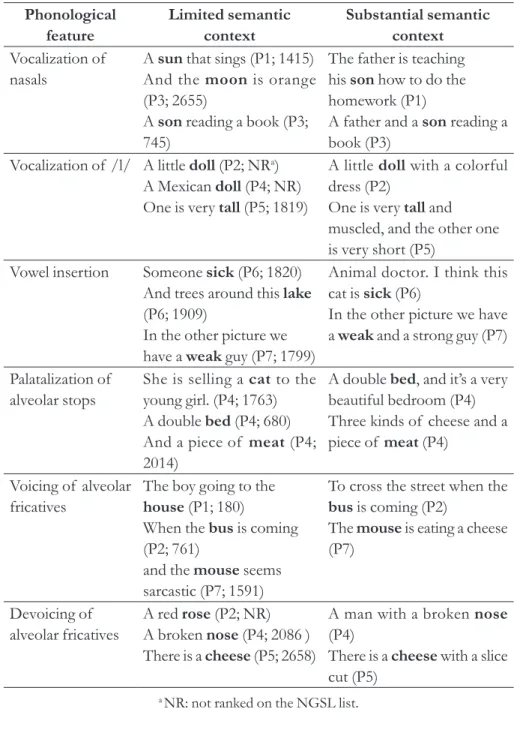
Based on these criteria, 30 utterances were selected, each of which containing one word with coda modification. Table 2 displays the type of modification present in the word-final codas and the carrier sentences with
the target words in boldface. Note that the carrier sentences used in this study were those taken from the naturalistic recordings obtained in a previous study
(SILVEIRA, 2012). As can be seen, there are 5 target words for each type of coda modification, and 18 sentences providing limited semantic context, while
12 sentences provided substantial semantic context. In parenthesis, the table
also shows the code for the speaker who produced each utterance (e.g., P1), and there is a number that refers to the frequency ranking of each target word (e.g., ‘sun’ appears as number 1415) in the New General List Service corpus. The NGSL corpus contains high-frequency words that foreign language learners should know. The current version of NGSL lists about 2,800 high frequency words selected from the Cambridge English Corpus (BROWNE, CULLIGAN; PHILLIPS, 2015). Two words (‘rose’ and ‘doll’) were absent from the NGLS, but they were included in the test, as they are deemed to be frequent words as well. The selection of frequent words was important for
the purposes of this study, as it would be inappropriate to use words that were
not present in the vocabulary of the L2 listeners.
4 We are aware that partial devoicing in the word-final position is a natural phenomenon
TABLE 2 – Test sentences with target words (boldface) and the phonological
features in their codas, amount of semantic context, and frequency rank
Phonological feature Limited semantic context Substantial semantic context Vocalization of nasals
A sun that sings (P1; 1415) And the moon is orange (P3; 2655)
A son reading a book (P3; 745)
The father is teaching his son how to do the homework (P1)
A father and a son reading a book (P3)
Vocalization of /l/ A little doll (P2; NRa) A Mexican doll (P4; NR) One is very tall (P5; 1819)
A little doll with a colorful dress (P2)
One is very tall and muscled, and the other one is very short (P5)
Vowel insertion Someone sick (P6; 1820) And trees around this lake (P6; 1909)
In the other picture we have a weak guy (P7; 1799)
Animal doctor. I think this cat is sick (P6)
In the other picture we have a weak and a strong guy (P7)
Palatalization of alveolar stops
She is selling a cat to the young girl. (P4; 1763) A double bed (P4; 680) And a piece of meat (P4; 2014)
A double bed, and it’s a very beautiful bedroom (P4) Three kinds of cheese and a piece of meat (P4)
Voicing of alveolar fricatives
The boy going to the house (P1; 180)
When the bus is coming (P2; 761)
and the mouse seems sarcastic (P7; 1591)
To cross the street when the bus is coming (P2)
The mouse is eating a cheese (P7)
Devoicing of alveolar fricatives
A red rose (P2; NR) A broken nose (P4; 2086 ) There is a cheese (P5; 2658)
A man with a broken nose (P4)
There is a cheese with a slice cut (P5)
There was an effort to have the same target words used in both testing
conditions: sentences with limited semantic context and with substantial
semantic context. This procedure was used to facilitate the task of using the same words to test the type of semantic context variable, using the same target words produced by the same speaker. The only case in which a different word
was used was in the selection of utterances for the Vocalization of Nasals, with the word ‘sun’, which did not appear in the sentences with substantial semantic context. Instead, the minimal pair ‘son’ was used.
Note that the number of sentences with limited semantic context is
larger (18) than those with substantial context (12). This is because an extra target word was added for each type of coda modification, to facilitate the statistical analysis for the type of coda modification variable. It is important
to highlight that many of the sentences with limited context are in fact clipped versions of the 12 sentences with substantial context.
All listeners completed a background questionnaire, which contained questions about their age, country of origin, mother tongue, second language knowledge, English proficiency level (self-rated and/or scores on standardized tests), and length of residence in Brazil, which was used as an alternative measure of familiarity with the speakers’ L1. Furthermore,
familiarity with English spoken by Brazilians was estimated by analyzing
the listeners’ answers to an open question: “How often do you use English to communicate with Brazilians and in what contexts?”. A four-point scale (0 = no familiarity, 3 = very familiar) was used to categorize the responses.
3.3 Data Collection Procedure
Due to space limitation, this section will focus on the procedures to collect the data for the Intelligibility Test, which is the central goal of the present study. For further information about the procedures to collect the
stimuli used to build the Intelligibility Test, see also Silveira (2012).
The data collection was conducted in individual sessions that lasted
about 30-40 minutes. The session started with the presentation of the consent form to the listeners, who read it, clarified any questions they had, and signed
it. The second step was to administer the Intelligibility Test, and the session
ended with the listeners completing the background questionnaire.
The listeners who volunteered to take the Intelligibility Test were
and extension program students). After reading and signing the consent form, the listeners were presented with Microsoft Jug-00013 Headset Lifechat LX-3000 headphones connected to a laptop computer, and began
a familiarization session to learn how to complete the Intelligibility test. For
the familiarization test, two utterances (distractors) were used.
The Intelligibility Test included three tasks: (i) listening to an utterance
and transcribing the missing word, that is, the target word in the blank box
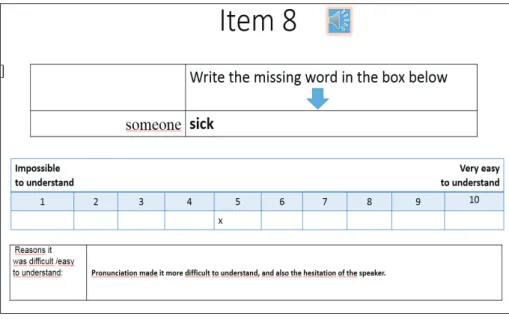
provided on the slides; (ii) rating how easy/difficult it was to understand the missing word; and (iii) writing possible explanations for why comprehending the missing word was easy/difficult. In this paper, only the data from the first task is analyzed. Figure 1 brings a PowerPoint screenshot depicting the
test layout, as it was presented to the listeners. In this example, a listener had already completed the test item, and the responses are also shown below.
FIGURE 1: Screenshot displaying a sample of the Intelligibility Test with listener’s response
]
was to understand the missing word. In the example in Figure 1, the listener
assigned 5, meaning the word was not very easy to understand. Finally, the listener explained that what made the word somewhat difficult to understand
was the way it was pronounced and the speaker’s hesitation.
After completing the Intelligibility Test, each listener was asked to complete the background questionnaire and was allowed to ask any questions they had about the questionnaire items.
3.4 Data Analysis
The first step was to analyze the questionnaire data in order to build spreadsheets to display the listeners’ background regarding: nationality, age, sex, proficiency level of the listeners whose English was not the L1 (self-rated and/or score on a standardized test), length of stay in Brazil (in months), and familiarity with English spoken by Brazilians (based on open questions answered by the listeners).
Next, the PowerPoint files containing the responses of each listener for
the Intelligibility test were analyzed and spreadsheets were created to display the results for the three tasks. In this study, the focus is on the analysis of task
1 (transcription of missing words). For each target word, the scores of correct
responses were tabulated, and, for the incorrect transcriptions, a table with all alternative responses was created to further examine possible patterns. The
results were then split according to (i) degree of semantic context (two levels: limited context and substantial context) and (ii) type of coda modification (six levels: vocalization of nasal, vocalization of /l/, palatalization of alveolar stops, vowel insertion, voicing, and devoicing of alveolar fricatives).
A spreadsheet displaying the scores of correct responses per listener
and information about the listeners’ background was also created to allow running correlations to investigate the role of the listeners’ background
variables in the transcription task. The variables included here were: (i) score of correct transcriptions, (ii) proficiency level, (iii) familiarity with English spoken by Brazilians, and (iv) length of residence in Brazil.
Finally, the data were organized for the purpose of examining the role
played by the listeners’ L1 background. Because the study collected data
from twelve nationalities, and the number of listeners for many of these nationalities was small, a decision was made to create two groups, separating
3 Italian listeners; total = 18) from those whose L1 has a different origin (8 English, 5 German, and 7 listeners form varied L1s; total = 20).
The data were submitted to statistical analysis with the help of the
SPSS (Statistics for Social Sciences, version 20) program. The alpha level was defined at .05. The descriptive statistical results revealed that the data set had non-normal distributions, which was confirmed by the Normality Tests.
Thus, all statistical tests presented in the next section are non-parametric.
For RQ1, Kruskall-Wallis tests were used to compare the Intelligibility Test results obtained for different types of modified codas and different degrees
of semantic information. To answer RQ2, a Mann-Whitney test was used
to compare the performance of two groups of listeners (L1 similar to Portuguese / L1 different from Portuguese) in the Intelligibility Test. Note
that the main criterion to accommodate the listeners in two different groups
is the fact that the listeners who speak a Romance language (i.e., Spanish, French, and Italian) are less likely to use English to communicate with
Brazilians and, therefore, less familiar with the English spoken by Brazilians.
The opposite is expected for listeners whose L1 is typologically different
from Portuguese, such as German, English, and Syrian, who are more likely to use or to have used English to communicate with Brazilians. Finally,
Spearman correlations were run to answer RQ3 and look for relationships
between coda intelligibility and listeners’ background variables.
4 Results
This study attempts to answer three research questions in order to better
understand what factors play a role in the intelligibility of English spoken by
Brazilians. Research question 1 (RQ1) examines the effect of the type of coda modification and the degree of semantic context on the listeners’ performance
when transcribing the target words. RQ2 investigates the role of the listeners’
L1 in their performance on the Intelligibility Test. The third research question
follows a correlational approach and investigated possible relationships
4.1 Type of Coda Modification and Semantic Information
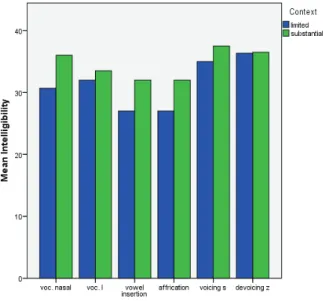
Figure 2 displays the rates of correct response in the Intelligibility
Test, with the results separated for the type of coda modification and the amount of semantic information available in each utterance (RQ1).
The results show that, overall, the listeners performed better with the utterances that provided substantial semantic information than with the utterances with limited information, except for one type of coda
modification (devoicing of /z/). As for the type of coda modification,
vowel insertion and affrication of the alveolar stops hindered intelligibility more often, while voicing and devoicing of the alveolar fricatives seemed
to pose less difficulty to the listeners. Overall, the listeners displayed very
high intelligibility rates, as the mean of correct responses for all types of
context ranged from 31.3 (82.3%) to 34.5 (90.7%), and for all types of coda modification they ranged from 29 (76%) to 36.4 (95.7%).
FIGURE 2 – Means of correct responses by the 38 listeners in the Intelligibility Test separated for the type of coda modification and the degreee of semantic
context
Given that the data set presented no normal distribution,
modification (5 levels5) and amount of semanatic context (2 levels). The results show that neither of the intedependent variables had a significant effect on the Intelligibility scores (coda modification: p = .268; semantic context: p = .089), despite the fact that the variable context approaced significance.
Although the overall results combining the performance of all
listeners indicate high intelligibility rates, it is important to observe listeners’ individual performance in order to have a better understanding of individual
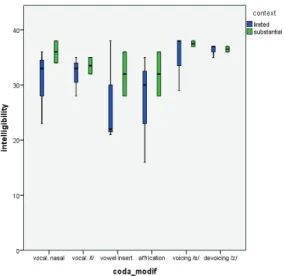
differences. A closer look at the results for RQ1 is made possible with the data displayed in Figure 3, as it shows information about variation within the group of 38 listeners. The boxplot allows us to compare the rates of correct response for each type of coda modification and semantic context, as well as to observe individual performances by examining the median (central line in the boxplot boxes), the minimum and maximum scores (lines extending vertically from the boxes) for each type of coda modification and degree
of semantic information.
FIGURE 3 – Boxplots summarizing the descriptive statistics for the Intelligibility Test, with results organized per type of coda modification and
amount of semantic context
5 Initially there were six levels per type of coda modification. However, the tokens containing words with devoiced /z/ were removed from analysis because nearly all listeners
Figure 3 shows that the range of responses varies much more for the
limited semantic context condition than for the words that appeared in the substantial context condition, as demonstrated by the long box whiskers and the rather asymmetric shapes of the boxes in the limited semantic context
condition. For example, the codas that were modified with vowel insertion (e.g., ‘sick’ [ˈsɪkɪ]) show a very low median of correct responses (median =
22 or 57.8% of correct responses), but there are many listeners who scored above this value, and at least for one of the target words (i.e., ‘lake’ with limited semantic information), all the listeners managed to transcribe it correctly (median = 38, or 100% correct responses). Another example can be seen with codas that were modified with affrication of the alveolar stops (e.g., ‘bed’ [bɛdʒ]), which yielded a median of 30 correct responses (78.9%), but with most listeners scoring below this median, and at least one of the target words
(‘bed’ with limited semantic information) obtaining the lowest score in the Intelligibility Test (median = 16, or merely 44.4% of the listeners transcribed it correctly). Conversely, the range of responses for the utterances with
substantial context was small, especially for the codas with voicing or devoicing of the alveolar fricatives, which caused very little problem.
4.2 Intelligibility and the effect of listeners’ L1
RQ2 scrutinizes how the listeners’ L1 affects their performance on the
Intelligibility Test. The present study includes intelligibility data from listeners
of varied L1 backgrounds, and, for this analysis, the listeners were split into two groups: listeners whose L1 is similar to BP (N = 18), and listeners whose L1 has a different origin (N = 20). The intelligibility scores of the two groups were compared with the listeners’ L1 familiarity variable, using the Mann-Whitney test. As Figure 4 demonstrates, the listeners whose L1 had a different origin (e.g., English, German) obtained higher intelligibility scores (mean = 27.45, sd = 2.11) than the listeners whose L1 has a similar origin (mean = 23.88, sd = 3.17). The boxplot also shows that the range of intelligibility scores was wider for the group with an L1 similar to BP (18-28) than for the group with an L1 different from BP (22-30). Note that the range for the different L1 group includes an outlier (Listener 8), who scored 22 in the Intelligibility Test.6
FIGURE 4 – Boxplots displaying Intelligibility Test results for listeners with L1s similar and different from talkers’ L1
The results for the two groups were compared, using the non-parametric Mann-Whitney test, which showed that the difference between
the two groups was significant (p < .001), thus confirming that the group with an L1 of different origin performed better on the intelligibility test.
4.3 Relationship between Intelligibility and Listeners’ Profile Variables
The third research question addresses the role of listeners’ variables,
namely listeners’ familiarity with English spoken by Brazilians and with
the speakers’ L1 (measured as the listeners’ length of residence in Brazil), and their proficiency level. Figures 5-7 show the relationship between the
intelligibility rates and the three listeners’ background variables.
In Figure 5, we can see a clear tendency for the listeners who reported
FIGURE 5 – Relationship between rates of correct responses in the Intelligibility Test and the listeners’ familiarity with the English spoken by Brazilians
Figure 6 shows a different scenario for the length of residence variable,
which demonstrates that most listeners reported having similar lengths of
residence, around 1 to 15 months, with a few cases of considerably higher lengths of residence, varying from 18 to 288 months. The results show no
clear relationship between length of residence and correct transcriptions, given that the scatterplot demonstrates that both listeners with low and high rates of correct transcriptions are among those who reported having the lowest lengths of residence, and the two listeners with the highest length of residence obtained mid-range scores of correct transcriptions.
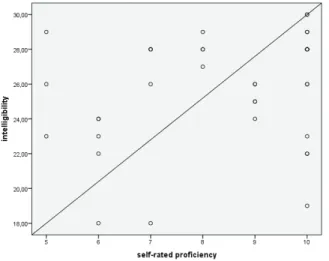
Finally, Figure 7 shows the results for a possible relationship between the listeners’ self-reported English proficiency and their performance on the Intelligibility Test. For the proficiency variable, the scores varied from 5 to 10,
including the data for the eight native speakers of English, who were assigned
the maximum score, together with another eight speakers from different L1s.
The scatterplot also shows no clear tendency for the listeners with the highest
proficiency levels to have obtained the best performance in the Intelligibility Test, but rather a random pattern, with low-proficiency listeners performing as well as some listeners with high proficiency levels, and vice-versa.
FIGURE 7 – Relationship between rates of correct responses in the Intelligibility Test and the listeners’ English proficiency.
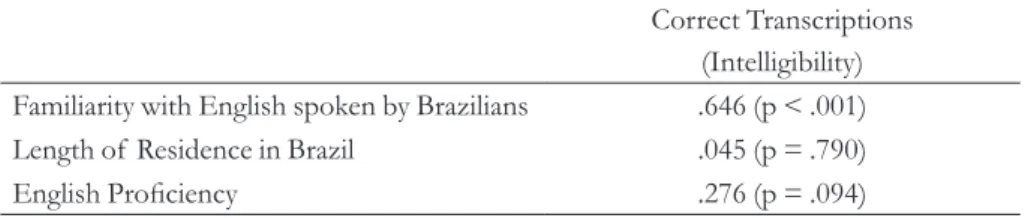
To further investigate possible relationships between these listeners’ background variables and the listeners’ performance on the Intelligibility
Test (i.e., the rates of correct transcription of the target words), Spearman correlations were run. The results displayed in Table 3 confirm what the scatterplots in Figures 5-7 suggested: the only variable that shows a clear
positive relationship with the performance on the Intelligibility Test is
relevant correlation with intelligibility (rho = .045, p = .790) and, at least
for this data set, it was unable to predict the listeners’ performance on the Intelligibility Test.
Table 3 – Correlations between Intelligibility scores and listeners’ background variables
Correct Transcriptions
(Intelligibility)
Familiarity with English spoken by Brazilians .646 (p < .001)
Length of Residence in Brazil .045 (p = .790)
English Proficiency .276 (p = .094)
5 Discussion
In summary, the results have shown that certain types of coda
modification hinder intelligibility more often than others, given that they
make the target words sound similar to other words in the English language.
For example, the target words ‘bed’ and ‘cat’ are among those with the
lowest scores of correct transcription because their codas were produced as
affricates, leading many listeners to transcribe them as ‘badge’ and ‘catch’,
respectively. This is because, by producing the alveolar stops as affricates, the speakers ended up pronouncing other words with a different meaning
in English. As reported in previous studies (DERWING; MUNRO, 1997; KENNEDY; TROFIMOVICH, 2008; GONÇALVES; SILVEIRA, 2015),
when presented with more semantic information, the listeners improved their performance, but some continued to transcribe the words with the affricate
codas. This runs in line with Jenkins’ (2002) claim that even when relevant
semantic information is present, listeners are likely to be so tuned to the
speech signal that miscommunication is likely to happen quite often due to
mispronunciation.
Conversely, when codas were modified by inserting vowels after the final consonant, no minimal pairs were created. However, once again the
listeners felt like transcribing exactly what they heard, which meant that many
number of correct transcriptions improved for words produced with vowels added to the coda, but not for all listeners.
Turning to the types of coda modification that caused fewer
intelligibility problems, the results showed that vocalizing the final nasal
consonant codas affected intelligibility when little semantic information was
provided, as, for example, with the word ‘sun’ being transcribed as ‘song’ and ‘sound’. These two types of transcriptions show that the listeners are
somehow trying to represent nasality in their transcriptions by adding a nasal consonant to the codas, although the transcriptions are not
target-like. Conversely, vocalizing the final /l/, voicing and devoicing of alveolar
fricatives were not much of a problem, even when little semantic information was available. This is probably due to the fact that the vocalization of /l/ is
also found in English as an L1 variety (JOHNSON; BRITAIN,2003) and that voicing/devoicing of alveolar fricatives is a type of coda modification found in the English spoken by many of these listeners (for example, Spanish and German speakers).
Another variable that should be controlled is the listeners’ L1. In the
present study, it was not possible to have a balanced number of listeners
from different L1 backgrounds. However, a follow-up analysis of the data showed that the degree of similarity or difference between the L1 listeners’ and speakers’ appeared to influence the results. The listeners whose L1 had
a different origin obtained higher scores on the Intelligibility Test than the listeners of other Romance languages like BP. Indeed, it is plausible that
listeners who speak an L1 that is similar to the speakers’ L1, such as Spanish
speakers, are less likely to use English to communicate with Brazilians, thus being less familiar with the pronunciation features of the English spoken
by Brazilians. Conversely, listeners whose L1 is quite different from BP,
such as German or English, are more likely to communicate in English with Brazilians, and thus have more familiarity with Brazilian-accented English. The literature on intelligibility studies reports controversial results
regarding listeners’ background variables. In the present study, significant
correlations were found between the listeners’ familiarity with the English spoken by Brazilian learners and their performance on the Intelligibility
Schadech (2013). This might have been caused by the fact that proficiency
was not directly measured in the present study, which relied on self-reports.
Likewise, length of residence in the country of the speakers showed no significant correlations, most likely due to the presence of many outliers for
the length or residence variable in the data set, but also due to the fact that being in a country does not imply familiarity with the national language and its phonetic-phonological traits.
It is important to point out that the results reported in the present study may have been caused by intervening variables, such as the listeners’
proficiency levels. However, only the use of a standardized test to measure proficiency could help to elucidate this matter, given that the self-rated proficiency measure of the present study did not correlate significantly with
the Intelligibility Test scores.
Final Considerations
The present study examined the role of coda modification and semantic context on the intelligibility of English words produced by
Brazilians. Because listeners’ factors influence the results of intelligibility
studies, we also examined a number of listeners’ variables and how they can help us to explain the listeners’ performance on the Intelligibility Test. The
study reveals some interesting findings to inform L2 pedagogy regarding
speech learning for successful communication.
Some types of coda modification seem to cause few intelligibility
problems, as in the case of vocalization of nasal and /l/, and voicing/ devoicing of alveolar fricatives. Others deserve serious attention in the classroom context, as they present a major potential for misunderstandings,
which is the case of affrication of /t/ and /d/, which frequently result in words with different meanings (e.g., ‘cat’ heard as ‘catch’). Another type of coda modification that may negatively affect communication is vowel
insertion, which creates an extra syllable and has a major impact on rhythm. The degree of semantic information available in the utterance certainly helps but does not solve all the cases of potential miscommunication, given the level of attention that listeners pay to the acoustic signal and the fact that
L2 speech may also contain other types of non-target pronunciations and
semantic information to help learners see the importance of avoiding certain
types of coda modification that hinder communication.
Because familiarity with L2 accents is a relevant factor for intelligibility,
we can never emphasize enough the importance of bringing to the classroom
the L2 as it is spoken by users from various nationalities, especially those
nationalities that English learners are more likely to interact with in English. Experience with different accents and different varieties of English can help learners and speakers become better listeners and increase the chances of successful interactions in international contexts.
Further investigation should provide a thorough analysis of the target words selected to compose the corpus of intelligibility studies. For example,
it is important to investigate the functional load (BROWN, 1991; MUNRO; DEWING, 2006) of the consonant codas of the target words (i.e., the frequency of these codas in the target language and the number of potential minimal pairs the target words have when their codas are modified), and whether the modified coda patterns investigated in a study create minimal
pairs in the target language.
References
ALVES, U. K. Estudios recientes sobre la adquisición fonético-fonológica de lenguas extranjeras desarollados en Brasil. In: LUCHINI, P. L.; GARCÍA JURADO, M. A.; ALVES, U. K. (Orgs.). Fonética y fonología: articulación entre enseñanza e investigación. Argentina: Editora da Universidad Nacional de Mar del Plata, 2015. p. 98-109.
BECKER, M. R. Inteligibilidade da língua inglesa sob o paradigma da Língua Franca: Percepção de discursos de falantes de diferentes L1s por brasileiros. 2013. 256 p. Doctoral Thesis (Ph.D. in Letters), College of Philosophy, Science, and Letters, Universidade Federal do Paraná, Curitiba. 2013.
BENT, T.; BRADLOW, A. R. The interlanguage speech intelligibility benefit. The Journal of the Acoustical Society of America, v. 114, n. 3, p. 1600-1610, 2003.
BRADLOW, A. R. & PISONI, D. B. Recognition of spoken words by native and non-native listeners: Talker-, listener- and item-related factors. Journal of the Acoustical Society of America, v. 106, n. 4, p. 2074-2085, 1999.
CELCE-MURCIA, M., BRINTON, D., & GOODWIN, J. M. Teaching pronunciation: A course book and reference guide (2nd ed.). New York: Cambridge University Press, 2010.
CRUZ, N. C. An exploratory study of pronunciation intelligibility in the Brazilian learners’ English. The Specialist, v. 24, n. 2, p. 155-175, 2003.
CRUZ, N. C. Pronunciation intelligibility in spontaneous speech of Brazilian learners English. 2004. 260 p. Doctoral Thesis (Ph.D. in English) – Center of Communication and Expression, Universidade Federal de Santa Catarina, Florianópolis, 2004.
CRUZ, N. C. Pronunciation intelligibility in spontaneous speech of Brazilian learners’ English. Claritas, v. 12, n. 1, p. 121-136, 2006a.
CRUZ, N. C. Inteligibilidade de pronúncia no contexto de inglês como língua internacional. Revista Intercâmbio, v. 15, p. 1-11, 2006b.
CRUZ, N. C. Familiaridade do ouvinte e inteligibilidade da pronúncia de aprendizes brasileiros de inglês. Revista Horizontes de Linguística Aplicada, v. 7, n. 1, p. 88-103, 2008.
DERWING, T.; MUNRO, M. Accent, comprehensibility and intelligibility: Evidence from four L1s. Studies in Second Language Acquisition, v. 19, n. 1, p. 1-16, 1997.
DERWING, T.; MUNRO, M. What speaking rates do non-native listeners prefer? Applied Linguistics, v. 22, n. 3, p. 324-337, 2001.
GASS, S.; VARONIS, E. The effect of familiarity on the comprehensibility of nonnative speech. Language Learning, v. 34, n. 1, p. 65–89, 1984.
GONÇALVES, A. R. In search of speech intelligibility: the case of English high front vowels. 2014. 170 p. Masters Thesis (M.A. in English: Linguistic Studies) – Center of Communication and Expression, Universidade Federal de Santa Catarina, Florianópolis. 2014.
GONÇALVES, A. R.; SILVEIRA, R. Frequency effects on the intelligibility of English words with high front vowels, Organon, v. 58, n. 1, p. 127-152, 2015. HAHN, L. Primary stress and intelligibility: research to motivate the teaching of suprasegmentals. TESOL Quarterly, v. 38, n. 2, p. 201–223, 2004.
JENKINS, J. A sociolinguistically-based, empirically-researched pronunciation syllabus for English as an international language. Applied Linguistics, v. 23, n.1, p. 83-103, 2002.
JOTO, A.; FUNATSU, S.; NAGASE, Y. Effect of VOT on intelligibility of English voiceless stops produced by native speakers of Japanese. Proceedings of the ICPhS XVII. 2007. Available at:< http://www.ucl.ac.uk/psychlangsci/ptlc/proceedings_2007 > Retrieved on January 24, 2014.
KENNEDY, S.; TROFIMOVICH, P. Intelligibility, Comprehensibility, and Accentedness of L2 Speech: The Role of Listener Experience and Semantic Context. The Canadian Modern Language Review, v. 64, n. 3, p. 459–489, 2008. MUNRO, M.; DERWING, T. Foreign accent, comprehensibility and intelligibility in the speech of second language learners. Language Learning, v. 45, n. 1, p. 73–97, 1995.
SCHADECH, T. S. The production of word-initial // by Brazilian learners of English and the issues of comprehensibility and intelligibility. 2013. 218 p. Masters Thesis (M.A. in English) – Center of Communication and Expression, Universidade Federal de Santa Catarina, Florianópolis. 2013.
SILVEIRA, R. L2 production of English word-final consonants: The role of orthography and learner profile variables. Trabalhos em Linguística Aplicada, v. 51, n. 1, p. 15-28, 2012.
SILVEIRA, R. The Influence of Pronunciation Instruction on the Perception and Production of English Word-final Consonants. Florianópolis: ARES - Pós-Graduação em Inglês, 2016.
SILVEIRA, R.; DELATORRE, F.; REIS, L. P.; GONCALVES, A. R. . Percepção, produção e inteligibilidade do inglês falado por usuários brasileiros. In: TOMITCH, L. M. B.; HEBERLE, V. M. (Orgs.). Perspectivas atuais de aprendizagem e ensino de línguas. Florianópolis: LLE/CCE/UFSC, 2017, p. 237-283.
Statistics for Windows, Version 20.0. Armonk, NY: IBM Corp. YAVAS, M. Applied English Phonology. Oxford: Wiley-Blackwell, 2011.
ZIMMER, M. C. A.; SILVEIRA, R.; ALVES, U. K. Pronunciation instruction for Brazilians: Bringing Theory and Practice Together. Newcastle upon Tyne: Cambridge Scholars Publishing, 2009.