Faculdade de Ciências e Tecnologia Departamento de Informática
Dissertação de Mestrado
Mestrado em Engenharia Informática
Static Detection of Anomalies in
Transactional Memory Programs
Bruno C. Teixeira — 26043
Faculdade de Ciências e Tecnologia Departamento de Informática
Dissertação de Mestrado
Static Detection of Anomalies in
Transactional Memory Programs
Bruno C. Teixeira — 26043
Orientador: Prof. Doutor João M. S. Lourenço
Dissertação apresentada na Faculdade de Ciências e Tecnologia da Universidade Nova de Lisboa para a obtenção do Grau de Mestre em Engenharia In-formática.
“If I have seen a little further, it is by standing on the shoulders of Giants."
— Sir Isaac Newton
In spite of all the days and nights spent on developing this work, I would have not been able to produce it without the help of numerous people.
I definitely owe much to my advisor, João Lourenço, for always being supportive, and for always being able to pragmatically put the most complex problems in the most simple perspectives, which so much helped me in times of despair. His disregard for his own sleeping needs has many times enabled crucial advances in my research, and shows his dedication to science and to his students.
A bigthank yougoes out to Diogo Sousa, who provided much help in developing the tests for the approaches presented in this thesis. Even though he’s an undergrad student at this time, I am by far outmatched by his tremendous technical skills, and he has a bright future ahead of him. Ricardo Dias, fellow student, also provided important help and companionship.
Eitan Farchi, from the IBM Haifa Research Lab played an irreplaceable role in the devel-opment of this thesis. The knowledge he shared and the hints he provided may have decided the direction in which this work was carried out. He also provided me with tests for my ap-proaches be enabling access to the IBM concurrency testing repository.
I would definitely like to thank the partial support by Sun Microsystems and Sun Microsys-tems Portugal under theSun Worldwide Marketing Loaner Agreement #11497, by the Centro de Informática e Tecnologias da Informação (CITI), and by the Fundação para a Ciência e Tecnolo-gia (FCT/MCTES) in the Byzantium research project PTDC/EIA/74325/2006.
And, of course, because there is more to life than work (even though it didn’t seem that way in last few months), I would like to thank a number of other people for helping preserve my sanity, and for sometimes righteously putting me on the wrong track.
I would like to thank Joana Pinto, without whose caring attentions this thesis would have been written in half the time, even though I would not know what to do with that time if I didn’t have her in my life.
less than I perceive) always reminds me of myself and of where I came from.
Transactional Memory (TM) is an approach to concurrent programming based on the transac-tional semantics borrowed from database systems. In this paradigm, a transaction is a sequence of actions that may execute in a single logical instant, as though it was the only one being ex-ecuted at that moment. Unlike concurrent systems based in locks, TM does not enforce that a single thread is performing the guarded operations. Instead, like in database systems, transac-tions execute concurrently, and the effects of a transaction are undone in case of a conflict, as though it never happened. The advantages of TM are an easier and less error-prone program-ming model, and a potential increase in scalability and performance.
In spite of these advantages, TM is still a young and immature technology, and has still to become an established programming model. It still lacks the paraphernalia of tools and standards which we have come to expect from a widely used programming paradigm. Testing and analysis techniques and algorithms for TM programs are also just starting to be addressed by the scientific community, making this a leading research work is many of these aspects.
This work is aimed at statically identifying possible runtime anomalies in TM programs. We addressed both low-level dataraces in TM programs, as well as high-level anomalies resulting from incorrect splitting of transactions.
We have defined and implemented an approach to detect low-level dataraces in TM pro-grams by converting all the memory transactions into monitor protected critical regions, syn-chronized on a newly generated global lock. To validate the approach, we have applied our tool to a set of tests, adapted from the literature, that contain well documented errors.
We have also defined and implemented a new approach to static detection of high-level concurrency anomalies in TM programs. This new approach works by conservatively trac-ing transactions, and matchtrac-ing the interference between each consecutive pair of transactions against a set of defined anomaly patterns. Once again, the approach was validated with well documented tests adapted from the literature.
A Memória Transaccional (MT) é uma abordagem à programação concorrente baseada na semân-tica transaccional importada dos sistemas de bases de dados. Neste paradigma, uma transacção é uma sequência de acções que podem ser executadas num instante lógico, como se fosse a única a ser executada nesse momento. Em contraste com sistemas de concorrência baseados emlocks, a MT não requer que apenas um único fio de execução esteja a executar as operações sincronizadas. Em vez disso, tal como em sistemas de bases de dados, as transacções execu-tam em paralelo, e os efeitos de uma transacção são anulados em caso de conflito, como se esta nunca tivesse tido lugar. A MT é um modelo de programação mais fácil e com menos tendência para erros, e oferece uma potencial melhoria na escalabilidade e no desempenho.
Apesar destas vantagens, a MT continua a ser uma tecnologia ainda jovem e imatura, e tem ainda de se afirmar como um modelo de programação estabelecido. A MT carece ainda da parafernália de ferramentas e padrões que se veio a esperar de um paradigma de programação generalizado. Técnicas e algoritmos para teste e análise de programas que utilizem MT também estão apenas agora a merecer a atenção da comunidade científica, fazendo deste um trabalho inovador em muitos destes aspectos.
A ambição deste trabalho prende-se com a detecção estática de possíveis anomalias em programas com MT, que possam surgir em tempo de execução. Irão ser abordadosdataracesde baixo nível, bem como anomalias de alto nível resultantes de quebra incorrecta de transacções. Foi definida e implementada uma abordagem para detectar dataraces de baixo nível em programas com MT através da conversão de todas as transacções de memória para regiões críticas protegidas por monitores, sincronizadas num novo lock global gerado. Para validar esta abordagem, a ferramenta foi aplicada a uma série de testes, adaptados da literatura, que contêm erros bem documentados.
Foi também definida e implementada uma nova abordagem para a detecção estática de anomalias de concorrência de alto nível em programas com MT. Esta nova abordagem funciona através da listagem pessimista de transacções, e da verificação da interferência entre cada par de transacções consecutivas em relação a padrões de anomalias pré-definidos. Uma vez mais, esta abordagem foi validada através de testes bem documentados adaptados da literatura.
1 Introduction 1
1.1 Context . . . 1
1.2 Problem Statement . . . 2
1.3 Thesis Claim . . . 4
1.4 Approach. . . 5
1.5 Contributions . . . 5
1.6 Document Layout . . . 5
2 Related Work 7 2.1 Transactional Memory . . . 7
2.1.1 Properties of Transactions . . . 8
2.1.2 Differences Between Memory and Databases . . . 9
2.1.3 HTM vs STM . . . 9
2.1.4 Design Considerations . . . 10
2.1.5 Discussion . . . 14
2.2 Program Analysis . . . 14
2.2.1 Static vs Dynamic Program Analysis . . . 14
2.2.2 Control-flow and Data-flow Analysis . . . 15
2.2.3 Program Representation for Static Analysis . . . 16
2.2.4 Type and Effect Systems . . . 17
2.2.5 Symbolic Execution. . . 17
2.2.6 Discussion . . . 18
2.3 Program Transformation and Analysis Tools . . . 18
2.3.1 Rewriting Engines vs Compiler Frameworks . . . 18
2.3.2 Examples of Analysis and Transformation Tools . . . 19
2.3.3 The Polyglot Compiler Framework. . . 21
2.3.4 Discussion . . . 23
2.4 Datarace Detection Methods and Tools. . . 23
2.4.1 Dataraces . . . 23
2.4.2 Static vs Dynamic Detection . . . 25
2.4.3 Datarace Detection Mechanisms . . . 26
2.4.5 JChord . . . 31
2.4.6 Discussion . . . 33
3 Low-Level Dataraces in Transactional Memory 35 3.1 Introduction . . . 35
3.2 Semantics . . . 35
3.3 Dataraces . . . 36
3.4 Conversion. . . 37
3.5 Datarace Detection . . . 39
3.5.1 Parsing . . . 39
3.5.2 Global Lock Generating Phase . . . 40
3.5.3 Atomic Blocks Replacing Phase . . . 41
3.6 Tests and Experiments . . . 41
3.6.1 Empty Program . . . 42
3.6.2 HelloWorld Single-Threaded . . . 42
3.6.3 HelloParallel Buggy . . . 43
3.6.4 HelloParallel Buggy Synchronized . . . 43
3.6.5 HelloParallel Buggy Corrected . . . 44
3.6.6 HelloWorld Modular . . . 44
3.6.7 HelloWorld Complex. . . 45
3.6.8 Account . . . 47
3.6.9 Airline . . . 48
3.6.10 Piper . . . 50
3.6.11 Clean . . . 51
3.6.12 Allocate Vector . . . 52
3.6.13 LeeTM . . . 54
3.7 Concluding Remarks . . . 55
4 High-Level Anomalies in Transactional Memory 57 4.1 Introduction . . . 57
4.2 Related Work . . . 59
4.2.1 Atomicity Violations . . . 59
4.2.2 High-Level Dataraces . . . 60
4.2.3 Comparison . . . 62
4.3 Definition of Anomalies . . . 63
4.3.1 All High-Level Anomaly Patterns . . . 64
4.3.2 Difference to Thread-Atomicity . . . 65
4.3.3 Common Patterns . . . 66
4.4 Anomaly Detection Approach . . . 68
4.4.1 Transaction Nesting . . . 69
4.4.3 Alternative Execution Statements . . . 69
4.4.4 Loop Statements . . . 70
4.4.5 Other Control-Flow Structures . . . 70
4.4.6 Discussion of the Approach . . . 70
4.5 Implementation . . . 72
4.5.1 Trace Tree Structure . . . 72
4.5.2 First Phase — Method Listing . . . 72
4.5.3 Second Phase — Expansion and Merging . . . 73
4.5.4 Third Phase — Analysis . . . 73
4.5.5 Static Analysis . . . 73
4.5.6 Standard or Unavailable Methods . . . 74
4.6 Validation of the Approach . . . 74
4.6.1 Test: Connection . . . 75
4.6.2 Test: Coordinates’03 . . . 76
4.6.3 Test: Local Variable . . . 77
4.6.4 Test: NASA . . . 78
4.6.5 Test: Coordinates’04 . . . 79
4.6.6 Test: Buffer . . . 80
4.6.7 Test: Double Check . . . 81
4.6.8 Test: StringBuffer . . . 82
4.6.9 Test: Account . . . 82
4.6.10 Test: Jigsaw . . . 83
4.6.11 Test: Over-reporting . . . 84
4.6.12 Test: Underreporting . . . 86
4.6.13 Test: Allocate Vector . . . 87
4.6.14 Test: Knight Moves . . . 88
4.7 Test Results . . . 89
4.8 Concluding Remarks . . . 91
5 Conclusion 93 5.1 Conclusions . . . 93
5.2 Future Work . . . 94
5.2.1 Enhancements on the Detection of High-Level Anomalies . . . 94
5.2.2 Possible Optimizations on TM Programs . . . 95
A Source Code of Test Subjects 103 A.1 Tests with Low-Level Dataraces . . . 103
A.1.1 Empty Program . . . 103
A.1.2 HelloWorld Single-Threaded . . . 103
A.1.3 HelloParallel Buggy . . . 104
A.1.5 HelloParallel Buggy Corrected . . . 105
A.1.6 HelloWorld Modular . . . 106
A.1.7 HelloWorld Complex. . . 107
A.1.8 Account . . . 108
A.1.9 Airline . . . 113
A.1.10 Piper . . . 117
A.1.11 Clean . . . 122
A.1.12 Allocate Vector . . . 128
A.1.13 LeeTM . . . 137
A.2 Tests with High-Level Anomalies . . . 138
A.2.1 Test: Connection . . . 138
A.2.2 Test: Coordinates’03 . . . 141
A.2.3 Test: Local Variable . . . 143
A.2.4 Test: NASA . . . 144
A.2.5 Test: Coordinates’04 . . . 146
A.2.6 Test: Buffer . . . 147
A.2.7 Test: Double Check . . . 149
A.2.8 Test: StringBuffer . . . 150
A.2.9 Test: Account . . . 151
A.2.10 Test: Jigsaw . . . 152
A.2.11 Test: Over-reporting . . . 154
A.2.12 Test: Underreporting . . . 155
A.2.13 Test: Allocate Vector . . . 156
2.1 Sample HTML output produced by JChord. . . 33
3.1 Concurrent regions. . . 36
3.2 Concurrent synchronized blocks. . . 38
3.3 Concurrent atomic blocks. . . 38
3.4 Low-level datarace detection approach. . . 40
4.1 Four threads that access shared fields. Thread 3 may cause an anomaly.. . . 62
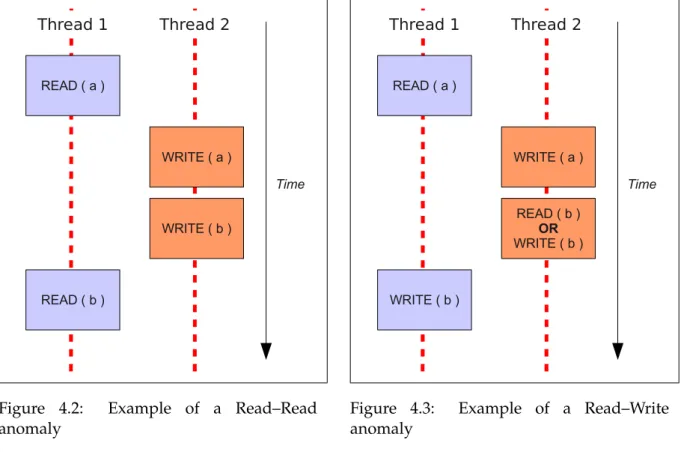
4.2 Example of a Read–Read anomaly . . . 64
4.3 Example of a Read–Write anomaly . . . 64
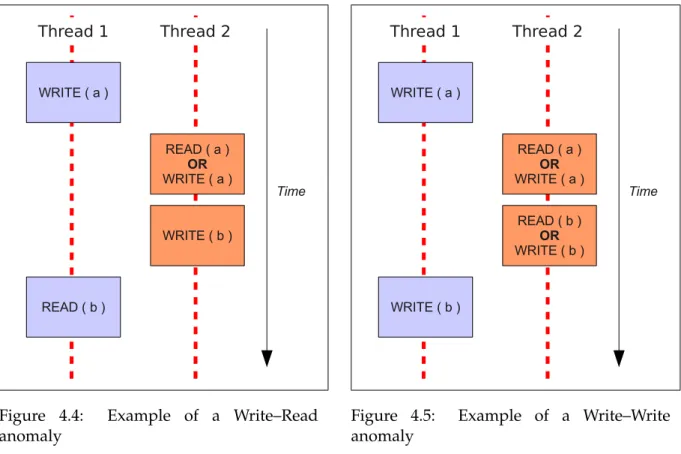
4.4 Example of a Write–Read anomaly . . . 65
4.5 Example of a Write–Write anomaly . . . 65
4.6 Example of a set of threads that are not atomic, but do not present anomalies on any pair of consecutive transactions. . . 65
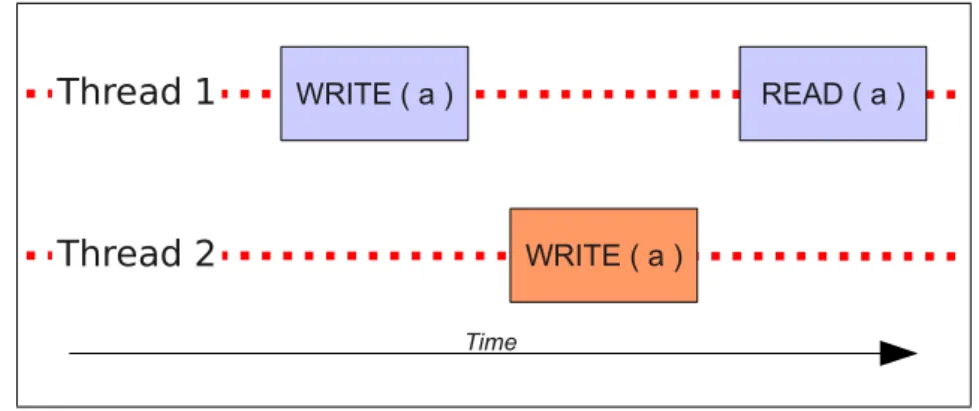
4.7 An unserializable pattern which does not appear to be anomalous. . . 66
4.8 Example of an RwR anomaly. . . 67
4.9 Example of a WrW anomaly. The condition ofxbeing the same asyis part of the program invariant. . . 67
4.10 Example of an RwW anomaly. . . 67
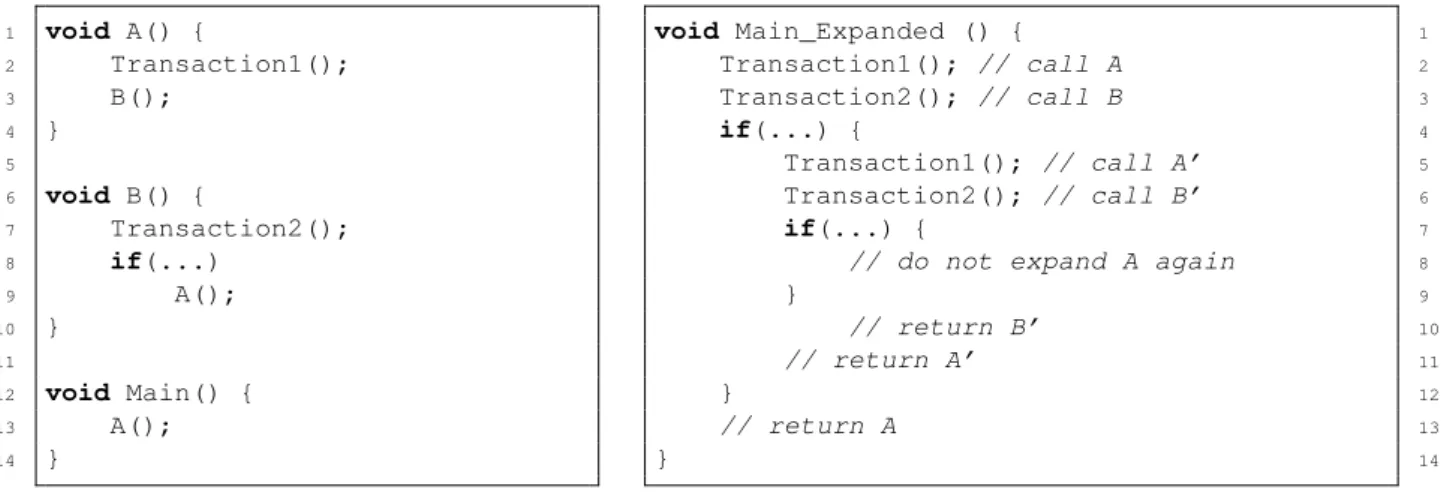
4.11 Method expansion. Care must be taken in aborting repeated expansions. . . 69
1.1 Example of a datarace in weak isolation. . . 3
1.2 Example of an anomaly in strong isolation. . . 4
2.1 Example of a Datarace . . . 24
2.2 Example of JChord configuration file. . . 32
3.1 Empty program test. . . 42
3.2 HelloWorld Monothreaded . . . 43
3.3 HelloWorld Multithreaded, with a bug. . . 43
3.4 HelloWorld Multithreaded, with a bug (synchronized) . . . 44
3.5 HelloWorld Multithreaded, with a bug (atomic) . . . 44
3.6 HelloWorld Multithreaded, corrected (synchronized) . . . 44
3.7 HelloWorld Multithreaded, corrected (atomic) . . . 44
3.8 HelloWorld Modular . . . 45
3.9 HelloWorld Complex, Java version.. . . 46
3.10 HelloWorld Complex, TM version. . . 46
3.11 Accounttest code snippet. . . 47
3.12 Accounttest – TM version . . . 47
3.13 Airlinetest code snippet, original version. . . 49
3.14 Airlinetest code snippet, TM version.. . . 49
3.15 Pipercode snippet . . . 50
3.16 Pipertest – TM version . . . 51
3.17 Cleanexample code . . . 52
3.18 Allocate Vectorsnippet code . . . 53
4.1 Example of an Atomicity Violation. . . 58
4.2 Example of a high-level datarace . . . 61
4.3 A set of transactions that are atomic, but view inconsistent. . . 63
4.4 A set of transactions that are view consistent, but not atomic. . . 63
4.5 Code snippet for the Connection test. . . 75
4.6 Code snippet for Local Variable test. . . 77
4.7 Code snippet for NASA test.. . . 78
4.8 Code snippet for Coordinates’04 test.. . . 79
4.9 Code snippet for the Buffer test.. . . 80
4.11 Code snippet for StringBuffer. . . 82
4.12 Code snippet for the Account test (a). . . 83
4.13 Code snippet for the Account test (b). . . 83
4.14 Code snippet for the Jigsaw test. . . 84
4.15 Code snippet for the Over-reporting test. . . 85
4.16 Code snippet for the Under-reporting test.. . . 86
4.17 Code snippet for the Allocate Vector test. . . 87
1
Introduction
1.1
Context
Concurrent programming has been an essential programming model in the last years. Even though the main paradigm in use has been that of sequential programming, concurrent pro-gramming has proved its advantages, and helped us better develop many programs, even on sequential processors.
Transactional Memory [HM93] is a fairly recent approach to concurrent programming that presents a new programming model. It borrows the abstraction oftransactionfrom database systems to provide for better abstraction and composability. Its goal is to provide a better programming model for concurrent applications, while potentially increasing performance of parallel programs on multi-processor systems. In a transactional memory system, critical ac-cesses to shared memory are coordinated through transactions. A transaction is a sequence of instructions and memory accesses that must appear logically atomic. Through transactions, a programmer can state that a particular code block must be executed as though a single thread was running on the system.
In contrary to memory accesses guarded by locks, a transaction can be committed, aborted, rolled-back and retried. A transaction’s effects are not immediate. Instead, after a transaction is done with its operations, it tries to commit. If it succeeds, the effects are made permanent and are visible by other threads. If a conflict is detected with another transaction, then one of them shall be aborted, and its effects rolled-back. The aborted transaction may be retried later, or give up. One desirable property of this execution model is that it allows real concurrent execution of mutual exclusive blocks. This optimistic synchronization allows two or more cores to execute blocks that access the same variables, instead of having all except one of them lock and wait for the active one to end. Transactional Memory was first proposed by using hardware support. However, approaches have been proposed that implement TM through software, without need for modifications on current hardware.
Although TM has promising advantages over lock-based synchronization, it is still possible to write an incorrect program [FQ03a]. Many problems are mitigated with the use of TM, but some are still present, in varied, often more subtle, forms. Because TM is such a young technol-ogy, a lot remains to be studied about the evolution of these problems into their transactional forms, and the seriousness they may still present.
1.2
Problem Statement
Transactional Memory (TM) is an emerging technology, and as such it still lacks the maturity and standards of other paradigms. In particular, there is a shortage of tools and mechanisms to analyze programs and detect errors, in the same amount of those available for non-concurrent programming, or even for other concurrent programming approaches.
Many problems that are present in legacy concurrent programs are still observed with TM. Such is true with dataraces. Although there has been a lot of study around datarace detec-tion, few of these works consider the transactional scenario. There are not either many studies that address the possible application of established datarace detection approaches on programs with transactions.
Low-Level Dataraces
As further detailed in Section2.1.4, even when using TM there is the risk that the code inside a transaction will be interleaved with non-transactional code. A system that allows this kind of interaction is said to provideweak isolation[BLM05,LR06]. In this scenario, we have the same pragmatic guarantees for thread interaction that we would have if not using synchronization at all. Therefore, it is easy to conceive a scenario where two threads have undesired concurrent accesses. An example is presented in Listing1.1. This small program has been written in a dialect of Java, that has been extended with theatomic keyword. This language extension is quiet common in the literature because it provides a transactional environment which is succinct and easy to understand, and is actually used in many systems [HF03,ATLM+
06]. The
atomickeyword defines a code block with transactional semantics. As such, all instructions in this block are to be executed completely, or not executed at all, and without allowing any other transactions to see the effects of this transaction until it has successfully finished. In
Listing 1.1: Example of a datarace in weak isolation. 1 public class Example extends Thread {
2 private static float salary = 0.00; // shared state 3 public void run() {
4 // ...
5 atomic {
6 float tmp = salary;
7 tmp = tmp + 42.00;
8 salary = tmp;
9 }
10 // ...
11 }
12
13 public static void main(String args[]) {
14 Thread t1 = new Example();
15 t1.start();
16 // ...
17 float tmp = salary; // read shared state
18 tmp += 42.00; // tmp might not reflect salary anymore
19 salary = tmp; // parallel updates might be lost
20 // ...
21 }
22 }
High-Level Anomalies
We will now assume that the underlying TM system providesstrong isolation[BLM05,LR06]. This means that code inside a transaction is guaranteed to run in full isolation, even from non-transactional code. In practice, this means that every operation outside an explicit transaction is automatically pushed inside a transaction of its own.
We will be reusing the previous example of a shared salary value. Because strong isolation is assumed this time, we have encapsulated all the pertinent instructions inside transactions, for illustrative purposes. This adaptation is shown in Listing1.2.
Listing 1.2: Example of an anomaly in strong isolation. 1 public class Example extends Thread {
2 private static float salary = 0.00; // shared state 3 public void run() {
4 // ...
5 atomic {
6 float tmp = salary;
7 tmp = tmp + 42.00;
8 salary = tmp;
9 }
10 // ...
11 }
12
13 public static void main(String args[]) {
14 Thread t1 = new Example();
15 t1.start();
16 // ...
17 float tmp;
18 atomic { tmp = salary; } // read shared state
19 tmp += 42.00; // tmp might not reflect salary anymore 20 atomic { salary = tmp; } // parallel updates might be lost
21 // ...
22 }
23 }
We are assured by the TM system that theatomicblock can assume that none of the op-erations in the main method will execute between two consecutive instructions of its own. However, the opposite is not true. Each single instruction in themainmethod is encapsulated inside a transaction, but the sequence of instructions as a whole is not. In this specific case, the programmer probably wanted to explicitly define a transaction containing the code pertinent to the counter increment.
1.3
Thesis Claim
that the detection of most high-level anomalies may be reduced to the evaluation of consecu-tive pairs of transactions only, as opposed to verify the whole set of transactions of a thread.
1.4
Approach
We have listed a series of issues that may possibly be observed in TM programs. As was said, many of these issues are derived from, or related to, similar issues that are present in either sequential, object-oriented, or non-transactional concurrent programs. Although TM is a recent technology, there is considerable study around detecting and correcting these issues on lock-based programs. Therefore, our approach will consist in assessing the possibility of applying these established techniques to the transactional scenario.
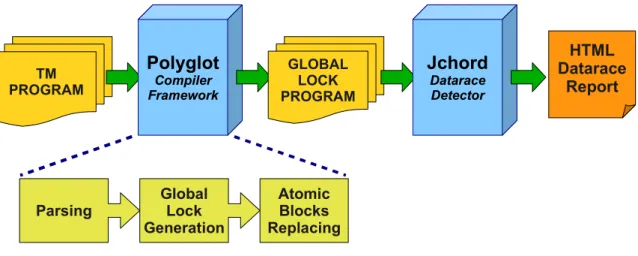
This work will perform anomaly detection through static analysis of Java source code. The anomalies addressed by our work are divided into two major classes, and accordingly the approach will be divided into two major parts. Due to the tight relation between low-level dataraces in TM and in typical synchronization mechanisms, the detection of these anomalies in TM programs will be carried out by porting these solutions to our context.
The detection of high-level anomalies will also take in consideration previous work which addresses lock-based concurrent programs. However, rather than merely porting these ap-proaches for usage in TM programs, we present a refined approach, which rivals with presently available solutions. We will refine previously established anomaly patterns, in order to produce more satisfiable results.
1.5
Contributions
As happens with all new development technologies, the use of TM will not be generalized immediately, and must be gradually integrated in the current software development context. The maturation and establishment of a new development technology is limited by the under-standing and confidence of the community in this new technology. We consider that automatic solutions for the problems presented here are facilities that would accelerate the assessment of the community as to how profitable TM can be for software development in this age of multi-cores.
We expect to contribute to increase the efficiency of TM software development, aiding cur-rent TM programmers with tools that will help assure a correct and desirable program behavior. We hope as well to provide a more appealing development environment, enabling the software development community to start using this new promising paradigm, and understand and use the advantages that TM offers.
1.6
Document Layout
con-current and transactional programming, and how they may affect the quality of applications and of their development.
In Chapter2we present the scientific context related with the work described in this disser-tation. We will address areas of research which must be discussed, since they will be used in defining the core work of this thesis.
Chapter3presents the detection of low-level dataraces in TM programs, its implementation resorting to a well known datarace detector for Java programs, and its validation by applying our detector to a set of well-known buggy programs from the literature. These programs were adapted from classical synchronization mechanisms to TM. The detection of high-level anoma-lies will in turn be addressed in Chapter4, where we will show how we implemented a static conservative inference of the sequences of transactions that may be executed at runtime, and check for anomaly patterns between each pair of consecutive transactions.
2
Related Work
2.1
Transactional Memory
While parallelism has been hard to manage in general programming, database systems have for long been required to cope with multiple simultaneous queries, and to efficiently exploit concurrency. Users of a DBMS typically describe their operations without having to worry with this underlying concurrency: each user sees the system as if his transaction was the only one running on the system. The system takes these concurrent requests and tries to serialize them. If a conflict is detected, the DBMS takes appropriate action. It is therefore the natural attempt to try to apply these techniques to general programming.
2.1.1 Properties of Transactions
A transaction should satisfy the following properties, commonly and collectively known as the ACIDproperties:
ATOMICITY A transaction’s effects must be visible in its totality, or not at all. If any of the effects implied in a transaction can not be observed, then the transaction should abort completely. A failed transaction must not leave evidence of its execution.
CONSISTENCY A transaction takes the system from a consistent state to another consistent state. A transaction is required to leave the system in consistency, because transactions will assume they start executing in a consistent state.
ISOLATION A transaction executes with the perception that no other transactions are execut-ing. Intermediate states of transactions must not be visible to each other, and a transaction must execute as if it was not interleaved with others.
DURABILITY Database systems are concerned with the additional property of durability. A transaction’s effects must be permanent and durable over time, even in the event of a system crash. Transactional Memory generally cares only of accesses to transient memory, and so this property is generally dropped, characterizing TM transactions as satisfying theACIproperties.
The goal of TM is to provide a better programming model for concurrent applications, while potentially increasing performance of parallel programs on multi-processor systems. Lock-based synchronization methods are conservative and pessimistic, potentially making threads block in order to avoid conflicts that would rarely occur. This is even more undesirable with multiprocessors, where interacting threads may be running on different processors, because we do not take full advantage of available parallelism and computational power. Locks are also a hard-to-manage mechanism, and as such are error-prone and lead to confusing code. For each lock in a program, the programmer must keep track of its name, its purpose, and which threads may hold it at an arbitrary moment. This turns the simple task of declaring a critical section into a very error-prone process.
of the system resources has been achieved achieved, compared to having one of the threads sleep and wait for a lock to be available.
2.1.2 Differences Between Memory and Databases
Although TM finds its roots on databases, the main memory of a computer system is a very different environment, and therefore techniques can not be immediately ported from one en-vironment to the other. The following are some differences between database systems and transactional memory, that require special attention when adapting existing techniques:
1. Database systems typically manage data on disks, while we are managing data on main memory. Access latency for a hard disk, or other type of permanent storage, is various orders of magnitude higher than that of memory access. Any delay caused by synchro-nization or management overhead in TM will result in a much higher overhead than it would in a database system. In addition, an access to disk can be delegated to a dedicated I/O system. An access to main memory inhibits the CPU from performing any other task;
2. In contrary to DBMS’s, transactional memory should not, in principle, have to worry about thedurabilityproperty. Operations are made on volatile memory whose state need not be preserved after execution. This allows the simplification of a TM system imple-mentation;
3. The interaction with DB systems is typically made through simple systems, using high-level languages. TM faces the challenge of penetrating a very wide environment, built on complex languages, large existing programs, established programing methodologies and libraries. TM must coexist with current trends and implementations. If TM is to replace present concurrency mechanisms, a transition must be supported.
4. Requests to a database system are only concerned with reading and writing of data, which are easy to reverse and remake. However, in a general programming environ-ment there are many operations, such as I/O and network communications, that can not be undone or replayed so straight-forwardly.
2.1.3 HTM vs STM
There are many proposals to implement TM both as specific hardware with support for trans-actions, or by software, through the use of special libraries or language constructs. Both of them have different implications, and different weaknesses and strengths, which we discuss in this section.
are therefore unable to perform possible optimizations. For example, STM systems can eas-ily provide object-granularity (discussed in the following section), whereas HTMs only allow word granularity, observing memory as a regular sequence of equal memory units. On the contrary, implementing word or byte granularity in STMs is feasible, but at a cost of increased complexity and overhead. HTM systems are bounded by the fixed size of registers and caches, imposing limitations, e.g., on the maximum number of instructions on a transaction. Finally, STM can be implemented on existing systems without the need for modifications. It can be modified or tuned more easily than HTM, without commitment to a specific implementation. In conclusion, HTM offers better performance and transparency, while STM offers more flexi-bility.
This subject would not be fully discussed without a word aboutHybridTM systems, which are a combination of both hardware and software mechanisms. The motivation for these ap-proaches arises naturally from the desire to combine the advantages of both HTM and STM. Some proposals simply take an existing HTM and STM systems and glue them together [Lie04,
KCH+
06]. Their typical mode of operation is to execute transactions in the HTM system, and in case of failure, gracefully and transparently delegate them to the software component. The main philosophy behind these systems is to take advantage of hardware for full performance in the common case, and use software to get around the problem of fixed size structures, only when required. Studies such as the ones present in [CCM+
06,AAK+
06] indicate that most transactions are compatible with the size of fixed hardware structures. A different approach is the one presented in [SMD+
06], a hardware-accelerated STM system. This system provides an interface for the STM system to have fine control over hardware transactional mechanisms, namely which cache lines the transactional system should control. Hybrid systems are indeed a promising approach, and may yet come to have a similar impact as hybrid virtual memory mechanisms have today.
2.1.4 Design Considerations
As transactional memory is still an emerging technology, many aspects remain without consent on which are the best decisions. We present some problems that arise when designing TM systems. Some of them are open issues that can be resolved, but lack deeper study by the community, or need time for TM to mature in order to be able to understand which are the best decisions. Others have more than one way of being solved, each with their own advantages, creating a kind of taxonomy for TM systems.
Granularity
memory units.
Direct/Deferred Update
Because changes made by transactions will potentially be rolled-back, it is not unnatural to delay these writings until the system can be sure they do not conflict with other transactions. This is calleddeferred update.
Deferred update can be achieved by modifying a local copy of an object, private to the transaction. This copy later replaces the target object, or is used to modify it atomically.
But one of the intentions of TM is to allow real concurrent access to data, based on the assumption that most transactions successfully end without conflicts. Thus, many systems have started to implementdirect update, executing the tentative changes directly on the target object. This is more suitable to an optimistic approach.
Optimistic/Pessimistic Concurrency Control
Some TM systems implement a pessimistic concurrency control, much in the same way that lock-based mechanisms do. They try to deal with conflicts before they occur, before a conflict is even confirmed. If two threads try to access the same memory location or object, the system assumes a conflict and takes action. On the other hand, optimistic systems allow these trans-actions to change the object concurrently and leave the detection for later, if the conflict occurs. Pessimistic systems typically resort to some form of locking, and as such will incur in some overhead. Optimistic approaches eliminate this overhead, although they may be problematic in scenarios where many conflicts arise.
Conflict Detection Timing
Associated with the type of concurrency control is the time at which conflicts are detected. Systems are generally split intoearlyconflict detection, andlateconflict detection systems. Early detection is made before a transaction starts, or during its execution. Late detection is when a conflict is detected immediately before the data is committed. Invariably, conflicts are detected throughvalidation, in which a transaction checks that the data that it will read and write (its read- and write- sets, respectively) is still consistent.
A transaction can be statically analyzed at compile time for variables that it will access. So a conflict can be detected even before a transaction starts if, for example, it will read a variable that is already marked as being written by another transaction.
Contention Policy
There is a number of contention policies available. These policies can take into consider-ation the order in which the transactions started, for how long they have been running, the number of times they have been involved in a conflict, their size, and the number of objects they have opened. Naturally, other policies are mixtures of two or more of these, and many contention managers implement more than one policy. Through STM it is possible to define dynamic policies, changing the current policy according to the scenario, or letting the pro-grammer define the policy to use.
Transaction Nesting
One of the strengths of TM is its ability to compose much better than guarded code blocks. In-cluding a transaction inside another one, or calling a transactional routine from inside a trans-action is straight-forward, and should be easily managed by the TM system. However, the semantics of this transaction nesting should be discussed. There are three established models of behavior for nested transactions:flattened,closed, andopen.
If nesting is flattened, then the enclosing and nested transactions behave as though they were a single one. The effects of the inner transaction are not visible by other transactions (except the enclosing one) until the outer transaction has committed. If the inner transaction is aborted, the outer transaction will abort as well. Flattened nesting is conceptually simple and easy to implement. However, because only one transaction is actually in execution, it is not very useful. It is also not a very good semantic for programmers. Imagine defining a transaction that manipulates data, then calls a methodm, then commits. Ifmcontains another transaction, and if that transaction aborts, then our original, enclosing transaction will be aborted as well. This might not be desirable, specially considering that we may not even be aware of the transaction insidem.
Closed nested transactions also do not have their effects visible until the outer transaction commits, although this outer transaction can see its effects. However, if the inner transaction is aborted, the enclosing transaction will remain active. If the inner transaction is given up, execution will resume at the body of the outer transaction.
An open transaction has an opposite behavior. When a nested open transaction commits, its effects are immediately visible to all other transactions, even ones that are not surrounding it. Furthermore, even if an enclosing transaction later aborts, the nested transaction’s effects will still persist.
Exceptions Handling
The system’s behavior must be defined in handling exceptions that are thrown from within transactions. If such an exception is not caught inside the transaction (and thus leaves its scope) it would be natural to make the transaction abort, and pass control to the closest exception han-dler. There is another alternative: the transaction could be terminated, committing its changes so far, but without proceeding, and treating the exception as in the previous case. In common exception-supporting languages such as Java, different exception classes could be created for each scenario, making the exception handling more flexible, and passing to the programmer the power and responsibility of deciding the behavior to adopt in the case of an exception.
Isolation Level
So far we have talked about interactions between different transactions, and assumed the prop-erty of isolation between them. However, the basic methodology for programming with trans-actions is to annotate the beginning and end of a transaction, encapsulating a small part of the code. So it is possible that an anomaly will be caused by interaction between transactional accesses, and accesses not protected by a transaction.
In database systems, all operations are defined inside of a transaction. Whenever a commit operation is requested, the system handles this, and immediately starts another transaction. This is called the transactions-all-the-time model. In this model, a program is a sequence of transactions, and not instructions. In this model, it is not possible for a data access to be out-side of a transaction, and so we may confine ourselves to study the interactions between trans-actions. However, most TM systems do not follow this model, and are designed for sporadic transactions which must be explicitly declared.
If the code outside of a transaction is allowed to interfere with code inside of a transaction, then we say that the system offersweak isolation. If a transaction is guaranteed to be executed in isolation, even from code that is not on a transaction, then we say that there isstrong isolation, which is equivalent to automatically encapsulate all accesses to shared data inside a transac-tion [LR06].
Unrevertible Operations
The behavior of transactions and the interaction between concurrent transactions are well de-fined for data manipulation. If a transaction commits, its changes to memory are made per-manent; if it aborts, any updates that it performed are reverted to the previous values; if the transaction is retried, these changes could be made again, possibly succeeding or being re-verted again.
are scenarios where this is not possible. Suppose a transaction that sends a prompt to a user and then receives input. If the prompt is buffered for the eventuality that it must be reverted, the user will not see the prompt, and thus will not provide the input, resulting in a technical deadlock.
There is no definite solution to this problem. Some systems drastically disallow such oper-ations inside transactions, or allow only one single non-abortable transaction to perform I/O. Others relax their guarantees and confine themselves to manage only memory accesses. This may be a good solution if combined with a mechanism to automatically invoke specific han-dling code when a transaction commits or aborts, such as the one presented in [DLC08].
2.1.5 Discussion
Transactional Memory defines the context for this work. Even when we discuss areas that are not directly related to TM, or not specific to TM, we will attempt to define the relation to TM and emphasize possible applications in TM. Throughout this thesis we will address issues related to TM systems such as the ones described in this section. The work presented here will as generic as possible, but may address specific types of TM systems. We will clarify any assumptions made about the type of TM system addressed.
2.2
Program Analysis
Program analysis is the automatic analysis of the behavior of a program. It enables the verifi-cation or discovery of certain properties of programs. Since our goal is to detect anomalies in programs, program analysis is naturally related to this work. Throughout this section we will explore relevant features of program analysis, with emphasis on static analysis and its possible application to TM programs.
We will first establish the difference between static and dynamic analysis, in Section 2.2.1. We then survey two different types of static analyses, dataflow and control-flow analyses, in Section2.2.2. Control Flow Graphs and Abstract Syntax Trees are two program representations used in static program analysis, and with particular relevance for this thesis. They are dis-cussed in Section2.2.3. Finally, we consider two prominent approaches to static analysis. Type systems are discussed in Section2.2.4, and symbolic execution is explored in Section2.2.5.
2.2.1 Static vs Dynamic Program Analysis
input programs. Most times these algorithms actually work on graphs, and for this there are some well-known program-representing graphs that are used often, such as the Control Flow Graph (CFG) [All70,dCLSL01].
Dynamic analysis, on the other hand, targets thebehaviorof the subject program. This kind of analysis is based on a specific execution of the program, and is performed while the program is running. This means an added overhead, but a much simpler implementation, and results that are the reflection of real program executions. In order for the results of dynamic analysis to be valid, the input variety and test size must be large enough, and reflect real scenarios. Dynamic analysis works by logging a series of events at runtime, relevant to the analysis in question, such as memory accesses to a specific memory area. These events are evaluated ei-ther during or after the program execution. The relationships between these events, as well as the timely ordering between them might also be important for the analysis. The events may be generated by a modified version of the target code, sometimes adding instructions at specific places surrounding the event-triggering instructions, in a process calledinstrumentation. An-other approach is to run the program on a controlled environment that observes the behavior in a way transparent to the program, such as some form of virtual machine.
The approach taken by this thesis will be based on static analyses, and throughout this document we will give special emphasis to it.
2.2.2 Control-flow and Data-flow Analysis
Data-flow analysis is a static program analysis that aims at determining the possible values of memory locations in each program step. Language compilers generally perform some sort of data-flow analysis, in order to make data-related optimizations, such as recycling memory locations mapped to variables that will no longer be used.
Control-flow analysis, on the other hand, is concerned with establishing flow relationships between the basic blocks [All70] of a program, i.e., where can the control of the program go from a specific point, or where may it have come from. Control flow is the order in which the operations (instruction, functional calls, and control flow statements) on a program are executed. Control flow analysis is used by compilers to perform a number of optimizations, such as the elimination of unreachable code.
In the remainder of this section we discuss other categorizations of static analysis related to control-flow and data-flow analyses.
Types of Data-flow Analyses
Data-flow analysis is actually a very broad class of analyses, with many specifications. Some of the more relevant for this thesis are now presented.
Liveness Analysis Determines which variables are live at a given program step. A variable is live if it will not be written before it is read again, i.e., it is live if it does not contain a value that will be needed in the future. Not to be confused with reaching definitions.
Pointer Analysis Determines the possible variable, or memory location, that a pointer points to. It may be also calledpoints-toanalysis.
Alias Analysis This is a specific case of pointer analysis. Its goal is to determine if two pointers point to the same location, in which case they are said to be aliased.
Escape Analysis Another specific case of pointer analysis. Escape analysis is concerned with the escaping of memory references from subroutines or threads. This happens when, for example, a variable or object is declared inside a subroutine, and then that routine returns a pointer to that memory location. We say the pointer hasescapedbecause we can no longer determine where in the program the pointer will be used.
Happens-in-Parallel A static analysis which is specific to concurrent programs. Happens-in-parallel analysis is concerned with defining which statements in a program are exe-cuted concurrently by different threads. The most common variant is the may-happen-in-parallel analysis, which is commonly used in datarace detection approaches.
2.2.3 Program Representation for Static Analysis
Any static analysis must be carried out by first interpreting the program. This input program is transformed into a structure which is more suitable for analysis than either the source-code or the binary form. We present two such structures which will be of special importance in our work.
Control Flow Graph (CFG)
The CFG is the basis for a number of analysis procedures, such as the one in [dCLSL01]. The CFG summarizes all the possible executions of a program by showing the possible traversal sequences between its statements.
In a CFG, a basic block is a sequence of instructions without any flow alteration such as branching or loops. In this kind of graph, the nodes represent statements or basic blocks, and the edges are the possible control transfers that may happen in the program.
Control-flow analysis is used to discover both the basic blocks and the edges of a program, thus providing an analysis of thebehaviorof the program. Data-flow analysis may be used in order to analyze thevaluesof the program, by determining the possible states of each node.
Abstract Syntax Tree (AST)
Although more often used in program translation or compilation, an Abstract Syntax Tree (AST) [Jon03] is also a frequent starting point for static program analysis. An AST is another graph representation of a program, which is concerned with source code structure. Unlike the CFG, which details the behavior of a program, the AST shows the relation between different statements in a program. Since it is a syntactic representation, and a direct mapping to points in the source code, it is suitable for easy program transformations. Even though it is not as ade-quate for program analysis, since it does not feature context information, it is often the starting point for building more complex representations, such as a CFG.
2.2.4 Type and Effect Systems
Type systems allow to statically assure that certain operations are only performed on data that corresponds to a required type [FQ03b]. The types of values may be either declared or inferred during the analysis. They are implemented in most common-use languages through anno-tations that define the data type of each value to use. A type-checker observes the program before compilation to assure that certain runtime errors derived from incorrect interaction be-tween data types do not occur, rejecting programs that are not correct according to the type system. A type system defines the available types, the type resulting from an interaction be-tween two specific types, the allowed combinations, and as such, the possible type-errors. A type system works by trying to apply a type to a program.
Effect systems specify the effects that result from an operation [FQ03b]. Effect systems are typically extensions of type systems, in which case they are collectively called a type-and-effect system. These specify not only what kind of values there are in the program, but also what happens to those values, maintaining the same idea of mechanically applying rules to check whether the program is correct with respect to the constraints of the system.
Type-and-effect systems may be used to statically check a program in respect to almost any correctness criterion, including those related to concurrency. We will see in Section2.4
how some solutions use type-and-effect systems to guarantee the absence of dataraces and deadlocks.
2.2.5 Symbolic Execution
2.2.6 Discussion
Program analysis is a very wide subject, with many ramifications that are out of the scope of this work. We have presented a few general concepts, some of which are of particular interest to us, and will be referred later in this dissertation. The concepts introduced in the following sections and in the remainder of this document will be defined by using the definitions pre-sented in this section. In Section2.3 we will see how some tools are used to provide program analysis for varied purposes, and in Section2.4 we will see in which ways datarace detection tools make use of program analysis. Later, in Chapters3and4, many concepts presented here will also be invoked in order to explain the approaches taken in detecting anomalies. Although the subjects we have addressed are not directly related to TM, they may be possibly applied to transactional programs.
2.3
Program Transformation and Analysis Tools
Our goal is to scan TM programs for spots that may cause an anomaly. For this, we must build tools that parse a subject program and find pieces of code that match a set of rules. In this section we consider systems that attempt to simplify the process of defining analyses and transformations of programs.
These transformation systems vary in many aspects. While some of them are confined to a single specific language (or a small set of languages), others have a language-definition component, typically through the usage of a language-definition-language. The approach for defining transformations may be through the use of a transformation language, or imperative manipulation of an abstract program representation. Particularly, each system generally falls into one of two categories; we shall call themrewriting systems andtransformation frameworks. These are very different types of systems, whose differences are relevant to the scope of this thesis. However, because they have coincident goals, we present and compare them together.
On the rest of this section we analyze this difference closer, as well as other forms of cat-egorization. We then take a look at some of these solutions, list their features, and make a comparison between them.
2.3.1 Rewriting Engines vs Compiler Frameworks
We present two typical characterizations of transformations systems. These are mere guide-lines, in the sense that a system that fits on one of these classifications does not necessarily present all of the related attributes.
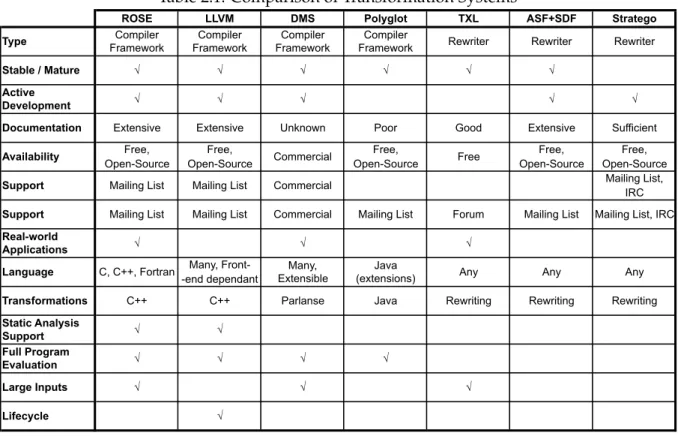
token. This is, however, very limited compared with the context-dependent transformation available with program analysis tools presented next. Many rewriting systems work by ex-amples, i.e., “find allx=x+1and replace them withx++”. Examples of such systems include TXL [Cor06], ASF+SDF Meta-environment [vHKO02], and Stratego/XT [Vis04].
Compiler Frameworksare more complex and powerful. Instead of making simple text trans-formations on input code, they manipulate some form of abstract representation of the target program, such as an Abstract Syntax Tree (AST). This representation is typically just referred to as the Intermediate Representation (IR). They are composed of front-, back-, and mid-ends. The front-end parses the input and generates an instance of the IR, which is passed to the mid-end. The mid-end then manipulates the IR and applies all required transformations on the program structure. This modified IR is then passed on to the back-end, which unparses it, i.e., generates the output code from it. This architecture around IRs is very good to handle programs written in a specific language, but makes it hard to adapt the system to a new one. These frameworks make a more semantical interpretation of the whole input program (which may span more than one file), and so this logic is spread throughout the framework. Although some provide facilities that allow them to be extended to new languages, this extension is not trivial and can not be accomplished without modifying at least one component of the architecture. In con-trast to the declarative environment used in rewrite systems, compiler frameworks take a more imperative approach. They provide libraries for representing and manipulating IR instances, often implemented in the same language they manipulate. Another difference from rewriters is that, because the whole program is handled on a static representation, a lot more context information from any part of the program can be used in the transformation or analysis. Note that representing a large part of the program in IR, or all of it, makes compiler frameworks a lot heavier than simple rewrite engines. Examples of such frameworks include ROSE [SQ03], LLVM [LA04], DMS-SRT [DMS04] and Polyglot [NCM03].
In conclusion, rewriting is very simple and quick to use, with light systems. They are great for quickly testing language extensions and direct translation between languages.
Compiler frameworks are less flexible, consisting of more complex systems. They do pro-vide additional power by supplying the user with specific and extensive API. for IR manipu-lation. This method can be a lot heavier: it is not cheap to handle an IR representing a program with millions of lines, compared with simple pattern detection and substitution. However, it does allow more complex program optimizations and analyses.
2.3.2 Examples of Analysis and Transformation Tools
We now present some of the most well-known systems, and try to understand how they relate.
a specific C++ API. It supports out-of-the-box graphical representation of programs, and high-level analyses such as control-flow and data-flow.
LLVM The Low Level Virtual Machine [LA04] (LLVM), is a compiler infrastructure designed for program optimization throughout the whole lifecycle of applications, i.e., at compile-time, execution compile-time, installation compile-time, and offline between executions. It was first spec-ified on the Master Thesis of Chris Lattner [Lat02]. Parts of the project are still not fully (or not at all) implemented, such as profile-adaptable optimizations. It does have an ex-tensive documentation. LLVM seems more flexible than ROSE when it comes to adding new language support, since it works on a specific low-level assembly-like language, per-forming all analyses and transformations on this representation. It provides an extensive API.for IR manipulation, including classes for pointer- and aliasing-analyses.
DMS-SRT The Design Maintenance System – Software Reengineering Toolkit [DMS04] from Semantic Designs Inc. is a commercial set of tools for performing analysis and trans-formation tasks on industrial-scale applications. It has been developed since the decade of 1990’s and has been used on a number of critical real-world scenarios, the most cited of which being the migration of the flight control system of Boeing [DMS05]. An inter-esting fact about DMS is that it was used to generate a significant part of its own system. It allows to manipulate IR instances through an API.for various languages, and attribute analysis.
Polyglot The Polyglot framework [NCM03] is an extensible compiler framework for Java. It is maintained by the Computer Science department at Cornell University, whose first technical report dates to 2002. There is an available JavaDoc API. that is commented but does not seem very elaborate. There is not much more documentation apart from that. Polyglot was designed to allow the creation of compilers for extensions of Java, through pre-compile transformation of these language extensions. The usage is through an im-perative AST-manipulating API. also in Java. There are examples of type-checkers that do not need to perform any program transformation, and instead simply analyze the pro-gram and abort compilation in case of error. This is a good example of the application of this framework to perform static program analysis, through its program representation and manipulation interface.
ASF+SDF The ASF+SDF Meta-environment [vHKO02] is a toolset that combines the Algebraic Specification Formalism (ASF) and the Syntax Definition Formalism (SDF). It is currently under active development, although it seems more focused on academic usage with little or no examples on production scenarios. Just like TXL and Stratego, it is better suited to simple text-based program transformations than deep semantic analysis of programs. SDF is used to specify the target language in a way similar to BNF, so it allows to handle any language. Transformations are defined by the ASF component, through rewrite rules that define the language semantics. It does not directly support context-dependent analy-sis such as data-flow, although it is featured enough to permit type-checking of programs and document-generators. The Meta-environment can handle large specifications, in the order of dozens of thousands of rules and millions of terms.
Stratego/XT [Vis04] is a language and toolset for program transformation that follows the same lines as TXL, but with more emphasis on the separation of concerns, in order to al-low more reusability. Development does not seem very active, and it has sal-lowly evolved since the decade of 1990. It uses the SDF language to define the target language. The transformations are made through rewrite rules, and the body of the rules can be speci-fied on the target language. There does not seem to be much concern about performance or experimental results. There are not many practical applications outside the academic environment.
The characterization of these systems is summarized in Table 2.1. As discussed earlier, we observe a major difference in features between systems identified asrewritersandcompiler frameworks.
If the goal is the implementation of a language extension or translation between languages, then a proved system like TXL allows to achieve that very quickly.
If the task is more complex then a robust compiler framework may be required. If this is the case, the most limiting factor in choosing a single system will be the target language, which may not be possible to handle in all systems. In particular, the best compiler framework for the specific task may not be prepared to work with our target language out-of-the-box, and a work-around will be required, if available. For example, although ROSE has powerful features, it is unable to work immediately with Java. If there is no satisfiable workaround then it may be preferable to have extra work with another system, which is not so well prepared for the type of transformation or analysis task that we intend, but is capable of working with our target language. DMS is a very particular system in this area. Because it is a commercial system, it is specifically targeted at industrial tools. It is able to handle projects that are written in more than one source language, or with embedded languages.
2.3.3 The Polyglot Compiler Framework
Table 2.1: Comparison of Transformation Systems
ROSE LLVM DMS Polyglot TXL ASF+SDF Stratego
Type Compiler Framework Compiler Framework Compiler Framework Compiler
Framework Rewriter Rewriter Rewriter
Stable / Mature ! ! ! ! ! !
Active
Development ! ! ! ! !
Documentation Extensive Extensive Unknown Poor Good Extensive Sufficient
Free, Free, Free, Free, Free,
Open-Source Open-Source Open-Source Open-Source Open-Source Mailing List,
IRC
Support Mailing List Mailing List Commercial Mailing List Forum Mailing List Mailing List, IRC
Real-world
Applications ! ! !
Many, Front--end dependant
Transformations C++ C++ Parlanse Java Rewriting Rewriting Rewriting
Static Analysis
Support ! !
Full Program
Evaluation ! ! ! !
Large Inputs ! ! !
Lifecycle !
Mailing List
Any Any
Availability Commercial Free
Language C, C++, Fortran Many, Extensible
Java
(extensions) Any Support Mailing List Commercial
Polyglot is an AST infrastructure with several nodes to handle the full range of Java con-structs. A Polyglot extension is defined as a set of passes, which iteratively traverse and trans-form this AST, eventually outputting the tree as new Java code which will be compiled. So polyglot may be used either for extensions to Java, translation from Java to other languages, or simply analyzing a Java program.
The first phase in defining a language extension is to define the new syntax. Rather than defining the language syntax completely, it is possible to define the syntacticdifferencesbetween Java and the new language. This is achieved through the CUP parser generator for Java [HFP+
], and the Polyglot Parser Generator [BM], an extension to CUP. The next step is to define the semantic aspects of the new language. For this, new AST nodes must be defined, as well as the new type system. Finally, the translation or analysis procedure must be defined by implementing and providing the necessary AST traversals.
2.3.4 Discussion
We have explored systems for program analysis and transformation, in order to carry out the anomaly detection approaches presented in Chapters 3 and 4. Since we will perform static analysis of anomalies, the usage of such a tool is vital. Full implementation of these approaches from scratch would be infeasible. From the set of available alternatives, we have chosen Poly-glot, for fitting well into our context, for its specificity to Java, and because of the availability of previous work with this framework [Dia09]. We will also see in the following section how available anomaly detection tools, and JChord [NAW06] in particular, use these systems in order to achieve their goals.
2.4
Datarace Detection Methods and Tools
Program testing is a very wide research area. The detection of dataraces has itself been the target of intense study, dating back nearly as far as the appearance of concurrent program-ming. In this section we address this subject by discussing related work on datarace definition and detection, in order to assess which methodologies may be applied to the context of TM programs.
2.4.1 Dataraces
Concurrent programming means that more than one instruction might be executed in parallel, potentially on different processors. While on sequential programs one may safely assume that the program state on a specific point is derived from the preceding instructions, on concurrent programs the program state may have changed between two consecutive statements, as a re-sult of thread interleavings. For this reason, synchronization is required between concurrent threads to avoid situations where a thread sees an inconsistent program state, because another one has overwritten a shared variable.
As an example, consider the program in Listing2.1. In this example, two threads run in par-allel, and each of them independently increments a shared variable a number of times. Suppose threadt1reads the value41from the variable, and a context-switch happens beforet1writes the updated value. Threadt2may run, read the value 41 as well, and updatecounter to value42. If threadt1runs immediately after, it will still consider the old value41, and up-date counterto 42 as well. As we can see, there has been a lost update, since the program behaves as if one of the updates had never taken place. Because the code was run two times, the shared counter should have been incremented twice, but because of concurrency between the two threads, the second increment was based on an inconsistent state. We call these events dataraces.
Datarace Definition and Conditions
Listing 2.1: Example of a Datarace 1 public class Example extends Thread {
2
3 private static int counter = 0; // counter, shared state 4
5 public void run() {
6 for (int i = 0 ; i < 50 ; i++) {
7 int n = counter;
8 n = n + 1;
9 counter = n;
10 }
11 }
12
13 public static void main(String args[]) {
14 Thread t1 = new Example();
15 Thread t2 = new Example();
16 t1.start();
17 t2.start();
18 // we want counter to be~100
19 }
20 }
occurs when:
1. There are two different accesses to the same memory location, and at least one of them is a write;
2. The two accesses are performed by different threads;
3. The two accesses are not guarded by at least one common lock; and
4. There is no order enforcement between these two accesses, for example by guaranteeing that the two threads are not running at the same time, by analyzing the order of thread startandwaitinstructions.
These are the formal datarace conditions that are the basis of current literature on the sub-ject [dCLSL01,CLL+
02].
Causes and Consequences
A datarace is almost always a programming error, although programs with dataraces may be correct. One notorious example is the one presented in [BLM05], in which a correct program with such a benign datarace actually exhibits a deadlock after it has been blindly (automati-cally) “corrected”.
dataraces are difficult to detect, and difficult to debug. Algorithms and tools that find dataraces, either statically or dynamically, are very valuable to concurrent program developers, and have become the target of intense research over the last decades. In the following sections we explore some of them.
2.4.2 Static vs Dynamic Detection
Like most testing and debugging procedures, the detection of dataraces can be achieved either statically, dynamically, or using a combination of both.
Static Detection
Static solutions do not evaluate an execution. Instead, they analyze thespecificationof a pro-gram. Because static detectors evaluate a program without (or before) running it, they are also referred in the literature asahead-of-time(AOT) approaches [Raz06,CLL+
02,OC03]. Static anal-ysis does not have access to runtime information, and so can not make a complete and precise detection. Static datarace detectors make a conservative estimate, and as such they have the drawback of an excessive amount of false positives, reporting events that are unrealistic and may never happen in a real execution. The program specification to analyze is typically source code, but not necessarily. Many tools are based on preprocessing code annotations. There is also the possibility of using type systems to express synchronization relationships. In this case, a program that has passed a type-checker has some guarantees of correctness, with respect to dataraces. These approaches have the disadvantage of forcing programmers to annotate the code, since they they are unable to verify unannotated programs.
Dynamic Detection
Dynamic detection is made based on a specific real execution of a program. For this execution, memory accesses and synchronization operations are logged with an explicit timely order es-tablished between them. The algorithm analyzes this log and determinesifandwhena datarace occurred. Because the analysis is based on a feasible execution, the false positive rate is much lower than that of static analyzers. However, the amount of false negatives is expected to be higher, especially in situations where the test cases do not cover all scenarios.