Mestre em Engenharia Informática
Maintaining the Correctness of Transactional
Memory Programs
Dissertação para obtenção do Grau de Doutor em
Engenharia Informática
Orientador :
João Manuel dos Santos Lourenço,
Prof. Auxiliar, Universidade Nova de Lisboa
Júri:
Presidente: José Legatheaux Martins
Arguentes: Timothy L. Harris João M. Cachopo
Maintaining the Correctness of Transactional Memory Programs
Copyright cRicardo Jorge Freire Dias, Faculdade de Ciências e Tecnologia, Universidade Nova de Lisboa
Acknowledgements
The work presented in this dissertation would not have been possible without the collaboration of a considerable number of people to whom I would like to express my gratitude.
First and foremost I would like to deeply thank my thesis advisor João Lourenço, who always helped me to overcome all the challenges that I had to face during my PhD studies. I’ve learned a lot from him, and I truly hope to be able to advise my students as well as he advised me.
To João Seco for his guidance in an area of research which was completely new to me, and for our discussions about the theoretical parts of my work. To Nuno Preguiça for always being avail-able to discuss my ideas and give excellent tips and suggestions which allowed me to improve the quality of my work. To Dino Distefano for hosting me at the computer science department of the Queen Mary, University of London, for teaching me everything I know about separation logic, and for his insightful suggestions to solve some hard problems that emerged during the development of this thesis.
To Tiago Vale for all the collaboration in the implementation and testing in parts of my ex-perimental work, and for all the fruitful discussions we had. To Vasco Pessanha for his help in the designing and implementation of the MoTH tool and its functionalities. To João Leitão for reviewing the last draft of this thesis.
To all my colleagues with whom I shared the ASC open space, including: Valter Balegas, Lamia Benmouffok, Jorge Custódio, Bernardo Ferreira, João Luis, David Navalho, Daniel Porto, Paulo Quaresma, João Soares, and Tiago Vale.
Finally, my very heartful thanks to my family. To my wife Ana, whom I owe everything of good in my life, including my beautiful children Diogo and Vasco. I stole too much of the time that was rightfully theirs in these past years. To my parents that although being far away always give the support that I need. To my parents-in-law for all the tasteful lunches and dinners, and for the comfort they provided while I was living at their home.
Abstract
This dissertation addresses the challenge of maintaining the correctness of transactional mem-ory programs, while improving its parallelism with small transactions and relaxed isolation lev-els.
The efficiency of the transactional memory systems depends directly on the level of paral-lelism, which in turn depends on the conflict rate. A high conflict rate between memory trans-actions can be addressed by reducing the scope of transtrans-actions, but this approach may turn the application prone to the occurrence of atomicity violations. Another way to address this issue is to ignore some of the conflicts by using a relaxed isolation level, such as snapshot isolation, at the cost of introducing write-skews serialization anomalies that break the consistency guarantees provided by a stronger consistency property, such as opacity.
In order to tackle the correctness issues raised by the atomicity violations and the write-skew anomalies, we propose two static analysis techniques: one based in a novel static analysis algo-rithm that works on a dependency graph of program variables and detects atomicity violations; and a second one based in a shape analysis technique supported by separation logic augmented with heap path expressions, a novel representation based on sequences of heap dereferences that certifies if a transactional memory program executing under snapshot isolation is free from write-skew anomalies.
The evaluation of the runtime execution of a transactional memory algorithm using snapshot isolation requires a framework that allows an efficient implementation of a multi-version algo-rithm and, at the same time, enables its comparison with other existing transactional memory algorithms. In the Java programming language there was no framework satisfying both these requirements. Hence, we extended an existing software transactional memory framework that already supported efficient implementations of some transactional memory algorithms, to also support the efficient implementation of multi-version algorithms. The key insight for this ex-tension is the support for storing the transactional metadata adjacent to memory locations. We illustrate the benefits of our approach by analyzing its impact with both single- and multi-version transactional memory algorithms using several transactional workloads.
Resumo
Esta dissertação aborda o desafio de manter a correcção dos programas de memória transaci-onal, quando são usadas pequenas transacções e níveis de isolamento relaxado para melhorar o paralelismo dos programas.
A eficiência dos sistemas de memória transacional depende directamente do nível de parale-lismo, o que por sua vez depende da taxa de conflitos. Uma elevada taxa de conflitos entre as transações em memória pode ser diminuida através da redução do tamanho das transações, mas esta abordagem poderá tornar a aplicação propensa à ocorrência de violações de atomicidade. Outra forma de abordar esta questão é ignorar alguns dos conflitos usando um nível de isola-mento relaxado, tal como o nível de isolaisola-mentosnapshot isolation, com o custo da introdução de anomalias de serialização, denominados comowrite-skews, que quebram a consistência garantida por uma propriedade de consistência forte, como a opacidade.
Com o intuito de abordar as questões levantadas pela correção das violações de atomicidade e das anomalias dewrite-skews, propomos duas técnicas de análise estática: uma baseada num novo algoritmo de análise estática que utiliza um grafo de dependências entre variáveis de programa para detectar violações de atomicidade; e uma segunda com base numa técnica de análise baseada em lógica de separação extendida com expressões deheap paths, uma nova representação baseada em sequências de desreferênciações da memória, que certifica se um programa que usa memória transacional, baseada emsnapshot isolation, está livre de anomalias write-skew durante a execução. A avaliação da execução de um algoritmo de memória transacional usando o nível de isola-mento relaxadosnapshot isolationrequer uma estrutura que permita a implementação eficiente de algoritmos baseados em multi-versão e, ao mesmo tempo, permitir a sua comparação com outros algoritmos de memória transacional existentes. Na linguagem de programação Java não existe uma ferramenta que satisfaça estes dois requisitos. Como tal, estendemos uma ferramenta de memória transacional por software já existente, que já permite a implementação eficiente de al-guns algoritmos de memória transacional, a também permitir a implementação eficiente de algo-ritmos multi-versão. A principal ideia desta extensão é o suporte para armazenar os metadados transacionais junto às localizações de memória. Nós ilustramos os benefícios da nossa aborda-gem, analisando o seu impacto tanto com algoritmos de memória transacional uni-versão como multi-versão utilizando vários tipos de testes transacionais.
Contents
1 Introduction 1
1.1 Problem Statement . . . 2
1.2 Contributions and Results . . . 7
1.3 Outline of the Dissertation . . . 8
2 Fundamental Concepts and State of the Art 9 2.1 Transactional Memory . . . 9
2.1.1 Semantics . . . 10
2.1.2 Algorithms Implementation . . . 11
2.1.3 STM Extensible Frameworks . . . 12
2.2 Atomicity Violations . . . 16
2.2.1 High-Level Data Races and Stale-Value Errors . . . 16
2.2.2 Access Patterns Based Approaches . . . 17
2.2.3 Invariant Based Approaches . . . 17
2.2.4 Dynamic Analysis Based Approaches . . . 17
2.3 Snapshot Isolation . . . 18
2.3.1 Transaction Histories . . . 19
2.3.2 Transaction Dependencies . . . 20
2.3.3 Dependency Serialization Graph . . . 20
2.3.4 Snapshot Isolation Anomalies . . . 21
2.3.5 Static Dependency Graph . . . 23
2.3.6 Detection of Anomalies in a SDG . . . 24
2.3.7 Static Analysis of Snapshot Isolation . . . 25
2.3.8 Snapshot Isolation in Transactional Memory . . . 26
2.4 Static Analysis . . . 26
2.4.1 Abstract Interpretation . . . 26
2.4.2 Shape Analysis . . . 27
2.4.3 Shape Analysis based on Separation Logic . . . 29
xiv CONTENTS
3 Detection of Atomicity Violations 37
3.1 Introduction . . . 37
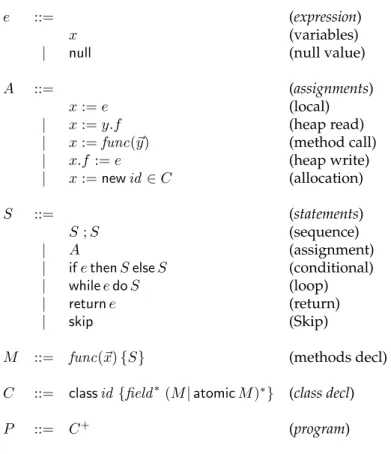
3.2 Core Language . . . 39
3.3 Causal Dependencies . . . 40
3.3.1 Dependency Analysis . . . 41
3.4 Atomicity Violations . . . 45
3.4.1 High Level data races . . . 45
3.4.2 Stale-Value Error . . . 50
3.5 The MoTH Prototype . . . 52
3.5.1 Process Analysis . . . 52
3.5.2 Instance Type Analysis . . . 54
3.5.3 Native Methods . . . 55
3.6 Evaluation . . . 57
3.7 Related Work . . . 59
3.8 Concluding Remarks . . . 60
4 Verification of Snapshot Isolation Anomalies 61 4.1 Introduction . . . 61
4.1.1 Motivation . . . 62
4.1.2 Verification of Snapshot Isolation Anomalies . . . 64
4.2 Snapshot Isolation . . . 65
4.3 Abstract Write-Skew . . . 66
4.3.1 Soundness . . . 67
4.4 StarTMby Example . . . 68
4.5 Core Language . . . 73
4.5.1 Syntax . . . 73
4.5.2 Operational Semantics . . . 74
4.6 Abstract States . . . 77
4.6.1 Symbolic Heaps . . . 77
4.6.2 Heap Paths . . . 79
4.6.3 Abstract Read- and Write-Sets . . . 80
4.6.4 From Symbolic Heaps to Heap Paths . . . 81
4.7 Abstract Semantics . . . 84
4.7.1 Past Symbolic Heap . . . 85
4.7.2 Symbolic Execution Rules . . . 86
4.7.3 Rearrangement Rules . . . 88
4.7.4 Fixed Point Computation and Abstraction . . . 89
4.7.5 Write-Skew Detection . . . 90
4.8 Experimental Results . . . 91
4.9 Related Work . . . 92
4.10 Concluding Remarks . . . 93
5 Support of In-Place Metadata in Transactional Memory 95 5.1 Introduction . . . 95
5.3 Supporting the In-Place Strategy . . . 99
5.3.1 Implementation . . . 99
5.3.2 Instrumentation Limitations . . . 105
5.4 Implementation Assessment . . . 105
5.4.1 Overhead Evaluation . . . 106
5.4.2 Implementing a Multi-Versioning Algorithm: JVSTM . . . 107
5.4.3 Speedup Evaluation . . . 109
5.4.4 Memory Consumption Evaluation . . . 110
5.5 Use Case: Multi-version Algorithm Implementation . . . 112
5.5.1 SMV – Selective Multi-versioning STM . . . 112
5.5.2 JVSTM Lock Free . . . 113
5.5.3 MVSTM – A New Multi-Version Algorithm . . . 114
5.6 Supporting the Weak Atomicity Model . . . 114
5.6.1 Read Access Adaptation . . . 115
5.6.2 Commit Adaptation . . . 116
5.6.3 MV-Algorithms Adaptation . . . 117
5.7 Performance Comparison of STM Algorithms . . . 121
5.8 Concluding Remarks . . . 126
6 Conclusions and Future Work 129 A Detailed Execution Results 141 A.1 In-place Metadata Overhead . . . 141
List of Figures
1.1 Example of atomicity violations. . . 3
1.2 Write-skew example . . . 4
2.1 Example of two memory transactions. . . 10
2.2 Example of a data-race between transactional and non-transactional code. . . 11
2.3 DSTM2 programming model. . . 13
2.4 Deuce’s programming model. . . 15
2.5 Withdrawprogram. . . 18
2.6 DSG of historyH3 . . . 21
2.7 DSG(Hws): Example of write skew. . . 22
2.8 DSG(Hro): Example of SO read-only anomaly. . . 23
2.9 Bank account program (P1). . . 24
2.10 Static dependency graph of thewithdrawfunction. . . 24
2.11 Singly linked list represented as a shape graph. . . 28
2.12 Symbolic heaps syntax . . . 30
2.13 Symbolic heaps semantics . . . 31
2.14 Simple imperative language. . . 31
2.15 Operational Symbolic Execution Rules . . . 32
3.1 Example of atomicity violations. . . 38
3.2 Core language syntax . . . 39
3.3 Dependency graph example . . . 41
3.4 Symbolic execution rules of data dependencies analysis . . . 43
3.5 Example of the variables that guard each block . . . 44
3.6 Symbolic execution rules of control dependencies analysis . . . 46
3.7 Symbolic execution rules for creating aview . . . 48
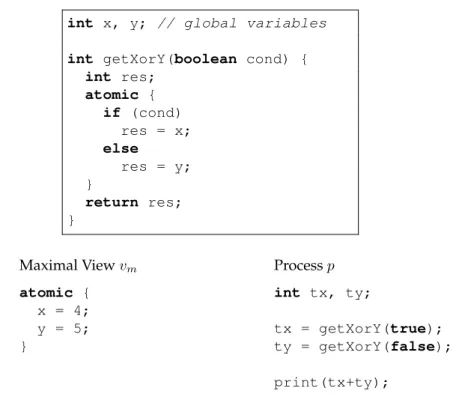
3.8 Example of compatibility property between a processpand a maximal viewvm. In this case, processpis incompatible with maximal viewvm. . . 49
3.9 Example of an atomic block that generates a false-negative. . . 50
3.10 MoTH architecture. . . 52
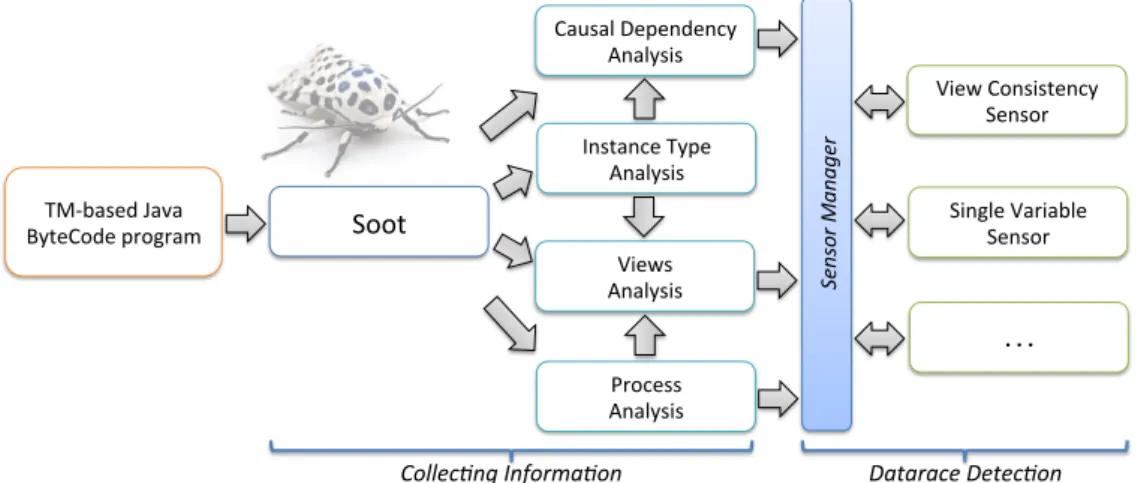
3.11 Call-graph of the above code examples. . . 53
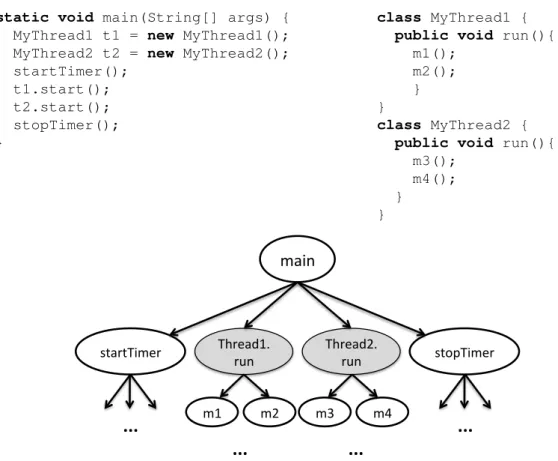
xviii LIST OF FIGURES
3.13 Type instance analysis rules. . . 56
3.14 Example of a native method XML specification. . . 57
4.1 Linked List (top) and Skip List (bottom) performance throughput benchmarks with 50% and 90% of write operations. . . 63
4.2 Withdrawprogram. . . 66
4.3 Order Linked List code. . . 69
4.4 Predicates and Abstraction rules for the linked list. . . 70
4.5 Sample ofStarTMresult output for the Linked List example. . . 71
4.6 Dummy write access inremove(int)method. . . 72
4.7 Sample ofStarTMresult output for correctedremove(int)method. . . 73
4.8 Core language syntax. . . 74
4.9 Linked list example in the core language. . . 75
4.10 Structural operation semantics. . . 76
4.11 Separation logic syntax. . . 77
4.12 Separation Logic semantics. . . 78
4.13 Graph representation of theNode(x, y)andList(x, y)predicates. . . 78
4.14 Heap Pathsyntax. . . 80
4.15 Heap Pathsemantics. . . 80
4.16 Operational Symbolic Execution Rules. . . 87
4.17 Compress abstraction function. . . 90
5.1 Contextinterface for implementing an STM algorithm. . . 99
5.2 Metadata classes hierarchy. . . 99
5.3 TxFieldclass. . . 100
5.4 Contextinterface for implementing an STM algorithm supporting in-place meta-data. . . 100
5.5 Declaration of the STM algorithm specific metadata. . . 101
5.6 Example transformation of a class with the in-place strategy. . . 101
5.7 Memory structure of aTxArrIntFieldarray. . . 103
5.8 Example transformation of array access in the in-place strategy. . . 103
5.9 Memory structure of a multi-dimensionalTxArrIntFieldarray. . . 104
5.10 Performance overhead measure of the usage of metadata objects relative to out-place TL2. . . 106
5.11 VBoxin-place implementation. . . 109
5.12 In-place over Out-place strategy speedup: the case of JVSTM. . . 109
5.13 Performance and transaction aborts of JVSTM-Inplace/Outplace for the Intruder and KMeans benchmarks. . . 110
5.14 Relative memory consumption of TL2-Overhead and JVSTM-Inplace . . . 111
5.15 SMV transactional metadata class. . . 113
5.16 JVSTM-LockFree transactional metadata class. . . 113
5.17 Performance comparison between original JVSTM and adapted JVSTM. . . 118
5.18 Performance comparison between original MVSTM and adapted MVSTM. . . 118
5.19 Performance comparison between original SMV and adapted SMV. . . 119
5.21 JVSTM-LockFree adapted commit operation. . . 121
5.22 Performance comparison between original LockFree and adapted JVSTM-LockFree. . . 122
5.23 Micro-benchmarks comparison. . . 123
5.24 STAMP benchmarks comparison. . . 125
5.25 STMBench7 comparison. . . 126
List of Tables
3.1 Results for benchmarks . . . 58 3.2 Results for benchmarks . . . 58 4.1 Read- and write-set statistic per transaction for a Linked List (top) and a Skip List
1
Introduction
Gordon Moore, back in 1965, observed that the number of transistors per square inch doubles every 18 months, and the rate of growth has been relatively steady since then. As the number of transistors was growing, the processor clock frequency grew along. However, since the appear-ance of CPUs (central processor units) with clock frequencies in the order of the gigahertzs, the growth of the clock frequency slowed down, even though the number of transistors is still rising at a steady pace. The CPU manufacturers opted to use the additional transistors by designing processors with more than one operational core, leading to the current widespread of multi-core architectures.
In the past, performance improvements had a strong dependency on the increasing of pro-cessor speed, unfortunately, propro-cessor speed has stabilized. The multi-core architectures are cur-rently ubiquitously available, from industrial to home computers and embedded devices, and the need to exploit their full computational power raised considerably the interest in the discipline of parallel programming.
Leveraging parallelism in multi-threaded programs requires synchronization constructs to control accesses to shared resources, such as main memory. From a programmer point of view, current synchronization constructs (locks, monitors, and condition variables) require a great ef-fort to be used correctly and achieve high scalability at the same time [LPSZ08]. The use of coarse grained locks in large data structures hinders parallelism and does not scale, while fine grained locks are prone to many difficult problems in large systems, such as priority inversion, convoying, and most specially, deadlocks.
1. INTRODUCTION 1.1. Problem Statement
atomicity, consistency, isolation, and durability. A memory transaction only provides three of these properties: atomicity, consistency, and isolation. Durability is dropped due to the nature of the storage medium.
Transactional memory runtime systems usually adopt an optimistic execution model, where transactions execute concurrently and conflicts are solved by a contention management algo-rithm, which can be as simple as aborting one of the conflicting transactions. The assertion of when two TM transactions conflict is algorithm dependent, but usually the conflict detection de-pends on the TM system keeping track of the memory locations accessed during the transactions lifetime, and on the validation of all those accesses during the execution of the transaction and/or at commit time.
The level of parallelism allowed by a transactional memory system depends directly on the conflict occurrence rate. A high rate of conflicts forces more transactions to abort and reduces the overall transactional throughput. Furthermore, the conflict rate depends on both the size of the transaction and on the level of permissiveness of the transactional system. Depending on the kind of workload, coarse-grain transactions may increase the probability of conflicts, which in turn reduces the system performance. The permissiveness level controls the kind of conflicts that are allowed, thereby ignored, by the transactional system without losing the desired consistency property. In the case of transactional memory the desired consistency property isopacity[GK08].
In some situations it is possible to reduce the number of conflicts by reducing the size of the transactions, splitting the large transactions into a sequence of smaller ones. Opposed to the use of finer-grain locks, which can easily lead to deadlocks, memory transactions never cause deadlocks. However, the use of finer-grain transactions may still lead to other concurrency bugs know as atomicity violations [LPSZ08], and thus we may expect that reducing the size of the transactions in an application may compromise its correctness. Additionally, we can also increase the permissiveness level of the transactional runtime by allowing the occurrence of some conflicts. This can be achieved by relaxing the isolation level, but at the cost of losing opacity.
In this dissertation we will address these two main problems: how to ensure the correct usage of finer-grain transactions by avoiding atomicity violations, and how to increase transactional memory performance by relaxing the isolation level without losing correctness.
1.1
Problem Statement
We argue that it is possible to develop a set of solutions that enable an increased parallelism of transactional memory without losing correctness. More specifically, we propose to address this problem by allowing the safe usage of finer-grain transactions with the avoidance of atomicity violations, and by the use of a relaxed isolation level without losing a stricter consistency property, such as opacity.
In summary the work presented in this thesis aims at demonstrate the truth of the following thesis statement:
Thesis Statement
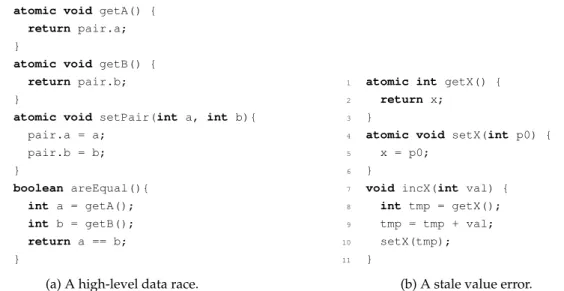
1 atomic void getA() {
2 return pair.a;
3 }
4 atomic void getB() {
5 return pair.b;
6 }
7 atomic void setPair(int a, int b){
8 pair.a = a;
9 pair.b = b;
10 }
11 boolean areEqual(){
12 int a = getA();
13 int b = getB();
14 return a == b;
15 }
(a) A high-level data race.
1 atomic int getX() {
2 return x;
3 }
4 atomic void setX(int p0) {
5 x = p0;
6 }
7 void incX(int val) {
8 int tmp = getX();
9 tmp = tmp + val;
10 setX(tmp);
11 }
(b) A stale value error.
Figure 1.1: Example of atomicity violations.
In the following we present a brief overview of the main techniques used to corroborate this thesis statement.
Detection of atomicity violations Although using transactional memory is much simpler than using fine-grain locking, the use of finer-grain transactions may still introduce concurrency bugs known as atomicity violations.
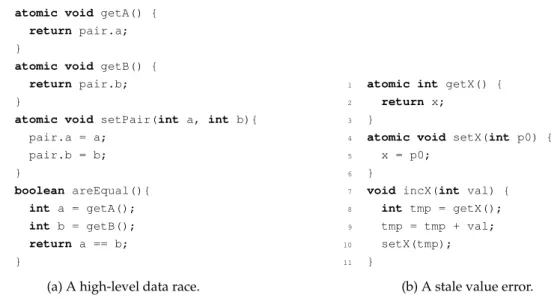
High-level data races are a form of atomicity violations and result from the misspecification of the scope of an atomic block, which is split into two or more atomic blocks with other (possibly empty) non-atomic block between them. This anomaly is illustrated in Figure 1.1(a). In this exam-ple a thread uses the methodareEqual()to check if the fieldsaandbare equal. This method reads both fields in separate atomic blocks, storing their values in local variables, which are then compared. The atomicity violation results from the interleaving of this thread with another thread running the methodsetPair(). If the methodsetPair()is executed between lines 12 and 13 of the methodareEqual(), whenareEqual()is resumed at line 13 the value of the pair may have changed. In this scenario the thread executingareEqual()observes an inconsistent pair, composed by the old value ofaand the new value ofb.
Figure 1.1(b) illustrates a stale value error, another source of atomicity violations in concurrent programs. The non-atomic methodincX()is implemented by resorting to two atomic methods, getX()(at line 1) andsetX()(at line 4). During the execution of line 9, if the current thread is suspended and another thread is scheduled to executesetX(), the value ofxchanges, and when the execution of the initial thread is resumed it overwrites the value inxat line 10, causing a lost update. This program fails due to a stale-value error, as at line 8 the value ofxescapes the scope of the atomic methodgetX()and is reused indirectly (by way of its private copytmp) at line 10, when updating the value ofxinsetX().
The early detection of these kind of anomalous interleavings in the development phase of the application is crucial to avoid runtime bugs that are very hard to find and to debug. To address this challenge, the dissertation will focus on the following question:
1. INTRODUCTION 1.1. Problem Statement
void withdrawX(int amount) {
atomic {
if (accountX + accountY > amount)
accountX -= amount; }
}
void withdrawY(int amount) {
atomic {
if (accountX + accountY > amount)
accountY -= amount; }
}
BEGIN withdrawX READ(accountX) READ(accountY) WRITE(accountX) COMMIT
BEGIN withdrawY READ(accountX) READ(accountY) WRITE(accountY) COMMIT
Figure 1.2: Write-skew example
We propose a novel approach for the detection of high-level data races and stale-value errors in transactional memory programs. The approach is based on a novel notion of variable depen-dencies, which we designate ascausaldependencies. There is acausaldependency between two variables if the value of one of them influences the writing of the other. We also extended pre-vious work from Artho et al. [AHB03] by reflecting the read/write nature of accesses to shared variables inside atomic regions, which we combine with the dependencies information to detect both high-level data races and stale-value errors. We formally describe the static analysis algo-rithms to compute the set ofcausaldependencies of a program and define safety conditions for both high-level data races and stale-value errors. The matter of detecting atomicity violations in TM programs is addressed in Chapter 3.
Consistent relaxed isolation level To solve the problem of relaxing the isolation level to in-crease transactional parallelism, we took inspiration from the database setting. Database systems frequently rely on weaker isolation models to improve performance. In particular, Snapshot Iso-lation (SI) is widely used in industry. An interesting aspect of SI is that only write-write conflicts are checked at commit time and considered for detecting conflicting transactions. As a main re-sult, a TM system using this isolation model does not need to keep track of read accesses, thus considerably reducing the book-keeping overhead.
By only detecting write-write conflicts, and ignoring read-write conflicts, the SI model allows a much higher commit rate, which comes at the expense of allowing some real conflicting trans-actions to commit. Thus, relaxing the isolation level of a transactional program to SI may lead previously correct programs to misbehave due to the anomalies resulting from malign data-races that are now allowed by the relaxed transactional runtime. These anomalies can be precisely characterized, and are often called in the literature as write-skew anomalies [BBGMOO95].
A possible approach to solve the problem of identifying the write-skew anomalies in a pro-gram running under SI could be to give the propro-grammer the burden of this task. However, this task could be overwhelming for the average programmer, the development would be very costly and error prone, and hardly worth the performance benefits. In the database setting, a different approach was followed where several algorithms were proposed to dynamically avoid write-skew anomalies, and hence provide a serializable model, while maintaining similar performance of snapshot isolation. Although this solution was well succeeded in databases, the application of such dynamic algorithms in a TM setting is not a viable option due to the significant overhead introduced at runtime, which is exactly the opposite of our objective of reducing the TM runtime overhead.
Another possible way to address the matter of correctness of TM programs executing in TM runtimes using SI, is to assert at compile-time, using static analysis techniques, that a TM pro-gram will execute without generating write-skew anomalies. This approach avoids the runtime overhead imposed by dynamic algorithms, and provide opacity guarantees to the programmer by asserting that the computations are free from write-skew anomalies.
To address this problem, the dissertation will focus on the following question:
Is it possible to develop a verification procedure to identify write-skew anomalies in programs written using an imperative language with support for dynamically allocated (heap) memory?
To address this specific question, we propose a technique that performs deep-heap analysis (also called shape analysis) based on separation logic [Rey02] to approximate the memory loca-tions in the read- and write- sets for each distinguished transaction in a program. The analysis only requires the specification of the state of the heap for each transaction and is able to automati-cally compute loop invariants during the analysis. Our analysis approximates read and write-sets of transactions using heap paths: a regular expression based representation that captures derefer-ences through field labels, choice, and repetition.
For those conflicting transactions that are prone to trigger anomalies, there are different strate-gies [FLOOS05] that can be applied to correct the runtime behavior of such transactions making them correct under SI. For instance, it is possible to modify the transaction code, or to execute the transaction in a more strict isolation level.
Using this approach, we achieve improved performance by relying on a less expensive snap-shot isolation-based TM runtime, while guaranteeing correctness of program execution by avoid-ing write-skews and keepavoid-ing opacity. Because it is based on static-analysis techniques, our ap-proach introduces no runtime overhead. Our apap-proach to detect write-skew anomalies for a general-purpose language is described in Chapter 4.
SI performance evaluation In terms of performance, the evaluation of our approach requires a fair comparison with otheropaqueTM algorithms. The implementation or adaptation of several TM algorithms to use the same transactional interface, and to work with the same benchmark code, is an unfeasible task. To solve this problem, generic and extensible frameworks were de-veloped, allowing the implementation of different TM algorithms by following a well defined interface that captures the essential steps performed by a memory transaction (e.g. transaction start, memory read, memory write, transaction commit, and transaction abort).
1. INTRODUCTION 1.1. Problem Statement
comparison of two different TM algorithms, where one of them isunfitfor the specific framework, cannot be made in a straightforward process and the obtained results will be biased towards the algorithm that better fits the framework.
Theunfitnessproblem between the TM algorithm and the generic framework may be caused by the management of transactional runtime information required by the TM algorithm. TM algo-rithms manage information per transaction (frequently referred to as atransaction descriptor), and per memory location (or object reference) accessed within that transaction. The transaction de-scriptor is typically stored in a thread-local memory space and maintains the information required to validate and commit the transaction. The per memory location information depends on the na-ture of the TM algorithm, which we will henceforth refer to asmetadata, and may be composed by e.g. locks, timestamps or version lists. Metadata is stored either “near” each memory loca-tion (in-placestrategy), or in an external table that associates the metadata with the corresponding memory location (out-placeorexternalstrategy).
TM libraries targeting imperative languages, such asC, frequently use an out-place strategy, while those targeting object-oriented languages bias towards the in-place strategy. The out-place strategy is implemented by using a table-like data-structure that efficiently maps memory refer-ences to its metadata. Storing the metadata in a pre-allocated table avoids the overhead of dy-namic memory allocation, but incurs in overhead for evaluating the location-metadata mapping function, and has limitations imposed by the size of the table. The in-place strategy is usually im-plemented by using thedecoratordesign pattern [GHJV94] that is used to extend the functionality of an original class by wrapping it in a decoratorclass, which also contains the required meta-data. This technique allows the direct access to the object metadata without significant overhead, but is very intrusive to the application code, which must be deeply rewritten to use the decora-tor classes. Thisdecoratorpattern based technique also incurs in two additional problems: some additional overhead for non-transactional code, and multiple difficulties to cope with primitive and array types. A brief discussion of the tradeoffs of using in-placeversusout-place strategies is presented in [RB08].
An efficient technique to implement a snapshot isolation based TM algorithm is to use multi-versioning. In a multi-version algorithm, several versions of a data item exist. In the particular case of transactional memory, several versions of the same memory block exist. The implementa-tion of a multi-version algorithm is not tolerant to the false-sharing introduced by the mapping-table approach, and is more adequate to an in-place strategy, which associate the list of versions to its respective memory block in a one-to-one relation, i.e., without false-sharing. As there was no single generic TM framework supporting efficiently both the in-place and the out-place strate-gies, it was inviable to compare a snapshot isolation TM algorithm (which requires the in-place strategy) with other kinds of opaque TM algorithms that use the out-place strategy. To tackle this problem, this dissertation will also address the following question:
Is it possible to build a generic and extensible runtime infrastructure for software transactional memory that fits equally well for both the in-place and the out-place algorithm implementation strategies?
TM algorithm. We implemented a simple SI algorithm and compared it against different state-of-the-art TM algorithms already available in the Deuce framework. Some of the benchmarks were successfully certified as write-skew free by our static analysis technique. Others were not possible to certify due to limitations of the analysis in terms of data structures support or because of time scalability problems. The matter of supporting the in-place strategy in Deuce is addressed in Chapter 5.
1.2
Contributions and Results
This dissertation presents contributions to the state of the art on three major challenges: a) Verification of atomicity violations in transactional memory programs.
• Definition of a novel notion ofcausal dependenciesbetween program variables, which unifies the data-flow and control-flow relation between variables;
• Refinement of existing high-level data-races and stale-value errors definition to incor-porate causal dependencies information;
• An implementation of our technique in a tool, called MoTH, the application of the tool to a set of well known faulty examples from the literature, and its comparison with previous works.
b) Verification of write-skew anomalies in transactional memory programs.
• The first program verification technique to statically detect the write-skew anomaly in transactional memory programs;
• The first technique able to verify transactional memory programs in the presence of deep-heap manipulation, thanks to the use of shape analysis techniques;
• A model that captures fine-grained manipulation of memory locations based on heap paths;
• An implementation of our technique and the application of the tool to a set of intricate examples.
c) Development of a generic and extensible runtime infrastructure for Java software transac-tional memory with support for efficient implementations of multi-version algorithms.
• Extension of Deuce to support in-place transactional metadata;
• Comparative analysis of multi-version algorithms using in-place metadata support; • Proposal of a new multi-version algorithm with bound sized version lists and per
write-set entry locking;
1. INTRODUCTION 1.3. Outline of the Dissertation
1.3
Outline of the Dissertation
The remainder of this dissertation is organized in five chapters, whose contents are summarized below:
Chapter 2. This chapter introduces the fundamental concepts to clearly understand the follow-ing chapters. It also presents the state-of-the-art of the techniques and tools related to the matters addressed by this dissertation.
Chapter 3. This chapter describes a new static analysis technique to detect atomicity violations. This novel approach to detect high-level data races and stale-value errors relies on the notion ofcausal dependenciesto improve the precision of previous detection techniques. We formal-ize the analysis technique to compute the causal dependencies of a program, and formalformal-ize the refinement of existing safety conditions, for high-level data races and stale-value errors, using the causal dependencies. Finally, we describe the implementation of these techniques in a tool to verify Java bytecode, and evaluate its precision with well known examples from the literature.
Chapter 4. This chapter presents the design and development of a static analysis technique to verify if a concurrent program, which uses snapshot isolation based memory transactions, is free from the occurrences of write-skew anomalies. We define the notion of heap path ex-pressions, present their semantics, and define their construction from separation logic for-mulas. We formalize the analysis abstract domain, composed by symbolic heaps and sets of heap path expressions, and abstract semantics. We finish with the experimental evaluation of the proposed technique.
Chapter 5. This chapter presents the design and implementation of an extension to the Deuce framework to support in-place transactional metadata, i.e., the co-location of transactional metadata near the memory locations instead of in a shared external mapping table. We describe in detail the technique used to implement the extension and thoroughly evalu-ate its performance and memory overhead. We also present the implementation of two state-of-the-art multi-version algorithms in the extended framework, and preform the first evaluation comparing multi-version algorithms within the same framework.
2
Fundamental Concepts
and State of the Art
In this chapter we present the research context for the theme of this dissertation. We start by describe the fundamental concepts of (software) transactional memory and present two extensi-ble STM frameworks that allow to experiment new STM algorithms for the Java programming language. Furthermore, we describe the state of the art in detection of atomicity violations, and describe throughly the concept of snapshot isolation and its known anomalies based on the sem-inal work of Fekete et al. [FLOOS05]. Fsem-inally, we present the current techniques of static analysis based on the abstract interpretation framework with special emphasis on shape analysis using separation logic, i.e., static analysis of heap structures.
2.1
Transactional Memory
In 1977 Lomet [Lom77] explored the idea of including anatomicaction as a method for program structuring, based on the idea of database atomic actions. Many years later in 1993 Herlihy et al. [HM93] introduced, for the first time, the terminologyTransactional Memoryfor describing a hardware architecture to optimize the efficiency and usability of lock-free synchronization. In 1995, Nir Shavit et al. [ST95] proposed a software approach to transactional memory, calling it Software Transactional Memory.
2. FUNDAMENTALCONCEPTS ANDSTATE OF THEART 2.1. Transactional Memory
Memory transactions, with roots in the database transactions, must only ensure three of the ACID properties: Atomicity, Consistency and Isolation. The Durability property is dropped, as memory transactions operate in volatile memory (RAM).
2.1.1
Semantics
The first step to study software transactional memory is to understand its execution behavior. Informally, a memory transaction is a group of read and write operations that will execute in a single step, or atomically. Thus, conceptually, no two memory transactions will ever execute at the same time. Two memory transactions are depicted in Figure 2.1. TransactionT1increments two variablesxandy. TransactionT2compares the values of the two variables,xandy, and if the two variables have different values the transaction will enter in an infinite loop. Before any of these transactions execute, the variables,xandy, have the same value. As a transaction executes in a single step there are only two possible outcomes of the execution of these two transactions: eitherT1executes beforeT2, orT1executes afterT2. Therefore, transactionT2will never enter in an infinite loop, because it will never be interleaved withT1.
Transaction 1 (T1)
1 atomic {
2 x = x+1;
3 y = y+1;
4 }
Transaction 2 (T2)
1 atomic {
2 while(x != y) {
3 // infinite loop
4 }
5 }
Figure 2.1: Example of two memory transactions.
A simple implementation of this behavior would be to use a global lock, and before a transac-tion starts its executransac-tion it has to acquire the global lock, releasing it at end of the transactransac-tion. This guarantees that only one transaction will execute at a time. The semantics just described is called Single Global Lock Semantics[MBSATHSW08].
More formal definitions are used to describe the semantics of memory transactions. Inherited from the databases literature, theserializationcriteria [EGLT76] defines formally the semantics of database transactions, and can be used also to define the semantics of memory transactions. The serialization theory states that the result of a parallel execution of a program with transactions must be equivalent to a sequential execution of all transactions.
Another criteria commonly used to describe concurrent shared objects and sometimes used as a correction criteria for transactional memory islinearizability[HW90]. This criteria states that every transaction should appear as if it took place at some single, unique point in time during its lifespan.
observes a consistent state of the system.
While the semantic definitions presented above define the behavior of the execution of trans-actions, they do not define the behaviour between code executed within a transaction and code executed outside of transactions. Although we would expect all references to shared data to be contained within transactions, legal programs may contain unprotected references to shared vari-ables (i.e., outside transactions) without creating malignant data races, so both transactional and non-transactional code can refer to the same data. Figure 2.2 depicts an example of a transaction that is executing concurrently with a thread executing code outside a transaction.
Transaction 1 (T1)
1 atomic {
2 x = y+1;
3 y = x+1;
4 }
Thread 2 (Th2)
1 /* ... */
2 x = y;
3 /* ... */
Figure 2.2: Example of a data-race between transactional and non-transactional code.
There are two approaches to define the behavior of the example depicted in Figure 2.2. These two approaches proposed in [BLM05] are calledweak atomicityandstrong atomicity.
Under weak atomicity model, the behavior of the example depicted in Figure 2.2 is undefined. The code executed by threadTh2, can execute right between line 2 and line 3 of the transactionT1. Thus, the isolation guaranteed by the memory transaction is lost with respect to non-transactional code. Blundell et al. [BLM05] define weak atomicity to be a semantics in which transactions are atomic only with respect to other transactions (i.e., their execution may be interleaved with non-transactional code).
This model permits very efficient implementations as it passes the burden of race errors to the programmer, and many STM frameworks implement this model such as DSTM [HLMWNS03] and TL2 [DSS06].
Under strong atomicity, the behavior of the example depicted in Figure 2.2 is either the trans-actionT1executes before the code section of threadTh2, or the transactionT1executes after the code section of threadTh2. Thus, in respect to transactionT1, the code in threadTh2is executed as a memory transaction. Blundell et al. [BLM05] defines strong atomicity to be a transaction semantics in which transactions execute atomically with respect to both other transactions and non-transactional code.
The implementation of this model implies a great performance penalty in order to enclose non-transactional shared accesses in transactions. Efficient implementations require specialized hardware support not available on existing commodity systems, a sophisticated type system that may not be easily integrated with languages such in Java or C++, or runtime barriers on non-transactional reads or writes that can incur substantial cost in programs that do not use transac-tions [MBSATHSW08]. Some STM frameworks implement this model, such as JVSTM [CRS06].
2.1.2
Algorithms Implementation
2. FUNDAMENTALCONCEPTS ANDSTATE OF THEART 2.1. Transactional Memory
free from deadlock problems, may have some performance issues due to the implementation complexity. Independently of the technique used to implement memory transactions, the same semantics must be always preserved.
Michael Scott in [Sco06] proposed a classification of the STM algorithms independent of the implementation techniques. This classification is based on the conflict detection strategy. The conflict detection strategy can be classified as:lazy invalidation,eager W-R, oreager invalidation.
Alazy invalidationalgorithm detects conflict only at commit time. This means that the trans-action will execute until the end, and in the end, it will execute the validation phase where it will check if all shared variables read are still consistent (i.e., if no previous committed transaction wrote to those same shared variable). This algorithm allows efficient implementations of read accesses, because it does not have to validate the consistency of the variable for every read access, but doomed transactions may waste processor time, and it may allow transactions to execute in inconsistent states, hence not satisfying theopacitysemantics. The OSTM [FH07] framework implements this conflict detection algorithm.
Aneager W-Ralgorithm detects the same conflicts as thelazy invalidationand also detects a con-flict if a transaction performs a read access on a shared variable already written by an incomplete concurrent transaction. Although this algorithm prevents doomed transactions from continue its execution, it may also abort transactions that would not abort underlazy invalidation. Also, the implementation of read accesses suffers from a performance penalty. The DSTM [HLMWNS03] framework implements this conflict detection algorithm.
Aneager invalidationalgorithm detects the same conflicts as theeager W-Rand also detects a conflict if a transaction tries to write a shared variable already read by an incomplete concurrent transaction. This conflict detection strategy is only possible to implement if the STM algorithm implements visible readers. In visible readersimplementations, transactions have access to a list of incomplete transactions that have read a shared variable. On the opposite, ininvisible read-ersimplementations, the set of incomplete transactions that read a shared variable is not known. The implementation of ainvisible readersalgorithm is quite straightforward, but the implementa-tion of avisible readersalgorithm requires that each shared variable keep record of all incomplete transactions that accessed such shared variable for reading.
Another classification of the STM algorithms, which is orthogonal to the one just described, is based on the recovery strategy. STM algorithms can be classified aslazy updateoreager update. Lazy updatealgorithms keep write accesses to shared variables in a private log. This technique also calleddeferred update, allows an aborted transaction to just discard this private log of tentative values. If the transaction commits, then the tentative values in the private log must substitute the respective values in the shared variables.Eager updatealgorithms perform write accesses directly in the shared variables, keeping track of their previous values in a private log. This technique, also calleddirect update, allows transactions to commit very efficiently because they just have to discard the private log, however for long transactions, conflicts are more likely to happen.
2.1.3
STM Extensible Frameworks
1 @atomic
2 interface INode {
3 int getValue();
4 void setValue(int v);
5 INode getNext();
6 void setNext(INode n);
7 }
(a)INodeinterface.
1 class List {
2 static Factory<INode> fact =
3 dstm2.Thread.makeFactory(INode.class);
4 INode root = fact.create();
5
6 void insert(int v) {
7 INode newNode = fact.create();
8 newNode.setValue(v);
9 newNode.setNext(root.getNext());
10 root.setNext(newNode);
11 }
12 }
(b)inserttransaction.
1 List list = ...;
2 int v = ...;
3 dstm2.Thread.doIt(new Callable<Void>() {
4 public Void call() {
5 list.insert(v);
6 return null;
7 }
8 });
(c) Invokinginsert.
Figure 2.3: DSTM2 programming model.
progress guarantees (blocking or non-blocking), the policies applied to conflict resolution (con-tention management), and the sensitiveness to interactions with non-transactional code (weak or strong atomicity). The existence of extensible frameworks allows the experimentation with new STM algorithms and their comparison, by providing a unique transactional interface and different implementations for each STM algorithm.
For the Java programming language only two extensible frameworks were proposed: DSTM2 [HLM06] and Deuce [KSF10]. These frameworks allow to experiment new STM algorithms but each one is biased towards some design choices and neither by itself is optimal for implementing all kind of STM algorithms. In Chapter 5 we present an extension of Deuce to support efficient implementation of multi-version algorithms.
In the following sections we will describe in detail the two frameworks: DSTM2 and Deuce.
2.1.3.1 DSTM2
From the work of Herlihyet al.comes DSTM2 [HLM06]. This framework is built on the assump-tion that multiple concurrent threads share data objects. DSTM2 manages synchronizaassump-tion for these objects, which are calledAtomic Objects. A new kind of thread is supplied that can exe-cute transactions, which access shared Atomic Objects, and provides methods for creating new Atomic Classes and executing transactions.
Perhaps the most notorious difference from the standard programming methodology lies on the implementation of the Atomic Classes. Instead of just implementing a class, this process is separated in two distinct phases:
2. FUNDAMENTALCONCEPTS ANDSTATE OF THEART 2.1. Transactional Memory
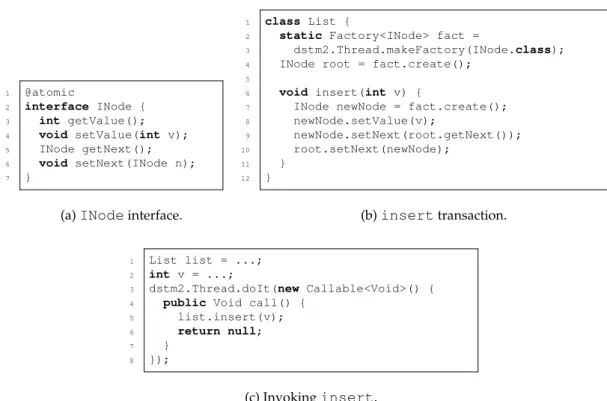
setter. These must follow the convention signaturesT getField()andvoid setField(T t), which can be thought as if defining a class field namedfieldof typeT. Additionally, this typeT can only bescalaror atomic. This restriction means that Atomic Objects cannot have array fields, so anAtomicArray<T>class is supplied that can be used wherever an array of typeTwould be needed, in order to overcome this. In Figure 2.3a we show an example of theINodeinterface to be used in a transactional linked list.
Implementing the interface The interface is then passed to a transactional factory constructor that returns a transactional factory capable of creatingINodeinstances, which is charged with ensuring that the restrictions presented in the previous phase are met. This factory is able to create classes at runtime using a combination of reflection, class loaders, and theByte Code Engineering Library(BCEL)1, a collection of packages for dynamic creation or transformation of Java class files. This means that atomic objects are no longer instantiated with thenewkeyword, but by calling the transactional factory’screatemethod.
In the example in Figure 2.3b, the transactional factory is obtained in line 2, and an atomic object is created in line 7.
Lastly, in Figure 2.3c, we inspect how does invoking a method differ from invoking a transac-tion. DSTM2 supplies a newThreadclass that is capable of executing methods as transactions. Specifically, itsdoItmethod receives aCallable<T>object whosecallmethod body will be executed as a transaction, wrapped in a start-commit loop.
All things considered, DSTM2’s programming model is very intrusive when compared to the sequential model. Atomic classes cannot be implemented directly, instead an@atomicinterface must be declared (Figure 2.3a). The instantiation of atomic objects is not done through thenew
keyword, but by calling thecreatemethod of the transactional factory (Figure 2.3b). And, fi-nally, starting a transaction is a rather verbose process. We wrap the transaction’s body in the call method of a Callableobject that is passed as argument to the dstm2.Thread.doIt method (Figure 2.3c). Moreover, the usage of arrays in atomic objects must be replaced by in-stances of theAtomicArray<T>class.
2.1.3.2 Deuce
A more recent proposal of a framework is Deuce [KSF10]. Korlandet al.aimed for an efficient Java STM framework that could be added to existing applications without changing its compilation process or libraries.
In order to achieve such non-intrusive behavior, it relies heavily on Java Bytecode manipula-tion using ASM2, an all-purpose Java Bytecode manipulation and analysis framework that can be used to modify existing classes or dynamically generate classes, directly in binary form. This instrumentation is performed dynamically as classes are loaded by the JVM using a Java Agent3. Therefore, implementing classes to be modified through transactions is no different from regular Java programming (Figure 2.4a), as Deuce will perform all the necessary instrumentation of the loaded classes.
To tackle performance-related issues, Deuce usessun.misc.Unsafe4, a collection of meth-ods for performing low-level, unsafe operations. Using sun.misc.Unsafe allows Deuce to
1http://commons.apache.org/bcel
2http://asm.ow2.org
3http://docs.oracle.com/javase/7/docs/api/java/lang/instrument/package-summary.html
1 class Node {
2 int value;
3 Node next;
4
5 int getValue() {
6 return value;
7 }
8 void setValue(int v) {
9 value = v;
10 }
11 Node getNext() {
12 return next;
13 }
14 void setNext(Node n) {
15 next = n;
16 }
17 }
(a)Nodeclass.
1 class List {
2 Node root = new Node();
3
4 @Atomic
5 boolean insert(int v) {
6 Node newNode = new Node();
7 newNode.setValue(v);
8 newNode.setNext(root.getNext());
9 root.setNext(newNode);
10 }
11 }
(b)inserttransaction.
1 List list = ...;
2 int v = ...;
3 list.insert(v);
(c) Invokinginsert.
Figure 2.4: Deuce’s programming model.
directly read and write the memory location of a fieldf given the hO, foipair, where O is an instance object of classC andfo the relative position off inC. This pair uniquely identifies its respective field, thus it is also used by the STM implementation to log field accesses.
As a framework, Deuce allows to plug in custom STM implementations, by implementing a Contextinterface which provides the typical operations used by an STM algorithm, namely: start, read, write, commit, and abort.
We now briefly present the manipulations performed by Deuce. For each fieldfin any loaded classC, a synthetic constant field is added, holding the value offo. In addition to the synthetic field, Deuce will also generate a pair of synthetic accessors, aGf getterandSf setter. These acces-sors encapsulate the read and write operations, by delegating the access to the Deuce runtime (the Contextimplementation). The accessors are invoked with the respectivehthis, foipair, so the runtime effectively knows which field is being accessed and can read and write its value using sun.misc.Unsafe.
Besides instrumenting class fields, Deuce also duplicatesall methods. For each methodm
Deuce will create a synthetic methodmt, a copy of methodm, to be used when in the context of a transaction. Inmt, read and write accesses to any fieldf are replaced by calls to the synthetic accessorsGf and Sf, respectively. Besides the rewriting of field accesses, method calls within
2. FUNDAMENTALCONCEPTS ANDSTATE OF THEART 2.2. Atomicity Violations
penalty on non-transactional code as Deuce provides the weak atomicity model.
This duplication has one exception. Each methodmaannotated with@Atomicis to be exe-cuted as a transaction (Figure 2.4b). Therefore, after the creation of itsma
t synthetic counterpart,
ma is itself instrumented so that its code becomes the invocation of ma
t wrapped in the start-commit transactional loop. The practical effect of this is that invoking a transaction is simply calling a method, as seen in Figure 2.4c, provided that the programmer annotates the method with@Atomic, of course.
In retrospective, Deuce is optimal regarding programming model intrusion, only requiring the@Atomicannotation when compared to the sequential model. Leveraging STM on an ex-isting application using Deuce requires only the annotation of the desired methods, as all these transformations are performed behind the scenes dynamically at class loading.
2.2
Atomicity Violations
Atomicity violations are race conditions where the lack of atomicity of the operations cause incor-rect behavior of the program. The atomicity violation depends on the intended atomic properties that the program relies on to ensure the correctness of program executions. A program can con-tain atomicity violations while being free from data races. This can happen when a program executes two operations in two atomic phases, and the intended behavior is only assured if those two operations execute as a single atomic operation.
Atomicity violations are one of the most causes of errors in concurrent programs [LPSZ08]. In the following sections we present some of the more relevant work in this area.
2.2.1
High-Level Data Races and Stale-Value Errors
Artho et al. defined the notion of view consistency in [AHB03]. View consistency violations are defined as High-Level Data Races and represent sequences of atomic operations in the code that should be atomic in a whole, but are not. Aview of an atomic operation is the set of variables that are accessed in that atomic operation. The set of views of a threadtis defined asV(t)and a threadtis said to be compatible with a viewv if and only if{v∩v′ | v′ ∈V(t)}forms a chain,
i.e., is totally ordered under⊆. The program is view consistent if every view from every thread is compatible with every other thread.
The notion of High-Level Data Races (HLDR) does not capture every anomaly regarding the execution of atomic operations, and a HLDR does not imply a real atomicity violation. However this concept is precise enough to capture real world anomalies.
This definition was subsequently extended by Praun and Gross [VPG04] to introducemethods view consistency. Method consistency is an extension of view consistency. Based on the intuition that the set of variables that should be accessed atomically in a given method contains all the variables accessed inside a synchronized block. The authors define the concept of method views, which relates to Artho et al’s maximal views, and aggregates all the shared variables accessed in a method, and also differentiates between read and write memory accesses. This approach is more precise than Artho et al’s because it also detects stale-value errors.
violation because the value may be stale, since it could have been updated by a concurrent thread. The freshness of the values may or may not be a problem depending on the application. Analysis to detect stale value errors are formalized in [AHB04; BL04].
The technique that we present in this dissertation, is comparable to the works just described as it detects both high-level data races and stale-value errors with a high precision.
2.2.2
Access Patterns Based Approaches
Vaziri et al. [VTD06] defines eleven access patterns that potentially represent an atomicity viola-tion. The access patterns are sequences of read and write accesses denoted byRt(L)andWt(L) and represent, respectively, read and write accesses to memory locationsL, performed by thread
t. The sequence order represents the execution order of the atomic operations. An example of an access pattern defined in this paper isRt(x)Wt′(x)Wt(x), that represents a stale value error,
since threadtis updating variablexbased on an old value. The patterns make explicit use of the atomic set of variables, i.e. sets of variables that must be accessed atomically, and these correlated variables are assumed to be known. These eleven patterns are proved to be complete with respect to serializability.
A related approach by Teixeira et al. [LSTD11] identifies three access patterns that capture a large number of anomalies. These anomalies are referred asRwR, where two related reads are interleaved by a write in those variables;W rWwhere two related writes are interleaved by a read in those variables; andRwWthat represents a stale value error.
2.2.3
Invariant Based Approaches
Another approach to detect atomicity violations is by directly knowing the intended semantics of the program. This was the approach followed in [DV12] by Demeyer and Vanhoof. The authors defined a pure functional concurrent language that is a subset ofHaskell, and includes theIO Monad, hence modeling sequential execution and providing shared variables that can be accesses inside atomic transactions. A specification of the invariants of the program’s functions are pro-vided by the programmer in logic. A shared variable is said to be consistent if all invariants upon it hold before and after every atomic transaction. The static analysis acquires the facts about the program and feeds them to a theorem prover to test if every shared variable will be consistent.
This approach is very accurate provided that the programmer can express the notion of pro-gram correctness by using invariants on the global state, but is also expensive because of the theorem proving involved.
2.2.4
Dynamic Analysis Based Approaches
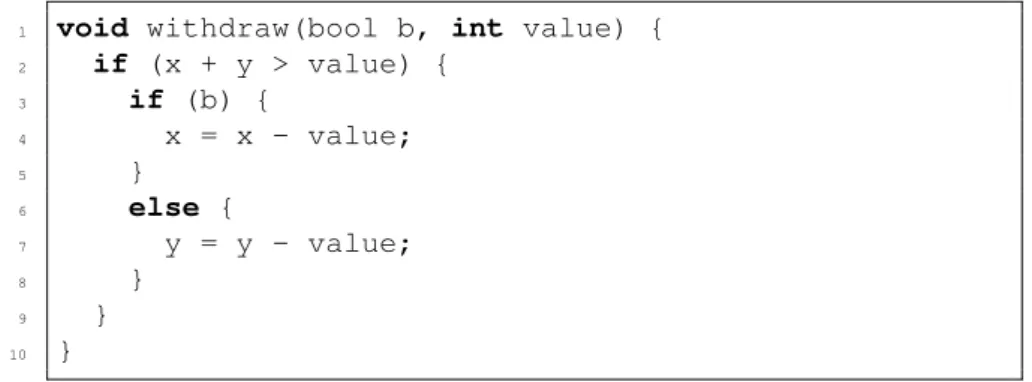
2. FUNDAMENTALCONCEPTS ANDSTATE OF THEART 2.3. Snapshot Isolation
1 void Withdraw(boolean b, int value) { 2 if (x + y > value) {
3 if (b) {
4 x = x - value;
5 }
6 else {
7 y = y - value;
8 }
9 }
10 }
Figure 2.5:Withdrawprogram.
obtained dynamically to a serialization trace. If these condition are not met, then an anomaly is reported, this can, however, lead to false positives.
Another work from Flanagan et al provides a sound and complete dynamic analysis for atom-icity violations [FFY08]. This work uses a well-known result from database theory that states that a trace is serializable if and only if no cycle exists in the happen-before graph of instructions of atomic operations [BHG87]. The dynamic analysis maintains a happens-before graph and reports anomalies if a cycle is found.
A different approach is presented by Shacham et al. [SBASVY11]. In this work the atomic operations are extracted from the program to be analyzed to create an adversary that will run them concurrently to the original program, if two different runs yield different results then an anomaly is reported. Some heuristics are used to explore the search space of possible interleavings from the adversary.
2.3
Snapshot Isolation
Snapshot Isolation (SI) [BBGMOO95] is a well known relaxed isolation level widely used in databases, where each transaction executes with relation to a private copy of the system state—a snapshot— taken at the beginning of the transaction and stored in a local buffer. All write oper-ations are kept pending in the local buffer until they are committed in the global state. Reading modified items always refer to the pending values in the local buffer.
Tracking memory operations introduces some overhead, and TM systems running under opac-ity must track both memory read and write accesses, incurring in considerable performance penalties. Validating transactions in SI only requires to check if any two concurrent transaction wrote at a common data item. Hence the runtime system only needs to track the memory write accesses per transaction, ignoring the read accesses, possibly boosting the overall performance of the transactional runtime.
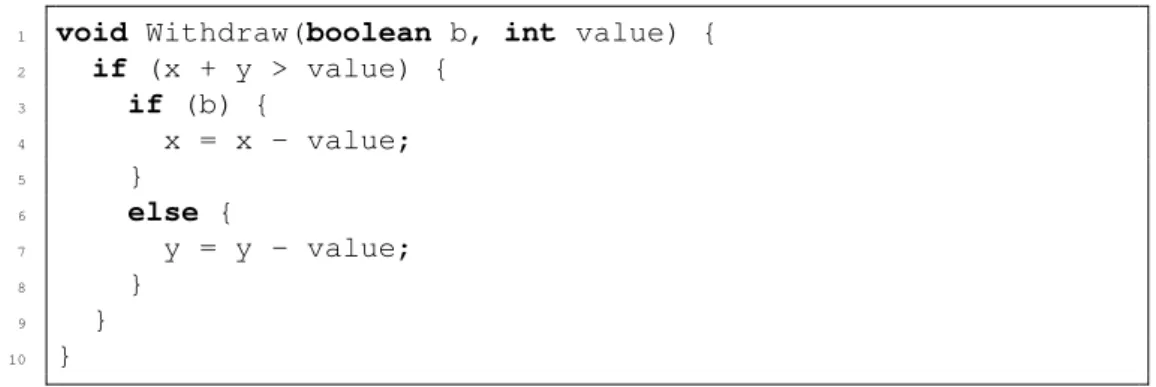
Although appealing for performance reasons, the use of SI may lead to non-serializable ex-ecutions, resulting in two kinds of consistency anomalies: write-skewand SI read-only anomaly [FLOOS05]. Consider the following example that suffers from thewrite-skewanomaly. A bank client can withdraw money from two possible accounts represented by two shared variables,x
andy. The program listed in Figure 2.5 can be used in several transactions to perform bank oper-ations customized by its input values. The behavior is based in a parameterband in the sum of the two accounts. Let the initial value ofxbe20and the initial value ofybe80. If two transactions
respectively, then one possible execution history of these two transactions under SI is:
H=R1(x,20)R2(x,20)R1(y,80)R2(y,80)R1(x,20)W1(x,−10)C1R2(y,80)W2(y,−10)C2
After the execution of these two transactions the final sum of the two accounts will be−20, which is unacceptable. Such execution would never be possible under opacity, as the last transaction to commit would abort because it read a value that was written by the first (committed) transaction. In the following sections we present the notions of transaction dependency, which is based on execution histories and static dependency between transactional programs. These notions are used to precisely define the possible anomalies that may occur under snapshot isolation.
2.3.1
Transaction Histories
The execution of a transaction can be defined as a sequence of read and write accesses to shared data items that ends either with a commit operation or an abort operation. A transaction implicitly starts upon the execution of the first operation in the sequence. Each transaction results from the execution of a program, hence a program is the static representation of a transaction, and a set of programs constitute an application. We writeRn(X)andWn(X)to denote read and write accesses to locationXin a transactionTnof applicationA. We define a history of an applicationA, writtenH(A), to an interleaving of the executions of all its transactions. For example consider the application historyH1for some applicationAwith transactionsT1andT2and shared variables
XandY:
H1(A) =R1(X)R2(X)W2(X)C2W1(X)A1
Notice that both transactionsT1 and T2 read variable X and that T2 writes variableX and
commits. TransactionT1then writes variableXbut finishes with an abort operation which reverts
all the changes made byT1, and in the end the value ofXis the one written byT2.
An application historyH is said to be serializable if its effect on the state of the application is equivalent to the one of a serializable historyS where all transactions are executed sequentially in some given order. For example, consider the following historyH2 for applicationA where
variableX is initialized with value50, and where transactionT1tries to incrementX by10and
transactionT2tries to incrementX by20:
H2(A) =R1(X,50)R2(X,50)W2(X,70)C2W1(X,60)C1
Consider that the only two possible histories that sequentially execute transactionsT1andT2
to a committed state areS1andS2below:
S1=R1(X,50)W1(X,60)C1R2(X,60)W2(X,80)C2
S2=R2(X,50)W2(X,70)C2R1(X,70)W1(X,80)C1
If historyH2is serializable then the final value of variableX should be the same as the one
resulting from eitherS1 orS2. Also the two read operations performed byT1andT2in history
H2could never yield the same result. Hence, we conclude that historyH2is not serializable.
However, if we consider historyH3below, where transactionT1is aborted, we would have
a serializable application history equivalent to a sequential history where only transactionT1is
executed.
2. FUNDAMENTALCONCEPTS ANDSTATE OF THEART 2.3. Snapshot Isolation
2.3.2
Transaction Dependencies
Fekete et al. [FLOOS05] defines a dependency relation between two transactions based on their execution history. Dependencies between transactions are classified into the following three cate-gories:
• There is awrite-readdependency,Tn x−wr
−−−−→Tm, if a committed transactionTnwrote a vari-ablexand a committed transactionTmread the value of variablexwritten byTn.
• There is awrite-writedependency,Tn x−ww
−−−−→ Tm, if a committed transactionTnhas written variablexand a committed transactionTmhas also written variablexafterTn.
• There is aread-writedependency, Tn −−−−→x−rw Tm, if a committed transactionTn reads vari-ablexwhich will be later written by a committed transactionTm, and no other committed transactionTpwrites to the same variable between the read ofTnand the write ofTm. From this definition we can observe that if there is a write-read dependency T1 −−−−→x−wr T2 we
know thatT1has committed before the start ofT2, thusT1andT2are not concurrent. Otherwise,
T2 would not be able to read the value written byT1. A write-write dependencyT1
x−ww −−−−→ T2
means that transaction T1 has committed before the start ofT2due to theFirst-Committer-Wins
rule, and hence they are not concurrent. A read-write dependencyT1
x−rw
−−−−→T2indicates thatT1
read a value from variablexwhich will be later written by a committed transactionT2, and in this
caseT1andT2executed concurrently.
The above dependencies can be generalized as: • There is aTn
wr
−−→Tmdependency ifTn i−wr
−−−→Tmfor any data itemi. • There is aTn−−→ww Tmdependency ifTn−−−−→i−ww Tmfor any data itemi. • There is aTn
rw
−−→ Tmdependency (also called an anti-dependency) ifTn i−rw
−−−→Tmfor any data itemi.
• There is aTn −→ Tmdependency if any of the following dependencies hold: Tn wr −−→ Tm,
Tn ww
−−→TmorTn rw −−→Tm.
Using these dependency definitions we can construct a dependency graph called dependency serialization graph (DSG) for a historyH.
2.3.3
Dependency Serialization Graph
A dependency serialization graph is defined over a historyH with vertices representing commit-ted transactions and each distinctly labeled edge fromTmtoTn corresponding to aTm
wr −−→ Tn,
Tm ww
−−→TnorTm rw
−−→Tndependency. Consider the follow history:
H3:W1(X)W1(Y)W1(Z)C1W3(X)R2(X)W2(Y)C2R3(Y)C3
The corresponding dependency serialization graph of historyH3,DSG(H3), is shown in
Fig-ure 2.6.