NATURAL STONE WALLS IN VERNACULAR ARCHITECTURE:
WHAT CONTRIBUTION TOWARDS RURAL nZEB CONCEPT?
Francesca POGGI, Ana Maria VIEGAS FIRMINO, Miguel P. AMADO
& Fernando F.S. PINHO
Abstract
Rural housing, with its vernacular characteristics related to landscape, constitutes a heritage resource and plays a key role in the cultural and physical production of countryside identity. This paper explores the energy performances of a traditional rural house with granite stone walls, located in Cova da Beira, Portugal. The analysis on thermal properties of granite walls and energy consumption patterns and the simulation of potential solar energy supply have been performed using Autodesk® Ecotect®. Findings show that the zero energy balance of rural housing can be achieved by means of some energy efficiency improvements and solar energy integration. This research aims to stimulate the debate about «(re)thinking» the background of existing vernacu-lar architecture, reflecting the need and benefits of improving global energy performances and give an outlook towards a new “Nearly Zero-Energy Building” (nZEB) concept for rural areas.
Keywords
energy efficiency, solar energy, rural housing, granite wall, vernacular architecture, nZEB
Résumé
L’architecture rurale, avec ses caractéristiques vernaculaires liées au paysage, constitue un patrimoine et joue un rôle clé dans la production culturelle et physique de l’identité de la cam-pagne. Ce document explore les performances énergétiques d’une maison rurale traditionnelle avec des murs en pierre de granit, situé à Cova da Beira, Portugal. On a effectué l’analyse sur les propriétés thermiques des murs de granit, les modèles de consommation d’énergie et la si-mulation du potentiel électrique de l’énergie solaire en utilisant le logiciel Autodesk® Ecotect® Analyse. Les résultats montrent que l’équilibre à énergie zéro des bâtiments ruraux peut être réalisé grâce à quelques améliorations de l’efficacité énergétique et à travers l’intégration de l’énergie solaire. Cette recherche vise à stimuler le débat concernant la «(ré)formulation» du background de l’architecture vernaculaire existante, manifestant la nécessité et les avantages de l’amélioration des performances énergétiques globales des maisons rurales afin de jeter un coup d’œil vers une nouvelle conception de “bâtiments à énergie quasi zéro - Nearly Zero-Energy Building” (nZEB) pour les zones rurales.
Mots-clés
efficacité énergétique, énergie solaire, maison rurale, mur de granit, architecture vernaculaire, nZEB
I. INTRODUCTION
In the EU-28, predominantly rural and intermediate regions represented 90% of the territory and 57.4% of the population in 2010 (European Commission, 2014). In such pathway, the attention to meet eco-nomic, environmental and social challenges, that face modern societies in the 21st century, is shifting to rural development, promoting a resurgence of initiatives. According to Europe 2020 strategies and the overall Common Agricultural Policy (CAP)
objectives, energy emerges as one of the most im-portant factors that contribute to the sustainability of European countryside, playing a crucial role for achieving adequate levels of rural development and quality of life. However, the current framework for energy issues in rural areas focuses mainly on sup-porting agriculture, forestry and agri-food sectors, combining energy saving and renewable energies.
rural housing stock, can play a key role in achie-ving the combined objectives of decarbonisation,
resource efficiency and competitiveness (FREE,
2012). Overall, the strength of this position is supported by an essential evidence: rural areas present much lower energy consumption patterns when compared to urban areas and offer a higher
degree of flexibility in the deployment of renewable
energy sources (EREC, 2005). The underlying in-terest within this framework is to direct an analysis towards the architecture of rural housing, that, with its vernacular characteristics related to landscape, tradition and social values, constitutes a heritage resource and plays a key role in the cultural and physical production of countryside identity. Indeed, it is necessary to pay special attention to rural hou-sing if the global objective is to stop depopulation in countryside, promote regional and local develop-ments and contribute to the sustainability of these territories (Brezzi & Piacentini, 2008; European Commission, 2008). To do this, vernacular
archi-tecture has to prove energy efficient buildings for
the future, integrated within its natural and cultural environment and in consonance with the axioma-tic thought of the Portuguese landscape architect Telles, (2004): “Bringing the countryside to the city without bringing the city to the countryside” (Firmino, 2004).
Understanding energy balance concept of a buil-ding is an essential starting point. The European Directive 2010/31/EU (EPBD recast) promotes the improvement of energy performance of buildings within the Union, taking into account outdoor climatic and local conditions, as well as indoor comfort and cost-effectiveness. Within
the framework of this directive, the definition of
‘Nearly Zero-Energy Building’ (nZEB), leads to a building that requires a very low amount of energy,
which should be covered to a very significant extent
by energy from renewable sources produced on-site or nearby (D׳Agostino, 2015). Although, most aid effort related to these issues are focused on cities, the implementation of nZEB could be considered as an opportunity and a target priority for traditional or new rural housing, as it is already the case for urban areas.
According to the OECD classification, in Portugal,
81.3% of the continent is predominantly rural and recently, activities like tourism, gastronomy and landscape, are creating conditions to raise
cour-tyard attractiveness and competitiveness (European Commission, 2013). The selection of traditional
construction materials and techniques reflects the
traits of each different region, constituting a great
ethnographic value and a significant touristic po -tential: two essential premises to promote rural de-velopment and retain population to these territories (Firmino, 2004). The link between stone walls and rural regions is a strong one in Portugal: from the famous terraces supported by stone walls in the Douro Valley (Firmino, 2015) to the promotion of tourism in the historic stone villages in the Centre Region of Portugal (Silva, 2009).
Considering the aforementioned framework, this paper explores the energy performance of a tradi-tional rural house with granite stone walls, located in Cova da Beira, Portugal. Analyses on thermal properties of granite wall and energy consumption patterns and simulation of potential solar energy supply were performed using Autodesk® Ecotect® Analysis software. Findings show that the zero energy balance of rural housing can be achieved
by means of some energy efficiency improvements
and solar energy integration. In this way, the present research aims to stimulate the debate about «(re) thinking» the background of existing vernacular
architecture, reflecting the need and benefits of
improving global energy performances of the rural houses in order to give an outlook towards a new “Nearly Zero-Energy Building” (nZEB) concept for rural areas.
II. BACKGROUND
At the present, the interest of countryside itself is
different from the architectural heritage that has long been protected by national and international instruments (Council of Europe, 2001). An overall approach to countryside is needed to maintain landscape features such as vernacular buildings terraces, hedges, stone walls or other and ensure that traditional housing stock preserves those ma-terials and construction systems inherited from the past (Council of Europe, 2002; Domingues, 2001). Since the start of vernacular as an academic and professional discipline in the nineteenth century, there has been strong emphasis on studying and preserving historical rural buildings and traditions, considering them the most “authentic” buildings (JA Al-Qawasmi, 2013). This is the real value of rural architecture in Europe: to be original and Eu-ropean at the same time (Council of Europe, 2001).
Climatic conditions, topography, and available
building materials influence the typological, struc -tural and morphological solutions of rural housing
and led to various configurations which reflect the specific habits, needs and the way of living of the
local (Philokyprou, Savvides, Michael & Malaktou, 2014). Vernacular architecture studies have given rise to a large number of publications, notably in the second half of the 20 the Century. Within this
field, the pioneering works of Rudofsky (1964), Oliver (1969) and Rapoport (1969) established
links between vernacular architecture and the com-plexity of societal and cultural processes (Asquith
& Vellinga, 2006). As Oliver (2006), commented in
a most recent publication: “all forms of vernacular
architecture are built to meet specific needs, accom -modating the values, economies and ways of living of the cultures that produce them”. In some way, this is precisely the perspective that responds to the notion of sustainability. Looking at the experience of vernacular architecture, local materials to provide thermal comfort, building forms to ensure natural lighting and sun radiation, traditional construction and technologies adapted to suit local environment and cultures, offer an interesting understanding of the lessons that can emerge from its study.
In-deed, scientific literature which relates vernacular
architecture and energy performances, has been reinforced in recent years, especially considering rural housing types and materials.
On this reading, the focus of the research is thermal
comfort, which is defined by ASHRAE (1966) as
“that condition of mind which expresses satisfaction
with the thermal environment” (Hall, 2010:128). The study of Martín et al., (2010) on two traditional houses, respectively made of local stone and adobe and one modern in prefabricated wooden, shows that the thermal behaviour of traditional houses is
definitely better than the new one, due to the high
thermal inertia of exterior walls. The research and intervention on the rehabilitation of rural houses, according to Lanzinha & Castro-Gomes (2010), may be done under a perspective of sustainable construction, especially in order to improve the thermal and hygrometric indoor comfort and com-bine traditional heating systems with new heating solutions, more ecologic and with renewable power supply (particularly geothermal and solar power). In line with Lanzinha and Castro-Gomes ‘studies (2010) of thermal rehabilitation, Moradias, et al., (2012), discuss the need to improve traditional house with stone masonry wall (granite) envelopes and prove the better contribution of the thermal resistance of pinewood, comparatively to plaster, which is in accordance with the thermal conduc-tivity of each of these materials. By means of en-ergy performance simulations, Alev et al., (2014) observe that different alternatives, such as the renovation of thermal envelope, heating and ven-tilation systems, can be used to make historic rural
houses more energy efficient and to improve the
indoor climate. Creating a base geometry and set of thermal characteristics for detached Irish traditional dwellings, the approach of Ahern et al., (2013), and
their methodology, constitute a significantly contri -bution for fabric improvement measures related to heat loss due to envelope surface areas, glazing, thermal bridging and ventilation loss.
With respect to on-site renewable energy technolo-gies, literature available on rural housing highlights the use of solar collectors for DHW and PV-panels (Alev et al., 2014; Martín et al., 2010; Missoum,
Hamidat, Loukarfi, & Abdeladim, 2014). Nerveless,
mi-crogeneration technologies with high standards of
energy efficiency (Dunster, Simmons, & Gilbert,
2007). In line with BedZED (Beddington Zero Emission Development), the UK’s largest mixed-use zero-carbon community, the Hope Homixed-use is
the first model of detached house suitable for rural
location (Dunster et al., 2007).
Inspired by the aforementioned framework on
en-ergy efficiency, solar enen-ergy and nZEB concepts,
this paper aims to deepen the approach to zero energy balance buildings, by studying vernacu-lar architecture characteristics and the positive contributions provided by stone walls with high thermal inertia. Focusing on building construction systems and materials, Beira Interior and Cova da Beira regions show a predominantly rural housing stock with stone wall (Lanzinha & Castro-Gomes, 2010). This kind of thick exterior wall, with high thermal inertia, provides comfortable indoor envi-ronment inside traditional rural housing with less energy consumption than new buildings (Martín et al., 2010). Furthermore, the high levels of solar radiation in Portugal represent an excellent condi-tion to implement photovoltaic and solar thermal system in rural buildings (Carvalho, Wemans, Lima & Malico, 2011). In this perspective, the present research discuss the relationship between natural stone walls and energy performances in vernacular architecture, in order to promote
ener-gy efficiency improvements and microgeneration
integration into existing and new rural buildings, towards a new Rural nZEB concept.
III. METHODOLOGY
The nZEB concept aims to produce high energy
performance buildings that reduce the specific
demand for heating to a minimum, reduce the primary energy consumption for heating, cooling, ventilation, domestic hot water and lighting and cover the overall primary energy demands with renewable energy resources (ECEEE, 2014). The three aforementioned nZEB principles, represent the theoretical background that has inspired the research question of this study: “Natural stone walls in vernacular architecture: what contribution towards Rural nZEB concept?”
The proposed approach is not strict linear but it integrates qualitative and quantitative methodo-logies. In this framework, the methodology is structured in three phases: conceptual, experi-mental and synthesis that have to be taken into account to derive reliable answers. The
concep-tual phase deals with the identification of basic
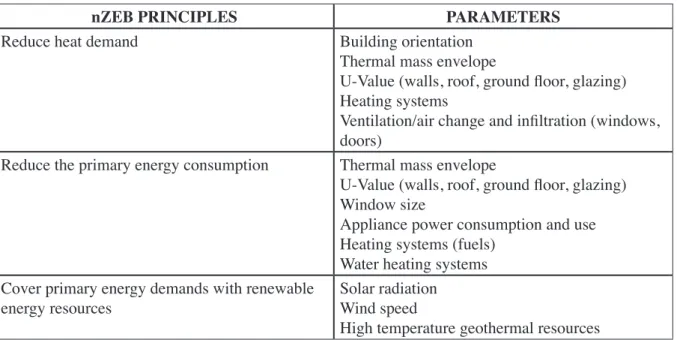
parameters, which relate to each of the three nZEB principles with building components and appliances (Table 1).
Table 1. Basic parameters relating nZEB principles and building components and appliances
nZEB PRINCIPLES PARAMETERS
Reduce heat demand Building orientation Thermal mass envelope
U-Value (walls, roof, ground floor, glazing)
Heating systems
Ventilation/air change and infiltration (windows,
doors)
Reduce the primary energy consumption Thermal mass envelope
U-Value (walls, roof, ground floor, glazing)
Window size
Appliance power consumption and use Heating systems (fuels)
Water heating systems Cover primary energy demands with renewable
energy resources
Solar radiation Wind speed
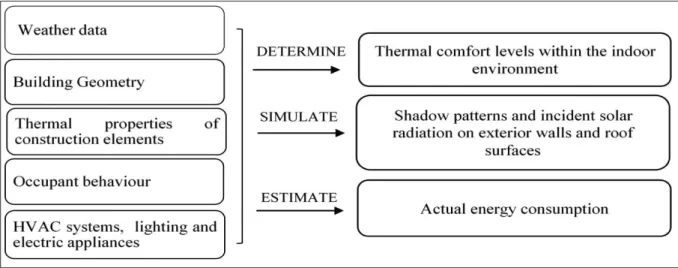
The experimental phase carries out analysis on a case study in order to understand the relationship between the basic parameters and the building energy performances. It is important to use a tool able to perform full thermal, solar and energy
ana-lysis. As a variety of coupling simulations and data visualizations are possible, Autodesk® Ecotect® Analysis software has been adopted, developing an approach for building performance analysis and simulation (Figure 1).
Figure 1. Proposed approach for building performance analysis and simulation
The synthesis phase compare the obtained results from the case study with the nZEB requirements,
reflecting then a formal definition of the Rural
nZEB concept.
IV. CASE STUDY
The ambition of the case study is to reflect on a
representative case of building in order to introduce the nZEB concept into vernacular architecture, with particular regard to the use of stone wall in traditional rural housing. The criteria used for the selection of the case study are the following: - Geographic location – rural regions where local stones are traditionally used as construction ma-terials;
- Climate conditions – temperate climate with dry and/or hot summer, large daily temperature varia-tions and high level of solar radiation throughout the year;
- Vernacular architecture – viewed as a local rural context asset, with particular regard to the use of stone wall in traditional rural housing;
- Socio-economic profile of occupants – existence
of residential or tourist-recreational activities related to historical centres and their religious heritage, archaeological sites, cultural landscapes, natural parks and places of traditional or ethnic
significance;
- Typology of building – traditional one family rural house;
- Constructive system and materials – existence of traditional exterior stone walls and available roof area for PV installation facing south.
Beira Interior and Cova da Beira are rural regions where traditional one-family house with exterior stone wall, is the predominant typology of re-sidential building (Moradias, 2012). According to the aforementioned features, the case study is established in the village of Colmeal da Torre, just north of Belmonte municipality, in Cova da Beira region (Figure 2).
Climate conditions
According to the Koppen Climate Classification,
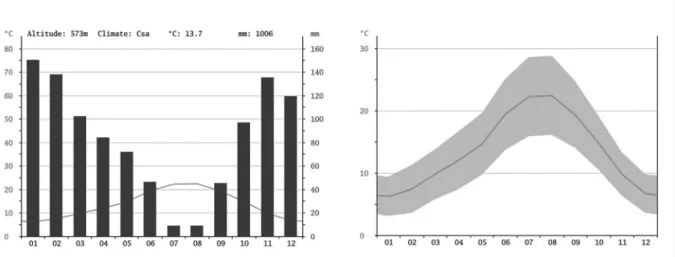
Belmonte holds a warm and temperate climate (Csa) with an average annual temperature of 13.7 °C. The temperatures are highest on average in August, at around 22.4 °C, while the lowest average
tempera-ture of the whole year is in January at around 6.2 °C. In a year, the average rainfall is 1006 mm with the
least amount of precipitation in July, with an ave-rage of 9 mm and the most amount in January, with an average of 150 mm. The climate conditions are
obtained from (CLIMATE-DATA, 2016) (Figure 3).
Vernacular architecture
High levels of thermal mass are common in rural houses of this region where, local sources bulk materials such as granite and schist stone, are ea-sily available. The case study has relevant features and challenges with respect to study its energy performances:
- First, the traditional exterior walls of granite, which due to their thermal mass, maintain constant the indoor temperature across the year.
- Second, the south orientation of the pitched roof,
which provides an optimal surface for solar energy system installation.
- Third, the occupants’ behaviour in rural houses, which shows different patterns in the countryside compared to the city, regarding energy consumption for heating and cooling requirements.
Socio-economic profile of occupants
The global socio-economic profile of this rural region reflects three different social classes: the
residents, the second homeowner and the tourists. In particular, the expansion of second homes in older and single-family buildings located in rural areas, with attractive natural and cultural landscape, shows percentage greater than 20% in Centre Re-gion of Portugal (Instituto Nacional de Estatística, 2012; Loureiro de Matos, 2013). According to J. Oliveira & Costa (2012), the majority of second home owners are residents in Lisbon metropolitan area, followed by Portuguese emigrants and forei-gners. These groups differ in frequency of use of second homes, given that residents in the Lisbon metropolitan areas and emigrants are mostly eco-nomically active couples with children, while forei-gners are predominately retirees (Oliveira & Costa,
2012). In this context, the profile of the occupants of
house is a middle-class one-family household with two sons who are 25 and 20 years old.
Description of the typology of building
The case study is an example of traditional rural house, with exterior granite walls dating back to the 1920s. On the other side, the roof and the windows have been recently replaced due to bad state of conservation. The type of the building is one-family house, presenting a rectangular plan with a rather simple interior room subdivision (Figure 4-Figure 5).
Constructive system and materials
The constructive system is composed by exterior granite stone walls with a thickness on the order
of 0.6 m. The roof was reconstructed in the last
decade, according to the original timber roof struc-ture and Marseille clay tile covering. In order to separate the occupied zones of the house from the unoccupied roof zone, it was necessary to provide a system of concrete columns and beams to support a new ceiling. The occupied zone is subdivided by internal partitions of single 0.1 m brick on a
ground floor that consists of a 0.1 m concrete slab
plus ceramic tiles. All the aforementioned elements have no insulation materials. On the other side, the old timber windows were replaced with PVC double glazing.
Figure 5. a) Floor plan; b) 3D model by Ecotect® Analysis
Weather data
The weather data used in this research was collected from the meteorological station of Castelo Branco (348m above sea level; N 39° 49’ W 7° 28’) and synthetized by means of Ecotect® Analysis, as
shown in Figure 6.
Thermal analysis
The present analysis combines local climate data, geometrical and thermal parameters and the oc-cupants’ behaviour patterns in order to assess the indoor comfort and the heating and cooling loads of the building. Table 2 reports the geometrical
Figure 6. Climatic data (Source: meteorological station of Castelo Branco)
and thermal parameters which result from the mo-delling and calibration of the building in Ecotect® Analysis.
From the perspective of energy performances,
the building wall envelope is the most influent
construction component. Thermal transmittance data of many traditional materials is simply not available and calculations at present are based upon idealised, homogenous walls. In this framework, the U-Value of the external granite wall has been
iden-tified, using the results of Rodrigues and Pina dos
Geometric data Thermal conductivity of the envelope U (W /m2C)
Number of floors 1 External granite walls (600mm) 2.1
Built in volume 312 m3 Double glazed windows with aluminium frame
2.7
Exposed area 578 m2 Concrete floor on ground plus ceramic tiles 0.9
Floor area 112 m2 Concrete ceiling 2.5
South roof area 81 m2 Interior partition with brick and plaster 3.1
Table 2. Technical description of the building
Figure 7. Granite wall description
total wall surface, the mean value between 2.4 W / m2K and 1.8 W /m2K has been adopted (Figure 7).
The thermal mass performances of the granite stone wall is then obtained by simulating the heat gains and losses (Watts) on an average day each month. The graph of Figure 8, with months along the hori-zontal axis and hours of the day along the vertical, shows a matrix where each grid square represents the heat gains from the exterior stone walls, due to both external temperatures and incident solar radiation.
Thus, it is possible to observe that from May to October, heat gains occur from 12am to midnight, showing the positive long term effects provided by the high thermal mass of the stone walls. In winter, heat gains occur mainly from about 15pm to 21pm and just during the months of December and January heat is lost through the exterior stone walls. Additionally, the thermal comfort analysis
confirms that the indoor environment of the buil -ding achieves good percentages of satisfaction in the dining room and kitchen zone, due to the wide area of south-facing stone wall and the use
of a fireplace as heater system. On the other hand,
the same results do not occur in other zones of the building where the heat gains are negatively
influenced from the north-facing orientation of the
stone wall (Figure 9).
Electricity consumption
In relation to the energy consumption, the house is occupied by four active inhabitants who work and
study during the day. The occupants use a fireplace,
burning 4Kg of wood charcoal per hour, to heat the dining room and kitchen zone. The bedrooms are heated by means of electrical appliances, especially during the winter nights. Besides, the thermal mass of the walls provides a natural comfortable indoor environment, so no cooling system is used, during the summer. Data, obtained from a questionnaire survey of appliances and heating systems, show
that the total electricity consumption is 5462 kWh/
year (Table 3).
The house is not cooled and the load is slightly higher in winter than in summer because of the need to run additional heating systems such as an electric appliance in each bedroom.
Solar energy generation
If the nZEB goal is to produce as much electricity as the annual demand, solar energy represents a key element to face electricity consumption patterns by means of photovoltaic (PV) and solar thermal collectors (STC) systems. The environmental and economic value of these technologies make them
significant for both existing and new housing deve
Appliances Watts Hrs/Wk Wh/Wk Annual operating schedule
Dishwasher 1400 2 2800
Iron 1000 2 2000
Laptop Computer 35 10 350
Microwave 1000 1 1000
Refrigerator 150 168 25200 48 weeks
TV: 25 Color 150 25 3750
Vacuum cleaner 700 1 700
Washing Machine 500 3 1500
30 Energy Saver Lights (20W)
600 5 3000
3 Electric heaters 6000 21 126000 28 weeks
Subtotals Watts Hrs/Wk Wh/Wk kWh/year
Appliances 5535 217 40300 1934
Heating systems 6000 21 126000 3528
Totals 11535 238 166300 5462
Table 3. Electricity consumption by appliances and heating systems
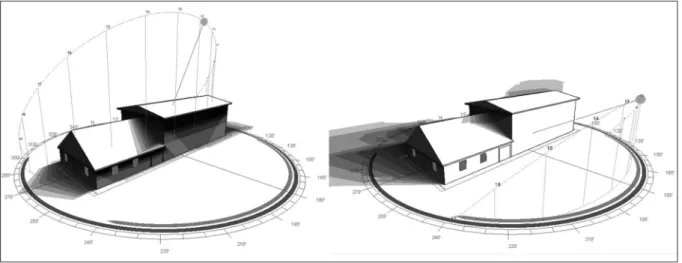
lopments. In this section, a solar radiation analysis on the case study has been carried out in order to identify suitable surface for PV or STC system. By performing the shadows range and solar radiation simulations on the building, it is possible to verify that the south orientation and inclination of the roof provide a wide surface with high level of incident insolation and which is not overshadowed from the surrounding building (Figure 10-12).
As a gas boiler is used to supply hot water to the house, the PV system installation on suitable roof area is studied in order to estimate the potential electricity supply. Figure 12 reports the framework of parameters that determine the potential electri-city supply, if the house was equipped with a PV system of 42 m2.
According to the analysis carried out with
Figure 11. Solar radiation simulation and suitable roof area for PV system
Figure 12. Monthly PV electricity supply on the suitable roof area (kWh)
PV System Area m2 Total solar
radia-tion kWh/m2
Mean global radia-tion kWh/m2
Predicted yield for PV systems kWh
PV electricity sup-ply kWh/year
tect®, it is evident that solar radiation is influenced
by seasonal and monthly variations that depend from the effects of latitude and the amount of cloud cover. The mean global radiation, depending on
the geographical location, shows a value of 1613
kWh/m2 giving a positive feedback about the high
level of solar energy potential on the roof surface (Amado & Poggi, 2012). The annual PV electricity
supply value of 6956 kWh/year has been obtained
by adopting the equation of (Bahaj & James, 2007):
Annual PV energy production
= PR×Me×Vst×(Gr) (1)
- PR is the Performance Ratio that considers the energy losses in the balance of system (adopted value in (1) | PR=0.75);
- Me is the nominal module efficiency rating at
standard test conditions: air mass AM 1.5, irra-diance 1 kW/m2, cell temperature 25ºC reported
by the selected manufacturer (Martifer Solar, 2014) (adopted value in (1) | Me = 13 %);
- Vst is the solar radiation values at standard test conditions of irradiance: Vstc =1 kWh/m² reported by the manufacturer;
- Gr is the predicted yield for PV systems over a year (value obtained from Ecotect® simulation, see Figure 12).
V. RESULTS AND DISCUSSION
The energy balance, related to nZEB concept, puts forward the target that the differential between the overall energy demand for heat, hot water, electri-city appliances and the renewable energy, produced locally, should be extremely low (almost zero). In the present case study, the energy balance equa-tion indicates that the actual electricity demand of the building can be totally covered by a PV system with 42m2 on the roof. Figure 13 reports
the percentage difference comparison between PV electricity supply and electricity consumption and the differential of 11 % represents the electricity power surplus of 1494 kWh. It is also possible to
note how heating systems accounts for 65 percent
on total electricity consumption, constituting one of the most important aspects to improve.
In this context, it is important to refer that the initial investment cost, associated with a PV system of 42 m2, can be high, requiring a long-term payback
because of low electricity rates in the residential sector. It is therefore necessary, to increase
ener-gy efficiency levels of the building by means of some specific improvements which can provide significant energy and cost savings. According to the features of the case study, the energy efficien
cy improvements that can be adopted involve the followings aspects:
- insulate walls, floors, roofs, possibly introducing
ecological materials for insulation such as, for exa-mple, cork which is largely produced in Portugal;
- repair and retrofit the original wood windows and
add new interior or exterior removable glazing pa-nels in order to protect the character of traditional building and respect the environment;
- replace the existing electric heating systems with an heat pump or an active solar heating system, which, considering the climatic conditions of the
site, constitute an efficient solution;
- install a thermal solar system, to cover the do-mestic heat water demand of the building. In order to make the best use of the suitable roof area for the PV system, the solar collector and the storage water tank could be installed in the outdoor garden area within the lot;
- the existing energy saver bulbs are an efficient way
for the general house lighting. Nevertheless, LED bulbs last longer and represent a better solution for the rooms that need directional light sources for reading, cooking, or working;
- replace electric appliances, especially those that account for major end uses of energy such as laun-dry, cooking and refrigeration, with more energy
efficient appliances;
- adopt smart meters to put occupants in control of how much energy each appliance uses, allowing to reduce energy consumption.
VI. CONCLUSIONS
In a world where energy efficiency continues to be a
predominantly urban challenge, this research shows as natural stone walls in vernacular architecture provide optimal levels of energy performances with regard to rural housing.
The promotion of local materials and traditional construction techniques represents a strategic vector to guarantee good energy performances of rural housing, reduce resources consumption and
green-house gas emissions. Energy efficiency plays a key
role in providing quality of “living in rural areas” which is an essential social aspect to be taken into account within the context of sustainable communi-ties. On the other hand, the solar analysis performed
in the case study, confirm the determinant role of PV
systems for achieving the positive energy balance, which is the primary target of the nZEB concept.
Due to climatic condition and site features, the implementation of solar power technologies for electricity and hot water supply is much simpler in rural areas than in urban ones. Nevertheless, it is
always necessary to provide functional and efficient
solutions, which don’t affect vernacular architecture and landscape aesthetic values.
«(Re)thinking» the background of existing
verna-cular architecture, reflects the need and benefits
of improving global energy performances of rural houses. In this sense, the Rural nZEB emerges as
a theoretical model that, involving specific design
principles, materials, renewable energy technolo-gies and refurbishment guidelines, will be deve-loped in order to preserve, protect and promote rural housing and thus contribute to the development of rural areas.
Acknowledgement
The first author acknowledges the Foundation for
Science and Technology (FCT) for the financial support
through the PhD grant SFRH/BD/94702/2013. Particular thanks to Maria A. D. Calheiros Braga and her family, for making available technical data on the house and for answering to the energy consumption survey.
REFERENCES
Ahern, C., Griffiths, P. & O’Flaherty, M. (2013). State
of the Irish housing stock- Modelling the heat losses of Ireland’s existing detached rural housing stock &
estimating the benefit of thermal retrofit measures
on this stock. Energy Policy, 55, 139–151. http://doi.
org/10.1016/j.enpol.2012.11.039
Alev, Ü., Eskola, L., Arumägi, E., Jokisalo, J., Donarelli, A., Siren, K., … & Kalamees, T. (2014). Renovation alternatives to improve energy performance of his-toric rural houses in the Baltic Sea region. Energy
and Buildings, 77, 58–66. http://doi.org/10.1016/j.
enbuild.2014.03.049
Amado, M. & Poggi, F. (2012). Towards Solar Urban Planning: A New Step for Better Energy
Perfor-mance. Energy Procedia, 30, 1261–1273. http://doi. org/10.1016/j.egypro.2012.11.139
Asquith, L. & Vellinga, M. (2006). Vernacular Archi -tecture in the 21st Century: Theory, Education and Practice. London: Taylor & Francis.
Bahaj, A.S. & James, P. A. B. (2007). Urban energy generation: The added value of photovoltaics in social housing. Renewable and Sustainable Energy
Reviews, 11(9), 2121–2136. http://doi.org/10.1016/j. rser.2006.03.007
Migration and Regional Development (p. 24). Paris: OECD.
Carvalho, D., Wemans, J., Lima, J. & Malico, I. (2011). Photovoltaic energy mini-generation: Future
pers-pectives for Portugal. Energy Policy, 39(9), 5465– 5473. http://doi.org/10.1016/j.enpol.2011.05.016 CLIMATE-DATA. (2016). Climate: Belmonte - Cli
-mate graph, Temperature graph, Cli-mate table.
Retrieved 21 January 2016, from http://en.cli
-mate-data.org/location/6945/
Council of Europe. (2001). European rural heritage, 95, 49.
Council of Europe. (2002). Resolution 128. The pro-blems of Europe’s countryside. Council of Europe. D׳Agostino, D. (2015). Assessment of the progress
towards the establishment of definitions of Near -ly Zero Energy Buildings (nZEBs) in European Member States. Journal of Building Engineering, 1,
20–32. http://doi.org/10.1016/j.jobe.2015.01.002
Domingues, Á. (2001). A paisagem revisitada.
Finis-terra, XXXVI(72), 55–66.
Dunster, B., Simmons, C. & Gilbert, B. (2007). The ZEDbook: solutions for a shrinking world. Abing-don England ; New York: Taylor & Francis. ECEEE. (2014). Understanding (the very European
concept of) Nearly Zero-Energy Buildings (p. 21). Stockholm: European Council f or an Energy
Efficient Economy.
EREC. (2005). Energy Sustainable Communities. Experiences, Success Factors and Opportunities in the EU-25 (p. 52). Bruxelles: Energy Sustainable Communities Consortium.
European Commission. (2008). The EU rural deve-lopment policy: facing the challenges. European Commission. Retrieved from http://ec.europa.eu/ agriculture/events/cyprus2008/brochure_en.pdf European Commission. (2013). Rural Development
in the EU. Statistical and Economic Information (Report 2013). Bruxelles: European Commission. Directorate - General for Agriculture and Rural Development.
European Commission. (2014). CAP context indica-tors 2014-2020. European Commission.
Firmino, A. (2004). A casa ecológica: inovação e desenvolvimento sustentável. Revista GeoInova DGPR/UNL, 10, 101–113.
Firmino, A. (2015). Stones: functionalities and sustai-nable landscapes. Carpathian Journal of Earth and
Environmental Sciences, 10(3), 189–196.
FREE. (2012). Policy Recommendations for Sustai-nable Rural Communities in Europe. FREE.
Hall, M.R. (2010). Materials for Energy Efficiency and
Thermal Comfort in Buildings. Elsevier.
Instituto Nacional de Estatística. (2012). Resultados
definitivos Portugal. Lisboa.
JA Al-Qawasmi. (2013). Contemporary vernacular as a diffusion of an innovation process. In Vernacular
Heritage and Earthen Architecture (pp. 233–238). CRC Press.
Lanzinha, J.C.G. & Castro-Gomes, J.P. (2010). Re-habilitation of Buildings in rural areas as a contri-bution to sustainable construction. In XXXVII World Congress on Housing, Santander, Spain
(pp. 26–29).
Loureiro de Matos, F. (2013). The expansion of se-condary housing in Portugal. The Overarching Issues of the European Space, 171–181.
Martifer Solar. (2014). Martifer Solar, Photovoltaic inverter manufacturer,. Retrieved 1 December 2014, from http://www.martifersolar.com/pt Martín, S., Mazarrón, F.R. & Cañas, I. (2010). Study
of thermal environment inside rural houses of Na-vapalos (Spain): The advantages of reuse buildings of high thermal inertia. Construction and Building
Materials, 24(5), 666–676. http://doi.org/10.1016/j.
conbuildmat.2009.11.002
Missoum, M., Hamidat, A., Loukarfi, L. & Abdela -dim, K. (2014). Impact of rural housing energy performance improvement on the energy ba-lance in the North-West of Algeria. Energy and
Buildings, 85, 374–388. http://doi.org/10.1016/j.
enbuild.2014.09.045
Moradias, P.A., Silva, P.D., Castro-Gomes, J.P., Salazar, M.V. & Pires, L. (2012). Experimental
study on hygrothermal behaviour of retrofit solu -tions applied to old building walls. Construction
and Building Materials, 35, 864–873. http://doi. org/10.1016/j.conbuildmat.2012.04.138
Moran, F. & Natarajan, S. (2015). PV in historic dwellings: The potential to reduce domestic CO2 emissions. Journal of Building Engineering, 3,
70–78. http://doi.org/10.1016/j.jobe.2015.06.004
Oliveira, J. & Costa, L. (2012). Second home tourism in the Oestes region, Portugal. Features and im-pacts. European Journal of Tourism, Hospitality and Recreation, 3(2), 35–55.
Oliver, P. (2006). Built to meet needs: cultural issues
in vernacular architecture. Oxford: Elsevier/Ar-chitectural Press.
Philokyprou, M., Savvides, A., Michael, A. & Ma-laktou, E. (2014). Examination and Assessment of the Environmental Characteristics of Vernacular Rural Settlements. Three Case Studies in Cyprus. In SB14 (pp. 1–8). Barcelona.
Silva, L. (2009). Building in the ‘Historic Villages of Portugal’: Social Processes, Practices and Agents. Journal of Ethnology and Folkloristics, (3 (2)), 75–91.
Telles, A.G.R. (2004). A Estrutura Ecológica da Ci-dade-Região. Vila Nova de Famalicão.
Authors affiliation :
Francesca POGGI CICS.NOVA - Centro Interdisciplinar
de Ciências Sociais, Faculdade de Ciências Sociais e Humanas, FCSH, Universidade NOVA de Lisboa,
Avenida de Berna, 26-C, 1069-061, Lisboa,
Portugal [email protected]
Ana Maria VIEGAS FIRMINO CICS.NOVA - Centro Interdisciplinar
de Ciências Sociais, Faculdade de Ciências Sociais e Humanas, FCSH, Universidade NOVA de Lisboa,
Avenida de Berna, 26-C, 1069-061, Lisboa,
Portugal
Miguel P. AMADO Departamento de Engenharia Civil, Arquitectura e Georrecursos, Tecnico, Universidade de Lisboa, Av. Rovisco Pais, 1, 1049/001, Lisboa, Portugal
Fernando F.S. PINHO CEris, ICIST, Departamento de Engenharia Civil,
Faculdade de Ciências e Tecnologia, Universidade NOVA de Lisboa,