BIM-LEAN SYNERGIES IN THE MANAGEMENT
ON MEP WORKS IN PUBLIC FACILITIES OF
INTENSIVE USE – A CASE STUDY
José Clemente1 and Nuno Cachadinha2 ABSTRACT
AEC industry has been known for budget overruns and delays for a long time. One important reason for weak performances is the difficulty to visualize the production flow, and the deficient information transmission between the different stakeholders involved in a construction project. The use of 3D models plays a significant role in facilitating the implementation of Lean principles, as it significantly improves the process visualization and supports the planning and coordination activities. This study portrays the utilization of VSM on a train station renovation project and proposes the use of a combined approach of BIM tools and Lean techniques for the coordination of MEP works.. BIM-Lean synergies were identified and set the foundation for the proposal of a team coordination approach combining BIM tools and Lean techniques. Besides an important reduction of non-added value activities and durations, the implementation of this approach achieved the alignment of interests of all stakeholders towards a common objective of meeting the overall project schedule. The findings show how a combined BIM-Lean approach improved workflow in MEP maintenance projects, and opens perspectives towards the generalization of the proposed approach into a practical Lean-BIM based production management method.
KEYWORDS
Lean construction, building information modeling, production, planning, control, MEP
INTRODUCTION
The AEC industry often makes headlines for its poor performances. Its production system kept until present characteristics of a craft activity, as it does not explore the new techniques that allow the progress of other industrial sectors, and allowed
significant increases in productivity, efficiency and effectiveness (Yang e Wang, 2010).
This paradigm shows there is a need to industrialize Construction. In other words, the construction activity should become an integrated project, oriented by working methods where prevail the planning and organization (Portuguese Court of Auditors, 2009). BIM provides the basis for new construction capabilities and changes in the roles and relationships among a project team (Eastman et al., 2008). The utilization of BIM models for process visualization, coordination and future directions is available to all, and brings high benefits for better implementation of lean principles (Galsworth, 1997). The use of these tools promotes the ability of those working on
1
MSc., Nova University of Lisbon, Portugal E-mail: [email protected] 2
site to manage the flow of operations at a daily level, thus reducing the need for direct control of higher levels of management and increasing work quality and reducing
waste (Sacks et al., 2010). The MEP systems on technically challenging projects,
like high technology, healthcare, airports or train stations, comprises as much as 50% of the project value. Therefore, the coordination and layout of the MEP systems on
these types of projects is a major endeavor (Eastman et al., 2008). The MEP systems
are located in limited space under the design, construction, and maintenance criteria established for the systems. The case study presented on this paper consists of a MEP renovation project on a high use public building in Portugal, which fits the definition of a technically challenging project.
RESEARCH GAP
Several studies have dealt with building design and with pre-construction planning. Rischmoller et al. (2006) used Computer Advanced Visualization Tools (CAVT) to improve the value generation in design and construction processes. They used lean principles as the theoretical framework to evaluate the impact of CAVT in waste reduction, better costumer value, and improving construction flow. The Sutter Health Castro Valley Medical Center project, a $320 M hospital building facility, builds on the project team’s earlier experience implementing BIM and lean on projects such as
the Camino Medical Center (Eastman et al. 2008). Each design and construction
partners uses the BIM system of their choice for design and/or fabrication detailing. The positive results reported to date demonstrate how the new project management
process combines the areas of lean and BIM to leverage maximum benefit (Sacks et
al., 2009). However, there have been far fewer efforts to develop BIM based tools to
support coherent production management on site (Sacks et al., 2010). Sacks et al.
(2009) propose a framework of BIM functionalities and-associated Lean principles to both guide and stimulate research of such systems beyond construction. However, little has been published on its materialization in practical works onsite. The present study builds upon this framework and proposes an approach for the utilization of BIM to enable Lean based management of MEP maintenance works on public facilities of intensive use. This approach supports production planning and day-to-day production control on operation works, and was implemented in a case study. Its benefits in maximizing workflow and reducing project duration have been evaluated. Finally, the
BIM functionalities and Lean principles proposed by Sacks et al. (2009) were
evaluated and concrete synergies between identified in the case study were portrayed and discussed.
LITERATURE REVIEW
In construction, to form a coherent picture of the flow of a project requires knowledge and interpretation of monitoring data collected from various sources; using BIM tools
we can integrate all the collected data and manage this information (Oskouie et al.,
2012). Lean thinking applied to construction has led to development of planning and
control systems and other practices that improve this activity (Koskela e Bertelsen,
and construction teams driven by owner Sutter Health’s Lean Construction delivery process used 3D models to capitalize on true value engineering worth nearly $6M. Lean Construction and BIM are creating a fundamental change in the AEC industry. Although the two concepts are independent and separate, there appear to have
synergies between them (Sacks et al., 2009). These tools take into account the
relationships between different processes, as well as the precedent of each and still
control the activities carried out and the activities still to be done (Oskouie et al.,
2012). Sacks et al. (2010) proposed the KanBIM concept, whose primary
contribution is providing visualization not only for the construction product, but also
for the production process. It extends the Last Planner System (LPS)TM by providing
the necessary information platform to reduce the resolution of planning coordination from weekly to daily. The evaluation results show that the system holds the potential for improving workflow and reduce waste by providing both process and product visualization at the work face.
In conclusion, construction projects suffer from waste that is manifested in waiting time for crews, rework, unnecessary movement and handling of materials,
unused inventories of workspaces and materials (Sacks et al., 2007). Adopting a
methodology based on a BIM-Lean approach will lead workers to manage the everyday processes with greater reliability and less variability, reducing operation downtimes in public facilities of intense use.
RESEARCH METHODOLOGY
This study follows an exploratory, action research general approach. Its nature is qualitative observational, but also participative. In a first stage a literature review was carried out on BIM-Lean synergies and implementation processes on a number of
different projects. The BIM functionalities and Lean principles proposed by Sacks et
al. (2009) were adopted as a starting point. Four related case studies were observed over a period of three months and one was selected for developing and implementing the proposed approach. The first stage went on for a period of three months. The
works in four case studies were observed towards determining the modus operandi of
CASE STUDY
The four case studies observed were part of a renovation project that compromised eight railway stations. The case study selected for the second and third stages of this work consisted of the largest station, with a daily users’ traffic of around 25000, and a budget for the MEP works of approximately 100.000 euros. The works took place in a common area beyond the sight of the public, during the regular operation period of the station. The project’s main works included the replacement of network cabling for access control, security cameras and a new exit/entrance barrier system. Four main activities were defined: project analysis, transport to the work face, identification and
replacement of network elements. The building was modeled using Autodesk Revit®.
Due to the absence of drawings in digital format, all 3D modeling had to be made from scratch, using only paper drawings. In this project, the MEP works were divided into two distinct coordination efforts: coordination of underground networks, such as plumbing and electrical; and above ceiling coordination of all MEP networks. We decided to do both underground and above ceiling coordination using 3D tools.
IDENTIFICATION OF BIM-LEAN SYNERGIES
As mentioned above, this study’s starting point was the framework of BIM-Lean
interconnections proposed by Sacks et al. (2009). The works analyzed in this case
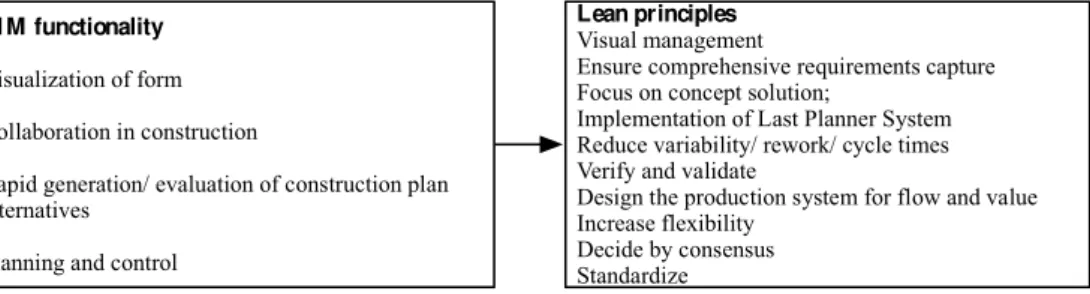
study were included in the pre-construction/ construction phase. This study focused on the following BIM functionalities identified: visualization of form, collaboration in design and construction, rapid generation and evaluation of construction plan alternatives and planning and control (4D). Figure describes the specific BIM functionalities and their associated Lean principles implemented in this study.
Figure 1 - BIM functionalities versus Lean principles in MEP maintenance works
IMPLEMENTATION
PRESENT STATE OF PROCESSES
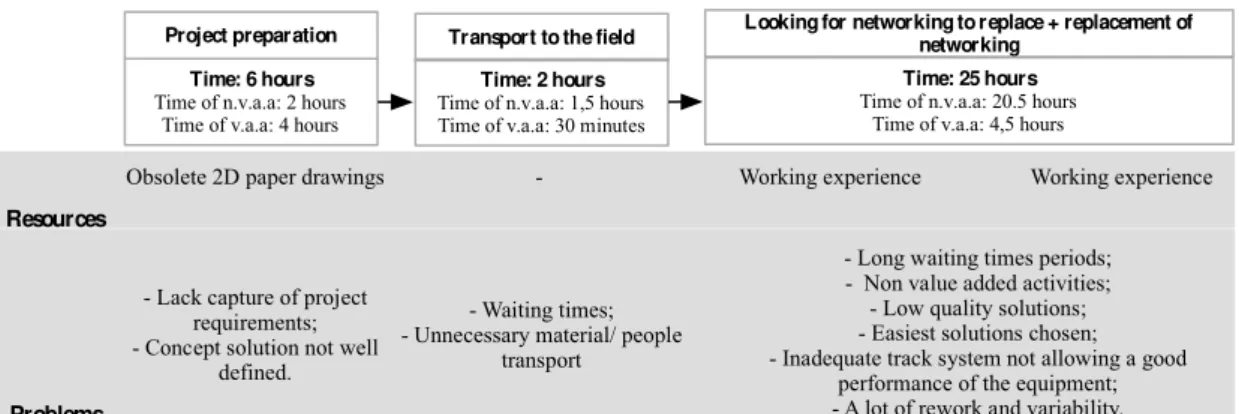
VSM will be utilized for evaluating the benefits that a BIM-Lean approach introduced in the work processes. The mapping of the current state was achieved through direct observation of the different teams and their modus operandi, the existing waste and the constraints to a continuous flow of value. The current state mapping included five main activities and is shown in Figure 2. Coordination efforts are often neglected in this type of works, which usually results in lower quality of the work performed, a less effective utilization of equipment, compromises regarding safety issues and long work durations.
BI M functionality
Visualization of form
Collaboration in construction
Rapid generation/ evaluation of construction plan alternatives
Planning and control
Lean principles
Visual management
Ensure comprehensive requirements capture Focus on concept solution;
Implementation of Last Planner System Reduce variability/ rework/ cycle times Verify and validate
Design the production system for flow and value Increase flexibility
Figure 2 - Present state of the process
OPTIMIZATION OF THE PROCESS
The process optimization strategy aimed at increasing workflow and reducing waste. The combined BIM-Lean approach created a virtual data environment, allowing for a comprehensive analysis of the entire facility. This enabled the teams to visualize and anticipate the exact place they would work on, and the exact conditions they would meet. It also allowed for a much more detailed management of the works. Figure 3 shows the benefits of the BIM integration in the working process, and the lean principles achieved.
Figure 3 – Future state of the process and activities’ optimization
ANALYSIS OF FUTURE STATE OF PROCESS
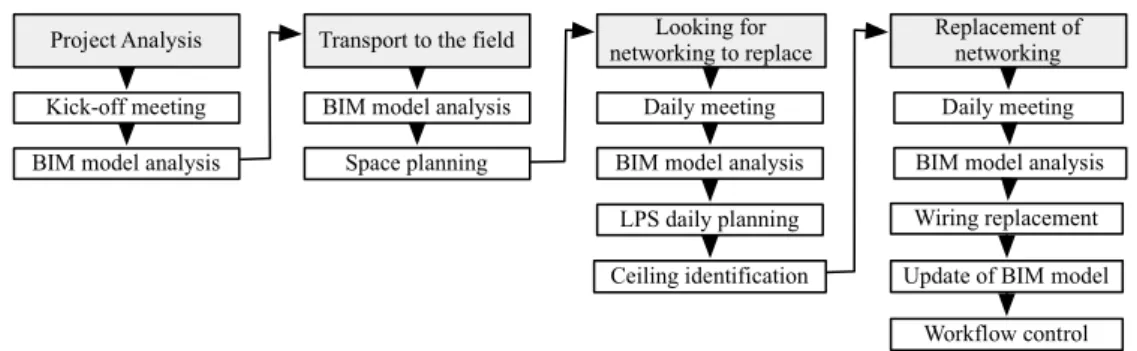
The activities management implemented is shown in Figure 4. The teams move to the work face with a work plan, documents and drawings with the exact location areas involved and the existing constraints for the day’s work. Later in the day the BIM model was updated with the information supplied by the teams’ feedback, and alternatives for possible work area for the next day were evaluated. Each day the model was updated with the amount of wiring installed the day before, and with the issues that had come up on site. Through this process, stakeholders were able to visually manage the work of teams and increase collaboration between them. This
Obsolete 2D paper drawings - Working experience Working experience
- Lack capture of project requirements; - Concept solution not well
defined.
- Waiting times; - Unnecessary material/ people
transport
- Long waiting times periods; - Non value added activities; - Low quality solutions; - Easiest solutions chosen; - Inadequate track system not allowing a good
performance of the equipment; - A lot of rework and variability.
Resources
Problems
Time: 6 hours
Time of n.v.a.a: 2 hours Time of v.a.a: 4 hours
Transport to the field Time: 2 hours
Time of n.v.a.a: 1,5 hours Time of v.a.a: 30 minutes
Project preparation Looking for networking to replace + replacement of networking Time: 25 hours
Time of n.v.a.a: 20.5 hours Time of v.a.a: 4,5 hours
- Ensure a comprehensive requirements capture; - Focus on concept solution;
- Defined working plan; - Implementation of LPS.
- Material/ people transport right at first
time.
- Detail management of the working progress; - Visual management of working progress;
- Increased collaboration between teams; - Optimization of the working progress;
- Well define work tasks; - Works done right at the first time; - Reduced of non value added activities;
- Improvement in teams performance. - Rapid generation and
evaluation of construction plan alternatives; - Visualisation of form; - Automated generation of
material take-off.
Resources - BI M model
Benefits - Lean principles
- Visualisation of form; - Collaboration in design.
- 3D visualisation of form; - Automated generation of
drawings; - Collaboration in design and
construction; - Generation of 3D images; - Virtual simulation of cable
layout.
- 3D visualisation of form; - Automated generation of
drawings; - Collaboration in
construction.
Time: 6 hours Time of n.v.a.a: 0 hours
Time of v.a.a: 6 hours
Transport to the field
Time: 30 minutes Time of n.v.a.a: 0 hours Time of v.a.a: 30 minutes
Project preparation Looking for networking to
replace
Time: 6 hours Time of n.v.a.a: 1,5 hours
Time of v.a.a: 4,5 hours
Replacement of networking
Time: 5 hours Time of n.v.a.a: 1.5 hours
drove a process of optimization and elimination of non-value activities, as teams started doing their work well at the first time.
Figure 4 –Flowchart of the implemented processes
DISCUSSION
FINDINGS
The implementation of BIM-Lean synergies resulted in a detailed management of the working process, and allowed the work teams to know beforehand the work they would perform and its exact location. This was particularly important, as all of the MEP networks intervened were hidden.
A number of BIM contributions to the materialization of Lean principles were identified. They are listed below, and associated to the benefits of the proposed
process. In their study, Sacks et al. (2009) proposed a number of BIM functionalities
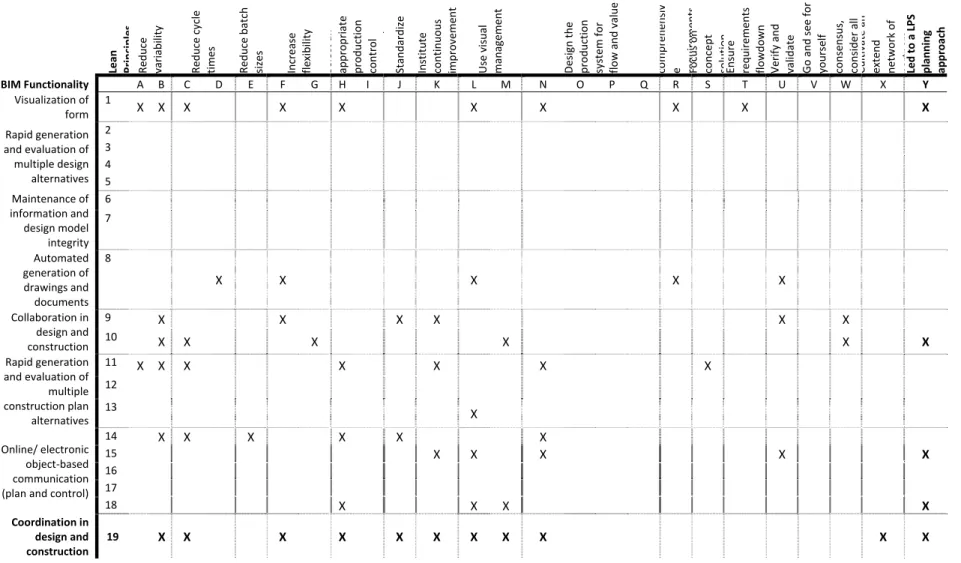
and associated Lean principles. These authors proposed a matrix to be used by subsequent studies in the identification and presentation of BIM-Lean synergies. This matrix was adopted in table 1, which portrays the synergies identified in the case study and adopted in the proposed method. The .The indices for Lean principles (1 to
19) and for BIM functionalities (A to Y) follow the notation used in Sacks et al.
(2009).
Visualization of form: One of the great advantages that BIM brought about was the accurate representation of geometric elements that made up the facility, with the possibility of extracting near-real 3D images fast and whenever necessary. This BIM functionality allowed the materialization of the following Lean principles: (1) a planning approach based on the Last Planner System (LPS) could be followed; (2) the global view of the whole working process encouraged the adoption of a pull planning system, as teams knew exactly which tasks to perform and their predecessors, and, all outstanding issues had been solved by the time the task was executed; (3) visual management based on the BIM model was adopted, allowing for a flow and value oriented strategy, as all assumptions were better understood, defined and organized, and comprehensive knowledge of the infrastructure was achieved, leading to choice of the best task sequence; (4) anticipation and minimizing potential conflicts that would have occurred in the field, fostering the choice of best solutions towards reducing variability and rework; (5) work assumptions were better understood due to the accurate visualization of the project.
Collaboration/coordination in design and construction: Coordination meetings Project Analysis Transport to the field networking to replaceLooking for Replacement of networking
BIM model analysis
Kick-off meeting BIM model analysis
Space planning
Daily meeting
BIM model analysis
LPS daily planning
Ceiling identification
BIM model analysis
Wiring replacement
Update of BIM model Daily meeting
in the field and gave feedback for updating the BIM model, such as the identification of areas where there wasn’t any space left for new wiring, or areas that were hard to reach. This led the other teams to seek new solutions, thus avoiding rework.. By analyzing work in areas where more than one team had to work at the same time, synergies were found conflicts avoided. This BIM functionality allowed the materialization of the following Lean principles: (1) BIM analysis/ management together with the work teams made the whole process transparent and collaborative, encouraging teams to coordinate and plan their work, optimizing production and increasing flexibility between them; (2) daily meetings led to greater involvement of work teams in the process, resulting into a continuous process improvement; (3) reduction of non-value added activities through identification of synergies between teams.
Rapid generation and evaluation of construction plan alternatives: Since BIM offered an accurate model of the facility, all the information introduced in the model was shaped to scale. This allowed for performing collision detection between the different objects modeled. Still, the model was manually analyzed towards finding problems that could later interfere with work. Thus, it was possible to avoid rework and unsuccessful work. This BIM functionality allowed for the materialization of the following Lean principles: (1) continuous improvement through the choice of efficient and higher quality solutions; (2) ability and incentive to focus on the solution; (3) corresponding reduction of waste and rework; (4) reduced variability through the anticipation of design collision, and automatic generation of updated documents and drawings.
Plan and control: The BIM model enabled the simulation of the workflow process. At the end of each day the model was updated with the work status and new situations not considered before. This transparent process control facilitated feedback to the others teams which would later face the same issue. Workers felt included in the work management. The definition of the task plan was visually made with BIM. This BIM functionality allowed materializing the following lean principles: (1) production control led to process optimization, thus increasing the workflow; (2) clearly defined task plans, focusing on the elimination of non-value added activities and on the reduction of variability; (3) reduction of the time spent on the different tasks, transport and movement of people through precise knowledge of the area; (4) greater involvement of teams in the management process; (5) BIM turned traditional process management into a virtual and visual process, leading to a better and detailed process control.
BIM-Lean synergies were noticed from the moment that BIM was implemented. The presence of the BIM model added a visual dimension to the project, which was needed. By allying this visual dimension to all information made available and exporting features available in BIM systems, the works were easily controlled and the facility management improved. This also enabled the implementation of a LPS planning approach for daily activities planning.
commitment and collaboration by the workers, and (4) a reduction in the global duration of the work by 56%.Thus, the BIM-Lean approach had a leveler effect in the team’s performance.
LIMITATIONS AND CONSTRAINTS
Know-how and interface: The companies involved in the project did not have the software used in the preparation of the BIM model, and had no way of operating it by themselves. The lack of know-how, hardware and software is an important obstacle to the replication of the proposed process.
BIM is time consuming: The time spent in modeling the project’s facility was approximately 300 hours. Keeping an updated model is crucial to guarantee the accuracy, adequacy and relevance of the model. This was a daily task, and consumed considerable time. The daily model update absorbed between thirty minutes and two hours, depending on the case. In large projects involving many teams, it is recommended the one person per team will be responsible for updating the model at the end of each coordination meeting.
Initial costs: Regarding the cost, a project manager said, “the existing software in the market is expensive and then you need to upgrade the hardware. Then you need to provide training…there is no template software, which you can plug into a project and it gives you BIM. We need a lot of effort to create a BIM-model. We need to accurately assess whether it is worth it. Three factors to be considered are the size, budget and complexity of the project”
BENEFITS
Coordination, collaboration and planning: A worker shared the following,
regarding the use of BIM for coordination and planning: “A lot of the coordination
issues will be solved in the head of people before going to work face…there are definitely savings to be found.”
Visualization: A quote from a worker: “A few people can look at 2D-drawings and see the building built in their mind, but most people don´t, and the visualization really helps.”
Communication: Regarding the communication, the model allowed to perform virtual visits inside the facility, simulating various alternatives and understanding their effects, and to choose the best solution. It facilitated the communication of objectives, problems and changes in design and construction.
Security: BIM enabled a visually definition of all relevant spaces, thus allowing security teams to be more aware and to keep a tighter surveillance on them. This is particularly important in high use facilities, which always have sensitive security issues. Increased process efficiency in MEP works result in shorter down times for the electronic surveillance systems.
CONCLUSIONS
restrictions in place, and the detection of potential collisions and conflicts during construction, as prescribed by Lean principles. Using a LPS planning approach and the BIM model simultaneously, it was possible to plan the best work sequence between the various participants, reducing the duration of the activities to about half. In terms of planning, poorly structured activities were modified, and procedures that did not add value and decreased productivity were eliminated. BIM is control, and this is the base for construction industrialization. BIM has proven to be a powerful resource for enabling Lean. This study opens perspectives towards the generalization of the proposed approach into a Lean-BIM based management method for MEP renovation works, thus contributing to closing the existing gap on practical guidelines for implementing combined BIM-Lean approaches in construction projects.
REFERENCES
Eastman, C., Lee, G., & Olofsson, T. (2008). Benefits ans Lessons Learned of Implementing Building Virtual Design and Construction (VDC) Technologies for Coordination of Mechanical, Electrical, and Plumbing (MEP) Systems on a Large
Healthcare Project. ITcon, 13.
Galsworth, G. G. (1997). Visual Systems: Harnessing the power of a visual workplace .
Gilligan, B., & Kunz, J. (2007). VDC use in 2007: Significant Value, Dramatic
Growth, and Apparent Business Opportunity. CIFE Technical Report #TR171,
Stanford University, Center for Integrated Facility Engineering, Stanford.
Koskela, L., & Bertelsen, L. (2004). Construction Beyond Lean: A new
Understanding of Construction Management. Proceedings for the 12th Annual
Conference of the International Group for Lean Construction , (pp. 1-12).
Elsinore.
Oskouie, P., Gerber, D. J., Alves, T., & Becerik-Gerberer, B. (2012). Extending the
interactions of building information modeling and lean construction. Proceedings
for the 20th Annual Conference of the International Group for Lean Construction.
San Diego.
Portuguese court of auditors. (2009). Audit to Public works projects by direct award
(in Portuguese). Portuguese Court of Auditors, Lisbon.
Rischmoller, L., Alarcon, L. F., & Koskela, L. (2006). Improving value generation in
the design process of industrial projects using CAVT. Journal of management in
engineering, 22 (2), 52-60.
Sacks, R., Dave, B. A., Koskela, L., & Owen, R. (2009). Analysis Framework For The Interaction Between Lean Construction and Building Information Modeling.
Proceedings 17th Annual Conference of the International Group for Lean Construction. Taipei.
Sacks, R., Esquenazi, A., & Goldin, M. (2007). LEAPCON: Simulation of lean
construction of high-rise apartment buildings. Journal of Construction
Engineering and Management, 133 (7), 529-539.
Sacks, R., Radosavljevic, M., & Barak, R. (2010). Requirements for building information modeling based lean production management systems for
construction. Automation in Construction, 19, 641-655.
Table 1 –BIM-Lean interconnections and synergies identified, in comparison with Sacks et al. (2009) Lean Principles Reduce var iability Reduce cy cl e tim e s Reduce batch sizes Inc rease fl ex ib il it y Select an appropriate production cont rol h Standardize Institu te continuous improv ement Use visual management Design the production system for flow and value comp rehe nsi v e require ments Focus on conce p t solution Ensure require ments flowdown Veri fy and validate Go and see for yours e lf consensu s, consi d er all Cultivate an extend network of partnersLed to a LPS pl a nni n g ap p roach
BIM Functionality A B C D E F G H I J K L M N O P Q R S T U V W X Y
Visualization of form
1
X X X X X X X X X X
Rapid generation and evaluation of multiple design alternatives
2
3
4
5
Maintenance of information and design model integrity
6
7
Automated generation of
drawings and documents
8
X X X X X
Collaboration in design and construction
9 X X X X X X
10 X X X X X X
Rapid generation and evaluation of multiple construction plan alternatives
11 X X X X X X X
12
13
X
Online/ electronic object‐based communication (plan and control)
14 X X X X X X
15 X X X X X
16
17
18 X X X X
Coordination in
design and
construction