The Open Access Israeli Journal of Aquaculture – Bamidgeh
As from January 2010 The Israeli Journal of Aquaculture - Bamidgeh (IJA) will be
published exclusively as an on-line Open Access (OA) quarterly accessible by all
AquacultureHub (
http://www.aquaculturehub.org
) members and registered individuals
and institutions. Please visit our website (
http://siamb.org.il
) for free registration form,
further information and instructions.
This transformation from a subscription printed version to an on-line OA journal,
aims at supporting the concept that scientific peer-reviewed publications should be made
available to all, including those with limited resources. The OA IJA does not enforce author
or subscription fees and will endeavor to obtain alternative sources of income to support
this policy for as long as possible.
Editor-in-Chief
Dan Mires
Editorial Board
Sheenan Harpaz
Agricultural Research Organization Beit Dagan, IsraelZvi Yaron
Dept. of Zoology Tel Aviv University Tel Aviv, IsraelAngelo Colorni
National Center for Mariculture, IOLR Eilat, IsraelRina Chakrabarti
Aqua Research Lab Dept. of Zoology University of DelhiIngrid Lupatsch
Swansea University Singleton Park, Swansea, UKJaap van Rijn
The Hebrew University Faculty of Agriculture IsraelSpencer Malecha
Dept. of Human Nutrition, Food and Animal SciencesUniversity of Hawaii
Daniel Golani
The Hebrew University of Jerusalem Jerusalem, IsraelEmilio Tibaldi
Udine University Udine, ItalyCopy Editor
Ellen Rosenberg
Published under auspices of
The Society of Israeli Aquaculture and
Marine Biotechnology (SIAMB),
University of Hawaii at Manoa Library
and
University of Hawaii Aquaculture
Program in association with
AquacultureHub
http://www.aquaculturehub.org
ISSN 0792 - 156X
Israeli Journal of Aquaculture - BAMIGDEH.
PUBLISHER:
Israeli Journal of Aquaculture BAMIGDEH
-Kibbutz Ein Hamifratz, Mobile Post 25210,
ISRAEL
Phone: + 972 52 3965809
INDUCTION OF OVULATION AND SPAWNING IN THE
MEDITERRANEAN RED PORGY, PAGRUS PAGRUS, BY
CONTROLLED DELIVERY AND ACUTE INJECTION OF GnRHa
L. Kokokiris1*, A. Canario2, C. Mylonas3, M. Pavlidis1, M. Kentouri1, and P. Divanach3
1Department of Biology, University of Crete, P.O. Box 2208, 71409, Heraklion, Greece 2Centro de Ciências do Mar, Universidade do Algarve, Campus de Gambelas, 8000-810,
Faro, Portugal
3Institute of Aquaculture, Hellenic Center of Marine Research, P.O. Box 2214, Heraklion,
71003, Greece
(Received 11.7.05, Accepted 26.9.05)
Key words: GnRHa, induced spawning, microspheres, red porgy, Pagrus
Abstract
Gonadotropin-releasing hormone analogue (GnRHa) in the form of saline injections or sus-tained-release microspheres was used to induce oocyte maturation, ovulation, and spawning in captive red porgy (Pagrus pagrus). Individually tagged vitellogenic females (n = 9 or 10) were treated at the beginning of the spawning season (March) with 20 µg/kg body weight (bw) GnRHa-loaded microspheres, a single injection of 20 µg/kg bw dissolved in saline, or physio-logical saline (control). Females were placed in tanks (one tank per treatment) connected to overflow egg collectors and monitored for 11 days. In addition to the eggs collected from the tank overflow, eggs were stripped from the fish on a daily basis. Only one spawn was obtained from the control fish, probably from a single female, given the small relative fecundity (700 eggs/kg bw). On the contrary, treatment with a GnRHa injection produced two spawns (9 and 11 days after treatment) and 50% of the fish ovulated. Treatment with GnRHa microspheres induced seven spawns (3 and 6-11 days after treatment) and 100% of the females ovulated. Females did not spawn all the eggs ovulated on a particular day, evident from the significant number of eggs obtained by manual stripping. Egg quality did not significantly differ among treatments, whereas number of spawned eggs and total relative fecundity were significantly higher in fish treated with GnRHa microspheres (ANOVA, p<0.05). The results demonstrate the potential of GnRHa-loaded microspheres to induce spawning in red porgy, as a method of overcoming spawning fail-ures in commercial hatcheries.
* Corresponding author. Current address: Laboratory of Ichthyology and Fish Diseases, Department of Veterinary Medicine, University of Thessaly, Trikalon 221, Kardista, 43100, Greece. E-mail: [email protected]
224 Kokokiris et al.
tered in the form of saline injections or sus-tained-release delivery (Weil and Crim, 1983; Crim and Bettles, 1997; Mylonas and Zohar, 2001). Sustained administration of GnRHa is advantageous compared to the injection approach, especially in fishes with asynchro-nous ovaries, because it stimulates long-term elevations of plasma LH, resulting in multiple spawnings. Some of these species include the gilthead sea bream (Sparus aurata; Zohar et al., 1995), yellowtail flounder (Pleuronectes ferrugineus; Larsson et al., 1997), turbot (Scophthalmus maximus; Mugnier et al., 2000), and dusky grouper (Epinephelus mar-ginatus; Marino et al., 2003). The alternative method of multiple GnRHa injections is labor-intensive and can be harmful to brood fish due to the frequent handling required.
The objective of the present study was to evaluate the effectiveness of two GnRHa delivery systems in inducing ovulation and spawning in the red porgy and the resulting production of viable eggs.
Material and Methods
In March, at the beginning of the red porgy spawning period (Kokokiris et al., 2001), 3-year-old females (first spawning season) were selected after biopsy of the gonads indicated that they were sexually mature. For the biopsy, females were anesthetized with 2-phe-noxyethanol (0.4 ml/l) and a 2 mm polyethyl-ene tube was introduced through the genital pore. At the same time the fish were implanted intraperitoneally with passive integrated transponder tags (P.I.T.; Fish Eagle Co., UK). The biopsy samples were placed in 0.9 g/l NaCl solution at 4°C for up to 6 h and the diameters of the 30 largest oocytes were mea-sured under a dissecting microscope. Only females with a mean oocyte diameter above 500 µm were selected for the experiment.
Females were randomly allocated to three
treatments (n = 9 or 10), each in one 2-m3
tank. The tanks were supplied with running, aerated seawater (salinity 38-40 psu, pH 7.8-8.0, temperature 17-18°C), renewed at a rate of 25% per hour. One group was injected with
20 µg/kg body weight (bw) of [des-Gly10,
Introduction
The red porgy (Pagrus pagrus L. 1758) is a marine fish of great commercial importance to the fishing industry in both the Mediterranean Sea and the Atlantic Ocean (Vassilopoulou and Papacon-stantinou, 1992; Harris and Mc-Govern, 1997). Due to its wide geographical distribution, high market demand, and good growth rates (Pajuelo and Lorenzo, 1996; Maragoudaki et al., 1999), there is strong inter-est in inter-establishing captive brood stocks and commercially growing the red porgy (Kolios et al., 1997; Bodington, 2000). However, commer-cial production is limited, primarily because of problems with skin discoloration in growout facilities (Kolios et al., 1997; Cejas et al., 2003) but also because of inconsistent spawning (Zohar and Mylonas, 2001).
The red porgy is a protogynous hermaph-roditic species with asynchronous ovarian development. In captivity, it reaches puberty at 3-5 years of age (Kokokiris et al., 1999). Depending on latitude, spawning occurs from February to mid-June (Vaughan et al., 1992; Pajuelo and Lorenzo, 1996; Kokokiris et al., 2001). Studies on spawning kinetics, fecundi-ty, and egg quality in captivity recently demon-strated the existence of significant variations in spawning and egg production characteristics among seemingly identical groups, as well as within the same brood stock in different spawning seasons (Mylonas et al., 2004). Such variations in egg production can create significant problems in farm planning and there is a need to develop methods to induce ovulation and reliable spawning to optimize spawning performance in captivity.
Important advances in the manipulation of spawning in a variety of farmed fish have been made by using gonadotropin releasing hormone agonists (GnRHa; Crim and Bettles, 1997; Zohar and Mylonas, 2001). Injected GnRHa stimulates the synthesis and release of the endogenous luteinizing hormone (LH; Breton et al., 1990), the hormone controlling final oocyte maturation (FOM) and ovulation (Nagahama et al., 1994), through stimulation of steroidogenesis and production of the mat-uration inducing steroid (Goetz and Garczynski, 1997). GnRHa can be
adminis-DAla6, Pro9-NEt]-GnRHa (Bachem, California) in 0.9% NaCl as the vehicle. The second group was injected with a suspension of biodegradable microspheres at a GnRHa dose of 20 µg/kg. The third group was inject-ed with saline as a control. The GnRHa microspheres were prepared according to Mylonas et al. (1995) using poly-[fatty acid dimer-sebasic acid] and were suspended in a solution containing 0.8% agar and 5% glu-cose at a concentration of 50 mg micros-pheres/ml. The microspheres were implanted into the dorsal musculature using a syringe with an 18-gauge needle. Two or three sper-miating males were placed in each tank to enable spawning and egg fertilization. Overflow egg collectors were connected to the outlet of the tanks and spawned eggs were collected from the collectors daily.
The experiment lasted 11 days after treat-ment. Each day all fish were anesthetized, weighed, and checked for ovulation by apply-ing gentle abdominal pressure to strip unre-leased eggs. Eggs were collected into volu-metric cylinders and their volume was record-ed. Eggs from the egg collector were placed in 10-l buckets and their number and the per-centage of fertilized eggs were estimated by sub-sampling and examination under a dis-secting microscope. Fertilization (%) was cal-culated as the number of fertilized eggs undergoing normal cell division divided by the total number of spawned eggs.
Data on daily ovulated eggs, daily spawned eggs, total daily fecundity, and fertilization per-centage were analyzed using one-way of vari-ance (ANOVA) followed by the post-hoc Dunkan’s multiple range test to compare mean levels at different times or treatments (STA-TISTICA, StatSoft Inc, USA). Bartlett’s test was used to verify the homogeneity of variances. When necessary, data were log transformed before subjection to ANOVA.
Results
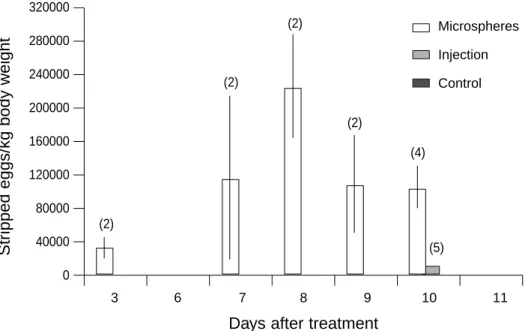
Control females spawned only once, 9 days after treatment (Fig. 1), and no eggs could be stripped from them (Fig. 2). Females given a single GnRHa injection spawned on days 9 and 11 (Fig. 1), while ovulating females were
detected only on day 10 when five were found to have ovulated (Fig. 2). On the contrary, all females given GnRHa microspheres were found to have ovulated during the monitoring period. Females of this group spawned on days 3 and 6-11 (Fig. 1) and eggs were stripped from some females on days 3 and 7-10 (Fig. 2). The mean number of ovulated eggs produced by microsphere females was higher although not significantly different from that of the injected females (p>0,05; Table 1) while mean daily spawning fecundity was significantly higher (p = 0.01) in the microsphere group (Table 1). Individual tagging showed that three of the nine females given GnRHa micropsheres ovulated at least twice while the rest ovulated at least once. As daily spawns were recorded in the microsphere group, some of the ovulating females may have already spawned by the time of ovulation monitoring, so that no more eggs could be stripped. Therefore, it is possible that three or more sequential spawns occurred in some of the females in this group. Overall mean total relative fecundity (including spawned and ovulated eggs) was significantly higher in the microsphere group than in the injected group (p<0.01). There was no differ-ence in fertilization rate (%) between eggs from these groups. The single spawn from the con-trol group (Fig. 3) had a fertilization rate of 20%.
Discussion
Treatment with GnRHa, both as a single injec-tion and as sustained-release microspheres, induced multiple spawning or ovulation in 3-year-old female red porgy and increased egg production compared to untreated fish. However, only the microsphere treatment induced ovulation in 100% of the females and, by stimulating multiple FOM cycles, resulted in significant increases in the daily number of eggs produced and the total relative fecundi-ty. These results confirm previous findings that the red porgy is a serial spawner with spawning intervals of 1-3 days (Kokokiris et al., 2001; Mylonas et al., 2004). The effective-ness of GnRHa from sustained-release devices in inducing multiple spawning agrees with results in other reared marine species such as the gilthead sea bream (Zohar et al.,
226 Kokokiris et al.
Fig. 2. Mean (±SEM) daily number of eggs obtained by stripping female red porgy treated with a GnRHa injection or controlled-release GnRHa microspheres. Numbers in parentheses indicate number of females that released eggs after gentle abdominal pressure. No eggs were stripped from females in the control.
Fig. 1. Number of spawned eggs in egg collection trays from female red porgy treated with a GnRHa injection, controlled-release GnRHa microspheres, or saline control.
30000 25000 20000 15000 10000 5000 0
Spa
wned eggs/kg body w
eight
Days after treatment
Microspheres Injection Control 3 6 7 8 9 10 11 320000 280000 240000 200000 160000 120000 80000 40000 0 Microspheres Injection Control
Str
ipped eggs/kg body w
eight
Days after treatment
3 6 7 8 9 10 11 (2) (2) (2) (2) (4) (5)
1995), white bass (Morone saxatilis; Mylonas et al., 1996), turbot (Mugnier et al., 2000), European sea bass (Dicentrarchus labrax; Forniés et al., 2001), and common dentex (Dentex dentex; Greenwood et al., 2001). Treatment with GnRHa has also been effec-tive at inducing ovulation in the congeners red sea bream (Pagrus major; Matsuyama et al., 1995) and red snapper (Pagrus auratus; Pankhurst, 1994).
Compared to a single injection of GnRHa, treatment with GnRHa microspheres was more efficient in terms of number of fish that ovulated, number of ovulations, and fecundity. It is likely that plasma GnRHa remains elevat-ed for a long time allowing a continuously ele-vated plasma LH that promotes multiple cycles of FOM, ovulation, and spawning (Zohar et al., 1995). The GnRHa micros-pheres used in this study were shown to pro-duce elevated plasma GnRHa levels for peri-ods of 3-8 weeks (Mylonas et al., 1995). In the European sea bass, a single GnRHa injection induced a short-term elevation of LH lasting only two days, whereas GnRHa implants and microspheres induced a sustained elevation of plasma LH for 35-44 days (Mañanos et al., 2002). A similar observation was made in the common dentex, where GnRHa implants caused sustained elevation of GnRHa for a longer period than did an acute injection (Greenwood et al., 2001).
Although the majority of eggs were obtained by manual stripping, spawning took place in all groups during the course of the experiment. However, it was more regular in females treated with GnRHa microspheres. It is uncertain whether eggs obtained by strip-ping would have eventually been naturally spawned if the fish were not handled every day during the study. However, in at least three species, the white grouper (Epinephelus aeneus), the tiger puffer (Takifugu rubripes), and the dusky grouper (Epinephelus margina-tus), it has been proven necessary to strip eggs obtained by GnRHa induction (Hassin et al., 1997; Matsuyama et al., 1997; Marino et al., 2003). The need to strip ovulated eggs stored in the ovarian cavity may be due to stress caused by rearing conditions, stress
Treatment n Body wt Ovulation Spawned Stripped eggs Relative Fertilization (kg) success (x 1000/kg) 2 (x 1000/kg) 3 fecundity rate (%) 1 (x 1000/kg) 4 (%) Control 9 1.20±0.06 0 0.7 a 0 a 0.7 a 20 a Injection 10 1.30±0.08 50 2.2±1.1 a 1.5±1.5 a 3.8±0.4 b 37±25 ab Microspheres 9 1.15±0.03 100 18.2±2.4 b 23.0±8.5 a 41.2±7.7 c 61±6.5 b Table 1.
Mean (±SEM) daily egg production parameters of red porgy after treatment with GnRHa via injection or controlled-release
microspheres. Egg numbers are expressed per kg body weight of the females in the population. Values in a column with different superscripts are significantly different (
p
<0.05).
228
due to handling and injecting, or a low number of males in the tank.
Injected females began to ovulate only 10 days after treatment while microsphere females began spawning within three days of treatment, suggesting that the sustained release of GnRHa accelerated spawning. It is likely that the dose of GnRHa administered via injection was inadequate to induce an earlier reaction. Fertilization rates did not significantly differ between eggs of microsphere and injected females and ranged in values similar to those reported for naturally spawning red porgy in captivity (36.9-68.9%; Mylonas et al., 2004).
In conclusion, applying GnRHa through sustained release microspheres appears to be an effective method for inducing FOM, ovulation, and spawning in red porgy females. Such treatment increases the percentage of females undergoing multiple FOM cycles, results in higher fecundity and better synchro-nization of ovulation, and can be an important tool for broodstock management in the com-mercial aquaculture of the red porgy.
References
Bodington P., 2000. Enterprise experiences in the culture of new sparids. pp. 135-139. In: B. Basurco, M. Pedini (eds.). Mediterranean Marine Aquaculture Finfish Species Diversification, Cahiers Options Méditerra-néennes, vol. 47. C.I.H.E.A.M., Zaragoza, Spain.
Breton B., Weil C., Sambroni E. and Y. Zohar, 1990. Effects of acute versus sus-tained administration of GnRHa on GtH release and ovulation in the rainbow trout, Oncorhyncus mykiss. Aquaculture, 91:373-383.
Cejas J.R., Almansa E., Tejera N., Jerez S., Bolaños A., and A. Lorenzo, 2003. Effects of dietary supplementation with shrimp on skin pigmentation and lipid composition of red porgy (Pagrus pagrus). Aquaculture, 218:457-469.
Crim L.W. and S. Bettles, 1997. Use of GnRH analogues in fish culture. pp. 369-382. In: M. Fingerman, R. Nagabhushanam, M.F. Thompson (eds.). Recent Advances in Marine Kokokiris et al.
Fig. 3. Fertilization success of eggs spawned by female red porgy treated with a GnRHa injection, con-trolled-release GnRHa microspheres, or saline control.
100 75 50 25 0
F
e
rtilization (%)
Days after treatment
3 6 7 8 9 10 11
Microspheres Injection Control
Biotechnology, Vol. 1. Endocrinology and Reproduction. Oxford & IBH Publ. Co., New Delhi.
Forniés M.A., Mañanos E., Carrillo M., Rocha A., Laureau S., Mylonas C.C., Zohar Y. and S. Zanuy, 2001. Spawning induction of individualised European seabass females (Dicentrarchus labrax) using different GnRHa-delivery systems. Aquaculture, 202:221-234. Goetz F.W. and M. Garczynski, 1997. The ovarian regulation of ovulation in teleost fish. Fish Physiol. Biochem., 17:33-38.
Greenwood L.N., Scott A.P., Vermeirssen E.L.M., Mylonas C.C. and M. Pavlides, 2001. Plasma steroids in mature common dentex (Dentex dentex) stimulated with a gonadotropin-releasing hormone agonist. Gen. Comp. Endocrinol., 123:1-12.
Harris P.J. and J.C. McGovern, 1997. Changes in the life history of red porgy, Pagrus pagrus, from the southeastern United States, 1972-1994. Fish. Bull., 95:732-747. Hassin S., de Monbrison D., Hanin Y., Elizur A., Zohar Y. and D.M. Popper, 1997. Domestication of the white grouper, Epine-phelus aeneus. 1. Growth and reproduction. Aquaculture, 156:305-316.
Kokokiris L., Bruslé S., Kentouri M. and A. Fostier, 1999. Sexual maturity and hermaph-roditism of the red porgy Pagrus pagrus (Teleostei: Sparidae). Mar. Biol., 134:621-629. Kokokiris L., Le Menn F., Kentouri M., Kagara M. and A. Fostier, 2001. Seasonal cycle of gonadal development and serum lev-els of vitellogenin of the red porgy, Pagrus pagrus (Teleostei, Sparidae). Mar. Biol., 139:549-559.
Kolios P., Kiritsis S. and N. Katribusas, 1997. Larval-rearing and growout of the red porgy (Pagrus pagrus) in the Riopesca hatch-ery (Greece). Hydrobiol., 358:321-325. Larsson D.G.J., Mylonas C.C., Zohar Y. and L.W. Crim, 1997. Gonadotropin releasing hor-mone-analogue (GnRH-A) advances ovulation and improves the reproductive performance of a cold-water batch-spawning teleost, the yel-lowtail flounder (Pleuronectes ferrugineus). Can. J. Aquat. Fish. Sci., 54:1957-1964. Mañanos E., Carrillo M., Sorbera L.S., Mylonas C.C., Asturiano J.F., Bayarri M.J.,
Zohar Y. and S. Zanuy, 2002. Luteinizing hormone and sexual steroid plasma levels after treatment of European sea bass with sustained-release delivery systems for gonadotropin-releasing hormone analogue. J. Fish Biol., 60:328-339.
Maragoudaki, D., Paspatis, M., Kentouri, M., 1999. Influence of stocking density on growth of juvenile red porgy Pagrus pagrus L. under different feeding conditions. Aquacult. Res., 30:501-508.
Marino G., Panini E., Longobardi A., Mandich A., Finoia M.G., Zohar Y. and C.C. Mylonas, 2003. Induction of ovulation in cap-tive-reared dusky grouper, Epinephelus mar-ginatus (Lowe, 1834) with a sustained-release GnRHa implant. Aquaculture, 219:841-858. Matsuyama M., Takeuchi H., Kashiwagi M., Hirose K. and H. Kagawa, 1995. Induced gonadal development and spawning of imma-ture red sea bream Pagrus major with LHRH-a LHRH-administrLHRH-ation in different wLHRH-ays during win-ter season. Fish. Sci., 61:472-477.
Matsuyama M., Chuda H., Ikeda Y., Tanaka H. and S. Matsuura, 1997. Induction of ovar-ian maturation and ovulation in the cultured tiger puffer Takifugu rubripes by different hor-monal treatments. Suisanzousyoku, 45:67-73 (with English abstract).
Mugnier C., Gaignon J.L., Lebegue E., Fostier A. and B. Breton, 2000. Induction and synchronisation of spawning in cultivated turbot (Scophthalmus maximus L.) broodstock by implantation of sustained-release GnRH-a pellet. Aquaculture, 181:241-255.
Mylonas C.C. and Y. Zohar, 2001. Use of GnRHa-delivery systems for the control of reproduction in fish. Rev. Fish Biol. Fish., 10:463-491.
Mylonas C.C., Tabata Y., Langer R. and Y. Zohar, 1995. Preparation and evaluation of polyanhydride microspheres containing gona-dotropin-releasing hormone (GnRH), for inducing ovulation and spermiation in fish. J. Control Release, 35:23-34.
Mylonas C.C., Magnus Y., Gissis A., Klebanov Y. and Y. Zohar, 1996. Application of controlled-release, GnRHa-delivery sys-tems in commercial production of white bass x striped bass hybrids (sunshine bass), using
230
captive broodstocks. Aquaculture, 140:265-280.
Mylonas C.C., Papadaki M., Pavlidis M. and P. Divanach, 2004. Evaluation of egg produc-tion and quality in the Mediterranean red porgy (Pagrus pagrus) during two consecutive spawning seasons. Aquaculture, 232:637-649. Nagahama Y., Yoshikuni M., Yamashita M. and M. Tanaka, 1994. Regulation of oocyte maturation in fish. pp. 393-439. In: N.M. Sher-wood and C.L. Hew (eds.). Fish Physiology. Academic Press, San Diego, California. Pajuelo G.C. and J.M. Lorenzo, 1996. Life history of the red porgy Pagrus pagrus (Teleostei: Sparidae) of the Canary Islands, central east Atlantic. Fish. Res., 28:163-177. Pankhurst N.W., 1994. Effects of gona-dotropin releasing hormone analogue, human chorionic gonadotropin and gonadal steroids on milt volume in the New Zealand snapper, Pagrus auratus (Sparidae). Aquaculture, 125:185-197.
Vaughan D.S., Huntsman G.R., Manooch C.S., Rohde F.C. and G.F. Ulrich, 1992. Population characteristics of the red porgy, Pagrus pagrus, stock off the Carolinas. Bull. Mar. Sci., 50:1-20.
Weil C. and L.W. Crim, 1983. Administration of LHRH analogues in various ways: effect on the advancement of spermiation in prespawn-ing landlocked salmon, Salmo salar. Aqua-culture, 35:103-115.
Zohar Y. and C.C. Mylonas, 2001. Endocrine manipulations of spawning in cultured fish: from hormones to genes. Aquaculture, 197:99-136.
Zohar Y., Harel M., Hassin S. and A. Tandler, 1995. Gilthead sea bream (Sparus aurata). pp. 94-117. In: N.R. Bromage, R.J. Roberts (eds.). Broodstock Management and Egg and Larval Quality. Blackwell Sci., Oxford.