Editor
Carla Nunes, FCT, Universidade do Algarve, Faro, Portugal
Editorial Board
Brion Duffy, Agroscope FAW Wadenswil Bacteriology, Switzerland Carla Nunes, FCT, Universidade do Algarve, Portugal
Christian Larrigaudiere, IRTA-Institut de Recerca i Tecnologia Agroalimentàries, Spain Josef Streif, Inst. Sonderkulturen & Produktsphysiologie, Hohenheim, Germany Maribela Pestana, FCT, Universidade do Algarve, Portugal
Maria Graça Barreiro, Instituto Nacional de Investigação Agrária, Portugal Maria Dulce Antunes, FCT, Universidade do Algarve, Portugal
Miguel Salazar, CICAE, Instituto Universitário Dom Afonso III, Portugal Mustafa Erkan, Akdeniz University, Turkey
Paolo Bertolini, Universita de Bologna, Italy Pol Tijskens, Wageningen University, Netherlands Shimshon Ben-Yehoshua, A.R.O. Volcani Centre, Israel Susan Lurie, A.R.O. Volcani Centre, Israel
The papers contained in this book report some of the peer reviewed Proceedings of the International Conference “Environmentally friendly and safe technologies for quality of fruit and vegetables”, but also other papers related with the subject were included. The manuscripts were reviewed by the Editor and Editorial Board, and only those papers judged suitable for publication were accepted. The Editor wish to thank to all the reviewers and authors for their contribution.
Proceedings of the International Conference “Environmentally friendly and safe
technologies for quality of fruit and vegetables”, held in Universidade do Algarve, Faro,
Portugal, on January 14-16, 2009. This Conference was a join activity with COST Action 924.Convener
Carla Nunes, Universidade do Algarve, Portugal
Scientific Committee
Carla Nunes, Universidade do Algarve, Portugal Amílcar Duarte, Universidade do Algarve, Portugal
Angelos Kanellis, Aristotle University of Thessaloniki, Greece Bart Nicolaï, Katholieke Universiteit Leuven, Belgium
Brion Duffy, Agroscope FAW Wadenswil Bacteriology, Switzerland
Christian Larrigaudiere, IRTA-Institut de Recerca i Tecnologia Agroalimentàries, Spain Domingos de Almeida, Universidade do Porto, Portugal
Josef Streif, Inst. Sonderkulturen & Produktsphysiologie Hohenheim, Germany Krzysztof Rutkowski, Research Inst. of Pomology and Floriculture, Poland Maria Dulce Antunes, Universidade do Algarve, Portugal
Maria da Graça Barreiro, Instituto Nacional de Investigações Agrárias, Portugal Mustafa Erkan, Akdeniz University, Turkey
Paolo Bertolini, Universita de Bologna, Italy Pol Tijskens, Wageningen University, Netherland Shimshon Ben-Yehoshua, A.R.O. Volcani Centre, Israel
Organizing Committee
Carla Nunes, Universidade do Algarve, Portugal Amílcar Duarte, Universidade do Algarve, Portugal Bart Nicolaï, Katholieke Universiteit Leuven, Belgium Maria Dulce Antunes, Universidade do Algarve, Portugal Maria Emília Costa, Universidade do Algarve, Portugal Maribela Pestana, Universidade do Algarve, Portugal
Miguel Salazar, Instituto Universitário Dom Afonso III, Portugal
Sponsors
COST, European Cooperation in the field of Scientific and Technical Research
Fundação para a Ciência e a Tecnologia
International Association of Students in Agriculture and Related Sciences, Faro
Serviço Técnico Pós-colheita do IRTA em Portugal Algarve.resorts.net
Câmara Municipal de Faro Câmara Municipal de Albufeira
Câmara Municipal de Aljezur Câmara Municipal de Lagos
Câmara Municipal de S. Brás de Alportel Crédito Agrícola, Caixa do Algarve A Farrobinha 80 g C.N. Kopke & Cª PrimeDrinks, S.A. Uniprofrutal Frutas Mourinho
Se c ti o n 1 . n on -d eS tr u c ti v e m et h o d S f o r m ea Su ri n g q u a li ty o f f ru it S a n d v eg et a bl eS
SECTION 2. PRE-HARVEST FACTORS AFFECTINg
POSTHARVEST QuALITy AND SAFETy
Se c ti o n 2 . P re -h a rv eS t f a c to r S a ff ec ti n g Po Sth a rv eS t q u a li ty a n d Saf et y
13. EFFECTS OF NITROgEN FERTILIzATION ON FRuIT
QuALITy DuRINg STORAgE OF SPANISH ‘PIEL DE
SAPO’ mELON
Paloma Sánchez-Bel1*, Francisco B. Flores1, María Concepción Martínez-Madrid2, Elena Martínez-Tébar2, María Jesús Cabello3, María Teresa Castellanos3, Francisco Ribas3, Félix Romojaro1
1Centro de Edafología y Biología Aplicada del Segura (CEBAS-CSIC), Abiotic Stress, Crop Production and Quality, P.O.
Box 164, E-30100 Espinardo – Murcia, Spain
2Escuela Politécnica Superior de Orihuela – Universidad Miguel Hernández (EPSO-UMH), Agro-chemistry and
Environment, Ctra. Beniel Km. 3.2, E-03312 Orihuela – Alicante, Spain
3Centro de Mejora Agraria El Chaparrillo (Agricultural research and technology department, Agricultural Council of
Castilla – La Mancha region), Ciudad Real, Spain *E-mail: [email protected]
abstract
The aim of the work is the evaluation of the effect of nitrogen fertilization on fruit quality during postharvest conservation at low temperatures. Melon cultivation was fulfilled at open air with a plastic mulch and drip irrigation (100% of crop evapotranspiration). Nitrogen fertilization was applied at 0, 50, 100 and 150 kg
N ha-1. Melon fruits were harvested at 48-50 d (days) after fruit set, and stored at 9±1 ºC and 85 % RH
during 10, 20 and 30 d. After each period of conservation colour, firmness, soluble solids, vitamin C and total nitrogen contents from pulp tissue were analysed. The % fruit weight loss was determined too. No influence from the level of nitrogen fertilization on the quality parameters analysed has been detected. As expected, only total nitrogen content in fruit was affected by the different fertilization treatments. During conservation fruit firmness gradually diminished, % weight loss gradually augmented and at the end of storage vitamin C content decreased. The whole set of results showed that melon plant cultivation could be carried out with low levels of nitrogen fertilization without negatively affecting quality during postharvest, but a compromise must be found in order to avoid a negative effect on fruit production.
Keywords: conservation, fertilization, fruit quality, melon fruit
Introduction
Melon is one of the most demanded and consumed fruits in the developed countries. Spain is the main European producer of melon, with 46% of the total European production and a high level of exports. It produces more than one million tonnes per year, generating an income higher than 6 billion euros (FAOSTAT 2006). The largest areas dedicated to melon crops are concentrated in the southern half of Spain and more than 13,000 ha (33% of the national area) are found in Castilla – La Mancha region, with a total production of 365,000 t (MAPA2006).
Melon quality is defined by several parameters, in particular by those referred to pulp tissue such as colour, firmness, sweetness, although the fruit size and shape are important too. Another important quality parameter is one related to compounds that contribute to human health such as vitamin C (Odet 1991; Lester 1996). Fruit quality must be accomplished during growth and ripening on the vine because after harvest, during postharvest life, the quality can only be preserved. Quality parameters mainly depend on genotype but environmental factors such as cultivation conditions play an important role too. Among the latter ones management of fertirrigation is crucial for assuring fruit yield and quality. Irrigation and nitrogen fertilization are two important preharvest factors influencing melon production and quality (Lester et al. 1994; Yasuo et al. 2000). This crop has critical periods of growth when irrigation is necessary for optimal yield and quality (Hartz 1997) and, as in other horticultural crops; nitrogen is a dominant nutrient in growth development, productivity and longevity (Huett 1996). In particular the effect of nitrogen fertilization on melon quality has been scarcely studied until very recently (Ferrante et al. 2008).
En v ir o n m En ta ll y F ri En d ly a n d S a FE tE ch n o lo g iES F o r Q u a li ty o F F ru it S a n d vE g Eta bl ES
The aim of this work has been evaluating the effect of nitrogen fertilization at 0, 50, 100 and 150 kg N ha-1
dose on melon quality during the storage of fruits at low temperatures after harvest. The interest of this objective is the optimal management of nitrogen fertilization in order to obtain the best postharvest fruit quality and at the same time avoiding environmental contamination by excessive doses of application of nitrogen to the fields.
material & methods
Plant material and Experimental design
This conservation assay was performed with Spanish ‘Piel de Sapo’ melon (Cucumis melo L., var. saccharinus cv. ‘Sancho’). Melon plants were grown during spring and summer seasons of 2007 in the Spanish province of Ciudad Real, in the Agronomic Experimental Station ‘Entresierra’ (3º 56’ W – 39º 0’ N, 640 m altitude). The cultivation design of the plantation was fulfilled in randomized split-plots with four replications, where the nitrogen fertilization was the only factor of variation. This fertilization was accomplished with
four treatments: 0, 50, 100 and 150 fertilization units (FU, kg N ha-1). Each elemental plot (126 m2) included
7 planting rows with 8 plants per row placed 1.5 m apart, with a distance of 1.5 m between plants. The
irrigation system consisted of one drip line per crop row and emitters of 2.0 l h-1, 0.5 m apart. Irrigation
water treatment was 100% of the crop evapotranspiration (Ribas et al. 1995). The cultivation was performed with transparent plastic mulch. As nitrogen source ammonium nitrate was applied at 34.5 % with the
irrigation water from 13th June until 31st August, with 120 kg P
2O5 as phosphoric acid.
Fruits were tagged at the moment of fruit set and harvested when they reached the commercial ripening stage, 48-50 d after fruit set. Immediately after harvest, fruits were transported to the research centre CEBAS-CSIC, located in Murcia, and subjected to low temperature storage. The conservation conditions were 9±1 ºC of temperature and 85% of relative humidity. After 10, 20 and 30 d of conservation samples were collected for their analysis. Also samples at day of harvest (day 0) were previewed. Samples were made of 3 fruits per each level of nitrogen fertilization, and pulp tissue was collected of each fruit for analytical determinations of fruit quality and total nitrogen content.
Fruit weight was measured at harvest and at the end of the experiment in order to assess weight loss. The following quality parameters were determined: colour, total soluble solids (TSS) content and firmness, according to methods described by Flores et al. (2007). Colour was expressed as L (luminosity), C (chroma or colour purity) and Hue angle (tone or true colour) parameters. Firmness and TSS results were expressed in Newtons (N) and ºBrix respectively. Ascorbic acid (ASC) was determined according to Wimalasiri & Wills (1983) with the modifications introduced by Egea et al. (2007). For the extraction 10.0 g of frozen pulp was dissolved into 10.0 mL 5% metaphosphoric acid. The results of total ASC content were expressed as
mg 100 g-1 FW.
The experimental results are shown as the mean of determinations made for each sample. A factorial analysis of the variance (ANOVA) was applied to the results and when significance was revealed a test of
results
No significant differences has been observed with regard to the evolution of colour parameters and TSS content in relation to nitrogen level in fertilization treatments and period of conservation of the fruits. The colour parameters values were around 66±0.69 for L, 12.34±0.82 for C and 108.3±0.58 for Hue angle for every sample, and for TSS the average value of all samples was 11.6±0.75 ºBrix.
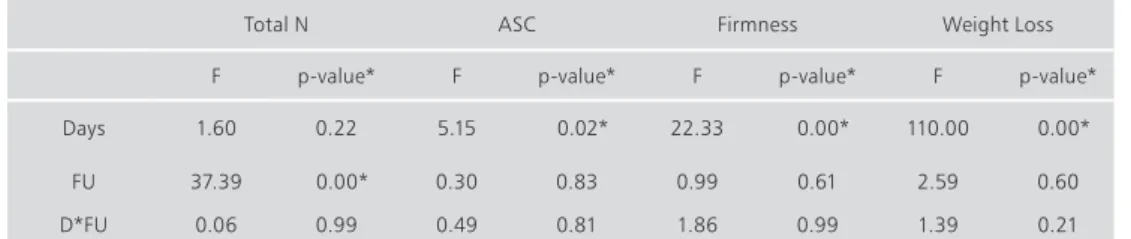
Total nitrogen content in pulp tissue gradually increased as nitrogen level in fertilization became higher, with significant differences among every level of nitrogen fertilization assayed (Fig 1A). The period of storage of fruits at low temperature seemed to have a negligible influence on the evolution of this parameter (Table 1). Total ASC content was not affected by nitrogen level of fertilization, but period of storage did
Se c ti o n 2 . P re -h a rv eS t f a c to r S a ff ec ti n g Po Sth a rv eS t q u a li ty a n d Saf et y
have an influence, since it significantly decreased after 30 days (d) of storage of the fruits (Fig 1B, Table 1). Also no significant influence of nitrogen level of fertilization has been observed on pulp firmness (Table 1).
fig 1. Total nitrogen (N) and ascorbic acid (ASC) contents in pulp tissue from ‘Piel de Sapo’ melon fruit in function of nitrogen fertilization treatment of plants and period of storage at 9 ºC of fruits.
table 1. Statistical F and p-value of ANOVA test performed on total nitrogen (N) and ascorbic acid (ASC) contents, and firmness in pulp tissue, and fruit weight loss, in function of period of storage (days), applied fertilization units (FU), and the interaction between both factors (D*FU).
Total N ASC Firmness Weight Loss
F p-value* F p-value* F p-value* F p-value*
Days 1.60 0.22 5.15 0.02* 22.33 0.00* 110.00 0.00*
FU 37.39 0.00* 0.30 0.83 0.99 0.61 2.59 0.60
D*FU 0.06 0.99 0.49 0.81 1.86 0.99 1.39 0.21
*p-values lower than 0.05 mean significant differences.
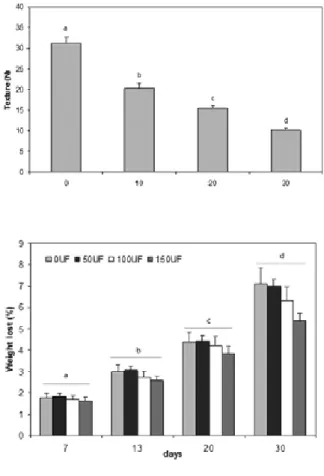
However, the evolution of this parameter is greatly influenced by the period of conservation of fruits at low temperatures (Fig 2, Table 1). In this case, pulp firmness gradually decreases along the period of storage, with
significant differences among each date of sampling ( 0.05). The opposite occurred with fruit weight loss
evolution, which significantly augmented with the period of conservation at 9 ºC ( 0.05) (Fig 3). Also it
was observed that fruits from plants with higher degree of nitrogen fertilization showed lower weight loss, mainly in samples with longer periods of storage, but differences among different fertilization treatments
En v ir o n m En ta ll y F ri En d ly a n d S a FE tE ch n o lo g iES F o r Q u a li ty o F F ru it S a n d vE g Eta bl ES
fig 2. Pulp firmness evolution of ‘Piel de Sapo’ melon fruit during storage at 9 ºC.
fig 3. Percentage of fruit weight loss of ‘Piel de Sapo’ melon fruit during conservation at 9 ºC in function of nitrogen fertilization treatment of plants and period of storage at 9 ºC of fruits.
discussion
Among quality attributes of ‘Piel de Sapo’ melon fruit, pulp colour, firmness and sugar content are the most important ones to determine the degree of acceptance of the fruit by consumers. The results from this experiment show that nitrogen fertilization did not affect pulp colour, contrary to results presented by Ferrante et al. (2008) in similar experiments with netted cantaloupe melons (C. melo L. var. reticulatus). These authors found that fruits from plants with the highest N fertilization dose showed an increase in lightness and yellowness. The minimum value of pulp firmness to be considered acceptable by consumers is 20 N. This parameter has not been found to be affected by nitrogen fertilization, although in other fruits it seems to be inversely correlated to the level of nitrogen applied in fertilization (Hernandez-Fuentes et al. 2003). However, storage strongly affected pulp firmness, as this parameter gradually and significantly decreased with longer periods of storage, already reaching values below 20 N from 20 d. Content of TSS did not vary with nitrogen dose in fertilization, a result in agreement with other authors. Kirnak et al. (2005) reported that nitrogen levels in fertilization of plants generally had little or no effect on TSS of fruits. Total nitrogen content in fruit increased with fertilization levels; these results support the hypothesis stated by Ferrante et al. (2008) who suggest that at high fertilization levels, the nitrogen content is not a growth limiting factor and therefore an accumulation dynamic situation takes place. Some studies have shown a negative correlation between nitrogen fertilization and ASC content (Lee & Kader 2000), while others found no effect of this first parameter on the latter one (Ferrante et al. 2008). In this study, ASC remained
Se c ti o n 2 . P re -h a rv eS t f a c to r S a ff ec ti n g Po Sth a rv eS t q u a li ty a n d Saf et y
steady among the different fertilization treatments applied. Also weight loss was not significantly affected by fertilization treatment, in spite of the fact that samples with longer periods of storage seems to suffer lower weight loss when plants were treated higher doses of nitrogen.
references
Egea MI, Sanchez-Bel P, Martinez-Madrid MC, Flores FB, Romojaro F. 2007. The effect of beta ionization on the antioxidant potential of ‘Búlida’ apricot and its relationship with quality. Postharvest Biol Technol 46:63-70
Ferrante A, Spinardi A, Maggiore T, Testoni A, Gallina PM. 2008. Effect of nitrogen fertilisation levels on melon fruit quality at the harvest time and during storage. J Sci Food Agr 88:707-13
Flores FB, Romojaro F, Latché A, Pech JC, Martínez-Madrid MC. 2007. Assay of a potential post-harvest handling procedure for Cantaloupe Charentais melon fruit with inhibited ethylene production. J Sci Food Agr 87:2034-9
Food and Agricultural Organization. FAOSTAT. 2006. http://faostat.fao.org/statistics
Hartz TK. 1997. Effects of drip irrigation scheduling on muskmelon yield and quality. Sci Hort 69:117-22 Hernandez-Fuentes AD, Saucedo-Veloz C, Colinas-Leon MT, Rodriguez-Alcazar J, Cortes-Flores JI,
Sanchez-Garcia P. 2003. Fertilization and postharvest quality of peach (Prunus persica L. Batsch) under cold storage. Revista Chapingo 9:115-33
Huett DO. 1996. Prospects for manipulating the vegetative-reproductive balance in horticultural crops through nitrogen nutrition: a review. Aust J Agric Res 47:47-66
Kirnak H, Higgs D, Kaya C, Tas I. 2005. Effects of irrigation and nitrogen rates on growth, yield and quality of muskmelon in semiarid regions. J Plant Nut. 28:621-38
Lee SK, Kader AA. 2000. Preharvest and postharvest factors influencing vitamin C content of horticultural crops. Postharvest Biol Technol 20:207-20
Lester G, Oebker NF, Coons J. 1994. Preharvest furrow drip irrigation schedule effects on postharvest muskmelon quality. Postharvest Biol Tec 4:57-63
Lester G. 1996. Melon (Cucumis melo L.) fruit nutritional quality and health functionality. HortSci 31:693 Ministerio de Agricultura, Pesca y Alimentación. MAPA (Spanish Ministry of Agriculture, Fisheries and
Food). 2006. www.mapa.es/es/estadistica
Odet J. 1991. La qualité: de la récolte à la consummation, pp:35-58. In: Le melon, CTIFL (ed.), Paris Ribas F, Cabello MJ & Moreno M. 1995. Necesidades de riego del melon y respuesta del cultivo a riegos
diferenciales en la provincial de Ciudad Real, pp:12-20. In: Proc XIII Jornadas Técnica sobre Riegos. Santa Cruz de Tenerife, Spain, 25-26 June
Wimalasiri P, Wills RB. 1983. Simultaneous analysis of ascorbic acid and dehydroascorbic acid in fruit and vegetables by high-performance liquid chromatography. J Chromatogr 256:368-71
Yasuo F, Shunichi K, Yuko T, Kenichi K. 2000. Nitrogen absorption and distribution of muskmelon (Cucumis melo L.) at different growth stages using hydroponics.Jpn J Soil Sci Plant Nutr 71:72-81