CHARACTERIZATION MORPHOAGRONOMIC OF GUAVA FRUITS UNDER
DIFFERENT WATER DEPTHS AND NITROGEN FERTLIZATION LEVELS
1JOSÉ DANTAS NETO2*, AARON DE SOUSA ALVES3, CARLOS ALBERTO VIEIRA DE AZEVEDO2, PEDRO
DANTAS FERNANDES2, VERA LÚCIA ANTUNES DE LIMA2
ABSTRACT – The objective of this study was to evaluate the effects of different water depths and nitrogen fertilization levels applied by fertigation on the physical attributes of guava fruits cv. Paluma. The study was carried out taking into account factors water depths (1144, 1465, 1785 and 2106 mm) and nitrogen fertilization levels (50, 100, 150 and 200 kg ha-1). The water depths 1730 and 1750 mm increased production and the aver-age weight of guava fruit in, respectively, 25.1 and 31.6%. The applications 178 and 152 kg N ha-1 increased at
67.1% in the production of fruits and 16.3% the average fruit weight. The combined application of 150 kg N ha-1 and 1789 mm of water amounted to 63.3% of the total weight of fruit. The equatorial diameter of
the fruit was influenced by individual water depths applied evidencing an increase of up to 26.8%. Already combinations 200 kg N ha-1 and 1746 mm of water increased the longitudinal diameter of the fruits by 18.77%. The application of water depth to 1144 mm, associated with 143 kg N ha-1 gave index of the most satisfactory way to guava fruit.
Keywords: Psidium guajava L. Irrigated fruit culture. Located Irrigation.
CARACTERIZAÇÃO MORFOAGRONOMICA DE FRUTOS DE GOIABEIRA SUBMETIDA A DIFERENTES LÂMINAS DE ÁGUA E ADUBAÇÃO NITROGENADA
RESUMO – Objetivou-se com este estudo avaliar os efeitos de diferentes lâminas totais de água e níveis de adubação nitrogenada, aplicados via fertirrigação, sobre os atributos físicos de frutos de goiabeiras cv. Paluma. O estudo foi conduzido levando-se em consideração os fatores lâminas de água (1144; 1465; 1785 e 2106 mm) e doses de nitrogênio (50; 100; 150 e 200 kg ha-1). As lâminas de água 1.730 e 1.750 mm aumentaram a produ-ção e o peso médio de frutos de goiabeira em, respectivamente, 25,1 e 31,6%, já as aplicações de 178 e 152 kg de N ha-1elevaram em 67,1% a produção de frutos e em 16,3% o peso médio de frutos. As aplicações combina-das de 150 kg de N ha-1 e 1.789 mm de água elevaram em 63,3% o peso total dos frutos. O diâmetro equatorial dos frutos foi influenciado isoladamente pelas lâminas de água aplicadas constatando-se um aumento de até 26,8%. Já as combinações 200 kg de N ha-1 e 1.746 mm de água incrementaram o diâmetro longitudinal dos frutos em 18,77%. A aplicação da lâmina de água correspondente a 1.144 mm, associada a 143 kg de N ha-1 conferiram índice de forma mais satisfatório aos frutos de goiabeira.
Palavras-chave: Psidium guajava L. Fruticultura irrigada. Irrigação localizada.
_________________________ *Corresponding author
1Received for publication in 12/03/2013; accepted on 07/04/2015.
2Prof. Dr., Graduate Program in Agricultural Engineering, Federal University of Campina Grande - CTRN/ UFCG. Rua Aprígio Veloso, CEP: 58109-970, Campina Grande (PB).
INTRODUCTION
The cultivation of potentially economic species to serve various purposes requires technical knowledge not always available. The adequate supply of water and nutrients to crops through irriga-tion is one of the many difficulties of this process, demanding from researchers and scientists, appropriate management techniques to provide effi-cient and safe quality control, especially when deal-ing with cultures of high economic importance, such as the guava culture.
Brazil has huge areas of climate and soil favorable to the commercial production of guava, which is important not only due to the nutritional value of this fruit, but also from the perspective of increasing the agricultural production, the expansion of the industrial activity and export potential (ROZANE; OLIVEIRA; LIRIO, 2003). Generating jobs, food, income and other key elements for im-proving the living conditions of the population (SOBEL; COSTA, 2005; XAVIER; COSTA; COS-TA, 2006). Thus, the guava culture has become of great importance in several regions of Brazil, mainly in the state of São Paulo, the largest national produc-er (PEREIRA; CARVALHO; NACHTIGAL, 2003). Where there are several areas cultivated with this culture, which is a great option for the diversification of the regional fruit farming activity (CARVALHO et al., 2006).
In the Brazilian semiarid region, mainly in regions where rainfall is insufficient to meet the wa-ter needs of crops, agricultural activities under irri-gated conditions have become an economically via-ble alternative; however, there is need to find alter-natives that minimize production costs. The supply of nutrients to the crop through irrigation in adequate amounts and at the right moment seems to be an eco-nomically viable and environmentally friendly tech-nological alternative for the guava production pro-cess.
Lousada Júnioret al. (2006) have reported a professionalization process, characterized by the exploitation of more extensive areas, use of irriga-tion and the development of new technologies aim-ing at increasaim-ing the production of fruits. In this sense, Teixeira; Quaggio and Mellis (2011) reported that irrigation and fertilization are essential for the practice of intensive agriculture. However, special attention should be paid to the use of nutrients used to increase production efficiency, quantifying appro-priate levels and knowing the magnitude and speed of their transformation (ALVES et al., 2010). Thus, many countries have adopted production through
new soil and water management techniques, provid-ing not only increased yields, but also the optimal use of natural resources (FARIAS et al., 2003).
Although fertigation has been used in some irrigated areas in Brazil, the lack of information, especially about dosages, most recommended type of fertilizer, prevention of precipitates and method and time of application reflect the need for research in this area, considering the diverse conditions of the country (PEIXOTO; GUERRA; CHAVES, 2006). However, its use requires improvements in the appli-cation techniques so that producers can obtain a maximum economic benefit by using this fertilizer (ALVES et al., 2010).
Thus, this study was aimed at assessing the effects of different water depths and nitrogen fertili-zation levels applied by fertigation on the physical attributes of guava fruits (Psidium guajava L.) cv Paluma with four years of age.
MATERIAL AND METHODS
The studies with the P. guajavacv. Paluma with four years of age were carried out at field level, under normal conditions of temperature, photoperiod and relative humidity at the Experimental Station of Veludo (07°18'00'' S and 38°09'00'' W) at the Exper-iment Station of the State Enterprise for Agricultural Research of Paraiba - EMEPA, municipality of Ita-poranga, PB. The study site is 291 m above sea level.
According to the Köppen climate classifica-tion, the climate in the region is type AW', hot and humid with summer and autumn rains. The rainy season starts in January and ends in April, and the driest months are from June to December. With rain-falls 806 mm annual, average temperature of about 24°C and relative humidity of around 73.8%. The pluviometric precipitations events in the region dur-ing the conduct of experiments are shown in Figure 1.
Figure 1. Pluviometric precipitations occurred in the region during the experimental period
Table 1. Physical characterization of soils cultivated with guava (Psidium guajava L.) cv Paluma.
Characteristics Unity Depths (cm)
0 - 20 20 – 40
Sand g kg-1 418.9 446.1
Silt g kg-1 269.2 281.5
Clay g kg-1 311.9 272.4
Texture - Clay-loam soil Clay-loam soil
Soil density g cm-3 1.29 1.27
Particle density g cm-3 2.77 2.76
Total porosity % 53.42 53.98
1
Table 2. Chemical characterization of soils cultivated with guava (Psidium guajava L.) cv Paluma.
1M.O.: Organic Matter; 2EC: Electrical Conductivity
The crop was irrigated by a sprayer-type drip irrigation system operated by a three-phase electric motor pump, type KSB, with power of 3 hp, speed of 3450 rpm and flow rate of 15 m3 h-1, main pipeline made with PVC and access to each experimental plot consisting of flexible polyethylene hoses with 16 mm in diameter containing self-compensating micro sprinklers with nominal flow rate of 50 L h-1, work-ing pressure of 250 kPa, providwork-ing a wet radius of 2.5 m, with one micro sprinkler at each plant.
Irrigation was performed daily after pruning in two productive cycles that lasted, respectively, 202 and 200 days. The irrigation was calculated based on the daily evaporation from tank class A, according to the methodology proposed by Maciel; Dantas Neto e Fernandes (2007). The irrigation level applied was a result of the irrigation plus effective precipitation (Pe), the latter being obtained accord-ing to Blaney and Criddle (1962).
The experimental design used in this study was randomized blocks with treatments arranged in a 4 x 4 factorial, with 4 water depths and 4 nitrogen
each, thus making 64 experimental plots with two plants each.
The water depths applied (TD) corresponded to 1144, 1465, 1785 and 2106 mm (L1, L2, L3, and L4, respectively) and nitrogen levels (N) were 50, 100, 150 and 200 kg ha-1(N1, N2, N3 and N4, respec-tively) applied in the form of potassium nitrate and urea through fertigation, three times per week during the production cycle of the culture, and to this end, a venturi-type fertilizer injector with flow rate of ap-proximately 900 ml min-1 was used.
From the results of soil analyzes and fertiliza-tion suggested for the cultivafertiliza-tion of guava, 60 kg ha-1 of P2O5 were applied in the form of simple super-phosphate and 90 kg ha-1 K2O as potassium nitrate. The first was applied in coverage after pruning at a dosage of 0.8 kg plant-1. The second, by having ni-trogen in its composition, had the value correspond-ing to this nutrient supplemented with urea, in amounts that were calculated according dosages al-ready specified in this study for Nitrogen (N), ac-cording to each experimental treatment.
Depths (cm) pH M.O. 1
P K S Ca Mg H+Al Na EC2
H2O g/kg ………mg dm-³…..…. …….….cmol dm-³………… dS m-1
0 - 20 8.07 1.03 14.55 148.58 16.73 6.8 7.68 0.0 1.87 0.30
20 - 40 7.40 0.65 11.37 125.12 17.45 7.2 7.88 0.0 2.05 0.33
determined during the harvest period, considering the following parameters: number of fruits per plant (NF), total fruit weight per plant (TW), average fruit weight (AW), equatorial diameter (ED), longitudinal diameter (LD) and shape index (SI).
Results were submitted to analysis of vari-ance and polynomial regression, evaluating the ef-fects of each factor alone, as well as the interaction between them using the SISVAR statistical package.
RESULTS AND DISCUSSION
The results shown in Table 3 correspond to analysis of variance of the following physical attrib-utes: number of fruits per plant (NF), total fruit weight per plant (TW), average fruit weight (AW), Equatorial Diameter (DE) Longitudinal diameter (DL) and shape index (SI) of guava fruits cv. Pa-luma.
Table 3. Summary of the analysis of variance for the following variables: number of fruits per plant (NF), total fruit weight
(TW) in kg plant-1 and average fruit weight (AW) in kg, equatorial diameter (ED) and longitudinal diameter (LD) in mm,
and shape index (SI).
Source of variation GL
Average square
NF TW AW DE DL SI
Irrigation level (L) 3 23841.52** 4046.86** 0.0089** 140.9** 282.5** 61.8ns
Nitrogen (N) 3 58505.72** 4315.75** 0.0028* 27.2ns 291.5** 287.2**
L x N 9 3571.22ns 440.57** 0.0012ns 9.7ns 44.0ns 62.6ns
Block 3 1742.26ns 92.42ns 0.0002ns 6.0 ns 14.7 ns 18.4ns
Residue 45 1885.22 62.79 0.0006 12.83 34.0 27.8
VC (%) 10.62 10.00 12.84 6.80 5.50 12.20
1
* and ** significant at 1% and 5% probability, respectively, ns - not significant.Except for the shape index (SI), the other variables were significantly influenced the 1% prob-ability level by water depths applied. An isolated effect was observed at 1 % probability level of factor nitrogen fertilization levels on variables number of fruits per plant (NF), total fruit weight (TW), Longi-tudinal Diameter (LD) and shape index (SI), and at 5% probability level on the average fruit weight (AW). Among the variables analyzed, only the total fruit weight per plant (TW) was significantly influ-enced by the interaction between water depths and nitrogen fertilization levels by the F test at 1% prob-ability.
According to results obtained from the regres-sion studies, there was a linear and quadratic re-sponse with a significant effect of factors on the vari-able number of fruits per plant (NF) at 1% probabil-ity level. Thus, according to the statistically signifi-cant models found in this study, the quadratic was chosen because it was the one that best fit the nature of factors studied, as well as its dispersion coeffi-cient (r2).
Figure 2 shows the isolated effect of different irrigation and nitrogen fertilization levels on the number of fruits per guava plant (NF).
Figure 2. Number of fruits per guava plant (Psidium guajava L.) as a function of water depths (a) and nitrogen fertilization levels(b)
NFP = 332.28 + 0.8998L - 0.00026**L2 R² = 0.97
235,0 291,3 347,5 403,8 460,0
1144 1384,5 1625 1865,5 2106
Nu
m
b
er
o
f
fr
u
its
p
er
p
lan
t
(NF
P)
Total water depth : irrigation+precipitation (mm)
(a)
NFP = 205.64 + 2.781N - 0.0078**N2 R² = 0.93
235,0 293,8 352,5 411,3 470,0
40 80 120 160 200
Nu
m
b
er
o
f
fr
u
its
p
er
p
lan
t
(NF
P)
Nitrogen levels (Kg ha-1)
(b)
Thus, based on results and according to the quadratic statistical model obtained for this factor (Figure 2a), it was observed that the highest physical performance was obtained when water depth corre-sponding to 1730 mm was applied, providing 446 fruit per P. guajava plant. This value represents an increase of 25.1% in crop production compared to the lowest water depth and of 8.2% compared to the greatest water depth adopted in this study.
Reductions in the number of fruits per plant provided by water depths corresponding to minimum and maximum applied to the culture probably were not only due to water deficit provided by the first, but also due to excess water applied through the highest irrigation level adopted in this study, which also caused a reduction in the number of fruits per guava plant.
In general, water depths tested in this study significantly influenced the P. Guajava production. Albrigo (1992) emphasized that water influences all fruiting stages of crops and irrigation is the cultural practice that most affects fruit development. Thus, the knowledge on the maximum daily and total an-nual water requirements of a given culture allows estimating the total volume of water that should be applied to meet the water needs (FREITAS; RA-MOS; COSTA, 2008). Since water supplied through irrigation promotes optimal plant development, in-creases productivity and allows obtaining production in a continuous and uniform way, as well as good fruit quality (COSTA et al., 2009).
Figure 2b shows that nitrogen fertilization
level equivalent to 178 kg ha-1 provided higher crop production, yielding 454 fruits per guava plant. This increase in crop yield points to a greater efficiency of this treatment about the others, which probably led this species to show different behavior according to the different nitrogen fertilization levels used in this study.
In this sense, Melo et al. (2010) reported that studies on mineral nutrition have shown high nutri-tional requirements and hence the importance of a balanced supply of nutrients to obtain economic pro-ductions. Carrijoetal. (2004) emphasized that nitro-gen is present in the formation of various molecules of biological action such as nucleic acids, amino acids and proteins, playing a key role in the growth and development of plants, being perhaps the most influential element in crop production. However, according to Alves et al. (2010), special attention should be paid to the use of this nutrient, aimed at increasing the efficiency of its use, quantifying ap-propriate levels and knowing the magnitude and speed of their transformation, since according to Silva et al. (2003), the increase of N (from 0 to 1600 kg ha-1 year-1) promoted reduction of about 10.61% in fruit yield.
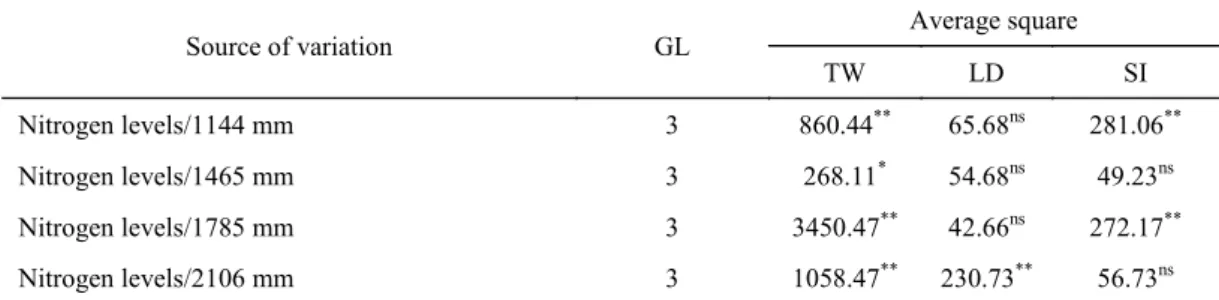
The results corresponding to the total fruit weight per plant (TW), longitudinal diameter (LD) and shape index (SI), obtained as a function of the interaction between the different irrigation and nitro-gen levels used in this study, can be observed in Ta-bles 4 and 5.
Table 4. Regression analysis of total water depths within nitrogen fertilization levels for variables total fruit weight per plant (TW), longitudinal diameter (LD) and shape index (SI)
Source of variation GL
Average square
TW LD SI
Water depths/50 kg ha-1 3 337.78* 86.43ns 72.25ns
Water depths/100 kg ha-1 3 1881.84** 54.68ns 37.75ns
Water depths/150 kg ha-1 3 2442.37** 42.66ns 114.22ns
Water depths/200 kg ha-1 3 666.57** 230.73** 96.75ns
1
* and ** significant at 1% and 5% probability, respectively, ns - not significant.Table 5. Regression analysis of the nitrogen fertilization levels within water depths for variables total fruit weight per plant (TW), longitudinal diameter (LD) and shape index (SI)
Source of variation GL
Average square
TW LD SI
Nitrogen levels/1144 mm 3 860.44** 65.68ns 281.06**
Nitrogen levels/1465 mm 3 268.11* 54.68ns 49.23ns
Nitrogen levels/1785 mm 3 3450.47** 42.66ns 272.17**
Nitrogen levels/2106 mm 3 1058.47** 230.73** 56.73ns
Thus, it could be inferred that the guava cul-ture responded positively to the combined applica-tion of factors at 5% probability level only when the lowest nitrogen fertilization level was applied, for the other levels, there was was significant effect at 1% probability level (Table 4). Regarding the results of the nitrogen fertilization level for each water depth (Table 5), there is a positive response to appli-cations of nitrogen levels associated with different water depths at 5% probability level only when irri-gation level corresponding to 1785 mm was applied, in other applications, significant effect at 5%
proba-bility was observed.
Figure 3a shows the influence of water depths and nitrogen fertilization levels on the total fruit weight per plant (TW). Thus, the highest values for this variable were obtained when nitrogen fertiliza-tion level equivalent to 150 kg ha-1 was applied in combination with water depth corresponding to 1789 mm, totaling 112.67 kg of fruits produced. It repre-sents a 63.3% increase in the total fruit weight, start-ing from the lowest water depth applied, and 9.4% compared to the maximum water depth adopted in this study.
Regression equations (R2) Regression equations (R2)
TWF(LN1) = 9.6 + 0.2002L –0.00006*L2
TWF(LN2) = 333.09+0.514L – 0.00015**L2
TWF(LN3) = 223.4+ 0.3757L – 0.0001**L2
TWF(LN4) = 109.32+ 0.2308L – 0.00007**L2
R2 = 0.81 R2 = 0.84 R2 = 0.60
R2 = 0.72
TWF(NL1) = 12.697+ 0.6776N – 0.0019*N2
TWF(NL2) = 43.572 + 0.5292N – 0.0017*N2
TWF(NL3)=-31.723+ 2.1987N– 0.0076**N2
TWF(NL4)=27.26+0.6746N–0.0019*N2
R2 = 0.97 R2 = 0.97 R2 = 0.98
R2 = 0.80
Figure 3. Total weight of guava fruit as a function of total water depths applied (a) and nitrogen fertilization levels (b)
30,0 57,5 85,0 112,5 140,0
1144 1384,5 1625 1865,5 2106
T o tal w eig h t o f fru it -T W F (k g p lan t -1)
Total water depth: irrigation + precipitation (mm) (a)
L(N1) L(N2) L(N3) L(N4)
30,0 57,5 85,0 112,5 140,0
40 80 120 160 200
T o tal w eig h t o f fru it -T W F (k g p lan t -1)
Nitrogen levels (kg ha-1)
(b)
N(L1) N(L2) N(L3) N(L4)
Figure 3. Total weight of guava fruit as a function of total water depths applied (a) and nitrogen fertilization levels (b)
By applying water depth corresponding to 1785 mm (Figure 3b), an increase in total fruit weight was observed, starting with the lowest nitro-gen level with 59.46 kg to 129.42 kg at the maxi-mum point of the model (147 kg of N ha-1), provid-ing an increase of 117.65% on the total fruit weight. From this point, the total fruit weight per plant de-creased by 16.54% at the highest nitrogen fertiliza-tion level used (200 kg ha-1).
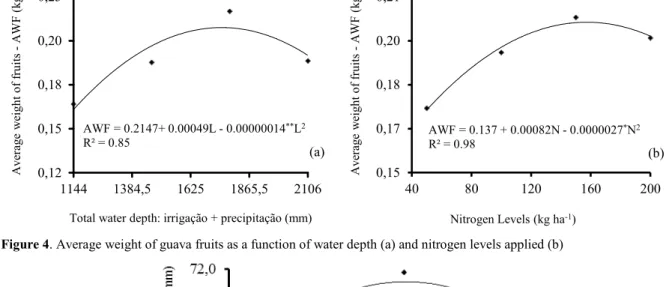
According to the quadratic statistical model obtained for factor total water depth (Figure 4a), an increase in the average fruit weight of 0.163 kg was obtained using the lowest irrigation level (1144 mm) for 0.214 kg in the maximum point of the model, i.e., when irrigation level corresponding to 1750 mm was applied. These values provided an increase of 31.6% in the average weight of guava fruits. According to the quadratic model obtained for factor nitrogen fer-tilization levels (Figure 4b), it was observed that there was an increase in the average weight of guava fruits of 0.172 kg with the lowest nitrogen fertiliza-tion level, 50 kg ha-1, up to 0.200 kg at the maximum point of the model (152 kg ha-1), thus representing an increase of 16.3%. Moreover, the use of the highest nitrogen fertilization level adopted in this study pro-vided a decrease of 3.0% in the average weight of
guava fruits from the maximum value estimated by the model (152 kg ha-1).
These results corroborate those obtained by Carvalho and Nakagawa (2000), who emphasized that water is the primary constituent of plant cells; thus a means for the occurrence of essential physical and biochemical phenomena. Albrigo (1992) report-ed that increasreport-ed soil moisture increases fruit size dilutes soluble solids and reduces acidity levels and other components. Its reduction, however, reduces photosynthesis, affecting the production of sugars and the growth of fruits, favoring their fall. Accord-ing to Teixeira; Quaggio and Mellis (2011) when dealing with intensive agriculture, irrigation and fertilization are essential conditions for its imple-mentation. Where there is an interaction between these factors, the application of fertilizers is strongly affected by soil water regimes. However, Alves et al. (2010) reported that the use of these sources requires improvements in the application techniques so that producers can obtain the maximum economic benefit when using fertilizers.
starting from 64.59 mm obtained with the applica-tion of water depth of 1144 mm to 71.58 mm ob-tained when irrigation corresponding to 1805 mm
obtained at the maximum point of the statistical model was applied.
Figure 4. Average weight of guava fruits as a function of water depth (a) and nitrogen levels applied (b)
Figure 5. Equatorial diameter of guava fruits as a function of the water depths applied Based on regression studies of water depths
within each nitrogen level applied (Table 4), it was observed that the intensity of the effects of water depths in the longitudinal diameter (LD) on the fruit only occurred when using nitrogen level correspond-ing to 200 kg ha-1; the other levels did not differ sta-tistically as a function of water depths used. Howev-er, the nitrogen fertilization levels used for each wa-ter depth (Table 5) influenced the longitudinal diam-eter of guava fruits only when water depth of 2106 mm was applied.
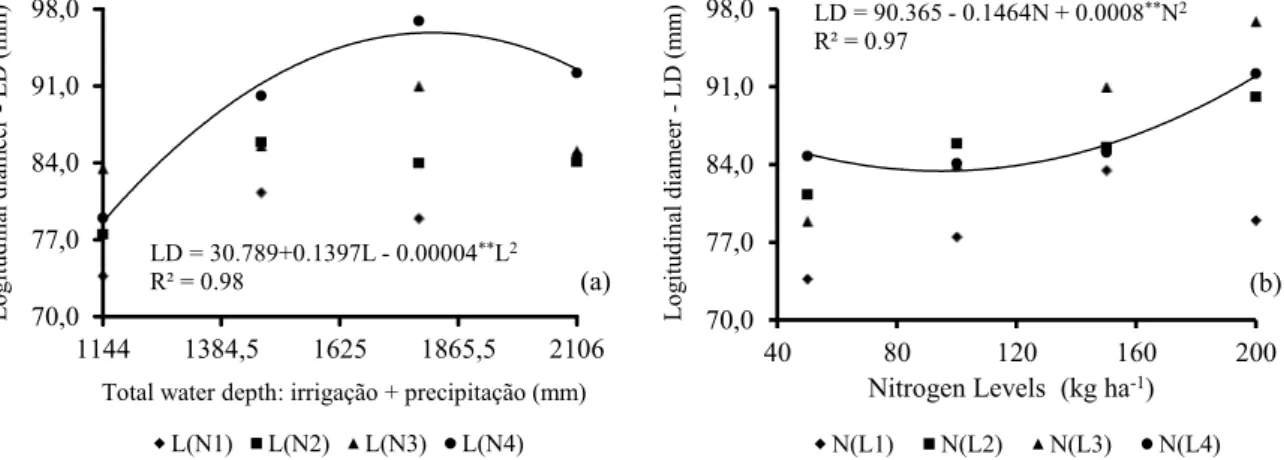
According to the statistical model obtained (Figure 6a), it was observed that there was an in-crease in longitudinal diameter of guava fruits start-ing from the lowest water depth applied (1144 mm), with longitudinal diameter estimated from 76.62 mm to 91.01 mm, obtained at the maximum point of the statistical model. This estimated maximum value represents an increase of 18.77, 14.76 and 12.05%, respectively, in relation to water depths correspond-ing to 1144, 1465 and 2106 mm, which demonstrat-ed a strong dependence on the amount of water sup-plied to the guava culture, since reducing the total water volume provided a reduction in the longitudi-nal diameter of fruits.
According to the amount of nitrogen applied to each water depth, Figure 6b shows that the appli-cation of total water depth of 2106 mm resulted in a decrease of 1.59% when using 100 kg ha-1of N, with longitudinal diameter of 83.71 mm in relation to the nitrogen fertilization level of 50 kg ha-1, with 85.04 mm and an increase of 1.56 and 9.40%, respectively, in relation to nitrogen levels corresponding to 150 kg ha-1, with 86.37 mm and 200 kg ha-1, with longitudi-nal diameter of 93.04 mm. It was also observed that the minimum value obtained for this variable was estimated to be 83.65 mm with the application of 92 kg ha-1 of nitrogen.
In experiments with fertilized Paluma guava in semiarid Paraiba, Gouveia et al. (2004) found that the longitudinal and transversal diameter of fruits did not exceed 72.5 and 64.8 mm, respectively. Lima, Assis e Gonzaga Neto (2002) observed that guava fruits grown in the São Francisco Valley showed longitudinal diameter between 58.4 and 76.0 mm and transversal diameter ranging from 53.0 to 77.9 mm.
Due to the shape index of Paluma guava fruits, Figure 7 shows a significant effect of nitrogen fertilization levels, only when water depths corre-sponding to 1144 and 1785 mm were applied. Thus, AWF = 0.2147+ 0.00049L - 0.00000014**L2
R² = 0.85
0,12 0,15 0,18 0,20 0,23
1144 1384,5 1625 1865,5 2106
A
v
erag
e
w
eig
h
t
o
f
fru
it
s
-A
W
F
(k
g
)
Total water depth: irrigação + precipitação (mm) (a)
AWF = 0.137 + 0.00082N - 0.0000027*N2
R² = 0.98
0,15 0,17 0,18 0,20 0,21
40 80 120 160 200
A
v
era
g
e
w
eig
h
t
o
f f
ru
its
-A
W
F
(k
g
)
Nitrogen Levels (kg ha-1)
the highest estimated shape index was 1.29, which was obtained by the application of water depth of 1144 mm together with nitrogen fertilization level corresponding to 143 kg ha-1. Moreover, when nitro-gen fertilization level corresponding to 50 kg ha-1 was used, increase of 13.0, 15.9 and 10% were
ob-served, when compared with nitrogen fertilization levels corresponding to 100 , 150 and 200 kg ha-1, respectively. For the total water depth of 1785 mm, the linear statistical model obtained indicates that there was an increase in the shape index of fruits with the use of nitrogen fertilization.
Figure 6. Longitudinal diameter of guava fruits as a function of water depths (a) and nitrogen fertilization levels applied (b)
Figure 7. Shape index of guava fruits as a function of the nitrogen fertilization levels The relationship between longitudinal and
transverse diameters of fruits is used to determine their shape, where values close to 1.0 suggest round-er fruits (GERHARDT et al., 1997). In ordround-er to char-acterize guava fruits and select cultivars produced in the Lower Region of the São Francisco River, Lima; Assis and Gonzaga Neto (2002) found that the rela-tionship between longitudinal and transverse diame-ters of fruits ranged from 0.98 to 1.25, and the lowest ratios (0.98 to 1.02) were obtained respectively in cultivars Banahas, Lucknow 49, Alabama Safed and R. S. Florida.
Based on the above, it is clear that the differ-ent irrigation and nitrogen fertilization levels ap-plied, both in excess and in low amounts significant-ly influenced the characteristics of guava fruits. Moreover, when properly administered, the factors evaluated in this study proved to be a viable alterna-tive, improving the physical attributes of guava fruits. Thus, Moura and Moura (2011) point out that fruit farming is an agricultural activity under the
process of expansion, which has emerged as a seg-ment of great socioeconomic importance. Several fruit trees compose the production systems in opera-tion, among them mango, banana, vine, coconut, and guava stand out (GONZAGA NETO, 2002). Regard-ing the latter, cultivar Paluma is the most widespread cultured in Brazil, achieving productivity exceeding 50 t ha-1 year-1 (LIMA; ASSIS; GONZAGA NETO, 2002).
CONCLUSIONS
The water depths corresponding to 1730 and 1750 mm increased production of fruits per plant and the average weight of guava fruit in, respectively, 25.1 and 31.6%, whereas, the applications 178 and 152 kg N ha-1 in creased at 67.1% in the production of fruits and 16.3% the average fruit weight;
The combined application of 150 kg N ha-1 and 1789 mm of water amounted to 63.3% of the
1
LD = 30.789+0.1397L - 0.00004**L2
R² = 0.98 70,0
77,0 84,0 91,0 98,0
1144 1384,5 1625 1865,5 2106
L
o
g
it
u
d
in
al
d
iam
ee
r
-LD
(m
m
)
Total water depth: irrigação + precipitação (mm) (a)
L(N1) L(N2) L(N3) L(N4)
LD = 90.365 - 0.1464N + 0.0008**N2
R² = 0.97
70,0 77,0 84,0 91,0 98,0
40 80 120 160 200
L
o
g
it
u
d
in
al
d
iam
ee
r
-LD
(m
m
)
Nitrogen Levels (kg ha-1)
(b)
total weight of guava fruit ‘Paluma’;
The equatorial diameter of the fruit was influ-enced by individual water depths applied evidencing an increase of up to 26.8%. Already combinations 200 kg N ha-1 and 1746 mm of water increased by 18.77% the longitudinal diameter of the fruits of guava;
The application of water depth to 1144 mm, associated with143 kg N ha-1gave index of more satisfactory way to fruit guava.
REFERENCES
ALBRIGO, G. Influências ambientais no desenvolvi-mento dos frutos cítricos. In: SEMINÁRIO INTER-NACIONAL DE CITRUS - FISIOLOGIA, 2, Cam-pinas, 1992, Anais..., Campinas, p.100-105, 1992. 1. CD-ROM.
ALVES, M. S. et al. Crescimento e produtividade da bananeira cv. Grande Naine sob diferentes combina-ções de nitrato de cálcio e uréia. Revista Ceres, Viçosa, v. 57, n. 1, p. 125-131, 2010.
BLANEY, F. H.; CRIDDLE, W. D. Determining consumptive use and irrigation water require-ments. Washington: United States Department of Agricultural, 1962. 93 p.
CARRIJO, O. A. et al. Fertirrigação de hortaliças. Brasília, DF: Embrapa Hortaliças, 2004. (Circular Técnica da Embrapa Hortaliças, 32).
CARVALHO, C. M. et al. Desempenho de um siste-ma de irrigação por gotejamento na cultura da goia-ba. Revista Irriga, Botucatu, v. 11, n. 1, p. 36-46, 2006.
CARVALHO, N. M.; NAKAGAWA, J. Sementes: ciências, tecnologia e produção. 2.ed. Campinas -SP: Fundação Cargill, 2000. 565 p.
COSTA, S. C. et al. Comportamento dos parâmetros indicativos de produção da bananeira pacovan sub-metida a diferentes lâminas de irrigação e doses de potássio na Chapada do Apodi, Limoeiro do Norte-Ce. Revista Caatinga, Mossoró, v. 22, n. 4, p. 46 -52, 2009.
FARIAS, C. H. A. et al. Crescimento e desenvolvi-mento da cultura do melão sob diferentes lâminas de irrigação e salinidade da água. Revista Brasileira de Engenharia Agrícola e Ambiental, Campina Gran-de, v. 7, n. 3, p. 445-450, 2003.
FREITAS, W. S.; RAMOS, M. M.; COSTA, S. L. Demanda de irrigação da cultura da banana na bacia do Rio São Francisco. Revista Brasileira de
Enge-12, n. 4, p. 343–349, 2008.
GERHARDT, L. B. A. et al. Características físico -químicas dos frutos de quatro cultivares e três clones de goiabeira em Porto Lucena, RS. Pesquisa Ag-ropecuária Brasileira, Brasília, v. 32, n. 2, p. 185-192, 1997.
GONZAGA NETO, L. Introdução e avaliação de clones de goiabeira de polpa Branca (Psidium guaja-va L.) Na região do submédio são Francisco. Revista Brasileira de Fruticultura, Jaboticabal, v. 24, n. 1, p. 120-123, 2002.
GOUVEIA, J. P. G. et al. Determinação de caracte-rísticas físico-químicas da goiaba: Goiabeiras aduba-das no semiárido da Paraíba. Revista Brasileira de Produtos Agroindustriais, Campina Grande, v. 6, n. 1, p. 35-38, 2004.
LIMA, M. A. C.; ASSIS, J. S.; GONZAGA NETO, L. Caracterização dos frutos de goiabeira e seleção de cultivares na região do Submédio São Francisco. Revista Brasileira de Fruticultura, Jaboticabal, v. 24, n. 1, p. 273-276, 2002.
LOUSADA JÚNIOR, J. E. et al. Caracterização físi-co-química de subprodutos obtidos do processamen-to de frutas tropicais visando seu aproveitamenprocessamen-to na alimentação animal. Revista Ciência Agronômica, Fortaleza, v. 37, n. 1, p. 70-76, 2006.
MACIEL, J. L.; DANTAS NETO, J.; FERNAN-DES, P. D. Resposta da goiabeira à lâmina de água e à adubação nitrogenada. Revista Brasileira de En-genharia Agrícola e Ambiental, Campina Grande, v. 11, n. 6, p. 571-577, 2007.
MELO, A. S. et al. Aspectos técnicos e econômicos da bananeira ‘prata-anã’ sob fertirrigação nos tabu-leiros costeiros de Sergipe. Revista Ciência e Agro-técnologia, Fortaleza, v. 34, n. 3, p. 564-571, 2010.
MOURA, A. P.; MOURA, D. C. M. Levantamento e flutuação populacional de parasitoides de moscas-das-frutas (Diptera: Tephritidae) de ocorrência em goiabeira (Psidium Guajava L.) em Fortaleza, Ceará. Arquivos do Instituto Biológico, São Paulo, v. 78, n. 2, p. 225-231, 2011.
PEIXOTO, J. F. S.; GUERRA, H. O. C.; CHAVES, L. H. G. Alterações de atributos químicos do solo pela fertirrigação com nitrogênio e potássio. Revista Agropecuária Técnica, Areia, v. 27, n. 2, p. 69–76, 2006.
Fruticul-ROZANE, D. E.; OLIVEIRA, D. A.; LIRIO, V. S. Importância econômica da cultura da goiabeira. In: ROZANE, D. E.; COUTO, F. A. D. (ed.). Cultura da goiabeira: Tecnologia e mercado. Viçosa: UFV, 2003. p.1-20.
SILVA, J. T. A. et al. Adubação com potássio e ni-trogênio em três ciclos de produção da bananeira cv. Prata-Anã. Revista Brasileira de Fruticultura, Ja-boticabal, v. 25, n. 1, p. 152-155, 2003.
SOBEL, T. F.; COSTA, E. F. Estimando taxas de adoção de tecnologias poupadoras de água na fruti-cultura irrigada do Vale do São Francisco: o caso dos pequenos agricultores. Revista Econômica do Nor-deste, Fortaleza, v. 36, n. 1, p. 121-146, 2005.
TEIXEIRA, L. A. J.; QUAGGIO, J. A.; MELLIS, E. V. Ganhos de eficiência fertilizante em bananeira sob irrigação e fertirrigação. Revista Brasileira de Fruticultura, Jaboticabal, v. 33, n. 1, p. 272-278, 2011.