ECO-FRIENDLY HEALING AGENTS FOR RECYCLED
CONCRETE
Julia GARCÍA-GONZÁLEZ PhD. Researcher. Escuela de Ingeniería Agraria y Forestal, University of Leon.[email protected] André FRECHES Researcher. LAQV-REQUIMTE, Dep. of Chemistry, Faculdade de Ciências e Tecnologia, Universidade NOVA de Lisboa. [email protected] Paulo C. LEMOS Principal Investigator. LAQV-REQUIMTE, Dep. of Chemistry, Faculdade de Ciências e Tecnologia, Universidade NOVA de Lisboa. [email protected] Alice S. PEREIRA Professor. UCIBIO-REQUIMTE, Dep. of Chemistry, Faculdade de Ciências e Tecnologia, Universidade NOVA de Lisboa. [email protected] Andrés JUAN-VALDÉS Professor. Escuela de Ingeniería Agraria y Forestal, University of Leon.
[email protected] Julia Mª. MORÁN-DEL POZO Professor. Escuela de Ingeniería Agraria y Forestal, University of Leon.
[email protected] M. Ignacio GUERRA-ROMERO Professor. Escuela de Ingeniería Agraria y Forestal, University of Leon.
[email protected] Paulina FARIA Professor. CERIS and Dep. Civil Engineering, Faculdade de Ciências e Tecnologia, Universidade NOVA de Lisboa. [email protected]
ABSTRACT
An innovative option to extend the service life of construction and building materials is the use of bio-healing agents. This study was focused on assessing the protection and consolidation effect of eco-friendly healing agents by analysing the water absorption of recycled concrete. A recycled concrete with 50% replacement of natural coarse aggregate by construction and demolition waste (CDW) aggregate and a similar recycled concrete in which, additionally, the Portland cement was replaced by recycled cement (with 25% ceramic waste) were biotreated by healing agents. These agents were obtained by using waste biomass of two different mixed microbial cultures from polyhydroxyalkanoates production processes. Results have shown that biotreatments decreased the water absorption significantly, more evident in concrete samples with both recycled cement and aggregates than on the other type of concrete.
RESUMEN
Una innovadora posibilidad planteada para prolongar la vida útil de los materiales de construcción y edificación es el uso de agentes bioreparadores. Este estudio se centró en la evaluación del efecto protector y consolidante de agentes reparadores y respetuosos con el medio ambiente mediante el análisis de la absorción de agua del hormigón reciclado. Un hormigón reciclado con sustitución del 50% de los áridos gruesos naturales por residuos de construcción y demolición (RCD) y un hormigón reciclado similar en el cual, además, se sustituyó el cemento convencional Portland por cemento reciclado (con 25% de residuo cerámico) fueron biotratados con agentes reparadores. Estos agentes se obtuvieron en el proceso de producción de polihidroxialcanoatos utilizando biomasa residual de dos cultivos microbianos mixtos diferentes. Los resultados mostraron que los biotratamientos disminuyen significativamente la absorción de agua del hormigón, siendo más eficaces en las muestras de hormigón que combinan cemento y árido reciclado que en el otro tipo de hormigón.
Keywords: Surface healing, mixed microbial culture, biotreatment, water absorption, construction and demolition waste, recycled aggregate, recycled cement, ceramic waste.
1. INTRODUCTION
Repairing needs gradually increases with the increase of age of concrete structures. In some cases, it can be more economical to accept the need for repair at suitable intervals than to attempt to build a structure that will be maintenance-free under severe conditions for a long period. In addition, in spite of the relatively good durability of concrete as construction material, there are large numbers of structures worldwide which
deteriorate due to expected factors that generate cracks (overloading, fatigue effects, changes in use, natural disasters, etc.). Therefore, surface cracking in concrete structures is inevitable; however, some cracks shall be repaired to prevent further structural damages and save money by being proactive. Several studies have tested the surface healing effect of organic and inorganic treatments on cement-based materials [1-7], showing improvements on permeability, resistance to moisture diffusion and filling of surface
cracks and voids. This study searches for a suitable bioproduct compatible with the existing cementitious substrate and able to improve the concrete surface quality by biotreatment of incipient cracks and porous structure. External repairing decreases maintenance costs of aged concrete structures and increases sustainability in the construction industry, being important advantages of this technology.
2. MATERIALS AND METHODS
A recycled concrete with 50% replacement of natural coarse aggregate by CDW aggregate (RAC - recycled aggregate concrete) and a similar recycled concrete in which, additionally, the Portland cement was replaced by recycled cement (with 25% ceramic waste) (RACC - recycled aggregate and cement concrete) were prepared to assess the protection and consolidation effect of an eco-friendly healing biotreatment on water absorption. A commercially available Portland blended cement CEM III/A 42.5 N/SR was conformed to the Spanish [8-9] and European [10] standards. In RACC, this Portland cement was replacement by recycled cement with 25% waste ceramic fraction. Table 1 shows the chemical composition of both types of cement. Natural aggregates presented a siliceous nature and complied with the requirements of the EHE-08 [11] and EN 12620+A1 [12]. Recycled mixed aggregates (RMA) were obtained through a mechanical treatment of CDW in a recycling plant located in the Autonomous Community of Madrid (Spain). The composition of the RMA, determined according to EN 933-11 [13], is presented in Table 2. Chemical composition (%) CEM III/A 42.5 N/SR Recycled cement Al2O3 7.59 7.32 CaO 51.33 47.04 Cl 0.02 0.04 Fe2O3 2.04 3.06 MgO 3.87 2.24 P2O5 0.06 0.17 K2O 0.60 1.70 SiO2 25.08 29.35 Na2O 0.14 0.41 SrO 0.11 0.08 SO3 2.54 2.45 TiO2 0.39 0.31 ZnO 0.04 0.03 Cr2O3 0.01 0.01 MnO 0.22 0.09 LOI 3.930 2.66
Table 1: Chemical composition of Portland and recycled cement
Component %
(w/w) Unbound aggregates (natural aggregates without cement mortar attached)
44.1
Ceramics (bricks, tiles, stoneware and sanitary ware, …)
33.6 Concrete and mortar (natural aggregates with cement mortar attached)
17.5
Asphalt 0.4
Glass 0.8
Gypsum 3.5
Other impurities (wood, paper, metals, plastic, …)
0.1
Table 2: Non-floating components of recycled aggregates
Physical and mechanical properties of RMA and natural aggregates such as D/d ratio [14], fines content [14], flakiness index [15], Los Angeles coefficient [16], were within the suitable parameters established by EHE-08 [11] for the concrete manufacture. Nevertheless, results obtained for RMA water absorption [17] showed a greater variation compared to the natural aggregates. The presence of attached mortar and ceramic materials in the recycled aggregates caused significant water absorption, higher than the one of the natural aggregates. The use of aggregates with high water absorption could result in a workability drawback. Consequently, the RMA were pre-saturated: a technique that showed to be a suitable method to manufacture inexpensive recycled concrete with low strength requirements and maintain a suitable workability [18]. Table 3 shows the detailed composition of the different raw components used in the manufacture of the concretes (RAC and RACC, both have the same composition, only the kind of cement is changed). The w/c ratio and fck of both concretes is 0.5 and 25 MPa, respectively. Material Composition Water (l) 155 Cement (kg) 313 Sand 0/4 mm (kg) 97 Sand 0/5 mm (kg) 442 Gravel 4/10 mm (kg) 242 Gravel 6/12 mm (kg) 81 RMA 4/20 mm (kg) 323
Table 3: Mix composition per cubic metre of concrete
The test samples were cubes cut from
concrete specimens that were molded, and had a cut surface with 50 mm x 50 mm.
The bioproducts used as healing agents were eco-friendly, being obtained by waste biomass from a microbial mixed culture (MMC) for polyhydroxyalkanoates production using pine wood bio-oil as substrate, on one hand, and crude glycerol (biodiesel by-product) on the other hand. MMC cell walls were disrupted by sonication (MMC-P_S and Gly_S) or not (P and MMC-Gly). In addition, two different concentrations of each product were tested (* - 1 Vol. of biopolymer:2 Vol. of water – lower concentration; ** - 1 Vol. of biopolymer:1 Vol. of water – higher concentration). Table 4 shows the different treatments.
Samples were treated with 2 mL of each bioproduct suspensions by using a pipette, covering the top surface.
The effect of each bioproduct on surface treatment was evaluated and compared with untreated samples (control) and treated with the same volume of tap water (reference). For each biotreatment and concrete, three samples were tested. The test room conditions were 20±2°C and 40±5% relative humidity (RH). Two days after the application, the healing capacity was assessed by water-drop absorption test performed in the test room. This test allows evaluating the permeability variation of the biotreated surfaces by monitoring the time required to absorb a water drop under open air conditions. The test was video recorded and the absorption time was then defined for each concrete, number of applications and treatment.
Treatment code
Treatment definition Control Control
H2O Reference with water
MMC-Gly* MMC from glycerol without sonication, lower concentration
MMC-Gly** MMC from glycerol without sonication, higher concentration
MMC-Gly_S* MMC from glycerol with sonication, lower concentration
MMC-Gly_S** MMC from glycerol with sonication, higher concentration
MMC-P* MMC from pinewood biooil without sonication, lower concentration MMC-P** MMC from pinewood
biooil without sonication, higher concentration MMC-P_S* MMC from pinewood
biooil with sonication, lower concentration MMC-P_S** MMC from pinewood
biooil with sonication, higher concentration
Table 4: Code and definition of treatments
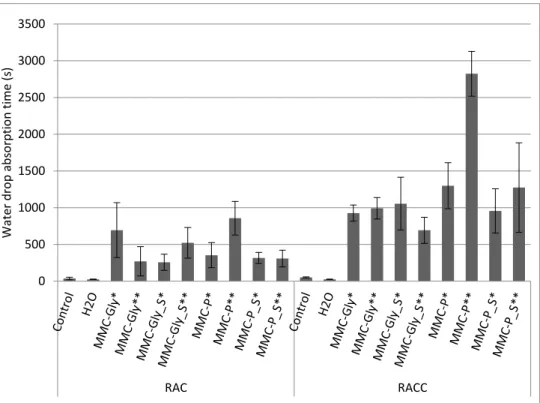
3. RESULTS AND DISCUSSION Figure 1 shows the time of water drop absorption for each biotreated concrete samples, the control (untreated) and the reference (with water application) samples.
Results have shown that all biotreatments increase significantly the absorption time, improving the expected durability of the
concrete surfaces. On the contrary, the reference concretes, with tap water, presented an increase in water drop permeability, being the absorption time shorter than in the control concrete in all cases.
The water drop absorption test shows that the MMC treatments are noticeable more effective in concrete with recycled cement than with conventional cement. This demonstrates the importance of the type of construction material surface to treat. Further research is needed, but these results point an appropriate healing effect of eco-friendly biopolymer treatments, improving with the presence of recycled ceramic. Also it is shown that, in most of cases, the biopolymer concentration directly benefits the healing effect on the treated samples. However, the sonication step apparently does not have influence over the water absorption of the concretes tested in this research, or even the water absorption resistance of the concrete samples decreases in comparison with the samples treated with the same bioproduct without sonication (MMC-P samples).
Chandra et al. [2] tested the use of cactus extract on concrete samples surface, to improve the water absorption resistance, achieving an upgrade of 83%. Woo et al. [1], evaluating the barrier performance of silane/clay nanocomposites as a coating material on concrete structures under different accelerated weathering tests, obtained an increase of water resistance of 29-57%. The improvement observed in this study is clearly higher (578-7328%). Further studies will allow to justify this effect and if it will be durable.
Figure 1: Water drop absorption time on concrete samples
5. CONCLUSION
A single application of the biotreatments with bioproducts from a mixed microbial culture for polyhydroxyalkanoates production process increases significantly the water drop absorption time on both recycled aggregate concrete and recycled cement and aggregate concrete, producing a decrease of their permeability and demonstrating the biopolymer healing effect.
The MMC treatments are noticeable more effective in concrete with recycled cement than with conventional cement, which
means in this case that the presence of recycled ceramic in the concrete increases the healing effect of biopolymer treatments of treated surfaces.
ACKNOWLEDGMENTS
This work was supported by a STSM Grant from the COST Action CA15202. (http://www.sarcos.enq.cam.ac.uk) and the Project BIA2017-83526-R “Procesos de auto-sanado mediante bio-polímeros en hormigones y morteros reciclados”, funded by the Spanish Ministry of Science, Innovation and Universities. This work was also supported by the Associate Laboratory for Green Chemistry-LAQV 0 500 1000 1500 2000 2500 3000 3500 RAC RACC W ate r d ro p ab so rp tio n tim e ( s)
and Applied Molecular Biosciences Unit-UCIBIO which are financed by national funds from FCT/MCTES (UID/QUI/50006/2013;
UID/Multi/04378/2013) and co-financed by the ERDF under the PT2020 Partnership Agreement (POCI-01-0145-FEDER – 007265; POCI-01-0145-FEDER-007728).
REFERENCES
[1] R. S. C. Woo, H. Zhu, M. M. K. Chow, C. K. Y. Leung, J. Kim, “Barrier performance of silane-clay nanocomposite coatings on concrete structure,” Compos Sci
Technol, vol. 68, pp. 2828-2836,
November 2008. DOI:
10.1016/j.compscitech.2007.10.02 8
[2] S. Chandra, L. Eklund, R. R. Villarreal, Use of cactus in mortars and concrete, Cem Concr Res,
vol. 28, pp. 41-51, January, 1998.
DOI:
10.1016/S0008-8846(97)00254-8
[3] C. K. Y. Leung, H. Zhu, J. Kim, R. S. C. Woo, Use of polymer/organoclay
nanocomposite surface treatment as water/ion barrier for concrete, J
Mater Civ Eng, vol. 20, pp.
484-492, July 2008. DOI:
10.1061/(ASCE)0899-1561(2008)20:7(484)
[4] B. Pigino, A. Leemann, E.
Franzoni, P. Lura, Ethyl silicate for surface treatment of concrete – Part II: characteristics and
performance, Cement Concr
Compos, vol. 34, pp. 313-321,
March 2012.
DOI:10.1016/j.cemconcomp.2011. 11.021
[5] S. Amidi, J. Wang, Surface treatment of concrete bricks using calcium carbonate precipitation,
Constr Build Mater, vol. 80, pp.
273-278, April 2015. DOI:
10.1016/j.conbuildmat.2015.02.00 1
[6] L. Jia, C. Shi, X. Pan, J. Zhang, L. Wu, Effects of inorganic surface treatment on water permeability of cement-based materials, Cement
Concr Compos, vol. 67, pp. 85-92,
March 2016. DOI:
10.1016/j.cemconcomp.2016.01.0 02
[7] J. Li, Z. Yi, Y. Xie, Progress of silane impregnating surface treatment technology of concrete structure, Mater Rev, vol. 26, pp. 120-125, January, 2012.
[8] Royal Decree 256, Cement Reception Instruction (RC-16),
2016.
[9] UNE 80303-1 Cements with additional characteristics. Part 1: Sulphate resisting cements,
Madrid, 2013.
[10] EN 197-1 Cement. Part 1:
Composition, specifications and conformity criteria for common cements, Brussels, 2011.
[11] EHE-08 Code on Structural
Concrete, Madrid, 2008.
concrete, Brussels, 2008.
[13] EN 933-11 Tests for geometrical
properties of aggregates - Part 11: Classification test for the constituents of coarse recycled aggregate, Brussels, 2009.
[14] EN 933-1 Tests for geometrical
properties of aggregates - Part 1: Determination of particle size distribution - Sieving method,
Brussels, 2012.
[15] EN 933-3 Tests for geometrical
properties of aggregates. Part 3: Determination of particle shape - Flakiness index, Brussels, 2012.
[16] EN 1097-2 Tests for mechanical
and physical properties of aggregates - Part 2: Methods for the determination of resistance to fragmentation, Brussels, 2010.
[17] EN 1097-6 Tests for mechanical
and physical properties of aggregates - Part 6: Determination of particle density and water absorption, Brussels, 2013.
[18] J. García-González, D. Rodríguez-Robles, A. Juan-Valdés, J.M. Morán-Del Pozo, M. I. Guerra-Romero, Pre-saturation technique of the recycled aggregates: solution to the water absorption drawback in the recycled concrete manufacture, Materials, vol. 7, pp. 6224-6236, September 2014. DOI: 10.3390/ma7096224