Globalisation,
Europe,
Multilateralism
Interregionalism
and
the
European
Union
A
Post-Revisionist Approach to Europe's
Place
in
a
Changing
World
Institutionally supported by the Institute for European Studies at the Université libre de Bruxelles
Mario TELO, Series Editor
International Editorial Board Salma BAVA, JNU, New Delhi Shaun BRESLIN, University of Warwick Theofanis EXADAKTYLOS, University of Surrey
Andrew GAMBLE, University of Cambridge Peter KAIZENSTEIN, Cornell University Robert O. KEOHANE, Princeton University
Christian LEQUESNE, CERI, Paris Leonardo MORLINO, LUISS-Guido Carli, Rome
Ben ROSAMOND, University of Copenhagen Vivien
SCHMIDI
Boston University Beth SIMMONS, Harvard UniversityKaren SMITH, LSE, London
Jan ZIELONKA, University of Oxford Michael zÜRN, WZB, Berlin Zhimtn CHEN, Fudan University, Shanghai
Frede¡ik PONJAERT, ULB, Series Manager ([email protected])
As a leading research. institution and a Jean Monnet Centre
of
Excellencein
European Studies, the Institut d'Études Européennes of the Université Libre de Bruxelles (IEE-ULB) supported the launch of this global series with a view to bringing together multidisciplinary research in global governance and EU studies. The series can draw on a wide and global networkof
partner universities acrossfive
continents. Amongits
numerous resources special mention is to be made of the Erasmus Mundus GEM PhD School on'Globalisation, Europe, Multilateralism'and the GR:EEN European research project on 'Global Reordering: Evolving European Networks'.Volumes included
in
the
series share innovative research objectives centred on: globalisation,the EU's
changingposition
therein, resultingforms
of
multilateral cooperation, and therole
of
transnational networks aswell
as multipolarityin
the contemporary intemational order.A
wide arrayof
possible approachesto
these shared themes are welcomed, including among others: comparative regionalism, public and foreign policy analysis, EU governance and Europeanisation studies, discourse analysis, area studies, and various institutional perspectives.With a shared aim to contribute to innovations in the study of both European Integration and International Relations, the series includes: collaborative volumes, research based monographs and textbooks. Each publication undergoes an intemational refereeing process, and enjoys the advice and feedback ofan international editorial board.
Edited by
MARIO
TELÓ
Université libre
deBruxelles, Belgium
andLUISS,
Italy
LOUISE FAWCETT
University of Oxford, UK
and
FREDERIK PONJAERT
Université libre
deBruxelles, Belgium
@ Mario Teló, Louise Fawcett and Frederik Ponjaert 2015
All
rights reserved.No
parlol
this publication may be reproduced. storedit
"
Ïi:]::il
systeà or transmitted in any form or by any means, electronic, mechanical, photocopytng' recording or otherwise without the prior permission of the publisher'Mario Teló, Louise Fawcett and Frederik Ponjaert have asserted their right under the Copyright, Designs and Patents Act, 1988, to be identified as the editors of this work'
Contents
List ofFigures
and TablesAbout the Editors About the Contributors
Foreword
Acknowledgements
List
of AcronYmsIntroduction
Louise Fawcett, Frederik Poniaert and
Mario
TelòPART
I
EUROPEAN INTEGRÄTION
STUDIES
AS
A
REFERENCE
FOR
REGIONAL AND
INTERREGIONAL COOPERATION
Contribution to a Periodization
of
Comparative Regionalist StudiesMario
TelòRegionalism by Emulation: Considerations across Time and Space Louise Fawcett
The EU and the
Diffusion
of RegionalismTanja A. Börzel and Thomas Risse
Three Reasons
for
Reasserting the Autonomy of a Regionalist andInterregionalist Research Agenda
Mario
TelòPART
II
EUROPEAN
INTERREGIONALISMAND
DE
FACTO
DRIVERS
OF'REGIONAL COOPERATION
The EU and Economic Regionalism in East Asia Min Shu
Published by
Ashgate Publishing Limited Wey Court East
Union Road Famham Surey, GU9 7PT England 121320.7.T45 2015 341.242'2--dc23 ISBN: 978 1 47247 3233 (hbk) ISBN: 97 8 1 47 247 3264 (Pbk) ISBN: 9781472473240 (ebk
-
PDF) ISBN: 9781472473257 (ebk-
ePUB).ô
Pap€r Mtxfrom rgsponslbl€ sourcesFSCa C013985
FSC
Ashgate Publishing ComPanY
1 10 Cherry Street Suite 3-1 Burlington, VT 05401-38 1 8 USA
vii
xi
xiii
xix
xxvxxvii
www.ashgate.comBritish
Library
Cataloguing in Publication DataA catalogue record for this book is available from the British Library
TheLibraryofCongresshascatalogedtheprintededitionasfollows:
Telò, Mario, author.
Inténegionalism and the European Union : a post-revisionist approach to Europe's place in a chãnging world / by Mariã Telò, Louise Fawcett, and Frederik Ponjaert'
pug.r-"tn.
--
(Globatisation, Europe, multilateralism series) Includes bibliographical references and index'ISBN 978-1'4724-7323-3 (hbk) -- ISBN 978-1-4724-1326'4 (pbk) -- ISBN 978'l-4724-7324-0 (ebook) -- ISBN 9'78-1'4724-'7325-7 (epub) l.Interregionalism--EuropeanUnioncountries.2.Regionaldisparities--European Union corintries.
3.
Regioial planning--European Union countries'4.
European Union countries--Foreign relatìons.5.
European Union countries--Politics and government'I'Fawcett,LouiseL,Estrange,author.II'Ponjaert,Frederik,author.III'Title. I 2 11 JJ
5l
81 3 4 5 6 67 2015022700Europe and Latin America:
Differing
Routes for RegionalIntegration
109Alfredo G.A. Vattadão
l
Printed in the United Kingdom by Henry Ling Limited' at the Dorset Press, Dorchester,
DTI
1HDvi
1
Interregionalism and the European Union
Economic Partnership Agreements (EPAs)
with
Sub-Sah aranAftica
t27 Cord JakobeitEUROPEAN
INTERREGIONALISM AND
DE JURE
DRIVERS
OFREGIONAL COOPERÄTION
PARTV
t7
18
19
Conclusion
Louise FawceÍt, Frederik Ponjaert and
Mario
TelòBíbliographY Index
Contents
EUROPEAN
INTERREGIONALISM AND
INSTRUMENTAL DRIVERS
OFREGIONAL
COOPERATION
vl1 325 351 365 431PART
III
8 9The EU and the Promotion of Democracy through Interregional Relations
Giovanni
Finizio
Interregionalism
in
EU ExternalMigration
Polictes Sandrq LavenexCountering Terrorism: Challenges and Opportunities in
ASEAN-EU
Cooperation
Cëline Cocq and Sarqh Teo
Drivers of Interregional Cooperation: The Rise and Consolidation
of
a European Rule ofLaw
Regime Ramona Coman and Frederik PonjaertEUROPEAN
INTERREGIONALISM AND
COGNITIVE
DRIVERS
OFREGIONAL
COOPERÄTION
The EU and
NATO's
Comprehensive Approaches in Afghanistan and Somalia: Interregional or Intraregional?Christiqn Olsson and Gustavo G.
Müller
Challenging the
Political
aqd Security Dimensions of theEU-LAC
Relationship
Andrés Malamud and Pedro Seabra
EU-Africa
Interregional Relations and the Roleof
SouthAfrica
Lorenzo
Fioramonti
and John Kotsopoulos307
t4l
159t7s
193 337 101l
PARTIV
12 13 14 15European Norms
Torr:
Between the Universal and RegionalLevels?
2ll
Barbara
Delcourt
The European
Union's Interegional
Human Rights Strategiesin
Northeasf and Southeast Asia: Learning Lessons
from
Localization
22'7Paul Bacon
ASEAN
and EU Cooperative Culture in theAsia-Europe
Meeting
249Evi
Fitriani
The Unintended Consequences of Interregional Democracy Promotion: Normative and Conceptual Misunderstandings
in
EU-ASEAN
RelationsJürgen Rüland
The European Parliament and Interregional Dialogue: The Case
of ResponsibilitY to Protect
Stelios Stavridis and Stephen Kingah
267
285 16
xll Interregionalism and the European Union
International Relations:
A
European Perspective(Foreword
by
R'O'Keohane'2009,
in
Frenchin
2008 andin
Mandarinin
2011);EU
øndGlobal
Governance(2009); The EU's
Foreign Policy
(2013); Globalization, Europe,Multilateralism
iZOl+¡,. He is the president
of
the Academic Boardof
the Erasmus Mundus GEMPhD School on
'Globalisation,
Europe andMultilateralism'which
involves somel0
Universities and near to 50 PhD students.About
the Contributors
Paul Bacon
is
Deputy
Director
of
the
EuropeanUnion
Institute
in
Japan atWaseda
University and
an Associate
Professorof
Intemational Relations
at Waseda's Schoolof
InternationalLiberal
Studies. He received his PhDfrom
theUniversity
of Kent(UK)
and his research interests include EU foreign policy,EU-Japan relations, human security and human rights protection. In 2014 he co-edited
two
Routledge monographs, Human Security andNatural
Disasters, and HumanSecurity and Japan's Triple Disaster, and has published a number of book chapters and articles
in
leading international relations journals.Tanja A.
Börzel
is Professor ofPolitical
Science and holds the Chair for EuropeanIntegration at the Otto-Suhr-Institut for
Political
Science, Freie UniversitätBerlin.
She
is
co-coordinatorof
the
ResearchCollege
'The
TransformativePower
of
Europe'as
well
as the FP7-Collaborative Project'Maximizing
the EnlargementCapacity of the European
Union'and
directs the Jean Monnet Center of Excellence.Europe and its Citizens'. Her recent publications include Governance Transfer by Regional Organizations (2015, co-edited
with
Vera vanHüllen)
and theOxþrd
Handbookof
Comparative Regionalrsrn(forthcoming,
co-editedwith
Thomas Risse).Cétine Cocq has obtained a law degree (2005), a Master's degree
in
InternationalHumanitarian Law (2010), two
University
Diplomas inCriminology
andCriminal
Studies (2005 and
20ll)
and graduatedwith
anLLM
in International PublicLaw
(2012)
from the
Centerof
Intemational
Law
(Université
Libre de
Bruxelles, Betgium). She iscurently
a PhD researcher at theLegal
Sectionof
theInstitut
d'Etudes Européennes
(ULB)
and a researcher on theSURVEILLE project.
Sheis also a member
of
theECLAN
(EuropeanCriminal Law
AcademicNetwork)
team.
Her
research focusesmainly on
substantivecriminal law
and criminal
procedure, dealing
with
seriouscrime,
at national and regional levels,including
the EU and Association of South East Asian Nations
(ASEAN),
in order to conductcomparative analysis
within
and between regional organizations. For the purposeof
theSURVEILLE
project, she studies the useof
surveillance technologiesin
these different legal frameworks.
Ramona Coman is professor assistant in
Political
Science at the UniversitéLibre
de Bruxelles
(ULB).
She received herBA
inpolitical
sciencefrom
theUniversity
of Bucharest, her
MA
in Europeanpolitics
fróm the Institute for European Studies(ULB)
and her PhDin politióal
xiv
Interregionalism andthe European Unionwas postdoçtoral
fellow
atthe
ResearchInstitute on Judicial
Systems(IRSIG-CNR),
in
Bologna/Italy.
Research interestsinclude
Europeanization' European integiation,judicial
reforms, the rule of law, and Central and Eastern Europe' Hermost recent co-edited book is Europeaniziation and European
Integration:
From Incremental toStructural
Change (2014).Barbara Delcourt
is Professor at the Institutefor
European Studies,ULB,
where she teaches CFSP and external relationsofthe
EU, and is Professoroflnternational
Relations at theULB.
Her main research focuses are security studies, internationaladministration
of
temitories
and political
uses
of
international
legal
norms'Among
herpublications
are thefoilowing:
'Intemational Norms
in
Theoriesof
Interdependénce: Towards State-Less
Law?',in
K.-G.
Giesen andK.
van derPijl
@d{,
Òlobal Norms in the 2l stcentury
(2006); ,The Doctrine of"Responsibility
ìo
piotect"
and the EU Stance: A CriticalAppraisal"
in G. Bono (ed.), The Impactof9/tlonEuropeanForeignandsecurityPolicy(7006).HerPhD.dissertationhas
been published under
the
litlenroU
et souverainétés. Analysecritique
du discours européen surla
Yougoslavie (2003)'Giovanni Finizio is
anAdjoint
Professorof
Europeanunion
Foreign Policy
andHistory
andPolitics
ofihe United
Nations at theUniversity
_of
Turin
and a researcher at the Centrefor
Studiesof
Federalism,Turin, Italy. He
also teachesHistory
of
International Relations
at the
universidade
Nacional de
Tres
deFebreio (LTNTREF), Buenos Aires. Among his books are'. The Democratization
of
International Institutions.
FirstInternational
Democracy Report (co-editedwith
L. Levi
andN.
Vallinoto,
2014); Democrøcyat îhe
UnitedNations.
UN Reformin
theAge
of
Globalisation
(ca-editedwith E' Gallo,
2013);African
RegionølIntegratlon Process: Regional, National Parliamentary
and
Civil
SocietyDimensions (co-edited
with
K.G. Adar andA'
Meyer, 2015)'Lorenzo Fioramonti
is
Professorof
Political
Economy
at the University
of
Pretoria (SouthAfrica),
where he directs thecentre for
the Studyof
GovernanceInnovation (Govlnn). He is also Associate Fellow at the
united
Nationsuniversity'
He is the
first
and only Jean Monnet ChairinAfrica
and also holds theUNESCO-uNU
Chair
in
Regional Integration,Migration
and FreeMovement
of
People' Hiswork
focuses on thepolitical
economyof
regional govemance and his latestbooks on the
subjectinclude:
civil
society
and
world
Regions:How
citizens are Reshaping Regionøl Goyernancein
Timesof
crßß
(2014)
and Regions andCrises: New Chotlenges
for
Contemporary Regionalisms (2012)'Evi Fitriani
is the Head of International Relations Department, Facultyof
Socialand
Political
Sciences, and a senior lecturer at the Master Program on European Studies,University
of
Indonesia. Sheis
also memberof
streering commiteeof
ASEAN
Studi Center and Indonesia Country Coordinator for theNetwork
of EastAsian
Think
Tanks(NEAT).
She has published a book entitled Southeast AsiansAbout the Contríbutors xv
and the Asia-Europe Meeting (ASEAtt): State's Interests and
Institutionb
Longevity (2014).Cord Jakobeit is
a
full
professorof
political
science, especially internationalrelations,
at the University
of
Hamburg, Germany'
He
is
the aulhor
of
five
monographs and 11 edited volumes, and currently also serves as the Vice-President of the Hamburg Academy of Sciences. He coordinates an
Initial
TrainingNetwork
(ITN) in
the
7thEU
Framework Programme dealingwith
therise
of
emerging powers (http://www.primo-itn.eu)..His
researchis mainly
focusedon
issuesof
global governance,
world
order and regional powers,with
an emphasison
Sub-SaharanAfrica.
Stephan
Kingah, PhD
in
law from the
Free
Universify
of
Brussels(VUB),
specializes on the rules that pertain to access to medicines and vaccines, especially
in
the
South.During his doctoral
studies, he was alsoPhD intern at
theIINU
CRIS, Bruges. He is a
visiting
lecturer at theUniversity
of
Strasbourg, where he teachesa
courseon the
EU's
relationswith
intemational financial
institutions. Previously he has taught as guest lecturer at theUniversity of
Amsterdam, the Eduardo MondlaneUniversity
in
Mozambique, the Collegeof
Europein
Bruges and theVUB
in Brussels. He is member of the scientific committee of the Reviewof
African
Law and serued as rapporteur for the American Society of InternationalLaw's
InterestGroup
on
International
Organizationsfor the
SouthernAfrican
Development CommunitY
(SADC).
John
Kotsopoulos
is
senior
ResearchFellow at
the
centre for the study
of
Governance
Innovation
(Govlnn)
at the University
of
Pretoria (SouthAfrica).
He holds a PhD
in
international relations(University
of
Kent)
with
a focus on asymmetrical negotiations between theEU
andAfrica.
He wasformerly
apolicy
analyst with the European Policy Centre in Brussels and earlier served as a
political
desk officer at the Deparlment of ForeignAffairs in
Ottawa, Canada'Sandra
Lavenex
is
Professorof
Europeanand
International
politics
at
theUniversity of Geneva and member of the Global Studies Institute. Since 2007 she has also been a regular
visiting
professor at the Collegeof
Europe, Bruges. She obtained her PhD from the EuropeanUniversity
Institutein
Florencein
1999for
a thesis on the Europeanization
of
refugee policies. Previously she was Professorof
International Relations andGlobal
Governance at theUniversity
of
Lucemein
Switzerland andVisiting
Professor at the Collegeof
Europe,Natolin
Campus aswell
as the European Instituteof
theUniversity of
Basel and at theUniversity
of
Beme. Her research coversEU
and international migrationpolicy,
therole
of
the EU in international relations, and intemational democracy promotion.
Among
her recent publications is
'EU
External Govemanc e',
Journal
ò¡Europ"o,
Pubtic
Po!r:/,16(6),
2009 (special issue co-editedwith
Frank Schimmelfenning), alsopublished as an edited
xvl Interregionalism and the European Union
About the Contributors xvll
ASEAN's
Regionalcorporatism
andNormative challenges"
EuropeanJournal
of
International
Relations,20(l)
(2014).Pedro
Seabra
is a
PhD
researcherat
the Institute
of
Social
Sciencesof
theuniversity
of Lisbon (ICS-ULisboa). He holds a Mastersin Political
science andIntemational
Relationsfrom
theNova
university of
Lisbon.
His
main
researchinterests
focus
on
intemationalrelations, south
Atlantic
dynamics andBrazil-Africa
defence cooPeration.Min
Shu
is Associate Professor atthe
Schoolof
InternationalLiberal
Studies, wasedauniversity. He
receivedhis
PhD
from
the
university
of
Bristol,
uK'
B"for"
moving
to hiscuffent
position, he was Lecturer at Fudanuniversity
andliriting
AssoJiaþ
Professorat the
WasedaInstitute
of
Advanced
Studies.His
*ur"Ih
focuses on the internationalpolitical
economy' comparative regionalismun¿Bu-e'arelations.HisworkshaveappearedintheEuropeanLawJournal,
E*op"o,
Journal
ofPotitical
Research,cuffent
Politics
and Economics of Asiaãná
,"u.rut
edited volumes.He is
currently
completinga
research monographentitled The Rise of state-Led Economic Regionalism in East Asia.
stelios Stavridis
is Professor at zarcgozauniversity,
spain.He
holds a PhDin
international relations
from
the LSE.
He
has beena
professor, researcher andvisiting fellow
in
severalinternational universities, including Athens (IDOS/
mpnir.ursS
Guidocarli,
Rome, valencia and theuLB.
Among his books andmain
árticles arethe
following:
tJnderstandingand Evaluating the
European[Jnion:
Theoretical
and Empirical
Approaches
(2009);
'Assessing
the
First
Years
of
the Parliamentary Dimensionof
the Barcelona Process', Mediteryaneaneuarterly
(2010), .Theiyprus
Problemin
the European Parliament:A
Caseof
lu"""rrful'o,.
Superficial Europeanisation?', EuropeanForeign
Alfaírs
Review(2009);
Potitical and securi4t
in
the
Euro-Mediterranean
Area (2009);
TheÈuropno, Union and the Cyprus Conflict, I 97 4-2 00 6 (2008); Glob
al
Governance and Multi-Level Multi-Actor-Examplesfrom
Europe, the Meditertanean andLatin
America (2011).
Sarah Teo is Associate Research Fellow
with
theMultilateralism
and Regionalism Programme at the s. Rajaratnam School of Intemational Studies (RSIS), Nanyang TechnologicalUniversity (NTU),
Singapore.
Her
researchinterests
includemultilateral
security and defence cooperationin ASEAN
andthe Asia
Pacific, middle powersin
theAsia Pacific,
SouthKorea's foreign
policy
aswell
as theinternational relations
of
NortheastAsia. Her
research has beenpublished
in Internatíonal Relationsof
theAsia^Pacific
and e-InternationalRelations,
wht'le her commentaries have been publishedin
theStraits
Times,Lianhe Zaobao
and EastAsia Forum.
She has also beena participant at the Track
II
Network of
ASEAN Defence and Security Institutions
(NADI)
since 2012.Andrés
Malamud
is a researchfellow
at the Instituteof
Social Sciencesof
theUniversity
of
Lisbon (ICS-ULisboa). He
received aBA
from
theUniversity
of
BuenosAires
and
a PhD
in
Political
and Social
Sciencesfrom
the
European University Institute. His areas of interest include regional integration, comparativepolitical
institutions,EU
studies and Latin Americanpolitics'
Gustavo G.
Müller is
a
doctoral
studentat the
ULB
(Belgium)
and
at
theUniversity
of
Warwick
with
an ErasmusMundus fellowship
of
the
GEM
PhDSchool.
His
research interestsinclude
comparative regionalism,legitimation
of
p"u""
op"rutions, and the cooperation between theUnited Nations
and regionalorganizations
for
securityprovision'
christian olsson
is Lecturerin
Intemational Relations at theuLB,
afÊliated toits
REpI
researchunit.
He is an associate editor of Frenchjournal of
intemationalfolitical
sociology cultures
&
conflits. Drawing
in
particular
on
(critical)
'r"curity
studies and sociological appróaches, his research focuses on the colonial genealogies of
contempora{ military
doctrine, the historical sociology of securityi.u"ti".ã
and therole
of
piivate
military
companiesin
recent overs€asmilitary
interventions,especiallyinAfghanistan,wherehehasrecentlycarriedoutfield
research.
Thomas
Risseis
Professorof
InternationalPolitics
at theotto
suhr
Tnstituteof
political
Science at the Freieuniversität
Berlin. His previous teaching and researchappointments
include the
Peace ResearchInstitute Frankfurt,
theUniversity
of
Ëánrtunr,
Germany, the European University Institute aswell
as Cornell, Harvard, Stanford, and Yale Ûniversities, and the University of Wyoming. He is coordinatorof the Research center 700 'Governance ofAreas of
Limited
Statehood'and is co-director of the Researchcollege
'Transformative Powerof Europe"
both fundedby
the German Research Foundation(DFG). He is the
authorof
A
communityi7
Erropnors?
Transnationalldentíties and
Pubtic
Spheres(2010)' editor of
nurop"ån
public
Spheres: Politics is Back (2014), and co-editor(with
TanjaA'
ntiråt;
of
theoxþrd
Handbook of comparative Regionalísrr (forthcoming).Jürgen Rüland
is
Professorof
Political
Sciencein
theUniversity
of
Freiburg'ceräany,
and
chair
of
the
university,s
southeastAsian
studies
programme fundedby
the German FederalMinistry
of
Education and Research. From 2006to2014,hewasChairpersonoftheAcademicAdvisoryBoardoftheGerman
GIGA.HismostrecentpublicationsincludeAsEANanditsCohesionasan
Actor
in International
Forums-
Reatity,Potential and
Constraints (2015,with
P.
Nguitragool);
'Context, Concepts and Comparisonin
Southe?ttl:iun
studies"
special
rssue,pacificdffáirs,8z(à)(septembår20|4,editedwirhMikkoH]r:ta:lll
Reflecting
Methodology
in
SouìheastAsian
Studies (co-editedwith
M'
Huotartxviii
Interregionalism and the European UníonAtfredo
G.A. Valladão
has a PhDin
political
sciencesfrom
Sciences. Po Paris' He is Professor at the Paris School of InternationalAffairs
(PSIA)of
Sciences Po; presidentof
theAdvisory
Board
of
EU-Brasil
Association (Brussels)lDirector
of the Latin America Research Chair atCESEM-HEM,
Morocco; memberof
the Boardof
Trusteesof
UNITAR;
columnistfor
Radio France International(RFI
-Brazilian service); fotmer Direc tor (1999_2010) of the Mercosur Chair of Sciences Po; and former Coordinator of the Working Group on EU-Mercosur Negotiationsand
of
the International
Conferenceof
Forle
copacabanaon
European-SouthAmerican Defense and Security Dialogue. He has published extensively on
Brazil,
Latin America,
geopolitics andglobal
economics.He
is
authorof
TheTwenty-First century Mtt
BeAmerican
(7996);Le triangle atlantique:
I'ëme.rgence del,Amérique
"latine
dans
lesrelations Europe-Etats-unis (1999);
and
'MastersoftheAlgorithms-TheGeopoliticsoftheNewDigitalEconomyfromFordto
Google', German Marshall Fund of the
USA(2014)'
Foreword
Interregionalism
in
a
Multiplex
World
International relations
scholarspay
far
more
attention
to
interactions
within
regions and between regions and the
global
system than they doto
interactionsfli*""n
regions themselves.This
is
partly
dueto
apaucity
of
institutions
that are interregìonalin
nature. Just as the studyof
regionsmight
befar
less popularli,rrou,
thãproliferation
of regional institutions, the study ofinteregionalism
has."muine¿
underdevelopedwithout
the growth
andvisibility
of
institutions
andinteractions between regions'
But
interestin
interregionalism isgrowing
now, bothin
thepolicy world
andin academia. To be sure, the phenomenon of interregionalism is not really new.
An
"".fV
f".-
of inteüegionalism could be found in the 1955
Asia-Africa
Conferencein
nunaung, whose 60th anniversary was heldin
Indonesiathis
yearwith
somei."f"t".
Buîmuch
of the recent theoretical andpolicy
attention to interregionalismi"
."c.*
years is largely becauseof
the elaborate effortsof
the EuropeanUnion
ieui,"
iroject a
giobal normative
influence.Inteffegionalism
is
also
evidentàt."ín"rå;
apartfrom
the revivedAsia-Africa
cooperation, there have emergedgroupings-suchastheAsia-EuropeMeeting(ASEM),andtheForumforEast
Áriu-Luìin
A.erican
Cooperation(FEALAC)
that are clearly interregional'yet, the study ofinterregionalismhas been constrainedby conceptual challenges. Regions are themselves not always thought of as easily identifiable or autonomous actors
to
constitute meaningful basisfor
theory-building.
The impofianceof
the regional level ofanalysis, as a distinct from national or global levels, is not alwaysrecognized as necessary or important by international scholars. Regional concepts, and theoretical approaches to ihe study ofregions, though growing,
still
lag behindconcepts and theories that apply to domestic or the global level. For example,
two
of
the mostinfluential
*o.kt
on
regions publishedin
recent years, Buzan and Waever's Regions and Powerst and Peter Katzenstein'sA
ITorld of Regíons,2offer
arich
arrayof
conceptsto
analyze and comparehow
regions and regionalismsare constructed
(fromwithin
andwithout)
and how they relate to the global levelas
well
aswith
the domesticpolitics
of
states,but
saylittle
abouthow
differentregions (or regional security complexes) interact
with
each other.Barry Buzan and Ole Waever, Regions and Powers; The Structure of International Security (Cambridge: Cambridge University press, 2003).
Peter J. Katzenstein,
A
Wortdof
Regions: Asia and Europein
the American Imperium (lthaca: Cornell Universitylreis,
ZO-OS).Chapter
18
Challenging
the
Political
and
Security
Dimensions of
the
EU-LAC
Relationship
Andrés
Malamud
andPedro
SeabraIntroductionr
To
speakof
a
relationship betweenthe
EuropeanUnion
on the
one hand andLatin
America
and the Caribbean on the other (hereinafterEU-LAC)
suggests asymmetry between the
two
partners thatis
difficult
to
substantiate.Actually,
the EU is a treaty-based organizationwith
legal personality and exclusive competencesvested
in
common
authorities,while the
Community
of
Latin
American
and Caribbean States(CELAC,
asfor its
Spanish acronym) is aninformal
forumfully
deprived
of
legal
structure, headquarters, competences and budget.While
the (now 28) European headsofstatejointly
integrate the European Council, a topEU
decision-making body, their 33
LatinAmerican
counterparts participate in nothingeven remotely similar. Therefore, the biennial
EU-LAC
summits that have taken place since 1999*
andall
things related-
maybring
togethertwo
regions, but nottwo
organizations.If
this distinction
is
relevantin
several issue areas,it
is even more so in the security and defence realm, where organization is crucialfor
decision-making, monitoring and enforcement.
Further
muddling
cross-regional interactions, thevery definition
of
securitydiffers
from
one shoreof
theAtlantic to
the other.While traditional,
Europeannational security
conceivesof
the
state asthe
foremostactor
andthreat,
and focuses on inter-state relations, mostLatin
American countries prefer tocall
thisdefence and reserve the term security
for
police matters (Malamud and Schenoni,2014). Such
a
gaphardly
makesup for
common theoreticalground,
let
alonepolicy
coordination.That
said, security issues have been taken on boardin
relation
to EU-LAC
relations.
An
illustrative
casecan
be found
in
the project
for
a
Euro-Latin
American Charter
for
Peaceand
Security,
first
proposedby
the
Euro-Latin
American Parliamentary Assembly
(EUROLAT).
Under theworking
assumption1
A
preliminary versionof
this chapter was presented at the GR:EEN Scientific Workshop,'The EU's
ForeignPolicy
and ExtemalAction
in
a
World
of
MultipleRegionalisms', held on l7*18 October 2014 at the Institut d'Etudes Européennes, Université Libre de Bruxelles. We are grateful to Frederik Ponjaert, Stelios Stavridis, Mario Telò and the other participants for comments.
326 Interregionalism and the European Union
that 'matters related to peace and international security should be a permanent item
on the agenda of the structured
political
dialogue between the Europeanunion
andLatin
America and the Caribbean', prevention, cooperation andcollective
actionwere then envisioned
'on
the basis of theprinciple
of the equal rights andright
toselÊdetermination of their peoples, and in accordance
with
the principles of socialjustice
and internationallaw,
andby
the shared commitmentto
peace, security, cooperation, human rights, democracyandmultilateralism'(EUROLAT,2009:
3).However, despite much fanfare, the submitted charter ended up unmentioned
in
the
final
declarationof
theIV
European-Latin American andcaribbean summit
in
Madrid
2010 and wasquietly
relegatedto oblivion.
The stateof
affairs
over this project mimics the real significanceof
security issues amidstEuropean-LAC
relations, where
international
'hard'
security matters are cast asideby
low-key
conceptualizations
ofsecurity
aswell
as by non-security issues.In
this
chapterwe
trace theevolution
and prospectsof
security cooperationbetween the EU and
LatinAmerica.
our
focus is on discourse as much as on action, aswe
intendto highlight
the gap between rhetoric and accomplishment beneath the ceremonial surface. The remaining is divided into three sections. Thefirst
one dealswith
theEU-LAC
institutional
relationwith
an emphasis on the Europeanperspective;
the
second introducesLatin
American security
arrangements and concentrates on the Latin American perspective, especially from the point ofview
ofthe
largest power-
Brazil; and the third discusses potential areasofcollaboration
and conflict.
An
analytical summary closes the chapter.The
EU-LAC Institutional Evolution:
Where
to PlaceSecurity?
Relations between
the EU, Latin
America
and
the
Caribbean
have
been characterized bytheir low profile in
the global scenario andby
the developmentof
a
multi-layered
approachthat
encompassesmany
mechanisms (Crawley, 2006). Yet both regions have an extensivetrack
recordof
cooperationties
that pre-datesits
curent
partnershipformat.
Indeed, alreadyby
1984,the EC
(later theEU)
was graduallyputting
in
place aninstitutional
frameworkwith
the aimof
fosteringpolitical
dialoguewith
the central American
countries through the San José Process. Relationswith
the restof
the continent were also incrementedin
the following
yearsthrough
the
1990Rome Declaration,
which
served to institutionalize meetings with the newly formed Rio Group, while focusingmainly
on democratization and
conflict
resolution. Throughout the 1990s, the EU startedto pay attention
to
the ongoing regional integration processes andtheir
potentialfor
deepening cooperationinitiatives. By
designating thecommon Market of
the South (Mercosur) and the Andean Pact-
later the Andean Community(CAN)
-
asmain targets, the European authorities started to engineer a network of agreements.
Among them were
the
Interregional Framework cooperation
Agreementwith
Mercosur
in
1995 and a Joint Declarationwith CAN
in
1996.Challenging the Political and Security Dimensions of the EU-LAC Relationship 327 Table
18.1
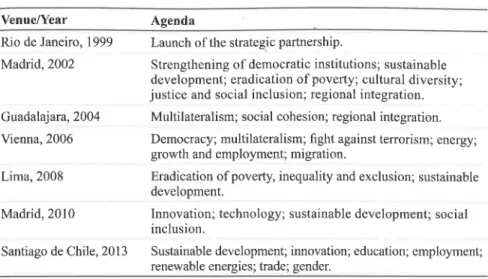
EU-LAC Interregional
Meetings
1999-2013Venue/Year Agenda
Rio de Janeiro, 1999
Madrid,2002
Guadalajara,2004 Vienna,2006
Launch of the strategic partnership.
Strengthening of democratic institutions; sustainable development; eradication of poverly; cultural diversity; justice and social inclusion; regional integration. Multilateralism; social cohesion; regional integration. Democracy; multilateralism; flght against terrorism; energy; growth and employment; migration.
Eradication of poverty, inequality and exclusion; sustainable development.
Innovation; technology; sustainable development; social inclusion.
Sustainable development; innovation; education; employment; renewable energies; trade; gender.
Lima,2008
Madrid,20l0
Santiago de Chile,2013
Aiming
for a more ambitious result, the heads of state and government ofLatin
America and the Caribbean gathered
with
their EU counterpartsin Rio
de Janeiroin June 1999 to lay the foundations
of
a more structured interregional partnership.The
generalgoal
wasto
fosterpolitical,
economic andcultural
understanding, supportedby
the strengtheningof
democracy, the ruleof
law, intemational peace andpolitical
stability. Speciûc goals included the liberalizationof
the multilateraltrade system and the creation of incentives for open regionalism. They continued to
be pursued through subsequent summits
in Madrid
(2002 and 2010), Guadalajara(2004),
Venna
(2006) andLima
(2008).In
addition, they were complementedby
an increasingly expanded agenda (Table 1 8. I ) and negotiations over more concrete
institutional
mechanisms between theEU
and as manyLAC
institutional
actors as possible,including
aPolitical
Dialogue and Cooperation Agreementwith
the Andean Community in2003,2 an Economic PartnershipAgreementwith
Caribbean countries (CAzuFORUM) in 2008, anAssociationAgreementwith CentralAmerica,and Free Trade Agreements with Colombia and Peru, all in 2010. On the other hand, the creation
of
such bodies asEUROLAT
and theEU-LAC
Foundation helped to provide a broader perspectiveofsuch
interactions and to open it up to contributionsfrom
each country's parliamentarians andcivil
society.3 The last variablein
this2
Its continuing non-ratification, however, has dictated its overall inapplicability.3
In
2005, the European Commission tried to boostEU-LAC
relationswith
new guidelines, while synthesizing its goals: increasing political dialogue, creating a climate favourable to trade and investment, and stimulating stability and prosperity in LatinAmerica togetherwith
greater mutual understanding and more effective cooperation (European Commission, 2005). It was updated in 2009 (European Commission, 2009).328 Interregionalism and the European Union
relation would be introduced
in
2011 , whenLAC
countries formalized the creationof
the Communityof Latin
American and Caribbean Countries(CELAC). As
an alleged regionalpolitical
entity
in
its own right, CELAC
thus became the EU,s natural counterpaftin
its
pre-established paftnership,with
the 2013 summit
inSantiago de Chile already reflecting this reality.
Obstacles abounded
though.
The
impact
of
EU's
enlargement,the
debateover
its
ill-fated
Constitution,
the possibility
of
the Andean
Comrnunify's disintegration (accentuatedby
venezuela'sexit)
and the constraintsof
the DohaRound on
multiparty
free trade proposals proveddifûcult
to overcome. Moreoveq despite occasional coincidencein
sensitive issues,a significant hurdles remainedfor
ajoint
approachto
thereform
of
international governance institutions. This induced 'notable shortcomings in the interpretation of the realities of both regions,which
frequently ledto
inadequate labels-
such asLatin American "populism"
or
European
"neo-colonialism"'
(Sanahuja2008).
The
protracted
free
tradenegotiations
with
Mercosur epitomize such interregional ups-and-downs.The difÊculties in reaching a multilateral consensus have led to the occasional focus on bilateral ties between the EU and
individual
countriesin
Latin America.sHowever,
these exceptionsdid not
compromisebloc-to-bloc
negotiationsuntil
2007, when
the
EU
choseto
engage moreactively
with
Brazll. The
argumentwas that,
'Brazil's
demographicweight
and economic developmentmake
it
anatural leader
in
SouthAmerica
and akey player
in
Latin America'
(EuropeanCommission, 2007l.
2).
Seekingto
sidestep Mercosur's internal conundrums andride on the wave
of Brazil's rising
image, a Strategic Partnership was establishedwith
the goalof
increasinghigh-level political
dialogue and helpingto drive
thedialogue
with
Latin America forward. The results failed tolive
upto
generalizedexpectations and, as
if
seeking a balance,the
EU
concededa
similar
'special'status to
Mexico
less than a year later.In the context of summitry proliferation and amidst a myriad
ofjoint
declarations and action plans, gauging the weight (or lack thereof) of specific issues in theofficial
agenda proves
difficult.
Security matters stand out for theirfizzy
conceptualizafion when comparedwith all
the other topics.An
intriguing, albeit non-consensual andnon-committal,
definition can
be
found
in
EUROLAI's own
proposals, whichunderstand security as a concept that 'embodies the defence of human
life
(and not4
A
commonly cited example is theIII
EU LAC
Summit in Guadalajarain
2004, as its final declaration repeatedly endorsed rnultilateralism and reproved torturein
Iraqi prisons. However, the declaration fell short of condemning unilateralism (the word is never rnentioned) and did not name the US as its object of criticism. This should provoke littlesurprise, as that same year four Latin American countries and 13 EU members had troops deployed in Iraq as part of the US-led 'coalition of the willing'.
5
In
1997,for
example, theEU
intensified its cooperationwith
Mexico under a general Economic Partnership, Political Coordination and Cooperation Agreement, which foresaw regular high-level political dialogue and established a free trade area between the two parties. An association agreement following the same model was signed with Chile in 2002.Chatlenging the Political and Security Dimensions of the EU-LAC Relationship 329
the mere survival
of
States), incorporating in a complex and integrated manner theprinciples
for
a hatmonious and balanced co-existence, amongstwhich
are human development, peace and the consen¿ationof
natural ,resources'(EUROLAT,2011:3). The basis
for
such a lackofa
precise definition over what can be labelled as asecurity issue
is twofold,
reflecting both the supremacyof
a singletopic
and theßmptation to encapsulate other sub-securitized dimensions.
Drugs have been at the
forefront of
theEU's
securityconcelïs
towardsLatin
America
since the inceptionof
interregional relations.This
priority
was evident alreadyin
1990, when theEU
grpnted special trade preferences to Andean andCentral American countries under the Generalized System
of
Preferences (GSP) Drugs mechanism, which promoted the replacement of coca cultivationwith
other agriculfural products.6 Thispriority
has remained unaltered due to the significant cocainetraffrcking
flows
emanatingfrom
Latin America
andinto
Europe'
Thelatest
EU-CELAC Action
Plan
for
2013-15
continuesto highlight the 'world
drug problem'
and
urgesthe
strengtheningof
interregional dialogue and
the effectivenessofjoint
efforts (Council of the EuropeanUnion,
2013al.9).7At
the
centreof
the transatlantic response,the
EU-LAC
Coordination
andCooperation Mechanism
on
Drugs,
createdin
1998, standsout
asa
seriesof
recurringhigh-level
meetings that have set the tonefor
each cooperation projectin
recent years. The 2007 Port-of-Spain Declaration,in
pafticular, enshrined themutual
understandingof
sharedresponsibility,
a
balancedand
evidence-basedapproach, and compliance
with
international law, including
respectfor
humanrights,
asthe
threemain
pillars for
anyjoint
action (Council
of
the
EuropeanUnion, 2007).lnturn,
the most concrete result of this dialogue can be found in thecooperation
Program on drug policies betweenLatin
America and the Europeanunion
(coPoLAD),
officially
establishedin
2011 and structured aroundfour
components, namely: (1) capacity-building to reduce both supply and (2) demand,
(3)
the
consolidationof
national
drugs observatories and(4)
the interegional
dialogue mechanism.s
Despite
the
emphasison
drugs,other
dimensionsof
(in)security
have beenincluded under the
EU-LAC
partnership'sthematic
fold. Citizen
security,for
instance, has recently garnered considerable attention.e Generally considered to be
6
Since 2005 onwards, GSP Drugs has been absorbed by GSP+.7
A
slight decrease in drug seizures over recent years has been observed. However, this reduction can be attributed to the existence of new entry routes via Western Africa(United Nations Offrce on Drugs and Crirne, 2011).
8
Other noteworthy initiatives include the programme on tl.re preventionof
the diversion of drug precursors in the Latin American and Caribbean region (PRELAC) and the programme for combating illegal drugs in the Andean Community (PRADICAN). Fora complete listing of anti-drugs projects with LAC pâftners funded by the EU, see Gratius (2012).
9
Such concept is, in itself, an upgrade of previous notionsof
'public security', as envisioned by the EU-CELAC's Final Declaration in Santiago de Chile, 2013 (Councilof
the European Union, 201 3b).330 Interregionalism and the European Union
incited
by
organized crime, gang activities and widespread violence; governanssand
rule
of
law
deficiencieslike
corruption, lack
of
institutional
resources andunfair
taxation; and underlying economic and social factors such as poverty and social inequality,it
reached itsformal
peakwith
the newEU
Strategy oncitizen
Security
in
central America
and the caribbean, approvedin July
zola
(councii
of
the
Europeanunion,
2014c).Food
securify has alsorisen
to
n"*
l"u.l,
of
visibility,
mainly due to the proceedings emanatingfrom
theRio+20
Summit andpromptly
adoptedby
the nearby region as apriority
(EUROLAT,
2014;council
of
the Europeanunion,
2013b:5).
Environmental security and the securitization of migrationflows
fromLAC
countries to Europe have also madetheir
way ontothe agenda, thus underscoring the
wide
net castin
termsof
security issues overthe years.
Hence, a conceptually ruzzy and substantially broad interpretation
of
securityhas taken root in
EU-LAC
relations. Yet, geographicaluni-directionality
is patentas securify issues tend
to
be consideredonly
whenthey:
(1)
originate
in
Latin
America
and the caribbean and(2)
affect European interests.In
other words. asasymmetry prevails, spaces in-between are neglected.
The
Lafin
American
Perspectivesr0Historically,
there have
beentwo major
institutional
mechanismsto
resolveinterstate security disputes in Latin America, both of which include extra-regional countries. The
Inter-American Treaty
of
Reciprocal Assistance(TIAR),
signedin Rio
de Janeiroin
1947,commits
signatoriesto
mutual
defencein
the eventof
an outside attack.The organization
of
American
States(oAS),
sponsoring institution of theTIAR,
was çreatedin
1948 to promote cooperation in the vy'estern Hemisphere.rrAlthough
both theRio
Treaty and theoAS
arestill
in
effect,their
relevance
in
high-stakespolitics in
the region is arguable. The refusalof
theus
to uphold
theTIAR
during
the Malvinas/Falklandswar,
siding
insteadwith
itshistoric
European ally, worked as an eye-openerfor
some Latin American elites.Henceforth, the mernbership
of
theus
in
theoAS,
aswell
as the locationof
its headquarters in washingtonDC,
haveleft
many Latin American administrations unconvincedof
the neutrality
of
the
organization.This
scepticisrn intensifiedin
the 2000swith
theelection
of
several centre-left governments across south America.However, as previous mechanisrns receded, others carne
to
be. Theunion
of
South American Nations (LTNASUR),
for
instance, was establishedin May
200gand can be seen as the skeleton
of
an autonomous SouthAmerican
governancestructure,
with
defenceand security
issues groupedunder
the
supervision
of
l0
This section draws partially on Malamud and Alcañiz (2014).I
I
The oAS is a successor of the Pan American union (pAU), which originated in a series of International Conferences of American States at the tum of the twentieth century.Challenging the Political and Security Dimensions of îhe
EU
LAC Relationship 331its
interministerial South American Defence
Council
(SDC).''?The
Brazilian
president
Lula
da Silva and hisMinister of
Defence, Nelson Jobim, launched the SDC proposal during a statevisit
to Argentina in February 2008, butit
only gainedtraction after the
Colombianattack on a FARC guerrilla
campin
Ecuador thefollowing
March. Jobim thenvisited
several South American countries to garnersupport and the SDC was eventually established
in
Ðecernber 2008(Weiffen
eta1.,2013).Although
it
is embedded intoUNASUR's
structure, its founding statute asserts thatit
is
also subordinatedto
theprinciples
and putposes established by theLìN
Charter and the OAS Charter: so muchfor
nationalistic ornativist
drifts.The main goals of the SDC are to consolidate South America as a zone of peace, to create a common identity on defence matters and to strengthen regional defence cooperation. Ideological rhetoric notwithstanding, the project does not envisage a
common defence policy, even less a
military
alliance(Amorim,
2013).On the other hand, both Mercosur and
UNASUR
include democratic clausesthrough
which
member govemmentsmay
interveneif
aMember
State revertsto
authoritarianism. Intervention
mechanismsrange
from the
suspensionof
membershipto
the
imposition
of
economic
sanctions. Procedurally,the
twoorganizations
allow
for high-level consultations and direct presidential diplomacyamong
members.This
becameevident
in
2012, when
Paraguay's PresidentFemando
Lugo
was removedfrom
office
through a controversial impeachment.Mercosur and
IINASUR
served as forumswithin
which the presidents debated onhow
to
proceed. Thefinal
decision wasto
invoke the democratic clauses,which
resulted in the temporary suspension of Paraguay from the
two
organizations.Continued reliance
on
multilateral
structures
is
not
without
motives'South
American
organizations arevirtually
costless, as host countriesfund
the corresponding headquarlers, each Member State paysfor
its own travel expenses,and common
budgetsare
non-existent(as
in
IINASUR) or
negligible (as in
Mercosur).
Moreover,all
arefully
intergovernmental.They lack
supranationalprocedures because
national
sovereignty remains
the utmost principle
andorganizingrule. Regional integration thus remains shallow, and
it would
be more accurateto call
it
regional
cooperation instead(Malamud
andGardini,
2012).Intergovernmental
institutions
offer a
different
setof
incentives and resourcesfor
member
statesseeking
to
influence neighbours'
policies,
among which
presidential diplornacy stands
out (Malamud,
2005).Informal
involvement and shuttle diplomacy have also been usedwithin
regional organizations or in bilateraland
multilateral
operations to diffuse occasional crises (Burges,2010; Mares andPalmer,2012).
Regional cleavages have always been at the core
of
continental interactions.Indeed, since
the
mid-1990suntil
the
creationof
CELAC, a practical
divorce between SouthAmerica
and Central,¡|JorthAmerica was
not only
evident
but was also promotedby
political
elites, especiallyfrom
Brazll'
But
evenwith
the12
The political rootsof
UNASUR can be traced back to the cusco Declaration, signed during the 3rd South American Sumrnit in December 2004.332 Inîerregionalism and the European (Jnion
new overarching forum. other points
ol
lracture have risenrecentlv
F,Chile.
Colornbia. peru andMexico
esrabtishedrh"
p;ifi;;t;;"'; ;ïåìiîîi
the
twofold
goal ofpromoting
free trade andbuilding
closer relationsmainly
chiná.
Just ãs the free-ma.ket orienrationof
rhebloc
,"r,
i,
llth
*tiu,
Mercosur,its
geographical orientarionpulls
it
awayfrom
Europe
,,ffill,i::
of
Brazil's
materialpower
andthe
emergenceof
anti-colonialist
stancesì"'ï:
Bolivarian
axis (i.e.Bolivia,
Ecuador and venezuela) have also fed an .aloofness
from the west. The
agreement betweena
chinese
,r;;r"::itii:
Nicaraguan government
to
build an
inter-oceanic canal
in
Cèntral
A,r".i.i
ultimately
erodes theEU
influence over its one-time most important cooperationrecipient in the Americas. Lastly, the recent
uS
opening tocuba
further tl.,.eut.ns to reduce the EU persuasionin
the Caribbean.Looking closely
to
thematic areas,it
is
visible how the
actionsof
singularstates overshadow
or
even overstep regional structures. Regarding arms control,for
example, afew Latin American
states have had a significant presencein
theNuclear Non-proliferation
Regime(NpR)
sinceits origin in
the
late
1950s. Infact,
when
the
International
Atomic
Energy
Agency (IAEA) was
created in1951
,
Brazll
andArgentina
secureda
coveted seaton its
Board
of
Governorsby striking
a dealto
alternate theposition
on an annual basis-
even though thegovernorship was
limited
to one state per (developing) region(Alcañiz,
zooo;. tnthe
1960s, when thelrN
created the comrnittee on Disarmamentin
order to draft an international agreementto
curb theproliferation
of
nuclear weapons,Brazil
was one of
its
I 8 members.During
the I 970s,Brazil
made considerable advancesin
nuclear energy development, aidedby
amajor
commercial parlnershipwith
west
Germany. Despiteits
high proflle
in
non-proliferation affairs,
the country maintained a strained relationshipwith
the 'western leadersof
theNpR
(theus
and its European allies) due to its rejection
of
a double standard in the 1970 Non-proliferation Treaty (NPT), whereby stateswith
nuclear weapons remained armed andonly
the non-nuclear weapons states committed to disarmament.Brazil's
stance
is
parlicularly
relevant.
Becauseof its
sheer
weight, it
contributes decisively to the setting
ofregional
standards. In the lasttwo
decades,Brazil's
successive administrations have pushed an agenda that has transformedLatin
America's
self-perception
by
splitting
the
region
into
competing organizations (Santander, 2014). LTNASUR, in particular, has become an integral partofBrazil's
strategyofusing
regional integration as a springboardfor
global influence. However, the Brazilian notion of the region has gradually changed fromasset
to
burdenin
the last decade, as potential synergies lost steam and negativeexternalities increased
(Malamud,201l).
correspondingly, the mission assigned to theBrazilian military
also evolved.As
expressedin
the National Defencepolicy,
the
National
Defence Strategy andthe
Defencewhite
Book,
themajor
currentthreat resides
in
the escalationof
neighbours'domestic conflicts that could resultin
the interventionof
external actors-
that is, theuS.
Thus,by institutionalizing
security relations,
aspromoted
by the
SDC,
Brazil
seeksto
forestall
ad
hocregional responses to crisis and avoid extra-regional interventions (Spektor, 20 I 0).
Challenging the Political and Security Dimensions of the
EU
LAC Relationship 333This position
is
also reflectedby
the
low priority
attributedto
the
sectorialsub-rnechanisms established
with
the EU,
namely
the Political
Dialogue
on bisarmament andNon-proliferation
and the High-Level Dialogue on Intemational peace and Security. Even though supposedly focused on high-end internationalsecurity issues,
their
irregular
calendarof
meetingsis only
matchedby
their
respective
negligible
results(Vivet
and Lalande, 2014).But
even
if
Europe is snubbed as a region, someindividual
Member States arestill
consideredworthy
oartnersfor
technology transfers. Indeed, the extensive purchasesof
French and iswedishrnilitary
hardwareby Brazil in
recent years,ranging
from
helicoptersto
nuclear submarines,prove that any
pretensionsrift
is
merely played out
on thepolitical
and strategic domain rather than impacting or constraining economic transactions.In a nutshell, the West
-
which,
conflating the US and theEU,
is thought of as theNorth from
a Latin American vantage point-
might
be patted on the backin
ofiñcial speeches, but
it
is neither considered aprioriry
paltner nor isit parlicularly
welcomed in the
vicinity
of the larger South American powers.Issues in-between,
or
theAtlantic
Rift
European
drug-fuelled
concernsand
Latin
American
unipolar
spikes aside, afurther continental
split
has recently developed, althoughit
is one that, this time,distinguishes maritime areas, namely, the South
Atlantic from
the NorthAtlantic.
In
the wordsof
CelsoAmorim,
the longest-seruing ForeignMinister
in
Brazil's
history and Defence
Minister
at the time ofwriting:
In recent years, there have been frequent atternpts to 'subsume'the SouthAtlantic
into a more general 'Atlantic issue'. But this is incor¡ect: the South Atlantic, frorn a political rather than strictly geographic perspective, is a distinct reality
and we are interested in keeping it so. The South Atlantic is neatly different from
the Nofth Atlantic, arena of a rnilitary alliance that is characterized, among other factors, by the presence of nuclear weapons. We can respect other initiatives, and nothing prevents us from cooperating with other countries, but we should bear
in
mind the very clear notion that the South Atlantic-
just like
SouthAmerica
constitutes a specific reality, different from others. (Even in Latin America, which we always use as a broader term, there are different geopolitical situations from those of South America, although we can and should cooperate also in that arena. We just cannot forget that our area of geopolitical interest is South America and our South Atlantic extension.) (Amorim, 2014:7-8).Such an outspoken position over a geographical area
with
clear ramificationsfor
Europe reflects a willingness to both assume yet another leading role in reframing South