adaptation to climate change
in Brazil: the role of private
investment
1
P
eter
H. M
ay
and
V
aléria
da
V
inHa
Introduction
I
n 2008, the nGo vitae Civilis published the research “Panorama de Atores e Iniciativas no Brasil sobre Mudanças do Clima” (overview ofPlay-ers and Initiatives on Climate Change in Brazil), identifying government institutions, universities and research centers, civil society and private sector or-ganizations engaged in the topic of climate change. at the time, the issue of adaptation was recognized in speeches, but not in concrete mitigation actions. three years later, actions and investments in adaptation measures have shown significant progress, thus reflecting the intensification of the adverse effects of climate change on different ecosystems and countries at different levels of de-velopment, increasing the perception that mitigation measures will not be suf-ficient to restrain the pace and extent of these impacts. therefore, the issue has been formally incorporated on the agenda of public and private actors.
But how to identify adaptation actions and distinguish them from those aimed at mitigation? How to assess their nature and temporality; their con-straints and difficulties? Can they be traded in any market, like carbon? Will there be sufficient resources for adaptation? these are all new questions, diffi-cult to answer, but we believe that mapping the trend of investment and financ-ing in projects with a high climate change adaptation component provides a powerful indicator of the effectiveness and reach of putting speech into practice.
What follows reproduces the results of a comprehensive survey sponsored by WWF-Brazil, with the aim to support future climate adaptation programs and actions by prioritizing initiatives at the implementation stage and not only at the conceptual and rhetorical level, in the public and private sectors and in all segments.
resource, and on two variables that have proven highly effective for the adapta-tion of agriculture in Brazilian regions particularly vulnerable to climate change:
agroecology and river basin (with an emphasis on micro-basin). the choice of
this focus helped identify alternatives and projects which, even if not named as such, are adaptive in nature, among other reasons because they rely on produc-tive systems recognized for their greater resilience and functionality, such as agroecological methods.
The conceptual problem
unlike “mitigation”, the term “adaptation” has not found a single, pre-cise definition. In the national Policy on Climate Change (2008) it is defined as “a set of initiatives and strategies that enable adaptation in natural or man-made systems to a new environment, in response to present or expected climate change.”
For purposes of this article, the definitions used by the Ministry of envi-ronment (MMa / sBF, 2007) have been chosen as guiding principles, as they are more focused on practical results and incorporate the different types of adap-tation as defined by the IPCC (2007), namely: anticipatory and reactive adapta-tion; private and public adaptaadapta-tion; and autonomous and planned adaptation.
Adaptation - adjustment in natural or human systems to a new or
chang-ing environment. adaptation to climate change refers to adjustment in natural or human systems in response to actual or expected climatic stimuli or their effects, which reduces harm or exploits beneficial opportunities (MMa / sBF, 2007).
according to the IPCC (2007), there are several categories of adaptation, with an emphasis on spontaneous adaptation, anticipatory or proactive adapta-tion, and planned adaptaadapta-tion, whether private or public. autonomous or spon-taneous adaptation is adaptation in which extreme events have already begun to occur. anticipatory or proactive adaptation regards actions that governments and societies adopt before the impacts of climate change are observed. Planned adaptation is adaptation resulting from political decisions, such as the national Climate Change Plan and state Climate Change Plans.
Based on the gaps pointed out in the literature, the following selection criteria were prioritized: projects that increase the resilience of natural ecosys-tems and the climate and water security of the population; projects that reduce regional vulnerabilities through the protection and/or restoration of water re-sources, generally adopting the river basin as the preferential unit of analysis.
Situating the debate on climate change adaptation
In its 4th assessment Report, the Intergovernmental Panel on Climate Change (IPCC, 2007) – a group established by the un and the World Meteo-rological organization in 1988 involving 2,500 scientists from more than 130 countries - was adamant in stating, with a of 90 percent margin of certainty, that although global climate goes through natural changes, the increase in green-house gas emissions from anthropogenic sources affects its balance and recom-mending immediate preventive action. the IPCC (2007) makes a negative as-sessment of the progress achieved in adaptive capacity and increased resilience, since the principles of sustainable development were launched in 1987, in the Brundtland Report.
While recommending the combination of mitigation and adaptation strat-egies, the IPCC states that the first will always be necessarily complementary and can neither replace nor reject adaptation measures. according to the document
even the most stringent mitigation efforts cannot avoid further impacts of cli-mate change in the next few decades, which makes adaptation essential, particu-larly in addressing near-term impacts. Long term unmitigated climate change would likely exceed the adaptation capacity of natural and human systems (ibid, p.20)
the great repercussion of this report helped put adaptation at the core of the debate on climate change in the context of multilateral agreements, while confirming the low technological and financial capacity of poor non-industrial-ized countries to address climate variability, as already pointed out in the pre-vious report in 2000. therefore, the national development process would be conditional, to a great extent, on the success of adaptation actions.
In its assessment of the literature devoted to climate change and its im-pacts in Brazil, the document economics of Climate, one of the most compre-hensive studies on the subject, concluded that technical and economic analyses of adaptation are very limited (dubeux & Margulis, 2010). the study attributes this gap to the complexity in conceptualizing adaptation, especially from an economic standpoint, given the difficulty to separate adaptation measures from general development actions, as well as to the high degree of uncertainty in-volved, since “it is necessary to adapt without knowing for sure what to adapt to” (ibid, p.44).
emphasizes the importance of working with vulnerabilities, especially of water resources, as climate change will make water supply increasingly less possible and reliable, requiring urgent adaptation measures. By analyzing the gaps in the state-of-the-art mapping of vulnerabilities, the document criticizes the lack of efforts to understand the resilience of natural environments (especially fresh-water), while recognizing that social vulnerability is well known. the fact that vulnerability studies prioritize urban areas rather than river basins is a serious flaw, because it precludes an overall view, which is a necessary precondition for governments to act before the occurrence of tragedies such as those in the Itajaí valley, in santa Catarina, and in the mountain region of Rio de Janeiro (WWF, 2009).
there is consensus among scholars that adaptation measures must address vulnerabilities from a systemic perspective, in which the ecological, geophysical and socioeconomic dimensions have equal weight, given its multi-causal and non-linear nature. Consequently, public policies should include coordinated planning actions by seeking to act within the limits of mainstreaming in differ-ent sectors (agriculture, energy, transport, forestry, etc.), and seek to integrate existing land management policies and instruments with those targeted specifi-cally at climate change. In this regard, WWF (2009) prioritizes the coordination and integration of plans for territorial planning, land use and occupation, river basins, urban planning and ecological-economic zoning.
When focusing on the impact of climate change on different sectors, a greater chance for synergy is observed in the agriculture and energy sectors, largely because there are more data on them, which enables comparing the costs involved in adaptation measures with the benefits generated (representing a re-duction in damages). at the other extreme, forest biodiversity and the coastal zone are mentioned as the segments with the largest gaps in terms of primary information and technical-scientific knowledge, resulting in a weak analytical basis for the definition of adaptation actions (dubeux & Margulis, 2010).
unfortunately, the environment of uncertainty and ignorance about the resilience of ecosystems, and the “tipping points” or thresholds associated with changes in these systems will always be obstacles to the development of effec-tive adaptation policies. at first glance, it seems prudent to err on caution, since the unintended or unpredictable consequences of human activities can lead to irreversible losses, causing damage to human well-being.
Adaptation and public investment
nicholls, 2011). therefore, the issue of adaptation becomes a central theme in development planning among these populations and a reflection of their greater organicity in national public policies.
Brazil’s position as a major global source of both raw materials for the in-dustry and food, contributes decisively to divert the adaptation issue from focus of macroeconomic and development policies. If anything, the issue is addressed at the state or regional level, with emphasis on southern states, particularly santa Catarina, and on some areas of the semi-arid northeast, which are the most fre-quent victims of extreme weather events. In the amazon, in turn, initiatives in this direction are virtually non-existent, although it is a biome globally recom-mended for protection, particularly because deforestation refuses to stabilize at a level that would allow it to maintain its resilience and ability to sustain a satisfactory level of natural regeneration.
scholars of climate economics are unanimous in pinpointing the semi-arid regions and the amazon as two biomes heavily impacted by economic growth. the degree of vulnerability to the effects of short- and long-term climate change is so high in the amazon and in the northeast, that some studies already accept the hypothesis that part of the populations of those areas will have to migrate elsewhere (MMa / sBF, 2007; dubeux & Margulis, 2010).
as the results of adaptation policies adopted in the present will occur mostly in the future in addition to not being compatible with the political and electoral calendar, a profound asymmetry is observed between the costs and benefits of public policies. one of the strategies to overcome these difficulties and attract governments to invest in adaptation projects would be to prioritize local initiatives, structured in a way that would enable generating short-term benefits as well. From this perspective, innovation would play a key role by of-fering products and processes specifically designed to meet this goal. However, the main national science & technology programs2 are not perceived as being
seriously engaged in the study of the effects of climate change, which is gener-ally covered by nGos of an agroecological orientation and in segments that are active in the niches of scientific and technological production and/or rural extension, such as the so-called social technology.
It is worth reflecting on the reasoning behind the recurrent hypothesis that adaptation costs are extremely high. several initiatives have been identified showing that the cost of adaptation can be much lower than originally thought, among other reasons because specific actions using low-cost technology are known to generate extended benefits, conditional on the implementation of institutional arrangements suitable for producing shared/co-responsible man-agement in an appropriate geographic and territorial space.
one of the iconic products of this niche is the cistern,3 the preferred
northeast was possible owing to the one Million Cisterns Program implement-ed in 2003 by the articulation in the Brazilian semi-arid Region (asa), which brings together 700 civil society organizations around the proposal “living with the semi-arid”. the program, which entails installing cisterns and other rainwa-ter warainwa-ter collection systems in small family and community units, has built more than 300,000 cisterns to date, benefiting about 1.5 million people.4
Methodological approach
an adaptation project is understood as each and every project that aims to tackle simultaneously, in the immediate and long-term, the asymmetries and weaknesses of a given population and/or ecosystem that contribute to keep them in a position of borderline or extreme vulnerability, while seeking to strengthen their resilience.
We agree with the CaRe concept whereby the development of the adap-tive capacity of human systems is “a process that requires the involvement of a wide range of stakeholders acting at multiple levels in virtually all sectors.” thus
this involves both analysis of current exposure to climate shocks and stresses, and model-based analysis of future climate impacts. It demands an understanding of existing vulnerability amongst individuals, households and communities, as well as their institutional, political, social and biophysical environment. (CaRe, 2011)
the research whose results are summarized below mapped the mecha-nisms, models and strategies, directly or indirectly related to climate change adaptation in all productive and financial segments, both public and private, as well as in major non-governmental, national and international organizations. However, within the scope of this article, only the results concerning the role of the private sector will addressed.
Based on the results of these studies, our research prioritizes the following criteria:
• Projects that increase the resilience of natural ecosystems and the cli-mate and water security of the population;
• Projects that reduce regional vulnerabilities based on the protection and/or restoration of water resources;
• the river basin as the preferred unit of analysis; and
• efficient management systems, particularly agroecological and agro-forestry methods.
The ambiguity of sector plans and actions
Law no.12187 of december 29, 2009). since then, the Brazilian state has rec-ognized its responsibility in reducing the impacts of climate change by focusing its actions especially on mitigation measures imposed on the economic sectors.
as stated in PnMC, each sector should prepare its own sector plan. a particularity of the Plan is this division, by sectors, between mitigation and ad-aptation actions. the only sector in which measures on both fronts have been recommended is agriculture. other sectors suitable for adaptation are: health; water resources; coastal and marine zone; human settlements; and natural eco-systems, while the mitigation focus is on forests; energy; waste; buildings; in-dustry; transportation; and agriculture. In compliance with this decision, the agriculture sector Plan took the forefront and was released on May 17, 2011. It is being called the Low Carbon agriculture Plan (aBC Plan), and will be detailed later in this article.
When surveying the hundreds of projects and programs whose goals in-clude addressing climate change, it was observed that the frontier between miti-gation and adaptation is not strict, since in most of such projects and programs there is a combination of these actions, which although not always clearly stated indicate the concern of the proposing institutions about becoming familiarized with the adaptation issue as a way of being prepared to manage the increasing risks of climate change effects, without relying solely on the possibilities result-ing from mitigation (May & vinha, 2011).
one of the clearest examples is the semi-arid northeast, where geomor-phologic and climatic conditions force any development project to choose water as the main resource. this is why most of the projects implemented in that re-gion have for some time been adaptive in nature, such as those of the Ministry of national Integration aimed at risk prevention, although under a different name.
another example of adaptation model is the agriculture sector plan. the aBC Plan (Low Carbon agriculture) introduced in 2010 by MaPa adopts the concept of integrated agriculture-Livestock-Forest system developed by eM-BRaPa in partnership with the Fao and IICa, which consists in combining agricultural, forestry and livestock activities in promoting the recovery of de-grading pastures. this model, probably inspired by the principles of agroecol-ogy, can be considered within the range of public funding options as a transition mechanism towards adaptive agriculture, based on the systemic logic of the most efficient land productivity methods.
main adaptation measures, understood from an integrated perspective, aimed to promote improvements in social conditions (housing, food, health, education) and income and employment generation.
However, the climate scenarios in which these actions will be implemented need to be known, since it is there that regional vulnerabilities will be mapped. Ideally, for the PnMC these se scenarios should be available starting from 2009 as a result of investments in climate modeling by the InPe. other adaptation measures highly recommended in the PnMC include developing warning sys-tems and investing in protective structures against floods and in water supply for humans. Regarding the latter, several funding modalities were identified, many of them following traditional action models, but also innovative institutional ar-rangements supported by public-private partnerships, with the active participa-tion of the banking sector, as described below.
The river basin as a territorial unit for adaptation measures
Gradually, river basin consortia and committees in Brazil are adjusting to the theme of adaptation. of the 70 of such entities surveyed, about one third develop actions or projects specifically focused on adaptation, and most report ongoing initiatives, generally within the area of a river basin, thereby confirming the aforementioned hypothesis that adaptation actions occur on a local scale.
From the physical standpoint, a micro-basin is a geographical unit bound-ed by a drainage network (streams) that flows into a main river. Considering the geographical aspect alone, the definition of micro-basin is not different from that of river basin, and may even be classified as a small river basin. the differ-ence is that the micro-basin is associated with the implementation of sustainable development programs, the beneficiaries of which are rural communities. Inte-grated water and land conservation actions within micro-basins in rural areas are generally developed along two distinct lines: a) demonstration projects in se-lected areas, adding knowledge about successful preventive practices or practices aimed to recover degraded areas; b) dissemination of projects and experiences already implemented, with the potential to be converted into public policy.
WWF advocates the thesis that the river basin acts as a “natural infrastruc-ture” and that conserving it requires implementing good governance measures focused on resilience, based on the definition of general adaptation guidelines at the national level and of specific guidelines at the regional level, as well as on the adoption of cross-cutting ancillary strategies in the areas of education, commu-nication, training, networking and fundraising. With regard to monitoring, the entity proposes the definition system adaptability Indicators, such as indicators of risk/vulnerability reduction; indicators of increased environmental and social resilience; and economic indicators among others (WWF, 2009).
have been structured for some time and payment has been implemented, their actions are planned and efficiently executed. But these cases are still a minority and concentrated in the southeast Region, where civil society is better orga-nized.
Criticism of the meager results of consortia is focused on two fronts: the need to overcome the rural area-city opposition, in order to strengthen the partnership between urban and rural populations (ortega, 1997); and the rec-ognition of its legitimacy in policy formulation and management, which entails political learning by social groups, so that they can take advantage of the demo-cratic mechanisms offered by consortia to plan long-term actions (Jacobi et al., 2002).
In turn, there is a proliferation of adaptation initiatives in specific proj-ects implemented in river basins and leveraged by the consortia to which they belong. a good example was the selection of the Projects for adaptation to Climate Change developed in 2010 by the solidarity Institute, linked to HsBC. It is not by chance that half of the six projects selected are targeted at a territory defined as a micro-basin or sub-basin (HsBC, 2008-2010).
Funding sources for adaptation to climate change
as noted in the first part of the article, some priorities were elected for the analysis of funding for adaptation, namely: emphasis on water conservation and/or production, and on agro-ecological and agroforestry systems, with a riv-er basin approach. It is assumed that agroecological methods have proven bettriv-er in promoting resilience in ecosystems that are more vulnerable to the effects of climate change, particularly in regions where water is the scarcest resource. therefore, the analysis that follows covers only initiatives within this scope.
National Program for the Strengthening of Family Agriculture (PRO-NAF)
Created in 1996, PRonaF is the main instrument of support to fam-ily agriculture. executed by the Ministry of agrarian development (Mda), it aims at strengthening productive income-generating activities of family produc-tion units, through rural credit facilities suitable for their needs. It funds either individual or collective projects that generate income for farmers and agrarian reform settlers, by offering the lowest interest rates on rural loans and the lowest delinquency rates among all credit systems in the country. Credit is operation-alized by the financial agents that make up the national Rural Credit system (snCR) and are grouped into basic institutions (Banco do Brasil, Banco do nordeste and Banco da amazônia) and associated institutions (Bndes, Ban-coob, Bansicredi and members of FeBRaBan).
infrastructure; 2) Agroecology: projects on agroecological or organic production
systems, including the costs of project implementation and maintenance; 3)
Forestry: projects on the implementation of agroforestry systems; 4) eco: projects
on environmental and renewable energy technologies, forestry, water storage, small hydropower facilities, and conservation practices and measures to correct soil acidity and fertility.
Analysis of projects funded by the private sector
to identify trends in relation to adaptation projects designed by the pri-vate sector, a survey was conducted with major Brazilian companies. the fol-lowing criteria were used in selecting the sample: publication of a sustainability Report based on the GRI (Global Reporting Initiative) and participation in one or more of the six water-intensive industries (energy, Mining, Pulp & Paper, steel, Beverages, Cosmetics - due to their great dependence on biodiversity as-sets -, and Financial services for its role in financing adaptation projects).
twenty-three companies with projects that fall under climate change ad-aptation were selected, including: aes eletropaulo; aes tietê; alcoa; amBev; Banco do Brasil; santander Bank; Bradesco; Celulose Irani; Citibank Brazil; Co-ca-Cola Brazil; Copel; CPFL energia; eletrobras eletrosul; eletrobras Furnas; HsBC, Itaipu Binacional; Itaú; Klabin; natura; usiminas; vale; and votorantim.
Based on the analysis of GRI reports, 40 projects/funds with an impact on adaptation were identified and analyzed according to the following criteria: geographic focus; nature of the impact on adaptation; operational focus; and use of implementing partners. only 18 of the 40 projects/funds published their budgets. the amounts ranged from R$0.5 million to R$200 million, with the average around R$26.7 million.
the nature of the impact was classified as direct, when the project directly contributed to climate change adaptation (recovery of riparian vegetation, slope protection, development of alternative activities for vulnerable populations, etc.); or indirect, when its contribution to climate change adaptation was indi-rect (training of multiplying agents, studies and publications, educational pro-grams, etc.). similar to what was found in public funding agencies, not always the goal of direct impact projects is explicitly adaptation. It is common to find mitigation projects which also include adaptation actions.
table 1 – Budget and number of projects by nature of Impact and Region *
Scope Nature of Impact
Region Direct Indirect Total
# projects Budget # projects Budget # projects Budget
South 4 0 4 0.8 8 0.8
Southeast 9 40.2 2 0 11 40.2
Central-West 3 1.2 0 0 3 1.2
Northeast 0 0 4 0.6 4 0.6
North 5 357.0 2 2.9 7 359.9
National 4 24.4 3 0 7 24.4
Total 25 422.8 15 4.3 40 427.2
*Budget in million Reals.
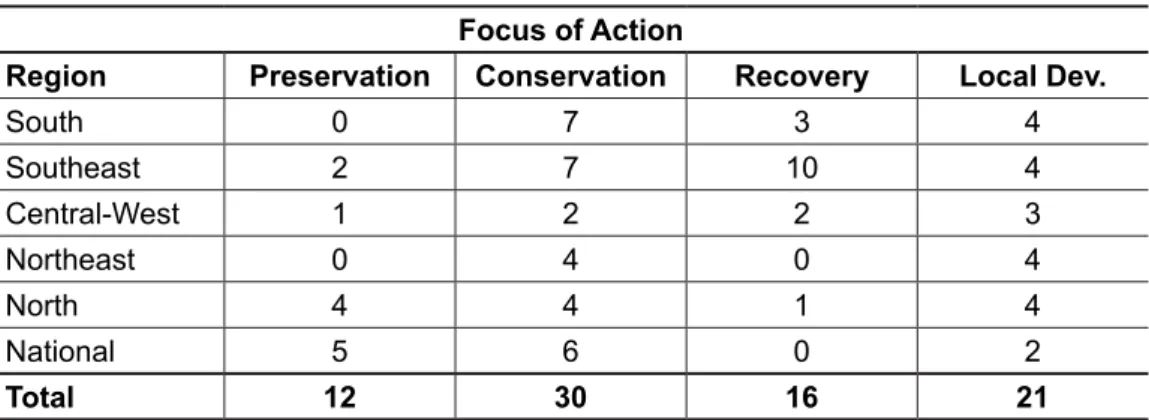
as for the operational focus of the project/fund, the following typology was used, considering that it could be classified under more than one category.
Preservation: ecosystem preservation projects aimed at maintaining envi-ronmental services, with a focus on integral protection.
Conservation: projects aimed at the sustainable use of resources and eco-systems through the conservation of their environmental services.
Recovery: ecosystem recovery projects for restoration of environmental services.
Local development: projects for income generation, training or prepara-tion of vulnerable populaprepara-tions.
table 2 – number of projects by operational Focus and Region Focus of action
Focus of Action
Region Preservation Conservation Recovery Local Dev.
South 0 7 3 4
Southeast 2 7 10 4
Central-West 1 2 2 3
Northeast 0 4 0 4
North 4 4 1 4
National 5 6 0 2
Total 12 30 16 21
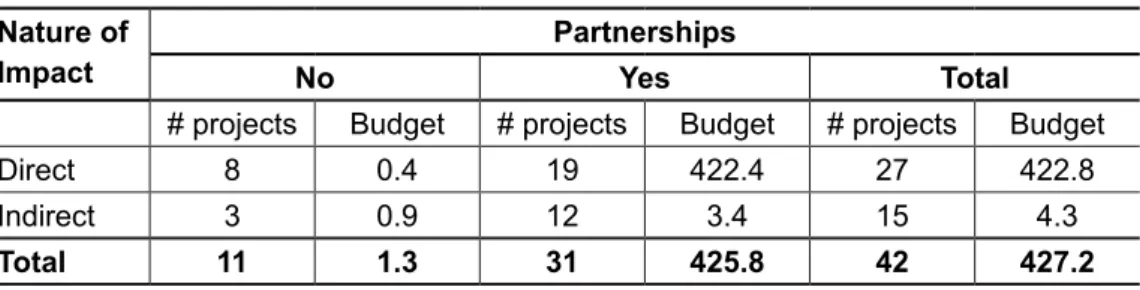
Finally, the paper sought to determine to what extent the funds/projects were implemented in partnership with other organizations. table 3 shows that 74 percent of the projects are implemented by or with partners, both public sector entities and civil society organizations. a qualitative analysis indicates a predominance of relatively known partners. there seems to be a clear opportu-nity for raising funds for these funds/projects, especially for institutions with a qualified technical team and a history of achievements.
table 3 – use of partnerships by nature of Impact*
Nature of Impact
Partnerships
No Yes Total
# projects Budget # projects Budget # projects Budget
Direct 8 0.4 19 422.4 27 422.8
Indirect 3 0.9 12 3.4 15 4.3
Total 11 1.3 31 425.8 42 427.2
*Budget in million Reals.
organizations identified as partners include:
Public Sector: ICMBio; IeF/MG; environmental Police; uFMG; uFRJ;
uFRRJ; usP; esalq; Government of the amazon; Bndes; national Water agency; Government of the state of amazonas; Government of the state of Pará; smithsonian tropical Research Institute.
Enterprises: Itaipu Binacional; eletrobrás; Banco do Brasil Foundation;
Fibria; Coca-Cola; the Climate Group.
Civil society: Brazilian Forum on Climate Change; são Paulo Forum on
Climate Change and Biodiversity; sos atlantic Forest; CI; FunBIo; WWF; thomie othake Institute; ethos; oikos; Bioatlântica Institute; Preservation society of Muriquis; Institute Friends of the atlantic Forest Biosphere; IesB; earthwatch Institute; apremavi; Perene Institute; oréades; Isa; ICv; Fas; Re-lictos Foundation; Imazon; Imaflora; IeB; IFt; tnC; Peabiru Institute.
Final remarks
this article sought to analyze the main vectors of adaptation to climate change, either through actions, projects or initiatives with replication poten-tial or through institutional arrangements. the analysis demonstrated that the binomial water-climate has concentrated most of the funding, and that 2010 and 2011 will be known as the years when the highest number of water- and climate-related initiatives was introduced in both the public and private sector, as recommended by CoP-16.5
reservoirs, the construction of detours that channel water from areas where it is abundant to others where it is scarce, and the extraction of water from aquifers are part of the strategy under development aimed at making water available where and when it is necessary. Furthermore, catching water requires using simple and innovative processes that promote the use of natural sources such as rain water, as is the case of cisterns and underground dams.
the generalized perception among scholars of business strategies related to climate change is that “adaptation solutions are an opportunity yet untapped by the institutions.” they attribute this gap in part to poor stakeholder engage-ment and to lack of transparency, which is necessary requireengage-ment to reduce information asymmetry between groups with different interests and establish a constructive dialogue (FGv-Ces, 2011).
Regarding the initiatives promoted the by public financial institutions mapped, the conclusion is that although still very closely associated with miti-gation, the issue of adaptation is experiencing a fast-growing internalization process, and several initiatives are underway. Because they are very recent, they have not yet yielded results. However, considering that the credit supply in Bra-zil is growing at a rapid pace, everything suggests that there will be funds for programs aimed at adaptation.
this is the time, therefore, to build the baseline and define the monitoring system and performance indicators. But this task does not fall on the financial sector; it depends on the leadership of environmental agencies in close collabo-ration with the academia.
notes
1 the authors thank Renato Maluf (CPda/uFRRJ), Glauco Kimura (WWF) and Gustavo Pimentel (consultant), as well as doctoral candidates Francine damasceno Pinheiro and sandra Kitakawa Lima (CPda/uFRRJ) and Liandra Peres Caldasso (PPed/Ie/uFRJ) for their contributions.
2 on July 7, 2010, the national Research Council (CnPq) released a basic document for the creation of the national Biodiversity Research system (sisbiota-Brazil), with the participation of representatives from CnPq, MCt, FaP, MMa and researchers from various research institutions. With this program, Brazilian s&t agencies inform the academic community of the needs for broad scope research aimed at building the baseline that will enable monitoring the effects of climate change on biomes. distri-buted in three public notices, R$52,060 million will be allocated to finance 36-month projects, on topics relating to capital, costing and grants (CnPq, Press Room, news from 12.21.2010).
4 asa website. available at: <http://www.asabrasil.org.br/Portal/Informacoes. asp?Cod_ Menu=1150>. access: 10 september 2011.
5 Bndes disbursements alone rose 50% (in millions: 2008, R$ 90,877.9; 2009, R$ 136,356.4) between 2008 and 2009. draft decision -/CP.16 - outcome of the work of the ad Hoc Working Group on Long-term Cooperative action under the Con-vention.
References
aLtIeRI, M. a.; nICHoLLs, C. I. o potencial agroecológico dos sistemas agroflo-restais na américa Latina. Agriculturas, v.8, n.2, p.31- 4 June 2011.
ana. Programa nacional de avaliação da Qualidade da Água - PnQa. BsB. october 2009.
BRaZIL. office of the President’s Chief of staff; Ministry of agriculture, Livestock and supply (MaPa); Ministry of agrarian development (Mda). sector Plan for Mitigation and adaptation to Climate Change for the consolidation of an economy in Low Carbon agriculture. Low Carbon agriculture Plan (aBC Plan). Preliminary draft, Brasilia dF, May 2011.
BRaZIL. Federal Government, Interministerial Committee on Climate Change. de-cree no. 6263 of 21/11/2007. national Plan on Climate Change. BsB, december 2008. Center for Weather Forecasting and Climate studies (CPteC / InPe), under the Ministry of science and technology, p.86.
CaRe. What is adaptation to climate change? october 2010. available at: <http:// www.careclimatechange.org/files/adaptation/o_que_e_%20a_adaptacao_a_mudan-ca_climatica.pdf>.
FGv-Ces, uneP. Financiamentos Públicos e Mudança do Clima: análise das estra-tégias e práticas de bancos públicos e fundos constitucionais brasileiros na gestão da mudança do clima. são Paulo: FGv, 2011.
HsBC. Social Investment. Presentation of financed projects. 2008-2010.
HuQ, s. Climate change and the big question we have not yet tried to answer, Interna-tional Institute for environment and development, Parliamentary Brief, april 2007. IIsd – InteRnatIonaL InstItute FoR sustaInaBLe deveLoPMent. Community Based adaptation to Climate Change Bulletin. a summary of the second International Workshop on Community Based adaptation to Climate Change. IIsd Reporting services, 2007.
IPCC, Climate Change 2007: The Physical Science Basis, summary for Policy Makers, February 2007.
IPCC Fourth assessment, Impacts [2007]. Intergovernmental Panel on Climate Change, Climate Change 2007: impacts, adaptation and vulnerability, Working Group II Contribution to the intergovernmental Panel on Climate Change, Summary for Policy- makers, april. available at: <http://www.ipcc.ch/>.
MaRGuLIs, s.; duBeuX. (ed.) Economia da mudança do clima no Brasil: custos e oportunidades. Coordenação geral Jacques Marcovitch. são Paulo: Ibep Gráfica, 2010. 82p.
MaY, P.; vInHa,v. Fontes de inanciamento para adaptação às mudanças climáticas: estado das artes, tendências de financiamento e modelos de projetos. Research Report. WWF-Brazil. June 2011.
MMa/sBF. Interrelações entre biodiversidade e mudanças climáticas. Biodiversity series no. 28. Brasilia, 2007.
MÜLLeR, B. Trust and the future of adaptation funding. nairobi: oxford Institute for energy studies ev38, January 2007.
nCaP – netHeRLands CLIMate assIstanCe PRoGRaMMe. Poverty at
risk, Managing the impacts of Climate Change on Poverty alleviation activities, March 2007.
oRteGa, a. C. A relação rural-urbana na nova forma de governança estabelecida pelos comitês de bacias hidrográicas: o caso do comitê da bacia hidrográfica do rio Paranaíba. economics department, uFu. 1997.
PeW Centre on Global Climate Change, Adaptation to Climate Change, international Policy Options, november 2006.
RaBoBanK BRasIL. Manual de boas práticas socioambientais no agronegócio. são-Paulo, 2009.
_______. Política socioambiental. são Paulo: s. n., s. d.
santandeR. Responsabilidade Social e Ambiental – Global Policy of the santander Group. Mimeo, s. d.
teaRFund/InstItute FoR deveLoPMent studIes (Ids). Overcoming
the barriers, Mainstreaming climate change adaptation in developing countries, tearfund Climate Change Briefing Paper 1, 2006.
uneP. Financing Initiative, Adaptation and vulnerability to climate change: the role of the private sector. Ceo Briefing, november 2006.
unFCCC. Impacts, vulnerabilities and adaptation in developing countries. Bonn, 2007.
_______. outcome of the work of the ad Hoc Working Group on long-term Coopera-tive action under the Convention. draft decision. CoP16, Cancún, 2010.
vItae CIvILIs. Panorama de atores e iniciativas no Brasil sobre mudanças de clima. são Paulo, 2008.
abstract – Given the intensifying effects of climate change and the limitations of
mi-tigation strategies to address them, the issue of adaptation has become increasingly important. this article presents some results of an extensive research that mapped the initiatives and projects implemented by the public sector, non-governmental organiza-tions and the private sector in all sectors of economic activity in all regions of the coun-try, analyzing in particular the fate of the investments of private financial system. It sets out the main vectors of adaptation projects, concluding that the binomial water-climate concentrates most of the financing of this sector, and that the challenges require coor-dination between finance, government and academia.
Keywords: adaptation, Climate change, Water resources, River basins, Private
Peter H. May holds a Ph.d in natural Resource economics from Cornell university and is an associate professor at the department of development, agriculture and society, Federal Rural university of Rio de Janeiro (ddas / ICHs / uFRRJ) and researcher at the national Institute of science and technology in Public Policies and development strategies, (InCt-PPed). @ – [email protected]