may-aug. 2015, Vol. 25, No. 61, 211-220. doi:10.1590/1982-43272561201509
factors (values, personality and goals), while the other stresses the impact of organizational characteristics (culture, work context). Despite the evidence of the isolated contributions of these variables in predicting happiness at work, there is an urge in the literature to focus on the interaction between individual and organizational characteristics (Porto, Tamayo, & Paschoal, 2012). Thus, researchers have devoted their energy to investigate the combined effect of both types of characteristics – individual and organizational – on well-being at work, satisfaction and similar concepts, within
Article
Happiness at Work: Organizational Values and Person-Organization Fit Impact
1Abstract: Despite the large quantity of research on person-organization (PO) it, there is a lack of empirical research using
axiological theories applicable to the value structure at the individual and organizational levels. In this study, we incorporated the PO it literature, Schwartz’ values theory and Warr’s vitamin analogy to evaluate the effect of values’ PO it on happiness at work. Using a sample of 145 questionnaires collected in a military organization, data analyses were performed using hierarchical quadratic regressions and surface analysis of polynomial regressions, conducted at an individual level. Individual values moderated the curvilinear relationship between organizational values and happiness at work (R2 = .25; p < .01). Additionally, agreement between higher levels of values promoted higher levels of happiness at work (.07 ≥ R2 ≤ .18; p < .05). We concluded that axiological PO it affects happiness at work and provide empirical support for Warr’s vitamin analogy.
Keywords: organizational behavior, happiness, theory of values
Felicidade no Trabalho: O Impacto dos Valores Organizacionais e da
Compatibilidade Indivíduo-Organização
Resumo: Apesar da quantidade de pesquisas sobre compatibilidade indivíduo-organização (IO), há carência de estudos utilizando teorias de valores aplicáveis aos níveis do indivíduo e da organização. Neste estudo adotou-se a literatura de compatibilidade IO, a teoria de valores de Schwartz e a analogia das vitaminas de Warr para avaliar o efeito da compatibilidade de valores IO na felicidade no trabalho. Com uma amostra de 145 questionários coletados em uma organização militar, foram realizadas regressões quadráticas hierárquicas e análises da superfície da regressão polinomial no nível individual. Valores organizacionais revelaram relação curvilinear com felicidade no trabalho, sendo essa relação moderada pelos valores individuais (R2 = 0,25; p < 0,01). Adicionalmente, concordância entre elevados níveis de valores promoveram maiores níveis de felicidade no trabalho (0,07 ≥ R2 ≤ 0,18; p < 0,05). Conclui-se que compatibilidade IO entre valores afeta a felicidade no trabalho, obtendo-se suporte para a analogia das vitaminas de Warr.
Palavras-chave: comportamento organizacional, felicidade, teoria dos valores
La Felicidad Laboral: El Impacto de los Valores Organizacionales y del Ajuste
Persona-Organización
Resumen: Malgrado la cantidad de investigaciones sobre el ajuste persona-organización (PO), poca investigación empírica ha utilizado las teorías de valores aplicadas a los niveles individuales y organizacionales. Este estudio incorpora la literatura de ajuste PO, las teorías de valores de Schwartz y de bienestar laboral de Warr para evaluar el efecto del ajuste de valores PO sobre la felicidad laboral. Con una muestra de 145 cuestionarios recogidos en una organización militar fueron realizadas regresiones cuadráticas jerárquicas y análisis de supericie de regresiones polinomiales en nivel individual. Valores organizacionales revelaron relación curvilínea con felicidad, y los valores individuales moderan esa relación (R2 = 0,25; p < 0,01). Adicionalmente, la concordancia entre niveles más altos de valores han promovido mayor felicidad laboral (0,07 ≥ R2 ≤ 0,18; p < 0,05). La conclusión es que el ajuste PO de valores afecta a la felicidad laboral, apoyando la analogía de las vitaminas de Warr.
Palabras clave: conducta organizacional, felicidad, teoría de los valores
1 Paper taken from the primary author’s master’s thesis under the secondary
author’s advice, defended in 2013 in the Graduate Program in Social, Work and Organizational Psychology at Universidade de Brasília.
2 Correspondence address:
Juliana Barreiros Porto. Universidade de Brasília - campus Universitário Darcy Ribeiro, Departamento de Psicologia Social e do Trabalho, Instituto Central de Ciências Sul, Sala AT-013. CEP 70910-900. Brasília-DF, Brazil. E-mail: [email protected]
Juliana Moraes de Sousa Agência Nacional de Aviação Civil,
Brasília-DF, Brazil
Juliana Barreiros Porto2 Universidade de Brasília,
Brasília-DF, Brazil
The differences between employee levels of well-being or happiness at work can be explained mainly by two sets of
the perspective of the person-organization it - PO it (Fisher, 2010; Kristof-Brown, Zimmerman, & Johnson, 2005).
Despite the large quantity of research on PO it, some
aspects of this area have been poorly investigated, resulting in theoretical and empirical gaps, especially concerning
happiness at work (Edwards & Cable, 2009; Kristof-Brown et al., 2005; Warr & Clapperton, 2010). First, there are few studies that assess the impact of PO it on actual happiness
at work, given the supremacy of research on satisfaction
and job-related illness (Warr, 2013). Secondly, despite the
existence of important theoretical assumptions regarding the non-linearity between organizational characteristics (including values) and happiness, there are few empirical
studies investigating this sort of pattern (Warr, 2013). A
non-linear relation in this case would mean that the increase in the levels of positive predictors of happiness can promote the increase of happiness at work levels until a certain optimal point, after which happiness stops growing in the same proportion as before, and sometimes even drops its levels. Finally, in relation to personal and organizational value interactions, there is a lack of compatible models to understand the structure of values. The relevance of a well-structured model of values is also noteworthy since, although the axiological literature has shown different structures for individual (such as personal or work values) and organizational values, there is a lack of empirical
research in the PO it literature using axiological theories
applicable to the proper structure of each level of values.
Most PO it studies were either based on measures of preference for organizational values (Kristof-Brown et
al., 2005) or, as more recently, on the use of individual dimensions of values for organizational variables (Edwards
& Cable, 2009). Given these shortcomings, this study evaluated the effect of it between organizational values (OVs) – deined as guiding principles of the company’s existence – and individual work values (WVs) – principles that guide the individual’s life at work – on happiness at work, deined from a positive perspective of human
functioning, using an axiological model applicable to the individual and organizational structures.
Happiness at Work
The academic literature condenses the deinitions
of happiness around two mainstreams: hedonic – which emphasizes internal, subjective experiences, such as job satisfaction – and eudemonic – which stresses that expression and self-actualization are inherent to well-being
(Warr & Clapperton, 2010). While the hedonic component
of happiness has become more central in the area (van Horn,
Taris, Schaufeli, & Schreurs, 2004), there is evidence for the superiority of eudemonia in the deinition of happiness at work (Dagenais-Desmarais & Savoie, 2012). Given
the importance of both approaches to understand this phenomenon, researchers have emphasized the need to adopt concepts of happiness that consider both aspects (McNulty
& Fincham, 2011; Seligman & Csikszentmihalyi, 2000; Warr, 2007; Warr & Clapperton 2010). In accordance to this, we adopted the deinition of happiness at work proposed
by Paschoal and Tamayo (2008), who understand it as the prevalence of positive emotions at work (including affects and moods) and perception by individuals that, in their work, they express and develop their potential, and progress in achieving their goals in life (self-actualization). As proposed
by Warr and Clapperton (2010), we use the term happiness
instead of well-being to emphasize the positive aspects, even though we do not exclude the importance of more neutral aspects, such as satisfaction, as components of the umbrella concept of happiness.
Direct Effect of Organizational Values on Happiness
Many models for predicting happiness at work (well-being, satisfaction) place a strong emphasis on environmental
characteristics as predictors of this construct (Warr, 2007),
including organizational culture (Hartnell, Ou, & Kinicki, 2011). Hartnell et al. (2011) conducted a meta-analysis,
inding that cultures that emphasize values of afiliation,
bonding, collaboration, trust, and support (Clan-type culture) had the strongest positive correlation with job satisfaction, followed by cultures that value growth, stimulation, variety, autonomy, and attention to detail (Adhocracy culture type), and cultures that value communication, competition, excellence, competence, and achievement of objectives (Market culture type), respectively.
Considering that values represent a core aspect of
culture that inluences behavior (Denison, Nieminen, &
Kotrba, 2014), in this study, we used an axiological model,
based on Schwartz’ cultural values theory (Schwartz, 1994,
1999). This model groups values in three bipolar axes at the cultural level: (a) Autonomy versus Conservation; (b) Hierarchy versus Egalitarianism; and (c) Mastery versus Harmony. Values that are at the extremes of the same axis
have a conlict relationship due to opposing motivational
orientation, while adjacent values share a similar underlying motivation. Previous studies using this paradigm found
evidence for its application to organizational culture (Borg, Groenen, Jehn, Bilsky, & Schwartz, 2011; Porto, Ferreira, &
Fonseca, 2014).
Incorporating the analogy of vitamins of Warr (2007)
and inferring the values underling the organizational practices proposed by this author, we established an association between organizational values and happiness
at work. According to Warr, there are 12 environmental
characteristics that would promote happiness at work, presenting a curvilinear relationship. Autonomy OVs emphasize independent thought and action promoting change
and innovation. Thus, it can be associated in the Warr model
OVs emphasize self-restraint, submission, preservation of traditional practices and protection and stability. These OVs
refer back to Warr’s environmental clarity characteristic
(successful anticipation of what can possibly occur in a given context).
Egalitarianism and Harmony OVs stress acceptance of co-workers as equals and concern for the well-being of others. They can be related, in the vitamin analogy, to equity, which implies justice in the relationship between employee and employer (distributive and procedural justice), and justice in the relationship between an organization and society in general (corporate social responsibility). Mastery OVs highlight the achievement of success for the organization and control over the environment. It can be linked to the environmental characteristic valued social position, which allows employee advancement in a social structure that provides the individual with recognition and esteem. At the same time, these OVs are also related to the characteristic of externally generated goals, which consists of environmentally generated goals for the individual. Finally, Hierarchy OVs emphasize the legitimacy of the unequal distribution of power, roles, and resources, with no near resemblance to characteristics of the vitamin analogy.
Warr (2007) afirms that environmental characteristics
can be assessed objectively, using frequencies of activities, length of time, among others, and can be measured subjectively as well, through descriptions of the environment taken from the concept of affordances or perceived opportunities. Even though the environmental
characteristics in Warr’s model are not deined as OVs,
this study assumes that organizational values underlie organizational practices (Fischer et al., 2014) and, thus, that organizational values can be related to organizational
practices and affordances of the vitamin model. Based on the aforementioned analogy by Warr and the OVs cited
above, we propose three hypotheses, presented sequentially.
As the irst hypothesis, we expect that perception of OVs
related to the environmental characteristics of the vitamin analogy has a curvilinear relationship (forming an inverted U or plateau) with happiness at work.
Despite the evidence of direct effects of OVs and organizational culture on happiness at work, the explained variance found is small (Hartnell et al., 2011). A possible explanation for this low impact lies in the caveat that environmental characteristics of little relevance to the employee should not affect happiness with the same intensity. Therefore, the literature indicates that individual values can affect the relationship between environmental
characteristics and happiness at work (Warr, 2007). In this sense, studies on PO it contribute to the maximal explanation
of happiness at work by addressing the matter based on the assumption that characteristics of the individual must match the characteristics of the environment to obtain positive
consequences. Hence, we evaluated the impact of PO it on
happiness at work.
Effect of PO Fit on Happiness at Work
The concept of PO it consists of compatibility between
individual and organizational characteristics that occurs when one of the entities (individual or organization) provides for
the other’s needs – complementary it, and/or even when they
share similar fundamental characteristics, such as values,
goals or personality – supplementary it (Kristof-Brown et al., 2005; Verquer, Beehr, & Wagner, 2003). This study addresses the impact of values’ supplementary it on happiness at work.
In this study, PO it was evaluated using dimensions of OVs and WVs based on an axiological model that is
applicable to the individual and the organizational levels.
As previously mentioned, Schwartz’s theory proposes that
values are organized in a circular structure of motivations
that represents compatibility and conlict among them.
Despite the differences between the different levels of values structures, the same basic and broad principles, represented by the second-order dimensions (Openness to Change versus Conservation, and Self-Enhancement versus Self-Transcendence), govern personal values and cultural values (Schwartz, 1994), WVs (Porto & Pilati, 2010) and preferred OVs (Sousa, 2013). In this way, WVs and OVs that
are associated with the same second-order dimension can be expected to be commensurable in nominal terms. Thus, this
study investigates the impact of the it between OVs and WVs
on happiness at work, with the nominal commensurability
between the WV and OV dimensions being empirically
tested on the basis of second-order dimensions.
PO it has been repeatedly investigated in the literature with different consequent variables. Based on the evidence
so far, it can be stated that there is a positive relationship
between PO it and positive consequences for the individual, such as satisfaction (Verquer et al., 2003). Studies using moderation models in it indicate that, the more something
is important to the person, the more the individual will be
affected by its absence or presence (Warr, 2007). Thus, in supplementary it models, the individual’s values can
be considered as moderators of the relationship between environmental characteristics and satisfaction or motivation at work, with a stronger relationship expected for individuals who place more importance on individual-level values or show a stronger preference for environmental characteristics and vice-versa.
The studies using polynomial regression, on the other
hand, tend to demonstrate that the effects of it are not
evenly manifested in predicting more positive attitudes, like
satisfaction and commitment (Kristof-Brown et al., 2005). Concerning axiological it, there is evidence that the it
between values with lower levels of importance promotes
less satisfaction compared to when this it occurs at higher
levels of importance in those same compatible values. The reason is that higher levels of positive attitudes are found only when the values are actually important and that increases in the discrepancy between them lead to reductions
Even though we found one PO it empirical study indicating that perception of deiciencies in the environment
could be associated with a state of active positive well-being,
such as engagement (Warr & Inceoglu, 2012), we did not ind
any axiological supplementary study indicating that excesses
or deiciencies of organizational values affect positive
attitudes at work, such as satisfaction and commitment,
unlike the complementary it studies (Kristof-Brown et al., 2005). We did not ind studies either relating axiological it and active positive well-being, such as engagement. Considering the results on IO it and positive consequences for the individual, as well as in view of Schwartz’ (1994,
1999) model, thus, Hypotheses 2 and 3 were elaborated.
As the second hypothesis, we propose that WVs moderate
the relationship between OVs and happiness at work. The relationship is stronger for individuals who exhibit higher
WV levels. Finally, as the third hypothesis, we expect
that happiness at work is predicted signiicantly by the it
between WVs and OVs, as follows: (a) when WVs and OVs
are high, higher levels of happiness are achieved compared to when both values are lower; and (b) increased discrepancies
between WVs and OVs with similar underlying content leads
to reductions in the level of happiness at work, while reduced
discrepancies between WVs and OVs promote higher levels
of happiness at work.
Overall, the purpose of this study is to identify the impact of axiological theories applicable to values at the individual and organizational levels on happiness at work.
Method
Participants
The participants were 497 employees of a Brazilian
military organization, with 145 valid cases after pairing
between the irst and second data collection, as explained
in the data gathering section, achieving a rate of 29% of effective match. Among the valid cases, participants reported having, on average, 16 years of service (SD = 10.09), 2.5 years in the same post. All had been in the organization for at least six months. 93% were men, and most were married (60%), predominantly Catholic (59%),
with a monthly income over one thousand US dollars
(77%), and a university degree (72%) or at least a high school diploma (94%). Most of the participants were low ranking military personnel (61%).
Instruments
The OVs were measured using an adaptation of the Organizational Values Scale (Porto et al., 2014), containing 40 principles (item examples: novelty, obedience to organization rules, protecting the environment) whose degree of importance to the organization was assessed on an eleven-point scale, ranging from zero (not important at all) to 10 (extremely important). For this study, the
multidimensional scaling (MDS) with interval level data
(n = 242) revealed the following OV motivational types
(S-STRESS = .08 and Tucker coeficient = .98): Harmony (α = .88), Egalitarianism (α = .93), Mastery (α = .79), Autonomy (α = .92), and Conservation/Hierarchy (α = .88). The compatibility and conlict relations appeared to be in
line with previous studies (Porto et al., 2014), except for the fusion between Conservation and Hierarchy. Analysis of the dimensions suggests that the most salient underlying content of the Conservation/Hierarchy OV is the maintenance of the status quo (Conservation) that refers to predictability,
according to Warr’s model (Warr, 2007).
To measure WVs, the Revised Work Values Scale - R-WVS (Porto & Pilati, 2010) was used, consisting of 38 items (36 from the original instrument and 2 additional
items to remedy deiciencies noted by the authors). Item
example: “It is important to me to have prestige”. To ensure commensurability of scale, the same response scale used to
measure the OVs was employed. The WVs were also submitted to MDS with interval levels (n = 233, S-STRESS = .11 and Tucker coeficient = .97). The motivational types of work values obtained were: Universalism/Benevolence (α = .89), Security (α = .89), Achievement (α = .86), Power (α = .71), Self-Direction/Stimulation (α = .94). Conformity items were removed from the analyses since their position in the MDS
suggested non-alignment with the second-order Conservation dimension, unlike previous studies (Porto & Pilati, 2010).
Despite itting into the structure, Achievement WV was
not used in subsequent data analyses, since it showed no
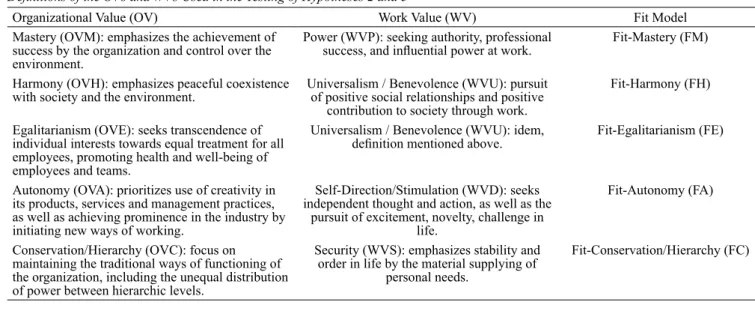
signiicant explanation of variance of happiness factors. Table 1 presents the deinitions of OVs and WVs that were jointly included in the data analyses of it effect upon
happiness, based on their theoretical alignment.
With regard to happiness at work, we used the Well-Being at Work Scale - WBWS (Paschoal & Tamayo,
2008), which contains 30 items that assess positive and negative emotions and moods (item examples: happy, worried, proud), as well as experiences of achievement (item example: I advance towards goals I have set for myself),
based on a ive point Likert scale. Factor analysis for this
sample (n = 152) revealed three factors: Positive Affect
(α = .95), Negative Affect (α = .94), and Achievement (α
= .88), consistent with previous studies. In this study, only Positive Affect and Achievement factors were used, which are related, respectively, to hedonic and eudemonic components.
Procedure
Data collection. The questionnaires were applied in
training centers for employees of a military organization in
Brasília from May to September 2012. To avoid common
method bias (Podsakoff, MacKenzie, & Podsakoff, 2012), their application was divided into two phases. In the
irst phase, questionnaires were applied measuring work
weeks later, participants answered the Organizational Values
Scale and demographic data. To match the questionnaires, a code containing the irst four letters of the name plus year of
birth was used.
Data analysis. Only cases with a percentage of
data loss inferior to 10% in each phase and not repeating the same score 80% or more of the time were used for subsequent analyses. The missing cases were not replaced by the average, since they remained below 8% for each case and, for each variable, over 75% of the responses were obtained without missing data. Extreme cases were
not signiicant and no inluential case was found. Due to
asymmetry violation, the natural logarithm of Positive Affect was used as the criterion variable. All analyses were conducted at the individual level.
The presence of curvilinear relationships between the OVs and the dependent variables (Hypothesis 1) was tested with hierarchical regressions. The linear predictor variable
was included in the irst hierarchical regression model,
followed by inclusion of the quadratic variable in the second model. Predictor variables were centered. The same type of centering procedure was used for the quadratic moderations
(Hypothesis 2). Only the OVs with a signiicant quadratic
relationship with the criterion variable were included in the model to test Hypothesis 2.
To test Hypothesis 3, the polynomial regressions were performed in accordance with the procedures described by Edwards (2002), Edwards & Cable (2009) and Ostroff et
al. (2005). To control the risk of Type I error, Bonferroni’s correction was used to evaluate the level of signiicance of R2. The remaining coeficients were analyzed based on the usual alpha level (.05). The polynomial regressions were
performed hierarchically, containing the linear WV and OV in the irst model and, in the second, the quadratic WV, quadratic OV and interaction between linear WV and linear OV were added. Subsequently, the results were submitted
to evaluation of the signiicance of the coeficients a1 (evaluates whether joint increases in predictor variables are related to linear increases or decreases in criterion variable), a2 (evaluates whether agreement between the two predictor variables has a concave or convex curvilinear relationship with criterion variable), a3 (evaluates whether criterion variable is higher when discrepancy between predictors is such that the Y-axis predictor, in this case OV, is higher
than the Z-axis predictor, in this case WV, or vice versa),
and a4 (evaluates whether criterion variable increases or decreases to the extent that discrepancy between predictor variables increases or decreases), which summarize the three-dimensional surface analysis made possible by
polynomial regression. Based on Hypothesis 3, it is expected that only coeficients a1 and a4 appear positively and
negatively signiicant, respectively. According to Ostroff
et al. (2005), when the second regression model shows no
signiicant increase in explained variance (R2), the effects of
it cannot be curvilinear. In this situation, only the surface test coeficients that evaluate the linear effects of it (coeficients a1 and a3) should be analyzed. Equation 1 was applied to test
Hypothesis 3, with O denoting OVs, W denoting WVs, and H meaning Happiness at Work factors:
H = b0 + b 1 O + b2 W + b3 O2 + b
4 OW + b5 W 2 + e (1)
Ethical Considerations
The IRB approval by the Ethics Committee on Human Research, Faculdade de Ciências da Saúde, Universidade de Brasília, was registered under number 186/11.
Results
Direct Effect of the OVs on Happiness at Work
Table 2 presents correlations between the study variables. The hierarchical multiple regressions were Table 1
Deinitions of the OVs and WVs Used in the Testing of Hypotheses 2 and 3
Organizational Value (OV) Work Value (WV) Fit Model
Mastery (OVM): emphasizes the achievement of success by the organization and control over the environment.
Power (WVP): seeking authority, professional
success, and inluential power at work. Fit-Mastery (FM)
Harmony (OVH): emphasizes peaceful coexistence
with society and the environment. Universalism / Benevolence (WVU): pursuit of positive social relationships and positive contribution to society through work.
Fit-Harmony (FH)
Egalitarianism (OVE): seeks transcendence of individual interests towards equal treatment for all employees, promoting health and well-being of employees and teams.
Universalism / Benevolence (WVU): idem,
deinition mentioned above. Fit-Egalitarianism (FE)
Autonomy (OVA): prioritizes use of creativity in its products, services and management practices, as well as achieving prominence in the industry by initiating new ways of working.
Self-Direction/Stimulation (WVD): seeks independent thought and action, as well as the
pursuit of excitement, novelty, challenge in life.
Fit-Autonomy (FA)
Conservation/Hierarchy (OVC): focus on maintaining the traditional ways of functioning of the organization, including the unequal distribution of power between hierarchic levels.
Security (WVS): emphasizes stability and order in life by the material supplying of
personal needs.
performed for each OV separately. The hierarchical regressions to test curvilinear effects presented, in general, greater explanatory value with the quadratic variables. This occurred in the prediction of Achievement provided by the following OVs: Harmony (quadratic R2 = .07, β = -.27, p < .01; ∆R2 = .07, p < .01), Autonomy (quadratic R2 = .05, β = -.20, p < .05; ∆R2 = .04, p < .05), and Conservation/Hierarchy
(quadratic R2 = .06, β = -.24, p < .05; ∆R2 = .06, p < .01), and
in the prediction of Positive Affect from the Egalitarianism OV (quadratic R2 = .07, β = -.21, p < .05; ∆R2 = .04, p < .05)
and Conservation/Hierarchy OV (quadratic R2 = .04, β = -.19, p < .05; ∆R2 = .03, p < .05). The negative β found in these
equations indicates that the relation between the quadratic term and the criterion variable takes the form of an inverted U, as hypothesized. The effect sizes encountered were small, in congruence with previous results (Hartnell et al., 2011).
Thus, we proceeded to test PO it.
Effect of PO Fit on Happiness at Work
Table 3 summarizes the signiicant results found
in testing Hypothesis 2, which were obtained from quadratic hierarchical regressions. The OVs that showed
no signiicant quadratic relationship in testing Hypothesis
1 were excluded. The regression to predict Positive Affect
was not signiicant, despite the power of the test power having proved satisfactory (1−β = .94). On the other
hand, the results for Achievement indicated the presence
of signiicant interaction between OVs and WVs, with a signiicant negative effect from the interaction between the quadratic Conservation/Hierarchy OV and Security WV,
which provides support for Hypothesis 2. The analysis of the regression equations for subgroups with low and high
Security WV indicates that the Conservation/Hierarchy
OV showed a stronger negative quadratic relationship
(quadratic R2 = .18, p < .01) for the high (above the median) Security WV group, and the shape of this relationship
demonstrated to be consistent with the pattern suggested
by the vitamin analogy (Warr, 2007). For the low (below the median) Security WV group, the relationship was nil
(quadratic R2 = .03, ns).
As for Hypothesis 3, the signiicant polynomial regression results are also shown in Table 3. Four of the ive
regressions run to predict the Achievement factor presented a
signiicant explanation of the variance in the irst model, but no model showed a signiicant increase with the inclusion of
the quadratic terms, which precludes a full corroboration of
Hypothesis 3. On the other hand, all the signiicant regression models showed a signiicant and positive a1 coeficient in predicting Achievement, indicating that, when OVs and
WVs are concordant and increase in the same direction, there
are increases in Achievement levels, which partially supports Hypothesis 3. In the case of regressions to predict Positive
Affect, a signiicant explanation of variance was obtained from the Fit-Autonomy model, with the coeficient a1 also
being signiicant and positive. As expected, the coeficient a3 did not appear signiicant in any model.
Discussion
In this paper, we evaluated the impact of it between OVs and WVs on happiness at work based on an integrated
axiological model. Moreover, we tested the curvilinear relationship between happiness at work and OVs. The
adopted deinition of happiness at work proved to be in line
with the eudemonic and hedonic components of happiness,
expanding on the studies of it that typically employ job
satisfaction (hedonic component) or work syndromes and pathologies (stress, burnout).
Table 2
Descriptive Data and One-Tailed Correlations
WVP WVD WVS WVU OVH OVE OVI OVM OVS PA AC
WVP 1.00 -.01 -.26b -.62c -.02 .09 .11 .17a -.22b .16a .13
WVD 1.00 -.61c -.31c -.05 -.10 -.10 -.04 .16a .16a .20b
WVS 1.00 -.07 -.10 .05 -.06 .17a -.07 -.24b -.23b
WVU 1.00 .10 -.06 .00 -.17a .11 -.10 -.16a
OVH 1.00 .21b .08 -.61c -.16a .02 .02
OVE 1.00 .57c -.34c -.77c .16a .15a
OVI 1.00 -.21b -.74c .06 .10
OVM 1.00 -.13 -.07 -.10
OVS 1.00 -.09 -.08
PA 1.00 .60c
AC 1.00
Note. PA = Positive Affect; AC = Achievement; OVS = Stability / Hierarchy OV; OVE = Egalitarianism OV; OVI = Innovation OV;
OVH = Harmony OV; OVM = Mastery OV; WVS = Security WV; WVU = Universalism/Benevolence WV; WVD = Self-Direction/Stimulation WV; WVP = Power WV; M = Mean; SD = Standard deviation.
Hypothesis 1 presented a curvilinear relationship between OV and happiness at work. The observed results corroborate this hypothesis for almost all OV. This means that there is a maximum degree to which happiness at work is enhanced and that, after this point, it remains stable or drops, providing
empirical support for Warr’s (2007) model. Therefore, if an
organization is willing to raise the levels of happiness of its employees, then it should pay attention to the most intense characteristics of its culture: people who perceive a certain cultural characteristic more strongly will probably feel less happy at work. The Mastery OV presented an exception, since it did not demonstrate a curvilinear relationship with any criterion variable. Possibly, the fact that data was collected in a military organization – for which there are no competing organizations or rivals – may have hindered high levels of this OV.
Based on Hypothesis 2, it was expected that the WVs
would moderate the relationship between OV and happiness
at work, which was corroborated, since signiicant impact was
seen in the interaction between the Conservation/Hierarchy
OV and the Security WV. The effects of it are stronger for the high WV group, suggesting that, for these individuals,
the fact that the organization promotes values similar to their own has more impact on their happiness at work, in line with
Warr’s proposal. However, only one signiicant contribution out of ive possible interactions was found, suggesting a
partial effect of this moderation. This is probably due to the fact that Conservation/Hierarchy OV is the most important value for the organization studied.
Hypothesis 3, which predicted a signiicant impact of PO it on happiness at work, obtained conirmatory evidence, to the
Table 3
Regression Models Related to Hypotheses 2 and 3
Parameters Models
Models for Hypothesis 2 – Hierarchical Regression for Achievement
Steps Model 1 Model 2 Model 3 Model 4 Model 5
R2 .01 .11* .16a .17* .25a
∆R2 .10a .05* .01 .08a
Step 1 OVC -.02 .03 .00 .00 -.07
OVA .09 .07 .06 .04 .03
OVH .01 .04 .02 .03 .06
Step 2 OVC2 -.15 -.15 -.20 -.12
OVH2 -.22* -.21* -.22* -.13
OVA2 -.06 .00 .02 .09
Step 3 WVS -.17 -.18 .06
WVU -.12 -.12 -.08
WVD .05 .04 .15
Step 4 OVCxWVS -.04 -.08
OVHxWVU -.05 -.03
OVAxWVD -.02 -.11
Step 5 OVC2xWVS -.54b
OVA2xWVD -.18
OVH2xWVU -.13
Models for Hypothesis 3 – Polynomial Regression
FH FE FA FM
AC AC AC PA AC
R2 .12b .13b .18b .07a .13b
Surface Tests a1 a3
.22b .21b .24b .08a .22b
.01 -.05 .07 .01 -.02
Regression Coeficients
Constant B (SE) 2.74b (.19) 2.83b (.18) 2.91b (.12) -1.18b (.06) 3.22b (.07) WV B (SE) .12* (.05) .13a (.05) .15b (.04) .04* (.02) .12a (.03)
OV B (SE) .11a (.03) .08b (.02) .08a (.02) .03* (.01) .09* (.04) Note. OVC, OVA, OVH correspond to the linear OV as deined in Table 1; OVC2, OVH2, and OVA2 correspond to the respective quadratic OVs; WVS, WVU, WD correspond to the linear WV as deined in Table 1; step 4 includes the interaction terms between OVs and WVs; in step 5 the terms containing the quadratic OVs with the WVs were included. For the models related to Hypothesis 3, a1 and a3 are coeficients of the surface test; AC = Achievement; PA = Positive Affect; FH, FE FA and FM correspond to the it models described in Table 1.
extent that almost all regression models predicting Achievement and one for Positive Affect have shown that agreement
between higher levels of WVs and OVs prove to be associated
with higher levels of happiness at work. That is, the absolute agreement between values does not always generate more happiness at work, but only for more important value levels (Ostroff et al., 2005). This result is in line with the moderation models presented. On the other hand, the discrepancies between
individual and organizational values did not inluence the levels of happiness at work, demonstrating a low impact of PO it on
happiness at work, according to Ostroff et al. (2005). Although unexpected, this result is noteworthy because it appears to
indicate that the relationship between PO it and low activated
forms of happiness (satisfaction) differs from the relationship
between PO it and active forms of happiness – like the one we
investigated. Against the background of positive psychology, the former authors also found evidences of a different logic in
the relation between PO it and engagement at work, another form of active positive experience (Warr & Inceoglu, 2012),
and this study reinforces this evidence.
In the present study, the highest explained variance of happiness was obtained from the Fit-Autonomy model, unlike Hartnell et al. (2011), who found the strongest relationship between the Clan culture type – similar to the Egalitarianism OV – and the hedonic component of happiness (job satisfaction) and not Adhocracy, more related to Autonomy. Our results reveal the strategic importance of the environmental characteristic of opportunity for personal control (or autonomy). Actually it reinforces the
understanding that this characteristic inluences all other
environmental characteristics mentioned in the vitamin
analogy (Warr, 2007), indicating that autonomy is probably
the most important antecedent of happiness at work.
In general, the eudemonic component of happiness at work (Achievement) reached a higher explained variance compared with the hedonic affective factor (Positive Affect).
The attainment of values (IO it) has a closer conceptual
relationship with Achievement than with affective experiences at work. Affects have diverse origins and may
offer less stability in various situations (Warr, 2007). Common method bias tends to inlate effect sizes in IO it studies. Although a number of signiicant results have been
found in the curvilinear relationships, unlike earlier studies
(Hartnell et al., 2011), no signiicant linear relationships were
found between cultural characteristics, in the case OVs, and happiness at work. It is possible that stronger relationships might have been obtained with a procedure that did not use intervals between the applications. In this sense, the results found herein reinforce the importance of using procedures that reduce the impact of common method bias.
Finally, it was observed that the explanation resulting
from models of it is greater than that provided solely by OVs.
This underscores the importance of taking into consideration not only environmental characteristics, but also individual preferences, in models predicting happiness at work.
As a practical contribution, this study indicates that organizations that have employees with their more important values similar to the more important values of the organization tend to obtain higher levels of happiness at work. Therefore, it is recommended that organizations elaborate strategies to
promote value it in order to achieve higher levels of happiness
at work, such as socialization processes and publicizing the organizational values in order to promote organizational attraction. Furthermore, concerning the curvilinear relation between OVs and happiness, a continuous monitoring of the organizational culture is indicated to avoid extreme perceptions of the OVs. Nevertheless, we reinforce that the direct effect of
OVs on happiness is small and that the it between organizational
and individual values should be considered.
IO it studies using axiological measures typically
employ OVs to investigate the organizational characteristics and ideal (or preferred) OVs to evaluate the characteristics of the individual in order to ensure nominal commensurability. In the present study, OVs were used to evaluate the
organizational characteristics and WVs to measure
individual characteristics, which may raise doubts as to the scope of the assumption of nominal commensurability required for polynomial regressions. However, nominal commensurability relates to the conceptual equivalence in the individual and organizational dimensions. Thus,
the use of an integrated axiological model – Schwartz’s
values theory – permitted an evaluation of the nominal
commensurability between OVs and WVs, in a more reliable manner than is typically used in studies of it.
The cultural characteristics of the organization studied
may have inluenced the results. A military body certainly presents structural speciics different from most contemporary
organizations. Although the phenomena of PO Fit should occur in any type of organization, it is recommended to verify
the generalizability of these indings in other organizational
contexts, mainly by considering a multilevel approach. Overall, the results provide important contributions to the literature that are worth mentioning. First, we emphasize
that empirical support was found for Warr (2007) vitamin
analogy, since the relationship between OVs and happiness at work proved curvilinear. In addition, evidence was found
for the linear relationship of values it and happiness at work,
even using procedures that reduced the impact of common method bias. Furthermore, despite the individual level analysis, the concepts of organizational and work values utilized have a theoretical basis to justify their inclusion in the organizational and individual levels, respectively, raising support for a multilevel conceptual framework. Finally, the study highlights the importance of including the eudemonic component of happiness at work in studies of well-being,
considering the different degree of impact of PO it on
the eudemonic and hedonic components. In this sense, a promising line of research consists in the investigation of mediators and moderators of the relationship between
References
Borg, I., Groenen, P. J. F., Jehn, K. A., Bilsky, W., & Schwartz, S. H. (2011). Embedding the organizational culture proile into Schwartz’s theory of universals
values. Journal of Personnel Psychology, 10(1), 1-12. doi:10.1027/1866-5888/a000028
Dagenais-Desmarais, V., & Savoie, A. (2012). What is
psychological well-being, really? A grassroots approach from the organizational sciences. Journal of Happiness Studies,13(4), 659-684. doi:10.1007/s10902-011-9285-3 Denison, D., Nieminen, L., & Kotrba, L. (2014). Diagnosing
organizational cultures: A conceptual and empirical review of culture effectiveness surveys. European
Journal of Work and Organizational Psychology, 23(1), 145-161. doi:10.1080/1359432X.2012.713173
Edwards, J. R. (2002). Alternatives to difference scores: Polynomial regression analysis and response surface
methodology. In F. Drasgow & N. W. Schmitt (Eds.),
Measuring and analyzing behavior in organizations: Advances in measurement and data analysis (pp.
350-400). San Francisco, CA: Jossey-Bass.
Edwards, J. R., & Cable, D. M. (2009). The value of value congruence. Journal of Applied Psychology, 94(3), 654-677. doi:10.1037/a0014891
Fischer, R., Ferreira, M. C., Assmar, E. M. L., Baris, G., Berberoglu, G., Dalyan, F., … Boer, D. (2014).
Organizational practices across cultures: An exploration in six cultural contexts. International Journal of Cross-Cultural Management, 14(1), 105-125. doi:10.1177/1470595813510644
Fisher, C. D. (2010). Happiness at work. International
Journal of Management Reviews, 12(4), 384-412. doi:10.1111/j.1468-2370.2009.00270.x
Hartnell, C. A., Ou, A. Y., & Kinicki, A. (2011). Organizational culture and organizational effectiveness: A meta-analytic investigation of the competing values
framework’s theoretical suppositions. Journal of Applied Psychology, 96(4), 677-694. doi:10.1037/a0021987
Kristof-Brown, A. L., Zimmerman, R. D., & Johnson, E. C. (2005). Consequences of individuals’ it at work:
A meta-analysis of person-job, person-organization,
person-group, and person-supervisor it. Personnel
Psychology, 58(2), 281-342. doi:10.1111/j.1744-6570.2005.00672.x
McNulty, J. K., & Fincham, F. D. (2011). Beyond positive
psychology? Toward a contextual view of psychological processes and well-being. American Psychologist, 67(2), 101-110. doi:10.1037/a0024572
Ostroff, C., Shin, Y., & Kinicki, A. J. (2005). Multiple
perspectives of congruence: Relationships between value congruence and employee attitudes. Journal
of Organizational Behavior, 26(6), 591-623. doi:10.1002/job.333
Paschoal, T., & Tamayo, A. (2008). Construção e validação da escala de bem-estar no trabalho. Avaliação Psicológica,
7(1), 11-22.
Podsakoff, P. M., MacKenzie, S. B., & Podsakoff, N. P. (2012). Sources of method bias in social science
research and recommendations on how to control it. Annual Review of Psychology, 63, 539-569. doi:10.1146/annurev-psych-120710-100452
Porto, J. B., Ferreira, M. C., & Fonseca, A. M. O. (2014, July). Organizational values: Structure and predictive power. In
J. Porto (Chair), Organizational culture: Its dimensions and impact on individuals. Symposium conducted at the meeting of the twenty-eighth International Congress of Applied Psychology, Paris, France.
Porto, J. B., & Pilati, R. (2010). Escala revisada
de Valores Relativos ao Trabalho - EVT-R. Psicologia: Relexão e Crítica, 23(1), 73-82.
doi:10.1590/S0102-79722010000100010
Porto, J. B., Tamayo, M., & Paschoal, T. (2012). (In)
congruência pessoa-ambiente: Relações com bem-estar, estresse e burnout. In M. C. Ferreira & H. Mendonça (Orgs.), Saúde e bem-estar no trabalho: Dimensões individuais e culturais (pp. 229-259). São Paulo, SP: Casa do Psicólogo.
Schwartz, S. H. (1994). Beyond individualism/collectivism:
New cultural dimensions of values. In U. Kim, H. C.
Triandis, Ç. Kagitçibasi, S.-C. Choi, & G. Yoon (Eds.),
Individualism and collectivism. Theory, method, and
applications (pp. 85-119). Thousand Oakes, CA: Sage. Schwartz, S. H. (1999). A theory of cultural values
and some implications for work. Applied
Psychology; An International Review, 48(1), 23-47. doi:10.1111/j.1464-0597.1999.tb00047.x
Seligman, M. E., & Csikszentmihalyi, M. (2000). Positive
psychology: An introduction. American Psychologist, 5(1), 5-14. doi:10.1037//0003-066X.55.1.5
Sousa, J. M. (2013). Felicidade laboral e valores
organizacionais: o efeito da compatibilidade
indivíduo-organização (Master’s thesis). Retrieved from http://repositorio.unb.br/handle/10482/13680
Van Horn, J. E., Taris, T. W., Schaufeli, W. B., & Schreurs,
P. J. (2004). The structure of occupational well-being: A study among Dutch teachers. Journal of Occupational and Organizational Psychology, 77(3), 365-375. doi:10.1348/0963179041752718
Verquer, M. L., Beehr, T. A., & Wagner, S. H. (2003). A
meta-analysis of relations between person-organization
it and work attitudes. Journal of Vocational Behavior, 63(3), 473-489. doi:10.1016/S0001-8791(02)00036-2 Warr, P. (2007). Work, happiness and unhappiness. Mahwah,
NJ: Lawrence Erlbaum.
Warr, P. (2013). Fuentes de felicidad e infelicidad en
el trabajo: Una perspectiva combinada. Revista de
Warr, P., & Clapperton, G. (2010). The joy of work? Jobs, happiness and you. New York, NY: Routledge.
Warr, P., & Inceoglu, I. (2012). Job engagement, job
satisfaction, and contrasting associations with person-job
it. Journal of Occupational Health Psychology, 17(2), 129-138. doi:10.1037/a0026859
Juliana Moraes de Sousa is a M.S. in Social, Work and Organizational Psychology from Universidade de Brasília. Juliana Barreiros Porto is a Professor of the Instituto de
Psicologia at the Universidade de Brasília.
Received: June 3, 2014 1st Revision: Oct. 22, 2014 2nd Revision: Feb. 26, 2015 Approved: Mar. 2, 2015
How to cite this article:
Sousa, J. M., & Porto, J. B. (2015). Happiness at work: Organizational values and person-organization it