Article
J. Braz. Chem. Soc., Vol. 19, No. 5, 894-902, 2008. Printed in Brazil - ©2008 Sociedade Brasileira de Química 0103 - 5053 $6.00+0.00
*e-mail: [email protected]
Michael Additions of Thiocompounds to
-Unsaturated Carbonyl Compounds in
Aqueous Media: Stereoselectivity with Unambiguous Characterization by NMR
Queli Aparecida Rodrigues de Almeida,
aMaria Luiza de Oliveira Pereira,
aRicardo Bezerra Coelho,
aErika Martins de Carvalho,
bCarlos Roland Kaiser,
aJoel Jones Junior*
,aand Flavia Martins da Silva*
,aaDepartamento de Química Orgânica, Instituto de Química, Universidade Federal do Rio de Janeiro,
CP 68.584, 21941-972 Rio de Janeiro-RJ, Brazil
bInstituto de Tecnologia em Fármacos, Far-Manguinhos, Rua Sizenando Nabuco no.100, Manguinhos,
21041-250 Rio de Janeiro-RJ, Brazil
As reações de crotonaldeído (8) com tiofenol (2) e benzalacetona (10) com 1,2-etanoditiol (11) levam aos produtos de adição de Michael. As reações de tiofenol (2) com (R)-carvona (13) e (S)-perilaldeído (15) levam aos produtos (2S,3R,5S)-5-isopropenil-2-metil-3-feniltio-cicloexanona (14) e (1R,2R,4S)-4-isopropenil-2-feniltio-cicloexano carbaldeído (16), respectivamente. Também é apresentada a elucidação inequívoca da estereoquímica de 14 e 16 por RMN.
The reactions of crotonaldehyde (8) with thiophenol (2) and benzalacetone (10) with ethane-1,2-dithiol (11) yield Michael addition products. The reactions of thiophenol (2) with (R)-carvone (13) and (S)-perillaldehyde (15) lead to (2S,3R,5S )-5-isopropenyl-2-methyl-3-(phenylthio)cyclohexano-ne (14) and (1R,2R,4S)-4-isopropenyl-2-(phenylthio)cyclohexanecarbaldehyde (16), respectively. An unambiguous elucidation of the stereochemistry of 14 and 16 by NMR is also presented.
Keywords:1,4-additions, water, Green Chemistry, NMR
Introduction
At this century’s threshold, the environmental conditions of our planet Earth are, and should be, one of our most serious concerns. Chemistry research may bring us great advances in the quality of life (e.g., medications, new materials, etc.), but on the other hand, it may also be responsible for several of our environmental pollution problems.
For sustainable development,1 we must think about
strategies to minimize the environmental impact of these technological activities. One of these strategies is known asGreen Chemistry.2-8 The objective of Green Chemistry
is the development of methodologies that generate and use the lowest possible amounts of possibly toxic substances for the production of chemical compounds.2-8
Today, the study of organic reactions using water as a solvent is considered an important strategy in the area of Green Chemistry. Water is an innocuous solvent that is also abundant and inexpensive.9-13 The Michael reaction, a widely
used technique in organic synthesis,14is an important tool
for the preparation of various polyfunctional compounds via carbon-carbon and carbon-heteroatom bond-forming reactions. In the literature, some examples of Michael reactions in aqueous media can be found. Water-tolerant Lewis acids,15,20 Br nsted acids,21 and bases can catalyze
these reactions in the presence or absence of phase transfer agents.22-27 Recently, it was reported that amphiphilic
polymer-supported ammonium hydroxides are efficient heterogeneous catalysts for these reactions.28 In some cases,
the Michael additions may be carried out without any type of catalysis.29-32 Moreover, it is interesting to point out that
in the applications of these aqueous methodologies, many nucleophile types can be used, including organometallic regents.33-36
In our research, we have analyzed some studies of this type of reaction in water catalyzed by bases without phase transfer agents.37-38 According to King and co-workers,39
de Almeida et al. 895 Vol. 19, No. 5, 2008
propane-1-thiol (1) and thiophenol (2) to cyclohex-2-enone (3) at three pH conditions in aqueous media (pH 7, 10, 13). The best condition for all of the tested reactions was at pH 7 using a 1 mol L-1 NaHCO
3 aqueous solution. The yields
were 70% and 95%, respectively (Scheme 1).38
Our research also showed that the Michael additions of thiophenol (2) to -unsaturated nitroolefins like 1-nitrocyclohex-1-ene (5) in aqueous media have a good diastereoselectivity; this result is cited in the literature as the first example of this kind of reaction in water that presents diastereoselectivity (Scheme 2).38,40
Experimental
Thiophenol (2), crotonaldehyde (8), benzalacetone (10), ethane-1,2-dithiol (11), (R)-carvone (13) and (S
)-perillaldehyde (15) were used as received (Aldrich). Some of the products were purified by radial chromatography in a Harrison Research Chromatotron. High resolution gas chromatography (HRGC) analyses were performed under two conditions: condition A) HP-5890-II gas chromatograph with FID, using a 30 m (length), 0.25 mm (ID) and 0.5 mm (phase thickness) RTX-5 silica capillary column with H2 as the gas carrier and a flow division of 1/20; condition B) Varian Star 3400cx gas chromatograph with FID, using a 30 m (length), 0.25 mm (ID) and 0.5 mm (phase thickness) capillary column HP1 for injection on-column, and H2 as the gas carrier. The analyses were performed in a BRUCKER-300 (1H - 300
MHz,13C - 75 MHz) and in a Varian Mercury (1H - 400
MHz, 13C - 100 MHz) in CDCl
3 and C6D6 as solvents, with
TMS as the internal standard.
The unambiguous 1H and 13C NMR assignments for
compounds 14 and 16 were obtained from COSY90, HSQC, HMBC, TOCSY and nOe. All experiments were run with a relaxation delay of 1.5 s, 65K (1H) and 32K
(13C) data points for 1D experiments and 2048 × 512 data
matrixes for COSY90, TOCSY (mixing time of 25 ms), nOe (mixing time of 300 ms) HSQC and HMBC. Gradient selections were used in all 2D techniques. Zero filling and/or linear predictions were used in all 2D experiments. Pulse programs and data processing were performed using XWINMR 3.5 software from BRUKER.
The FT-IR spectra were recorded on a Nicolet Magna-IR-FT (NaCl film).
3-(Phenylthio)butyraldehyde (9)
To 10 mL of a 0.5 mol L-1 aqueous NaHCO
3 solution,
5 mmol of thiophenol (2) were added. Soon after, 0.4 mL of a 45% aqueous crotonaldehyde (8) solution (2.5 mmol)
Scheme 1. Optimization of Michael addition of thiols in water.
Michael Additions of Thiocompounds to -Unsaturated Carbonyl Compounds in Aqueous Media J. Braz. Chem. Soc.
896
were also added. The reaction mixture was then stirred vigorously for 40 min at room temperature. Then, the reaction mixture was neutralized with concentrated hydrochloric acid and extracted with chloroform. The organic extract was dried (using anhydrous Na2SO4), and the solvent was evaporated under reduced pressure. The product was purified by radial chromatography using chloroform as a solvent. 0.34 g of product was obtained. The following spectroscopic data were obtained: IR (KBr)
max/cm
-1 2825, 2727, 1724, 748, 693; 1H NMR (300 MHz,
CDCl3)G 1.35 (d, 1H, J 6.78 Hz), 2.58 (ddd, 1H, J 1.65, 7.60, 17.30 Hz), 2.70 (ddd, 1H, J 1.70, 6.00, 17.30 Hz), 3.69 (sextet, 1H, J 6.78 Hz), 7.27-7.44 (m, 5H), 9.75 (t, 1H, J 1.65 Hz); 13C NMR (75 MHz, CDCl
3)G 21.1, 37.6, 50.1,
127.6, 129.1, 133.0, 133.5, 200.5; MS, m/z (%), 182 (1), 182 (2), 180 (23), 137 (4), 110 (100), 77 (6.1); tR= 12.1 mim [condition A: column temperature: 50 oC (5 min) to 280 oC
(5 min) (25oC min-1); injector temperature: 260 oC; detector
temperature: 280oC].
4-(2-mercaptoethylthio)-4-phenylbutan-2-one (12)
To 15 mL of a 0.3 mol L-1 aqueous NaHCO
3 solution,
5 mmol of ethane-1,2-dithiol (11) were added. Soon after, 5 mmol of benzalacetone (10) were also added. The reaction mixture was then stirred vigorously for 17 h at room temperature. Then, the reaction mixture was extracted with chloroform. The organic extract was dried (using anhydrous Na2SO4), and the solvent was evaporated under reduced pressure to obtain the pure product. 0.87 g of the product was obtained. The following spectroscopic data were obtained: 1H RMN (300 MHz, CDCl
3) G 1.59 (bs,
1H), 2.08 (s, 3 H), 2.55 (m, 4H), 2.97 (d, J 7.21 Hz, 2H), 4.35 (t, J 7.21 Hz, 1H), 7.30 (m, 5H); 13C RMN (50 MHz,
CDCl3) G 23.90, 30.66, 31.06, 44.18, 49.98, 127.66, 127.75, 128.67, 141.57, 205.05; MS, m/z (%) 240 (15), 222 (9), 206 (20), 179 (25), 147 (41), 104 (30), 77 (18), 43 (100); tR= 20.2 mim [condition B, column temperature: 40oC (2 min) to 250 oC (15 min) (10 oC min-1), injector
temperature: room temperature (on column), detector temperature: 280oC].
Michael addition of thiophenol (2) to -unsaturated terpenes
To 10 mL of a 0.5 mol L-1 NaHCO
3 aqueous solution, 20
mmol of thiophenol (2) were added. Soon after, 10 mmol of the respective terpene were also added. The reaction mixture was then stirred vigorously for 24 h at room temperature. The products of each substrate were isolated and characterized as follows:
For (R)-carvone (13)
(2S,3R,5S)-5-Isopropenyl-2-methyl-3-(phenylthio) cyclohexanone (14): The solid product was isolated from the reaction media by filtration and purified by recrystalization using hexane as the solvent; 1.27 g were obtained. For NMR data, see Table 1 (1H - 300 MHz, 13C - 75 MHz),
tR= 20.7 min [condition A: column temperature: 70 oC to
250oC (5 min) (8 oC/min), injector temperature: 220 oC,
detector temperature: 250 oC]. mp, 63-65 oC (hexane);
[ ]D
24 = –91.0 (c10, CH2Cl2).
For (S)-perillaldehyde (15)
( 1R ,2R ,4S) - 4 - I s o p r o p e n y l - 2 - ( p h e n y l t h i o ) cyclohexanecarbaldehyde (16): The solid product was isolated from the reaction media by filtration and crystallized using hexane as the solvent. 1.77 g of a sample of compound
16 and thiophenol were obtained. In order to obtain a pure sample, this mixture was purified by flash chromatography using hexane:ethyl acetate (9:1); 1.20 g were obtained. For NMR data, see Table 2 (1H - 400 MHz,13C - 100 MHz),
tR= 20.5 min [condition A: column temperature: 70 oC to
250oC (5 min) (8 oC min-1), injector temperature: 220 oC,
detector temperature: 250 oC]. mp, 75-76 oC (hexane), [ ]
D
24 = –58.0 (c10, CH2Cl2).
Results and Discussion
Synthesis
In this work, we extended our studies to other -unsaturated carbonyl compounds.
The reactions of aliphatic acyclic carbonyl compounds like crotonaldehyde (8) with thiophenol (2) and benzalacetone (10) with ethane-1,2-dithiol (11) also yielded Michael addition products (Scheme 3).
Some chiral terpenic substrates for this reaction type were also tested in order to analyze their stereoselectivity in aqueous media. It was observed that thiophenol (2) reacts with (R)-carvone (13) and (S)-perillaldehyde (15) at pH 7, leading to the kinetic products shown in Scheme 4.
The stereochemistry of these reactions is controlled by the axial addition of thiophenol in the first step and by the axial protonation in the next step (Scheme 5).
These reactions (Scheme 4) are reported in the literature using CH2Cl2 or hexane at 0 oC as the solvent and triethylamine
as the catalyst, leading to the same products.41,42 However,
de Almeida et al. 897 Vol. 19, No. 5, 2008
Scheme 3. Michael addition in water.
Scheme 4. Stereoselectivity of Michael addition in water.
Michael Additions of Thiocompounds to -Unsaturated Carbonyl Compounds in Aqueous Media J. Braz. Chem. Soc.
898
The methodology developed in this paper presents as an advantage the substitution of a toxic and inflammable organic solvent for water. Furthermore, no temperature control was necessary. Also, in operational work-up, our methodology reduces the product isolation procedure to a filtration step, as these products are insoluble in water.
Stereochemical elucidation with unambiguous spectral assignments of compounds 14 and 16 by NMR
The 1H NMR spectrum for compound 16 was fully
assigned by a combination of homo- and heteronuclear 2D NMR methods, including DQF-COSY, HSQC, HMBC, nOe experiments and 1D-TOCSY. Some important details of the experiments will be commented on.
(2S,3R,5S)-5-Isopropenyl-2-methyl-3-(phenylthio)cyclo-hexanone (14)
The1H and 13C NMR assignments of compound 14 are
listed in Table 1. The DQF-COSY experiment of compound
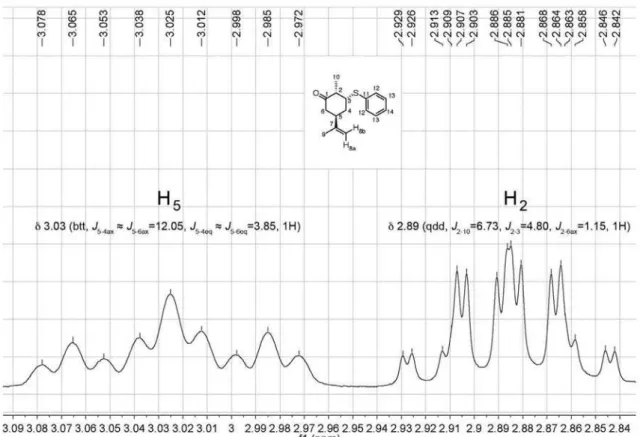
14 demonstrates that H-2 at G2.89 (qdd) shows cross signals with the methyl H-10 at G1.22 (d) and H-3 at G
3.9 (bdt). The H-3 hydrogen shows cross signals with H-2, H-4eq at G2.06 (dtd) and H-4ax at G1.89 (ddd) (Figure 1).
In the nOe difference experiment, the relative configuration of the H-2 and H-3 hydrogens was
Table 1. Summary of the 1H and 13C data for compound 14
Assignment G1H (J/ Hz) G13C
1 -- 209.6
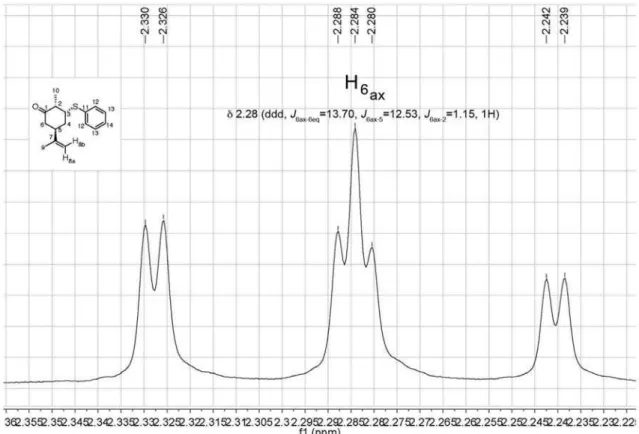
2 2.89 (qdd, J2-106.73,J2-34.80,J2-6ax1.15, 1H) 48.2 3 3.9 (bdt, J3-2 4.80, J3-4eq J3-4ax 3.50, 1H) 53.2 4 eq 2.06 (dtd, J4eq-4ax13.85,J4eq-3 J4eq-5 3.65, J4eq-6eq
2.06, 1H)
35.0
4 ax 1.89 (ddd, J4ax-4eq 13.85, J4ax-5 11.60, J4ax-3
3.13, 1H)
5 3.03 (btt, J5-4ax J5-6ax12.05,J5-4eq J5-6eq3.85, 1H)
40.1
6 eq 2.53 (ddd, J6eq-6ax13.70, J6eq-54.30,J6eq-4eq
2.06, 1H)
45.7
6 ax 2.28 (ddd, J6ax-6eq13.70,J6ax-512.53, J6ax-2
1.15, 1H)
7 -- 146.7
8a 4.76 (app quint d, J8a-9=J8a-51.38,J8a-8b0.44, 1H)
109.9
8b 4.69 - 4.72 (m, 1H)
9 1.66 (app d, J0.60, 3H) 20.6
10 1.22 (d, J10-2 6.73, 3H) 12.6
11 -- 134.3
12 7.38 -7.43 (m, 2H) 132.3
13/14 7.21-7.33 (m, 3H) 128.9
127.2
de Almeida et al. 899 Vol. 19, No. 5, 2008
established. The selective irradiation of H-2 produces nOe enhancements at H-3 and H-10, and a slight effect at axial hydrogens H-6 and H-4, while the selective saturation of H-3 produces nOe enhancements at H-2 and both H-4 and H-10. The nOe effect on axial and equatorial hydrogen H-4 is very similar. These nOe indicate that hydrogen H-3 is at the equatorial position, because if it were in the axial position this difference would be greater (Figure 2).
(1R,2R,4S)-4-isopropenyl-2-(phenylthio)cyclohexanecar-baldehyde (16)
The determination of the stereochemistry of compound
16 was only possible with a NMR study in CDCl3 and C6D6 (Table 2).
In CDCl3 (Figure 3a), the H-2 and H-5 hydrogens are overlapped as a multiplet in 2.49-2.58 dby DQF-COSY
spectrum (Figure 4). On the other hand, in C6H6 (Figure 3b), H-5 appears as a triplet of triplets in 2.50 d (J5-4eq J5-6eq 3.10 Hz, J5-4ax J5-6ax 12.00 Hz), but the H-2 is overlapped with H-7eq in 1.77-1.88 d (m, 2H).
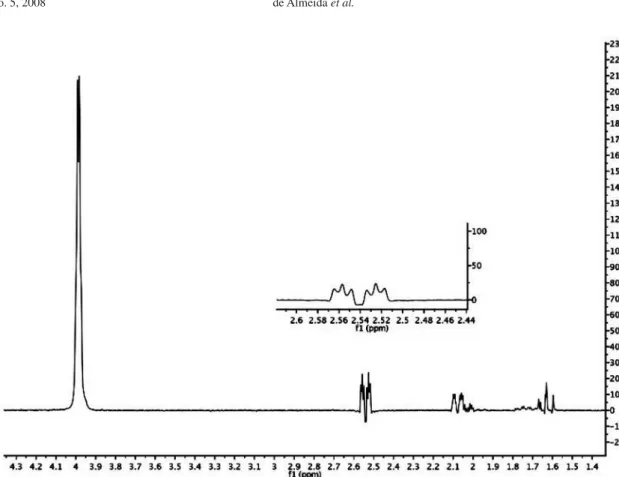
With the TOCSY experiment, it was possible to determine the multiplicity of hydrogen H-2 (G2.49-2.58). Hydrogen H-3 (G3.98) was selectively saturated in CDCl3. The spectrum was obtained with a mixing time of 25 ms at 20oC. The irradiation changes the multiplet to a double triplet
withJ2-7ax 12.37 Hz and J2-7eq J2-3 3.10 Hz (Figure 5). These couplings are consistent with H-2 in the axial position.
Finally, the relative configurations of H-3 and H-5 were examined with 1H nOe difference spectroscopy. Saturation
of H-3 in CDCl3 produces nOe enhancements at H-2 and H-4 axial, while the saturation of H-5 in the C6D6 solvent shows nOe at H-4 equatorial. With this result, it is possible to suggest that H-3 and H-2 are synclinal, as shown in Figure 6.
Conclusions
The present work is an additional relevant contribution to the study of organic reactions in water. The Michael addition reactions of thiophenol to , -unsaturated terpenes in aqueous media show high stereoselectivity in the formation of the products at room temperature, with
Figure 2. nOe for compound 14.
Table 2 . Summary of the 1H and 13C data for compound 16
Assig. CDCl3 C6D6
G1H (J/ Hz) G13C G1H (J/ Hz) G13C
1 9.70 (s, 1H) 202.4 9.48 (s, 1H) 200.7
2 2.49-2.58 (m, 1H) 53.1 1.77-1.88 (m, 1H) 53.0
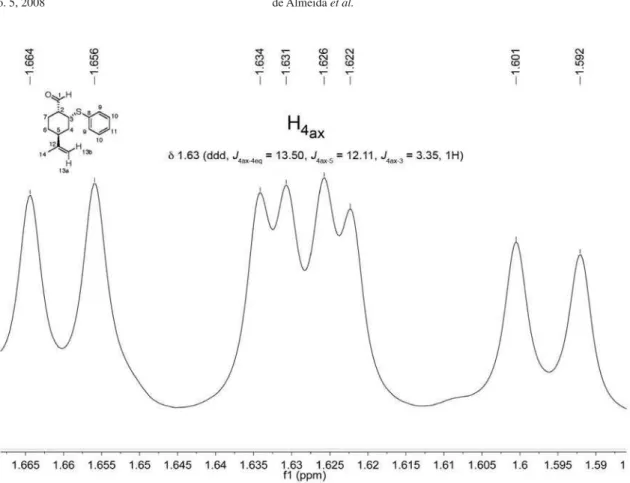
3 3.98 (app dd, J3-4eq 5.97 J3-4ax J3-2 3.10, 1H) 48.0 3.52 (app dd, J3-4eq 5.98, J3-4ax J3-2 3.33, 1H) 48.2 4 ax. 1.63 (ddd, J4ax-4eq 13.50, J4ax-5 12.11, J4ax-3 3.35, 1H)
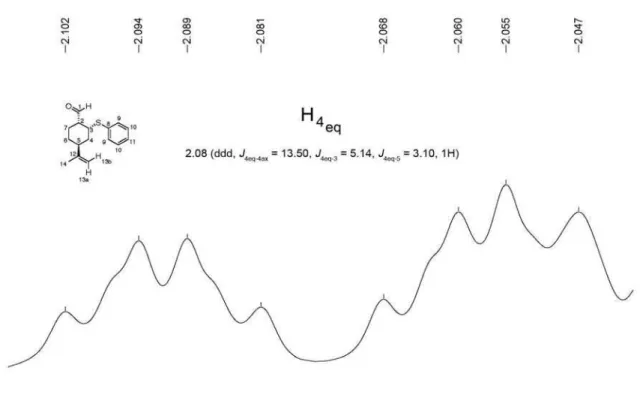
36.7 1.20 (ddd, J4ax-4eq 13.40, J4ax-5 12.00, J4ax-3 3.33, 1H) 36.9 4 eq. 2.08 (ddd, J4eq-4ax 13.50, J4eq-3 5.14, J4eq-5 3.10, 1H) 1.92 (ddd, J4eq-4ax 13.40, J4eq-3 5.10, J4eq-5 3.10, 1H)
5 2.49-2.58 (m, 1H) 39.0 2.50 (tt, J5-4eq J5-6eq 3.10, J5-4ax J5-6ax 12.00, 1H) 39.3 6 ax. 1.22 (qd, J6ax-6eq J6ax-5 J6ax-7ax 12.70, J6ax-7eq 3.65, 1H)
30.0 0.86 (qd, J6ax-6eq J6ax-5 J6ax-7ax 12.20, J6ax-7eq 3.60, 1H) 30.2
6 eq. 1.98-2.05 (m, 1H) 1.63-1.72 (m, 1H)
7 eq.
1.91-2.03 (m, 2H) 21.8 1.77-1.88 (m, 1H) 22.1
7 ax. 1.63-1.72 (m, 1H)
8 -- 135.2 -- 135.9
9 7.41-7.46 (m, 2H) 132.4 7.27-7.73 (m, 2H) 132.6
10
7.19 - 7.34 (m, 3H) 127.5
129.1 6.80-7.07 (m, 3H)
127.5 129.2 11
12 -- 149.1 -- 149.3
13a 4.73 (app quint, J13a-14 J13a-5 1.30, 1H)
109.1 4.75 (app quint, J13a-14 J13a-5 1.38, 1H) 109.3
13b 4.71 (app s, 1H) 4.71 (app s, 1H)
Michael Additions of Thiocompounds to -Unsaturated Carbonyl Compounds in Aqueous Media J. Braz. Chem. Soc.
900
Figure 3.1H NMR spectra of compound 16 in (a) a chloroform solvent and (b) a benzene solvent.
de Almeida et al. 901 Vol. 19, No. 5, 2008
Figure 5. Selective excitation of hydrogen H-3 in the TOCSY experiment.
Figure 6. nOe for compound 16.
good yields. This methodology represents an improvement over previous methods available in the literature in that it: a) uses a non-aggressive solvent; b) substitutes NaHCO3 for triethylamine as the base; c) can be carried out at room temperature (while in previous procedures low temperatures were needed); and d) the isolation step was reduced to a simple filtration. All of these advantages show progress toward the goal of Green Chemistry.
Supplementary Information
NMR spectra for the compounds 14 and 16 are available free of charge as PDF file at http://jbcs.sbq.org.br.
Acknowledgments
We thank CNPq and CAPES for financial support.
References
1. Bezerra, M. C. L.; Bursztyn, M.; Ciência e Tecnologia para
Desenvolvimento Sustentável, Ministério do Meio Ambiente, Instituto Brasileiro do Meio Ambiente e dos Recursos Naturais Renováveis, Consórcio CDS/UNB/Abipti, Ed. IBAMA: Brasília, 2000.
2. Anastas, P. T.; Warner, J. C.; Green Chemistry: Theory and
Practice, Oxford University Press: Great Britain, 2000.
3. da Silva, F. M.; Lacerda, P. S. B.; Jones Jr., J.; Quim. Nova 2005,
28, 103.
4. Prado, A. G. S.; Quim. Nova 2003,26, 738.
5. Merat, L. M. O. C.; San Gil, R. A. S.; Quim. Nova2003,26,
779.
6. Lenardão, E. J.; Freitag, R. A.; Dabdoub, M. J.; Batista, A. C.
F.; Silveira, C. C.; Quim. Nova2003,26, 123.
7. Dupont, J.; Quim. Nova2000,23, 825.
8. “wwverde” - www.ufpel.tche.br/iqg/wwverde - accessed in February 2008.
9. Breslow, R.; Acc. Chem. Res. 1991,24, 6.
10. Grieco, P. A.; Organic Synthesis in Water, Blacki Academic &
Professional: London, 1998.
11. Li, C. -H.; Chan, T. -H.; Organic Reaction in Aqueous Media,
John Wiley & Sons, Inc.: New York, 1997.
Michael Additions of Thiocompounds to -Unsaturated Carbonyl Compounds in Aqueous Media J. Braz. Chem. Soc.
902
13. da Silva, F. M.: Jones Jr., J.; Quim. Nova2001,24, 646.
14. Bergmann, E. D.; Ginsburg, D.; Pappo, R.; Organic Reactions:
The Michael Reaction, John Wiley & Sons, Inc.: London, 1959, Vol. 10.
15. Keller, E.; Feringa, B. L.; Tetrahedron Lett.1996,37, 1879.
16. Keller, E.; Feringa, B. L.; Synlett1997, 842.
18. Mori Y.; Kakumoto, K.; Manabe, K.; Kobayashi,S.; Tetrahedron
Lett.2000,41, 3107.
19. Loh, T. -P.; Wei L. -L.; Synlett1998, 975.
20. Ding, R.; Katebzadeh, K.; Roman, L.; Bergquist, K.; Lindström,
U. M.; J. Org. Chem.2006,71, 352.
21. Chaudhuri, M. K; Hussain, S.; J. Mol. Cat. A2007,269, 214.
22. Balline, R; Bosica, G.; Tetrahedron Lett.1996, 37, 8027.
23. Bensa, D.; Brunel, J. -M.; Buono, G.; Rodriguez, J.; Synlett
2001, 715.
24. Shimizu, S.; Shirakawa, S.; Suzuki, T.; Sasaki, Y.; Tetrahedron
2001,57, 6169.
25. Balline, R.; Barboni, G.; Bosica, G.; Filippone, P.; Peretti, S.;
Tetrahedron2000,56, 4095.
26. Balline, R.; Barboni, L.; Giarlo, G.; J. Org. Chem.2003,68,
9173.
27. Naidu, B. N.; Sorenson, M. E.; Bronson, J. J.; Pucci, M. J.;
Clark, J. M.; Ueda, Y.; Bioorg. Med. Chem. Lett.2005,15,
2069.
28. Shibatomi, K.; Nakahashi, T.; Uozumi, Y.; Synlett2000,
1643.
29. Lubineau, A.; Augé, J.; Tetrahedon Lett.1992,33, 8073.
30. Hajos, Z. G.; Parrish, D. R.; J. Org. Chem. 1974,39, 1612.
31. Harada, N.; Sugioka, T.; Uda, H.; Kuriki, T.; Synthesis1990,
53.
32. Naidu, B. N.; Li, W.; Sorenson, M. E.; Connolly, T. P.; Wichtowski, J. A.; Zhang, Y.; Kim, O. K.; Matiskella, J. D.;
Lam, K. S.; Bronson, J. J.; Ueda, Y.; Tetrahedron Lett.2004,
45, 1059.
33. Petrier, C; Dupy, C.; Luche, J. L.; Tetrahedron1986, 27,
3149.
34. Luche, J. L.; Allavenda, C.; Tetrahedron1988,29, 5369.
35. Luche, J. L.; Allavenda, C.; Petrier, C.; Dupuy, C.; Tetrahedron
1992,29,5373.
36. Suárez, R. M.; Sestelo, J. P.; Sarandeses, L. A.; Chem. Eur. J.
2003,9, 4179.
37. da Silva, F. M.; Gomes, A. K.; Jones Jr., J.; Can. J. Chem. 1999,
77, 624.
38. da Silva, F. M.: Jones Jr., J.; J. Braz. Chem. Soc.2001,12,
135.
39. Lindström, U. M.; Chem. Rev.2002,102, 2751.
40. King, J. F.; Rathore, R.; Lam, J. Y. L.; Guo, Z. R.; Klassen, D. F.; J. Am. Chem. Soc.1992,114, 3028.
41. Solladie, G.; Hutt, J.; Bull. Soc. Chim. Fr.1986,4, 643.
42. Smitt, O; Högberg, H. -E.; J. Chem. Res. (S),2002, 527.
Received: May 9, 2007
Supplementary Information
J. Braz. Chem. Soc., Vol. 19, No. 5, S1-S15, 2008. Printed in Brazil - ©2008 Sociedade Brasileira de Química 0103 - 5053 $6.00+0.00
*e-mail: [email protected]
Michael Additions of Thiocompounds to
AB
-Unsaturated Carbonyl Compounds in
Aqueous Media: Stereoselectivity with Unambiguous Characterization by NMR
Queli Aparecida Rodrigues de Almeida,
aMaria Luiza de Oliveira Pereira,
aRicardo Bezerra Coelho,
aErika Martins de Carvalho,
bCarlos Roland Kaiser,
aJoel Jones Junior*
,aand Flavia Martins da Silva*
,aaDepartamento de Química Orgânica, Instituto de Química, Universidade Federal do Rio de Janeiro,
CP 68.584, 21941-972 Rio de Janeiro-RJ, Brazil
bInstituto de Tecnologia em Fármacos, Far-Manguinhos, Rua Sizenando Nabuco no.100, Manguinhos,
21041-250 Rio de Janeiro-RJ, Brazil
Michael Additions of Thiocompounds to AB-Unsaturated Carbonyl Compounds in Aqueous Media J. Braz. Chem. Soc.
S2
Figure S2.1H NMR spectrum of compound 14 between G 1.15-1.70 (400 MHz, CDCl 3).
de Almeida et al. S3 Vol. 19, No. 5, 2008
Figure S4.1H NMR spectrum of compound 14 between G 2.22-2.35 (400 MHz, CDCl 3).
Michael Additions of Thiocompounds to AB-Unsaturated Carbonyl Compounds in Aqueous Media J. Braz. Chem. Soc.
S4
Figure S6.1H NMR spectrum of compound 14 between G 2.84-3.09 (400 MHz, CDCl 3).
de Almeida et al. S5 Vol. 19, No. 5, 2008
Figure S8.1H NMR spectrum of compound 14 between G 4.69-4.79 (400 MHz, CDCl 3).
Michael Additions of Thiocompounds to AB-Unsaturated Carbonyl Compounds in Aqueous Media J. Braz. Chem. Soc.
S6
Figure S10.1H NMR spectrum of compound 16 (400 MHz, CDCl 3).
de Almeida et al. S7 Vol. 19, No. 5, 2008
Figure S12.1H NMR spectrum of compound 16 between G 1.59-1.67 (400 MHz, CDCl 3).
Michael Additions of Thiocompounds to AB-Unsaturated Carbonyl Compounds in Aqueous Media J. Braz. Chem. Soc.
S8
Figure S14.1H NMR spectrum of compound 16 between G 2.04-2.11 (400 MHz, CDCl 3).
de Almeida et al. S9 Vol. 19, No. 5, 2008
Figure S16.1H NMR spectrum of compound 16 between G 3.95-4.03 (400 MHz, CDCl 3).
Michael Additions of Thiocompounds to AB-Unsaturated Carbonyl Compounds in Aqueous Media J. Braz. Chem. Soc.
S10
Figure S18.13C NMR spectrum of compound 16 (100 MHz, CDCl 3).
de Almeida et al. S11 Vol. 19, No. 5, 2008
Figure S20.1H NMR spectrum of compound 16 between G 0.80-0.91 (400 MHz, C 6D6).
Michael Additions of Thiocompounds to AB-Unsaturated Carbonyl Compounds in Aqueous Media J. Braz. Chem. Soc.
S12
Figure S22.1H NMR spectrum of compound 16 between G 1.59-1.72 (400 MHz, C 6D6).
de Almeida et al. S13 Vol. 19, No. 5, 2008
Figure S24.1H NMR spectrum of compound 16 between G 1.88-1.95 (400 MHz, C 6D6).
Michael Additions of Thiocompounds to AB-Unsaturated Carbonyl Compounds in Aqueous Media J. Braz. Chem. Soc.
S14
Figure S26.1H NMR spectrum of compound 16 between G 3.49-3.57 (400 MHz, C 6D6).
de Almeida et al. S15 Vol. 19, No. 5, 2008