Printed in Brazil - ©2004 Sociedade Brasileira de Química 0103 - 5053 $6.00+0.00
A
r
ti
c
le
* e-mail: [email protected]
Kinetics and Isotherms of Dazomet Adsorption on Natural Adsorbents
T. Sismanoglu*, A. Ercag, S. Pura and E. Ercag
Istanbul University, Engineering Faculty, Department of Chemistry, 34850 Istanbul, Turkey
A adsorção do 3,5-dimetiltetrahidro-1,3,5-tiodiazina-2-tiona (dazomet) sobre betonita e clinopetilolita foi estudada em quarto temperaturas (288, 293, 298 e 303 K) e em duas soluções distintas (água e mistura água-etanol 50%, v/v). A velocidade de adsorção em baixas concentrações de dazomet foi determinada como sendo de primeira ordem. Para cada sistema em concentração fixa, a constante de velocidade aumenta com o aumento da temperatura na solução aquosa, mas diminui no caso da mistura água-álcool a 50%. Usando-se a equação de Arrhenius, as energias de ativação de cada sistema foram calculadas. Parâmetros termodinâmicos foram avaliados de acordo com a equação de Eyring. Os valores de entalpia de ativação, ∆H*, são menores que T∆S*. Os resultados indicam que o processo de adsorção é controlado entropicamente em cada sistema. As isotermas de adsorção foram determinadas a 288 e 303 K. Estas isotermas seguem a equação de Freundlich para soluções aquosas a 15 °C. Para as duas soluções a 30 °C as isotermas foram modeladas de acordo com isotermas de Langmuir e BET.
The adsorption of 3,5-dimethyltetrahydro-1,3,5-thiadiazine-2-thione (dazomet) on bentonite and clinoptilolite has been studied at four temperatures (288, 293, 298 and 303 K) and two different solutions (water and water-ethyl alcohol mixture, 50% v/v). The adsorption rates at low concentrations of dazomet were found to fit the first-order kinetic equation. For each system at constant concentration, the rate constants increased with increasing temperature in aqueous solution, but these constants decreased with increasing temperature for 50% (v/v) water-ethyl alcohol mixture solution. By using the Arrhenius equation, the activation energies for each system were calculated. Thermodynamic parameters were evaluated according to Eyring’s equation. The values of enthalpy of activation,
∆H*, are lower than T∆S*. The results indicated that the adsorption process was entropy-controlled for each system. Adsorption isotherms were determined at 288 and 303 K. These isotherms were fitted to Freundlich equation for aqueous solution at 15 °C, but adsorption from the two different solutions at 30 °C were modeled according to the Langmuir and BET isotherms.
Keywords: bentonite, natural zeolite, dazomet, Langmuir and BET isotherms
Introduction
Dazomet (3,5-dimethyltetrahydro-2H-1,3,5-thiadiazine-2-thione) has been widely used as a pesticide in a variety of settings.1 In agriculture dazomet has found application as a fungicide, herbicide and nematocide for cabbage, cucumber, maize, potato and tomato plants. In the industrial environments dazomet was used as a slimicide in paper mills and as a biocide in metal working fluids in the manufacture of engines, transmissions, aircraft and special metal products. Dazomet was considered for use as a biocide in pump spray-delivered consumer products and custodial supplies. In addition, in the vulcanisation of rubber, it was used as a heat and pressure resistant.
Dazomet is degraded by hydrolysis in an aqueous solution within a time period of days. The pesticide activity of the compound was suggested to be based upon isothiocyanates and dithio carbamic acid which are formed by hydrolysis of the tetrahydro-2H-1,3,5-thiadiazine-2-thione ring. Hydrolysis of dazomet is greatly dependent upon the soil moisture, temperature and the soil type. If the temperature is low and alkalinity of the soil is high, its hydrolysis rate decreases. The portions that are not degraded reach the water sources. Therefore, the aim of this study is to investigate the adsorption of dazomet on bentonite and zeolite and to find its various adsorption parameters.
Materials and Methods
rhyolitic tuff level of the Neogene volcano sedimentary sequence in Gördes, West Anatolia, Turkey.2 Bentonite (TONSIL 550 FF) was purchased from Ormes Agency and was used in adsorption experiments. The chemical composition of zeolite was reported to be 69.35% SiO2, 11.9% Al2O3, 0.11% TiO2, 0.65% Fe2O3, 2.39% CaO, 0.8% MgO, 0.29% Na2O, 3.09%K2O, 0.04 %SO3, 7.89% H2O+, 3.48% H2O– and, for bentonite, to be 64.3% SiO
2, 13.2% Al2O3, 3.9% Fe2O3, 1.5% CaO, 6.1% MgO, 0.2% Na2O,1.2% K2O, and the loss on ignition to be 9.1%. They were first ground in a grinder (Janetzki with time controller) and sieved to obtain a particle size range smaller than 125 µm. After washing with distilled water, the samples were dried in an oven at 110 °C. Double distilled water and absolute ethyl alcohol were also used to prepare all the solutions. The pure crystalline dazomet used in the adsorption studies was synthesised according to the procedure suggested by Lam et al.3 Stock solutions of dazomet were prepared on a daily basis.
The initial concentrations of dazomet ranged from 4×10⁻⁵ to 1×10⁻⁴ mol L-1. The solutions were prepared in both water and 50% (v/v) ethanol-water solution. The amount of adsorption was calculated from the difference of dazomet concentrations in the aqueous solutions and ethanol-water solutions before and after the adsorption. Natural adsorbents (0.1g zeolite and bentonite samples) and 10 mL dazomet solution were shaken using a shaker with a water bath to control temperature. The liquid and solid phases were separated by centrifuging at 3000 rpm (MSE MISTRAL 2000) for 15 min. The change of dazomet concentration in each of the solutions was determined spectrophotometrically. All the spectrophotometric measurements were made with an ATI-Unicam UV-visible spectrophotometer. The maximum absorbance value of dazomet was measured at 280nm. This value was used to calculate the absorbate concentration during kinetic studies.The effect of temperature on the rate of adsorption for each system at 15, 20, 25 and 30 °C was studied for the highest concentration value (1.0×10⁻⁴ mol L-1 ).
Results and Discussion
Adsorption kinetics
The change in the amount of solute adsorbed per unit weight of adsorbent with time was found to fit in a first-order kinetics equation of,
ln(Xe-X)= -kt+ I (1)
where Xe; amount of adsorbed material at equilibrium, X;
amount of adsorbed material in time, I; the integration constant, t; time in seconds and k; rate constant.
The experiments showed that the amount of X
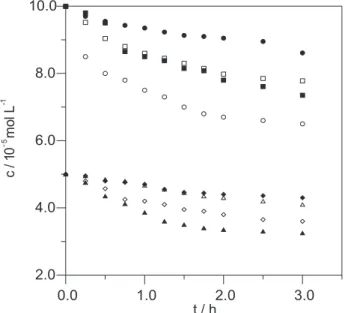
decreased with time. As seen in Figure 1, the initial rate of adsorption is lower for 50% (v/v) ethanol-water solution than that for the aqueous solution. The magnitude of the curves decreases with the elapsed time and reaches equilibrium within three hours. The dazomet adsorption was accepted to be complete at the end of this period. For each system, the rate of adsorption of dazomet on both zeolite and bentonite decreased with time at constant temperatures (15 and 30 °C). The values of k given in Table 1 showed that the rate of adsorption of dazomet on both adsorbents increased with increasing temperature in aqueous solution at constant concentration (1×10⁻⁴ mol L-1). Conversely, for 50% (v/v) ethanol-water solution of dazomet, this rate decreased with increasing temperature at the same concentration.
As known, the adsorption of solute from solution involves three steps.4 In the first step, bulk transport of solute in solution is rapid. In the second step, film transport covers diffusion of solute through of a hypothetical film boundary layer. In the third step, the solute diffuses within the pore volume of the adsorbent and along pore-wall surfaces to an active adsorption site. Film transport is the major factor controlling the rate of adsorption from solution onto porous adsorbent. The adsorption process is controlled by film diffusion when the rate of adsorption changes
Figure 1. Plots of concentration of dazomet vs time,using different solution concentrations (expreesed as mol L-1) at 15oC on bentonite
and zeolite respectively in aqueous solution ({)1x10⁻⁴, ()5x10⁻⁵,
in 50% (v/v) water-ethyl alcohol solution (z)1x10⁻⁴, (¡)5x10⁻⁵, in
aqueous solution ( )1x10⁻⁴, (U)5x10⁻⁵,in 50% (v/v) water-ethyl
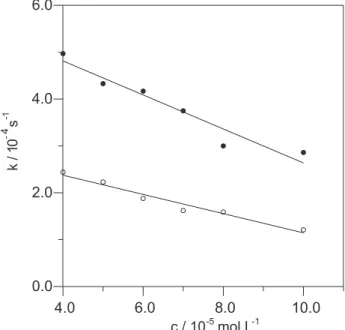
linearly with concentration.5 The effect of initial concentration of dazomet on the adsorption rate for each system is shown in Figure 2. The adsorption rate decreased linearly with the initial concentrations. It is evident that the adsorption is controlled by a film diffusion mechanism. The activation energies of the adsorption of dazomet on both adsorbents were calculated by a linearised Arrhenius equation,
(2)
where k; adsorption rate, Ea ; activation energy, R; gas constant and T; absolute temperature, A; preexponential factor. As shown in Figure 3, the plot of ln k against the reciprocal of absolute temperature resulted in straight lines for each system. The activation energies were evaluated from the slope of each linear plot as shown in Table 2. The adsorption mechanism is simple physical adsorption because the values of activation energy are in the range of
Table 1. Kinetic parameters of dazomet at concentration 1.0x10⁻⁴
mol L-1 at absorbent- water interfacea
Adsorbents Solution T/K k/10-4 s-1
Bentonite water 288.15 1.16
293.15 1.42
298.15 2.06
303.15 2.49
ethanol + water 50% (v/v)
288.15 2.12
293.15 1.86
298.15 1.67
303.15 1.45
Zeolite water 288.15 1.21
293.15 1.46
298.15 1.78
303.15 2.10
ethanol+ water 50% (v/v)
288.15 2.86
293.15 2.36
298.15 1.97
303.15 1.81
aThe standart error of the k values was calculated to be in the range
of ±0.03-0.05.
Table 2. Calculated thermodynamic values for adsorption of dazomet at adsorbent-water interfacea
Adsorbents Solution Ea/kJ mol-1 ∆H*/kJ mol-1 ∆S*/J mol-1 K-1 ∆G*/kJ mol-1
Bentonite water 37.0 34.0 -200 94.3
ethanol + water 50% (v/v) - 17.3 -21.0 -385 94.6
Zeolite water 26.0 25.0 -234 94.4
ethanol + water 50% (v/v) -23.0 -25.0 -399 94.1
aAll the∆H* values are accurate to ± 3 kJ mol-1
,all the∆S
* values are accurate to ±17 J mol-1 K-1 , all the ∆G* values are accurate to ± 5 kJ mol-1.
Figure 2. For zeolite plot of k vs initial concentration of dazomet at 15 oC; in aqueous solution ({) r=0.99, and 50% (v/v) water-ethyl
alcohol solution (z) r=0.98.
21 to 42 kJ/mol.6 As seen in Table 2, the values of activation energy are higher in aqueous solution than that of in 50% (v/v) ethanol-water solution. The fact that dazomet was adsorbed more in aqueous solution and less in 50% (v/v) ethanol-water solution may simply be interpreted with the higher solubility of dazomet in alcoholic medium. Since the adsorbate has a higher tendency for the alcohol containing solvent, it is adsorbed less from that solvent, because adsorption is a competition for the adsorbate molecules between the solvent and the solid adsorbent. Also, the values of activation energy and enthalpy are smaller for 50% (v/v) ethanol-water solution than those for water. Adsorption of dazomet from water involves breaking of hydrogen bonds and other intermolecular attraction while new interactions form between the adsorbent and adsorbate. Since more bonds seem to be broken than formed, the adsorption of dazomet from water is both more endothermic and needs a higher activation energy (see Table 2) than in 50% ethanol-water solution where H-bonds are less predominant.
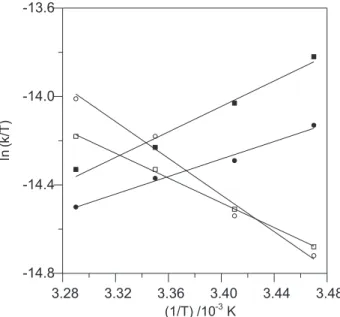
Figure 4 shows that the plot of ln(k/T) against the reciprocal of absolute temperature for each system is linear following the Eyring equation of:
(3)
The entropy of activation, ∆S*, and the enthalpy of activation, ∆H*, were calculated from the intercept and the slope of each linear plot, as listed in Table 2. k and h
are Boltzmann’s and Planck’s constants, respectively. The free energies of activation, ∆G*, for each system equal to
∆H* – T∆S* were determined at a T value which is equal to 298.15 K, and these values are included in Table 2. It is noted from Table 2 that ∆H* is lower than T∆S*, which means that the adsorption process is mostly entropy-controlled for each system.7 As expected, the entropy of activation, ∆S*, for all systems are smaller than zero. As can be seen from Table 2, the values of ∆G* are close to each other in the studied solvent systems.
Adsorption isotherms
The molecular structure of dazomet is given Figure 5. The diagonal of dazomet molecule was calculated as 0.65 nm by the aid of ACD/3D, 2001(Advanced Chemistry Development Inc., Canada) program.8 The dimensions of the open channels in clinoptilolite are 0.89x0.35 nm2 for the 10-membered ring or 0.72x0.44nm2, large enough to include the dazomet molecule by physical adsorption mechanism.9,10
The dazomet molecule does not have the strong functional group OH and a strong affinity for hydrogen bonding in its molecular structure, as seen Figure 5.
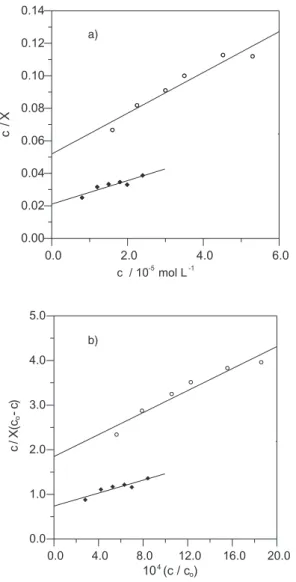
Therefore, the adsorbents can adsorb the solute molecules of dazomet in planar configuration from each system by means of non-hydrogen bonding forces, as oriented flat in water-penetrated regions.11 Thus, an L type curve is expected for the adsorption of dazomet onto the adsorbents from polar solvents such as water and 50% (v/v) ethanol-water solution, as seen in Figures 6 and 7.11,12 Because of the shape of the L curve, the most appropriate adsorption models for the concentration ranges between 4.10-5 and 1.10-4 mol L-1 were Langmuir and BET isotherms as depicted in Figures 8 and 9.
The equations linearised from Langmuir and BET isotherms are as follows, respectively,
(4)
where X, the amount of dazomet adsorbed per unit weight of zeolite and bentonite at equilibrium (mol g-1 ), c, the
Figure 4. Plot of ln (k/T) against 1/T for the adsorption dazomet on bentonite and zeolite, respectively; in aqueous solutin ({) r=0.99, in 50% (v/v) water-ethyl alcohol solution (z) r=0.99 and in aqueous solutin ( ) r=0.99 in 50% (v/v) water-ethyl alcohol solution () r=0.99.
Figure 8. a) For aqueous solution application of Langmuir equation to adsorption of dazomet at 30 oC; on bentonite (¡), on zeolite ({);
b) For aqueous solution application of BET equation to adsorption of dazomet at 30 oC; on bentonite (¡), on zeolite ({).
Figure 9. a) For 50% (v/v) water-ethyl alcohol solution application of Langmuir equation to adsorption of dazomet at 30 oC; on
bento-nite (), on zeolite (z); b) For 50% (v/v) water-ethyl alcohol solu-tion applicasolu-tion of BET equasolu-tion to adsorpsolu-tion of dazomet 30 oC;
on bentonite (), on zeolite (z).
Figure 7. In 50% (v/v) water-ethyl alcohol solution adsorption isotherms of dazomet; (+) 15 oC , () 30 oC for bentonite and ({)
15 oC, (U) 30 oC for zeolite.
equilibrium concentration in aqueous phase (mol L-1 ), Xmax, the maximum adsorption at monolayer coverage (mol g-1 ) and b, the adsorption equilibrium constant (L mol-1 ) and,
(5)
where co, the concentration of dazomet at saturated solution, as seen in Table 3, c, the equilibrium concen-tration of dazomet in actual solution, k, a constant related with the heat of adsorption.
The adsorption data could also be fitted to the following linearised Freundlich equation,
log X = n log c + log K (6)
where X and c are as described before, K and n are Freundlich constants representing adsorption capacity and intensity, respectively. Langmuir, BET and Freundlich isotherm
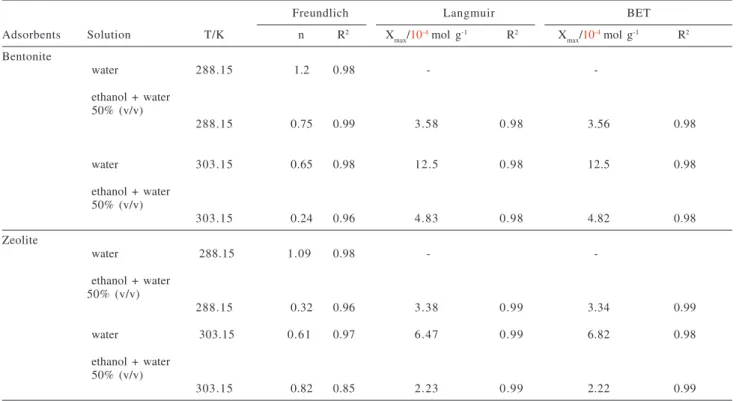
constants were summarised in Table 4. These constants show that the linearised Freundlich isotherm is followed at 15 oC for all systems, but the adsorption data are not in a good agreement with the Freundlich equation at 30 oC, and these data are poorly linear with the values of correlation coefficient (R2) < 0.98. For Langmuir and BET equations, the isotherm constants were not estimated for aqueous solution at 15 oC because of poor linearity. The adsorption data show a good fit to Langmuir and BET equations (R2>0.98) for each system. The values of X
max in aqueous solution at 30 oC are higher than those of the other solvent mixtures. The maximum adsorption may be related to a saturated monolayer of adsorbate molecules on the adsorbent surface at aqueous and 50% (v/v) ethanol-water solution, and this observation is totally in accordance with the basic assumptions of the Langmuir approach. After the initial plateau region corresponding to monolayer adsorption, the curve rises steadily, as seen in Figures 6 and 7. Then, the second plateau may represent a second condensed monolayer formed on top of the first, and this observation is not coincident with the basic Langmuir assumptions. This may show the adsorption behaviour of dazomet onto zeolite and bentonite from polar solvents such as water and 50% (v/v) ethanol-water solution, where the appropriate measurements are consistent with complete surface coverage in flat orientation at the first plateau, and complete coverage in vertical orientation at the second plateau.11,13
Table 3. The concentrations of dazomet at saturated solution
Solution T/K co /10-2mol L-1
water 288.15 1.85
303.15 2.85
ethanol + water 50% (v/v) 288.15 9.26
303.15 10.0
Table 4. Isotherm Constants
Freundlich Langmuir BET
Adsorbents Solution T/K n R2 X
max/10
-4mol g-1 R2 X
max/10
-4mol g-1 R2
Bentonite
water 288.15 1.2 0.98 -
ethanol + water 50% (v/v)
288.15 0.75 0.99 3.58 0.98 3.56 0.98
water 303.15 0.65 0.98 12.5 0.98 12.5 0.98
ethanol + water 50% (v/v)
303.15 0.24 0.96 4.83 0.98 4.82 0.98
Zeolite
water 288.15 1.09 0.98 -
ethanol + water 50% (v/v)
288.15 0.32 0.96 3.38 0.99 3.34 0.99
water 303.15 0.61 0.97 6.47 0.99 6.82 0.98
ethanol + water 50% (v/v)
Conclusion
This adsorption process was interpreted as simple physical adsorption for each system, because of the values of activation energy in the range of –23.0 to 37.0 kJ mol-1. The value of ∆H* for the adsorption of dazomet on zeolite and bentonite is positive for aqueous solution, but it is negative for 50% (v/v) ethanol-water solution. Because the value of ∆H* is lower than the value of T∆S*, the adsorption process is entropy-controlled for all systems. The adsorption isotherms of dazomet on clinoptilolite and bentonite were modelled according to the Langmuir and BET adsorption isotherms. These isotherms were assigned as L curves. The adsorption isotherm of dazomet is a two-step curve (L), because the molecular orientation was flat at first and later end-on. As a result, the adsorption of dazomet follows the monolayer (conforming to Langmuir) and then multilayer mechanism (conforming to BET model).
Acknowledgment
Authors would like to thank Prof.Resat Apak from Istanbul University for the editing of the manuscript in terms of grammar.
References
1. Goksoyr, J.; Acta Chem.Scand.1964, 18, 1341.
2. Esenli, F.; Publication of the Chamber of Geological Engineers of Turkey, 1993, 42.
3. Lam, W.W.; Kim, J.H.; Sparks, S.E.; Quistad, G.B.; Casida, J.E.; J. Agric. Food. Chem.1993, 41, 1497.
4. Slejko, F.L.; Adsorption Technology; Marcel Dekker: New York, 1985.
5. Atun, G.; Sismanoglu, T.; J. Environ. Sci. Health1996, A31, 2055.
6. Glasstone, S.; Lewis, D.; Element of Physical Chemistry; The Macmillan Press LTD: New York, 1960, p. 560.
7. Sarkar, D.; Chattoraj, D.K.; J. Colloid Interface Sci.1993,
157, 219.
8. www.acd/abs.com, Advanced Chemistry Development Inc.; Toronto, Ontario M5H 3V9, Canada, 2001.
9. Li, Z.; Langmuir1999, 15, 6438.
10. Barros, M.A.S.D.; Machado, N.R.C.F.; Alves, F.V.; Sousa-Aquiar, E.F.; Braz. J. Chem. Eng. [online]1997, 14, available at <http://www.scielo.br>.
11. Giles, C.; MacEwan, T.; Nakwa, S.; Smith, D.; J. Chem. Soc. 1960, 3973.
12. Guangyu, Y.; Thiruvenkatachari, V.; Water Research 2003,
37, 4486.
13. Ying, Y.;Yuan-Yi, Z.; Zhong-Hua, W.; Ming-Qiang, Q.;
Chemosphere2004, 54, 425.
Received: April 23, 2003