http://dx.doi.org/10.1590/bjpt-rbf.2014.0160 Braz J Phys Ther. 2016 July-Aug; 20(4):367-373 367
Effects of 10,000 steps a day on physical and mental
health in overweight participants in a community setting:
a preliminary study
Kornanong Yuenyongchaiwat1
ABSTRACT | Background: Being overweight is associated not only with physical health problems, but also with risk of mental health problems. Increased physical activity (PA) has been recommended for the prevention of cardiovascular disease; however, little is known about the effect of walking on physical and mental health outcomes. Objective: The purpose of the study was to explore the effectiveness of a pedometer-based PA intervention on physical and mental health states. Method: Thirty-ive overweight participants with body mass index (BMI) ≥25 kg•m–2 were selected and
assigned to a 12-week pedometer-based walking program (10,000 steps•d–1). The proile of mood states, BMI, waist circumference (WC), body fat percentage (%BF), and lean body mass (LBM) were measured before and after the 12-week intervention. The number of step counts was recorded 5 days a week in a diary booklet. Results: The 30 participants who accumulated 10,000 steps•d–1 had signiicantly lower anxiety, depression, anger, fatigue, confusion, and total mood
distress scores compared with measurements taken prior to the intervention. Further, the participants had higher vigor
scores compared to baseline. Regarding physical health, the participants who accrued 10,000 steps a day had signiicantly lower body weight, WC, BMI, and %BP. After adjustment for gender, height, and daily steps at follow-up, changes in
WC were negatively associated with depression, fatigue, confusion, and total mood distress. Conclusions: An increase
in PA by accumulating at least 10,000 steps•d–1 over a 12-week period improves physical and mood states in sedentary,
overweight individuals.
Keywords: physical activity; physical health; proile of mood states; overweight; walking; physical therapy.
Thai Clinical Trials Registry number: TCTR20151214002
BULLET POINTS
• To explore the effect of 10,000 steps a day in sedentary, overweight Thai subjects. • 10,000 steps a day may help to decrease physical and mental health problems.
• They may also help to reduce risks of non-communicable disease and cardiovascular disease.
HOW TO CITE THIS ARTICLE
Yuenyongchaiwat K. Effects of 10,000 steps a day on physical and mental health in overweight participants in a community setting: a preliminary study. Braz J Phys Ther. 2016 July-Aug; 20(4):367-373. http://dx.doi.org/10.1590/bjpt-rbf.2014.0160
1 Physiotherapy Department, Faculty of Allied Health Sciences, Thammasat University, Pathumthani, Thailand Received: Aug. 06, 2015 Revised: Nov. 20, 2015 Accepted: Dec. 07, 2015
Introduction
Recently, overweight and obesity present major
health problems worldwide and these issues lead to non-communicable diseases (NCDs) and cardiovascular disease1,2. Further, evidence suggests that obesity is associated with mental health problems (e.g. depression), poor perceived health, low self-esteem, and body image concern3. There is also evidence that obese individuals
can decrease mood disorders by controlling diet and body weight, managing stress, improving self-esteem, having psychological treatment, and exercising. Physical activity (PA) has been consistently linked to improved mood. In addition, there is strong evidence
that PA helps to decrease anxiety and depression and improves mood, self-esteem, and body image4-6. Regarding the relationship between obesity and PA,
several studies have shown that overweight/obesity
was inversely related to PA. For example, high body
mass index (BMI) and waist circumference (WC)
are related to decreased PA7,8. A recent systematic review from 25 prospective cohort studies found that
PA levels including low PA (e.g. walking less than
150 minutes/week) could prevent future depression9.
physical health problems by increasing PA should be considered.
Recently, programs that increase the number of daily walking steps have been promoted to improve PA and a pedometer or step-counting device has been commonly used to measure and promote PA. However, little research has been conducted on the effects of
accumulating 10,000 steps with a pedometer on both
physical and mood states. Therefore, the aim of this
study was to determine the effect of 10,000 steps per day with a pedometer on the proile of mood states
and physical health in overweight participants in a community setting.
Method
Participants and design
Thirty-ive overweight adults aged 35-59 were recruited (BMI≥25 kg•m–2). The ethics and protocol
were approved by the Ethics Committee of Thammasat University, Pathumthani, Thailand (approval number
069/2557). All participants gave written informed
consent. The quasi-experimental study was designed to determine whether the effect of a pedometer-based intervention decreased mental and physical health problems.
Measures and apparatus
Anthropometric measures, i.e. weight (kg), height (cm), and WC, were assessed prior to and
after the intervention program. Evaluation of BMI
was used as an indicator of being overweight. WC was measured at the level of the umbilicus. In addition, percentage of body fat mass (%BF), lean
body mass (LBM; kg) were measured, which have
been described in detail elsewhere10.
All participants completed the Proile of Mood States (POMS) scale11 to measure psychological well-being at baseline and 12 weeks after baseline assessment. The POMS is composed of 65 items rated on a 5-point Likert scale. The checklist items are comprised of 6 subscale scores: tension/anxiety, depression, anger/hostility, fatigue, confusion, and
vigor. In addition, the total mood distress score was used to evaluate an overall measure of mood states. Subtraction of vigor scores from the sum of the negative mood (i.e. tension, depression, anger,
fatigue, and confusion) was deined as the total mood distress. The POMS has been found to have
good internal consistency of subscales, ranging
from 0.63 to 0.9611.
The number of walking steps per day was measured
at baseline with a pedometer (Yamax SW-200).
The participants were asked to wear their sealed
pedometer during the working day for 5 days whilst
following their normal daily routine and then record
the details in their booklet. During the 12-week
intervention, the participants were instructed to
walk at least 10,000 steps per day and record their steps in their diary. At the end of week 12, body weight, POMS, BMI, WC, WHR, %BF, and LBM
were assessed again.
Statistical analysis
Sample size calculations indicated that 30 participants were needed to complete the study to ensure suficient power (80%) to detect an effect size (Cohen’s d=1.08).
In order to allow for attrition, 35 overweight participants
were recruited. Steps per day were calculated weekly
(i.e. 5 working days per week). The change in the average number of steps per day over the 12-week
intervention program was modeled for each participant. Descriptive data are presented as percentage (%),
mean, and standard deviation (SD). Data were veriied
for normality of distribution (Kolmogorov-Smirnov
goodness-of-it test). Changes in physical health
outcomes were calculated by subtracting physical health outcomes at follow-up from initial baseline physical health values. The paired t-test was used to
determine whether the pedometer decreased signiicant
changes in physical and mental health outcomes.
Pearson’s correlations coeficients were calculated between POMS after a 12-week period and changed
physical health. To examine the association between
POMS and physical health outcomes after adjusting
for possible confounding variables (e.g. gender, height, and daily walking steps at follow-up), partial correlational analysis was conducted. In addition, a regression analysis was performed to evaluate the utility of the effects of the pedometer for improving
health outcomes in overweight participants. Multiple
regression analyses were conducted to determine
the unique contribution of 10,000 steps per day to
the improvement of mental health outcomes after
adjustment for initial POMS and daily walking steps. In
the linear regression, the assumptions of normality of the residual scores were met. In addition, all analyses
369
Braz J Phys Ther. 2016 July-Aug; 20(4):367-373
Results
Changes in physical and mental health states with the pedometer-based intervention program
The mean age of the participants was 49.67±6.51 years. A total of 30 participants (9 males and 21 females) completed the walking program. Of the 5 participants (14.29%) who did not complete the protocol,
one was pregnant and one had leg pain due to a herniated disc caused by heavy lifting. Based on
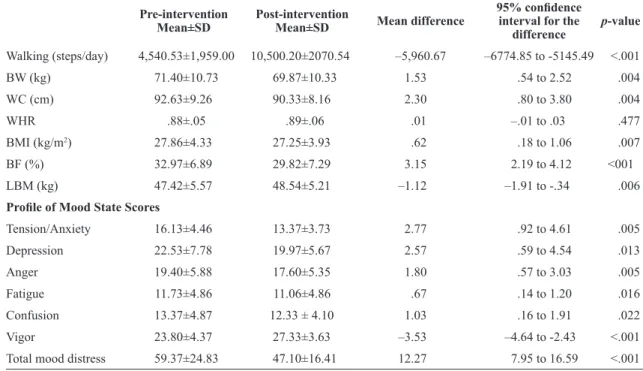
the deinition of PA by Tudor-Locke et al.12, the participants were deined as a sedentary (i.e. less than 5,000 steps a day) at baseline. As shown in
Table 1, feelings of tension, depression, anger, confusion, fatigue, and total mood distress decreased
signiicantly after the 12-week program, as did body weight, BMI, WC, and %BF. In addition, vigor scores increased signiicantly (p<.05 in all cases).
In short, accumulating 10,000 steps a day resulted in a signiicant decrease in negative mood and negative physical health outcomes and signiicant
improvements in vigor-activity with a large effect size (d≥.8 in all cases; Cohen13).
Correlations between daily walking steps,
profile mood states, and physical health
outcomes at follow-up
As seen in Table 2, the participants who accrued
10,000 steps a day had a modest but signiicant inverse correlation with decreased body weight, BMI, and WC at 12 weeks. In addition, analysis of the correlation
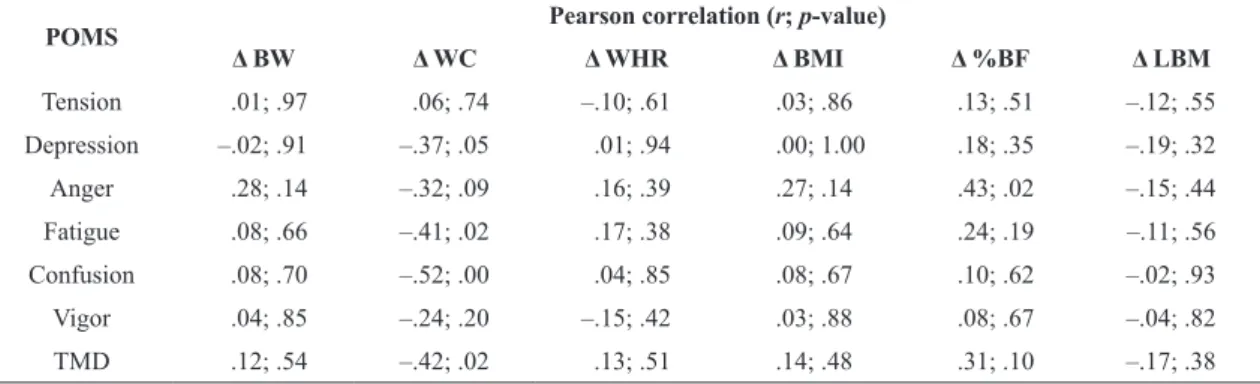
revealed that changes in WC were negatively associated with depression, fatigue, confusion, and total mood distress (p<.05 in all cases). Further, negative association was observed between %BF and anger state (p<.05; see Table 3). Overall, there was a large (r>0.4 in all cases, according to Cohen13) negative correlation between health outcomes (e.g. WC) and proile of
mood states (e.g. depression).
To determine whether the relationship between mental health states and physical health changes
survived adjustment, partial correlation analysis was then computed adjusting for gender, height, and daily
walking steps at follow-up.
Partial correlations showed that the relationships between changes in WC and depression, fatigue,
confusion, and total mood distress survived adjustment
for gender height and daily walking steps at follow-up. Further, the relationship between %BF and anger
states also remained signiicant after adjusting for
Table 1. Comparison between pre- and post-intervention programs in overweight participants.
Pre-intervention Mean±SD
Post-intervention
Mean±SD Mean difference
95% conidence interval for the
difference
p-value
Walking (steps/day) 4,540.53±1,959.00 10,500.20±2070.54 –5,960.67 –6774.85 to -5145.49 <.001
BW (kg) 71.40±10.73 69.87±10.33 1.53 .54 to 2.52 .004
WC (cm) 92.63±9.26 90.33±8.16 2.30 .80 to 3.80 .004
WHR .88±.05 .89±.06 .01 –.01 to .03 .477
BMI (kg/m2) 27.86±4.33 27.25±3.93 .62 .18 to 1.06 .007
BF (%) 32.97±6.89 29.82±7.29 3.15 2.19 to 4.12 <001
LBM (kg) 47.42±5.57 48.54±5.21 –1.12 –1.91 to -.34 .006
Proile of Mood State Scores
Tension/Anxiety 16.13±4.46 13.37±3.73 2.77 .92 to 4.61 .005
Depression 22.53±7.78 19.97±5.67 2.57 .59 to 4.54 .013
Anger 19.40±5.88 17.60±5.35 1.80 .57 to 3.03 .005
Fatigue 11.73±4.86 11.06±4.86 .67 .14 to 1.20 .016
Confusion 13.37±4.87 12.33 ± 4.10 1.03 .16 to 1.91 .022
Vigor 23.80±4.37 27.33±3.63 –3.53 –4.64 to -2.43 <.001
Total mood distress 59.37±24.83 47.10±16.41 12.27 7.95 to 16.59 <.001
gender, height, and daily walking steps at follow-up (see Table 4). In other words, lower WC was still associated with lower depression, confusion, and total mood distress scores, after controlling for
gender, height, and 10,000 steps a day. Moreover, the
participants who had higher %BF were associated with higher anger states. In sum, the negative relationships
between physical health and proile of mood states
remained statistically signiicant, albeit modest, after controlling for gender, height, and 10,000 steps a day.
Prediction of longitudinal changes in mental health problems over a 12 week later
In addition, the study examined whether the
contribution of walking steps•d–1 to the prediction of
follow-up mental health outcomes. As can be seen in Table 5, future depression scores were related to initial depression scores and daily walking steps at follow-up (R2=.645, p<.001), and the more the
number of walking steps (≥10,000 steps per day) or PA
increased, the more the depression scores decreased.
Discussion
The present study evaluated the efficacy of
accumulating 10,000 steps per day on the mood
states and physical health outcomes of overweight participants in a community setting. Further, these
participants were leading a sedentary lifestyle (<5,000
Table 3. Bivariate correlations between physical health changes and proile mood states after a 12-week period.
POMS Pearson correlation (r; p-value)
Δ BW Δ WC Δ WHR Δ BMI Δ %BF Δ LBM
Tension .01; .97 .06; .74 –.10; .61 .03; .86 .13; .51 –.12; .55
Depression –.02; .91 –.37; .05 .01; .94 .00; 1.00 .18; .35 –.19; .32
Anger .28; .14 –.32; .09 .16; .39 .27; .14 .43; .02 –.15; .44
Fatigue .08; .66 –.41; .02 .17; .38 .09; .64 .24; .19 –.11; .56
Confusion .08; .70 –.52; .00 .04; .85 .08; .67 .10; .62 –.02; .93
Vigor .04; .85 –.24; .20 –.15; .42 .03; .88 .08; .67 –.04; .82
TMD .12; .54 –.42; .02 .13; .51 .14; .48 .31; .10 –.17; .38
Δ: changes; POMS: proile of mood states; BW: body weight; WC: waist circumference; WHR: waist-hip ratio; BMI: body mass index; BF: body fat; LBM: lean body mass; TMD: total mood distress.
Table 2. Bivariate correlation between daily walking steps and
physical health at the 12-week follow-up.
Physical health outcomes
Daily walking steps at follow-up Pearson
correlation (r) p-value
BW –.46 .01
BMI –.42 .02
WC –45 .01
WHR –.26 .16
%BF –.30 .11
LBM –.29 .12
BW: body weight; BMI: Body mass index; WC: waist circumference; WHR: waist-hip ratio; BF: body fat; LBM: lean body mass.
Table 4. Partial correlations between psychological well-being and physical health changes controlling for height, gender, and daily walking steps at follow-up among overweight participants.
POMS Pearson correlation (r; p-value)
Δ BW Δ WC Δ WHR Δ BMI Δ %BF Δ LBM
Tension –.02; .94 .124; .54 –.049; .81 .01; .97 .05; .80 –.09; .64
Depression .00; .99 –.449; .02 .035; .86 .03; .90 .18; .38 –.16; .41
Anger .29; .15 –.302; .13 .200; .32 .28; .15 .45; .02 –.14; .47
Fatigue .11; .58 –.407; .04 .193; .34 .12; .55 .29; .14 –.12; .56
Confusion .11; 58 –.558; .00 .001; 1.00 .13; .53 .21; .29 –.06; .77
Vigor .06; .77 –.203; .31 –.144; .47 .06; .78 .12; .55 –.06; .77
TMD .13; .51 –.437; .02 .149; .46 .15; .45 .32; .10 –.16; .43
371 Braz J Phys Ther. 2016 July-Aug; 20(4):367-373
steps per day)12. The main indings of the present study were that participants displayed decreased negative mood (i.e. anxiety, depression, anger, confusion,
and total mood distress scores), body weight, BMI,
WC, and %BF after increasing PA by accumulating
≥10,000 steps daily using the pedometer in a 12-week
walking intervention. In addition, the results found that
walking 10,000 steps a day played a role in decreasing
depression scores after controlling for gender, height, initial depression scores, initial daily walking steps, and changes in daily walking steps.
The results conirm recent indings indicating that walking 10,000 steps per day is effective in increasing PA. In particular, a meta-analysis of 26 studies from 1966 to 2007 suggested that using a pedometer
increased PA14. Further, the beneicial change in weight demonstrated in the current study agrees with
other studies, which showed that 10,000 steps per day resulted in a signiicant decrease in body weight, BMI,
%BF, and WC15-17. Further, Tudor-Locke18 described
pedometer-based guidelines and cardiovascular health outcomes and concluded that increasing walking
steps can improve BMI and cardiovascular health
outcomes18. Thus, accumulating at least 10,000 steps
per day may account, in part, for a reduction in WC
and BMI.
In addition, the present study results indicate that
walking 10,000 steps per day is effective in reducing
negative mood states. Previous studies have also demonstrated positive effects following a walking intervention. Several systematic reviews have shown the effect of exercise (e.g. aerobic exercise, walking) on PA on emotional states (i.e. depression, anxiety, and mood)4,9,19-21. These reviews revealed that exercise/PA is related to decreased anxiety, depression, and mood states as well as improved psychological well-being.
In the present study, the beneits of accumulating 10,000 steps a day over a 12-week period were supported by the self-reported results of the POMS:
decreased tension, depression, anger, confusion,
fatigue, and total mood distress. Moreover, increased
vitality was observed in the participants who attained
10,000 steps a day.
It has been known that the effects of exercise reduce stress; however, few studies have reported the
accumulation of 10,000 steps a day speciically22,23. The American College of Sports Medicine (ACSM)
and the American Heart Association (AHA) have recommended individual accumulations of at least
30 minutes of moderate-intensity PA (e.g. brisk walking) 5 days per week or 150 minutes per week
for all population groups24. Other studies have shown
that accumulating at least 10,000 steps•d–1 meets that
minimum requirement12,25. Therefore, a daily target
of 10,000 steps has been generally suggested to
improve health outcomes in sedentary lifestyle and promote a decrease in negative mood (e.g. anxiety and depression).
With respect to POMS and physical outcomes, our
results indicate that participants with decreased WC exhibited less depression, fatigue, confusion, and total
mood distress scores after a 12-week intervention. In
addition, the relationships between WC and negative mood disorders (i.e. depression, confusion, and total mood distress) were maintained after statistical
adjustment for baseline walking steps, increased steps walk, gender, and age. Moreover, increasing steps daily (accumulating up to 10,000 steps a day)
predicted future depression scores after controlling for initial depression scores and baseline daily walking steps. Therefore, the present study would suggest that one mechanism linking negative mood disorders
with the 10,000 steps a day may involve changed
physical outcome (i.e. decreased WC). In addition, WC is assumed to be a risk factor for obesity and an
indicator for cardiovascular risk (e.g. type 2 diabetes,
hypertension, cardiovascular disease)2. In a large survey with U.S. adults, Zhao et al.26 reported that WC is related to increased risk of depressive symptoms. Hence, the present study provides some supporting
evidence for the involvement of 10,000 daily steps
in participants with negative mood: they showed a decreased WC.
It should be noted that this study has a few limitations that may have affected the results. The absence of a control group is the most important limitation;
Table 5. Multiple regression analysis effect of 10,000 steps per day on depression from baseline characteristics. Non-standardized
coeficients (B) Coeficients (β)Standardized p-value 95% Conidence
interval for B
Baseline depression scores .54 .74 <.001 .36 to .72
Initial daily walking steps –.00 –.32 .030 .00 to .00
therefore, the effects observed are overestimated, given that important confounders (i.e. placebo effects, polite patients, regression to the mean, recall bias, and natural history) were not controlled. Therefore, a high quality randomized controlled trial is strongly needed
to conirm our results. The study had a relatively small
sample size and most of the participants recruited
were females (70%). Therefore, results cannot be
used to draw conclusions for the whole population. In summary, the use of a pedometer can improve PA, and the effect of walking with the goal of
accumulating 10,000 steps per day results in improved POMS scores (i.e. decreased tension, depression,
anger, fatigue, confusion, and total mood distress) as well as improved vigor in overweight adults with sedentary lifestyle.
Acknowledgements
The author acknowledges the help of Mr. Paitoon
Dhari, head of the community health service, and
Mrs. Somsong Duren, registered nurse, for organizing
and overseeing participant recruitment in the community. The study is also thankful to Pantip Sukprasert for her assistance in completing this study. Lastly, the author would like to thank the participants in the community for their participation. This study was fully supported by a research grant from Thammasat
University No. 19/2557.
References
1. Park YW, Zhu S, Palaniappan L, Heshka S, Carnethon MR, Heymsfield SB. The metabolic syndrome: prevalence and associated risk factor findings in the US population from the Third National Health and Nutrition Examination Survey. Arch Intern Med. 2003;163(4):427-36. http://dx.doi.
org/10.1001/archinte.163.4.427. PMid:12588201.
2. World Health Organization – WHO. Waist circumference and waist-hip ratio: report of a WHO expert consultation. Geneva: WHO; 2008.
3. Gatineau M, Dent M. Obesity and mental health. Oxford: National Obesity Observatory; 2011.
4. Teychenne M, Ball K, Salmon J. Physical activity and likelihood of depression in adults: a review. Prev
Med. 2008;46(5):397-411. http://dx.doi.org/10.1016/j.
ypmed.2008.01.009. PMid:18289655.
5. Ströhle A. Physical activity, exercise, depression and anxiety disorders. J Neural Transm. 2009;116(6):777-84. http://
dx.doi.org/10.1007/s00702-008-0092-x. PMid:18726137. 6. De MelloMT, Lemos VA, Antunes HK, Bittencourt L,
Santos-Silva R, Tufik S. Relationship between physical activity and depression and anxiety symptoms: a population
study. J Affect Disord. 2013;149(1-3):241-6. http://dx.doi.
org/10.1016/j.jad.2013.01.035. PMid:23489405.
7. Ara I, Moreno LA, Leiva MT, Gutin B, Casajús JA. Adiposity, physical activity, and physical fitness among children from Aragon, Spain. Obesity (Silver Spring). 2007;15(8):1918-24.
http://dx.doi.org/10.1038/oby.2007.228. PMid:17712107. 8. Lohman TG, Ring K, Pfeiffer K, Camhi S, Arredondo E, Pratt
C, et al. Relationships among fitness, body composition, and physical activity. Med Sci Sports Exerc. 2008;40
(6):1163-70. http://dx.doi.org/10.1249/MSS.0b013e318165c86b.
PMid:18460987.
9. Mammen G, Faulkner G. Physical activity and the prevention of depression: a systematic review of prospective studies.
Am J Prev Med. 2013;45(5):649-57. http://dx.doi.org/10.1016/j.
amepre.2013.08.001. PMid:24139780.
10. Yuenyongchaiwat K. Effect of using pedometer to increase physical activity in middle-aged Thais with overweight: a preliminary study. Thammasat International Journal of Sciences and Technology. 2015;20(4):57-61.
11. Curran SL, Andrykowski MA, Studts JL. Short form of
the Profile of Mood States (POMS-SF): psychometric
information. Psychol Assess. 1995;7(1):80-3. http://dx.doi.
org/10.1037/1040-3590.7.1.80.
12. Tudor-Locke C, Hatano Y, Pangrazi RP, Kang M. Revisiting “How many steps are enough?”. Med Sci Sports Exerc.
2008;40(7 Suppl):S537-43. http://dx.doi.org/10.1249/
MSS.0b013e31817c7133. PMid:18562971.
13. Cohen J. A power primer. Psychol Bull. 1992;112(1):155-9.
http://dx.doi.org/10.1037/0033-2909.112.1.155. PMid:19565683.
14. Bravata DM, Smith-Spangler C, Sundaram V, Gienger AL, Lin N, Lewis R, et al. Using pedometers to increase physical activity and improve health. JAMA. 2007;298(19):2296-304.
http://dx.doi.org/10.1001/jama.298.19.2296. PMid:18029834.
15. Chan CB, Ryan DAJ, Tudor-Locke C. Health benefits of a pedometer-based physical activity intervention in sedentary workers. Prev Med. 2004;39(6):1215-22. http://
dx.doi.org/10.1016/j.ypmed.2004.04.053. PMid:15539058. 16. Schneider PL, Bassett DR Jr, Thompson DL, Pronk NP, Bielak
KM. Effects of a 10,000 steps per day goal in overweight adults. Am J Health Promot. 2006;21(2):85-9. http://dx.doi.
org/10.4278/0890-1171-21.2.85. PMid:17152246. 17. MurphyMH, Nevill AM, MurtaghEM, Holder RL. The
effect of walking on fitness, fatness and resting blood pressure: a meta-analysis of randomized, controlled trials.
Prev Med. 2007;44(5):377-85. http://dx.doi.org/10.1016/j.
ypmed.2006.12.008. PMid:17275896.
18. Tudor-Locke C. Steps to better cardiovascular health: how many steps does it take to achieve good health and how confident are we in this number? Curr Cardiovasc Risk Rep. 2010;4(4):271-6.
http://dx.doi.org/10.1007/s12170-010-0109-5. PMid:20672110.
19. Guszkowska M. Effects of exercise on anxiety, depression and mood. Psychiatr Pol. 2004;38(4):611-20. PMid:15518309.
20. Teychenne M, Ball K, Salmon J. Physical activity and likelihood of depression in adults: a review. Prev
Med. 2008;46(5):397-411. http://dx.doi.org/10.1016/j.
ypmed.2008.01.009. PMid:18289655.
373 Braz J Phys Ther. 2016 July-Aug; 20(4):367-373 and meta-analysis. Ment Health Phys Act. 2012;5(1):66-75.
http://dx.doi.org/10.1016/j.mhpa.2012.03.002.
22. Tayama J, Yamasaki H, Tamai M, Hayashida M, Shirabe S, Nishiura K, et al. Effect of baseline self-efficacy on physical activity and psychological stress after a one-week pedometer intervention. Percept Mot Skills. 2012;114(2):407-18. http://
dx.doi.org/10.2466/24.27.PMS.114.2.407-418. PMid:22755445.
23. Sounan C, Lovoie-Tremblay M, Martin K, Trudel J, Lavigne G, Lowensteyn I, et al. Impact of a pedometer-based physical activity challenge on behavioral, biomedical, anthropometric and psychological outcomes in hospital employees: an interventional study. Clin Health Promot.
2013;3:5-11.
24. Haskell WL, Lee IM, Pate RR, Powell KE, Blair SN, Franklin BA, et al. Physical activity and public health updated recommendation for adults form the American College
of Sports Medicine and the American Heart Association.
Circulation. 2007;116:1081-93. http://dx.doi.org/10.1161/
CIRCULATIONAHA.107.185649. PMid:17671237.
25. Le Masurier GC, Sidman CL, Corbin CB. Accumulating 10,000 steps: does this meet current physical activity guidelines?
Res Q Exerc Sport. 2003;74(4):389-94. http://dx.doi.org/10.
1080/02701367.2003.10609109. PMid:14768840.
26. Zhao G, Ford ES, Li C, Tsai J, Dhingra S, Balluz LS. Waist circumference, abdominal obesity, and depression among overweight and obese U.S. adults: national health and
nutrition examination survey 2005-2006.BMC Psychiatry.
2011;11(1):130. http://dx.doi.org/10.1186/1471-244X-11-130.
PMid:21834955.
Correspondence
Kornanong Yuenyongchaiwat
Thammasat University Faculty of Allied Health Sciences Physiotherapy Department
99 Moo 18, Paholyothin Road, Klong Luang, Rangsit Prathumthani, 12120, Thailand