RESEARCH ARTICLE
Insight into the Migration Routes of
Plutella
xylostella
in China Using mtCOI
and ISSR
Markers
Jiaqiang Yang1,2☯, Lixia Tian2‡, Baoyun Xu2‡, Wen Xie2‡, Shaoli Wang2‡, Youjun Zhang2‡,
Xiangjing Wang1*, Qingjun Wu2*
1Key Laboratory of Agriculture Biological Functional Gene of Heilongjiang Provincial Education Committee, Northeast Agricultural University, Harbin, China,2Institute of Vegetables and Flowers, Chinese Academy of Agricultural Sciences, Beijing, China
☯These authors contributed equally to this work. ‡These authors also contributed equally to this work.
*[email protected](QJW); [email protected](XJW)
Abstract
The larvae of the diamondback moth,Plutella xylostella, cause major economic losses to cruciferous crops, including cabbage, which is an important vegetable crop in China. In this study, we used the mitochondrialCOIgene and 11 ISSR markers to characterize the genetic structure and seasonal migration routes of 23P.xylostellapopulations in China. Both the mitochondrial and nuclear markers revealed high haplotype diversity and gene flow among the populations, although some degree of genetic isolation was evident between the populations of Hainan Island and other sampling sites. The dominant haplo-types, LX1 and LX2, differed significantly from all other haplotypes both in terms of the num-ber of individuals with those haplotypes and their distributions. Haplotypes that were shared among populations revealed thatP.xylostellamigrates from the lower reaches of the Yang-tze River to northern China and then to northeastern China. Our results also revealed another potential migration route forP.xylostella, i.e., from southwestern China to both northwestern and southern China.
Introduction
The diamondback moth,Plutella xylostella(Lepidoptera: Plutellidae), which originated in the Mediterranean region or South Africa [1,2], is now considered a globally distributed insect pest [3].P.xylostellacan cause crop losses of more than 90% [4]. The total annual cost of damage caused byP.xylostellawas recently estimated to be US$4–5 billions [5]. In China,P.xylostella has been a major pest of cruciferous crops since the 1970s and is now found in most cruciferous crop-growing areas.P.xylostellais considered a long-distance migratory species [3].P. xylos-tellacannot survive in the cold winter conditions of regions such as western Canada, northern Japan, or northern China. However, re-colonization from warmer regions where populations persist year round occurs annually [6–9].
PLOS ONE | DOI:10.1371/journal.pone.0130905 June 22, 2015 1 / 15
a11111
OPEN ACCESS
Citation:Yang J, Tian L, Xu B, Xie W, Wang S, Zhang Y, et al. (2015) Insight into the Migration Routes ofPlutella xylostellain China Using mtCOI and ISSR Markers. PLoS ONE 10(6): e0130905. doi:10.1371/journal.pone.0130905
Editor:Chao-Dong Zhu, Institute of Zoology, CHINA
Received:February 11, 2015
Accepted:May 25, 2015
Published:June 22, 2015
Copyright:© 2015 Yang et al. This is an open access article distributed under the terms of the
Creative Commons Attribution License, which permits unrestricted use, distribution, and reproduction in any medium, provided the original author and source are credited.
Data Availability Statement:All sequences are available from the GenBank (accession number(s) KM588399 - KM588591, KC154937- KC155152 and DQ076332- DQ076411).
Many approaches have been used to determine the genetic structure ofP.xylostella. Caprio and Tabashnik [10] in Hawaii and Kim [11] in South Korea used allozyme analyses and found little genetic differentiation amongP.xylostellapopulations. Simple sequence repeat (SSR) markers have been used to determine the dispersal ofP.xylostellapopulations in Australia where no population structure was observed [12]. Rouxet al. [13] used ISSR markers to deter-mine that each of 19 populations ofP.xylostellafrom different areas of the world was geneti-cally distinct. Another molecular marker that is widely used to study population structure is mitochondrial DNA (mtDNA) [14]. mtDNA is easy to extract, is maternally inherited, lacks genetic recombination, and has a relatively higher evolutionary rate compared with nuclear DNA [15,16]. Among several genes in the mtDNA, the cytochrome oxidase subunit I (mtCOI) gene is highly variable at the DNA level [17]. Diversity as affected by genetic bottlenecks and migration events can be identified by testing the frequency of mtCOIhaplotypes [18,19]. InP. xylostella, the mtCOIgene has 1531 bp [20] and greater variability and nucleotide diversity than other mitochondrial genes [21]. Previous studies have used the mtCOImarker to charac-terize the genetic structure ofP.xylostellain South Korea [22], China [23], Australia, and New Zealand [24]. Because of the short fragment lengths, small sample sizes, and narrow sampling ranges, however, these studies failed to accurately depict the migration route ofP.xylostella. Hence, knowledge ofP.xylostellamigration routes and of geographical landscapes that act as barriers to dispersal remains unclear.
Because of their high variability, ISSR and mtCOImarkers are particularly suitable for eval-uating the genetic structure and dispersal routes of insects [25–27]. In this study, we used 11 ISSR markers and one mtCOImarker to determine the migration pattern and population genetic structure ofP.xylostellasampled from 23 sites spread throughout China. We also com-pared the mtCOIgene sequence data with published sequences from previous studies ofP. xylostellain other regions.
Materials and Methods
Ethics Statement
The diamondback moth,Plutella xylostella, is the most significant insect pest of cruciferous plants. The study of this pest will provide information needed for its forecast and control. Sam-ple collection did not involve endangered species. Thus, no specific permissions were required.
Sampling sites
We collected 620P.xylostellaindividuals from 23 sampling sites (Fig 1). Adults were sampled using pheromone traps from May 2008 to October 2011 (Table 1). The collected materials were stored in 95% alcohol at -20°C.
DNA extraction, PCR amplification, and sequencing
Whole moths were ground, and their DNA was extracted using the TIANamp genomic DNA kit and the manufacturer’s protocol (TIANGEN Biotech Co., Ltd., Beijing, China). A 704-bp fragment of the mtCOIgene was amplified from all individuals analyzed using the primers and PCR procedures described by Liet al. [23]. After visual verification via gel electrophoresis, the PCR products were sequenced in both directions using an ABI 3730XL analyzer (Applied Bio-systems, Foster City, CA).
and analysis, decision to publish, or preparation of the manuscript.
ISSR-PCR and electrophoresis
Inter-simple sequence repeat (ISSR) PCR amplification was performed using 11 primers (S1 Table) and the optimized procedures described in a previous study [28]. The reaction mixture Fig 1. Locations wherePlutella xylostellapopulations were sampled in China.Arrows indicate possible migration routes based on shared haplotypes. The software Adobe Photoshop CS6, Micosoft PowerPoint 2013 and Micosoft Word 2013 were used to create and modify this map.
doi:10.1371/journal.pone.0130905.g001
Table 1. Details ofPlutella xylostellapopulations collected in China.
Code Location Latitude Longitude Date of collection No. of moths screened
HRB11 Haerbin, Heilongjiang 45.80N 126.53E 2011.5 33
HRB Haerbin, Heilongjiang 45.80N 126.53E 2009.6 14
SY Shenyang, Liaoning 41.80N 123.42E 2011.5 32
NM Huhhot,Neimenggu 42.26N 118.88E 2011.6 31
ZJK Zhangjiakou, Hebei 40.83 N 114.88E 2011.5 32
YQ Yanqing, Beijing 40.48N 115.98E 2011.6 31
BJ Haidian, Beijing 39.96N 116.27E 2011.5 36
TJX Tianjin, Tianjin 39.36N 117.07E 2009.6 7
SX Taiyuan,Shanxi 37.86N 112.43E 2011.10 28
SDLY Laiyang, Shandong 36.99N 120.71E 2011.6 21
QHHZ Huzhu, Qinghai 36.87N 101.96E 2011.6 33
GS Lanzhou, Gansu 36.19N 103.78E 2008.7 8
JS Yangzhou, Jiangsu 32.37N 119.39E 2011.8 31
SH Shanghai, Shanghai 30.94N 121.49E 2011.4 35
ZJSM Sanmen, Zhejiang 29.05N 121.47E 2011.5 36
ZJLS Lishui, Zhejiang 28.38N 119.92E 2011.5 34
HN Yueyang, Hunan 29.34N 113.12E 2011.5 22
FJ Fuzhou, Fujian 26.12N 119.20E 2011.10 36
GDFY Fanyu, Guangdong 22.95N 113.41E 2011.7 36
YX Yuxi, Yunnan 24.35N 102.54E 2008.6 9
YNMD Midu, Yunnan 25.34N 100.48E 2011.5 35
DZ Danzhou, Hainan 19.55N 109.58E 2011.3 31
YL Yunlong, Hainan 19.87N 110.47E 2010.5 9
doi:10.1371/journal.pone.0130905.t001
Migration Routes ofPlutella xylostellain China
(20μL) contained: 1.5 mmol/L of Mg2+, 2.5 U of LA Taq DNA polymerase (Takara), 0.2 mmol/L of dNTPs mixture, 1.25μmol/L of each primer, and 20 ng of DNA template. The cycling conditions were: initial denaturation of 5 min at 94°C; 35 cycles of 45 s at 94°C, 1 min at 40–58°C, and 1.5 min at 72°C; and a final extension of 10 min at 72°C, followed by storage at 4°C.
PCR products were subjected to electrophoresis on a 2% agarose gel using 1x Tris boric acid EDTA buffer at 150 V. The gels were visualized with ethidium bromide under UV.
ISSR data analysis
ISSR DNA bands were scored qualitatively for the presence (1) or absence of bands (0) for each sample (each individual). This information was used to create matrices of the 11 primers. The software POPGENE 1.32 [29] was used to calculate the percentage of polymorphism (Ppl), Shannon’s information index (I), Nei’s gene diversity (He), the effective number of alleles (Ne), the total genetic diversity for species (Ht), the genetic diversity within the population (Hs), the coefficient of gene differentiation (Gst), and the gene flow among populations (Nm). The dendrogram of 23P.xylostellapopulations was constructed by cluster analysis using the unweighted pair group method of the arithmetic averages (UPGMA) in the software POP-GENE 1.32.
Population genetics and phylogenetic analysis
To assess how genetic diversity differed among geographic populations, we calculated haplo-type diversity (Hd), nucleotide diversity (Pi), and the mean number of pair-wise differences using DnaSP5 [30]. Arlequin 3.5 was used to estimate genetic differentiation between popula-tions (FST) [31]. To determine the relationship amongP.xylostellahaplotypes, a parsimony
haplotype network with 95% statistical support was obtained using TCS 1.21 [32]. The statisti-cal parsimony haplotype networks are reported here to provide representations of gene geneal-ogies at the population level [33].
To compare the relationship of the haplotypes between China and neighboring country, the availablemtCOIgene sequences ofP.xylostellawere downloaded from GenBank. A total of 296 sequences with 658-bp homologous regions were used for further analysis (GenBank accession numbers KC154937–KC155152 and DQ076332–DQ076411). Thirty of 296 sequences were sampled from South Korea, and the remaining sequences were sampled from China. With the program MEGA 4.0 and the K2P model [34], a neighbor-joining (NJ) tree was created to pro-vide a graphic representation of haplotype divergence.
A Mantel test for isolation-by-distance, as revealed by a correlation between Fst values and log-geographic distances, was performed using IBDWS 3.23 [35]. We used a reduced major axis (RMA) regression analysis to estimate the slope and intercept of the isolation-by-distance relationship, and calculated from 10000 randomizations.
Demographic analysis
To detect evidence of range expansion in the populations ofP.xylostella, Tajima’s D [36] and Fu’s FS[37] tests were performed. A significant Tajima’s D value could result from factors
other than selective effects, such as population expansions, bottlenecks, or heterogeneity of mutation rates [38]. Similarly, Fu’s FStest is very sensitive to demographic population
expan-sion, which generally leads to larger negative values [39]. Both Tajima’s D and Fu’s FStests
Results
General features of mtCOI gene sequences
Alignment of a 704-bp fragment of theP.xylostellamtCOIgene from 620 individuals revealed 193 haplotypes (GenBank accession numbers KM588399–KM588591) among the 23 popula-tions (Table 1andFig 1). These haplotypes contained 99 polymorphic sites (14.06% variation), consisting of 58 parsimony-informative sites and 41 singleton-variable sites. Nucleotide diver-sity among the 23 populations ranged from 0.212 to 0.529 (Table 2).
Population genetic structure
The FSTvalues among the 23 populations ranged from -0.03916 to 0.2433 (S2 Table).
Neutral-ity tests showed that the Tajima’s D and Fu’s FSvalues of allP.xylostellapopulations were
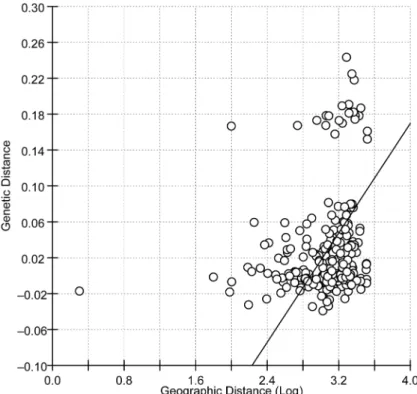
negative (Table 2), which does not support a neutral model of evolution and suggests that population expansion, genetic hitchhiking, and/or selection have occurred during the evolu-tionary history ofP.xylostella. The Mantel test revealed a weak but significant positive corre-lation between genetic distance and the log of geographical distance (r = 0.1885,P= 0.0030; Fig 2).
Table 2. Results of genetic diversity and neutrality tests based onmtCOIsequences for populations ofPlutella xylostellain China.
Population H Hd Pi(%) k Tajima’s D Fu’s FS
HRB11 25 0.968±0.020 0.461±0.910 3.242 -1.73411* -24.161
HRB 11 0.956±0.045 0.379±0.581 2.670 -1.39345 -7.00444
SY 17 0.891±0.040 0.344±0.600 2.423 -1.43889 -11.2692
NM 16 0.912±0.033 0.298±0.462 2.099 -1.16430 -11.1953
ZJK 18 0.911±0.035 0.320±0.741 2.252 -1.96549** -13.9527
YQ 19 0.908±0.042 0.320±0.640 2.254 -1.71046* -16.4052
BJ 14 0.816±0.054 0.212±0.514 1.495 -1.90664** -9.81075
TJX 6 0.952±0.096 0.473±0.522 3.333 -0.49212 -1.99294
SX 18 0.897±0.051 0.395±0.657 2.783 -1.39099 -13.1206
SDLY 9 0.824±0.060 0.241±0.434 1.695 -1.87758* -3.87167
QHHZ 18 0.896±0.043 0.307±0.490 2.163 -1.22098 -14.0939
GS 5 0.786±0.151 0.380±0.548 2.679 -1.51227 -0.52342
JS 16 0.883±0.045 0.291±0.423 2.046 -1.00830 -11.1824
SH 18 0.921±0.029 0.344±0.690 2.424 -1.69613* -12.2197
ZJSM 17 0.921±0.027 0.335±0.617 2.357 -1.52067* -10.5413
ZJLS 22 0.947±0.026 0.393±0.764 2.766 -1.67027* -18.939
HN 12 0.909±0.044 0.359±0.468 2.528 -0.81289 -5.63523
FJ 12 0.903±0.023 0.299±0.514 2.102 -1.36184 -4.47463
GDFY 22 0.930±0.029 0.411±0.822 2.897 -1.71472* -17.3971
YX 8 0.972±0.064 0.458±0.679 3.222 -1.55699 -4.0932
YNMD 22 0.938±0.029 0.365±0.793 2.571 -1.85376* -19.5432
DZ 8 0.718±0.080 0.324±0.391 2.284 -0.54500 -0.77414
YL 8 0.972±0.064 0.529±0.679 3.722 -1.05826 -3.61144
H, number of haplotypes; Hd, haplotype diversity; Pi, nucleotide diversity; k, average number of nucleotide differences.
*P<0.05
**P<0.01.
doi:10.1371/journal.pone.0130905.t002
Migration Routes ofPlutella xylostellain China
Haplotype distribution and network
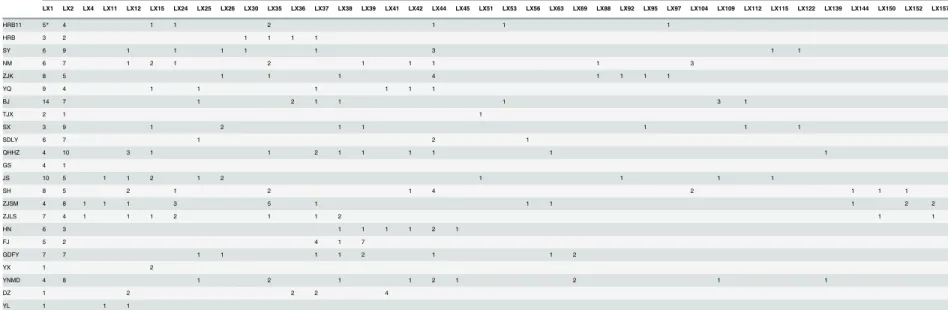
Of the 193 haplotypes, 38 were shared among all the populations (Table 3). The other 155 hap-lotypes were unique, with each sampled population containing unique haphap-lotypes, suggesting some degree of isolation between the populations (Table 3). The haplotype LX1 (n = 123) was the most common haplotype and was shared by all 23 populations. The haplotype LX2 (n = 108) differed by only one nucleotide from LX1 and was the next most widely distributed haplotype and was detected in all populations except the two on Hainan Island (DZ and YL; Table 3). Twenty of the 38 shared haplotypes were observed in only two individuals sampled from two populations (Table 3).
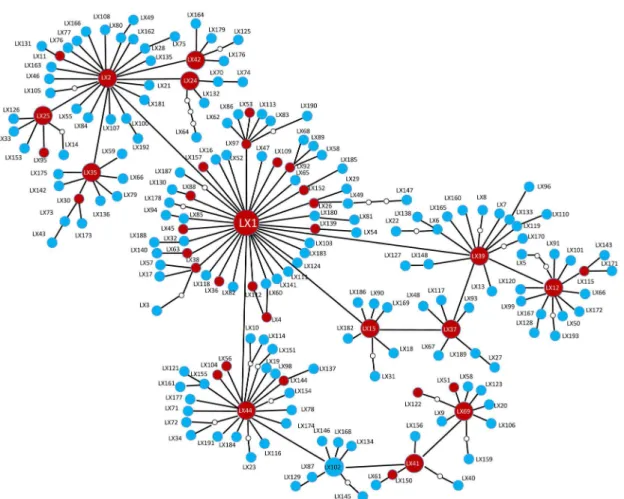
A statistical parsimony network analysis of the relationships among mtCOIhaplotypes revealed that haplotype LX1 occupied a central position in all populations. Unique haplotypes were located at the edges of the network (Fig 3). When we compared the sequences of the mtCOIgene with 658-bp homologous regions from GenBank (GenBank accession numbers KC154937–KC155152 and DQ076332–DQ076411), the number of haplotype increased to 324. Two South Korean haplotypes were identical to haplotypes LX37 and LX39 from China, but the most common haplotype in South Korea (LX194) was absent in China. In addition, neither haplotype LX1 nor LX2 was found in South Korea (Fig 4). A neighbor-joining tree constructed for the 324 haplotypes revealed that most haplotypes clustered as a single clade (S1 Fig).
ISSR profile and analysis
Using 11 ISSR primers (S1 Table), we repeatability detected a total of 230 loci (bands) from the 23 populations. The percentage of polymorphism (Ppl) ranged from 62.17 to 86.96 (S3 Table). Fig 2. Results of a Mantel test showing the correlation between pairwise Fst values and the logarithm of geographic distances of Chinese populations ofPlutella xylostella.Reduced major axis (RMA) analyses were calculated from 10000 randomizations.
Table 3. The number of shared haplotypes for each of the sampled populations ofPlutella xylostellain China.
Population Shared haplotypes
LX1 LX2 LX4 LX11 LX12 LX15 LX24 LX25 LX26 LX30 LX35 LX36 LX37 LX38 LX39 LX41 LX42 LX44 LX45 LX51 LX53 LX56 LX63 LX69 LX88 LX92 LX95 LX97 LX104 LX109 LX112 LX115 LX122 LX139 LX144 LX150 LX152 LX157
HRB11 5* 4 1 1 2 1 1 1
HRB 3 2 1 1 1 1
SY 6 9 1 1 1 1 1 3 1 1
NM 6 7 1 2 1 2 1 1 1 1 3
ZJK 8 5 1 1 1 4 1 1 1 1
YQ 9 4 1 1 1 1 1 1
BJ 14 7 1 2 1 1 1 3 1
TJX 2 1 1
SX 3 9 1 2 1 1 1 1 1
SDLY 6 7 1 2 1
QHHZ 4 10 3 1 1 2 1 1 1 1 1 1
GS 4 1
JS 10 5 1 1 2 1 2 1 1 1 1
SH 8 5 2 1 2 1 4 2 1 1 1
ZJSM 4 8 1 1 1 3 5 1 1 1 1 2 2
ZJLS 7 4 1 1 1 2 1 1 2 1 1
HN 6 3 1 1 1 1 2 1
FJ 5 2 4 1 7
GDFY 7 7 1 1 1 1 2 1 1 2
YX 1 2
YNMD 4 8 1 2 1 1 2 1 2 1 1
DZ 1 2 2 2 4
YL 1 1 1
*: The number in the table represents the number of individuals with a particular haplotype in that population. doi:10.1371/journal.pone.0130905.t003
Migration
Routes
of
Plutella
xylostella
in
China
PLOS
ONE
|DOI:10.137
1/journal.p
one.0130905
June
22,
2015
7/1
At the species level, all individuals possessed a unique ISSR genotype, suggesting a high degree of genetic variation within populations.
The percentage of polymorphism (Ppl), Shannon’s information index (I), Nei’s gene diver-sity (He), and effective number of alleles (Ne) within population are summarized inS3 Table. The population‘DZ’located on Hainan Island showed the lowest effective number of alleles (1.1233 ± 0.1864), lowest Nei’s gene diversity (0.0911 ± 0.1151), and lowest Shannon’s infor-mation index (0.1625 ± 0.1781). Another Hainan Island population, YL, also exhibited less diversity than the other populations (S3 Table). Gstwas estimated as 0.0858, indicating that
8.58% of the genetic variability was distributed among populations. The number of genetic migrants (Nm) was 5.3277, which suggests a high level of gene flow among the sampled popu-lations (S4 Table).
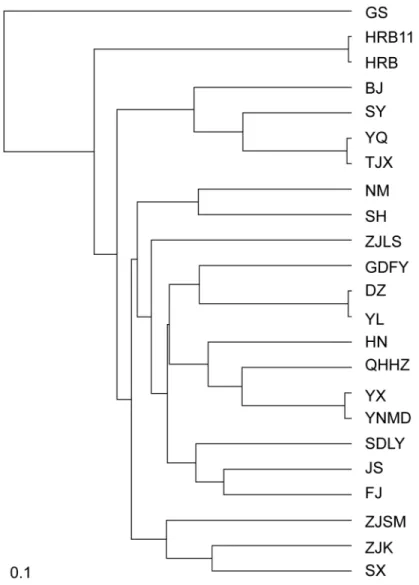
We constructed a dendrogram using UPGMA analysis to infer phylogenetic relationships among theP.xylostellapopulations. The populations BJ, SY, YQ, and TJX in seasonally suitable areas clustered together (Fig 5). The clustering roughly correspond to geographical distance.
Discussion
By analyzing mtCOIand ISSR data, we have determined thatP.xylostellapopulations in China exhibit high genetic variability at the nucleotide level and high mitochondrial haplotype Fig 3. Statistical parsimony network ofPlutella xylostellamtCOIhaplotypes.The red and blue circles represents shared and unique haplotypes, respectively. Haplotype names are beside the circles. The small circles indicate the presence of missing intermediates, while the connections are based on the set of plausible solutions with a 95% of parsimony probability.
diversity. The haplotype distribution was characterized by a large number of unique haplotypes isolated in each population’s home range; only a few haplotypes were widely shared among the 23 populations. While only three haplotypes were reported in Australian populations ofP. xylostellabased on a 257-bp fragment of the mtCOIgene [24], we found 193 haplotypes. In our demographic analysis, the values of Tajima’s D and Fu’s FStests were negative, suggesting that
the haplotype diversity was due to population expansion and genetic selection. Chemical com-pounds and insecticides with high mutagenicity increase the number of mutations in resistant individuals. Many studies have shown thatP.xylostellahas developed resistance to a variety of insecticides in the field [40–47]. Different levels of resistance have even been reported in two geographically close populations [10,40,41,48]. The bottleneck effect caused by excessive use of insecticides selects for differing haplotypes and leads to divergence between populations. Fig 4. Comparison ofmtCO1haplotype frequency distributions in samples ofPlutella xylostellafrom South Korean (top) and inPlutella xylostellapopulations across China (bottom).Haplotypes with frequency2 are not shown.
doi:10.1371/journal.pone.0130905.g004
Migration Routes ofPlutella xylostellain China
Differences in local survival rates and insecticide-induced selection pressure might be the major force leading to high haplotype diversity [21,22]. Another factor that might explain the high haplotype diversity could be the widespread and continuous planting of cruciferous crops grown in China, which provide a steady supply of highly suitable host plants forP.xylostella. Host plant shift is generally thought to be an important cause of genetic polymorphism in host plant adaptation [49]. Genetic analyses ofP.xylostellapopulations have shown that this insect has substantial genetic plasticity in that alleles enabling survival on different hosts [50]. You et al. [51] also reported thatP.xylostellacoevolved with its host plant.
Of the 38 shared haplotypes found in our study, LX1 and LX2 were found in almost all of theP.xylostellapopulations, indicating their significance. Although both of these haplotypes were widely distributed, LX2 was not found in the populations located on Hainan Island (DZ and YL). Based on these finding, we infer thatP.xylostellapopulations in China originated from one female founder moth with haplotype LX1.
P.xylostellahas historically been considered to be capable of long-distance migration [3]. More recent studies, however, suggest that the dispersal ability of this species is limited [52,53]. Fig 5. UPGMA dendrogram of 23 populations ofPlutella xylostellain China based on ISSR markers.
A mark-recapture study showed that adult males and females ofP.xylostellahad similar dis-persal abilities and that fewer than 1% moved more than 200 m from their release point within 5 to 9 days [52]. In Hawaii, genetically distinct populations ofP.xylostellaare separated by less than 10 km [53]. Our results showed that the majority of haplotypes (155 of 193) were unique, indicating that most haplotypes are locally restricted. In addition, the Mantel test revealed a positive correlation between genetic distance and geographic distance. The UPGMA dendro-gram also revealed that the populations closely located geographically clustered in the same clades. We found that seven haplotypes were shared by populations SH and ZJSM, of which two haplotypes (LX144 and LX152) were found only in these two close locations (a distance of ~200 km). Similarly, five haplotypes were shared by populations NM and ZJK in northern China, with only a single individual possessing haplotype LX88 in each population. The num-ber of shared haplotypes was reduced as distance increased. The limited numnum-ber of shared hap-lotypes and the high level of gene flow that we observed among populations indicates thatP. xylostellacan migrate only short distances. Short distance migration enablesP.xylostellato move in a step-by-step manner in search of seasonally suitable areas. Annually,P.xylostellais able to migrate from regions where it can overwinter to regions where it cannot overwinter because the winter temperatures are too low [3,6–9,21,54].
Several shared haplotypes were distributed in different regions of China, and this informa-tion reveals potential relainforma-tionships between populainforma-tions.Plutella xylostellapersists year-round in subtropical and tropical regions. The widely distributed shared haplotypes suggest the gene flow in those region. Furthermore, in the temperate zone, where the JS and ZJK populations are located, shared haplotypes become more common because of migration. Besides the widely distribution haplotypes, the point-to-point haplotypes (haplotypes shared by only two popula-tions) revealed the migration direction betweenP.xylostellapopulations. Three point-to-point haplotypes of the JS population were shared with other temperate zone populations located in northern China (TJX, ZJK, and SY). Similarly, the ZJK population also shared point-to-point haplotypes with SX, NM, and HRB populations. From these results, we infer that one possible migration ofP.xylostellabegins in southeastern China (JS, ZJLS, and ZJSM populations) and progresses north (ZJK and BJ populations) into northeastern China (SY and HRB popula-tions). In addition, the YNMD population in southwestern China shared point-to-point haplo-types with QHHZ, HN, and GDFY populations, which suggests another migration route that begins near the location of the YNMD population. The YX, YNMD, QHHZ, and HN popula-tions clustered together in the UPGMA dendrogram, which is highly consistent with the hypothesis stated above. Recent studies have shown that the Qinling Mountain is a barrier for P.xylostellamigration and gene flow [55]. Interestingly, we found that none of the point-to-point haplotypes appeared to cross this mountain range.
The factors affecting dispersal and gene flow ofP.xylostellaare complex. Wind-enabled flight enables these insects to fly further than would be possible by powered flight alone [56,57]. In China, the East Asian subtropical monsoon providesP.xylostellawith an annual opportunity to re-colonize from southern to northern regions [21]. In southwestern China, the Bengal Bay monsoon begins in May, concurrent with theP.xylostellaoutbreak in Yunnan Province. This indicates thatP.xylostellamay use the strong southwesterly winds caused by the monsoon to migrate into northwestern and southern China. Alternatively, however, the distribution ofP.xylostellamight simply reflect the extended cultivation of its host plants [58]. Indeed, the long-distance transport of cabbage plants probably has had a greater effect on genetic exchange ofP.xylostellathan natural gene flow [13].
In this study, the two most common and widely distributed haplotypes, LX1 and LX2, were absent from Hainan Island, and no point-to-point haplotype was found between the popula-tions on Hainan Island and other sites. These findings indicate that the ocean is an effective
Migration Routes ofPlutella xylostellain China
barrier forP.xylostelladispersal. This is supported by the results of the ISSR data, which showed that the Hainan populations were genetically distinct from the other populations. Fur-ther evidence that oceans can act as barriers forP.xylostelladispersal was that both LX1 and LX2 were absent from South Korea and that the most common haplotype of South Korea (LX194) was not found in China. This indicates thatP.xylostellapopulations in China and South Korea are isolated by the barrier of the East China Sea. A former study ofP.xylostella populations suggested that there were barriers to gene flow and some degree of genetic isola-tion between Australia and New Zealand [24].
In conclusion, we used both mitochondrial and nuclear markers to analyze the genetic structure ofP.xylostellapopulations in China and found high haplotype diversity and high gene flow among geographic populations. Nevertheless, the high pairwise FSTvalues between
Hainan Island and mainland China populations indicate strong genetic differentiation when dispersal is limited by oceanic barriers. The distribution of shared haplotypes among our sam-pled populations reveals two primary migration routes forP.xylostellain China; the first route begins in southeastern China (in the lower reaches of the Yangtze River) and progresses through northern and northeastern China, and the second route begins in southwestern China and progresses through northwestern and southern China.
Supporting Information
S1 Fig. NJ tree of 324 mtCOI haplotypes ofPlutella xylostellain China and South Korea. (PDF)
S1 Table. ISSR-PCR primers and their annealing temperatures. (PDF)
S2 Table. Pair-wise FSTvalues between sampled populations ofPlutella xylostellain China. (PDF)
S3 Table. Genetic variability of thePlutella xylostellabased on ISSR data. (PDF)
S4 Table. Estimated gene diversity for 23Plutella xylostellapopulations as indicated by 11 ISSR makers.
(PDF)
Acknowledgments
We thank Dr. Xun Zhu (Chinese Academy of Agricultural Sciences) for comments on an ear-lier draft.
Author Contributions
Conceived and designed the experiments: QJW XJW JQY. Performed the experiments: JQY LXT WX. Analyzed the data: JQY. Contributed reagents/materials/analysis tools: YJZ BYX XJW SLW. Wrote the paper: QJW JQY.
References
1. Harcourt DG. Biology of cabbage caterpillars in eastern Ontario. Proc Entomol Soc Ont. 1963; 93:61–75.
3. Talekar NS, Shelton AM. Biology, ecology, and management of the diamondback moth. Annu Rev Entomol. 1993; 38(1):275–301.
4. Verkerk RH, Wright DJ. Multitrophic interactions and management of the diamondback moth: a review. Bull Entomol Res. 1996; 86(3):205–216.
5. Zalucki MP, Shabbir A, Silva R, Adamson D, Liu SS, Furlong MJ. Estimating the economic cost of one of the world's major insect pests,Plutella xylostella(Lepidoptera: Plutellidae): just how long is a piece of string? J Econ Entomol. 2012; 105(4):1115–1129. PMID:22928287
6. Dosdall LM, Mason PG, Olfert O, Kaminski L, Keddie BA. The origins of infestations of diamondback moth,Plutella xylostella(L.), in canola in western Canada. The management of diamondback moth and other crucifer pests: Proc IV Int workshop, Melbourne, Australia. 2001; 15:26–29.
7. Honda K. Hibernation and migration of diamondback moth in northern Japan. Diamondback moth and other crucifer pests: proceedings of the second international workshop AVRDC, Taiwan. 1992;168:43–50.
8. Ma CS, Chen RL. Studies on the overwinter and migration of diamondback moth. In: Protection CSoP, Agriculture ECoCAo, editorsProceedings of the First National Plant Protection Congress Attended by Middle-aged and Youth Scientists Beijing: China: Scientech Press 1991:294–299.
9. Ma CS, Ma G, Yang HP. Overw intering of the diamondback moth,Plutella xylostellain temperate coun-tries. Acta Ecologica Sinica. 2010; 30(13):3628–3636.
10. Capriol MA, Tabashnik BE. Allozymes used to estimate gene flow among populations of diamondback moth (Lepidoptera: Plutellidae) in Hawaii. Environ Entomol. 1992; 21(4):808–816.
11. Kim Y, Kim K, Kim N. Genetic difference between two field population ofPlutella xylostella(Linne) based on four polymorphic allozymes. J Asia Pac Entomol. 1999; 2:1–5.
12. Endersby NM, Mckechnie SW, Ridland PM, Weeks AR. Microsatellites reveal a lack of structure in Aus-tralian populations of the diamondback moth,Plutella xylostella(L.). Mol Ecol. 2006; 15(1):107–118. PMID:16367834
13. Roux O, Gevrey M, Arvanitakis L, Gers C, Bordat D, Legal L. ISSR-PCR: Tool for discrimination and genetic structure analysis ofPlutella xylostellapopulations native to different geographical areas. Mol Phylogenet Evol. 2007; 43(1):240–250. PMID:17098449
14. Wilson AC, Cann RL, Carr SM, George M, Gyllensten UB, Helm-Bychowski KM, et al. Mitochondrial DNA and two perspectives on evolutionary genetics. Biol J Linn Soc. 1985; 26(4):375–400. 15. Brown WM, Prager EM, Wang A, Wilson AC. Mitochondrial DNA sequences of primates: tempo and
mode of evolution. J Mol Evol. 1982; 18(4):225–239. PMID:6284948
16. Harrison RG. Animal mitochondrial DNA as a genetic marker in population and evolutionary biology. Trends Ecol Evol. 1989; 4(1):6–11. doi:10.1016/0169-5347(89)90006-2PMID:21227301
17. Simons C, Frati F, Beckenbach A, Crespi B, Liu H, Floors P. Evolution, weighting, and phylogenetic util-ity of mitochondrial gene sequences and a compilation of conserved polymerase chain reaction prim-ers. Ann Entomol Soc Am. 1994; 87(6):651–701.
18. Roderick GK. Geographic structure of insect populations: gene flow, phylogeography, and their uses. Annu Rev Entomol. 1996; 41(1):325–352.
19. Roderick GK, Navajas M. Genes in new environments: genetics and evolution in biological control. Nat Rev Genet. 2003; 4(11):889–899. PMID:14634636
20. Wei SJ, Shi BC, Gong YJ, Li Q, Chen XX. Characterization of the mitochondrial genome of the dia-mondback mothPlutella xylostella(Lepidoptera: Plutellidae) and phylogenetic analysis of advanced moths and butterflies. DNA Cell Biol. 2013; 32(4):173–187. doi:10.1089/dna.2012.1942PMID:
23496766
21. Wei SJ, Shi BC, Gong YJ, Jin GH, Chen XX, Meng XF. Genetic structure and demographic history reveal migration of the diamondback mothPlutella xylostella(Lepidoptera: Plutellidae) from the south-ern to northsouth-ern regions of China. PLoS ONE. 2013; 8(4):e59654. doi:10.1371/journal.pone.0059654
PMID:23565158
22. Kim IS, Lee KS, Lee HS, Yoon HJ, Moon BJ. Mitochondrial COI gene sequence-based population genetic structure of the diamondback moth,Plutella xylostella, in Korea. Korean J Genet. 2003; 25 (2):155–172.
23. Li JH, Zhao F, Choi YS, Kim IS, Sohn HD, Jin BR. Genetic variation in the diamondback moth,Plutella xylostella(Lepidoptera: Yponomeutidae) in China inferred from mitochondrial COI gene sequence. Eur J Entomol. 2006; 103(3):605–611.
24. Saw J, Endersby NM, Mckechnie SW. Low mtDNA diversity among widespread Australian diamond-back mothPlutella xylostella(L.) suggests isolation and a founder effect. Insect Sci. 2006; 13 (5):365–373.
Migration Routes ofPlutella xylostellain China
25. Dick CW, Roubik DW, Gruber KF, Bermingham E. Long-distance gene flow and cross-Andean dis-persal of lowland rainforest bees (Apidae: Euglossini) revealed by comparative mitochondrial DNA phy-logeography. Mol Ecol. 2004; 13(12):3775–3785. PMID:15548290
26. Ma C, Yang PC, Jiang F, Chapuis MP, Shali Y, Sword GA, et al. Mitochondrial genomes reveal the global phylogeography and dispersal routes of the migratory locust. Mol Ecol. 2012; 21(17):4344– 4358. doi:10.1111/j.1365-294X.2012.05684.xPMID:22738353
27. Schaefer H, Renner SS. A phylogeny of the oil bee tribe Ctenoplectrini (Hymenoptera: Anthophila) based on mitochondrial and nuclear data: evidence for Early Eocene divergence and repeated out-of-Africa dispersal. Mol Phylogenet Evol. 2008; 47(2):799–811. doi:10.1016/j.ympev.2008.01.030PMID:
18353689
28. Yang JQ, Wang XJ, Guo ZJ, Zhu X, Wu QJ, Xie W, et al. Establishment and optimization of ISSR-PCR reaction system with orthogonal design forPlutella xylostella. Plant Protection. 2012; 6(38):90–94. 29. Yeh FC, Yang R, Boyle TB, Ye Z, Mao JX. POPGENE, the user-friendly shareware for population
genetic analysis. Molecular biology and biotechnology centre, University of Alberta, Canada. 1997;10. 30. Librado P, Rozas J. DnaSP v5: a software for comprehensive analysis of DNA polymorphism data.
Bio-informatics. 2009; 25(11):1451–1452. doi:10.1093/bioinformatics/btp187PMID:19346325
31. Raymond M, Rousset F. An exact test for population differentiation. Evolution. 1995; 49(6):1280–1283. 32. Clement M, Posada DC, Crandall KA. TCS: a computer program to estimate gene genealogies. Mol
Ecol. 2000; 9(10):1657–1659. PMID:11050560
33. Templeton AR, Crandall KA, Sing CF. A cladistic analysis of phenotypic associations with haplotypes inferred from restriction endonuclease mapping and DNA sequence data. III. Cladogram estimation. Genetics. 1992; 132(2):619–633. PMID:1385266
34. Tamura K, Dudley J, Nei M, Kumar S. MEGA4: molecular evolutionary genetics analysis (MEGA) soft-ware version 4.0. Mol Biol Evol. 2007; 24(8):1596–1599. PMID:17488738
35. Jensen JL, Bohonak AJ, Kelley ST. Isolation by distance, web service. BMC Genet. 2005; 6(1):13. 36. Tajima F. Statistical method for testing the neutral mutation hypothesis by DNA polymorphism.
Genet-ics. 1989; 123(3):585–595. PMID:2513255
37. Fu YX. New statistical tests of neutrality for DNA samples from a population. Genetics. 1996; 143 (1):557–570. PMID:8722804
38. Tajima F. The amount of DNA polymorphism maintained in a finite population when the neutral mutation rate varies among sites. Genetics. 1996; 143(3):1457–1465. PMID:8807315
39. Fu YX. Statistical tests of neutrality of mutations against population growth, hitchhiking and background selection. Genetics. 1997; 147(2):915–925. PMID:9335623
40. Zhou LJ, Huang JG, Xu HH. Monitoring resistance of field populations of diamondback mothPlutella xylostellaL.(Lepidoptera: Yponomeutidae) to five insecticides in South China: A ten-year case study. Crop Prot. 2011; 30(3):272–278.
41. Zhou L, Huang J, Xu H. Insecticide resistance ofPlutella xylostellafrom fields of Pearl River Delta. J South China Agric Univ. 2011; 32(1):45–48.
42. Zhao F, Wang M, Li JH. Resistance ofPlutella xylostellato nine insecticides in several field populations in China. Chin Bull Entomol. 2006; 43(5):640–643.
43. Liu Y, Tabashnik BE, Pusztai-Carey M. Field-evolved resistance to Bacillus thuringiensis toxin CryIC in diamondback moth (Lepidoptera: Plutellidae). J Econ Entomol. 1996; 89(4):798–804.
44. Sayyed AH, Omar D, Wright DJ. Genetics of spinosad resistance in a multi-resistant field-selected pop-ulation ofPlutella xylostella. Pest Manag Sci. 2004; 60(8):827–832. PMID:15307676
45. Vastrad AS, Lingappa S, Basavana Goud K. Status of Insecticide Resistance in Diamondback Moth,
Plutella xylostellaLinnaeus (Plutellidae: Lepidoptera) in Karnataka. Karnataka Journal of Agricultural Sciences. 2002; 15(2):379–383.
46. Zhao JZ, Collins H, Li YX, Mau RFL, Thompson G, Hertlein M, et al. Monitoring of diamondback moth (Lepidoptera: Plutellidae) resistance to spinosad, indoxacarb, and emamectin benzoate. J Econ Ento-mol. 2006; 99(1):176–181. PMID:16573338
47. Zhao JZ, Li YX, Collins H, Gusukuma-Minuto L, Mau RFL, Thompson G, et al. Monitoring and charac-terization of diamondback moth (Lepidoptera: Plutellidae) resistance to spinosad. J Econ Entomol. 2002; 95(2):430–436. PMID:12020024
48. Lee SC, Cho YS, Kim DI. Comparative study of toxicological methods and field resistance to insecti-cides in diamondback moth (Lepidoptera: Plutellidae). Korean J Appl Entomol. 1993; 32:323–329. 49. Menken SB, Herrebout WM, Wiebes JT. Small ermine moths (Yponomeuta): their host relations and
50. Henniges-Janssen K, Reineke A, Heckel DG, Groot AT. Complex inheritance of larval adaptation in
Plutella xylostellato a novel host plant. Heredity. 2011; 107(5):421–432. doi:10.1038/hdy.2011.27
PMID:21673741
51. You MS, Yue Z, He WY, Yang XH, Yang G, Xie M, et al. A heterozygous moth genome provides insights into herbivory and detoxification. Nat Genet. 2013; 45(2):220–225. doi:10.1038/ng.2524
PMID:23313953
52. Mo J, Baker G, Keller M, Roush R. Local dispersal of the diamondback moth (Plutella xylostella(L.)) (Lepidoptera: Plutellidae). Environ Entomol. 2003; 32(1):71–79.
53. Tabashnik BE, Cushing NL, Johnson MW. Diamondback moth (Lepidoptera: Plutellidae) resistance to insecticides in Hawaii: intra-island variation and cross-resistance. J Econ Entomol. 1987; 80(6):1091– 1099.
54. Furlong MJ, Wright DJ, Dosdall LM. Diamondback moth ecology and management: problems, prog-ress, and prospects. Annu Rev Entomol. 2013; 58:517–541. doi:
10.1146/annurev-ento-120811-153605PMID:23020617
55. Niu YQ, Nansen C, Li XW, Liu TX. Geographical variation ofPlutella xylostella(Lepidoptera: Plutellidae) populations revealed by mitochondrial COI gene in China. J Appl Entomol. 2014; 138(9):692–700. 56. Chapman JW, Reynolds DR, Smith AD, Riley JR, Pedgley DE, Woiwod IP. High-altitude migration of
the diamondback mothPlutella xylostellato the UK: a study using radar, aerial netting, and ground trap-ping. Ecol Entomol. 2002; 27(6):641–650.
57. Chapman JW, Reynolds DR, Smith AD, Smith ET, Woiwod IP. An aerial netting study of insects migrat-ing at high altitude over England. Bull Entomol Res. 2004; 94(2):123–136. PMID:15153295
58. Chu YI. The migration of diamondback moth. Diamondback moth management. Asian Vegetable Research and Development Center1986. pp 77–81.
Migration Routes ofPlutella xylostellain China