Breast feeding and t he nut rit ional t ransit ion
in t he Lat in American and Caribbean Region:
a success st ory?
Amame ntaç ão e transiç ão nutric io nal na Amé ric a
Latina e Carib e : um c aso b e m-suc e d id o ?
1 Department of Nutritional Sciences, University of Connecticut. Storrs, CT, 06269, U.S.A. [email protected]
Rafael Pérez-Escamilla 1
Abst ract The objectives of this paper are to examine recent breastfeeding duration trends in Latin America and the Caribbean to document: (a) rural-urban differentials, (b) differences in educational levels, and (c) changes in breastfeeding duration across time. Secondary data analy-ses were conducted with 23 Demographic and Health Surveys collected between the mid-1980s and mid-1990s. Results indicate that median breastfeeding duration is still greater in rural (as compared to urban) areas and among less (versus more) educated women, although these differ-entials are decreasing with time. In five of the six countries examined for secular trends, breast-feeding duration continues to increase in both rural and urban areas. Breastbreast-feeding duration in urban and rural areas was strongly correlated within countries. Breastfeeding duration im -proved more among women with the highest and declined among those with the lowest levels of education. Results indicate that breastfeeding duration has increased in Latin America and the Caribbean at a time when the opposite was predicted, given the region’s increased urbanization. Breastfeeding protection policies and promotion programs may explain part of the increase in breastfeeding duration.
Key words Breastfeeding; Demography; Nutritional Transition
Resumo Os objetivos deste artigo incluem examinar tendências recentes na duração da ama-mentação na América Latina e Caribe e documentar: (a) diferenciais entre áreas rurais e urba-nas, (b) diferenças em escolaridade materna e (c) mudanças na duração do aleitamento mater-no ao longo do tempo. Foram realizadas análises de dados secundários a partir de 23 pesquisas demográficas em saúde conduzidas entre meados das décadas de 80 e 90. Os resultados indicam que a duração mediana da amamentação continua sendo maior nas áreas rurais comparadas com as urbanas e entre mulheres com menos escolaridade, embora tais diferenças estejam dimi-nuindo ao longo do tempo. Em cinco dos seis países estudados em relação a tendências seculares, continua aumentando a duração da amamentação, tanto em áreas rurais quanto urbanas. A duração da amamentação em áreas urbanas e rurais estava fortemente correlacionada dentro dos países. A duração do aleitamento aumentou mais entre mulheres com maior escolaridade e declinou entre mulheres com menor escolaridade. Os resultados indicam que a duração do alei-tamento vem aumentando na América Latina e Caribe numa época em que era previsto o opos-to, em vista da crescente urbanização da região. Políticas de proteção ao aleitamento materno e programas de promoção podem explicar parte do aumento na duração do aleitamento materno.
Introduction
The nutrition transition in developing coun-tries can be defined as a process that involves the coexistence of nutritional imbalances and health-related conditions linked with under-and over-nutrition (under-and often with a sedentary life-style). This phenomenon has major impli-cations for the health care systems of Latin America and the Caribbean Region where the incidence of obesity (Peña & Bacallao, 2001; Popkin, 2001) and obesity-related chronic dis-eases – e.g., heart disease (Yusuf et al., 2001), diabetes type 2 (Barceló & Rajpathak, 2001) – has increased dramatically at the same time that infectious diseases in children (e.g., pneu-monia, diarrhea) continue to be a major public health problem even though their incidence has declined substantially in the past decades (Yusuf et al., 2001).
For a number of reasons, breastfeeding epi-demiology is crucial for our understanding of health outcomes shaped by the nutrition tran-sition currently under way in the Latin Ameri-can and Caribbean Region. This is because breastfeeding is associated with protection against both infectious and chronic conditions. For example, at the same time that breastfeed-ing offers protection against upper respiratory (Cesar et al., 1999) and gastro-intestinal tract (Brown et al., 1989) infections, it may also pro-tect against the onset of obesity (Dietz, 2001). By the same token, breastfeeding protects women against severe post-partum hemorrhages and may protect them against pre-menopausal breast cancer (Labbok, 1999).
On the one hand, nationally representative data from the Latin American and Caribbean Region has shown that: (a) within countries, breastfeeding is more prolonged in rural than in urban areas and among women with lower rather than higher levels of formal education (Pérez-Escamilla et al., 1994; Trussell et al., 1992), and (b) among countries, those with a higher proportion of their population living in rural areas present more extended breastfeed-ing when compared with more urbanized na-tions (Pérez-Escamilla, 1994; Trussell et al., 1992). On the other hand, nationally represen-tative data also show that in the last decades, the countries in our region have become more urbanized and women have achieved higher levels of formal education and are more likely to be employed outside of their households. Thus, it would be reasonable to expect for breastfeeding to decrease in duration within countries across time. Unexpectedly however, epidemiological data have consistently shown
that breastfeeding duration in Latin American and Caribbean countries has increased from the 1970s to the 1980s in most countries exam-ined (Elo & Strawn, 1993; Grummer-Strawn, 1996; Trussell et al., 1992). A similar up-ward trend for this period has been reported in the City of São Paulo (Monteiro et al., 1987) and for Brazil as a whole (Venâncio & Monteiro, 1998). The objective of this article is to: (a) analyze recent nationally representative data to learn whether the upward breastfeeding trend de-tected from 1970s to 1980s continued during the 1990s, (b) if confirmed, to provide possible explanations for these increases in spite of all the potential downward forces on breastfeed-ing that characterize the nutrition transition (e.g., more urbanization and higher maternal employment and level of education), and (c) discuss implications of breastfeeding trends for the nutrition transition.
M et hods and st at ist ical analyses
The Demographic and Health Surveys (DHS) program assists developing countries in con-ducting national population and health sur-veys. The program is funded primarily by the United States Agency for International Devel-opment (USAID) and is administered by Macro International Inc. in Calverton, Maryland (In-stitute for Resource Development/Macro Inter-national, 1990). The DHS surveys target child-bearing-age women (i.e., 15-49 years of age in most surveys) and are designed to generate na-tionally representative data on infant feeding practices, population and family planning, and various maternal and child health outcomes (Institute for Resource Development/Macro In-ternational, 1990). DHS sampling frameworks are based on complex stratified sampling de-signs. Strict training and quality-control proce-dures are followed in all countries conducting DHS surveys (Institute for Resource Develop-ment/Macro International, 1991).
DHS replaced the World Fertility Surveys (WFS) as one of the most reliable sources for tracking infant feeding and family planning da-ta worldwide. Whereas WFS were conducted in the 1970s, DHS-I surveys were collected in the 1980s, and DHS-II and DHS-III surveys began to be collected in the early 1990s. A core infant feeding module is applied in all countries to women with children under three years of age.
Analyses were based on 23 surveys distributed across 12 countries ( Table 1). These included: Bolivia (n = 3 surveys), Brazil (n = 2 national surveys), Colombia (n = 3 surveys), Dominican Republic (n = 3 surveys), Ecuador (n = 1 survey), Guatemala (n = 3 surveys), Haiti (n = 1 survey), Mexico (n = 1 survey), Nicaragua (n = 1 survey), Paraguay (n = 1 survey), Peru (n = 3 surveys), and Trinidad and Tobago (n = 1 survey). Breast-feeding duration results and sample sizes were checked for inconsistencies, and in two in-stances required correction or clarification from DHS-STAT personnel. In the case of Mexico-1997, the computed median breastfeeding du-ration and sample sizes for urban and rural ar-eas were incorrect and had to be re-estimated using the appropriate classification for area of residence. Guatemala-1987 required clarifica-tion, as estimated duration for “any breastfeed-ing” was identical to that reported for exclusive breastfeeding. The error was with the exclusive breastfeeding estimates, and the any-breast-feeding data presented in this article were con-firmed as correct.
All of the surveys included women from 15 to 49 years of age with sample sizes ranging from 3,806 in Trinidad and Tobago-1987 to 28,951 in Peru-1996. Data collection years ranged from 1986 to 1999 ( Table 1). Median breastfeeding duration for women with children less than three years of age was computed for each coun-try based on current status breastfeeding “sur-vival” curves (i.e., whether infant was breastfed or not at the time of the survey plotted across time – child age). Median BF durations gener-ated by STAT were exported into Excel and sub-sequently read as an SPSS for Windows file (ver-sion 10.07). This software was used to compare within-countries’ breastfeeding duration as a function of area of residence (urban, rural) and levels of maternal education (none, primary, secondary, or higher). Secular trends in BF du-ration were examined across time in the six countries with more than one DHS (Bolivia, Brazil, Colombia, Dominican Republic, Guate-mala, and Peru). Within-country secular trend comparisons were based on comparing BF du-ration between the first and last survey wave, a
Tab le 1
De mo g rap hic and He alth Surve ys c o nd uc te d in 12 Latin Ame ric an and Carib b e an c o untrie s amo ng wo me n 15 to 49 ye ars o ld .
Count ry/ survey year N St art ing dat e (mont h/ year) Final dat e (mont h/ year)
period of time that spanned about 10 years and referred to in this paper as “from the mid-1980s to the mid-1990s”. SPSS for Windows (version 10.07) was used to determine the BF duration’s Pearson’s correlation coefficient by area of resi-dence and level of education.
The Brazil-1996 data set was downloaded from the Internet (http://www.measuredhs. com) and read as an SPSS for Windows data file. This statistical software was used to exam-ine the relationship between maternal educa-tion and the likelihood of BF initiaeduca-tion (ever-/never-breastfed) using the chi-square test and a maximum 2-sided probability value of 0.05 as the criterion for statistical significance.
Result s
Analyses demonstrated a wide variation in me-dian breastfeeding duration across countries ranging from 5.2 months in Brazil 1986 to 20.5 months in Guatemala-1987. Women in coun-tries with the highest percent of rural popula-tion in the sample tended to breastfeed longer. Guatemala had both the highest median dura-tion of breastfeeding as well as the highest per-centage of rural population. By contrast, Brazil, Mexico, and Colombia, which had the lowest percent of rural populations included in the survey samples tended to have the lowest me-dian BF duration in the 1980s (5.2 months, 8.1 months, and 8.2 months, respectively). Longer breastfeeding in more rural countries was not universal, as for example Peru had one of the longest median breastfeeding figures (15.4 months in 1986 to 19.5 months in 1996), even though the country is predominantly urban. By contrast, Trinidad and Tobago-1987, which in-cluded a predominantly rural sample, had a median BF duration of only 6 months (Table 2).
Breastfeeding duration as a function of area of residence and level of education
In all but one country ( Trinidad and Tobago-1987), median breastfeeding duration was longer in rural (range: 5.8 months in Trinidad and Tobago-1987 to 20.8 months in Guatema-la-1987) than in urban areas (range: 4.6 months in the Dominican Republic-1991 and Brazil-1986 to 19.1 in Guatemala-1987). This rural-ur-ban (R-U) differential ranged from -0.6 months in Trinidad and Tobago-1987 to 8.9 months in Mexico-1987 (Table 2). There was a strong with-in-country correlation between BF durations in rural and urban areas (Pearson’s r = 0.89, p < 0.001, n = 23).
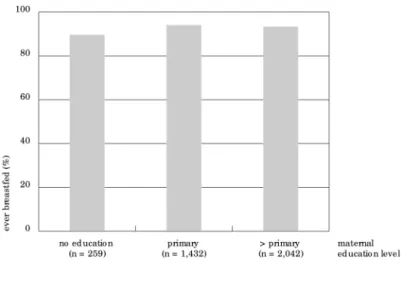
In all but one survey (Brazil-1996), breast-feeding duration was greater among women with no schooling (range: 5.8 months in Brazil-1996 to 22.5 months in Peru-1986) than among women with at least secondary education (range: 4.1 months in the Dominican Republic-1991 to 18.3 months in Peru-1986). This educa-tional level differential (N-S) ranged from -1.5 months in Brazil-1996 to 13.7 months in Mexi-co-1987 (Table 3). There was a significant with-in-country correlation between BF duration among women with no schooling and women with at least a secondary education (Pearson’s r = 0.61, p = 0.001, n = 23). In Brazil, level of ed-ucation was also positively associated with the likelihood of BF initiation (Figure 1).
Breastfeeding duration as a function of time
Five of the six countries with more than one DHS survey experienced increases in BF dura-tion from the mid-1980s to the mid-1990s (BF delta range: +0.5 months in the Dominican Re-public to +4.1 months in Peru). During this pe-riod, Guatemala experienced a slight decline in BF duration, from 20.5 months to 19.9 months (Table 2).
• Area of residence
In rural areas, Guatemala was the only one of the six countries not experiencing an increase in BF duration from the 1980s to the mid-1990s (BF delta range: -0.4 months in Guatemala to 3.1 months in the Dominican Republic). In urban areas, Guatemala and the Dominican Republic experienced slight declines in BF du-ration from the mid-1980s to the mid-1990s (-0.5 months and -0.7 months, respectively). The remaining countries experienced positive changes in BF duration in these urban areas (+7.8 months in Peru, +3.9 months in Colom-bia, and +2.1 months in both Brazil and Bo-livia). In short, from the 1980s to the mid-1990s, five of the six countries examined for secular trends experienced positive changes in BF duration in the whole country, five in rural areas, and four in urban areas. Four countries (Bolivia, Brazil, Colombia, and Peru) experi-enced positive increases during this period in BF duration both in urban and rural areas, with improvements more pronounced in urban than in rural areas (Table 2).
Dominican Republic, this delta increased across time (range: +0.1 months in Guatemala, +3.8 months in the Dominican Republic). In Brazil, the R-U delta did not change during the target period (Table 2).
• Level of education
In five of the six countries examined, breast-feeding duration declined from the mid-1980s to the mid-1990s among women without for-mal education (BF delta range: -3.3 months in Brazil to –0.1 months in Peru). The only coun-try with an increase in BF duration among women with no schooling was Bolivia, with a BF duration delta of +2.7 months. By contrast,
BF duration increased across time in all six countries among women with at least sec-ondary education (BF delta range: +0.9 months in the Dominican Republic to +7.8 months in Peru). The same trend towards increased BF duration from the mid-1980s to the mid-1990s was found in all countries among women with a primary education (BF delta range: +0.2 months in Guatemala to +1.9 months in Co-lombia) (Table 3).
In all countries, the difference in the “no education/at least some secondary education” (N-S) differential in BF duration decreased in the mid-1990s as compared to the mid-1980s ((N-S) BF delta range: -7.9 months in Peru to –0.4 months in Bolivia) (Table 3).
Tab le 2
Bre astfe e d ing (BF) time tre nd s and d iffe re ntials b ase d o n are a o f re sid e nc e in 12 Latin Ame ric an and Carib b e an c o untrie s. Curre nt status e stimate s b ase d o n c hild re n le ss than thre e ye ars o f ag e .
Count ry/ n1 Rural (%)2 BF M edian BF Delt a3 Rural BF Rural BF Urban BF Urban BF R-U4(mo) R-U BF
survey year (mo) (mo) median Delt a3 M edian Delt a3 Delt a3
(mo) (mo) (mo) (mo) (mo)
Bo livia 1989 3,548 51.5 16.4 – 17.5 – 14.3 – + 3.2 –
Bo livia 1994 3,614 47.6 17.6 + 1.2 18.9 + 1.4 15.7 + 1.4 + 3.2 0 Bo livia 1998 4,106 43.0 17.5 + 1.1 19.1 + 1.6 16.4 + 2.1 + 2.7 -0.5
Brazil 1986 1,960 34.7 5.2 – 6.8 – 4.6 – + 2.2 –
Brazil 1996 2,865 24.4 7.0 + 1.8 8.9 + 2.1 6.7 + 2.1 + 2.2 0 Co lo mb ia 1986 1,604 39.5 8.2 – 12.0 – 6.1 – + 5.9 – Co lo mb ia 1990 2,301 32.4 9.0 + 0.8 10.2 -1.8 7.9 + 1.8 + 2.3 -3.6 Co lo mb ia 1995 3,077 35.5 11.3 + 3.1 13.0 + 1.0 10.0 + 3.9 + 3.0 -2.9
Do minic an 2,664 41.8 7.1 – 7.6 – 6.9 – + 0.7 –
Re p ub lic 1986
Do minic an 2,397 41.2 5.8 -1.3 8.3 + 0.7 4.6 -2.3 + 3.7 + 3.0 Re p ub lic 1991
Do minic an 2,653 41.7 7.6 + 0.5 10.7 + 3.1 6.2 -0.7 + 4.5 + 3.8 Re p ub lic 1996
Ec uad o r 1987 1,861 49.6 13.4 NA 14.9 NA 11.9 NA + 3.0 NA G uate mala 1987 2,797 73.0 20.5 – 20.8 – 19.1 – + 1.7 – G uate mala 1995 5,648 67.9 19.8 -0.7 20.4 -0.4 19.0 -0.1 + 1.4 -0.3 G uate mala 1998 2,751 61.8 19.9 -0.6 20.4 -0.4 18.6 -0.5 + 1.8 + 0.1 Haiti 1994 2,147 67.9 17.5 NA 18.4 NA 15.2 NA + 3.2 NA Me xic o 1987 3,412 38.4 8.1 NA 13.9 NA 5.0 NA + 8.9 NA Nic arag ua 1997 4,637 47.3 12.2 NA 16.3 NA 9.3 NA + 7.0 NA Parag uay 1990 2,426 54.7 10.9 NA 13.1 NA 7.8 NA + 5.3 NA
Pe ru 1986 1,796 47.8 15.4 – 19.4 – 10.8 – + 8.6 –
Pe ru 1992 4,960 39.8 17.3 + 1.9 19.9 + 0.5 14.2 + 3.4 + 5.7 -2.9 Pe ru 1996 9,188 41.6 19.5 + 4.1 20.2 + 0.8 18.6 + 7.8 + 1.6 -7.0 Trinid ad & 1,138 56.8 6.0 NA 5.8 NA 6.4 NA -0.6 NA To b ag o 1987
NA = no t ap p lic ab le .
1we ig hte d samp le size .
2p e rc e nt samp le d fro m rural are as b ase d o n we ig hte d samp le size s.
Discussion
The most important finding in this study was the confirmation (with data from the 1990s) of a continuing trends towards increased breast-feeding duration in Latin America that had been documented since the 1970s (Monteiro et al., 1987; Trussell et al., 1992; Venancio & Mon-teiro, 1998). Of the six countries where time trends could be examined, only Guatemala did not show an increase, perhaps due to a ceiling effect, since Guatemala already had the longest BF duration among the 12 countries included in the analyses. The findings are indeed en-couraging, since this is happening at a time when one would have predicted a decline rather than an increase in breastfeeding dura-tion, i.e., during this same period Latin Ameri-ca has been deeply immersed in the epidemio-logical and demographic transition
character-ized by increased levels of urbanization, mater-nal education, and matermater-nal employment out-side the home, all of which have been inversely associated with breastfeeding outcomes in de-veloping countries (Grummer-Strawn, 1996, Pérez-Escamilla, 1994).
An important question then becomes: What explains the observed increases in breastfeed-ing duration? Although the answers to this question are unknown, several hypotheses can be formulated. First, breastfeeding promotion efforts in the region may have had an impact (Elo & Grummer-Strawn, 1993). One particular initiative that may be responsible for part of the increase in BF duration from the mid-1980s to the mid-1990s is the Baby Friendly Hospital Initiative (BFHI) launched by the United Na-tions Children’s Fund (UNICEF) in the late 1980s (Naylor, 2001). This initiative, based on fostering the implementation of ten key steps
Tab le 3
Bre astfe e d ing (BF) time tre nd s and d iffe re ntials b ase d o n mate rnal le ve l o f e d uc atio n in 12 Latin Ame ric an and Carib b e an c o untrie s. Curre nt status e stimate s b ase d o n c hild re n le ss than thre e ye ars o f ag e .
Count ry/ survey year N one Primary Secondary or higher N -S3
BF Me d ian BF De lta2 BF Me d ian BF De lta BF Me d ian BF De lta Mo BF De lta
mo (n)1 mo mo (n) mo mo (n) mo mo
Bo livia 1989 17.8 (711) – 17.0 (1,824) – 13.1 (1,013) – 4.7 – Bo livia 1994 20.7 (513) + 2.9 17.5 (1,757) + 0.5 15.8 (1,344) + 2.7 4.9 0.2 Bo livia 1998 20.5 (456) + 2.7 18.1 (1,965) + 1.1 16.2 (1,684) + 3.1 4.3 -0.4 Brazil 1986 9.1 (248) – 4.8 (1,373) – 5.3 (336) – 3.8 – Brazil 1996 5.8 (189) -3.3 6.5 (1,122) + 1.7 7.3 (1,554) + 2.0 -1.5 -5.3 Co lo mb ia 1986 13.1 (120) – 10.7 (915) – 6.0 (569) – 7.1 – Co lo mb ia 1990 12.8 (128) -0.3 9.7 (1,089) -1.0 6.5 (1,083) + 0.5 6.3 -0.8 Co lo mb ia 1995 12.2 (144) -0.9 12.6 (1,297) + 1.9 10.0 (1,636) + 4.0 2.2 -4.9 Do minic an Re p ub lic 1986 15.9 (171) – 8.2 (1,763) – 4.4 (730) – 11.5 – Do minic an Re p ub lic 1991 16.6 (190) + 0.7 6.9 (1,283) -1.3 4.1 (920) -0.3 12.5 + 1.0 Do minic an Re p ub lic 1996 14.2 (229) -1.7 8.2 (1,453) 0 5.3 (972) + 0.9 8.9 -2.6 Ec uad o r 1987 15.0 (199) NA 14.4 (1,053) NA 11.7 (609) NA 3.3 NA G uate mala 1987 22.2 (1,375) – 18.8 (1,222) – 10.1 (200) – 12.1 – G uate mala 1995 22.2 (2,160) 0 19.0 (2,774) + 0.2 10.5 (714) + 0.4 11.7 -0.4 G uate mala 1998 21.4 (880) -0.8 19.0 (1,445) + 0.2 13.6 (426) + 3.5 7.8 -4.3 Haiti 1994 18.8 (1,019) NA 17.0 (872) NA 8.0 (257) NA 10.8 NA Me xic o 1987 18.1 (493) NA 9.3 (2,022) NA 4.4 (897) NA 13.7 NA Nic arag ua 1997 17.6 (973) NA 13.3 (2,161) NA 8.5 (1,502) NA 9.1 NA Parag uay 1990 18.0 (86) NA 11.9 (1,715) NA 7.1 (624) NA 10.9 NA Pe ru 1986 22.5 (293) – 18.3 (819) – 10.5 (684) – 12.0 – Pe ru 1992 21.5 (498) -1.0 19.3 (1,987) + 1.0 13.3 (2,474) + 2.8 8.2 -3.8 Pe ru 1996 22.4 (903) -0.1 19.9 (3,653) + 1.6 18.3 (4,632) + 7.8 4.1 -7.9 Trinid ad & To b ag o 1987 11.5 (9) NA 6.2 (544) NA 5.8 (584) NA 5.7 NA
NA = no t ap p lic ab le .
1we ig hte d samp le size .
2De lta: d iffe re nc e in me d ian BF d uratio n ac ro ss time in re latio n to first surve y wave .
for the successful promotion of breastfeeding in maternity wards, is very likely to change breastfeeding behaviors (Pérez-Escamilla et al., 1994) and would be expected to have a stronger impact in urban than in rural areas and by con-sequence among women with higher levels of education. Indeed, the analyses presented clearly show that the improvements in BF du-ration across time tended to be stronger in ur-ban than in rural areas and, in agreement with Trussell et al. (1992) and Monteiro et al. (1987), among women with more schooling. Although this hypothesis would explain changes in BF duration from the mid-1980s to the mid-1990s, it does not explain the urban gains in breast-feeding duration that also took place from the 1970s to the 1980s (i.e., before the BFHI was launched on a massive scale). It is possible that national BF promotion policies and program efforts in the region (Elo & Grummer-Strawn, 1993; Jelliffe & Jelliffe, 1988) were strong enough before the BFHI to begin making a difference in both urban and rural areas. One outstanding example during this period was the adoption of the World Health Organization code for mar-keting of breast milk substitutes (WHO, 1981).
A second hypothesis is based on possible changes in infant feeding practices that result-ed from the massive migrations that have tak-en place from rural to urban areas in Latin America since the 1970s. One positive influ-ence that rural populations may have brought to urban areas is the contextual support neces-sary for urban-based breastfeeding promotion efforts to succeed. However, Trussell et al. (1992) have demonstrated that increases in breast-feeding duration from the 1970s to 1980s in several developing countries applied not only to women who migrated from rural to urban ar-eas but also to women born in urban arar-eas. Thus, this hypothesis may explain some but not all of the increases observed in urban areas of Latin America.
Results from these analyses show that al-though women in rural areas continue to breast-feed longer than their urban counterparts, this differential is decreasing across time in most countries examined. Furthermore, there is a very high country-level correlation between breastfeeding duration in urban and rural ar-eas. This may be explained by the ever-increas-ing exchange and contact between rural and urban areas, which may result partially from secular trend towards “globalization”, better roads and telecommunication systems and in-frastructures.
More schooling continues to be associated with shorter breastfeeding. However, this
dif-ferential is decreasing over time in some coun-tries like Brazil, where the direction of this as-sociation may already be reversing (i.e., as in the United States and other industrialized na-tions, women with higher levels of education have improved breastfeeding outcomes when compared with their less educated counter-parts). The case of Brazil and other countries examined raises the concern that breastfeed-ing duration may be declinbreastfeed-ing among the most disadvantaged groups (e.g., women with the least schooling) that stand to lose the most in terms of maternal and child health when this form of infant feeding is abandoned. Thus, the influence of education and income on breast-feeding behaviors and how it has changed across time in our region needs to be carefully examined. This relationship is undoubtedly complex, as Monteiro et al. (2001) have ele-gantly shown with regards to the obesity epi-demic in Brazil. Cross-sectional national sur-vey data (such as those from DHS) are very use-ful to document time trends in infant feeding behaviors in populations or large population subgroups. However, to further understand how caretaker’s education level is related to in-fant feeding behaviors it is essential to conduct smaller-scale prospective hypothesis-testing studies.
In conclusion, the continuing improvement in breastfeeding duration still detected in the
Fig ure 1
Asso c iatio n b e twe e n mate rnal le ve l o f e d uc atio n and like liho o d o f c hild re n e ve r b e ing b re astfe d in Brazil (p < 0.05, n = 3,733).
mid-1990s in Latin America and the Caribbean is one of the few positive nutrition-related out-comes that can be reported during the nutri-tion, epidemiological, and demographic tran-sition that is taking place in our region. In fact, the aggressive steps taken to protect and pro-mote breastfeeding in the region should be tak-en as a model by those trying to slow down negative behaviors and health outcomes asso-ciated with the nutrition transition, including the obesity epidemic (Martorell et al., 1998). As Popkin et al. (1991) showed in Honduras, these improvements are likely to be explained at least in part by massive and well-planned and well-executed national breastfeeding policies and promotion programs. Most such programs began as small-scale efforts by concerned indi-viduals who foresaw the potentially enormous public health losses for the world if nothing was done to prevent the expected declines in breastfeeding in an increasingly urbanized world, where women’s participation in the
for-mal labor sector was increasing (Rea et al., 1999). The contribution of such improved breastfeeding practices during the nutrition transition is likely to be of a serious magnitude as breastfeeding is likely to protect individuals against both infectious and chronic diseases during childhood and/or later in life. It is known that exclusive breastfeeding for the first six months of life maximizes the benefits that breastfeeding (which should continue until the infant is two years of age or older) has to offer. The promotion of this infant feeding method is likely to lead to significant reductions in infant mortality in Latin America and the Caribbean (Betran et al., 2001). It is indeed our challenge to start seriously investing and concentrating on how to promote exclusive breastfeeding in our region. This infant feeding method is still rare (Labbok et al., 1997), but we have already gained a good understanding as to how to pro-mote it in a cost-effective manner (Horton et al., 1996; Lutter et al., 1997; Morrow et al., 1999).
References
BARCELÓ, A. & RAJPATHAK, S., 2001. Incidence and prevalence of diabetes mellitus in the Americas.
Pan American Journal of Public Health, 10:300-308.
BETRAN, A. P.; DE ONIS, M.; LAUER, J. A. & VILLAR, J., 2001. Ecological study of effect of breastfeed-ing on infant mortality in Latin America. BMJ, 323: 303-306.
BROWN, K. H.; BLACK, R. E.; DE ROMANA, G. L. & DE KANASHIRO, H. C., 1989. Infant-feeding prac-tices and their relationship with diarrheal and other diseases in Huascar (Lima) Peru. Pediatrics, 83:31-40.
CESAR, J. A.; VICTORA, C. G.; BARROS, F. C.; SANTOS, I. S. & FLORES, J. A., 1999. Impact of breast feed-ing on admission for pneumonia durfeed-ing post neonatal period in Brazil: Nested case-control study. BMJ, 318:1316-1320.
DIETZ, W. H., 2001. Breastfeeding may help prevent childhood overweight. JAMA, 285:2506-2507. ELO, I. T. & GRUMMER-STRAWN, L. M., 1993. Changes
GRUMMER-STRAWN, L. M., 1996. The effect of changes in population characteristics on breast-feeding trends in fifteen developing countries. In-ternational Journal of Epidemiology, 25:94-102. HORTON, S.; SANGHVI, T.; PHILLIPS, M.; FIEDLER,
J.; PEREZ-ESCAMILLA, R.; LUTTER, C.; RIVERA, A. & SEGALL-CORREA, A. M., 1996. Breastfeeding promotion and priority setting in health. Health Policy and Planning, 11:156-168.
INSTITUTE FOR RESOURCE DEVELOPMENT/MACRO INTERNATIONAL, 1990. An Assessment of Demo-graphic and Health Surveys-I: Data Quality. Calver-ton: Institute for Resource Development/Macro International.
INSTITUTE FOR RESOURCE DEVELOPMENT/MACRO INTERNATIONAL, 1991. Proceedings of the De-mographic and Health Surveys World Conference: August 5-7. Washington, DC: Institute for Resource Development/Macro International.
JELLIFFE, D. B. & JELLIFFE, E. F. P., 1988. Programmes to Promote Breastfeeding. New York: Oxford Uni-versity Press.
LABBOK, M. H., 1999. Health sequelae of breastfeed-ing for the mother. Clinics in Perinatology, 26:491-503.
LABBOK, M. H.; PEREZ-ESCAMILLA, R.; PETERSON, A. & COLY, S., 1997. Breastfeeding and Child Spac-ing Country Profiles. Washington, DC: Institute for Reproductive Health.
LUTTER, C. K.; PEREZ-ESCAMILLA, R.; SEGALL, A.; SANGHVI, T.; TERUYA, K. & WICKHAM, C., 1997. The effectiveness of a hospital-based program to promote exclusive breast-feeding among low-in-come women in Brazil. American Journal of Pub-lic Health, 87:659-663.
MARTORELL, R.; KHAN, L. K.; HUGHES, M. L. & GRUMMER-STRAWN, L. M., 1998. Obesity in Latin American women and children. Journal of Nutri-tion, 128:1464-1473.
MONTEIRO, C. A.; CONDE, W. L. & POPKIN, B. M., 2001. Independent effects of income and educa-tion on the risk of obesity in the Brazilian adult population. Journal of Nutrition, 131:881S-886S. MONTEIRO, C. A.; ZUNIGA, H. P.; BENICIO, M. H.;
REA, M. F.; TUDISCO, E. S. & SIGULEM, D. M., 1987. The recent revival of breast-feeding in the city of São Paulo, Brazil. American Journal of Pub-lic Health, 77:964-966.
MORROW, A. L.; GUERRERO, M. L.; SHULTS, J.; CAL-VA, J. J.; LUTTER, C.; BRAVO, J.; RUIZ-PALACIOS, G.; MORROW, R. C. & BUTTERFOSS, F. D., 1999. Efficacy of home-based peer counselling to pro-mote exclusive breastfeeding: A randomised con-trolled trial. Lancet, 353:1226-1231.
NAYLOR, A. J., 2001. Baby-Friendly Hospital Initia-tive. Protecting, promoting, and supporting breastfeeding in the twenty-first century. Pedi-atric Clinics of North America, 48:475-483. PEÑA, M. & BACALLAO, J., 2001. La obesidad y sus
tendencies en la region. Revista Panamericana de Salud Pública, 10:75-78.
PEREZ-ESCAMILLA, R., 1994. Breastfeeding in Africa and the Latin American and Caribbean region: The potential role of urbanization. Journal of Tropical Pediatrics, 40:137-143.
PEREZ-ESCAMILLA, R.; POLLITT, E.; LONNERDAL, B. & DEWEY, K. G., 1994. Infant feeding policies in maternity wards and their effect on breast-feed-ing success: An analytical overview. American Journal of Public Health, 84:89-97.
POPKIN, B. M., 2001. The nutrition transition and obesity in the developing world. Journal of Nutri-tion, 131:871S-873S.
POPKIN, B. M.; CANAHUATI, J.; BAILEY, P. E. & O’GARA, C., 1991. An evaluation of a national breast-feed-ing promotion programme in Honduras. Journal of Biosocial Science, 23:5-21.
REA, M. F.; VENANCIO, S. I.; BATISTA, L. E. & GREIN-ER, T., 1999. Determinants of the breastfeeding pattern among working women in Sao Paulo.
Journal of Human Lactation, 15:233-239. TRUSSELL, J.; GRUMMER-STRAWN, L.; RODRIGUEZ,
G. & VANLANDINGHAM, M., 1992. Trends and differentials in breastfeeding behaviour: Evidence from the WFS and DHS. Population Studies, 46: 285-307.
VENANCIO, S. I. & MONTEIRO, C. A., 1998. A tendên-cia de prática da amamentação no Brasil nas dé-cadas de 70 e 80. Revista Brasileira de Epidemio-logia, 1:40-49.
WHO (World Health Organization), 1981. Interna-tional code of marketing of breast-milk substi-tutes. WHO Chronicle, 35:112-117.
YUSUF, S.; REDDY, S.; OUNPUU, S. & ANAND, S., 2001. Global burden of cardiovascular diseases. Part I: General considerations, the epidemiologic transition, risk factors, and impact of urbaniza-tion. Circulation, 104:2746-2753.
Submitted on March 6, 2002