Carbon dioxide contrast medium for endovascular
treatment of ilio-femoral occlusive disease
Cynthia de Almeida MendesI,II,*Alexandre de Arruda Martins,I,IIMarcelo Passos Teivelis,ISergio Kuzniec,I Andrea Yasbek Monteiro Varella,IAlexandre Fioranelli,I Nelson WoloskerI,III
IHospital Israelita Albert Einstein, Cirurgia Vascular, Sa˜o Paulo/SP, Brazil.IIHospital Municipal Dr Moyses Deutsch, Servic¸o de Cirurgia, Sa˜o Paulo/SP, Brazil. IIIHospital das Clinicas da Faculdade de Medicina da Universidade de Sa˜o Paulo, Servic¸o de Cirurgia Vascular, Sa˜o Paulo/SP, Brazil.
OBJECTIVES: Compare the use of carbon dioxide contrast medium with iodine contrast medium for the endovascular treatment of ilio-femoral occlusive disease in patients without contraindications to iodine. MATERIALS AND METHODS: From August 2012 to August 2014, 21 consecutive patients with ilio-femoral occlusive disease who were eligible for endovascular treatment and lacked contraindications to either iodine contrast or carbon dioxide were randomized into the carbon dioxide or iodine groups and subjected to ilio-femoral angioplasty.
We analyzed the feasibility of the procedures, the surgical and clinical outcomes, the procedure lengths, the endovascular material costs, the contrast costs and the quality of the angiographic images in each group. RESULTS:No conversions to open surgery and no contrast media related complications were noted in either group. A post-operative femoral pulse was present in 88.9% of the iodine group and 80% of the carbon dioxide group. No differences in procedure length, endovascular material cost or renal function variation were noted between the groups. Four patients in the carbon dioxide group required iodine supplementation to complete the procedure. Contrast media expenses were reduced in the carbon dioxide group. Regarding angiographic image quality, 82% of the carbon dioxide images were graded as either good or fair by observers.
CONCLUSIONS:The use of carbon dioxide contrast medium is a good option for ilio-femoral angioplasty in patients without contraindications to iodine and is not characterized by differences in endovascular material costs, procedure duration and surgical outcomes. In addition, carbon dioxide has lower contrast expenses compared with iodine.
KEYWORDS: Contrast Media; Carbon Dioxide; Iliac; Endovascular.
Mendes CA, Martins AA, Teivelis MP, Kuzniec S, Varella AY, Fioranelli A, et al. Carbon dioxide contrast medium for endovascular treatment of ilio-femoral occlusive disease. Clinics. 2015;70(10):675-679
Received for publication onFebruary 24, 2015;First review completed onMay 18, 2015;Accepted for publication onJuly 14, 2015
E-mail: [email protected]
*Corresponding author
’ INTRODUCTION
Arteriosclerotic occlusive disease of the ilio-femoral arteries is a common cause of ischemic symptoms in the lower limbs. Revascularization is the treatment of choice for patients when either limiting intermittent claudication unresponsive to clinical treatment or critical limb ischemia is present (1-4).
Iodine contrast medium (ICM) is considered the gold standard for endovascular treatments worldwide. An alter-native that has been used within the last 15 years is carbon dioxide (CO2), which is used for patients with renal
impairment or hypersensitivity to iodine because it is non-nephrotoxic and non-allergenic (5). With improvements in both imaging equipment and injection techniques, CO2 has
even been used in patients without contraindications to ICM for the detection of endoleaks (6), femoral-popliteal angio-plasty (7,8), cavography for vena cava filter placement (9) and investigation of the biliary tree (10).
To date, no randomized prospective studies have com-pared the outcomes of CO2contrast media and ICM use for
endovascular revascularization of the ilio-femoral segment in patients with no contraindications to ICM. Therefore, to determine whether CO2is as effective as iodine contrast media
for ilio-femoral angioplasties, we performed a randomized pros-pective study involving patients with ilio-femoral occlusive disease who were eligible for either type of contrast (ICM or CO2). We analyzed the feasibility of the procedures, the surgical
and clinical outcomes, the procedure lengths, the endovas-cular material costs, the contrast costs and the quality of the angiographic images.
DOI:10.6061/clinics/2015(10)03
Copyright&2015CLINICS–This is an Open Access article distributed under the terms of the Creative Commons License (http://creativecommons.org/licenses/by/ 4.0/) which permits unrestricted use, distribution, and reproduction in any medium or format, provided the original work is properly cited.
’ MATERIAL AND METHODS
From August 2012 to August 2014, 21 consecutive patients with ilio-femoral disease (all with atherosclerotic disease) with arterial lesions classified as Trans-Atlantic Inter-Society Consensus Document on Management of Peripheral Arterial Disease (TASC) A, B, C or D (identified via preoperative angiotomography) and adequate runoff underwent endo-vascular ilio-femoral reendo-vascularization in a prospective randomized controlled study. This study was approved by the Ethics Committee for Analysis of Research Projects on Human Experimentation of our institution (Clinical Trials Identifier: NCT01861327). None of these patients exhibited severe chronic obstructive pulmonary disease, kidney failure, heart failure, or pregnancy
The patients were randomized into the following two groups: a CO2group and an ICM group, according to the
contrast medium selected for the procedure. All patients provided informed consent and agreed to the use of either contrast medium. Randomization was performed using a computer-generated list immediately prior to the beginning of the surgery. Eighteen of the 21 patients had no palpable femoral pulses in the limb that was revascularized. Two patients in the CO2group and one patient in the ICM group
had weak palpable femoral pulses pre-operatively. Table 1 presents the demographic, clinical and laboratory profiles of the patients in our study sample who were subjected to either ICM or CO2.
All procedures were performed in an endovascular suite operating room utilizing a Philips Allura Xper FD system (Philips Healthcare, Best, the Netherlands) under general anesthesia with cardiac monitoring, invasive arterial pres-sure monitoring and bladder catheterization.
The patients underwent ilio-femoral angioplasties by the same surgical team (four surgeons) using the same surgical technique throughout the study in the same hospital (Hospital Israelita Albert Einstein, São Paulo, Brazil). An ipsilateral puncture of the common femoral artery was used for access in 19 of the 21 patients. In one case, an ipsilateral puncture was unsuccessful; therefore, we opted for contralateral femoral access. In another case, a contralateral puncture was the initial choice due to the presence of an atherosclerotic lesion in the external iliac artery.
Standard surgical technique was used in all cases. After an ultrasound guided arterial puncture and the insertion of a
6-French introducer access sheath, systemic heparinization was performed followed by initial angiography with the appropriate contrast medium. The lesion was crossed using catheters and hydrophilic guide wires followed by the selective delivery of a self-expanding stenting and pre- and post-dilatation with an angioplasty balloon. At the end of the procedure, the heparinization was reversed, and local manual compression was performed for 30 minutes after removal of the introducer. All of the endovascular materials were provided by Cook Medical, Inc.s
.
The CO2 injection was performed manually without a
specific pump system. A cylinder with medicinal CO2, a
particle filter (Millexs
Durapores
hydrophilic 0.22mm pore) and a three-way stopcock were used for CO2aspiration, and
the entire procedure was performed inside a bowl with saline solution. After capturing the required volume of CO2,
an additional 3 to 5 ml of saline solution was aspirated into the syringe to provide a water seal as the tip was held down. This process allowed for the creation of a physical barrier between the room air and the carbon dioxide, which was independent of the manual compression and safe from air contamination (11). Twenty-milliliter syringes were used for the CO2 intra-arterial contrast injection, which was per-formed using either a femoral introducer or a catheter.
The injection of ICM was performed manually using 10-ml syringes with 3 ml of iodinated contrast media and 7 ml of saline solution per injection. The ICM used in all cases was Omnipaque 300 (Iohexol), a nonionic low osmolar contrast agent routinely used by our service.
Immediately after the operation, all patients were referred to the intensive care unit for at least 24 hours in accordance with our institutional research protocol for vascular surgery and received intravenous fluids following a fixed protocol for renal protection, regardless of the contrast medium used. The protocol for renal protection included intravenous fluids pre-procedure with endovenous acetylcysteine and intravenous fluid maintenance for 24 hours. Thereafter, the patient remained hospitalized for the time needed, with daily renal function, blood count and electrolyte monitoring for at least 72 hours.
The endovascular material used in each intervention and the volumes of ICM or CO2 were precisely recorded for
further analysis.
The endovascular material costs included puncture needles, sheaths, angioplasty balloons, catheters, insufflating syringes and stents used during the endovascular procedure. The contrast costs included the total cost of the contrast used during the procedure. It is important to emphasize that because ICM is required for balloon filling during angioplasties, we included the price of one 20-ml flask of ICM for each patient in the CO2group
(irrespective of ICM supplementation).
Procedure length was measured based on the amount of time elapsed from the arterial puncture until the end of manual compression.
We analyzed creatinine clearance levels between the groups during the pre- and post-operative periods as well as creatinine clearance variations between the post- and pre-operative periods (delta clearance).
All procedures were recorded on DVD and the recorded angiography procedures (of both groups) were analyzed by two observers who did not participate in the intervention and had no experience with the use of CO2 contrast. The
observers assigned a score ranging from 1 to 3 to each image (scoring was only based on the iliac-femoral segment; therefore, 11 CO2 images were scored, i.e., one image per
Table 1-Demographic and clinical profiles.
GROUPS
CO2(n=11) ICM (n=10) p-value
Age average (IIQ) 48 (43.5-60.0) 69 (60.0-75.0) 0.005 * Age range (years) 37-73 58-79
Median BMI (kg/m2) 21.72 24.17 0.26 *
Diabetes (%) 6 (54.5) 4 (40.0) 0.67 #
Hypertension (%) 7 (63.6) 8 (80.0) 0.63 # Dyslipidemia (%) 4 (36.4) 4 (40.0) 40.99 # Coronary disease (%) 0 (0.0) 1 (10.0) 0.48 # History of tobacco use (%) 10 (90.9) 7 (70.0) 0.42 # Intermittent claudication (%) 3 (27.3) 3 (30.0) 40.99 # Critical ischemia 8(72.7) 7(70.0) 0,63 # TASC A lesion (%) 6 (54.5) 2 (20.0) 0.24 # TASC B lesion (%) 2 (18.2) 2 (20.0) 0.24 # TASC C lesion (%) 0 (0.0) 3 (30.0) 0.24 # TASC D lesion (%) 3 (27.3) 3 (30.0) 0.24 #
patient). A score of 1 was considered poorand was assigned when there was significant loss of definition within the vessels or collateral circulation, which precluded performing the proce-dure. A score of 2 was consideredfairand was assigned when there was some loss of definition within the vessels or collateral circulation, which did not preclude the intervention. A score of 3 was considered goodand was assigned when there was good contrast within the vessels or collateral circulation.
We evaluated the following clinical outcomes in both groups: the feasibility of the procedures, the complications, the surgical outcomes (femoral pulses and ankle brachial index (ABI)), the pre- and post-operative creatinine clear-ance, the contrast volume, the quality of the angiographic images, the procedure costs and the contrast media costs.
Statistical Analysis
Categorical variables were expressed as absolute frequen-cies and percentages and compared between groups via Fisher’s exact test. Numerical variables were expressed as medians and interquartile ranges and compared via the nonparametric Mann-Whitney U test. The level of signifi-cance was 5%.
’ RESULTS
Endovascular treatment was performed in 21 patients (11 patients in the CO2 group and 10 patients in the ICM
group) with ilio-femoral disease. The percentages of overall technical success in the CO2and ICM groups were 90.9% and
90%, respectively, with only one procedure failure per group. These failures were the only patients who did not receive a self-expanding stent. No procedure-related deaths were noted and none of the patients presented with major clinical or surgical complications. Conversion to open surgery was not necessary in any of the cases and no contrast media-related complications were noted in either group (CO2or ICM).
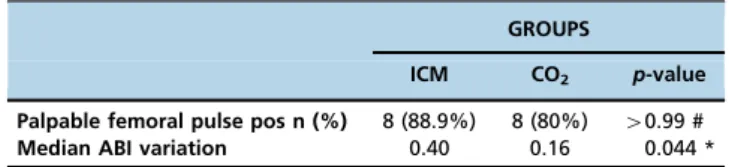
The surgical outcomes were satisfactory in both groups. The presence of palpable femoral pulses measured immediately following each procedure indicated that the technical success rate was similar for both groups, as presented in Table 2. (The three patients with weak femoral pulses pre operatively presented with strong palpable femoral pulses post operatively and were considered technical successes.) Variability (difference
between post-operative and pre-operative ABI) was higher for the ICM group (0.40vs. 0.16,p=0.044).
For the ICM group, the median iodine contrast volume was 34.25 ml (range: 9 to 69 ml); for the CO2 group, the
median CO2 volume was 60 ml (range: 23 to 130 ml). In four (36.4%) CO2 patients, the use of iodine contrast was
necessary to complete the procedure; however, none of these patients required more than 15 ml of iodine (range: 3 to 15 ml). The median iodine contrast volume used for the CO2
patients who required iodine supplementation was 6.5 ml. Creatinine clearance during the postoperative period did not differ significantly between the groups and remained stable during the post-operative period in both groups, as presented in Table 3.
The delta clearance (creatinine clearance after the proce-dure minus clearance before the proceproce-dure) was positive for the CO2group (2.01) and zero for the ICM group; however,
this difference was not statistically significant (p=0.44). Procedure length did not differ significantly between the groups (median length was 75 minutes for the CO2 group
and 70 minutes for the ICM group,p=0.92), indicating that CO2does not increase procedure duration. We also analyzed
the procedure lengths for the different TASC classifications in each group and observed no significant differences.
The costs of the endovascular materials were similar for both groups, indicating that CO2does not increase procedure
costs. However, the contrast medium costs were significantly increased for the ICM group compared with the CO2group
(see Table 4).
Regarding angiographic image quality, which is presented in Table 5, 82% of the CO2angiography images were graded
as either good or fair by both observers, with high inter-observer image quality concordance. All iodine arteriograms were graded as good by both observers. Figure 1 depicts an example of CO2angiography.
’ DISCUSSION
Treating patients with renal impairment or iodine related hypersensitivity remains a challenge when performing both diagnostic and therapeutic endovascular procedures. The use of CO2 as an alternative contrast medium to ICM has
provided a solution for these situations. Given that CO2is a
good option for these patients, we aimed to investigate the possibility of the more widespread use of CO2by treating
patients with no contraindications to either CO2or ICM.
In this study, we observed that the use of CO2 did not
change surgical outcomes given that the patients in the CO2
group exhibited no differences in post-operative femoral pulses compared with the patients who received iodine contrast. The variation in ABI between the groups may be explained by differences in distal outflow (i.e., patients presented with different patterns of femoro-popliteal and infra-genicular stenosis/occlusion). In addition, procedure Table 2-Surgical outcomes.
GROUPS
ICM CO2 p-value
Palpable femoral pulse pos n (%) 8 (88.9%) 8 (80%) 40.99 #
Median ABI variation 0.40 0.16 0.044 *
# Fisher exact test, * Mann-Whitney U test, ICM: Iodine contrast media CO2: Carbon dioxide, Pos: Immediate post-operative period, ABI: Ankle
brachial index.
Table 3-Comparison of pre- and post-operative creatinine clearance and delta clearance between the groups.
ICM GROUP n=10 CO2GROUP n=11 p-value#
Median creatinine clearance pre (IIQ) 90.20 (64.04-112.65) 79.40 (74.29-108.74) 0.94
Median creatinine clearance pos (IIQ) 93.05 (75.55-99.16) 88.40 (69.93-131.88) 0.62
Median delta clearance 0 (-16.9-10.28) 2.01 (-7.65-13.54) 0.44
# Mann-Whitney U test, IIQ: Interquartile interval, ICM: Iodine contrast media, CO2: Carbon dioxide, Pre: Before procedure, Pos: Post-operative period,
length was not extended in the CO2group. Pain during the
injection of CO2was not assessed because the patients were
under general anesthesia. However, some of the patients could have received local anesthesia (and this assessment could have been undertaken). Due to the institutional research protocol (which mandated general anesthesia and an overnight stay on ICU for every vascular surgery patient), we were unable to compare discomfort (e.g., pain) during the procedure between the groups.
No significant differences were noted between the patients treated with CO2 or iodine with respect to renal function
during the post-operative period. In the ICM group, we did not observe any changes. The lack of alteration was most likely because of either a small sample size or the admini-stration of a low volume of iodine contrast, as numerous studies have demonstrated the nephrotoxicity of ICM.
Endovascular material costs were similar for both groups, demonstrating that the use of CO2 does not increase
procedure costs. However, the contrast media costs for the ICM group were significantly higher compared with the CO2
group, even after including the price of one 20-ml flask of ICM for balloon filling for each patient in the CO2group.
The evaluation of the angiographic images by the observers indicated that most of the images in the CO2
group (82%) were evaluated as either good or fair; therefore, it may be possible to perform the procedure with only CO2in
these cases. It is noteworthy that 63% of images for observer 1 and 45% for observer 2 were considered good with CO2
and that all images with iodine were rated as good. However, our aim was to assess the feasibility of C02 not
its superiority to iodine contrast media.
Images were considered poor with CO2 in patients with
long occlusions (2 patients with TASC D lesions for whom the filling of the distal vessels with CO2 was difficult to
assess). Additional poor images were observed at the beginning of our series, at which time we supplemented patients with iodine to verify vessel patency. Although the learning curve of this procedure may be overcome with experience, it is possible that CO2may not replace iodine in
TASC D lesions. This limitation might be a problem for allergic patients but may also benefit patients with borderline renal function for whom iodine contrast media usage may be significantly reduced.
The CO2 contrast agent is a gas; therefore, its
manipu-lation requires the use of an unusual technique. Most vascular surgeons are not accustomed to working with a gaseous contrast medium, as its manipulation requires care to prevent air contamination (12). In addition, most surgeons lack the training needed to obtain good quality images.
Some CO2injection pumps have been developed (13-15),
but they are expensive and difficult to use. We have developed and published a simple homemade delivery Table 4-Endovascular material costs and contrast costs between the CO2and iodine contrast media groups.
GROUPS
CO2 ICM p-value #
Endovascular material cost (IIQ) 1527.69 (1527.6 9-1789.23) 2302.69 (1540.19-2984.07) 0.168
Contrast cost (IIQ) 10.12 (10.12-10.12) 25.0 (25.0-25.0) o0.001
# Mann-Whitney U test, IIQ: Interquartile interval, ICM: Iodine contrast media, CO2: Carbon dioxide, values in American dollars.
Table 5-Evaluation of CO2angiography by observers.
Ilio-femoral angiography
Good Fair Poor
Observer 1 7 2 2
Observer 2 5 4 2
system for CO2 in endovascular procedures, which uses
materials that may be found in any hospital and are both cheap and reproducible. We believe that systems such as ours may lead to more widespread use of CO2as a contrast
agent in endovascular procedures.
When performed by experienced physicians familiar with its use, CO2 may provide angiographic image quality
comparable to that achieved using iodinated contrast media. We consider CO2as effective as ICM within the
femoro-popliteal territory. We demonstrated that CO2is a viable
con-trast option for ilio-femoral lesion treatment and observed outcomes similar to those noted with iodine contrast. Complications following the use of intra-arterial CO2 have
been reported, includingvapor-lock, which occurs upon entrap-ment of CO2at the origin of a vessel, thereby impairing flow
and potentially resulting in ischemia. This condition may be mild and cause only transient pain or may present as signi-ficant bowel ischemia (16,17). However, no adverse events were observed in our series secondary to the use of this particular contrast media. We routinely waited 3 minutes between CO2injections to avoidvapor-lockand any subsequent
complications.
We believe that vascular surgeons should be trained during their residency in vascular surgery to acquire the technical ability to use CO2. The technique is unusual, but its
learning curve is not steep. The technique may be useful for vascular surgeons searching for the best contrast option for each patient, as opposed to being limited to the use of only one type of contrast.
Given this study’s small sample size and the absence of a longer follow up period with respect to renal function, additional studies supporting our findings are encouraged.
Our study demonstrated that CO2is a good alternative to
ICM in the endovascular treatment of ilio-femoral occlusive disease (except in TASC D patients, for whom iodine was often but not always necessary to complete the procedure). CO2is
characterized by similar endovascular material costs, proce-dure lengths and surgical outcomes as well as and reduced contrast medium costs compared with iodine contrast.
’ ACKNOWLEDGMENTS
This work was supported by the Ministério da Saúde do Brasil.
’ AUTHOR CONTRIBUTIONS
Mendes CA and Wolosker N conceived the study, participated in its design and drafting, collected the data, were responsible for analysis and interpretation of the samples, manuscript writing and statistical analysis. Martins AA, Teivelis MP and Yasbek AM collected the data, wrote the manuscript and helped with the statistical analysis. Kuzniec S and Fioranelli A participated in the analysis, interpretation of the samples and data collection.
’ REFERENCES
1. Wolosker N, Nakano L, Rosoky RA, Munia MA, Netto BM, Puech-Leão P. Endovascular treatment for intermittent claudication in patients who do not improve with clinical treatment. Clinics. 2005;60(3):193-200, http://dx.doi.org/10.1590/S1807-59322005000300003.
2. Ferrari FB, Wolosker N, Rosoky RA, D’Ippolito G, Wolosker AMB, Puech-Leão P. Natural history of stenosis in the iliac arteries in patients with intermittent claudication undergoing clinical treatment. Rev Hosp Clin Fac Med Sao Paulo. 2004;59(6):341-8, http://dx.doi.org/10.1590/ S0041-87812004000600006.
3. Setacci C, De Donato G, Teraa M, Moll FL, Ricco J-B, Becker F, et al. Chapter IV: Treatment of critical limb ischaemia. Eur J Vasc Endovasc Surg. 2011;42 Suppl 2:S43-59.
4. Jongkind V, Akkersdijk GJM, Yeung KK, Wisselink W. A systematic review of endovascular treatment of extensive aortoiliac occlusive disease. Journal of Vascular Surgery. 2010;52(5):1376-83, http://dx.doi.org/10.1016/j.jvs.2010. 04.080.
5. MD IFH, Kyung J Cho MD F, MD JGC. Carbon Dioxidein Angiographyto Reduce the Risk of Contrast-Induced Nephropathy. Radiologic Clinics of NA. Elsevier Ltd; 2009;47(5):813-25.
6. Garvin RP, Ryer EJ, Kendrick JB, Franklin DP. Endoleak visualized with carbon dioxide angiography during endovascular aneurysm repair using the Endurant stent-graft. J Endovasc Ther [Internet]. 2014;21(1):172-6. Available from: http://eutils.ncbi.nlm.nih.gov/entrez/eutils/elink.fcgi? dbfrom=pubmed&id=24502499&retmode=ref&cmd=prlinks
7. de Almeida Mendes C, de Arruda Martins A, Teivelis MP, Kuzniec S, Nishinari K, Krutman M, et al. Carbon dioxide is a cost-effective contrast medium to guide revascularization of TASC A and TASC B femoropopliteal occlusive disease. Ann Vasc Surg. 2014;28(6):1473-8, http://dx.doi.org/10.1016/j.avsg.2014.03.021.
8. Mendes C de A, Martins A de A, Teivelis MP, Kuzniec S, Wolosker N. Public private partnership in vascular surgery. Einstein (Sao Paulo). 2014;12(3):342-6.
9. Holtzman RB, Lottenberg L, Bass T, Saridakis A, Bennett VJ, Carrillo EH. Comparison of carbon dioxide and iodinated contrast for cavography prior to inferior vena cava filter placement. Am J Surg. 2003;185(4):364-8, http://dx.doi.org/10.1016/S0002-9610(02)01410-1.
10. Sugimoto M, Yasuda H, Koda K, Suzuki M, Yamazaki M, Tezuka T, et al. Carbon dioxide-enhanced virtual MDCT cholangiopancreatography. J Hepatobiliary Pancreat Sci. 2010;17(5):601-10, http://dx.doi.org/10.1007/ s00534-009-0201-8.
11. Mendes C de A, Wolosker N, Krutman M. A simple homemade carbon dioxide delivery system for endovascular procedures in the iliofemoral arteries. Circ J. 2013;77(3):831, http://dx.doi.org/10.1253/circj.CJ-12-1310. 12. Cho DR, Cho KJ, Hawkins IF. Potential air contamination during CO2
angiography using a hand-held syringe: theoretical considerations and gas chromatography. Cardiovasc Intervent Radiol. 2006;29(4):637-41, http://dx.doi.org/10.1007/s00270-005-0019-y.
13. Nicolini A, Lovaria A, Meregaglia D, Palatresi S. Carbon dioxide angio-graphy. A new injection system. Radiol Med. 2000;99(1-2):51-5. 14. Scalise F, Novelli E, Auguadro C, Casali V, Manfredi M, Zannoli R.
Automated carbon dioxide digital angiography for lower-limb arterial disease evaluation: safety assessment and comparison with standard iodinated contrast media angiography. J Invasive Cardiol. 2015;27(1):20-6. 15. Giordano A, Messina S, Polimeno M, Corcione N, Ferraro P, Biondi-Zoccai G, et al. Peripheral diagnostic and interventional procedures using an automated injection system for carbon dioxide (CO2): case series and
learning curve. Heart Lung Vessel. 2015;7(1):18-26.
16. Johnson PL, Neperud J, Arnold J, Thomas J. Livedo reticularis and bowel ischemia after carbon dioxide arteriography in a patient with CREST syn-drome. J Vasc Interv Radiol. 2011;22(3):395-9, http://dx.doi.org/10.1016/ j.jvir.2010.11.012.