
Imaging Alzheimer’s disease
pathophysiology with PET
Lucas Porcello Schilling1,2,3, Eduardo R. Zimmer1,2,3,4, Monica Shin1,2,
Antoine Leuzy1,2,5, Tharick A. Pascoal1,2, Andréa L. Benedet1,2, Wyllians Vendramini Borelli3, André Palmini3, Serge Gauthier2, Pedro Rosa-Neto1,2
ABSTRACT. Alzheimer’s disease (AD) has been reconceptualised as a dynamic pathophysiological process characterized by preclinical, mild cognitive impairment (MCI), and dementia stages. Positron emission tomography (PET) associated with various molecular imaging agents reveals numerous aspects of dementia pathophysiology, such as brain amyloidosis, tau accumulation, neuroreceptor changes, metabolism abnormalities and neuroinflammation in dementia patients. In the context of a growing shift toward presymptomatic early diagnosis and disease-modifying interventions, PET molecular imaging agents provide an unprecedented means of quantifying the AD pathophysiological process, monitoring disease progression, ascertaining whether therapies engage their respective brain molecular targets, as well as quantifying pharmacological responses. In the present study, we highlight the most important contributions of PET in describing brain molecular abnormalities in AD.
Key words: Alzheimer’s disease, positron emission tomography, amyloid imaging, neuroinflammation, neurodegeneration, tau.
A FISIOPATOLOGIA DA DOENÇA DE ALZHEIMER ATRAVÉS DO PET
RESUMO. A doença de Alzheimer tem sido reconceitualizada como um processo patofisiológico dinâmico caracterizado pelos estágios pré-clínico, comprometimento cognitivo leve e demência. A tomografia por emissão de pósitrons associada a vários agentes de imagem molecular revela numerosos aspectos da patofisiologia da demência tais como amiloidose cerebral, acúmulo de tau, mudanças em neurorreceptores, anormalidades de metabolismo e neuroinflamação nestes pacientes. No contexto de um crescimento em direção ao diagnóstico precoce pré-sintomático e intervenções modificadores da doença, a imagem de PET com agentes moleculares fornece meio para quantificar o processo patofisiológico da DA sem precedentes, monitorizar a progressão da doença, bem como quantificar resposta farmacológica. Aqui, nós realçamos as mais importantes contribuições do PET na descrição de anormalidades moleculares cerebrais na DA.
Palavras-chave: doença de Alzheimer, tomografia por emissão de positron, imagem amilóide, neuroinflamação, neurodegeneração, tau.
INTRODUCTION
A
lzheimer’s disease (AD) was irst described in 1906, when the German psychiatrist Alois Alzheimer reported the clinical and pathological features from a patient called Auguste Deter. At age 51, she became alicted by an obscure progressive neuropsychiatric condition characterized by severe cognitivedecline associated with behavioral symptoms. Five years after admission, she became mute and conined to her bed. Similarly to many patients, her death came as a consequence of septicemia. At the necropsy, the brain histo-pathological examination revealed the pres-ence of amyloid plaques and neuroibrillary tangles, both of which later became known
This study was conducted at the Douglas Mental Health Research Institute, Montreal, Canada.
1Translational Neuroimaging Laboratory (TNL), McGill Center for Studies in Aging (MCSA), Douglas Mental Health Research Institute, Montreal, Canada. 2
Al-zheimer’s Disease Research Unit, MCSA, Douglas Mental Health Research Institute, Montreal, Canada. 3Brain Institute of Rio Grande do Sul, Pontifical Catholic
University of Rio Grande do Sul (PUCRS), Porto Alegre RS, Brazil. 4Department of Biochemistry, Federal University of Rio Grande do Sul (UFRGS), Porto Alegre RS,
Brazil. 5Department NVS, Centre for Alzheimer Research, Division of Translational Alzheimer Neurobiology, Karolinska Institutet, Stockholm, Sweden.
Pedro Rosa-Neto. McGill Center for Studies in Aging, 6825 LaSalle Boulevad, Montreal, H4H 1R3 Quebec – Canada. E-mail: [email protected]
Disclosure: The authors report no conflicts of interest.
Received December 10, 2015. Accepted in final form March 16, 2016.
as the neuropathological hallmarks of AD. he term “Alzheimer’s disease” was introduced by the psychiatrist Emil Kraepelin in 1910, in his Handbook of Psychiatry.1,2 Initially considered a rare disease, AD became recognized as a frequent condition in aging individuals as well as the leading cause of dementia.3
he neuropathological features of AD constitute the extracellular deposition of amyloid-b (Ab) aggregates (senile plaques), intracellular inclusions of hyperphos-phorylated tau aggregates (neuroibrillary tangles; NFTs), brain atrophy and cell depletion.4 hese features silently accumulate and propagate across brain regions for many years, leading to subsequent clinical and functional decline. At the stage of clinical symptoms of dementia, these pathophysiological processes have already sig-niicantly compromised a large proportion of brain cir-cuits involved in cognition. In its typical presentation, AD is characterized by progressive cognitive impair-ment initially conined to the episodic memory system.
he research criteria for the diagnosis of AD were irst deined in 1984 by a working group jointly estab-lished by the National Institute of Neurological and Communicative Disorders and Stroke (NINCDS) and the Alzheimer’s Disease and Related Disorders Associa-tion (ADRDA).5 he NINCDS-ADRDA criteria assumed a static association between the pathological and clini-cal characteristics of AD.6 hese criteria were useful and widely adopted, remaining in use for over 25 years. Dur-ing the last decade, important advances in genetics, bio-chemistry, clinical, and pathological characterization of dementias have taken place, including the development of in vivo biomarkers of AD pathophysiology, leading to changes in the criteria for AD.6 An International Working Group (IWG) initiated these revisions,7,8 followed by the National Institute on Aging and Alzheimer’s Association workgroup (NIA-AA), leading to new diagnostic criteria including predementia stages of AD. In particular, the NIA-AA research criteria encompasses asymptomatic “preclinical” AD,9 mild cognitive impairment (MCI) due to AD,10 and AD dementia stages.11 his disease frame-work incorporates important advances such as the notion of clinical and pathophysiological progression, the genetic form of AD, as well as atypical presentations of AD. Importantly, AD pathophysiology now assumes a progressive cascade of events associated with Ab toxic-ity, which triggers a series of downstream biochemical cascades including tau hyperphosphorylation, synap-tic depletion,12,13 neuroinlammation,14 and abnormal neurotransmission.15
Positron emission tomography (PET) is a non-invasive method capable of quantifying biological
pro-cesses based on the dynamic distribution of radiotracers injected during the scanning session. here are numer-ous PET molecular imaging agents, each of which is spe-ciically designed to quantify a single molecular target. hey allow for the characterization of abnormal protein aggregation (ibrillary Ab or hyperphosphorylated tau deposits), metabolic abnormalities (glucose metabolism and cerebral blood low), and neuroinlammation (astro-cytosis, microgliosis and phospholipase activity). his review article focuses on PET molecular imaging in AD, reviewing the role of imaging biomarkers in the diagno-sis and monitoring of key pathophysiological events of AD, which include Ab and tau deposition, neurodegen-eration, and neuroinlammation.
PET BIOMARKERS FOR AMYLOID DEPOSITION
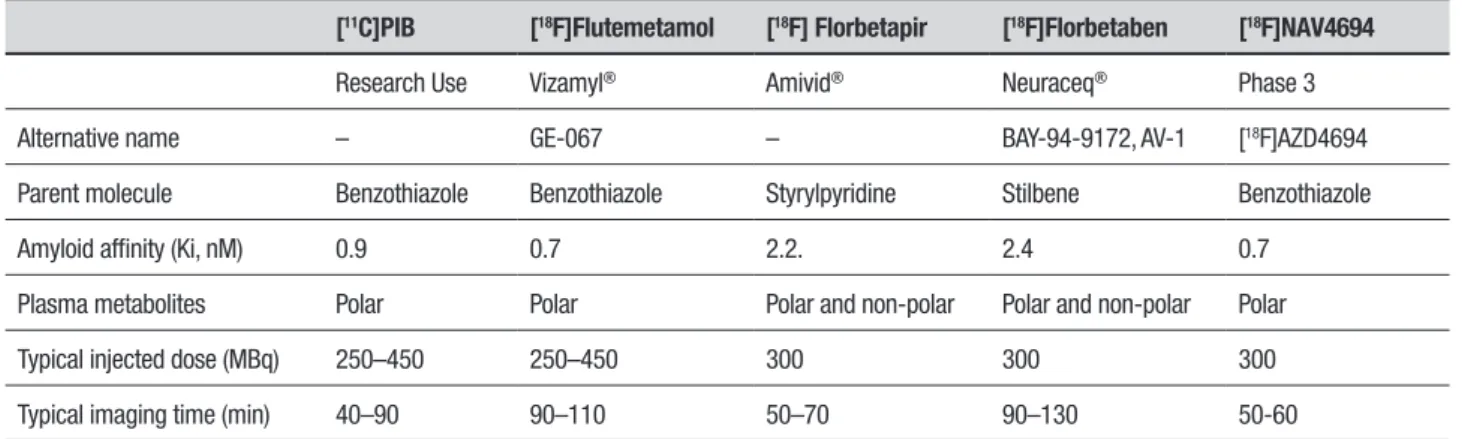
hough the pathogenesis of AD remains unclear, the hallmark of this neurodegenerative disease is the depo-sition of Ab plaques, together with other features, such as the presence of NFTs. Ab deposits are known to progressively accumulate in certain brain regions over the course of the disease, beginning long before the clin-ical onset. he canonclin-ical PET molecular agent capable of detecting ibrillary Ab in vivo is the carbon-11 labelled thiolavin T derivative 2-(4’-methylaminophenyl)-6-hydroxybenzothiazo le, also known as [11C]Pittsburgh Compound-B ([11C]PiB). he most widely studied amyloid PET tracer, [11C]PiB is considered the bench-mark for PET-amyloid imaging.16-18 he short half-life of carbon-11 (20 minutes), however, limits its use to centers possessing an on-site cyclotron and special-ized radiochemistry. he new generation of amyloid ligands, labeled with luorine-18, have a longer half-life of approximately 110 minutes. Due to these diferences in half-life, these luorine-18 labeled compounds can be regularly produced at a cyclotron site and distributed to other facilities (Table 1).19,20Table 1. Summary of amyloid imaging agents currently available for quantifying brain amyloid.
[11C]PIB [18F]Flutemetamol [18F] Florbetapir [18F]Florbetaben [18F]NAV4694
Research Use Vizamyl® Amivid® Neuraceq® Phase 3
Alternative name – GE-067 – BAY-94-9172, AV-1 [18F]AZD4694
Parent molecule Benzothiazole Benzothiazole Styrylpyridine Stilbene Benzothiazole
Amyloid affinity (Ki, nM) 0.9 0.7 2.2. 2.4 0.7
Plasma metabolites Polar Polar Polar and non-polar Polar and non-polar Polar
Typical injected dose (MBq) 250–450 250–450 300 300 300
Typical imaging time (min) 40–90 90–110 50–70 90–130 50-60
AD pathophysiology in MCI patients, given the lack of eicacious therapy as well as the ethical limitations when proposing amyloid imaging in patients meeting clinical criteria for MCI. On the other hand, positive amyloid-PET scans in MCI patients provides conirmation that this clinical situation occurs due to AD pathophysiology, supporting the idea of investing in non-pharmacological interventions, such as cognitive enrichment and diet and lifestyle changes. By contrast, a negative amyloid-PET scan in patients presenting cognitive impairment suggests other non-AD pathologies, such as fronto-temporal lobar degeneration, hippocampal sclerosis, or argyrophilic grain disease. Although Parkinson’s disease (PD) and dementia with Lewy bodies (DLB) are neuro-degenerative disorders associated with brain deposition of ibrillary aggregates of α-synuclein protein, individu-als with these synucleinopathies and cognitive decline have shown variability with regard to the presence of an abnormal amyloid-PET scan.28,29 Individuals present-ing with Parkinson’s disease (PD) dementia have shown lower brain amyloid burden than AD, dementia with Lewy bodies, exhibiting similar burden to controls. On the other hand, patients presenting dementia with DLB have shown higher amyloid burden than controls, com-parable to levels seen in AD patients.30,31 Interestingly, these studies have suggested that a positive amyloid-PET scan in DLB individuals might be associated with more rapid clinical progression.28,30
he clinical importance of amyloid imaging has been extensively debated. In order to delineate scenarios in which the use of amyloid PET radiotracers is appropriate in the evaluation of cognitive impairment, the Alzheim-er’s Association and the Society of Nuclear Medicine and Molecular Imaging have set up an Amyloid Imag-ing Taskforce (AIT).32 Performing a literature review in conjunction with expert opinion, the AIT deined a set of
Appropriate Use Criteria (AUC) for clinical amyloid imag-ing, recommending that the use of amyloid imaging be limited to patients showing progressive and unexplained cognitive decline with uncertain diagnosis, early onset dementia and/or atypical clinical presentation, and when knowledge of amyloid status is expected to alter the ther-apeutic approach. Clinical utilities of amyloid imaging are restricted to speciic cases. Patients with early-onset dementia (commonly deined as onset before 65 years of age) have a lower probability of AD pathophysiology underlying their cognitive decline than late-onset cases. In this regard, amyloid imaging might clarify whether underlying brain amyloidosis is associated with clinical syndromes such as primary progressive aphasia, demen-tias characterized by a predominance of executive dys-function, visuospatial symptoms, progressive apraxia, and corticobasal syndrome. Given the economic and family impact of the diagnosis of AD in this population, an elevated level of diagnostic certainty is highly desir-able. Furthermore, the presence of amyloid pathology might provide the rationale for proposing the clinical use of cholinesterase inhibitors in this population. he AIT contraindicates the use of amyloid imaging in asymp-tomatic people or in those with a cognitive complaint but no clinical conirmation of impairment, for determining the severity of dementia and for non-medical reasons, such as insurance, legal or employment decisions.
How-ever, the clinical utility of amyloid PET has been increas-ingly discussed, particularly in the absence of efective disease modifying agents.32,34,35 he ensuing para-graphs summarize progress regarding amyloid imaging in AD.
[11C]Pittsburgh Compound-B. [11C]PIB exhibits a high ainity and speciicity for Ab plaques, as opposed to Lewy bodies or tau proteins.36,37 showing high accuracy in the evaluation of Ab plaque burden. In individuals with AD, [11C]PIB uptake is distributed in the frontal, medial and lateral posterior parietal cortices, precuneus, occipital cortex and lateral temporal cortices, as well as in the striatum (Figure 1).16,38-40 Low [11C]PIB uptake is typically observed in the cerebellar cortex.
A recent Cochrane review study on [11C]PIB for early diagnosis of AD in individuals with MCI41 estimated sensitivity of 96% (95% conidence interval: 87-99) and median speciicity of 58%. A growing consensus emerg-ing from longitudinal studies indicates that disease-modifying therapies targeting amyloid should be admin-istered at very early stages of the disease.42 Concerted eforts worldwide are focusing on advancing the diag-nosis of AD to a preclinical stage.43,44 Elevated [11C]PIB binding in nondemented subjects indicates that it may be sensitive for the detection of preclinical AD,45 suggesting a 20 to 30-year interval between irst amyloid positivity and onset of dementia.25
Presently, [11C]PIB is one of the most accurate agents for localizing and quantifying Ab deposition; however, the short half-life of carbon-11 restricts its use to facili-ties with an onsite cyclotron and expertise in carbon-11 radiochemistry. Hence, the overall production and utili-zation costs are not generally afordable. In order to solve this issue, recent studies haves focused on luorine-18 labeled radiopharmaceuticals, whose longer half-life allows for regional distribution and commercialization. Widely used as a biomarker in the diagnostic criteria for AD, cerebrospinal luid (CSF) also conirms Ab pathology, with CSF Ab1-42 having an inverse correlation with [11C] PIB SUVR values.46 However, one limitation of CSF Ab1-42 is that it does not provide any regionalized information on amyloid burden in the brain.
Fluorine-18 labeled ligands. While the short half-life of carbon labeled radiotracers limits the application of [11C]PIB in clinical practice, luorine-18 labeled amyloid PET radiopharmaceuticals have been developed, with a growing potential for clinical and research purposes. hese compounds provide a new window of opportunity in the assessment of preclinical and clinical AD due to
Figure 1. Amyloid signature. Representative [11C]PIB PET images
show-ing white matter uptake of [11C]PIB in a patient with CBS (a; age 74,
MMSE 23), and extensive cortical uptake in a patient with AD (b; age 70, MMSE 28).
the 110-minute half-life of luorine-18, a massive difer-ence in terms of distribution logistics when compared to [11C]PIB production. At present, four radioluori-nated labeled radiopharmaceuticals are drawing scien-tiic attention: [18F]3-F-PIB ([18F]lutemetamol),47 [18F] AV- 45 ([18F]lorbetapir),48 [18F]AV-1 or [18F]BAY94– 9172 ([18F]lorbetaben),49,50 and [18F]AZD4694 or [18F] NAV4694.51
Similarly to [11C]PIB, these luorine-18 amyloid tracers exhibit signiicant binding to ibrillar Ab in the brain,47,48 albeit with some diferences. [18 F]Flute-metamol, [18F]lorbetapir, and [18F]lorbetaben are less speciic than [11C]PIB, displaying white matter binding whereas [18F]NAV4694 shows more speciic grey-white matter demarcation and better pharmacokinetic proper-ties as a potential competitor of [11C]PIB PET. he Food and Drug Administration (FDA) and European Medicines Agency (EMA) have already approved [18F]lorbetapir (AmyvidTM), [18F]lutemetamol (VizamylTM), and [18 F]lo-rbetaben (Neuraceq™) for use in clinical practice, while [18F]NAV4694 is currently in phase III trials.50,51
symptom-atic and preclinical AD, showing relevance in detecting primarily advanced stages of Ab deposition at both clini-cal and precliniclini-cal stages.54 [18F]Florbetaben is a highly accurate Ab PET tracer that has the potential to support the clinical diagnosis of AD and other causes of cognitive decline,49 with similar visual and quantitative assessment in PET.
A third generation probe, [18F]AZD4694, called NAV4694, has been attracting growing attention for its near-identical imaging characteristics , but longer half-life to those of [11C]PIB. [18F]NAV4694 binds spe-ciically to Ab plaques, with excellent frontal cortex-to-white matter ratios both in AD and healthy controls.51 he accuracy of [18F]NAV4694 in binding Ab plaques has been tested, reliably discriminating AD patients from healthy controls, and satisies requirements for clinical usage and evaluation of disease-modifying strategies in AD.55 In a recent study, [18F]NAV4694 exhibited a signii-cant overlap in amyloid imaging with [11C]PIB in patients with FTLD, theoretically an Ab-free disease in most of its pathological subtypes.56 Also, the linear correlation of [18F]NAV4694 with [11C]PIB of 0.95 is higher than the values reported for [18F]lorbetapir (range 0.33-0.64) and [18F]lorbetaben (0.71).51
PET BIOMARKERS FOR NEUROINFLAMMATION
A factor known to be involved in the pathogenesis of AD is the immune response, with initial associa-tion between amyloid deposits and immune response emerging among elderly in their 70s and 80s.57,58 More recently, there is emerging knowledge on components of innate immunity associated with AD pathology, as well as increasing discussion over the beneicial and detrimental efects of the immune response in AD. Another controversial topic is the start point of neuro-inlammatory processes observed in AD brains, which raises the question as to whether inlammation is a cause or a consequence of AD pathology. Despite the initial assumption of their occurrence only in late stages of the disease, inlammatory changes in the CSF can be detected in MCI patients, revealing the possibility of involvement of the immune system at very early stages of AD.59In a bid to answer the as yet unsolved questions regarding the Janus face of inlammation in AD, PET imaging is being used in vivo to trace markers of neu-roinlammation with promising outcomes, as outlined below.60
Radiopharmaceuticals for imaging microglial activation.
Neuroinlammatory changes are a part of AD pathology,
and microglial activation in areas afected by neurode-generation is a key brain tissue event.61 Microglial acti-vation occurring in early stages of AD dementia is asso-ciated with a signiicant elevation in the fractional area of reactive microglia following the formation of neuritic plaques comprising ibrillar Ab.62-65 Using a speciic ligand for the 18-kDa translocator protein (TSPO), formerly called the peripheral benzodiazepine receptor (PBR), [11C]PK11195 quantiication of microglial acti-vation in vivo has been measured.66 Probably due to its poor speciic binding, initial [11C]PK11195 studies in AD showed negative results.67 However, improvements in the [11C]PK11195 tracer, particularly with the utili-zation of its dextro-isomer, the radiotracer [11 C]-(R)-PK11195, revealed increased sensitivity for detecting TSPO expression in parieto-temporal, entorhinal, and cingulate cortices of AD patients.64 In [11C]PIB+ AD patients, high microglial activation has been observed, with an inverse correlation between cognition and microglial activity.68 However, a recent study reported that the inclusion of a vascular component results in an ampliied signal in AD patients,69 suggesting that an increase in [11C]-(R)-PK11195 sensitivity signal modeling may be required.
Other TSPO radiopharmaceuticals have been designed aimed at improving pharmacokinetics and spec-iicity. In this regard, preclinical studies involving radio-tracers [18F]FEDAA1106 or [11C]AC5216 have shown promising results in AD-like transgenic models,70,71 and [11C]DAA1106 PET imaging showed greater binding in AD patients compared to healthy control subjects.72 Another recent clinical study using [18F]FEDAA1106 — a novel TSPO ligand with in vitro ainity superior to that of [11C]DAA110673 — showed widespread increases in MCI patients when compared to healthy controls, with these values predicting the conversion to AD dementia stage within a 5-year follow-up period.74
Radiopharmaceuticals for imaging reactive astrocytosis.
In AD post-mortem tissue, the augmented expression of glial ibrillary acidic (GFAP) and astroglial S100B proteins is typically observed, indicating an increase in the number of reactive astrocytes.79 Utilizing a ligand with a high ainity/speciicity for monoamine oxidase B (MAO-B), an enzyme expressed primarily on the mito-chondrial membrane of reactive astrocytes,80,81 PET imaging using the carbon-11 labeled L-deprenyl ([11C] DED) has revealed increased binding in patients with MCI, suggesting that astrocytosis is an early event in AD pathophysiology.82
PET BIOMARKERS OF NEURODEGENERATION
PET radiopharmaceuticals of tau pathology. Misfolding and aggregation of hyperphosphorylated tau deposition into NFTs has a key role in AD pathophysiology.83,84 It is has been proposed that tau pathology propagates across brain circuits. NFTs have been associated with neuronal dysfunction, cell death, and cognitive impairment.85 CSF levels of total tau (t-tau) and phosphorylated tau (p-tau) have been associated with disease severity,86 with altered tau levels in the CSF being interpreted as surro-gate markers of neurodegeneration in AD.87 Despite this evidence, the clinical application of CSF tau as an AD biomarker has been further discussed elsewhere.88
CSF tau biomarkers are somewhat disadvantageous compared to imaging biomarkers given the need for a lumbar puncture. Moreover, CSF measurements pro-vide global estimates of the disease process without any information regarding the topographic localization of NFT. Finally, the quantiication of p-tau and t-tau pro-tein varies signiicantly across centres.89 Due to these features, imaging methods for NFT quantiication are extremely important, particularly for assessing upcom-ing tau-based therapeutics. Given this scenario, several radiotracers characterized by high ainity for tau ibrils and with suitable kinetics have been developed, includ-ing the benzothiazole derivative [11C]PBB3, the phenyl-quinoline derivatives—[18F]THK-523, [18F]THK-5105, and [18F]THK-5117—and benzimidazole pyrimidine derivatives, such as [18F]T807 and [18F]T808.90
[11C]PBB3 has shown to rapidly cross both the blood-brain barrier (BBB) and neuronal plasma membranes, binding to intraneuronal tau inclusions. In vitro and ex vivo autoradiographic studieshave shown that [11C]PBB3 produced speciic, high-contrast labeling of neuronal tau inclusions in the brain stem of mice models expressing human tau pathological mutations. he same indings were reported with in vitro autoradiography and AD tissue, showing evident radiolabelling of ibrillar
aggre-gates in speciic regions of the hippocampus (including CA1), and the frontal cortex. Similarly, a clinical PET study using [11C]PBB3 in probable AD patients revealed increased tracer binding in lateral temporal and frontal cortices, in line with the distribution of tau pathology at Braak stage V/VI, and with higher SUVRs correlating with lower memory scores. A slight increase in [11C]PBB3 retention was also observed around the hippocampus of a control subject who showed decline on the Mini-Mental State Examination (MMSE), consistent with Braak stage III/IV or earlier.91
Aside from [11C]PBB3, the luorinated probes [18F] T-807 and [18F]T-808 are also potential tau ligands. An autoradiography study using AD brain tissue has shown that [18F]T-807 exhibits strong binding to NFTs, with a selectivity estimate of 29-fold for tau relative to Ab.92 In addition, comparing double immunohistochemical staining of NFTs and Ab on adjacent tissue sections, [18F]T-807 autoradiography showed that tracer bind-ing co-localized with immunoreactive NFTs, not with Ab plaques.93 In the case of [18F]T-808, it also has a high ainity and good selectivity for NFTs over Ab, which was indexed by autoradiographic studies.94 In addition, [18F]T-808 presents fast brain uptake followed by a rapid washout, suggesting low non-speciic binding,94 which is consistent with in vivo indings obtained using [18F] T-807.93 Moreover, the irst human brain using [18F] T-807 showed elevated SUVR in AD compared to MCI and healthy control subjects. Distinct patterns of tracer accumulation, in line with Braak staging, was observed across the frontal, temporal and parietal cortices, as well as in the hippocampus/entorhinal region.92
Another class of luorinated probes includes the THKs, which have exhibited high ainity and selectiv-ity for tau aggregates.95In vitro preliminary studies have reported [18F]THK-523 binding ainity for tau ibrils, with subsequent autoradiographic analysis using AD medial temporal brain sections showing accumulation of [18F]THK-523 in the pre- and pri-α layers of the entorhi-nal cortex and hippocampal CA1 region. Immunohisto-chemistry conirmed that these indings were consistent with the density of PHF-tau deposition.96 Subsequently, histoluorescence and autoradiographic studies revealed that [18F]THK-523 binding to NFTs co-localized with tau immunoreactivity, with no visible binding to Ab
he second generation of THKs was developed, which includes [18F]THK-5105 and [18F]THK-5117. Binding studies conducted in vitro using [18F]THK-5105 and [18F]THK-5117 have found increased binding ainity to synthetic truncated tau (K18ΔK280) ibrils—compris-ing the four repeat regions (244-372) in the absence of lysine 280 (ΔK280)—with both tracers proving supe-rior to [18F]THK-523. he selective binding capacity of these compounds was further examined using in vitro autoradiography and AD mesial temporal brain sections, showing increased accumulation of the radiotracer with particularly high binding in the Sommer’s sector of the hippocampus, the parahippocampus, and the subiculum. hese indings were conirmed through staining and immunohistochemistry, with reduced binding among healthy controls.100 Additional assessment of [18 F]THK-5105, conducted using [11C]PIB and AD hemibrain sec-tions, observed dense accumulation of [18F]THK-5105 in tau-rich areas—including the hippocampus/para-hippocampus, insula, cingulate gyrus and inferior and middle temporal gyri—with the pattern of tracer bind-ing correspondbind-ing to the recognized distribution of tau pathology but not to that of Ab or areas showing elevated retention of [11C]PIB. In addition, further stud-ies of biodistribution conducted in normal mice showed profuse and rapid brain uptake and fast clearance, with the kinetics of both tracers superior to those reported for [18F]THK-523.100-102
[18F]FDG Radiotracer. he glucose analogue
2-deoxy-2-(18F)luoro-D-glucose ([18F]FDG) PET has been utilized to assess cerebral glucose metabolism. [18F]FDG images have been interpreted as markers of neuronal activity103 and synaptic density.104 he typical AD metabolic signature consists of hypometabolism in the parieto-temporal association, medial parieto-temporal, posterior cingu-late and frontal cortices, with relative preservation of the visual cortex, primary sensory motor cortices, basal ganglia, thalamus, and cerebellum (Figure 2).105-109 his hypometabolic signature is frequently observed in AD patients and in over 85% of pathologically-conirmed cases.106 However, in atypical focal cortical syndromes of AD, topographic variants of hypometabolism have been identiied. For example, compared to typical AD, patients with logopenic primary progressive aphasia presented with disproportionate left temporoparietal hypometabolism.110 Patients with posterior cortical atrophy showed hypometabolism predominantly in occipito-parietal regions; some patients can present hypometabolism in the frontal eye ields.111 Patients with early onset AD also show greater metabolic
reduc-Figure 2. Representative PET [18F]FDG images acquired from a total of
103 individuals with normal cognition (NCI, N= 17), mild cognitive im-pairment (MCI, N=52) and dementia due to AD (AD, N= 27) obtained from a total of 103 structural MRI and [18F]FDG scans from the
Alzheim-er’s Disease Neuroimage Initiative (ADNI) database. The hot color scale represents the magnitude of [18F]FDG standardized uptake value ratio
(SUVR), proportional to glucose uptake. Note lower [18F]FDG SUVRs in
MCI and AD as compared to controls. High SUVRs are particularly re-duced in the posterior cingulate, precuneus and prefrontal (medial and dorsolateral) cortices. Imaging Methods: MRI images were corrected for non-linearity, classified (white, grey matter and CSF) and automatically segmented into cortical regions. Standard uptake value ratio (SUVR) im-ages were calculated in PET native space using the cerebellum as a ref-erence image. Images were subsequently resampled into the standard stereotaxic space and averaged using minctools.
tions, with hypometabolism from mild dementia comparable to that observed in late onset cases with severe dementia.112 hese indings are supported by studies showing more aggressive progression from patients with early onset AD113 and, possibly, by the cognitive reserve theory.114
for the partial volume efect, this inding is no longer supported.117 [18F]FDG has limited clinical value in MCI patients due to the lack of speciicity for AD pathophysi-ology. At a population level, however, subjects with MCI presenting a more marked or ‘AD-like’ pattern have been found to convert to dementia at higher rates,126,127 with accuracies in the range of 75 to 100%.128,129 he magni-tude of hypometabolism in the parietal and posterior cingulate cortices in MCI is associated with memory decline.130,131 As compared to decliners, stable MCI popu-lations tend to exhibit hypometabolism restricted to the dorsolateral frontal cortex.132,133
In order to study the progression to MCI and AD among cognitively normal older individuals, [18 F]FDG-PET has been used to predict cognitive decline with an accuracy approaching 80%.121,123 Progressive reductions in PET glucose metabolism were observed years before the appearance of clinical symptoms, with reductions in the hippocampus preceding declines in cortical regions134 in a clinicopathological study that evaluated cognitively normal individuals followed through MCI to patholog-ically-conirmed AD. he same metabolic changes have been noted in cognitively normal subjects homozygous for a susceptibility gene, the apolipoprotein E (APOE)
ε4 allele,130,135 asymptomatic carriers of genetic muta-tions associated with early onset familial AD,128,129,136 and those with a maternal family history of AD, as compared to those with a paternal history or no family history of AD.137 Ultimately, [18F]FDG will potentially prove of use in the characterization of a subgroup of patients exhib-iting neurodegeneration in the absence of Ab deposi-tion.138,139 hese patients, classiied in the category of “suspected non-amyloid pathophysiology (SNAP)”, could suggest that the onset of neurodegeneration in AD may not depend on the accumulation of Ab.140
IMAGING ALZHEIMER’S DISEASE
PATHOPHYSIOLOGY IN EXPERIMENTAL MODELS
A miniaturized version of PET, termed microPET, has made non-invasive imaging of small animals possible, such as rats and mice. In addition, advances in genetic engineering have led to the development of diverse animal models harboring human pathological gene mutations, which are capable of mimicking amyloid and tau pathologies (for review see (141)). hese models show progressive deposition of amyloid or tau, in parallel with signiicant cognitive decline, and are highly suited to longitudinal assessment with microPET.To date, several studies have investigated AD patho-physiological events in rodent models with microPET (for review see (142)). However, few such studies have
been conducted using a longitudinal design. Recently, the irst prolonged longitudinal study with microPET evaluating amyloid was published and revealed non-linear patterns of amyloid deposition during full disease progression.143 By contrast, to our knowledge, there are no longitudinal studies in the literature following tau pathology, and such studies are anxiously awaited by the AD community.144 In this context, longitudinal studies associating these animal models and microPET imaging have high translational capability, which indicates that data collected can be rapidly translated to clinical studies. In addition, microPET longitudinal studies ofer unprec-edented opportunities for monitoring the efectiveness of innovative therapeutic strategies.
CONCLUSION
Predictions based on biomarkers indicate that AD pathophysiological abnormalities precede the onset of clinical symptoms by at least two decades. By obtaining earlier AD diagnosis, it will be possible to develop poten-tial innovative therapies that may impact the natural progression of AD. In fact, several clinical studies testing potential new drugs are currently underway with amyloid and tau being the most promising pharmaco-logical targets (for review see (145)). In this scenario, PET radiotracers and neuropathological features for these processes are crucial to determine amyloid and tau engagement and to assess treatment response in clin-ical trials. In keeping with this, radiopharmaceutclin-icals for neuroinlammatory molecular imaging can equally contribute to the development of potentially efec-tive anti-inlammatory interventions. Although the majority of PET studies in AD populations have focused on Ab imaging, several ‘non-amyloid’ radiopharmaceu-ticals exist for evaluating neurodegeneration, neuroin-lammation and perturbations in neurotransmission across the spectrum of AD, potentially contributing to improved therapeutic perspectives for AD (for review see (146)).
Table 2. PET imaging signatures in Alzheimer’s disease.
Biological target Radiotracers Findings Typical brain regions involved
Amyloid deposition [11C]PIB
[18F]Florbetapir
[18F]Florbetaben
[18F]Flutemetamol
[18F]NAV4694
Increased retention Frontal cortex, medial and lateral posterior parietal cortices, precuneus
Occipital cortex, lateral, temporal cortices and striatum
Tau pathology [18F]T807
[18F]T808
[18F]THK523
[18F]THK5105
[18F]THK5117
[11C]PBB3
Increased retention Frontal cortex, temporal cortex, parietal cortex and hippocampus/ entorhinal region
Glucose metabolism [18F]FDG Low uptake Parietotemporal association cortices, medial temporal cortex, posterior
cingulate and frontal cortex (at later stages)
Neuroinflammation [11C]PK11195
[11C]DAA1106
[18F]FEDAA1106
[11C]AC5216
[11C]A836339
[11C]L-deprenyl
Increased retention Widespread retention within the whole brain
patients with early AD or at risk of developing AD; pref-erably in association with [18F]FDG imaging in order to combine pathological (amyloid deposition) and meta-bolic (hypometabolism) information. Other radiotrac-ers will also play a key role for research in AD (Table 2), especially in targeting novel therapies and for monitor-ing the response and eicacy of new drugs (e.g. tau and neuroinlammation).
Author contribution. Lucas Porcello Schilling collected and critically analysed literature, contributed with tables and wrote the paper; Eduardo R. Zimmer collected and critically analysed literature, contributed with igures
and wrote the paper; Monica Shin collected and criti-cally analysed literature and wrote the paper. Antoine Leuzy collected and critically analysed literature, contributed with igures and wrote the paper; harick A. Pascoal collected and critically analysed literature and wrote the paper; Andréa L. Benedet collected and criti-cally analysed literature and wrote the paper. Wyllians V. Borelli collected and critically analysed literature and wrote the paper. André Palmini collected and critically analysed literature and wrote the paper; Serge Gauthier collected and critically analysed literature and wrote the paper; Pedro Rosa Neto collected and critically analysed literature and wrote and reviewed the paper.
REFERENCES
1. Cipriani G, Dolciotti C, Picchi L, Bonuccelli U. Alzheimer and his disease: a brief history. Neurol Sci. 2011;32(2):275-9.
2. Dahm R. Alzheimer’s discovery. Curr Biol. 2006;16(21):R906-10. 3. Brookmeyer R, Johnson E, Ziegler-Graham K, Arrighi HM. Forecasting
the global burden of Alzheimer’s disease. Alzheimers Dement. 2007; 3(3):186-91.
4. Duyckaerts C, Delatour B, Potier MC. Classification and basic pathology of Alzheimer disease. Acta Neuropathol. 2009;118(1):5-36.
5. McKhann G, Drachman D, Folstein M, Katzman R, Price D, Stadlan EM. Clinical diagnosis of Alzheimer’s disease: report of the NINCDS-ADRDA Work Group under the auspices of Department of Health and Human Services Task Force on Alzheimer’s Disease. Neurology. 1984;34(7):939-44.
6. Jack CR, Jr., Albert MS, Knopman DS, et al. Introduction to the recom-mendations from the National Institute on Aging-Alzheimer’s Association workgroups on diagnostic guidelines for Alzheimer’s disease. Alzheimers Dement. 2011;7(3):257-62.
7. Dubois B, Feldman HH, Jacova C, et al. Research criteria for the diag-nosis of Alzheimer’s disease: revising the NINCDS-ADRDA criteria. Lancet Neurol. 2007;6(8):734-46.
8. Dubois B, Feldman HH, Jacova C, et al. Revising the definition of Alzheimer’s disease: a new lexicon. Lancet Neurol. 2010;9(11):1118-27. 9. Sperling RA, Aisen PS, Beckett LA, et al. Toward defining the preclinical stages of Alzheimer’s disease: recommendations from the National Institute on Aging-Alzheimer’s Association workgroups on diagnostic guidelines for Alzheimer’s disease. Alzheimers Dement 2011;7(3):280-92. 10. Albert MS, DeKosky ST, Dickson D, et al. The diagnosis of mild cogni-tive impairment due to Alzheimer’s disease: recommendations from the National Institute on Aging-Alzheimer’s Association workgroups on diagnostic guidelines for Alzheimer’s disease. Alzheimers Dement 2011;7(3):270-9.
diagnostic guidelines for Alzheimer’s disease. Alzheimers Dement 2011;7(3):263-9.
12. Jack CR, Jr., Knopman DS, Jagust WJ, et al. Hypothetical model of dynamic biomarkers of the Alzheimer’s pathological cascade. Lancet Neurol. 2010;9(1):119-28.
13. Jack CR, Jr., Knopman DS, Jagust WJ, et al. Tracking pathophysiolog-ical processes in Alzheimer’s disease: an updated hypothetpathophysiolog-ical model of dynamic biomarkers. Lancet Neurol. 2013;12(2):207-16.
14. McGeer PL, McGeer EG. The amyloid cascade-inflammatory hypoth-esis of Alzheimer disease: implications for therapy. Acta Neuropathol. 2013;126(4):479-97.
15. Govoni S, Mura E, Preda S, et al. Dangerous Liaisons between Beta-Amyloid and Cholinergic Neurotransmission. Curr Pharm Des. 2014;20(15):2525-38.
16. Klunk WE, Engler H, Nordberg A, et al. Imaging brain amyloid in Alzheimer’s disease with Pittsburgh Compound-B. Ann Neurol 2004;55(3):306-19.
17. Kemppainen NM, Aalto S, Wilson IA, et al. PET amyloid ligand [11C] PIB uptake is increased in mild cognitive impairment. Neurology. 2007; 68(19):1603-6.
18. Ikonomovic MD, Klunk WE, Abrahamson EE, et al. Post-mortem corre-lates of in vivo PiB-PET amyloid imaging in a typical case of Alzheimer’s disease. Brain. 2008;131(Pt 6):1630-45.
19. Leuzy A, Zimmer ER, Heurling K, Rosa-Neto P, Gauthier S. Use of amyloid PET across the spectrum of Alzheimer’s disease: clinical utility and associated ethical issues. Amyloid. 2014;21(3):143-8.
20. Leuzy A, Zimmer ER, Bhat V, Rosa-Neto P, Gauthier S. Imaging biomarkers for amyloid: a new generation of probes and what lies ahead. Int Psychogeriatr. 2014;26(5):703-7.
21. Okello A, Koivunen J, Edison P, et al. Conversion of amyloid positive and negative MCI to AD over 3 years: an 11C-PIB PET study. Neurology. 2009;73(10):754-60.
22. Pike KE, Savage G, Villemagne VL, et al. Beta-amyloid imaging and memory in non-demented individuals: evidence for preclinical Alzheimer’s disease. Brain. 2007;130(Pt 11):2837-44.
23. Vandenberghe R, Van Laere K, Ivanoiu A, et al. 18F-flutemetamol amyloid imaging in Alzheimer disease and mild cognitive impairment: a phase 2 trial. Ann Neurol. 2010;68(3):319-29.
24. Wolk DA, Price JC, Saxton JA, et al. Amyloid imaging in mild cognitive impairment subtypes. Ann Neurol. 2009;65(5):557-68.
25. Jansen WJ, Ossenkoppele R, Knol DL, et al. Prevalence of cerebral amyloid pathology in persons without dementia: a meta-analysis. JAMA. 2015;313(19):1924-38.
26. Nordberg A, Carter SF, Rinne J, et al. A European multicentre PET study of fibrillar amyloid in Alzheimer’s disease. Eur J Nucl Med Mol Imaging. 2013;40(1):104-14.
27. Forsberg A, Engler H, Almkvist O, et al. PET imaging of amyloid deposition in patients with mild cognitive impairment. Neurol Aging. 2008;29(10):1456-65.
28. Gomperts SN, Rentz DM, Moran E, et al. Imaging amyloid deposition in Lewy body diseases. Neurology. 2008;71(12):903-10.
29. Petrou M, Dwamena BA, Foerster BR, et al. Amyloid deposition in Parkinson’s disease and cognitive impairment: a systematic review. Mov Disord. 2015;30(7):928-35.
30. Edison P, Rowe CC, Rinne JO, et al. Amyloid load in Parkinson’s disease dementia and Lewy body dementia measured with [11C] PIB positron emission tomography. J Neurol Neurosurg Psychiatry. 2008;79(12):1331-8.
31. Claassen DO, Lowe VJ, Peller PJ, Petersen RC, Josephs KA. Amyloid and glucose imaging in dementia with Lewy bodies and multiple systems atrophy. Parkinsonism Relat Disord. 2011;17(3):160-5.
32. Johnson KA, Minoshima S, Bohnen NI, et al. Appropriate use criteria for amyloid PET: a report of the Amyloid Imaging Task Force, the Society of Nuclear Medicine and Molecular Imaging, and the Alzheimer’s Associa-tion. J Nuclear Med. 2013;54(3):476-90.
33. Dubois B, Feldman HH, Jacova C, et al. Advancing research diag-nostic criteria for Alzheimer’s disease: the IWG-2 criteria. Lancet Neurol. 2014;13(6):614-29.
34. Soucy JP, Bartha R, Bocti C, et al. Clinical applications of neuroimaging in patients with Alzheimer’s disease: a review from the Fourth Canadian Consensus Conference on the Diagnosis and Treatment of Dementia 2012. Alzheimers Res Ther. 2013;5(Suppl 1):S3.
35. Rowe CC, Villemagne VL. Amyloid imaging with PET in early Alzheimer disease diagnosis. Med Clin North Am. 2013;97(3):377-98.
36. Fodero-Tavoletti MT, Smith DP, McLean CA, et al. In vitro characteriza-tion of Pittsburgh compound-B binding to Lewy bodies. J Neurosci. 2007;27(39):10365-71.
37. Lockhart A, Lamb JR, Osredkar T, et al. PIB is a non-specific imaging marker of amyloid-beta (Abeta) peptide-related cerebral amyloidosis. Brain. 2007;130(Pt 10):2607-15.
38. Buckner RL, Snyder AZ, Shannon BJ, et al. Molecular, structural, and functional characterization of Alzheimer’s disease: evidence for a rela-tionship between default activity, amyloid, and memory. J Neurosci. 2005;25(34):7709-17.
39. Braak H, Braak E. Alzheimer’s disease: striatal amyloid deposits and neurofibrillary changes. J Neuropathol Exp Neurol. 1990;49(3):215-24. 40. Brilliant MJ, Elble RJ, Ghobrial M, Struble RG. The distribution of amyloid
beta protein deposition in the corpus striatum of patients with Alzheim-er’s disease. Neuropathol Appl Neurobiol. 1997;23(4):322-5. 41. Zhang S, Smailagic N, Hyde C, et al. (11)C-PIB-PET for the early
diag-nosis of Alzheimer’s disease dementia and other dementias in people with mild cognitive impairment (MCI). Cochrane 2014;7:CD010386. 42. Sperling RA, Jack CR, Jr., Aisen PS. Testing the right target and right
drug at the right stage. Sci Transl Med. 2011;3(111):111cm33. 43. Pascoal TA, Mathotaarachchi S, Mohades S, et al. Amyloid-beta and
hyperphosphorylated tau synergy drives metabolic decline in preclinical Alzheimer’s disease. Mol Psychiatry. 2016. doi: 10.1038/mp.2016.37. 44. Benedet AL, Labbe A, Lemay P, et al. Epistasis analysis links immune
cascades and cerebral amyloidosis. J Neuroinflammation. 2015;12:227. 45. Mintun MA, Larossa GN, Sheline YI, et al. [11C]PIB in a nondemented
population: potential antecedent marker of Alzheimer disease. Neurology. 2006;67(3):446-52.
46. Toledo JB, Bjerke M, Da X, et al. Nonlinear Association Between Cere-brospinal Fluid and Florbetapir F-18 beta-Amyloid Measures Across the Spectrum of Alzheimer Disease. JAMA Neurology. 2015;72(5):571-81. 47. Wolk DA, Grachev ID, Buckley C, et al. Association between in vivo
fluorine 18-labeled flutemetamol amyloid positron emission tomog-raphy imaging and in vivo cerebral cortical histopathology. Arch Neurol. 2011;68(11):1398-403.
48. Clark CM, Schneider JA, Bedell BJ, et al. Use of florbetapir-PET for imaging beta-amyloid pathology. JAMA. 2011;305(3):275-83. 49. Syed YY, Deeks E. [(18)F]Florbetaben: A Review in beta-Amyloid PET
Imaging in Cognitive Impairment. CNS Drugs. 2015;29(7):605-13. 50. Sabri O, Sabbagh MN, Seibyl J, et al. Florbetaben PET imaging to detect
amyloid beta plaques in Alzheimer’s disease: Phase 3 study. Alzheimers Dement. 2015;11(8):964-74.
51. Rowe CC, Pejoska S, Mulligan RS, et al. Head-to-head comparison of 11C-PiB and 18F-AZD4694 (NAV4694) for beta-amyloid imaging in aging and dementia. J Nuclear Med. 2013;54(6):880-6.
52. Fischer FU, Wolf D, Scheurich A, Fellgiebel A, Alzheimer’s Disease Neuroimaging I. Altered whole-brain white matter networks in preclinical Alzheimer’s disease. Neuroimage Clin. 2015;8:660-6.
53. Rosenberg PB, Wong DF, Edell SL, et al. Cognition and amyloid load in Alzheimer disease imaged with florbetapir F 18(AV-45) positron emission tomography. Am J Geriatr Psychiatry. 2013;21(3):272-8.
54. Thal DR, Beach TG, Zanette M, et al. [(18)F]flutemetamol amyloid posi-tron emission tomography in preclinical and symptomatic Alzheimer’s disease: Specific detection of advanced phases of amyloid-beta pathology. Alzheimers Dement. 2015;11(8):975-85.
55. Cselenyi Z, Jonhagen ME, Forsberg A, et al. Clinical validation of 18F-AZD4694, an amyloid-beta-specific PET radioligand. J Nuclear Med. 2012;53(3):415-24.
56. Rowe CC, Villemagne VL. Brain amyloid imaging. J Nuclear Med Technol. 2013;41(1):11-8.
57. Ishii T, Haga S. Immuno-electron microscopic localization of immu-noglobulins in amyloid fibrils of senile plaques. Acta Neuropathol. 1976;36(3):243-9.
58. Eikelenboom P, Stam FC. Immunoglobulins and Complement Factors in Senile Plaques - an Immunoperoxidase Study. Acta Neuropathol.1982;57(2-3):239-42.
59. Brosseron F, Krauthausen M, Kummer M, Heneka MT. Body fluid cyto-kine levels in mild cognitive impairment and Alzheimer’s disease: a comparative overview. Mol Neurobiol. 2014;50(2):534-44.
Tracking neuroinflammation in Alzheimer’s disease: the role of positron emission tomography imaging. J Neuroinflammation. 2014;11:120. 61. McGeer EG, McGeer PL. Inflammatory processes in Alzheimer’s disease.
Prog Neuropsychopharmacol Biol Psychiatry. 2003;27(5):741-9. 62. Vehmas AK, Kawas CH, Stewart WF, Troncoso JC. Immune reactive cells
in senile plaques and cognitive decline in Alzheimer’s disease. Neurol Aging. 2003;24(2):321-31.
63. Akiyama H, Barger S, Barnum S, et al. Inflammation and Alzheimer’s disease. Neurol Aging. 2000;21(3):383-421.
64. Cagnin A, Brooks DJ, Kennedy AM, et al. In-vivo measurement of acti-vated microglia in dementia. Lancet. 2001;358(9280):461-7. 65. Versijpt JJ, Dumont F, Van Laere KJ, K, et al. Assessment of
neuroinflam-mation and microglial activation in Alzheimer’s disease with radiolabelled PK11195 and single photon emission computed tomography. A pilot study. Eur Neurol. 2003;50(1):39-47.
66. Papadopoulos V, Baraldi M, Guilarte TR, et al. Translocator protein (18kDa): new nomenclature for the peripheral-type benzodiazepine receptor based on its structure and molecular function. Trends Phar-macol Sci. 2006;27(8):402-9.
67. Groom GN, Junck L, Foster NL, Frey KA, Kuhl DE. PET of peripheral benzodiazepine binding sites in the microgliosis of Alzheimer’s disease. J Nuclear Med. 1995;36(12):2207-10.
68. Edison P, Archer HA, Gerhard A, et al. Microglia, amyloid, and cogni-tion in Alzheimer’s disease: An [11C](R)PK11195-PET and [11C]PIB-PET study. Neurobiol Dis. 2008;32(3):412-9.
69. Tomasi G, Edison P, Bertoldo A, et al. Novel reference region model reveals increased microglial and reduced vascular binding of 11C-(R)-PK11195 in patients with Alzheimer’s disease. J Nuclear Med. 2008;49(8):1249-56.
70. Higuchi M. Visualization of brain amyloid and microglial activation in mouse models of Alzheimer’s disease. Curr Alzheimer Res. 2009; 6(2):137-43.
71. Maeda J, Zhang MR, Okauchi T, et al. In vivo positron emission tomo-graphic imaging of glial responses to amyloid-beta and tau pathologies in mouse models of Alzheimer’s disease and related disorders. J Neurosci. 2011;31(12):4720-30.
72. Yasuno F, Ota M, Kosaka J, et al. Increased binding of peripheral benzo-diazepine receptor in Alzheimer’s disease measured by positron emission tomography with [11C]DAA1106. Biol Psychiatry. 2008;64(10):835-41. 73. Wischik CM, Edwards PC, Lai RY, Roth M, Harrington CR. Selective
inhibition of Alzheimer disease-like tau aggregation by phenothiazines. Proc Natl Acad Sci U S A. 1996;93(20):11213-8.
74. Yasuno F, Kosaka J, Ota M, et al. Increased binding of peripheral benzo-diazepine receptor in mild cognitive impairment-dementia converters measured by positron emission tomography with [(1)(1)C]DAA1106. Psychiatry Res. 2012;203(1):67-74.
75. Miyoshi M, Ito H, Arakawa R, et al. Quantitative analysis of peripheral benzodiazepine receptor in the human brain using PET with (11)C-AC-5216. J Nuclear Med. 2009;50(7):1095-101.
76. Yoder KK, Nho K, Risacher SL, Kim S, Shen L, Saykin AJ. Influence of TSPO genotype on 11C-PBR28 standardized uptake values. J Nuclear Med. 2013;54(8):1320-2.
77. Horti AG, Gao Y, Ravert HT, et al. Synthesis and biodistribution of [11C] A-836339, a new potential radioligand for PET imaging of cannabinoid type 2 receptors (CB2). Bioorg Med Chem. 2010;18(14):5202-7. 78. Benito C, Tolon RM, Pazos MR, Nunez E, Castillo AI, Romero J.
Canna-binoid CB2 receptors in human brain inflammation. Br J Pharmacol. 2008;153(2):277-85.
79. Verkhratsky A, Olabarria M, Noristani HN, Yeh CY, Rodriguez JJ. Astro-cytes in Alzheimer’s disease. Neurotherapeutics. 2010;7(4):399-412. 80. Fowler JS, MacGregor RR, Wolf AP, et al. Mapping human brain
mono-amine oxidase A and B with 11C-labeled suicide inactivators and PET. Science. 1987;235(4787):481-5.
81. Fowler JS, Volkow ND, Wang GJ, et al. Age-related increases in brain monoamine oxidase B in living healthy human subjects. Neurol Aging. 1997;18(4):431-5.
82. Carter SF, Scholl M, Almkvist O, et al. Evidence for astrocytosis in prodromal Alzheimer disease provided by 11C-deuterium-L-deprenyl: a multitracer PET paradigm combining 11C-Pittsburgh compound B and 18F-FDG. J Nuclear Med. 2012;53(1):37-46.
83. Jucker M, Walker LC. Pathogenic protein seeding in Alzheimer disease and other neurodegenerative disorders. Ann Neurol. 2011;70(4):532-40.
84. Spires-Jones TL, Stoothoff WH, de Calignon A, Jones PB, Hyman BT. Tau pathophysiology in neurodegeneration: a tangled issue. Trends Neurosci. 2009;32(3):150-9.
85. Iqbal K, Liu F, Gong CX, Alonso Adel C, Grundke-Iqbal I. Mechanisms of tau-induced neurodegeneration. Acta Neuropathol.2009;118(1):53-69. 86. de Calignon A, Polydoro M, Suarez-Calvet M, et al. Propagation of tau
pathology in a model of early Alzheimer’s disease. Neuron. 2012;73(4): 685-97.
87. Buerger K, Teipel SJ, Zinkowski R, et al. CSF tau protein phosphory-lated at threonine 231 correlates with cognitive decline in MCI subjects. Neurology. 2002;59(4):627-9.
88. Augustinack JC, Schneider A, Mandelkow EM, Hyman BT. Specific tau phosphorylation sites correlate with severity of neuronal cytopathology in Alzheimer’s disease. Acta Neuropathol. 2002;103(1):26-35.
89. Blennow K, Hampel H. CSF markers for incipient Alzheimer’s disease. Lancet Neurol. 2003;2(10):605-13.
90. Zimmer ER, Leuzy A, Gauthier S, Rosa-Neto P. Developments in Tau PET Imaging. Can J Neurol Sci. 2014;41(5):547-53.
91. Maruyama M, Shimada H, Suhara T, et al. Imaging of tau pathology in a tauopathy mouse model and in Alzheimer patients compared to normal controls. Neuron. 2013;79(6):1094-108.
92. Chien DT, Bahri S, Szardenings AK, et al. Early clinical PET imaging results with the novel PHF-tau radioligand [F-18]-T807. J Alzheimers Dis. 2013;34(2):457-68.
93. Xia CF, Arteaga J, Chen G, et al. [(18)F]T807, a novel tau positron emis-sion tomography imaging agent for Alzheimer’s disease. Alzheimers Dement. 2013;9(6):666-76.
94. Zhang W, Arteaga J, Cashion DK, et al. A highly selective and specific PET tracer for imaging of tau pathologies. J Alzheimers Dis. 2012;31(3): 601-12.
95. Okamura N, Suemoto T, Furumoto S, et al. Quinoline and benzimidazole derivatives: candidate probes for in vivo imaging of tau pathology in Alzheimer’s disease. J Neurosci. 2005;25(47):10857-62.
96. Harada R, Okamura N, Furumoto S, et al. Comparison of the binding characteristics of [18F]THK-523 and other amyloid imaging tracers to Alzheimer’s disease pathology. Eur J Nucl Med Mol Imaging. 2013;40(1):125-32.
97. Fodero-Tavoletti MT, Okamura N, Furumoto S, et al. 18F-THK523: a novel in vivo tau imaging ligand for Alzheimer’s disease. Brain. 2011; 134(Pt 4):1089-100.
98. Villemagne VL, Furumoto S, Fodero-Tavoletti MT, et al. In vivo evaluation of a novel tau imaging tracer for Alzheimer’s disease. Eur J Nucl Med Mol Imaging. 2014;41(5):816-26.
99. Fodero-Tavoletti MT, Furumoto S, et al. Assessing THK523 selectivity for tau deposits in Alzheimer’s disease and non Alzheimer’s disease tauopa-thies. Alzheimers Res Ther. 2014;6(1):11.
100. Okamura N, Furumoto S, Harada R, et al. Novel 18F-Labeled Arylquino-line Derivatives for Noninvasive Imaging of Tau Pathology in Alzheimer Disease. J Nuclear Med. 2013;54(8):1420-7.
101. Johnson KA, Schultz A, Betensky RA, et al. Tau PET imaging in aging and early Alzheimer’s disease. Ann Neurol. Ann Neurol. 2016;79(1): 110-9.
102. Marquie M, Normandin MD, Vanderburg CR, et al. Validating novel tau positron emission tomography tracer [F-18]-AV-1451 (T807) on post-mortem brain tissue. Ann Neurol. 2015;78(5):787-800.
103. Sokoloff L, Reivich M, Kennedy C, et al. The [14C]deoxyglucose method for the measurement of local cerebral glucose utilization: theory, proce-dure, and normal values in the conscious and anesthetized albino rat. J Neurochem. 1977;28(5):897-916.
104. Rocher AB, Chapon F, Blaizot X, Baron JC, Chavoix C. Resting-state brain glucose utilization as measured by PET is directly related to regional synaptophysin levels: a study in baboons. Neuroimage. 2003; 20(3):1894-8.
105. Silverman DH, Small GW, Phelps ME. Clinical Value of Neuroimaging in the Diagnosis of Dementia. Sensitivity and Specificity of Regional Cere-bral Metabolic and Other Parameters for Early Identification of Alzheim-er’s Disease. Clinical positron imaging : official journal of the Institute for Clinical PET. 1999;2(3):119-30.
106. Silverman DH, Small GW, Chang CY, et al. Positron emission tomog-raphy in evaluation of dementia: Regional brain metabolism and long-term outcome. JAMA2001;286(17):2120-7.
of Alzheimer’s disease. FDG-PET studies in MCI and AD. Eur J Nucl Med Mol Imaging. 2005;32(4):486-510.
108. Minoshima S, Giordani B, Berent S, Frey KA, Foster NL, Kuhl DE. Meta-bolic reduction in the posterior cingulate cortex in very early Alzheimer’s disease. Ann Neurol. 1997;42(1):85-94.
109. Scholl M, Damian A, Engler H. Fluorodeoxyglucose PET in Neurology and Psychiatry. PET Clin. 2014;9(4):371-90.
110. Rabinovici GD, Jagust WJ, Furst AJ, et al. Abeta amyloid and glucose metabolism in three variants of primary progressive aphasia. Ann Neurol. 2008;64(4):388-401.
111. Nestor PJ, Caine D, Fryer TD, Clarke J, Hodges JR. The topography of metabolic deficits in posterior cortical atrophy (the visual variant of Alzheimer’s disease) with FDG-PET. J Neurol Neurosurg Psychiatry. 2003;74(11):1521-9.
112. Kim EJ, Cho SS, Jeong Y, et al. Glucose metabolism in early onset versus late onset Alzheimer’s disease: an SPM analysis of 120 patients. Brain 2005;128(Pt 8):1790-801.
113. Jacobs D, Sano M, Marder K, et al. Age at onset of Alzheimer’s disease: relation to pattern of cognitive dysfunction and rate of decline. Neurology. 1994;44(7):1215-20.
114. Katzman R, Brown T, Thal LJ, et al. Comparison of rate of annual change of mental status score in four independent studies of patients with Alzheimer’s disease. Ann Neurol. 1988;24(3):384-9.
115. Mosconi L, Brys M, Glodzik-Sobanska L, De Santi S, Rusinek H, de Leon MJ. Early detection of Alzheimer’s disease using neuroimaging. Exp Gerontol. 2007;42(1-2):129-38.
116. Nestor PJ, Fryer TD, Smielewski P, Hodges JR. Limbic hypometabo-lism in Alzheimer’s disease and mild cognitive impairment. Ann Neurol. 2003;54(3):343-51.
117. De Santi S, de Leon MJ, Rusinek H, et al. Hippocampal formation glucose metabolism and volume losses in MCI and AD. Neurobiol Aging. 2001;22(4):529-39.
118. Mosconi L, De Santi S, Li Y, et al. Visual rating of medial temporal lobe metabolism in mild cognitive impairment and Alzheimer’s disease using FDG-PET. Eur J Nucl Med Mol Imaging. 2006;33(2):210-21.
119. Clerici F, Del Sole A, Chiti A, et al. Differences in hippocampal metabo-lism between amnestic and non-amnestic MCI subjects: automated FDG-PET image analysis. The quarterly journal of nuclear medicine and molecular imaging : official publication of the Italian Assoc Nucl Med. 2009;53(6):646-57.
120. Coutinho AM, Porto FH, Duran FL, et al. Brain metabolism and cerebro-spinal fluid biomarkers profile of non-amnestic mild cognitive impairment in comparison to amnestic mild cognitive impairment and normal older subjects. Alzheimers Res Ther. 2015;7(1):58.
121. Mosconi L, De Santi S, Li J, et al. Hippocampal hypometabolism predicts cognitive decline from normal aging. Neurobiol Aging. 2008;29(5): 676-92.
122. Mosconi L, Tsui WH, De Santi S, et al. Reduced hippocampal metabo-lism in MCI and AD: automated FDG-PET image analysis. Neurology. 2005;64(11):1860-7.
123. de Leon MJ, Convit A, Wolf OT, et al. Prediction of cognitive decline in normal elderly subjects with 2-[(18)F]fluoro-2-deoxy-D-glucose/ poitron-emission tomography (FDG/PET). Proc Natl Acad Sci U S A. 2001;98(19):10966-71.
124. Samuraki M, Matsunari I, Chen WP, et al. Partial volume effect-corrected FDG PET and grey matter volume loss in patients with mild Alzheimer’s disease. Eur J Nucl Med Mol Imag. 2007;34(10):1658-69.
125. Chetelat G, Desgranges B, Landeau B, et al. Direct voxel-based compar-ison between grey matter hypometabolism and atrophy in Alzheimer’s disease. Brain 2008;131(Pt 1):60-71.
126. Chetelat G, Desgranges B, de la Sayette V, Viader F, Eustache F, Baron JC. Mild cognitive impairment: Can FDG-PET predict who is
to rapidly convert to Alzheimer’s disease? Neurology. 2003;60(8): 1374-7.
127. Mosconi L, Perani D, Sorbi S, et al. MCI conversion to dementia and the APOE genotype: a prediction study with FDG-PET. Neurology. 2004; 63(12):2332-40.
128. Drzezga A, Lautenschlager N, Siebner H, et al. Cerebral metabolic changes accompanying conversion of mild cognitive impairment into Alzheimer’s disease: a PET follow-up study. Eur J Nucl Med Mol Imag. 2003;30(8):1104-13.
129. Herholz K, Nordberg A, Salmon E, et al. Impairment of neocortical metabolism predicts progression in Alzheimer’s disease. Dement Geriatr Cogn Disord. 1999;10(6):494-504.
130. Anchisi D, Borroni B, Franceschi M, et al. Heterogeneity of brain glucose metabolism in mild cognitive impairment and clinical progression to Alzheimer disease. Arch Neurol. 2005;62(11):1728-33.
131. Herholz K, Salmon E, Perani D, et al. Discrimination between Alzheimer dementia and controls by automated analysis of multicenter FDG PET. Neuroimage. 2002;17(1):302-16.
132. Rossi S, Cappa SF, Babiloni C, et al. Prefrontal [correction of Prefontal] cortex in long-term memory: an “interference” approach using magnetic stimulation. Nat Neurosci. 2001;4(9):948-52.
133. Desgranges B, Baron JC, Eustache F. The functional neuroanatomy of episodic memory: the role of the frontal lobes, the hippocampal forma-tion, and other areas. Neuroimage. 1998;8(2):198-213.
134. Mosconi L, Mistur R, Switalski R, et al. FDG-PET changes in brain glucose metabolism from normal cognition to pathologically verified Alzheimer’s disease. Eur J Nucl Med Mol Imag. 2009;36(5):811-22. 135. Drzezga A, Grimmer T, Riemenschneider M, et al. Prediction of individual
clinical outcome in MCI by means of genetic assessment and (18)F-FDG PET. J Nucl Med. 2005;46(10):1625-32.
136. Bateman RJ, Xiong C, Benzinger TL, et al. Clinical and biomarker changes in dominantly inherited Alzheimer’s disease. New Engl J Med. 2012;367(9):795-804.
137. Mosconi L, Brys M, Switalski R, et al. Maternal family history of Alzheim-er’s disease predisposes to reduced brain glucose metabolism. Proc Natl Acad Sci U S A.2007;104(48):19067-72.
138. Jack CR, Jr., Knopman DS, Weigand SD, et al. An operational approach to National Institute on Aging-Alzheimer’s Association criteria for preclin-ical Alzheimer disease. Ann Neurol. 2012;71(6):765-75.
139. Knopman DS, Jack CR, Jr., Wiste HJ, et al. Short-term clinical outcomes for stages of NIA-AA preclinical Alzheimer disease. Neurology. 2012; 78(20):1576-82.
140. Knopman DS, Jack CR, Jr., Wiste HJ, et al. Brain injury biomarkers are not dependent on beta-amyloid in normal elderly. Ann Neurol. 2013;73(4):472-80.
141. Gotz J, Ittner LM. Animal models of Alzheimer’s disease and frontotem-poral dementia. Nat Rev Neurosci. 2008;9(7):532-44.
142. Zimmer ER, Parent MJ, Cuello AC, Gauthier S, Rosa-Neto P. MicroPET imaging and transgenic models: a blueprint for Alzheimer’s disease clinical research. Trends Neurosci. 2014;37(11):629-41.
143. Maier FC, Wehrl HF, Schmid AM, et al. Longitudinal PET-MRI reveals beta-amyloid deposition and rCBF dynamics and connects vascular amyloidosis to quantitative loss of perfusion. Nat Med. 2014;20(12): 1485-92.
144. Zimmer ER, Leuzy A, Bhat V, Gauthier S, Rosa-Neto P. In vivo tracking of tau pathology using positron emission tomography (PET) molecular imaging in small animals. Transl Neurodegener. 2014;3(1):6.
145. Qian X, Hamad B, Dias-Lalcaca G. The Alzheimer disease market. Nat Rev Drug Discov. 2015;14(10):675-6.
![Figure 1. Amyloid signature. Representative [ 11 C]PIB PET images show- show-ing white matter uptake of [ 11 C]PIB in a patient with CBS (a; age 74, MMSE 23), and extensive cortical uptake in a patient with AD (b; age 70, MMSE 28)](https://thumb-eu.123doks.com/thumbv2/123dok_br/15189298.527199/4.892.440.786.104.456/figure-amyloid-signature-representative-patient-extensive-cortical-patient.webp)
![Figure 2. Representative PET [ 18 F]FDG images acquired from a total of 103 individuals with normal cognition (NCI, N= 17), mild cognitive im-pairment (MCI, N=52) and dementia due to AD (AD, N= 27) obtained from a total of 103 structural MRI and [ 18 F]](https://thumb-eu.123doks.com/thumbv2/123dok_br/15189298.527199/7.892.484.829.109.345/representative-acquired-individuals-cognition-cognitive-pairment-dementia-structural.webp)

