Dement Neuropsychol 2016 June;10(2):152-155
152
152 Cognitive training using a computer program Assed et al.
Case Report
Memory training and benefits
for quality of life in the elderly
A case report
Mariana Medeiros Assed1, Martha Kortas Hajjar Veiga de Carvalho2,
Cristiana Castanho de Almeida Rocca3, Antonio de Pádua Serafim4
ABSTRACT. Studies emphasize the training of cognitive functions to decrease losses in the population. Memory training associated with neurotracker was performed by an 80-year-old man with memory complaints. A battery for measuring memory, quality of life and stress was initially applied and showed low scores. The patient underwent a program for stimulating memory and attention comprising 32 sessions (2 weekly sessions of 90 minutes each). The post-test follow-up showed improvements in the process of storage and retrieval of episodic and working memory, greater use of strategies, faster information processing speed, as well as reduction in complaints and positive impact on quality of life. The results suggest that the use of Neurotracker for training cognitive processes is valid for cognitive rehabilitation programs to promote improvements in quality of life in the elderly.
Key words: memory and attention training, quality of life, healthy elderly, aging.
TREINO DE MEMÓRIA E SEUS BENEFÍCIOS NA QUALIDADE DE VIDA DO IDOSO: RELATO DE CASO
RESUMO. Estudos enfatizam o treinamento de funções cognitivas para diminuição de prejuízos na população. Um treino de memória associado ao neurotracker foi realizado com homem, 80 anos, com queixas de memória. Foi usada uma bateria para aferição da memória, qualidade de vida e estresse nos quais apresentou baixos escores. Ingressou em programa de estimulação da memória e atenção por 32 sessões (2 sessões semanais de 90 minutos). No pós-teste apresentou melhoras no processo de armazenamento e evocação da memória episódica e de trabalho, maior uso de estratégias, rapidez de processamento de informações, bem como, redução de queixas e repercutindo positivamente na qualidade de vida. Os resultados sugerem que o uso do neurotracker para o treinamento de processos cognitivos se mostra consistentes como programas de reabilitação cognitiva corroborando a melhora da qualidade de vida em idosos.
Palvaras-chave: treino de memória e atenção, qualidade de vida, idoso saudável, envelhecimento.
INTRODUCTION
I
ncreasing longevity, a common phenom-enon in many societies, brings to the fore issues pertaining to health, quality of life and well-being in the elderly population. In this scenario, cognitive rehabilitation programs for stimulating cognitive functions have become commonplace, proving efective in reducing cognitive deicits.1,2he study by Balardin6 assessed the neural
correlates of the eicacy of memory training, using functional magnetic resonance (fMR). he results showed diferences in the recruit-ment of pre-frontal regions in response to the use of coding strategies in speciic word coding models between older adults with mild cogni-tive impairment (MCI) and healthy controls. Initially, performance of the MCI patients was
This study was conducted at the Neuropsychology Unit of the Institute of Psychiatry of the University of São Paulo, São Paulo, Brazil.
1Masters Student on the Neurosciences and Behavior Program, Institute of Psychology, University of São Paulo, São Paulo, Brazil. 2Collaborating Psychologist at
the Neuropsychology Unit, Institute of Psychiatry, University of São Paulo, São Paulo, Brazil. 3Psychologist, Head of the Neuropsychology Unit, Institute of Psychiatry,
and Collaborating Prof. Dr. of the Department of Psychiatry, University of São Paulo, São Paulo, Brazil. 4Director of the Neuropsychology Unit, Institute of Psychiatry,
Collaborating Prof. Dr. of the Department of Psychiatry, University of São Paulo, São Paulo, Brazil. Full Prof. of the Post-Graduate Program in Health Psychology, Methodist University of São Paulo, São Bernardo do Campo, Brazil.
Mariana Medeiros Assed. Rua Dr Ovidio Pires de Campos, 785 / 4º andar – 05403-010 São Paulo SP – Brazil. E-mail: [email protected]
Disclosure: The authors report no conflicts of interest.
Received March 2, 2016. Accepted in final form May 12, 2016.
Dement Neuropsychol 2016 June;10(2):152-155
153
Assed et al. Cognitive training using a computer program
lower than that of healthy controls for retrieval of spon-taneously coded information. he increased use of verbal learning strategies associated with greater activation in frontoparietal regions suggests the eicacy of the efects of applying strategies on cognitive mechanisms in both impaired and healthy individuals.
he study of Barnes et al.,5 involving 12 sessions of
computer-based cognitive training in older adults with mild cognitive impairment, concluded that the intense mental activity based on cognitive training yielded ben-eits in individuals with MCI, since a pattern of improve-ment was observed in learning and verbal memory performance.
In this context, many computerized techniques have proven useful resources for cognitive training.1,7 One
such tool is Neurotracker,8 a computerized program that
entails tracking multiple moving targets in a wide 3D ield of view. his rapidly stimulates high-level conditions of brain resources essential for working memory, atten-tion and response time processing. his activity recruits various attention systems that are all key components for executive functions, resulting in the stimulation of working memory resources.8
hus, the present study reports the results of a mem-ory training program incorporating the Neurotracker with pre and post-intervention cognitive assessments.
CASE
We report the case of S.Z., an 80-year-old, right-handed male, married with four children, holder of a Doctorate in architecture and living with family members in São Paulo. here was no history of alcoholism, smoking or pathologies relevant to this report. he patient sought medical assistance in 2014 after presenting frequent memory complaints. Clinical and functional assess-ments conducted by a neurologist and neuropsycholo-gists revealed no symptoms of cognitive impairment. his result was obtained based on clinical observations and on the Daily Activities Scale and Mini-Mental State Exam,9 on which the patient had satisfactory
perfor-mance for age and educational level, suggesting decline due to the natural aging process.
he patient was undergoing medical and neurological treatment with the following medications: Galvus Met 850 mg, Betaserc 24 mg, Lipitor (Atorvastatin) 20 mg, Puran T4 50 mg, Rivotril (Clonazepam) 1 mg, Nexum 20 mg, Fluoxetine 20 mg, Benicar 20 mg, and Vitamin D, 8 gts.
In August 2014, the subject was referred for assess-ment and brain performance training at the Neuropsy-chology Unit of the Institute of Psychiatry of the Clinicas
Hospital of the University of São Paulo School of Medi-cine. he initial assessment included direct observation of the patient, determination of intelligence quotient, completion of a brief questionnaire on motivation, expectations and impairment prior to training, applica-tion of scales measuring self-concepapplica-tion and self-per-ceived memory, stress, anxiety, depression and quality of life. Tests of attention, memory, information processing speed and reaction time, simple and entailing selection, were also performed. All participants signed the free and informed consent form.
RESULTS
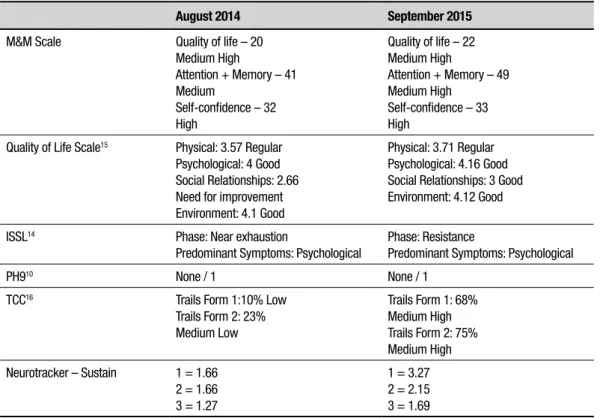
he results of the pre and post-training cognitive assess-ments are given in both Table 1 and Graph 1.
Pre-training and training. Intellectual performance was assessed using two sub-tests from the Wechsler Abbre-viated Scale of Intelligence – WASI,10 showing high
performance (August 2014) for age and gender. On the M&M Scale, which assesses self-perceived attention, memory, quality of life and self-conidence, the patient was classiied as medium high. he rating on attention and memory assessments was medium. he result for self-conidence was high (Table 1).
he subject exhibited no depressive symptoms (Geri-atric Depression Scale – Yesavage short form - GDS-15),11
but showed stress in the near exhaustion phase with pre-dominant psychological symptoms on the Lipp Inven-tory of Stress Symptoms for Adults – ISSL.12 Results
on the quality of life assessment using the WHOQOL-BREF13 were for the physical domain: regular;
psycho-logical: good; social relationships: need for improvement; and on the environmental domain: good. (Table 1).
100
75
50
25
0
Sep
2014 2015Jan 2015Nov
81
88
14
41
6
Working memory – Accuracy Working memory – Processing speed
Dement Neuropsychol 2016 June;10(2):152-155
154 Cognitive training using a computer program Assed et al.
Table 1. Results pre- and post-memory training.
August 2014 September 2015
M&M Scale Quality of life – 20 Medium High
Attention + Memory – 41 Medium
Self-confidence – 32 High
Quality of life – 22 Medium High
Attention + Memory – 49 Medium High
Self-confidence – 33 High
Quality of Life Scale15 Physical: 3.57 Regular
Psychological: 4 Good Social Relationships: 2.66 Need for improvement Environment: 4.1 Good
Physical: 3.71 Regular Psychological: 4.16 Good Social Relationships: 3 Good Environment: 4.12 Good
ISSL14 Phase: Near exhaustion
Predominant Symptoms: Psychological
Phase: Resistance
Predominant Symptoms: Psychological
PH910 None / 1 None / 1
TCC16 Trails Form 1:10% Low
Trails Form 2: 23% Medium Low
Trails Form 1: 68% Medium High Trails Form 2: 75% Medium High
Neurotracker – Sustain 1 = 1.66 2 = 1.66 3 = 1.27
1 = 3.27 2 = 2.15 3 = 1.69
he Colored Trails Test14 in forms 1 and 2, assessed
concentrated, sustained and alternating attention, as well as cognitive lexibility. On the two forms, the patient had a lower-than-expected result for age, educational level and gender (Table 1).
Performance on the Memo Checkup (randomized computerized test for assessing accuracy of episodic and working memory), showed medium episodic memory and signiicantly lower-than-expected working memory for age (Graph 1).
Neurotracker8 was used as a tool for generating
computerized attentional stimuli in Sustain mode – Sustained Attention test; using six trials with one, two and three balls; performed both at pre-training, serving as baseline, and at post-memory training, where stim-uli were presented similarly to the attention training protocols.
After the initial assessment battery, the intervention consisting of individual sessions of 90 minutes, twice per week, was run for a 12-month period. he computer was used for the cognitive training, both to access the Neurotracker software and run the Memory Training sessions. he sessions were devised according to the consciously learned mnemonic strategies which required efort to put into practice. he training employed ver-bal and visual mnemonic methods (image and rhyming
cues), expanded repetition (involving presentation of the content to be remembered followed by testing immedi-ately and then later with gradual retention interval), errorless learning (technique for avoiding errors while learning new information), cue removal (stimuli are displayed and gradually withdrawn), PQRST (Preview: preview the material to be retrieved; Question: ask gist questions about the text; Read: read the material care-fully; State: state the answers and if necessary reread the text; and Test), association (semantic relationship between words and subsequent retrieval), production (similar to association only sentences must be created for the register) and the categorization process (forming classes of the information to be memorized).15
DISCUSSION
At the post-training stage, improvements were evident in perceived attention, memory, quality of life and self-conidence on the M&M Scale. A similar result was found for perceived subjective memory on the MAC-Q scale.16
Dement Neuropsychol 2016 June;10(2):152-155
155
Assed et al. Cognitive training using a computer program
A reduction in stress symptoms was also observed, in line with studies suggesting that cognitive training serves to help improve stress symptoms.3 On the
reas-sessment using the WHOQOL-BREF, the results were maintained on physical, psychological and environmen-tal domains (regular, good and good, respectively), but all items were slightly higher on the inal score. he social relationships domain improved substantially, whose rating increased to good, corroborating the indings of previous studies.8 At post-intervention, the use of
learn-ing techniques with mnemonic strategies, reductions in memory complaints and in depressive symptoms,17,18 as
well as increases in processing speed and working mem-ory were evident (Graph 1). his result suggests that the reduction in memory complaints, which possibly contrib-uted to better adaptation to daily activities as perceived by the subject, can mediate stress symptoms.12
Training proved efective for sustained and alternat-ing attention, with above-average cognitive lexibility on the Colored Trails test16 for patient age, educational level
and gender. his inding is relevant in that no references are available in the literature for these test measure-ments (Table 1).
Results of the computerized memory test showed changes in score during and after training. he results, despite luctuating at some points, showed a steadily ris-ing curve for both Accuracy and Processris-ing Speed on the test (Graph 1).
Positive results were also obtained on the Neu-rotracker, the computerized stimuli employed, in the
form of a rising curve for scores comparing accuracy, speed and diiculty provided by the software (Table 1).
he results indicate that the use of the Neurotracker for training cognitive processes is valid as part of cogni-tive rehabilitation programs promoting improvements in the quality of life of the elderly, corroborating the results of previous studies.1,2,8
Political issues regarding costs of pension, welfare and healthcare systems oblige societies to seek ways of improving assistance in the aging process. he psycho-logical universe of older adults, besides the biopsycho-logical spectrum (natural or pathological), also encompasses individual potentialities (such as information process-ing, memory, cognitive performance, among others), in addition to inluences from the environment and the sociocultural context.19,20
Given this scenario, such assistance should include computerized cognitive training programs in private and public institutions for elderly care to improve qual-ity of life and delay the signs of senilqual-ity during the aging process. Future studies focusing on the development of new techniques and furthering this area should also be encouraged.
Author contribution. Mariana Medeiros Assed: study design, data analysis; Martha Kortas HajjarVeiga de Carvalho: data analysis; Cristiana Castanho de Almeida Rocca: study design, drafting of manuscript; Antonio de Pádua Seraim: study design, data analysis, drafting of manuscript.
REFERENCES
1. Legault I, Allard R, & Faubert J. Healthy older observers show equivalent perceptual-cognitive training benefits to young adults for multiple object tracking. Front Psychol. 2013;4:323.
2. Arnemann KL, Chen AJ, Novakovic-Agopian T, Gratton C, Nomura EM, D’Esposito M. Functional brain network modularity predicts response to cognitive training after brain injury. Neurology. 2015;84(15):1568-1574. 3. Carvalho FCR, Neri AL, Yassuda MS. Treino de memória episódica com
ênfase em categorização para idosos sem demência e depressão. Psicol Reflex Crit.2010;23(2):317-323.
4. Ball K, Berch DB, Helmers KF, et al. Willis SL. Effects of cognitive training interventions with older adults: a randomized controlled trial. JAMA. 2002;288(18):2271-2281
5. Barnes DE, Yaffe K, Belfor N, et al. Computer-based cognitive training for mild cognitive impairment: Results from a pilot randomized, controlled trial. Alzheimer Dis Assoc Disord. 2009;23(3):205-210.
6. Balardin JB. Análise dos correlatos neurais associados ao uso de estratégias de memória no comprometimento cognitivo leve: avaliação por ressonância magnética funcional. [Tese]. São Paulo: Faculdade de Medicina da Universidade de São Paulo: 2013.
7. Parsons B, Magill T, Boucher A, Zhang M, Zogbo K, Bérubé S, et al. Enhancing Cognitive Function Using Perceptual-Cognitive Training. Clin EEG Neurosci. 2016:47(1):37-47.
8. Legault I, Faubert J. Perceptual-cognitive training improves biological motion perception: evidence for transferability of training in healthy aging. Neuro Report. 2012;23:469-473.
9. Gorestein C, Andrade LHSG, Zuardi AW. Escalas de Avaliação Clínica em Psiquiatria e Psicofarmacologia. São Paulo: Lemos; 2000: 336.
10. Wechsler DI. Escala Wechsler abreviada de inteligência - WASI: manual. São Paulo: Casa do Psicólogo; 2014:456.
11. Paradela EMP, Lourenço RA, Veras RP. Validação da escala de depressão geriátrica em um ambulatório geral. Rev Saude Publica. 2005;39(6):918-923.
12. Lipp MEN. Manual do Inventário de Sintomas de Stress para Adultos de Lipp (ISSL). São Paulo: Casa do Psicólogo; 2000:76.
13. Fleck MPA, Chachamovich E, Trentini CM. Projeto WHOQOL-OLD: método e resultados de grupos focais no Brasil. Rev Saude Publica. 2003;37(6):793-739.
14. D´Elia FL, Satz P, Uchiyama CL, White T. TTC - Teste de trilhas coloridas. 1 edição. São Paulo: Editora Casa do Psicólogo; São Paulo: 2010:128 15. Wilson B. Reabilitação da Memória - Integrando Teoria e Prática. Porto
Alegre: Artmed; 2011:304.
16. Crook TH, Feher EP, Larrabee GJ. Assessment of memory complaint in age-associated memory impairment: the MAC-Q. Int Psychogeriatr. 1992;4(2):165-76.
17. Netto MT, Fonseca RP, Landeira-Fernandez J. Reabilitação da memória em idosos com queixas mnemônicas e sintomas depressivos: estudo piloto não controlado. Estud. Psicol. 2012;17(1):161-169.
18. Lam RW, Michalak EE, Swinson RP. Assessment Scales in Depression, Mania and Anxiety. London: Informa Helthcare; 2006:198.
19. Teixeira-Fabricio A, Lima-Silva TB, Kissaki PT, et al. Treino cognitivo em adultos maduros e idosos: impacto de estratégias segundo faixas de escolaridade. Psico-USF. 2012;17(1):85-95.